 GST & indirect tax
GST on Plywood in 2026: Plywood, MDF, Laminates, Veneer and Timber Rates, HSN Codes and Interior Work
GST on plywood in 2026: 18% on plywood, blockboard, MDF, veneer and laminates (HSN 4408–4412), 5% on agri-waste boards, interior work and worked ₹ bills.
 Edited by Sumeet YadavFounder & editor, MSMETOOLS · fact-checked against official sources
Contents (10)
- 1. GST rates on plywood, boards and wood in 2026
- 2. HSN codes for plywood, MDF, veneer and laminates
- 3. Laminates, veneers, adhesives and hardware
- 4. Worked bills: GST on plywood and boards in rupees
- 5. Interior work and carpentry: how it is taxed
- 6. Input tax credit on plywood
- 7. Plywood mills: logs, veneer and cash tax
- 8. Plywood dealers: registration, composition and invoices
- 9. Common mistakes with GST on plywood
- 10. What to do next
Plywood and boards are the backbone of Indian woodwork — kitchens, wardrobes, doors, shop fit-outs and most factory-made furniture start as a sheet. GST on them is mostly one rate, but the exceptions are easy to miss and the way the work is billed often matters more than the sheet itself. This guide is for plywood and laminate dealers, interior designers and carpentry contractors, plywood and veneer mills in Yamunanagar, Perumbavoor, Gandhidham and elsewhere, and homeowners checking a quote. It gives the 2026 GST rates on plywood, blockboard, MDF, particle board, veneer, laminates and timber, the HSN codes, how interior work is taxed, input tax credit rules and worked bills in rupees. Rates were checked against the notified schedule in October 2026.
Quick answer
Plywood, blockboard and veneered panels (HSN 4412) attract 18% GST, and so do MDF and HDF (4411), particle board and OSB (4410), veneer sheets (4408), decorative laminates and timber. GST 2.0 did not change these rates. Boards made from bagasse, jute, rice husk, sisal, cotton stalk or other crop residues, cement-bonded particle board and GRG fell from 12% to 5%.
20 sheets of 18 mm plywood at ₹2,800: GST ₹10,080
Supply-and-install interiors are works contracts at 18%
Bamboo flooring 5%; wooden furniture 18%
Plywood capitalised in your own premises: no ITC
No compensation cess on wood products
GST rates on plywood, boards and wood in 2026
Notification 9/2025–Central Tax (Rate), the goods rate schedule in force from 22 September 2025, lists the main wood-panel headings in Schedule II — the 9% central tax schedule — at serials 153 to 163. Serial 159 reads simply "Plywood, veneered panels and similar laminated wood" against heading 4412. Serial 157 covers particle board, oriented strand board and similar board under 4410, and serial 158 fibre board under 4411, in both cases "other than specified boards". With the matching state tax, all of these are 18% within a state, or the same as IGST.
The 56th GST Council's wood-sector annexure cut fifteen items from 12% to 5%, but plywood, MDF and particle board were not among them because they were already at 18%. The cuts went to items that had been in the 12% slab: the specified boards, veneer for match splints, bamboo flooring, packing cases, casks, tool handles, wooden tableware, marquetry and several handicrafts.
GST on plywood, boards and wood products (2026)
| Product (HSN) | GST rate | Schedule entry |
|---|---|---|
Plywood, blockboard, laminboard, LVL, veneered panels (4412) | 18% | Sch. II 159 |
MDF, HDF and other wood fibre board (4411) | 18% | Sch. II 158 |
Particle board, OSB, wafer board (4410) | 18% | Sch. II 157 |
Specified boards — cement-bonded, jute, rice husk, sisal, bagasse, cotton stalk, GRG, crop-residue boards | 5% | Sch. I 292 |
Veneer sheets for plywood and decorative veneer (4408) | 18% | Sch. II 155 |
Veneer for match splints (4408) | 5% | Sch. I 298 |
Logs and sawn timber (4403, 4407) | 18% | Sch. II 153–154 |
Flush doors, door and window frames, assembled flooring panels (4418) | 18% | Sch. II 162 |
Bamboo flooring (4409) | 5% | Sch. I 299 |
Resin-bonded bamboo mat board, bamboo flooring tiles | 18% | Sch. II 164 |
Decorative laminates — paper-based (4823) or plastic (3921) | 18% | Sch. II 189 / 122 |
Furniture of wood (9403) | 18% | Sch. II 612 |
Plywood, blockboard, laminboard, LVL, veneered panels (4412)
- GST rate
18%
- Schedule entry
Sch. II 159
MDF, HDF and other wood fibre board (4411)
- GST rate
18%
- Schedule entry
Sch. II 158
Particle board, OSB, wafer board (4410)
- GST rate
18%
- Schedule entry
Sch. II 157
Specified boards — cement-bonded, jute, rice husk, sisal, bagasse, cotton stalk, GRG, crop-residue boards
- GST rate
5%
- Schedule entry
Sch. I 292
Veneer sheets for plywood and decorative veneer (4408)
- GST rate
18%
- Schedule entry
Sch. II 155
Veneer for match splints (4408)
- GST rate
5%
- Schedule entry
Sch. I 298
Logs and sawn timber (4403, 4407)
- GST rate
18%
- Schedule entry
Sch. II 153–154
Flush doors, door and window frames, assembled flooring panels (4418)
- GST rate
18%
- Schedule entry
Sch. II 162
Bamboo flooring (4409)
- GST rate
5%
- Schedule entry
Sch. I 299
Resin-bonded bamboo mat board, bamboo flooring tiles
- GST rate
18%
- Schedule entry
Sch. II 164
Decorative laminates — paper-based (4823) or plastic (3921)
- GST rate
18%
- Schedule entry
Sch. II 189 / 122
Furniture of wood (9403)
- GST rate
18%
- Schedule entry
Sch. II 612
There is no compensation cess on plywood or wood products, so the rate on the invoice is the whole tax. Firewood and fuel wood are exempt under Notification 10/2025–Central Tax (Rate), wood chips and sawdust (4401) are at 5%, and wood charcoal is Nil.
HSN codes for plywood, MDF, veneer and laminates
Heading 4412 covers every laminated wood panel. Its sub-headings, which follow the international Harmonised System, separate the products by construction:
- 4412 10 — plywood and laminated panels of bamboo.
- 4412 31 to 4412 39 — plywood made only of sheets of wood, each ply up to 6 mm thick; 4412 31 when at least one outer ply is tropical wood, 4412 33 and 4412 34 for outer plies of named non-coniferous species, and 4412 39 when both outer plies are coniferous.
- 4412 41 to 4412 49 — laminated veneered lumber (LVL).
- 4412 51 to 4412 59 — blockboard, laminboard and battenboard.
- 4412 91 to 4412 99 — other laminated wood panels.
The other headings used in the panel trade are 4408 for veneer sheets up to 6 mm thick, 4410 for particle board and OSB, 4411 for fibre board — MDF by thickness under 4411 12 to 4411 14, and HDF and other fibre board under 4411 92 to 4411 94 — and 4418 for builders' joinery such as flush doors, door frames and engineered flooring panels.
All of these are at the same rate, so a wrong sub-heading does not change the tax. It does affect your HSN summary in GSTR-1, where businesses with aggregate turnover up to ₹5 crore must report at least a 4-digit HSN and larger businesses a 6-digit HSN. Marine or BWP plywood, fire-retardant plywood and film-faced shuttering plywood are all 4412; the grade affects the price, not the heading. Our HSN code finder helps with less common items.
Laminates, veneers, adhesives and hardware
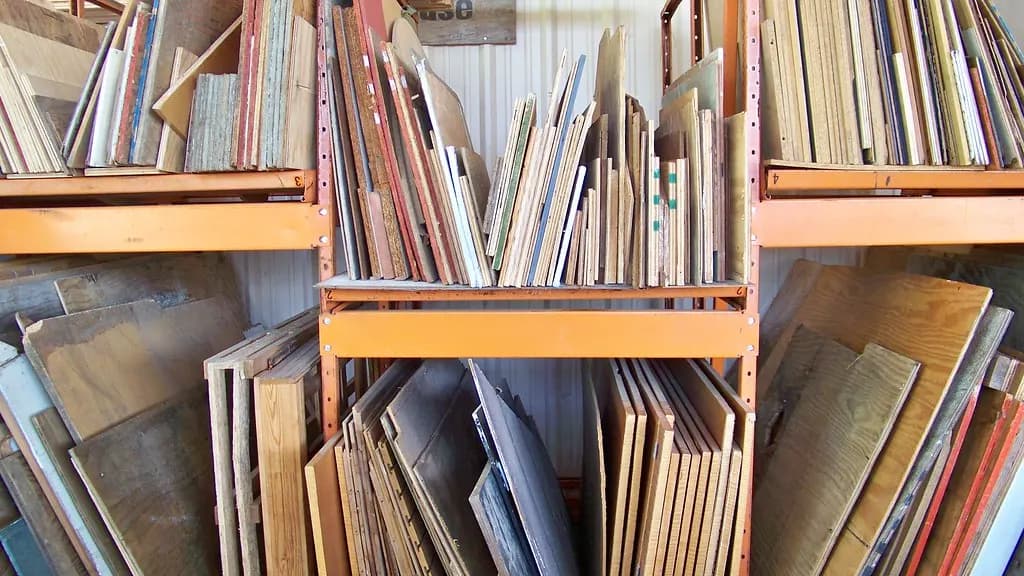
Decorative laminates. High-pressure laminates — the 0.8 mm and 1 mm sheets pasted on plywood — are made of kraft paper layers impregnated with phenolic resin and a decorative paper with melamine. The trade classifies them either as paper products under 4823 or as plastic sheets under 3921. Both headings are in Schedule II, at serials 189 and 122, so the rate is 18% either way. Acrylic and PVC sheets used as kitchen shutters fall under 3920 or 3921, at 18%.
Veneers. Face veneer and core veneer bought by plywood mills, and decorative natural veneer sold to interior designers, are under 4408 at 18%. The only 5% veneer is the narrow entry for veneer meant for match splints.
Adhesives and resins. Ready adhesives for woodwork under 3506 are 18%. Plywood mills make their own urea-formaldehyde or phenol-formaldehyde resin, mostly from technical-grade urea, phenol and formaldehyde. Urea bought for resin is "clearly not to be used as fertilizer", so it is taxed at 18%, not at the 5% fertiliser rate — a point our GST on fertilisers guide explains.
Hardware. Hinges, drawer channels, handles, door closers and other base-metal fittings for furniture and doors under 8302 are 18%. Screws and fasteners of steel are 18%. A hardware and plywood shop therefore sells almost everything at 18%; see our hardware shop business plan for the retail side.
Worked bills: GST on plywood and boards in rupees
The prices below are illustrative round figures to show the arithmetic, not market quotes. Prices vary widely by brand, grade, thickness and city.
| Purchase | Pre-tax value | GST rate | GST | Bill total |
|---|---|---|---|---|
| 20 sheets of 18 mm BWP plywood, 8×4 ft, at ₹2,800 | ₹56,000 | 18% | ₹10,080 | ₹66,080 |
| 15 sheets of 18 mm MDF at ₹1,600 | ₹24,000 | 18% | ₹4,320 | ₹28,320 |
| 10 sheets of 1 mm decorative laminate at ₹1,200 | ₹12,000 | 18% | ₹2,160 | ₹14,160 |
| 4 flush doors at ₹4,500 | ₹18,000 | 18% | ₹3,240 | ₹21,240 |
| 10 bagasse boards at ₹900 | ₹9,000 | 5% | ₹450 | ₹9,450 |
| 200 sq ft bamboo flooring at ₹150 | ₹30,000 | 5% | ₹1,500 | ₹31,500 |
To find the tax inside a price that includes GST, multiply by 18 and divide by 118. A sheet quoted at ₹3,304 "with GST" is ₹2,800 plus ₹504 of tax. Cutting, edge-banding and delivery charges added on the same dealer invoice form part of the value of the sheets under section 15 of the CGST Act and take the same rate.
Try it — GST on a plywood bill
Interior work and carpentry: how it is taxed
How a woodwork job is taxed depends on what the contractor supplies and where the finished item ends up.
Supply and install, fixed to the building. A contractor who supplies plywood, laminates, hardware and labour and builds a modular kitchen, fitted wardrobes, wall panelling or a false ceiling in a flat or office is supplying a works contract — a composite supply of goods and services for the construction or improvement of immovable property. It is taxed at 18% on the full contract value. On a ₹3,50,000 kitchen and wardrobe contract, GST is ₹63,000. The contractor claims credit on the plywood and hardware it bought. See our GST on works contract guide.
Loose furniture made in a workshop. A carpenter or factory that makes a bed, table or free-standing wardrobe and delivers it is supplying furniture of heading 9403 at 18%. The plywood inside is not billed separately. Our GST on furniture guide covers the furniture rates, including the 5% rate for furniture wholly of bamboo, cane or rattan.
Labour only. A registered carpenter who brings tools and labour while the owner buys the materials charges 18% on the labour. Entry 11 of Notification 12/2017–Central Tax (Rate) exempts pure labour contracts for construction, erection, commissioning or installation of original works pertaining to a single residential unit that is not part of a residential complex. Carpentry for a new independent house can fall within it — Nil (exempt) — but repairs and renovation of an existing home generally do not, and nor does work in an apartment in a residential complex. A carpenter below the services registration threshold of ₹20 lakh does not register and charges no GST.
Design fees. An interior designer who only designs and supervises, without supplying materials, charges 18% on the fee. Our guide to starting an interior design business covers pricing and registration.
Woodwork job — which GST applies?
Step 1
Fitted kitchen or wardrobe, contractor supplies material
works contract, 18%
Step 2
Loose furniture delivered from workshop
furniture, 18%
Step 3
Labour only, registered carpenter
18%
Step 4
Labour only, new independent house
exempt
Input tax credit on plywood
Plywood dealers, interior contractors and furniture makers claim full credit on plywood they buy, because it is resold or used in a taxable supply. The difficulty is for businesses that use plywood in their own premises.
Section 17(5)(c) of the CGST Act blocks credit on works contract services for construction of immovable property, except where they are an input for a further works contract. Section 17(5)(d) blocks credit on goods and services used to construct immovable property on your own account, even when used for business. Explanation 1 to section 17 says construction includes renovation, additions, alterations or repairs "to the extent of capitalisation".
A clinic, showroom or restaurant that does a fit-out with fixed panelling, counters and wardrobes, and capitalises the cost in its building or leasehold improvements, cannot claim the GST on it. Loose furniture — chairs, free-standing tables, display racks that are not fixed — is generally a capital good, not immovable property, and its credit is allowed. Minor repairs charged to the profit and loss account, rather than capitalised, can also usually be claimed. Keep the accounting treatment and the invoices consistent. Our guide to input tax credit explains the conditions.
Plywood mills: logs, veneer and cash tax
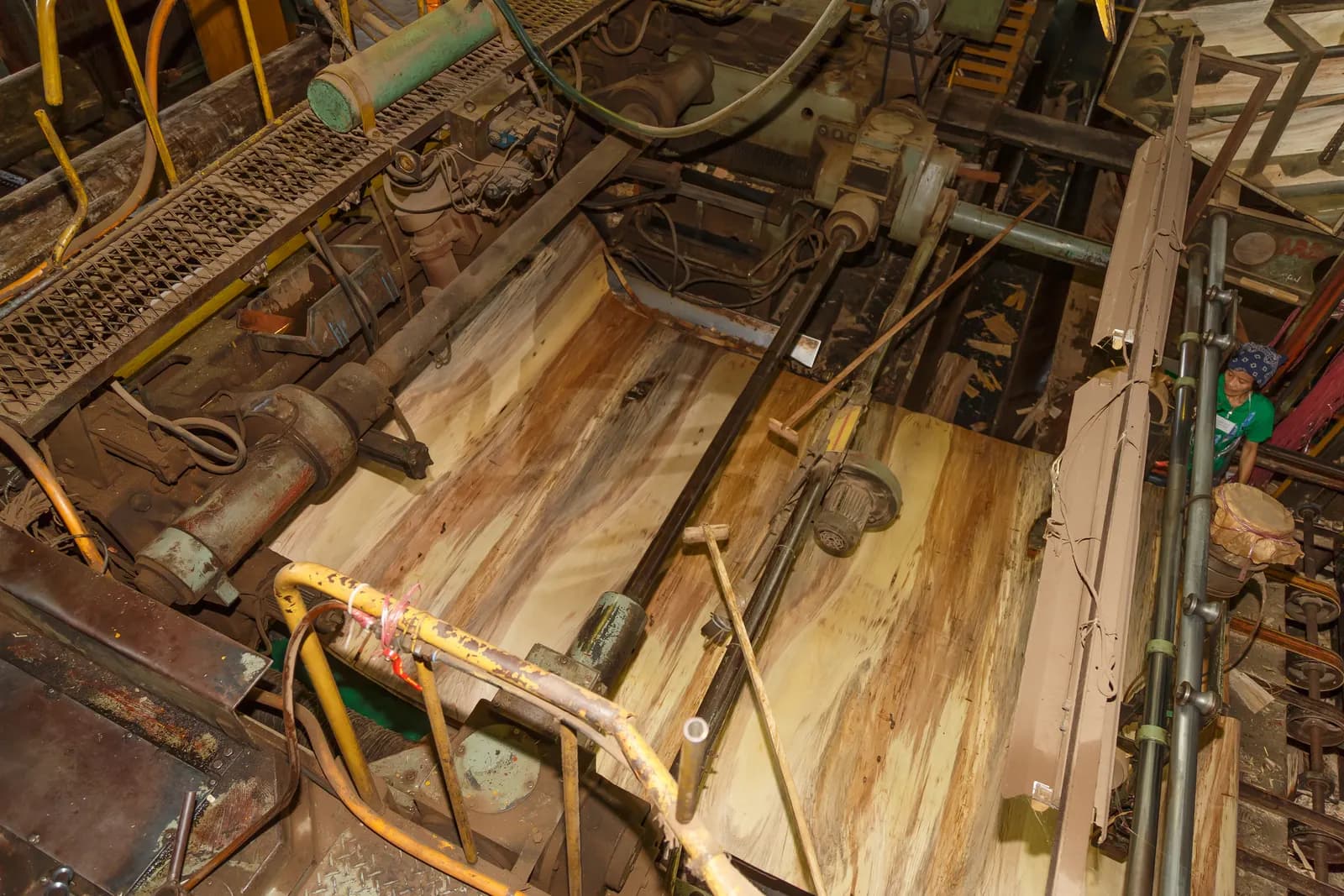
A plywood mill's chain runs from logs to veneer to pressed panels. Logs and sawn timber (4403, 4407) are 18%, veneer is 18%, and plywood is 18%. Because inputs and output are at the same rate, plywood makers do not face an inverted duty structure and usually pay some tax in cash every month.
A worked month. A mill in Yamunanagar sells ₹50,00,000 of plywood, so its output tax is ₹9,00,000. It buys ₹25,00,000 of core and face veneer (₹4,50,000 of credit), ₹6,00,000 of resin chemicals and hardener (₹1,08,000) and ₹3,00,000 of services (₹54,000). Its total credit is ₹6,12,000, and it pays ₹2,88,000 in cash.
The weak link is at the start of the chain. Much of the poplar and eucalyptus peeled in north India is grown by farmers on their own fields. Most of these growers are not registered for GST — many are small, and an agriculturist supplying produce of cultivation is not required to register under section 23(1)(b) of the CGST Act — so their sales carry no GST and the peeling unit gets no credit on the logs. The unit then charges 18% on the full value of its veneer, including the cost of the logs. This is why veneer prices sometimes move more than plywood prices when GST rates elsewhere change.
Imported timber logs and veneer, which mills in Gandhidham and Kandla depend on, carry IGST at the same rates at import on top of basic customs duty, and that IGST is available as credit.
Plywood dealers: registration, composition and invoices
A plywood and laminate dealer must register once aggregate turnover crosses ₹40 lakh in most states, or ₹20 lakh in states that did not adopt the higher limit for goods. Buying from mills in another state, or selling to customers outside the state, generally requires registration whatever the turnover.
Small dealers can opt for the composition scheme if turnover is up to ₹1.5 crore, paying 1% of turnover instead of charging GST. That suits a shop that sells mostly to homeowners. It suits a dealer whose customers are contractors, furniture makers and businesses much less, because a composition dealer cannot issue a tax invoice and those buyers lose the 18% credit they would otherwise claim. Most contractors will ask for a regular GST invoice. Dealers whose aggregate turnover exceeds ₹5 crore must also issue e-invoices for sales to registered buyers. Our composition scheme guide shows the comparison in rupees.
Common mistakes with GST on plywood
Check your plywood or interiors bill
0/6Billing particle board at 5%. Only the named specified boards are at 5%. Ordinary wood particle board, pre-laminated particle board and MDF stay at 18%.
Billing all bamboo boards at 5%. Bamboo flooring is 5%, but resin-bonded bamboo mat board and bamboo flooring tiles are listed separately at 18%.
Splitting a works contract. An interior contractor who issues one bill for plywood at 18% and another for labour is still supplying a single works contract if the work is fixed in a building. Splitting the invoice does not change the rate but makes the records harder to defend.
Claiming ITC on capitalised fit-outs. Showrooms and offices often take credit on plywood and interior contracts. If the work is capitalised as part of the premises, section 17(5) blocks the credit.
Ignoring e-way bills. A truckload of plywood easily crosses ₹50,000, so it needs an e-way bill, including for stock transfers between your own godowns.
Official links
- Notification 9/2025–CT(Rate) — goods rate scheduleWood panels Sch. II 153–164; specified boards Sch. I 292
- 56th GST Council — recommendations and annexuresWood sector changes
- Notification 10/2025–CT(Rate) — exempt goodsFirewood exempt
- Section 17, CGST ActBlocked credits on construction
- Notification 12/2017–CT(Rate)Entry 11 — pure labour on a single residential unit
- CGST rate notificationsLater amendments, if any
What to do next
If you are buying plywood or boards for a home, compare quotes on a pre-tax basis, check that bagasse or jute boards are billed at 5% and everything else at 18%, and ask your interior contractor whether the quote is a works contract with GST included. If you run a plywood or interiors business, map each product to the right HSN and bill fitted work as one contract. Use the GST calculator to check any bill, and read our guides to GST on furniture, GST on tiles and GST on works contract.
This is general information, not legal or tax advice — confirm on the official source or with a professional.
Frequently asked questions
Plywood, veneered panels and similar laminated wood under HSN 4412 attract 18% GST. That covers commercial and marine (BWP/BWR) plywood, blockboard, flush-door panels and LVL. GST 2.0 on 22 September 2025 did not change the rate. Particle board, OSB and MDF are also 18%, while particle and fibre boards made from bagasse, jute, rice husk and other agricultural residues are 5%.
Plywood is heading 4412, 'Plywood, veneered panels and similar laminated wood'. Plywood made of wood sheets each up to 6 mm thick is under 4412 31 to 4412 39, LVL under 4412 41 to 4412 49, and blockboard, laminboard and battenboard under 4412 51 to 4412 59. MDF and HDF are 4411, particle board and OSB 4410, and veneer sheets 4408.
MDF, HDF and other fibre board of wood (4411) and particle board and OSB (4410) attract 18%. The exception is the list of 'specified boards' — cement-bonded particle board, jute, rice-husk, sisal-fibre, bagasse and cotton-stalk boards, glass-fibre reinforced gypsum board and boards from agricultural crop residues — which fell from 12% to 5% on 22 September 2025.
Decorative laminates attract 18% whether classified as paper-based products under 4823 or as plastic sheets under 3921. Veneer sheets for plywood and decorative veneers under 4408 are 18%; only veneer for match splints is 5%. Edge-banding tape, adhesives and hardware such as hinges and channels are also 18%.
A contractor who supplies plywood and other materials and builds wardrobes, kitchens or panelling fixed into a building is supplying a works contract, taxed at 18% on the whole value. Loose furniture made in a workshop and delivered is a supply of goods at 18%. A registered carpenter supplying only labour charges 18%.
Usually not, if the interiors are capitalised as part of the building. Section 17(5)(c) and (d) of the CGST Act block credit on works contracts and on goods and services used to construct immovable property on your own account, including renovation to the extent of capitalisation. Loose furniture that is not fixed to the building is a capital good on which credit is generally allowed.
Sources & verification
Figures on this page were checked against the sources below when it was last reviewed on 9 October 2026. Each rate and limit is stored once with its own official source and review date, and official update channels are monitored daily so changes are picked up. How we verify
- 1.Notification No. 9/2025–Central Tax (Rate), 17 September 2025 (Gazette of India, G.S.R. 641(E)) — Ministry of Finance / Gazette of India · accessed 9 October 2026
- 2.Notification No. 9/2025 – State Tax (Rate), Maharashtra (state mirror of the central schedule) — Government of Maharashtra · accessed 9 October 2026
- 3.Notification No. 10/2025–Central Tax (Rate) (exempt goods), Gazette of India, G.S.R. 660(E) — Ministry of Finance / Gazette of India · accessed 9 October 2026
- 4.Recommendations of the 56th GST Council meeting (press release with rate annexures) — GST Council / PIB · accessed 9 October 2026
- 5.Section 17 – CGST Act, 2017 (blocked credits) — CBIC · accessed 9 October 2026
- 6.Notification No. 12/2017–Central Tax (Rate), entry 11 — CBIC · accessed 9 October 2026
- 7.Section 23 – CGST Act, 2017 (persons not liable for registration) — CBIC · accessed 9 October 2026
MSMETOOLS is an independent platform and is not affiliated with any government agency, ministry or department.
Tools for this
GST Calculator (India)
Calculate GST for your sales and purchases with current rates.
Invoice Generator
Create professional invoices with tax, logo and custom details.
HSN Code Finder (India)
Find the correct HSN/SAC code for your product.
Related guides
 GST on Furniture 2026: Rates, HSN Codes & ITC RulesRead guide
 GST on Tiles 2026: Vitrified, Marble & Granite Rates, HSNRead guide
 GST on Sanitary Ware 2026: 18% Rate, HSN 6910, CP FittingsRead guide
 GST on Bricks 2026: 6% vs 12%, Fly Ash & AAC Block RatesRead guide
Official links open the government site in a new tab.