 GST & indirect tax
GST on Painting and Works Contracts in 2026: Rates, SAC Codes, Labour-Only Jobs and Input Tax Credit
GST on painting and works contracts in 2026: 18% rate for private and government work, SAC 9954, labour-only exemptions, ITC blocks under s.17(5) and ₹ examples.
 Edited by Sumeet YadavFounder & editor, MSMETOOLS · fact-checked against official sources

Contents (10)
- 1. What is a works contract under GST?
- 2. GST rate on works contracts in 2026
- 3. SAC and HSN code for works contracts
- 4. GST on painting: with paint, labour-only and new houses
- 5. Repair, maintenance, renovation and fit-out contracts
- 6. Input tax credit on works contracts: section 17(5)(c) and (d)
- 7. Worked examples in ₹
- 8. Registration, composition and invoicing for contractors
- 9. Common mistakes and how to fix them
- 10. What to do next
Painting a showroom, repairing a factory roof, fitting out an office, laying a road for the municipality — each of these is a works contract under GST, and each raises the same three questions: what rate to charge, which SAC code to use, and whether the client can claim the tax back. This guide is for contractors, painters, interior firms and the businesses that hire them. It covers the legal definition, the rate in 2026 for private and government work, painting and repair jobs, labour-only contracts, the input tax credit blocks in section 17(5), GST TDS, and worked examples in ₹. Rates were checked against CBIC notifications and the GST Council's September 2025 rate changes in October 2026.
Quick answer
A works contract — building, repair, painting or fit-out of immovable property where the contractor also supplies material — is a service taxed at 18% with input tax credit, for private and government clients alike. Labour-only painting and construction is also 18%.
SAC heading 9954 (construction services); painting is 995473
Government earthwork and offshore contracts moved from 12% to 18% on 22 September 2025
Exempt: pure labour for original work on a single standalone house, and labour for PMAY / Housing for All homes
Client's ITC is blocked if the work is capitalised into its building — repainting and repairs charged to expenses are usually allowed
What is a works contract under GST?
Section 2(119) of the CGST Act defines a works contract as a contract for building, construction, fabrication, completion, erection, installation, fitting out, improvement, modification, repair, maintenance, renovation, alteration or commissioning of any immovable property, where transfer of property in goods is involved in carrying it out. Two conditions have to be met together.
It must relate to immovable property. A building, a road, a boundary wall, a borewell, an underground tank, a factory shed, built-in fixtures — things attached to the earth and not meant to be moved. Repainting a car, servicing a lift motor in a workshop or repairing a machine that sits on the floor without a foundation isn't a works contract, even if the job uses parts and paint.
Goods must pass to the client. If the contractor brings cement, steel, tiles, wiring, paint or putty and they become part of the property, that's a transfer of property in goods. If the client buys all the material and the contractor only provides labour, it's a labour (pure service) contract, not a works contract.
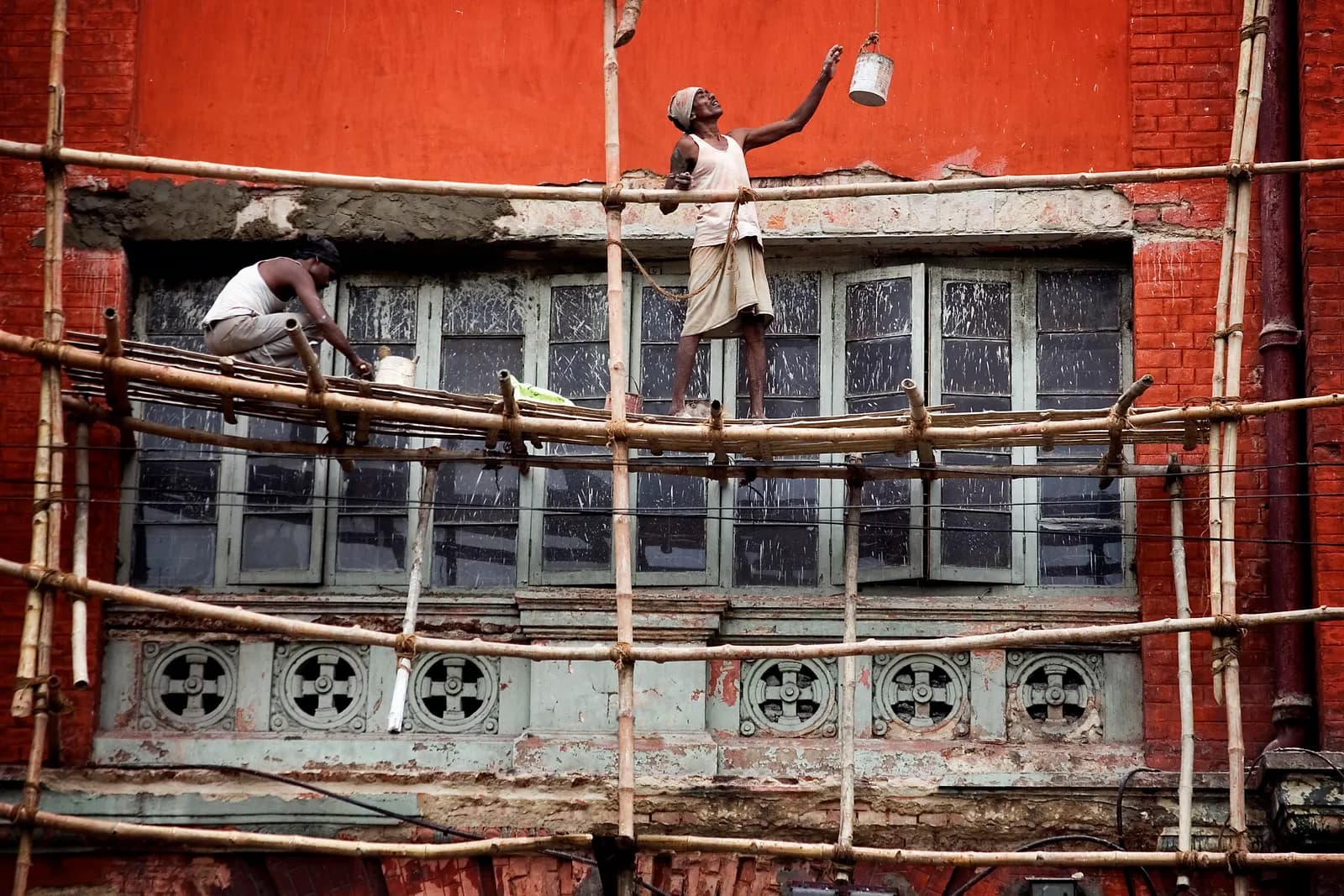
Paragraph 6(a) of Schedule II then says a works contract is to be treated as a supply of services. That ends the old VAT-era split between a "goods portion" and a "labour portion": under GST the whole contract value is one service. You don't charge 18% on the paint and something else on the labour; you charge one rate on the total.
A contract for movable property that combines goods and labour — repairing a generator with spare parts, say — is assessed instead as a composite supply under section 8, taxed at the rate of its principal supply.
GST rate on works contracts in 2026
Works contract rates sit in serial number 3 of Notification 11/2017-Central Tax (Rate), which the government has amended many times. After two rounds of clean-up — July 2022 and September 2025 — the structure is much simpler than older articles suggest.
| Type of contract | GST rate (2026) | Input tax credit |
|---|---|---|
| Works contract for private buildings, offices, factories, shops, roads, repairs, fit-outs, painting with material | 18% | Yes |
| Works contract for Central/State Government, local bodies, government entities (including earthwork-heavy contracts and their sub-contracts) | 18% (12% until 21 September 2025 for earthwork items) | Yes |
| Offshore works contract for oil and gas exploration | 18% (12% until 21 September 2025) | Yes |
| Labour-only construction, repair or painting (no material supplied) | 18% | Yes |
| Pure labour for original works on a single residential unit not in a complex | Exempt | — |
| Pure labour for houses under PMAY / Housing for All (Urban) beneficiary-led construction | Exempt | — |
| Flats sold by a promoter in a residential project (from 1 April 2019) | 1% without ITC affordable · 5% without ITC others | No |
What changed and when. Until July 2022, many contracts for government — canals, dams, historical monuments, schools and hospitals for government, mass housing schemes — had concessional 12% (and some 5%) entries. Notification 03/2022-Central Tax (Rate) omitted most of them from 18 July 2022, so those contracts moved to 18%. Three entries stayed at 12%: earthwork-heavy contracts for government (where earthwork is more than 75% of the value), sub-contracts under them, and offshore oil and gas works contracts. The 56th GST Council moved those to 18% too, effective 22 September 2025 through Notification 15/2025-Central Tax (Rate). As of October 2026, there is no concessional works contract rate left for government work.
Flats sold by builders are taxed under separate entries at 1% without ITC or 5% without ITC, without credit; our GST on flat purchase guide covers them. A contractor building for that promoter still charges 18% to the promoter.
Exempt services to government. Separately from works contracts, Notification 12/2017-Central Tax (Rate) exempts pure services, and composite supplies where goods are no more than 25% of the value, supplied to the Central or State Government, or a local authority in relation to functions entrusted to panchayats and municipalities under Articles 243G and 243W. Most civil works contracts carry far more than 25% material, so they rarely qualify — check the entry carefully before billing a municipality at nil.
SAC and HSN code for works contracts
GST uses the services accounting code (SAC) classification for services, and works contracts on immovable property fall under heading 9954 – construction services. Common six-digit codes include 995411–995419 (general construction of buildings), 995421–995429 (civil engineering works such as roads, bridges and pipelines), 995461–995469 (installation services such as electrical, plumbing and HVAC) and 995471–995479 (completion and finishing). Painting is 995473.
The code describes the service; it doesn't fix the rate. The rate comes from the notification entry the contract falls under — which is why the same 9954 heading has covered 1%, 5%, 12% and 18% entries over the years. On your invoice, use the six-digit SAC if your aggregate turnover was above ₹5 crore last year, and at least four digits (9954) otherwise. Our HSN code guide explains the digit rules, and the HSN code finder helps you look up the right code.
GST on painting: with paint, labour-only and new houses
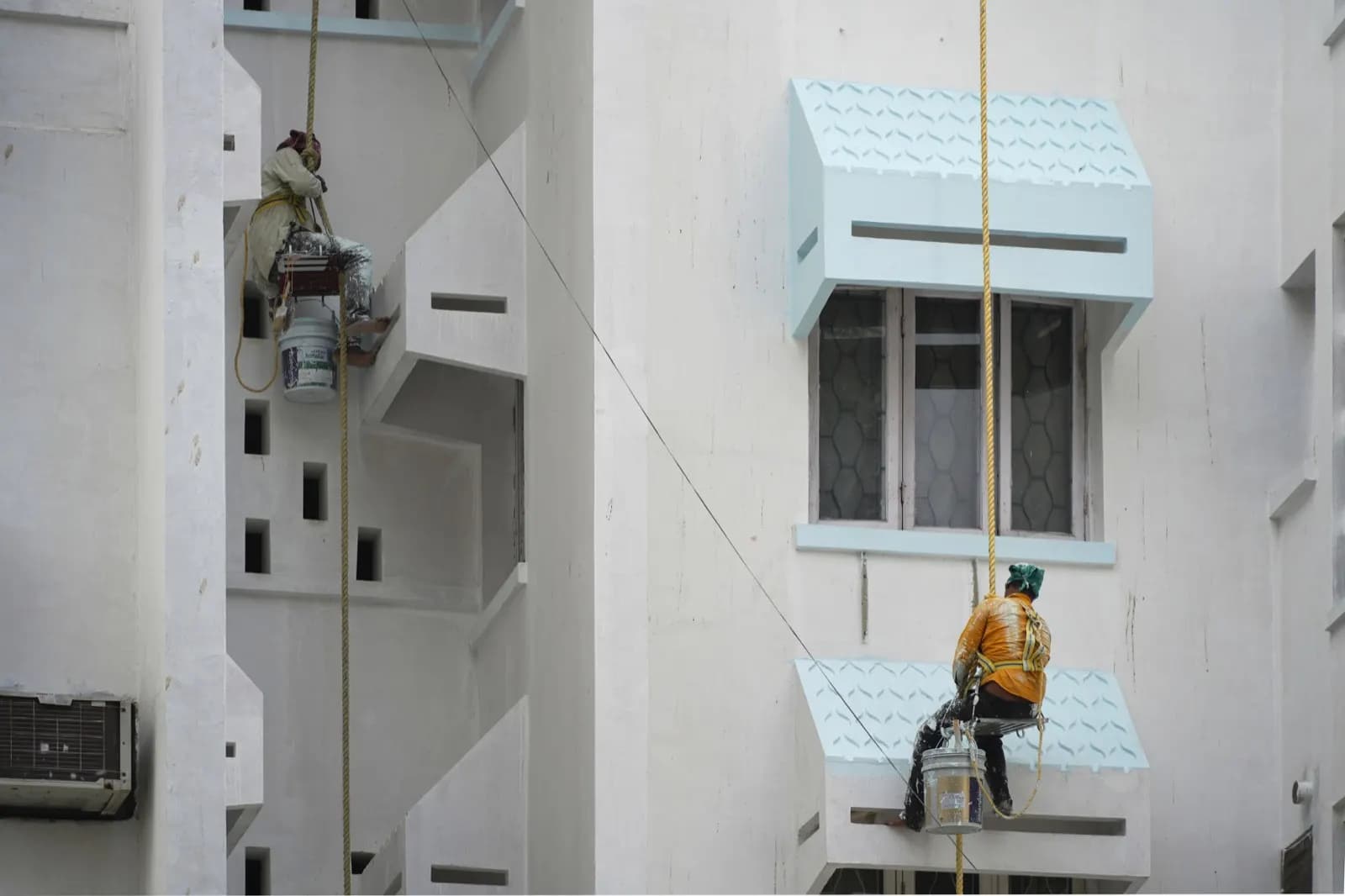
Painting is the single most searched works contract question, because almost every business and homeowner buys it. The answer depends on who supplies the paint and what is being painted.
Painting with the contractor's paint, putty and primer. Walls, ceilings, doors, grills and exteriors are part of an immovable building, and the paint becomes part of it, so this is a works contract taxed at 18% on the full contract value. The painting contractor claims credit on the GST it paid for paint, primer, putty, scaffolding hire and tools, and pays the balance in cash.
Labour-only painting. If you buy the paint yourself and the painter supplies only labour, the painter's charge is a construction service under 9954 (SAC 995473), taxed at 18% — the same headline rate. The difference is that GST applies only to the labour charge; you've already paid GST on the paint at the shop.
Painting a new standalone house. Notification 12/2017-Central Tax (Rate) exempts pure labour contracts for construction, erection, commissioning or installation of original works pertaining to a single residential unit that isn't part of a residential complex. If a painter is engaged on a labour-only basis while your new independent house is being built, the labour charge is exempt. Repainting an existing house isn't "original works", so that exemption doesn't extend to it, and a registered painter will charge 18%.
Small painters below the threshold. Many individual painters aren't registered because their turnover is under the ₹20 lakh services threshold. An unregistered painter can't charge GST at all. If a registered business hires one, painting isn't on the reverse-charge list, so for most buyers there's simply no GST on that bill (real-estate promoters have their own reverse-charge rules on purchases from unregistered suppliers).
Painting movable things. Spray-painting a car, a steel almirah or factory machinery that isn't fixed to the ground isn't a works contract. It's a repair or treatment service on goods, taxed under its own entry — check the rate for your specific job before quoting.
GST on painting jobs at a glance
| Job | Who supplies paint | GST on the painter's bill |
|---|---|---|
Office, shop or factory repainting | Contractor | 18% on full value (works contract) |
Office, shop or factory repainting | Client | 18% on labour only |
New standalone house, during construction | Owner | Exempt (pure labour, original works) |
Repainting an existing house or flat | Owner | 18% on labour (if painter is registered) |
Any job by an unregistered painter | Either | No GST can be charged |
Office, shop or factory repainting
- Who supplies paint
Contractor
- GST on the painter's bill
18% on full value (works contract)
Office, shop or factory repainting
- Who supplies paint
Client
- GST on the painter's bill
18% on labour only
New standalone house, during construction
- Who supplies paint
Owner
- GST on the painter's bill
Exempt (pure labour, original works)
Repainting an existing house or flat
- Who supplies paint
Owner
- GST on the painter's bill
18% on labour (if painter is registered)
Any job by an unregistered painter
- Who supplies paint
Either
- GST on the painter's bill
No GST can be charged
Repair, maintenance, renovation and fit-out contracts
The definition covers more than new construction. Repair, maintenance, renovation and alteration of a building are named in section 2(119), so a contractor who waterproofs a terrace with its own chemicals, re-tiles a shop floor, re-wires a factory with new cable, or carries out an annual maintenance contract that includes replacement parts for a building's plumbing is supplying a works contract at 18%.
Interior fit-outs are the same: false ceilings, partitions, built-in wardrobes, modular kitchens fixed to walls and electrical work in a new office are a works contract when the interior firm supplies materials. Loose furniture delivered with the fit-out is a supply of goods at its own rate and should be billed as a separate line. Our interior design business guide shows how interior firms structure these quotes.
Plant and machinery installation. Erecting a boiler or a production line on a foundation is a works contract too, and taxed at the same rate. The difference shows up on the client's side, in input tax credit, because plant and machinery is carved out of the credit block.
Input tax credit on works contracts: section 17(5)(c) and (d)
Can the client claim ITC on a works contract?
Step 1
Is it immovable property?
no → normal ITC rules
Step 2
Plant and machinery?
yes → ITC allowed
Step 3
Capitalised in books?
no (repairs, repainting) → ITC allowed
Step 4
Further works contract?
yes (sub-contract) → ITC allowed
Step 5
Otherwise
ITC blocked — s.17(5)(c)/(d)
The contractor is entitled to credit on its own inputs like any other supplier. The question is whether the client can take credit for the GST on the contractor's bill.
Section 17(5)(c) blocks credit on works contract services supplied for construction of an immovable property, other than plant and machinery, except where the service is an input for a further works contract. So a main contractor can take credit on a sub-contractor's bill, but a business owner building its own office can't.
Section 17(5)(d) blocks credit on goods or services received by a taxable person for construction of an immovable property on its own account, again other than plant and machinery, even if the building is used for business. This catches material you buy yourself for a building project.
The capitalisation test. Explanation 1 to these clauses says "construction" includes re-construction, renovation, additions, alterations or repairs to the extent of capitalisation to the immovable property. If you charge a repair or a repainting job to profit and loss as an expense, it isn't "construction" for these clauses and the block doesn't apply. If you capitalise it — adding it to the building's cost in your fixed asset register — credit is blocked. Your accounting treatment has to match the real nature of the work; an officer will look at the invoices and the scope of work, not just the ledger head.
Plant and machinery after Finance Act 2025. In October 2024 the Supreme Court's Safari Retreats judgment held that a building could be "plant" for clause (d), which uses the words "plant or machinery", depending on its function. Parliament responded through the Finance Act 2025: clause (d) now reads "plant and machinery", substituted with effect from 1 July 2017, and a new Explanation 2 says any reference to "plant or machinery" is to be read that way. "Plant and machinery" means apparatus, equipment and machinery fixed to earth by foundation or structural support, including those foundations — but not land, buildings or other civil structures. Malls, hotels and office buildings let out on rent therefore can't use that route to claim credit.
Worked examples in ₹
Painting a 2,000 sq ft office — three ways
₹54,000
Works contract with paint (₹3 lakh)
18% — ITC if expensed
₹18,000
Labour-only (₹1 lakh) + paint bought separately
18% on labour
₹0
Unregistered painter
can't charge GST
Example 1 — repainting an office (private client). A Pune IT company hires a registered contractor to repaint its 2,000 sq ft leased office for ₹3,00,000, paint included. GST at 18% is ₹54,000 (₹27,000 CGST + ₹27,000 SGST), and the invoice totals ₹3,54,000. The company books it as repairs and maintenance in profit and loss, so the block in section 17(5)(c) doesn't apply and it can claim the ₹54,000 as credit, subject to the usual conditions (invoice in GSTR-2B, payment within 180 days).
Example 2 — same job, capitalised. If the painting were part of a new office fit-out costing ₹40 lakh that the company capitalises as leasehold improvements, the GST on the whole fit-out — ₹7,20,000 at 18% — would be blocked under section 17(5)(c). That's a real cost difference, which is why it's worth separating routine repainting from capital fit-outs in contracts and invoices.
Example 3 — government road contract. A contractor in Madhya Pradesh wins a ₹50,00,000 (excluding GST) rural road repair contract from the state PWD with materials. GST at 18% is ₹9,00,000, so the bill is ₹59,00,000. Because the contract exceeds ₹2.5 lakh, the PWD deducts GST TDS of 2% (1% CGST + 1% SGST, or 2% IGST) on the taxable value: ₹1,00,000 (₹50,000 CGST + ₹50,000 SGST). The contractor receives ₹58,00,000 (before any income-tax TDS), and claims the ₹1,00,000 in its cash ledger once the PWD files GSTR-7. Our GST TDS guide explains the process. Under the pre-September 2025 rules, an earthwork-heavy version of this contract would have been billed at 12%; now it's 18%.
Example 4 — homeowner building a house. A family in Coimbatore builds a standalone house. They buy cement, steel and paint themselves — paying GST on each at the shop, cement at 18% — and hire a mason and a painter on labour-only contracts. Both labour contracts are exempt as pure labour for original works on a single residential unit. Five years later they hire the same registered painter to repaint the house for ₹80,000 labour: that's not original work, so GST at 18% is ₹14,400.
Registration, composition and invoicing for contractors
Because a works contract is a service, the services threshold of ₹20 lakh applies for registration in most states. A contractor who works across states needs registration in each state where it has a place of business, and site offices can count.
Small contractors can opt for the composition scheme for service providers under section 10(2A) if turnover is up to ₹50 lakh: they pay 6% of turnover, can't charge GST to clients and can't claim credit. That suits contractors working mainly for homeowners; it's a poor fit for those working for GST-registered businesses, who want an 18% invoice they can claim. See our composition scheme guide.
Normal registration vs composition for a contractor
| Normal (regular) GST | Composition, s.10(2A) | |
|---|---|---|
Turnover limit | None | ₹50 lakh |
Tax charged to client | 18% on the invoice | None — issue a bill of supply |
Tax you pay | Output GST minus your ITC | 6% of turnover, no ITC |
Best for | Clients who are GST-registered businesses or government | Mostly homeowners and unregistered clients |
Turnover limit
- Normal (regular) GST
None
- Composition, s.10(2A)
₹50 lakh
Tax charged to client
- Normal (regular) GST
18% on the invoice
- Composition, s.10(2A)
None — issue a bill of supply
Tax you pay
- Normal (regular) GST
Output GST minus your ITC
- Composition, s.10(2A)
6% of turnover, no ITC
Best for
- Normal (regular) GST
Clients who are GST-registered businesses or government
- Composition, s.10(2A)
Mostly homeowners and unregistered clients
The time of supply for a works contract is usually the earlier of the invoice date and the date of payment. For running-account bills on long contracts, raise a tax invoice for each certified bill within 30 days of the stage being completed. Each invoice should show SAC 9954 (or 995473), the taxable value, the rate and CGST/SGST or IGST, and the site address as the place of supply — for services directly related to immovable property, the place of supply is where the property is located. The invoice generator produces a compliant format.
Common mistakes and how to fix them
Before you raise a works contract invoice
0/7Still billing government work at 12%. Contracts signed before 22 September 2025 generally take the new rate for work supplied after that date; section 14 of the CGST Act decides edge cases where the invoice, payment and work straddle the change. A contractor who keeps charging 12% owes the difference itself plus interest; fix it with a debit note to the client where the contract allows.
Splitting the contract into "material" and "labour" with different rates. Under GST the whole works contract is one service. Splitting invoices to put materials at a lower goods rate is a classic audit finding.
Claiming exemption for repainting a home. The single-residential-unit exemption covers pure labour for original works only.
Claiming ITC on capitalised building work. If the work is capitalised, reverse the credit before an officer does; interest at 18% a year applies to credit wrongly availed and used.
Official links
- Section 2(119) – works contract definitionCGST Act
- Section 17(5) – blocked creditsClauses (c) and (d), plant and machinery
- 56th GST Council recommendationsWorks contracts from 12% to 18%
- Notification 03/2022-Central Tax (Rate)Government works contract concessions withdrawn
- CBIC rate notificationsCheck for later amendments to serial 3
What to do next
If you're a contractor, update your quotation templates to 18% for every client type and add a line that separates loose furniture or goods from the works contract value. If you're hiring one, decide before the work starts whether the job will be capitalised, because that decides whether the GST is a cost or a credit. Use the GST calculator for quick quotes, read the input tax credit guide for the conditions on claiming credit, and see the construction business plan if you're setting up a contracting firm.
This is general information, not legal or tax advice — confirm on the official source or with a professional.
Frequently asked questions
Painting of a building with the contractor's paint is a works contract taxed at 18% with input tax credit. Labour-only painting is a construction service, also at 18%. The only common exemption is a pure labour contract for original work on a single standalone house — repainting an existing home doesn't qualify.
Composite works contracts for buildings, civil work, repairs and fit-outs are taxed at 18% with ITC, for both private and government clients. The last 12% entries — earthwork-heavy government contracts, their sub-contracts and offshore oil and gas work — moved to 18% from 22 September 2025. Flats sold by promoters carry 1% without ITC or 5% without ITC instead.
Works contracts for immovable property fall under heading 9954, construction services, in the services classification used for GST. Painting is 995473 within building completion and finishing services. The rate depends on the notification entry, not the six-digit code: most works contracts and construction services are taxed at 18% under serial 3 of Notification 11/2017-Central Tax (Rate).
Not if the work builds or is capitalised into your own immovable property — section 17(5)(c) and (d) block it, unless the building is plant and machinery or you are a works contractor reselling the service. Repairs and repainting that you charge to profit and loss, rather than capitalise, are outside the block, so credit is generally available.
No, if it's a pure labour contract for original construction of a single residential unit that isn't part of a residential complex — it's exempt under Notification 12/2017-Central Tax (Rate). If the contractor supplies cement, steel or other material, it becomes a works contract at 18%.
Yes. Government departments, local authorities and notified bodies deduct GST TDS of 2% (1% CGST + 1% SGST, or 2% IGST) from payments to a contractor when the contract value exceeds ₹2.5 lakh. TDS is worked out on the value excluding GST, and the contractor claims it in the electronic cash ledger after the deductor files GSTR-7.
Sources & verification
Figures on this page were checked against the sources below when it was last reviewed on 9 October 2026. Each rate and limit is stored once with its own official source and review date, and official update channels are monitored daily so changes are picked up. How we verify
- 1.Section 2 – CGST Act, 2017 (definitions: 2(119) works contract) — CBIC · accessed 9 October 2026
- 2.Section 17 – CGST Act, 2017 (apportionment of credit and blocked credits) — CBIC · accessed 9 October 2026
- 3.Recommendations of the 56th GST Council meeting (3 Sep 2025) — annexure of rate changes — PIB / GST Council · accessed 9 October 2026
- 4.Notification No. 15/2025 – Central Tax (Rate) — CBIC (copy on Taxo) · accessed 9 October 2026
- 5.Notification No. 03/2022 – Central Tax (Rate) — CBIC (hosted by GST Council) · accessed 9 October 2026
- 6.Advance Ruling — Shree Vinayak Buildcon (Rajasthan AAR) — Rajasthan Authority for Advance Ruling (hosted by GST Council) · accessed 9 October 2026
- 7.SAC 995473 — painting services — Busy Infotech · accessed 9 October 2026
- 8.Rule 46 – CGST Rules (tax invoice) — CBIC · accessed 9 October 2026
MSMETOOLS is an independent platform and is not affiliated with any government agency, ministry or department.
Tools for this
GST Calculator (India)
Calculate GST for your sales and purchases with current rates.
Invoice Generator
Create professional invoices with tax, logo and custom details.
HSN Code Finder (India)
Find the correct HSN/SAC code for your product.
Related guides
 GST on Flat Purchase 2026: 1% or 5% and How to CalculateRead guide
 HSN Code for Cement & GST Rate 2026: 2523, 18% After GST 2.0Read guide
 GST on Repair & Maintenance 2026: 18% Rate, AMC & WarrantyRead guide
 TDS on GST 2026: 2% Rate, ₹2.5 Lakh Rule & GSTR-7 GuideRead guide
Official links open the government site in a new tab.