 Starting & growing a business
How to Start a Concrete Business in 2026: Licensing, Equipment, OSHA Silica Rules and Pricing per Yard and Square Foot
How to start a concrete business in 2026: contractor licenses (CA C-8 and more), OSHA silica rules, equipment, startup costs and pricing per yard and sq ft.
 Edited by Sumeet YadavFounder & editor, MSMETOOLS · fact-checked against official sources

Contents (9)
- 1. Choose your concrete niche
- 2. Concrete contractor licenses: how states differ
- 3. OSHA rules for concrete crews
- 4. Insurance and bonds
- 5. Equipment and startup costs
- 6. How to price concrete work per yard and per square foot, with a worked example
- 7. Weather, cracking and warranty callbacks
- 8. Common mistakes when starting a concrete business
- 9. What to do next
Concrete is a trade where small companies can do well. Every house needs a driveway, a patio, sidewalks and a foundation, and much of that work is too small for big commercial contractors. It's also unforgiving. Concrete arrives on a schedule, starts setting whether your crew is ready or not, and a slab that cracks or scales becomes a warranty problem with your name on it. This guide is for finishers and foremen starting a residential or light commercial concrete business in 2026. It covers contractor licensing with state examples, OSHA silica and rebar rules, equipment, startup costs, and a worked example of pricing a driveway per square foot and per yard, checked against state boards, OSHA, BLS and the SBA in October 2026.
Quick answer
To start a concrete business, choose a niche such as residential flatwork or foundations, register the business and get the contractor license your state requires for your job sizes, such as California's C-8. Buy liability, auto and workers' comp insurance, write a silica exposure control plan, rent heavy equipment until you're busy enough to own it, and price every job from cubic yards, base, steel, labor and overhead.
California: C-8 license for jobs of $1,000 or more; workers' comp required even with no employees
Virginia: license on single jobs over $1,000; Tennessee at $25,000
OSHA silica limit: 50 µg/m³ as an 8-hour average
Ready-mix: roughly $140–$200 a yard delivered (our estimate)
Our worked 600 sq ft driveway sells for about $15.86 a square foot
Choose your concrete niche
Concrete companies specialize because each niche needs different skills and equipment. Residential flatwork covers driveways, patios, sidewalks, garage slabs and steps. It's the easiest entry, jobs take one to three days, and homeowners pay on completion. Decorative concrete, such as stamped, colored and exposed-aggregate work, sells at higher prices but needs skill and experience to avoid costly mistakes. Foundations and footings work for builders on new homes and additions, with steady volume but builder payment terms and strict inspection schedules. Commercial flatwork and site concrete covers parking lots, curbs and sidewalks, often bid through general contractors and public agencies, with bonds, retainage and prevailing wage rules.
Most new concrete owners start with residential flatwork and repairs after years as a finisher or foreman. Decide early, because your niche determines your license classification, your insurance class codes and whether you need equipment such as a skid steer or a laser screed.
Concrete contractor licenses: how states differ
There's no federal concrete license. Some states license concrete as its own specialty, some fold it into a general or residential contractor license with a dollar threshold, and some leave it to cities. Register the business first: form an LLC (state filing fees run $35 – $500) and get an EIN (Free ($0)); see our LLC registration guide.
Concrete contractor licensing — state examples
| State | License | Key requirements |
|---|---|---|
California | C-8 Concrete (CSLB) | Jobs of $1,000 or more; 4 years within the last 10 experience; $25,000 bond; workers' comp with or without employees |
Virginia | Class C, B or A contractor (DPOR) | Single jobs over $1,000; Class C up to $250,000 a year |
Tennessee | Contractor license | Projects of $25,000 or more |
North Carolina | General contractor license | Projects of $40,000 or more |
Texas | No state concrete license | City permits, inspections and sometimes registration |
California
- License
C-8 Concrete (CSLB)
- Key requirements
Jobs of $1,000 or more; 4 years within the last 10 experience; $25,000 bond; workers' comp with or without employees
Virginia
- License
Class C, B or A contractor (DPOR)
- Key requirements
Single jobs over $1,000; Class C up to $250,000 a year
Tennessee
- License
Contractor license
- Key requirements
Projects of $25,000 or more
North Carolina
- License
General contractor license
- Key requirements
Projects of $40,000 or more
Texas
- License
No state concrete license
- Key requirements
City permits, inspections and sometimes registration
California
California licenses concrete contractors under the C-8 Concrete classification, which covers forming, pouring, placing and finishing concrete, including mass concrete, pavement and flatwork. The standard CSLB rules apply: a license for any job of $1,000 or more in labor and materials, a qualifier with 4 years within the last 10 of journey-level experience, the law and business exam plus the trade exam, and a $25,000 contractor's bond. The rule that hits concrete startups hardest is insurance: C-8 is one of the classifications that must carry workers' compensation whether or not you have employees, so even an owner-operator pays a premium from day one. California plans to extend the workers' comp requirement to all licensees from January 1, 2028.
Virginia, Tennessee, North Carolina and Texas
Virginia uses a tiered license for all contractors rather than a concrete specialty: you need at least a Class C license for any single job over $1,000, and Class C firms are limited to $250,000 of work in 12 months; larger firms need Class B or A. Tennessee requires a contractor license for projects of $25,000 or more, and North Carolina's general contractor license applies to projects of $40,000 or more, so many small flatwork jobs fall below them, but local business licenses and permits still apply. Texas has no state concrete or general contractor license; cities require permits for driveways, approaches and structural work, and some require contractor registration to pull them.
Wherever you are, check the city before you pour. Driveway approaches and sidewalks in the public right-of-way usually need a separate city permit and inspection, and many cities have their own specifications for thickness, joints and concrete strength. The International Residential Code, adopted with local changes in most states, sets a minimum slab thickness of 3½ inches and calls for 3,500 psi air-entrained concrete for exterior slabs in severe weathering regions; our concrete calculation guide covers the code minimums.
Concrete in numbers
$57,020 a year
Median cement mason and finisher pay
BLS, May 2025
2.3%
Ready-mix producer price change, 12 months
BLS PPI, Aug 2026
27 cu ft
One cubic yard
50 µg/m³ as an 8-hour average
OSHA silica exposure limit
OSHA rules for concrete crews
Concrete work has its own hazards: silica dust from cutting and grinding, impalement on rebar, chemical burns from wet cement, heavy lifting and fast-moving trucks and pumps. OSHA's construction standards apply to every employer, and inspectors visit residential sites as well as commercial ones.
Silica is the rule most small concrete companies get wrong. OSHA's construction silica standard limits respirable crystalline silica to 50 µg/m³ as an 8-hour average. The simplest way to comply is to follow Table 1 in the standard, which lists approved controls for common tasks. For a handheld power saw cutting concrete, that means a saw with a water system that continuously feeds water to the blade; outdoors, no respirator is required for 4 hours or less of cutting per shift, but more than 4 hours requires a respirator with an assigned protection factor of 10, and indoors the respirator is required regardless. Every employer covered by the rule also needs a written exposure control plan describing the tasks, controls, respirators, housekeeping and how access is restricted, reviewed at least once a year, and must name a competent person to inspect job sites and enforce it. Dry sweeping and compressed air for cleaning silica dust are generally off limits.
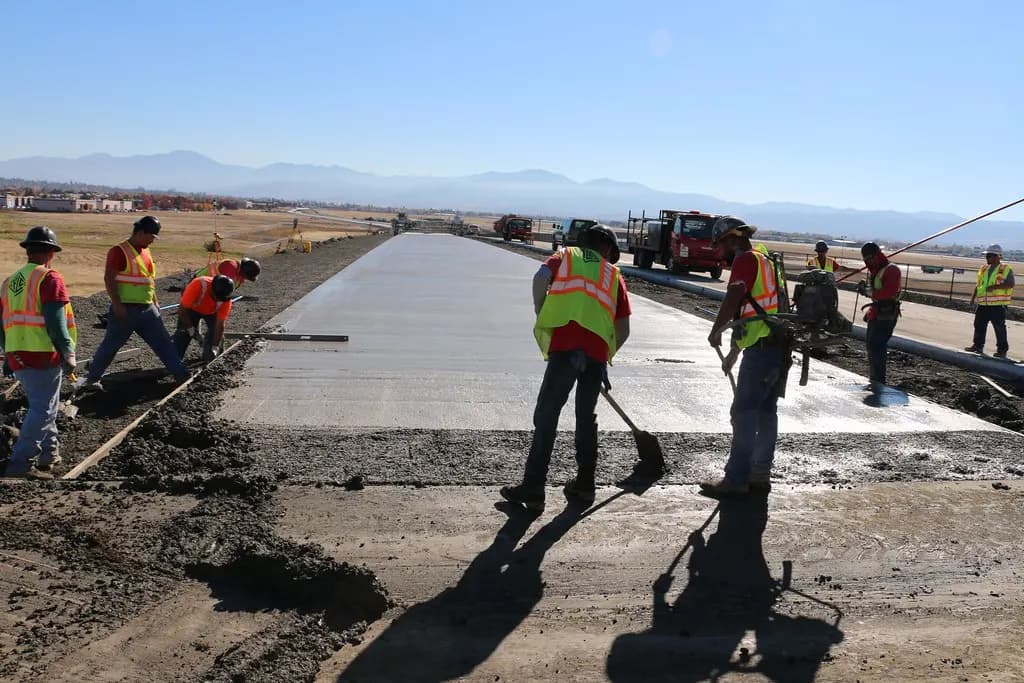
OSHA's concrete and masonry rules add specific requirements. All protruding reinforcing steel onto which workers could fall must be guarded against impalement, usually with rebar caps or troughs rated for the purpose. Nobody may work under a concrete bucket while it's being raised or lowered, and only essential workers may be behind a post-tensioning jack. Foundation walls, elevated forms and deep excavations bring in the 6 feet fall protection trigger and the trench rules. Penalties reach $16,550 per violation for a serious violation and $165,514 per violation for a willful or repeated one, so a written plan and a few hundred dollars of caps and water-fed saws are cheap insurance.
Insurance and bonds
General liability covers damage to the customer's property and injuries to the public, such as a ready-mix truck cracking a sidewalk, or a slab that causes water to run into a neighbor's basement. Builders and commercial clients usually want $1 million per occurrence and to be named as additional insured. Workers' compensation is required in most states once you hire, and for C-8 contractors in California even without employees; concrete class codes are expensive, so get quotes before you set prices. Commercial auto covers trucks and trailers, and inland marine covers power trowels, saws, a skid steer and forms. Our business insurance guide and workers' comp guide explain the policies.
Commercial and public work brings bid, performance and payment bonds. New contractors often struggle to get bonded because sureties want financial statements and a track record. The SBA's Surety Bond Guarantee program backs bonds for small contractors on contracts up to $9 million, for a contractor fee of 0.6% of the contract price. Our guide to writing a construction bid explains bid bonds and retainage.
Equipment and startup costs
Concrete is equipment-heavy, but you don't have to own everything on day one. Rent skid steers, mini excavators, pumps and plate compactors by the day and charge them to the job until you're using them often enough that owning is cheaper. There's no official benchmark for concrete startup costs; these are our planning estimates for a small flatwork company whose owner already has a pickup.
Concrete business startup checklist
0/9That adds up to roughly $20,000 to $60,000 to start. Tools, a trailer and equipment you buy can usually be deducted in the year you place them in service under Section 179 (limit $2,560,000 for 2026). Use our startup cost calculator to total your list and see how much runway you have, and open accounts with one or two ready-mix plants and a building supply yard early, because credit terms help a lot when a customer pays 30 days after a pour.
How to price concrete work per yard and per square foot, with a worked example
Concrete contractors talk about two different "per yard" numbers, and mixing them up is a classic pricing mistake. The material price per yard is what the plant charges for ready-mix delivered, which our planning estimate puts at about $140 to $200 a yard for standard 3,000 to 4,000 psi mixes in 2026, plus short-load, fuel and waiting-time fees. The price per yard in place is what you charge for a finished slab divided by the yards in it, which includes base, steel, forms, labor, equipment and overhead and is many times the material price. Customers usually think in price per square foot, so quote that, but build it up from the yards.
Try it — the 30 × 20 ft driveway at 4 inches
Worked example. A homeowner wants a 30 × 20 foot driveway, 600 square feet, torn out and replaced at 4 inches thick. Volume is 30 × 20 × (4 ÷ 12) = 200 cubic feet, or 7.41 cubic yards; with 10% waste you order 8.5 yards. Our cost estimates, based on 2026 supplier, rental and labor pricing, are: ready-mix, 8.5 yards at $170, $1,445; tear-out disposal, $900; skid steer rental for a day, $400; gravel base, about 10 tons at $35, $350; rebar grid, $350; forms, expansion joint, curing compound and sealer, $250; permit, $150. Labor is a four-person crew for two 9-hour days plus 8 hours to strip forms and saw-cut joints, 80 hours at a loaded $38 an hour (wages near the BLS median of $57,020 a year plus payroll taxes and workers' comp), $3,040. Direct cost is $6,885.
Overhead covers everything you don't charge to a job: the owner's salary, the estimating truck, insurance not in labor, yard rent, software and marketing. If you expect $160,000 of overhead and 80,000 square feet of flatwork a year, that's $2 a square foot, or $1,200 here. Total cost is $8,085. To earn a 15% net margin, divide by 0.85: 8,085 ÷ 0.85 = $9,511.76, quoted as $9,515. That's about $15.86 a square foot, or $1,284 per yard in place for the 7.41 yards in the finished slab, against $170 a yard for the material.
| Line item | Our estimate | Basis |
|---|---|---|
| Ready-mix, 8.5 yards | $1,445 | 7.41 yd + 10% waste at $170 |
| Tear-out disposal | $900 | Old 600 sq ft slab |
| Skid steer, one day | $400 | Rental |
| Gravel base, rebar, forms, joints, curing | $950 | Supplier pricing |
| Permit | $150 | Varies by city |
| Labor, 80 hours | $3,040 | $38 loaded hourly cost |
| Overhead | $1,200 | $2 per sq ft |
| Profit (15% margin) | $1,430 | Price minus total cost |
| Price | $9,515 | About $15.86 per sq ft |
A 17.7% markup on cost produces the same price as a 15% margin; our markup guide explains why. Price extras in writing: a pump when the truck can't reach, extra thickness or fiber for heavy vehicles, stamping or color, removal of tree roots, and a minimum charge for small jobs, because a 60 square foot pad still needs a truck, a crew and a cleanup. Our quotation generator builds a line-item quote.
Weather, cracking and warranty callbacks
Concrete is sensitive to the weather. Hot, dry and windy days make slabs set fast and crack; cold weather slows curing and risks freezing. Plan pours for the morning in summer, have curing compound and blankets ready, and write weather delays into your contract so you aren't forced to pour in bad conditions. Build a rain day or two into every schedule, because a crew sitting idle still costs money.
Pour-day plan
- 1
Day before
Check the forecast, confirm the order, slump and arrival times with the plant, and inspect forms, base and steel.
- 2
Morning of the pour
Stage tools, curing compound and blankets; brief the crew on who places, screeds and finishes.
- 3
After finishing
Apply curing compound, saw-cut joints at the right time with a water-fed saw, and keep traffic off until the slab has strength.
Every slab cracks somewhere, so the goal is to control where. Cut or tool control joints at the right spacing and depth, compact the base, and use the right mix for exterior exposure. Then tell customers in writing what's normal, such as hairline shrinkage cracks, and what your workmanship warranty covers, such as settlement or scaling caused by your work. Track callbacks by crew and cause; most come from base preparation, joint spacing and finishing in bad weather.
Common mistakes when starting a concrete business
The first mistake is pricing from material cost. A contractor who thinks "$170 a yard plus labor" leaves out tear-out, base, steel, equipment, overhead and profit, and loses money on every driveway. The second is ordering short: a second truck brings a short-load fee and a cold joint, so use our concrete calculator and add waste. The third is ignoring silica: cutting joints with a dry saw and no plan is exactly what OSHA inspectors look for.
Others include working above your state's license threshold without a license, skipping the right-of-way permit for a driveway approach, buying heavy equipment before you have steady work, paying finishers as 1099 contractors to avoid workers' comp, and taking a large deposit and using it to cover payroll on an earlier job. Each of these can turn a good season into a bad one.
Official links
- CSLB — C-8 Concrete classificationCalifornia concrete license scope
- CSLB — workers' compensationC-8 must carry coverage
- Code of Virginia §54.1-1100Class A, B and C thresholds
- OSHA 29 CFR 1926.1153 — silicaTable 1 and written plan
- OSHA 29 CFR 1926.701 — concrete and masonryRebar guarding and other rules
- SBA — Surety bondsSurety Bond Guarantee program
What to do next
Check your state's license threshold and your city's permit rules, get insurance quotes before you set prices, and write your silica exposure control plan before the first cut. Then estimate every job from the yards up: use our concrete calculator for volume, our guide to calculating concrete for footings, bags and rebar, the startup cost calculator for your launch budget and the markup calculator to hit your margin. For bigger commercial and public jobs, our guide to starting a construction company covers bonding and licensing in more states.
This is general information, not legal or tax advice — confirm on the official source or with a professional.
Frequently asked questions
It depends on the state and job size. California requires a C-8 Concrete license for jobs of $1,000 or more, and C-8 contractors must carry workers' comp even without employees. Virginia requires a license on single jobs over $1,000, Tennessee at $25,000 and North Carolina's general contractor license at $40,000. Texas has no state license, but cities issue permits.
There's no official figure. Our estimate for a small flatwork company that owns a pickup and rents heavy equipment is roughly $20,000 to $60,000: licensing and bond, insurance deposits, forms, screeds, floats, trowels, a power trowel, saws with water delivery, a trailer, marketing and two to three months of overhead. Buying a skid steer, mixer or a dump truck pushes it well past $100,000.
Work out the cubic yards from length, width and thickness, add waste, and price concrete, base, reinforcement, forms, equipment, disposal, permits and crew hours. Add overhead, then divide by one minus your target margin and by the square footage. In our worked example a 600 sq ft driveway replacement costs $8,085 and sells for $9,515, about $15.86 a square foot at a 15% margin.
There's no official national price. Our planning estimate for standard 3,000 to 4,000 psi ready-mix is about $140 to $200 per cubic yard delivered in 2026, before short-load and waiting-time charges. Producer prices for ready-mix rose 2.3% over the year to August 2026. A finished slab costs far more per yard once base, steel, labor and overhead are added.
The big ones are the silica standard, which limits respirable crystalline silica to 50 µg/m³ as an 8-hour average and requires a written exposure control plan when crews cut, grind or drill concrete; the concrete and masonry rules, which require guarding of protruding rebar; and fall protection from 6 feet. Serious violations can cost up to $16,550 per violation each.
It can be. Every driveway, patio, foundation and sidewalk needs concrete, and BLS reports a median wage of $57,020 a year for cement masons and concrete finishers. Profit depends on estimating accurately, keeping crews productive, avoiding weather losses and callbacks for cracking, and charging for tear-out and access. Treat 10% to 20% net margins as a planning range, not a published benchmark.
Sources & verification
Figures on this page were checked against the sources below when it was last reviewed on 12 October 2026. Each rate and limit is stored once with its own official source and review date, and official update channels are monitored daily so changes are picked up. How we verify
- 1.C-8 Concrete contractor classification — California Contractors State License Board · accessed 12 October 2026
- 2.Workers' compensation requirements — California Contractors State License Board · accessed 12 October 2026
- 3.Before applying for a license — California Contractors State License Board · accessed 12 October 2026
- 4.Code of Virginia §54.1-1100 — Definitions — Virginia General Assembly · accessed 12 October 2026
- 5.29 CFR 1926.1153 — Respirable crystalline silica — U.S. Occupational Safety and Health Administration · accessed 12 October 2026
- 6.29 CFR 1926.701 — General requirements (concrete and masonry) — U.S. Occupational Safety and Health Administration · accessed 12 October 2026
- 7.OSHA penalties — U.S. Occupational Safety and Health Administration · accessed 12 October 2026
- 8.Masonry workers — Occupational Outlook Handbook — U.S. Bureau of Labor Statistics · accessed 12 October 2026
- 9.PPI — Ready-mixed concrete (PCU327320327320) — U.S. Bureau of Labor Statistics · accessed 12 October 2026
- 10.Surety bonds — U.S. Small Business Administration · accessed 12 October 2026
MSMETOOLS is an independent platform and is not affiliated with any government agency, ministry or department.
Tools for this
Construction Material Calculator
Estimate cement, sand and aggregate for slabs.
Startup Cost Calculator
Estimate how much capital you need to launch.
Markup Calculator
Turn cost and markup into a selling price.
Quotation Generator
Create professional quotes for clients.
Related guides
 How to Start a Roofing Business in 2026: Licenses & PricingRead guide
 How to Start a Construction Company in 2026: Full GuideRead guide
 How to Start a Handyman Business in 2026: Limits & PricingRead guide
 How to Start a Painting Business in 2026: Licenses & PricingRead guide
Official links open the government site in a new tab.