 Starting & growing a business
Mushroom Farming Business in India (2026): Varieties, MIDH Subsidy, GST and a Worked ₹ Plan
Start a mushroom farming business in India in 2026: button vs oyster vs milky, MIDH subsidy norms, FSSAI and GST rules, and a ₹ plan with cost and profit.
 Edited by Sumeet YadavFounder & editor, MSMETOOLS · fact-checked against official sources
Contents (10)
- 1. Is mushroom farming a good business in India?
- 2. Button, oyster or milky: choosing your mushroom
- 3. How mushroom growing works, step by step
- 4. MIDH subsidy for mushroom units
- 5. Training, site and set-up
- 6. FSSAI, GST and other registrations
- 7. Worked ₹ plan: a 600 sq ft oyster unit
- 8. Selling: where mushroom money comes from
- 9. Common mistakes and how to avoid them
- 10. What to do next
Mushrooms are one of the few farm businesses you can run without owning farmland. A spare room, a shed or a rented godown near a town, a steady supply of wheat or paddy straw, and a buyer list of hotels, vegetable vendors and supermarkets is enough to begin. This guide is for farmers diversifying from field crops, rural youth and women's self-help groups, and urban entrepreneurs writing a mushroom farming business plan for a bank. It compares button, oyster and milky mushrooms, explains the MIDH subsidy norms that apply in 2026, sets out the FSSAI and GST position, and works through a rupee plan with the losses most guides leave out.
Quick answer
A small oyster or milky mushroom unit in an existing room can start for about ₹2–4 lakh (MSMETOOLS estimate) and sell within six weeks; button mushroom needs cool weather or air-conditioned rooms and compost-making skill. Fresh and dried mushrooms are GST-exempt. Capital support comes from MIDH: 40% of a ₹30 lakh per unit norm for a production unit, or 50% (up to 5 units per beneficiary) of ₹2 lakh per 200 sq ft unit for a low-cost 200 sq ft unit.
MIDH also funds spawn units (₹20 lakh per unit) and compost units (₹30 lakh per unit) at 40%; 50% in NE and Himalayan states
Selling fresh mushrooms from your own farm is outside the FSS Act; drying, packing or processing needs FSSAI registration
Canned or preserved mushrooms attract 5% GST; fresh, frozen and dried are Nil (exempt)
Train first — ICAR-DMR Solan, KVKs and state horticulture departments run short courses
Is mushroom farming a good business in India?
Demand has grown steadily as restaurants, cloud kitchens and urban households have added mushrooms to everyday cooking. Button mushrooms dominate supermarket shelves and hotel kitchens; oyster mushrooms sell well in the north-east, Odisha, Kerala and tribal belts where people already eat wild mushrooms; dried mushrooms and mushroom powder reach buyers across the country through online stores. Because mushrooms grow indoors on racks, output per square foot is high, and a small unit can produce several hundred kilos a month. ThePrint, reporting from ICAR's Directorate of Mushroom Research in January 2026, put India's output at about 4 lakh tonnes a year — up from roughly 6,000 tonnes in the late 1990s — with Bihar and Odisha now the leading producers rather than the traditional hill states.
The business also turns farm waste into money. Oyster and milky mushrooms grow on chopped wheat or paddy straw, and button mushroom compost is made from straw, chicken manure and gypsum. After cropping, the spent substrate is a decent soil conditioner that vegetable growers and nurseries will buy or swap. That makes mushrooms a natural fit alongside dairy, poultry or a plant nursery.
The drawbacks are just as real. Mushrooms are highly perishable — fresh button mushrooms keep only a couple of days without refrigeration — so you need buyers before you need a crop. Contamination by green mould and other competitor fungi, or a pest flare-up, can wipe out a batch. Temperature and humidity control is the whole game: a few hot days in the wrong month can stop fruiting. Most failed units in India failed on marketing and hygiene, not on the growing technique itself.
Button, oyster or milky: choosing your mushroom
The three mushrooms most Indian growers start with need very different conditions. The temperature windows below are typical fruiting ranges taught in ICAR and state horticulture trainings; the capital figures are MSMETOOLS estimates based on 2026 equipment and material prices.
| Mushroom | Fruiting temperature (typical) | Substrate | Crop cycle (approx.) | Skill and capital (estimate) |
|---|---|---|---|---|
| White button (Agaricus bisporus) | 14–18°C | Composted straw + chicken manure, cased with soil mix | 10–12 weeks from composting to end of crop | High; ₹10 lakh+ for a climate-controlled unit, less for one winter season in hills or north India |
| Oyster / dhingri (Pleurotus spp.) | 20–30°C | Pasteurised wheat or paddy straw in polybags | 6–8 weeks per batch | Low; ₹2–4 lakh in an existing room |
| Milky (Calocybe indica) | 30–35°C | Pasteurised straw in bags, cased | 8–10 weeks per batch | Low–medium; ₹2–5 lakh, suits hot plains |
| Paddy straw (Volvariella) | 30–35°C | Paddy straw beds | 3–4 weeks | Low capital, short shelf life; mostly eastern and southern states |
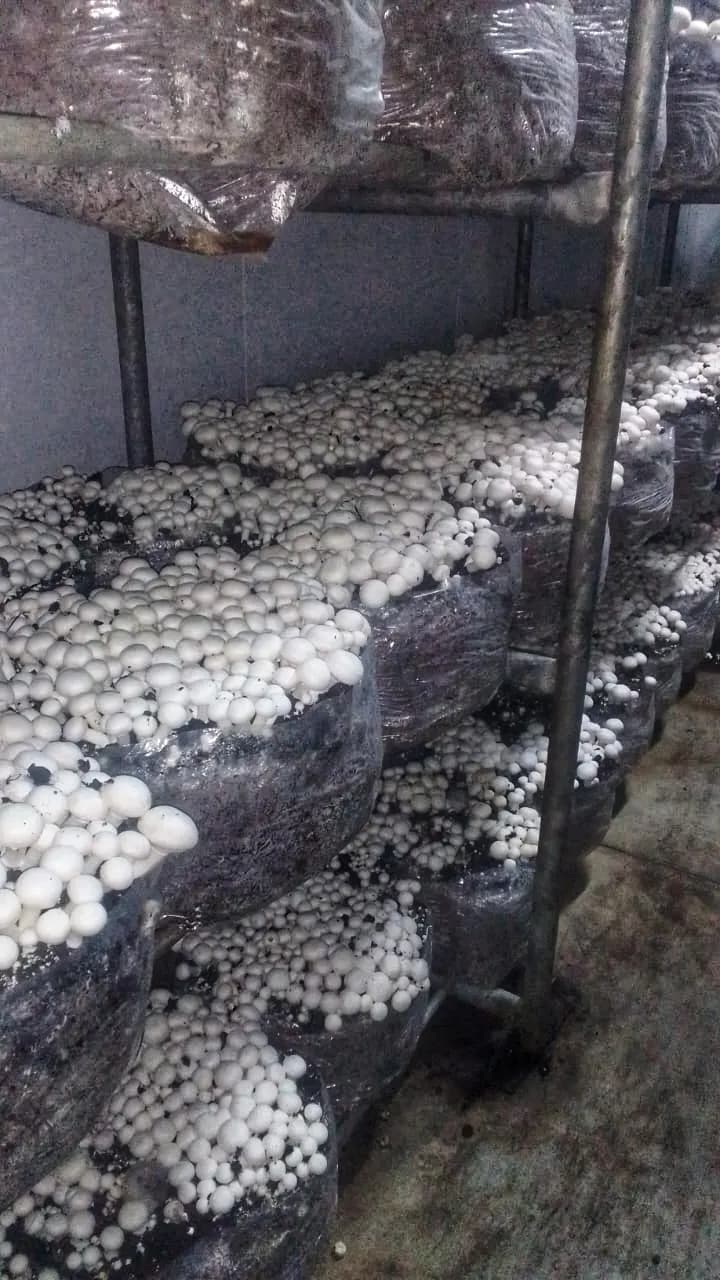
Button mushroom has the largest market and the best supermarket and hotel demand, but it is a technical crop. Growers either make their own compost in a yard with turning machines and tunnels, or buy pasteurised, spawn-run compost bags from a large compost unit. In the hills and in north India, many farmers grow one natural-season crop between October and February in thatched or bamboo huts; year-round growing needs insulated rooms with air-conditioning and humidifiers, which pushes the cost up sharply.
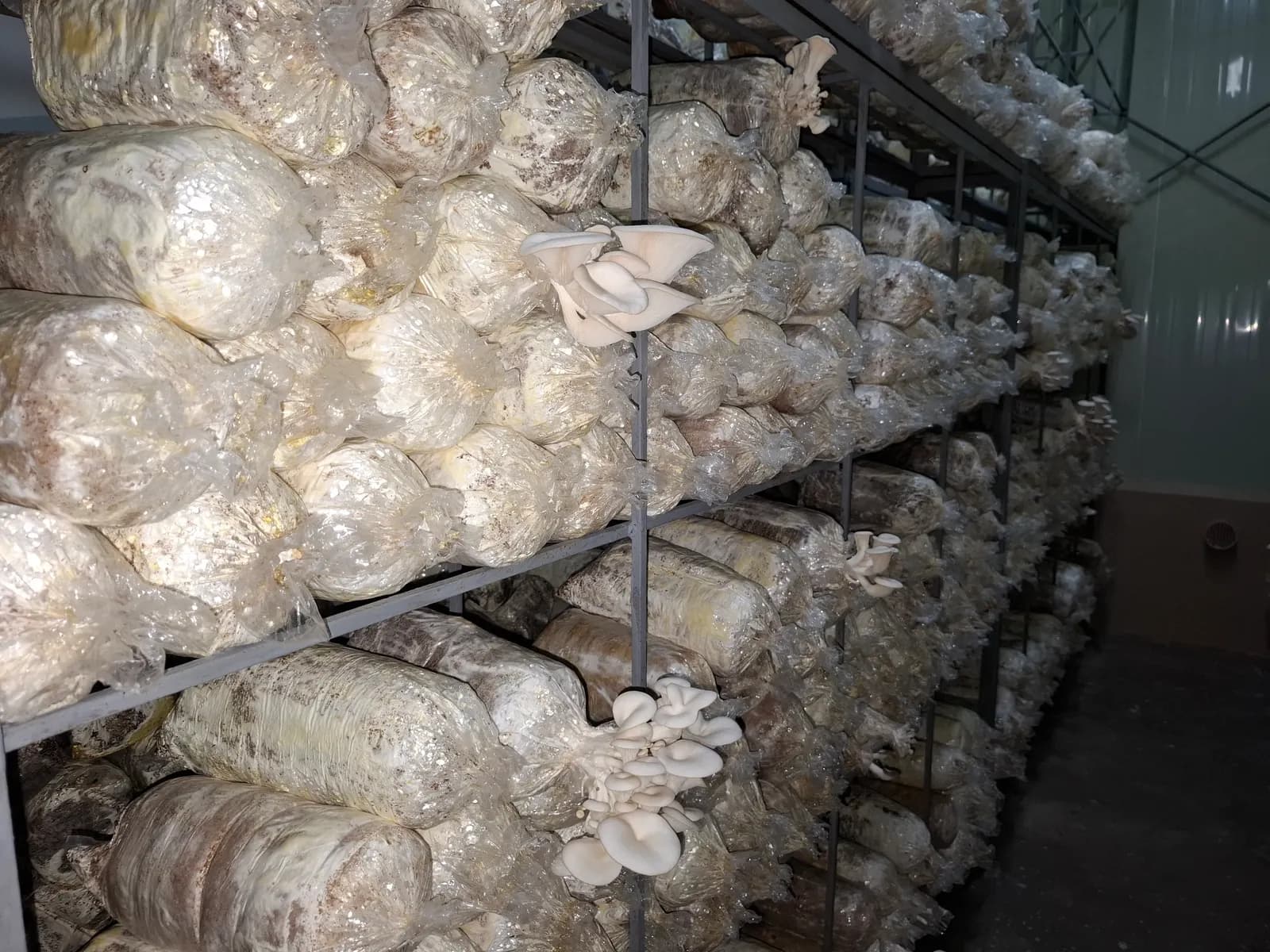
Oyster mushroom is the usual starting point. It tolerates a wide temperature range, the substrate is simply chopped straw soaked or steamed to kill competitors, and the bags start fruiting about three weeks after spawning. Different Pleurotus species suit different seasons, so a grower can switch strains through the year.
Milky mushroom is the summer answer for hot regions — Tamil Nadu, Andhra Pradesh, Karnataka, Odisha and the plains of the north in April–September. It has a longer shelf life than oyster and a firm white body that buyers like. Many small growers alternate oyster in the cooler months with milky in the hot ones to keep a year-round supply.
How mushroom growing works, step by step
Whatever the variety, every batch follows the same logic: prepare a clean food source, introduce the mushroom's seed (spawn), let it colonise in the dark, then trigger fruiting with fresh air, light and humidity. The sequence below is for oyster mushroom, the most common beginner crop.
One oyster mushroom batch
- 1
Chop and pasteurise the straw
Cut wheat or paddy straw into short pieces, soak it, then pasteurise with hot water or steam to kill competing moulds. Drain until it is moist but not dripping.
Tip: Most contamination starts here — rushed pasteurisation or wet straw is the commonest cause of green mould.
- 2
Spawn the bags
Layer the straw and grain spawn into polythene bags, tie them and punch small holes. Buy spawn only from a known lab and use it fresh.
- 3
Spawn run in the dark
Keep bags in a clean, dark room for about two to three weeks until white mycelium covers the straw. Check daily and remove any bag with green, black or pink patches.
- 4
Fruiting
Cut or remove the bags, give diffused light and fresh air, and keep humidity high with foggers or wet gunny curtains. Pin heads appear within days.
- 5
Harvest and flushes
Twist off clusters before the caps flatten and curl. Most bags give two or three flushes over three to four weeks.
- 6
Clear out and clean
Remove spent bags, sell or compost the substrate, and disinfect the room before the next batch.
Spawn is the single most important input. It is grain (usually wheat or sorghum) colonised by a pure culture of the mushroom, made in a lab with an autoclave, laminar air-flow cabinet and incubation room. Old or contaminated spawn gives patchy colonisation and poor yields, so serious growers either buy from a reputed spawn lab or, once their volume justifies it, set up their own spawn unit — which MIDH also funds.
Yields vary with strain, substrate and skill. For button mushroom, trials across centres of ICAR's All India Coordinated Mushroom Improvement Project recorded roughly 11–23 kg of fresh mushrooms per 100 kg of compost depending on the strain, composting method and casing. For oyster mushroom, growers commonly plan on about 0.8–1.2 kg of fresh mushrooms from a bag made with around 2 kg of dry straw over two or three flushes; treat that as a planning estimate, not a guarantee.
MIDH subsidy for mushroom units
The Mission for Integrated Development of Horticulture (MIDH) is the main source of capital support. It is a centrally sponsored scheme run in each state by the State Horticulture Mission. Para 7.19 of the MIDH Operational Guidelines 2025 provides assistance for individual mushroom production, spawn production and compost-making units, plus a separate low-cost unit for small growers, with the cost norms in Annexure V.
MIDH mushroom norms for private applicants (2025 guidelines)
₹30 lakh per unit
Production unit cost norm
40% assistance, credit-linked
₹20 lakh per unit
Spawn-making unit
40% assistance, credit-linked
₹30 lakh per unit
Compost-making unit
40% assistance, credit-linked
₹2 lakh per 200 sq ft unit
Low-cost unit (200 sq ft)
50% (up to 5 units per beneficiary), up to 5 units per person
For the three larger units, private applicants get 40% of the cost as a credit-linked, back-ended subsidy on infrastructure. In the North Eastern and Himalayan states, scheduled areas, vibrant villages and the Andaman & Nicobar and Lakshadweep islands, the rate is 50%. Public-sector units get 100%. "Credit-linked" means you need a term loan sanctioned by a bank; the subsidy is released to the bank after the unit is built and inspected, and is usually kept in a subsidy reserve account against the loan.
Worked examples. A private grower in Haryana building a production unit that costs ₹34 lakh gets assistance on the norm, not on actual spend: 40% of ₹30 lakh, or up to ₹12 lakh. The same unit in Uttarakhand or Meghalaya would qualify for 50% of ₹30 lakh, up to ₹15 lakh. A self-help group member in Odisha setting up two low-cost 200 sq ft units can claim 50% of ₹4 lakh, or ₹2 lakh, which covers both structure and inputs.
The low-cost unit is the most useful line for beginners. It is meant for small huts or rooms of about 200 sq ft, and the assistance covers both the structure and the inputs, up to five units per beneficiary. Because state missions decide their own annual action plans, not every district funds mushroom units every year. Ask your district horticulture officer whether mushroom targets exist for 2026-27 before you pay for a project report. Our agriculture subsidy guide covers MIDH and the other farm schemes in more detail.
Other routes. If MIDH targets are exhausted, a PMEGP loan can fund a mushroom unit as a new micro-enterprise with a margin-money subsidy of 15% to 35% depending on category and location, and a Mudra loan covers smaller working-capital needs. You generally can't stack two capital subsidies on the same asset, so pick the scheme that pays most for your project and declare the other.
Training, site and set-up
Get trained before you spend. ICAR's Directorate of Mushroom Research (DMR) at Solan in Himachal Pradesh runs paid residential courses — five- and nine-day programmes covering button, oyster, milky, paddy straw and shiitake — and sells spawn on advance booking. Other ICAR centres hold one-day farmer trainings on hygiene, temperature and moisture control. Krishi Vigyan Kendras, state agricultural universities and many state horticulture departments run shorter courses, often free or subsidised for farmers. A course also gives you a certificate that banks and MIDH officers like to see in a project file.
Choose the site for climate and hygiene. You need a room that can be kept dark during spawn run, cleaned easily, ventilated without letting in dust and flies, and kept humid. A pucca room with a cement floor, nets on windows and a separate area for preparing straw is ideal. Water must be clean and plentiful; straw soaking and humidity control use a lot of it. Keep the straw-preparation area well away from the growing rooms so that spores from the outside don't reach the bags.
Equipment for a small oyster or milky unit typically includes iron or bamboo racks, a large drum or tank for hot-water pasteurisation (or a steam boiler for bigger units), a chaff cutter, polythene bags, foggers or humidifiers, exhaust fans, a thermometer–hygrometer, a weighing scale, and crates or punnets for packing. Button units add compost yards, bulk pasteurisation tunnels, insulated cropping rooms, air-handling units and a cold room.
FSSAI, GST and other registrations
FSSAI. The Food Safety and Standards Act, 2006 says its provisions don't apply to any farmer, farming operations or crops, or to the products of crops produced by a farmer at farm level. A grower selling fresh mushrooms from the farm is therefore generally outside the Act. The position changes once you move into food business activity: drying and packing mushrooms, making pickle or powder, selling under a brand, or buying mushrooms from other growers to resell. Then you need at least basic FSSAI registration — ₹100/year for turnover up to ₹1.5 crore, the limit FSSAI set from 1 April 2026 — or a state licence above it. Supermarket chains and hotel groups often ask for an FSSAI number even from farm suppliers, so many growers register anyway. See our FSSAI registration guide.
Registration and tax at a glance
| Activity | FSSAI | GST |
|---|---|---|
Grow and sell fresh mushrooms from your farm | Generally not covered by the FSS Act | Nil (exempt) |
Dry and sell dried mushrooms in packs | Registration / licence by turnover | Nil (exempt) |
Canned or preserved mushrooms (2003) | Registration / licence by turnover | 5% |
Selling mushroom spawn | Not a food | Nil (exempt) (Chapter 06) |
Training courses, consultancy | — | 18% if registered |
Grow and sell fresh mushrooms from your farm
- FSSAI
Generally not covered by the FSS Act
- GST
Nil (exempt)
Dry and sell dried mushrooms in packs
- FSSAI
Registration / licence by turnover
- GST
Nil (exempt)
Canned or preserved mushrooms (2003)
- FSSAI
Registration / licence by turnover
- GST
5%
Selling mushroom spawn
- FSSAI
Not a food
- GST
Nil (exempt) (Chapter 06)
Training courses, consultancy
- FSSAI
—
- GST
18% if registered
GST. Since 22 September 2025, Notification 10/2025-Central Tax (Rate) exempts vegetables that are fresh or chilled (0709, which includes mushrooms), frozen (0710) and dried (0712, which has separate lines for dried mushrooms), so they are Nil (exempt). Mushroom spawn is classified in Chapter 06, which the same notification exempts as live plants and similar. Mushrooms prepared or preserved — canned in brine, ready-to-cook packs treated with preservatives — fall under heading 2003 and attract 5%.
A grower selling only fresh or dried mushrooms makes exempt supplies, and under section 23 of the CGST Act a person making only exempt supplies doesn't have to register. Add taxable lines — canned mushrooms, mushroom pickle, consultancy, training fees, selling spawn-run bags as a kit with services — and once taxable turnover crosses ₹40 lakh for goods or ₹20 lakh for services in most states, you must register. Exempt sales count towards that aggregate turnover.
Other registrations. Udyam registration is free and helps with bank loans and priority-sector lending. Pre-packed mushrooms sold in retail packs must carry the declarations required under the Legal Metrology (Packaged Commodities) Rules — see our legal metrology guide. A unit with a boiler for steam pasteurisation may need boiler registration under the state boiler inspectorate, and large compost yards can attract odour complaints, so check with the local body and state pollution control board before you build near houses.
Worked ₹ plan: a 600 sq ft oyster unit
Here is a simple mushroom farming business plan for an oyster (and summer milky) unit in a rented 600 sq ft shed near a tier-2 town, selling fresh mushrooms to vegetable vendors, restaurants and a local supermarket. All figures are MSMETOOLS estimates based on typical 2026 prices for straw, spawn, equipment and wages; they are not official figures. Replace them with quotes from your area.
The unit runs about 1,200 bags per batch and five batches a year, or 6,000 bags. At an assumed 1 kg of fresh mushrooms per bag and 10% loss to contamination, grading and unsold stock, it sells about 5,400 kg a year at an average ₹140 a kg across wholesale and retail.
| Item | One-time set-up (estimate) | Yearly (estimate) |
|---|---|---|
| Shed repairs, nets, insulation, cement floor | ₹80,000 | — |
| Racks for 1,200 bags | ₹90,000 | — |
| Pasteurisation drums, burner, chaff cutter | ₹50,000 | — |
| Foggers, exhaust fans, thermometer–hygrometer | ₹60,000 | — |
| Weighing scale, crates, sealing machine, tools | ₹30,000 | — |
| Training, first batch, contingency | ₹40,000 | — |
| Total set-up | ₹3,50,000 | |
| Straw, spawn, bags, disinfectants (₹45 a bag × 6,000) | ₹2,70,000 | |
| Shed rent | ₹60,000 | |
| One full-time worker plus casual help | ₹2,16,000 | |
| Power and water | ₹36,000 | |
| Packing, transport, marketing | ₹72,000 | |
| Total running cost | ₹6,54,000 | |
| Sales: ~5,400 kg at an average ₹140 | ₹7,56,000 | |
| Sales: spent substrate to farmers and nurseries | ₹20,000 | |
| Profit before owner's labour and loan repayment | ₹1,22,000 |
That is roughly ₹10,000 a month on average — a modest return that improves quickly with better prices and lower losses. Push the retail share up (₹180–200 a kg in punnets to households and gyms instead of ₹110–120 wholesale), dry the second-grade mushrooms instead of dumping them, and cut contamination from 10% to 5%, and the same unit can clear ₹2.5–3 lakh a year. If you funded half the set-up with a ₹1.75 lakh Mudra loan over three years at about 11%, the EMI would be roughly ₹5,700 a month; check yours with our EMI calculator.
What a button unit looks like. A climate-controlled button mushroom farm with its own compost unit is a ₹40 lakh-plus project and is normally built with a bank loan and the MIDH subsidy. Its economics depend on running every room all year, buying compost raw materials at the right season, and selling through cold-chain buyers. Many first-time button growers start by buying spawn-run compost bags from an established compost unit and cropping them in one or two insulated rooms, which cuts capital and skill needs while they learn.
Use our break-even calculator to see how many kilos a month you must sell at your price to cover fixed costs.
Price for losses, not for the best bag. Budget for 10–15% of bags contaminated or underperforming in your first year, and work out your cost per kilo on the bags that actually fruit. That is the number to beat when you agree prices with buyers.
Before your first batch
0/8Selling: where mushroom money comes from
Line up buyers before your first spawning. For fresh mushrooms the usual channels are vegetable wholesalers in the nearest mandi, retail vegetable vendors, hotels and restaurants, hospital and hostel kitchens, supermarkets and quick-commerce dark stores, and direct sales to households through WhatsApp groups and weekend farmers' markets. Restaurants pay well but expect daily delivery of a fixed quantity; supermarkets want consistent grading, punnet packing and sometimes an FSSAI number and invoices.
Value addition rescues surplus. Oyster mushrooms dry easily in a solar or electric dryer and keep for months; dried mushrooms, mushroom powder for soups, pickles and ready-to-cook packs all extend shelf life and reach buyers far from your town. Once you start processing, register with FSSAI, label properly and check the GST rate on each product line. A dryer, grinder and packing machine can be funded through PMEGP, or through the PMFME scheme — but PMFME's temporary extension ran only until 30 September 2026, so check whether it is taking new applications before you plan around it.
Spawn and training as a second business. Experienced growers often earn more from selling spawn, ready-to-fruit bags and short training sessions than from mushrooms themselves. A spawn lab needs sterile technique and steady quality, and MIDH supports it at 40% of the ₹20 lakh per unit norm.
Common mistakes and how to avoid them
Starting without buyers. Fresh mushrooms don't wait. A first batch that finds no buyer becomes a loss and a contamination source. Sign up at least two or three regular buyers and know the mandi price before you spawn.
Poor hygiene. Green mould, cobweb disease and flies spread fast in a dirty room. Disinfect between batches, use foot dips at the door, keep the straw yard away from the growing rooms and remove contaminated bags immediately, sealed in a sack.
Wrong variety for the season. Growing oyster in the peak of a North Indian summer or button without cooling outside the winter window wastes a batch. Match the species and strain to your local temperature, and plan milky mushroom for the hottest months.
Building before approval. MIDH assistance is credit-linked and back-ended. Construction started before the state mission's approval and your bank's sanction is usually ineligible.
Ignoring records. Keep a batch register — date, straw quantity, spawn source, yield per flush and losses. It shows you where profit leaks, and banks and subsidy inspectors ask for it.
What to do next
Take a short course, visit two working mushroom farms in your district, and talk to buyers before you buy racks. Build your first-year budget in our startup cost calculator and draft a bank-ready plan with the business plan generator. If you want land-based diversification as well, see our guides to organic farming and the agriculture subsidy guide.
Official links
- MIDH Operational Guidelines 2025 (PDF)Para 7.19 and Annexure V — mushroom norms
- ICAR-DMR SolanMushroom research directorate — training and spawn
- Notification 10/2025-CT(Rate) (PDF)GST exemption for fresh, frozen and dried vegetables
- Notification 9/2025-CT(Rate) (PDF)5% on prepared/preserved mushrooms
- FoSCoS — FSSAI registrationFor drying, packing or processing
This is general information, not legal or tax advice — confirm on the official source or with a professional.
Frequently asked questions
A small oyster or milky mushroom unit in an existing room or shed can start for about ₹2–4 lakh, covering racks, a pasteurisation drum, humidifiers, fans and the first batches of straw and spawn — an MSMETOOLS estimate. A climate-controlled button mushroom unit with its own compost yard is a different scale: MIDH's cost norm is ₹30 lakh per unit for a production unit and ₹30 lakh per unit for a compost unit.
Under MIDH, private growers get 40% of the cost norm as a credit-linked, back-ended subsidy for a production unit (₹30 lakh per unit), spawn unit (₹20 lakh per unit) or compost unit (₹30 lakh per unit) — 50% in NE and Himalayan states. A low-cost 200 sq ft unit has a norm of ₹2 lakh per 200 sq ft unit with 50% (up to 5 units per beneficiary). Apply through your State Horticulture Mission.
Not on fresh, chilled, frozen or dried mushrooms — they are exempt (Nil (exempt)) under Notification 10/2025-Central Tax (Rate) from 22 September 2025. Prepared or preserved mushrooms under heading 2003, such as canned or brined mushrooms, attract 5%. A grower selling only fresh or dried mushrooms makes exempt supplies and doesn't need GST registration for them.
The FSS Act says it doesn't apply to a farmer or to products of crops produced by a farmer at farm level, so a grower selling fresh mushrooms from the farm is generally outside it. Once you dry, pack, label, pickle or process mushrooms, or buy from others to resell, take FSSAI registration — ₹100/year for turnover up to ₹1.5 crore.
Button mushroom has the biggest market, but it needs cool weather or air-conditioned rooms and compost-making skill. Oyster mushroom is the cheapest to start, grows on wheat or paddy straw at 20–30°C and suits beginners. Milky mushroom fits hot regions where button can't be grown without cooling. Profit depends more on steady buyers and low losses than on the variety.
Our estimate for a 600 sq ft oyster unit running about 6,000 bags a year and selling fresh mushrooms near a town is roughly ₹1.5 lakh a year before the owner's own labour — about ₹13,000 a month. Better prices from direct retail, dried products and year-round production with milky mushroom in summer can raise that.
Sources & verification
Figures on this page were checked against the sources below when it was last reviewed on 11 October 2026. Each rate and limit is stored once with its own official source and review date, and official update channels are monitored daily so changes are picked up. How we verify
- 1.MIDH Operational Guidelines 2025 (dated 31.12.2024) — Department of Agriculture & Farmers Welfare (hosted by NHB) · accessed 11 October 2026
- 2.Notification No. 10/2025-Central Tax (Rate) — exempted goods — Ministry of Finance (Gazette of India) · accessed 11 October 2026
- 3.Notification No. 9/2025-Central Tax (Rate) — goods rate schedules — Ministry of Finance (Gazette of India) · accessed 11 October 2026
- 4.Food Safety and Standards Act, 2006 — FSSAI · accessed 11 October 2026
- 5.All India Coordinated Mushroom Improvement Project — Annual Report 2011-12 — ICAR-Directorate of Mushroom Research, Solan · accessed 11 October 2026
- 6.ICAR-IISWC Research Centre organises training on scientific button mushroom cultivation (11 Sep 2026) — Indian Council of Agricultural Research · accessed 11 October 2026
- 7.FSSAI order on revised turnover thresholds (13 March 2026) — FSSAI · accessed 11 October 2026
- 8.The Solan mushroom bank helping farmers grow empires up to Odisha — ThePrint (secondary) · accessed 11 October 2026
MSMETOOLS is an independent platform and is not affiliated with any government agency, ministry or department.
Tools for this
Startup Cost Calculator
Estimate how much capital you need to launch.
Break Even Calculator
Find your break even point and units.
EMI Calculator
Calculate loan EMIs for business and personal loans.
Business Plan Generator (US)
Create a professional business plan for US investors and banks.
Related guides
 Plant Nursery Business 2026: Subsidy, Licence & ProfitRead guide
 Organic Farming Business in India 2026: Certification & ProfitRead guide
 Poultry Farming Business Plan 2026: Costs, Subsidy & ProfitRead guide
 Beekeeping Business 2026: Subsidy, Registration & ProfitRead guide
Official links open the government site in a new tab.