 Starting & growing a business
Plant Nursery Business in India (2026): Subsidy, Licences, GST and a Worked ₹ Plan
Start a plant nursery business in India in 2026: MIDH nursery subsidy (40–50%), NHB accreditation fee, state nursery licences, GST-exempt plants and a ₹ plan.
 Edited by Sumeet YadavFounder & editor, MSMETOOLS · fact-checked against official sources
Contents (11)
- 1. Is a plant nursery a good business in India?
- 2. Choosing your nursery model
- 3. MIDH nursery subsidy: cost norms and how much you get
- 4. NHB support after the August 2026 changes
- 5. NHB accreditation and star rating
- 6. Licences and registrations you may need
- 7. GST on plants, pots and services
- 8. Worked ₹ plan: a half-acre retail nursery
- 9. Common mistakes and how to avoid them
- 10. Selling: where nursery revenue comes from
- 11. What to do next
India plants hundreds of millions of saplings a year, and almost every one of them passes through a nursery — orchards, roadside avenues, apartment balconies, temple gardens, farm bunds and corporate campuses. This guide is for farmers with a small plot near a town, landscapers who want their own stock, and anyone writing a plant nursery business plan for a bank. It covers what kind of nursery to run, the MIDH and NHB subsidy norms that apply in 2026, NHB accreditation, the state licences and seed rules you may need, GST, and a worked rupee plan with the costs most guides leave out.
Quick answer
A plant nursery raises and sells seedlings, saplings, grafts and potted plants. Live plants and sowing seeds are GST-exempt, so a small nursery selling only plants needs no GST registration. Capital support comes from MIDH: 50% of ₹20 lakh per hectare for a private small nursery (0.4–1 ha) and 40% of ₹30 lakh per hectare for a large one (1–2 ha), pro rata.
Some states (Maharashtra, Punjab and others) license fruit nurseries under their own Acts
Selling packeted seeds needs a seed dealer licence under the Seeds (Control) Order, 1983
NHB recognition costs ₹5,900 and lasts two years at first
NHB support for plug-type nurseries is now 35% (45% in NE and hill states)
Is a plant nursery a good business in India?
Demand comes from three very different buyers, and a good nursery usually serves at least two of them. Farmers buy grafted fruit plants, plantation crops and vegetable seedlings in bulk at planting time. Urban households buy indoor plants, flowering seasonals and pots in small lots all year, with peaks before Diwali and during the monsoon. Institutions — builders, municipal bodies, forest and social forestry departments, schools and companies with plantation drives — buy avenue trees and shrubs in hundreds or thousands, often by tender.
The business has real advantages. Plants are GST-exempt, start-up capital is modest compared with most farm enterprises, and you can begin on half an acre of leased land on the edge of a town. A healthy grafted mango plant that costs a few rupees in rootstock, scion and labour can sell for well over a hundred rupees after a year. Margins on value-added items — decorative pots, potting mix, garden tools, small landscaping and maintenance jobs — are often better than on the plants themselves.
The risks are just as real. Plants are perishable stock: a heat wave, a waterlogged week, a pest outbreak or a dead pump can kill a season's inventory. Sales are seasonal, so you carry stock and pay labour through months when little moves. And trust is everything — a farmer who plants 200 mislabelled or diseased mango grafts loses three years, which is exactly why several states license fruit nurseries and why the Centre is pushing accreditation.
Choosing your nursery model
Before you buy a single polybag, decide what you will grow and who will buy it. The models below need very different skills and capital. The capital ranges are MSMETOOLS estimates based on typical dealer quotes for shade nets, irrigation and stock in 2026; your costs depend on land, location and scale.
| Model | What you sell | Main buyers | Skill needed | Indicative set-up (estimate) |
|---|---|---|---|---|
| Retail ornamental nursery | Indoor and flowering plants, pots, potting mix | Households, offices, gift buyers | Low–medium | ₹4–10 lakh on leased land |
| Fruit plant nursery (grafts) | Mango, guava, citrus, sapota, pomegranate grafts | Farmers, horticulture schemes | High — grafting and mother plants | ₹8–30 lakh for 0.4–1 ha |
| Vegetable seedling (plug) nursery | Tomato, chilli, brinjal, cabbage seedlings in trays | Vegetable farmers | Medium — media, hygiene, timing | ₹5–15 lakh; more under a polyhouse |
| Forestry and avenue plants | Neem, teak, bamboo, native trees | Forest departments, builders, CSR drives | Low–medium; tenders | ₹5–15 lakh |
| Wholesale supplier | Bulk plants bought in and resold | Retail nurseries, landscapers | Trading and logistics | Mostly working capital |
Retail ornamental nurseries succeed on location. A plot on a busy road at the edge of a growing town, with parking and visible display beds, does more business than a better-run nursery hidden down a lane. Many owners buy a large share of their stock from wholesale clusters — Kadiyam near Rajahmundry in Andhra Pradesh is the best-known — and grow on, pot up and resell.
Fruit plant nurseries need mother blocks: healthy, true-to-type parent trees from which you take scions, plus rootstock beds. This is where state licensing and NHB recognition matter most, and where the government buys planting material for its own area-expansion programmes.
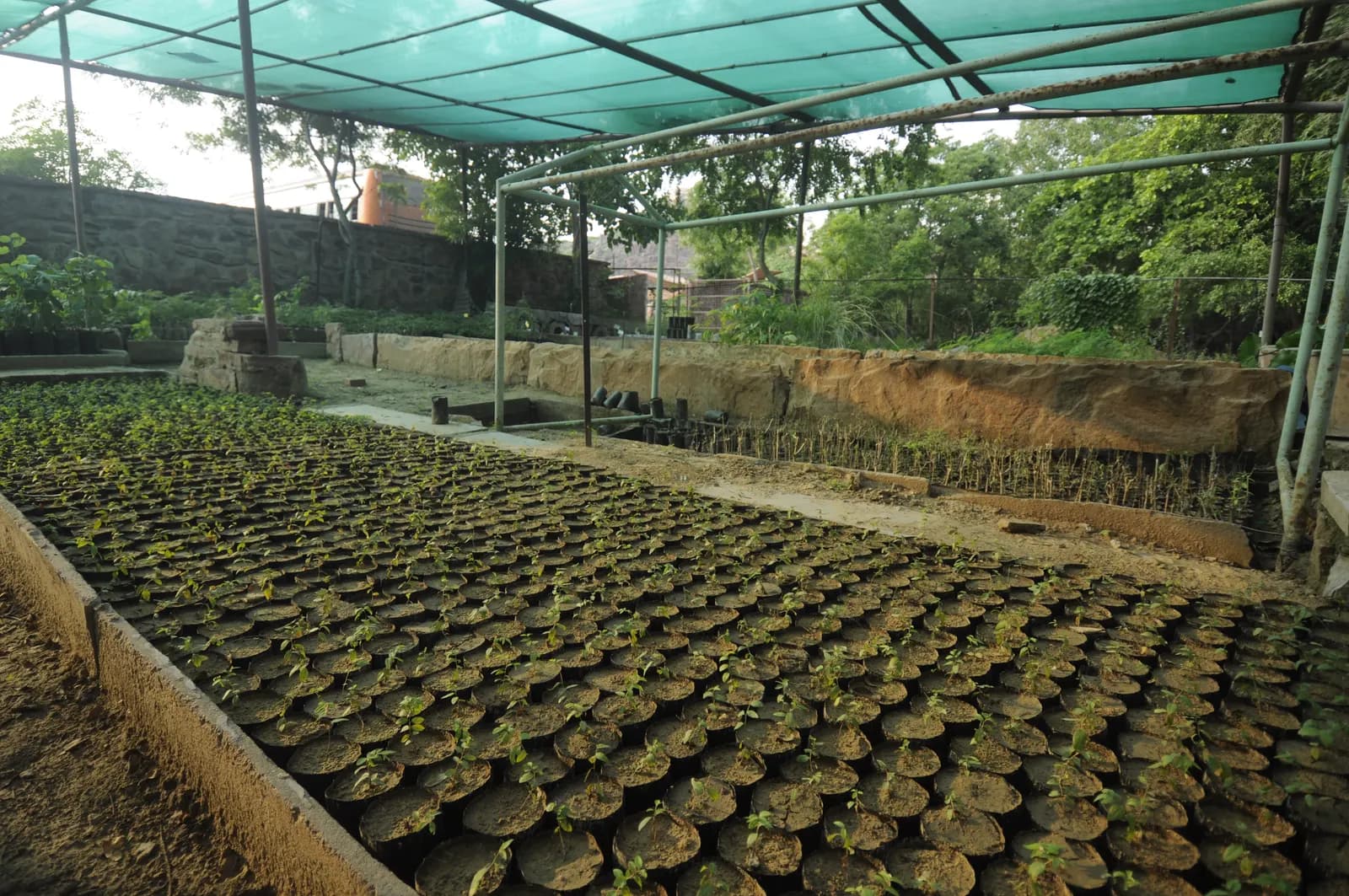
Vegetable plug nurseries raise seedlings in plastic trays filled with soilless media such as cocopeat, usually under insect-proof netting. Farmers pay because tray seedlings survive transplanting better and save seed. The work is precise and seasonal, and a single damping-off outbreak can wipe out a batch.
MIDH nursery subsidy: cost norms and how much you get
The Mission for Integrated Development of Horticulture (MIDH) is the main source of capital support for new nurseries. It is a centrally sponsored scheme run in each state by the State Horticulture Mission, with the Centre paying 60% of the programme cost and the state 40% (90:10 in the North Eastern and Himalayan states). The current norms are in Annexure V of the MIDH Operational Guidelines 2025, dated 31 December 2024 — and they are higher than the figures many older websites still quote.
Assistance is calculated on the MIDH cost norm, not on what you actually spend, and it is released as a back-ended subsidy after the work is completed and inspected. If your nursery costs more than the norm, the extra is your own money and your bank's.
MIDH nursery norms for private applicants (2025 guidelines)
₹20 lakh per hectare
Small nursery cost norm (0.4–1 ha)
50% assistance, pro rata
₹30 lakh per hectare
Large nursery cost norm (1–2 ha)
40% assistance, pro rata
₹4 lakh per hectare
Upgrade to accreditation norms
50% for private nurseries up to 2 ha
₹1,200 per sq m
Hi-tech plug-type nursery
0.2–1 ha, credit-linked
Worked examples. A private small nursery of 0.4 hectare (about one acre) has a cost norm of ₹8 lakh (0.4 × ₹20 lakh), so the maximum assistance at 50% is ₹4 lakh. A one-hectare small nursery has a norm of ₹20 lakh and assistance of up to ₹10 lakh. A 1.5-hectare large nursery has a norm of ₹45 lakh and assistance of up to ₹18 lakh at 40%. In the North Eastern and Himalayan states, scheduled areas, vibrant villages and the island territories, the minimum size for a large nursery drops to 0.5 hectare.
The subsidy comes with output targets and strings. A large nursery must produce at least 1,00,000 plants per hectare a year of mandated perennial crops — fruit plants, tree spices, aromatic plants, plantation crops, perennial flowers — certified for quality. A small nursery must produce at least 50,000 per hectare a year. Every MIDH-funded nursery must be accredited within 18 months of the last instalment. The norm covers components such as fencing, mother and rootstock blocks, irrigation, an insect-proof hardening net house, a pump house with two days' water storage and media sterilisation.
Existing nurseries can claim help to upgrade to accreditation standards — hot-bed media sterilisation, a working shed, a hardening chamber or net house, a mist chamber, a mother block and fertigation — up to ₹4 lakh per hectare at 50% for private nurseries of up to two hectares.
Is MIDH running in 2026? Yes. District horticulture offices have posted MIDH project lists for 2026-27 — Hooghly's notice, for example, runs from July 2026 to March 2027 — but each state decides how many nurseries it will fund in its annual action plan. Ask your district horticulture officer whether nursery targets exist for your district this year before you spend on a project report.
NHB support after the August 2026 changes
The National Horticulture Board (NHB) runs its own commercial horticulture scheme for larger, credit-linked projects. Under MIDH norms, a hi-tech plug-type nursery under controlled conditions is supported as a project. The rate changed on 21 August 2026: NHB's public circular cut assistance for open-field and protected cultivation projects — including plug-type nurseries under protected structures — to 35% of eligible cost in general areas and 45% in the North Eastern and Himalayan states, scheduled areas and island territories. Land cost no longer counts as project cost.
The same circular tightened eligibility. "Family" now means the applicant, spouse, parents, sons and daughters, and only one family member can ever take NHB assistance, whether individually, through a firm or as a company director. Sitting legislators, serving government and PSU employees (other than Group-D staff), pensioners drawing ₹10,000 a month or more, and groups of farmers are not eligible. If your father took NHB help for a cold store in 2019, you cannot claim it for a nursery now. Our agriculture subsidy guide covers the circular in detail.
Rule changes that affect nurseries
Aug 2024
Cabinet approves the ₹1,765.67 crore Clean Plant Programme
22 Sep 2025
Notification 10/2025-CT(Rate) replaces 2/2017; live plants stay exempt
12 Nov 2025
Draft Seeds Bill released — proposes compulsory nursery registration
10 Jul 2026
Maharashtra bill to replace jail with a fine for first nursery offences
21 Aug 2026
NHB cuts protected-cultivation and plug-nursery support to 35%/45%
NHB accreditation and star rating
NHB runs a voluntary system of recognition for horticulture nurseries. Inspectors assess your infrastructure, mother plants, propagation methods, record-keeping and staff training, and award marks; nurseries that pass are star-rated. Recognition is specific to the premises and the crops named on the certificate, so a second site needs its own application.
The fee is ₹5,900 for a new application (₹3,540 for renewal), non-refundable and paid online. Recognition is granted at first for two years, with at least one surveillance visit a year; it lapses unless renewed. Nurseries already licensed under a state Act can get provisional recognition for a year while they are assessed.
Why bother? Because MIDH requires that planting material for its area-expansion programmes be bought only from NHB-accredited nurseries, and state action plans can only set planting targets up to the supply available from accredited sources. If you want to sell grafts to farmers who are claiming MIDH subsidy for a new orchard, accreditation is effectively your licence to that market. The ₹1,765.67 crore Clean Plant Programme, approved in August 2024, adds a further layer for fruit crops: Clean Plant Centres will supply virus-free mother material to large nurseries, backed by a certification system under the Seeds Act.
From plot to accredited nursery
Step 1
Lease or own land with water
Step 2
State nursery licence (if your state has an Act)
Step 3
MIDH/NHB approval before building
Step 4
Build, plant mother block, start production
Step 5
NHB recognition
within 18 months if MIDH-funded
Licences and registrations you may need
India has no single national nursery licence today, which is why the rules confuse new owners. What applies depends on your state and what you sell.
State nursery Acts. Several states license nurseries under their own laws, mostly for fruit plants. Maharashtra's Fruit Nurseries and Sale of Fruit Plants (Regulation) Act, 1969 requires every fruit nursery owner and every seller of fruit plants to hold a licence. A 2026 amendment bill, introduced in the Legislative Council on 10 July 2026, replaces imprisonment for a first offence with a fine of up to ₹15,000, keeping up to six months or ₹25,000 for repeat offences. Punjab's 1961 Act, renamed the Punjab Horticulture Nurseries Act in 2022, needs a separate licence for each nursery and, since the amendment, a trained person on the staff. Uttarakhand, Jammu & Kashmir and others have their own Acts. Your district horticulture officer will tell you whether one applies.
Seed dealer licence. If you sell packeted seeds — vegetable or flower seed packets on the counter — you need a dealer licence from the state agriculture department under the Seeds (Control) Order, 1983, with a separate licence for each place of business. Selling plants you raised yourself is not seed dealing, but the packets on your shelf are.
What is coming. The draft Seeds Bill, 2025, released for comments on 12 November 2025, would for the first time require every plant nursery to register with the state government within a year of the law taking effect, keep records of the source of every planting material and mother plant, maintain a layout plan of rootstocks and scions, and report production, stock and prices. The Centre could exempt small nurseries. As of October 2026 the Bill has not been introduced in Parliament; the agriculture minister said in September 2026 that consultations with farmers would continue. Start keeping those records now — they also earn marks in NHB assessment.
General business registrations. A shop and establishment registration or trade licence from the municipality or panchayat may apply to a retail nursery with a sales counter, especially in towns. Udyam registration is free and helps with bank loans and priority-sector lending. If you import plants or bulbs, every consignment needs an import permit and phytosanitary clearance under the Plant Quarantine (Regulation of Import into India) Order, 2003.
GST on plants, pots and services
Live trees and other plants, bulbs, roots, cut flowers and ornamental foliage — the whole of Chapter 06 of the tariff — are exempt from GST. Since 22 September 2025 the exemption sits at serial number 26 of Notification 10/2025-Central Tax (Rate), which replaced the old exemption list in Notification 2/2017; matching state and integrated tax notifications exempt the other halves. Seeds, fruit and spores of a kind used for sowing are exempt too (serial number 84), but only when they are actually for sowing.
A nursery that sells only plants therefore makes exempt supplies and, under section 23 of the CGST Act, does not have to register for GST at all, however large its turnover. The picture changes once you add taxable lines: pots and planters, fertiliser, pesticides, garden tools, potting mix in branded packs, and services such as landscaping, garden maintenance contracts or plant rental to offices. Once your taxable sales cross the registration threshold — ₹40 lakh for goods or ₹20 lakh for services in most states — you must register, and exempt plant sales count towards aggregate turnover. See our GST registration guide.
Two practical tips. Invoice plants and taxable items as separate lines with their own HSN codes, so a GST officer can see what is exempt. And if you register, remember that input tax credit on shared costs — say, a shade net used for both exempt plants and a taxable rental business — must be split.
Worked ₹ plan: a half-acre retail nursery
Here is a simple plant nursery business plan for a half-acre (about 0.2 hectare) retail nursery on leased land beside a main road at the edge of a tier-2 city, selling ornamental and fruit plants grown on from bought-in stock, plus pots and small landscaping jobs. All figures are MSMETOOLS estimates based on typical 2026 dealer quotes, wage rates and nursery retail prices; they are not official figures. Too small for MIDH's 0.4-hectare minimum, this unit is funded by the owner and a Mudra loan.
| Item | One-time set-up (estimate) | Yearly (estimate) |
|---|---|---|
| Lease deposit and land levelling | ₹50,000 | — |
| Shade-net house, about 1,000 sq m | ₹2,00,000 | — |
| Borewell connection, drip and sprinklers | ₹1,00,000 | — |
| Mother plants and opening stock | ₹1,50,000 | — |
| Polybags, pots, cocopeat, soil, manure | ₹60,000 | — |
| Store shed, sales counter, display racks | ₹1,00,000 | — |
| Signboard, scale, tools, miscellaneous | ₹40,000 | — |
| Total set-up | ₹7,00,000 | |
| Land lease | ₹1,20,000 | |
| Two workers at ₹12,000 a month | ₹2,88,000 | |
| Stock bought in, inputs, replacement of losses | ₹2,50,000 | |
| Power and water | ₹40,000 | |
| Transport, marketing, packaging | ₹60,000 | |
| Total running cost | ₹7,58,000 | |
| Sales: ~25,000 plants at an average ₹35 | ₹8,75,000 | |
| Sales: pots, potting mix, small landscaping jobs | ₹2,00,000 | |
| Profit before owner's salary and loan repayment | ₹3,17,000 |
That is about ₹26,000 a month on average, before the loan EMI. A ₹5 lakh Mudra loan over five years at around 10–11% would cost roughly ₹10,000–11,000 a month, so the owner's real take-home in year one is modest. Year two usually improves: the shade house and mother plants are paid for, you propagate more stock yourself instead of buying it in, and repeat customers and builder orders grow.
The biggest swing factors are losses (budget for 10–20% of plants dying or becoming unsaleable), sell-through (unsold stock outgrows its bag and loses value), and seasonality (June to September and October–November can account for half the year's sales). Use our break-even calculator with your own numbers before you commit.
Common mistakes and how to avoid them
Building before approval. MIDH and NHB assistance is back-ended and project-based. If you build the net house first and apply later, the work is usually ineligible. Get the state mission's or NHB's in-principle approval and your bank's sanction first.
Ignoring water. A nursery drinks every day. A borewell that dries up in April or a canal supply that stops for maintenance will kill stock within days. Test the water for salinity too — salty water burns many ornamental plants.
Buying unknown stock. Bought-in plants bring pests and diseases. Quarantine new arrivals in a separate corner for a week or two, and buy grafts only from licensed or accredited nurseries with a name and address on the invoice.
No labels, no records. Mislabelled varieties are the most common complaint against nurseries and the main thing state Acts police. Label every bed with the variety and date, keep a register of where mother plants and scions came from, and keep sale invoices. It protects you in a dispute and earns NHB marks.
Pricing below cost. Many new owners copy a neighbour's prices without counting bags, media, water, labour and losses. Work out your cost per plant for each line, then price; a quick check with our startup cost calculator helps.
Before you open
0/8Selling: where nursery revenue comes from
Most successful nurseries mix channels so that one slow season does not sink the year. Walk-in retail gives the best price per plant. Farmer sales are bulk and seasonal — fruit grafts before the monsoon, vegetable seedlings ahead of each cropping season — and are easiest to win with a state licence or NHB recognition. Institutional orders from builders, municipalities, forest departments and company plantation drives move thousands of plants at a time, though payment can be slow; register on your state's e-procurement portal and the Government e-Marketplace (GeM) if you want to bid.
Online sales have grown fast. A WhatsApp catalogue, a Google Business Profile with photos and prices, and listings on plant marketplaces bring in urban buyers who never pass your road. Delivery adds packaging and breakage costs, so price it separately. Landscaping and garden maintenance contracts for housing societies and offices give steady monthly income, but they are taxable services, so watch your GST threshold.
What to do next
Visit two or three nurseries in your area, ask your district horticulture officer about state licensing and this year's MIDH nursery targets, and build a first-year budget in our startup cost calculator. If you plan to grow fruit grafts for farmers, budget for NHB recognition from the start. For farm-loan and subsidy options beyond nurseries, see our agriculture subsidy guide and the PMEGP loan guide.
Official links
- MIDH Operational Guidelines 2025 (PDF)Annexure V — nursery cost norms
- NHB public circular, 21 August 2026 (PDF)35%/45% rates, one-family rule
- NHB nursery recognition fee (PDF)New and renewal application fees
- NHB guidelines for fruit plant nurseries (PDF)Recognition procedure and marking
- Draft Seeds Bill, 2025 (PDF)Proposed plant nursery registration
- CGST rate notificationsNotification 10/2025-CT(Rate) exemptions
This is general information, not legal or tax advice — confirm on the official source or with a professional.
Frequently asked questions
There is no single national nursery licence today. Several states require a licence under their own nursery Acts — for example Maharashtra's Fruit Nurseries and Sale of Fruit Plants (Regulation) Act, 1969 and the Punjab Horticulture Nurseries Act, 1961 — mainly for fruit plants. Selling packeted seeds needs a seed dealer licence under the Seeds (Control) Order, 1983. Check with your district horticulture or agriculture office before you open.
Under MIDH, a private small nursery of 0.4 to 1 hectare gets 50% of a cost norm of ₹20 lakh per hectare, pro rata, and a large nursery of 1 to 2 hectares gets 40% of ₹30 lakh per hectare. NHB support for plug-type nurseries under protected cultivation is now 35% (45% in NE and hill states). Apply through the State Horticulture Mission or NHB before you build.
No. Live trees and other plants, bulbs, roots, cut flowers and ornamental foliage (Chapter 06) are exempt — Nil (exempt) — under Notification 10/2025-Central Tax (Rate), which replaced Notification 2/2017 from 22 September 2025. Seeds for sowing are also exempt. Pots, fertiliser, tools and landscaping services are taxable, so a nursery that sells those may need GST registration.
NHB charges ₹5,900 for a new recognition application (₹5,000 plus 18% GST) and ₹3,540 for renewal. Recognition is granted initially for two years, after inspection and marking, and nurseries are star-rated. Accreditation matters because MIDH projects must buy planting material only from NHB-accredited nurseries.
It varies with location and mix. Our estimate for a half-acre retail nursery near a tier-2 city, selling about 25,000 plants a year plus pots and small landscaping jobs, is roughly ₹3 lakh a year before the owner's salary and loan repayment — about ₹26,000 a month on average. Sales peak in the monsoon and festive months, so cash flow is uneven.
Grafted fruit plants (mango, guava, citrus, sapota), indoor foliage plants, flowering seasonal seedlings and vegetable seedlings raised in plug trays sell fastest in most Indian towns. Grafted fruit plants fetch the highest price per plant but need mother blocks and skill. Vegetable plug seedlings have thin margins but sell in volume to farmers every season.
Sources & verification
Figures on this page were checked against the sources below when it was last reviewed on 9 October 2026. Each rate and limit is stored once with its own official source and review date, and official update channels are monitored daily so changes are picked up. How we verify
- 1.MIDH Operational Guidelines 2025 (dated 31.12.2024) — Department of Agriculture & Farmers Welfare (hosted by NHB) · accessed 9 October 2026
- 2.Public Circular — amendment in scheme guidelines of Commercial Horticulture and Cold Storage (21 August 2026) — National Horticulture Board · accessed 9 October 2026
- 3.Recognition of Horticulture Nurseries — cost of application — National Horticulture Board · accessed 9 October 2026
- 4.Guidelines for recognition of fruit plant nurseries — National Horticulture Board · accessed 9 October 2026
- 5.Draft Seeds Bill, 2025 (circulated 12 November 2025) — ICAR / Department of Agriculture & Farmers Welfare · accessed 9 October 2026
- 6.Maharashtra Fruit Nurseries and Sale of Fruit Plants (Regulation) (Amendment) Bill, 2026 — Government of Maharashtra (via PRS Legislative Research) · accessed 9 October 2026
- 7.The Punjab Horticulture Nurseries Act, 1961 — India Code · accessed 9 October 2026
- 8.CGST (Rate) notifications — Notification 10/2025-Central Tax (Rate) — GST Council · accessed 9 October 2026
- 9.Notification 10/2025-CT(Rate) — schedule text — TaxGuru (secondary) · accessed 9 October 2026
- 10.Seeds (Control) Order, 1983 — Ministry of Agriculture (via PRS) · accessed 9 October 2026
- 11.Ambitious Clean Plant Programme to revolutionise horticulture sector — Prime Minister's Office · accessed 9 October 2026
MSMETOOLS is an independent platform and is not affiliated with any government agency, ministry or department.
Tools for this
Startup Cost Calculator
Estimate how much capital you need to launch.
Break Even Calculator
Find your break even point and units.
EMI Calculator
Calculate loan EMIs for business and personal loans.
Business Plan Generator (US)
Create a professional business plan for US investors and banks.
Related guides
 Fish Farming Business in India 2026: PMMSY Subsidy & ProfitRead guide
 Organic Farming Business in India 2026: Certification & ProfitRead guide
 Mushroom Farming Business 2026: Subsidy, Cost & ProfitRead guide
 Beekeeping Business 2026: Subsidy, Registration & ProfitRead guide
Official links open the government site in a new tab.