 Starting & growing a business
Beekeeping Business in India (2026): Subsidy, Madhukranti Registration, Honey Standards and a Worked ₹ Plan
Start a beekeeping business in India in 2026: MIDH and NBHM support, Madhukranti registration fees, FSSAI honey standards, GST on honey and a 50-box ₹ plan.
 Edited by Sumeet YadavFounder & editor, MSMETOOLS · fact-checked against official sources

Contents (11)
- 1. Is beekeeping a good business in India?
- 2. Choosing your bee and your system
- 3. The honey calendar and migration
- 4. MIDH, KVIC and NBHM: what support exists in 2026
- 5. Madhukranti registration and fees
- 6. FSSAI honey standards and testing
- 7. GST on honey, beeswax and equipment
- 8. Exports and the minimum export price
- 9. Worked ₹ plan: 50 Italian bee colonies
- 10. Common mistakes and how to avoid them
- 11. What to do next
Bees work for free, need no land of your own and raise the yields of the farms around them. That is why beekeeping keeps showing up in government schemes, and why it suits farmers, landless rural youth, self-help groups and anyone with a few hours a week and a tolerance for stings. This guide covers what it really takes to run beekeeping as a business in India in 2026: choosing the bee, the honey seasons, MIDH and KVIC support, the National Beekeeping and Honey Mission, Madhukranti registration and its fees, FSSAI honey standards and testing, GST on honey, exports, and a worked rupee plan for 50 colonies with the costs that most plans leave out.
Quick answer
A 50-colony apiary of Italian bees costs about ₹3 lakh to set up (MSMETOOLS estimate). MIDH gives 40% of the cost norm — ₹4,000 per unit per box with colony, ₹2,000 per hive per hive, ₹20,000 per set per equipment set — for up to 50 colonies. Register on the National Bee Board's Madhukranti portal (₹470 for 10–100 colonies).
Packed and labelled honey attracts 5% GST; loose honey is Nil (exempt)
FSSAI honey limits include moisture 20%, HMF 80 mg/kg and C4 sugar 7%
Honey exports carry a minimum export price of US$1,400 per tonne (FOB) until 31 December 2026
Income comes from honey, colony sales, beeswax and pollination rental — not honey alone
Is beekeeping a good business in India?
India produced about 1.4 lakh tonnes of natural honey in 2024 and has become the world's second-largest honey exporter, up from ninth in 2020, according to the government's National Beekeeping and Honey Mission backgrounder. Uttar Pradesh, West Bengal, Punjab, Bihar and Rajasthan lead production, and the United States is by far the biggest buyer. Domestic demand for honey as a sugar substitute, in ayurvedic products and in processed foods keeps growing.
The attractions are clear. Start-up capital is modest, the boxes can sit on someone else's farm (owners usually welcome them because bees raise crop yields), and a colony multiplies — a healthy box can be split to make new colonies you can keep or sell. Beyond honey, beekeepers earn from beeswax, colony sales, pollination rental to apple, litchi, mustard and seed-crop growers, and, with skill, from pollen, propolis and royal jelly.
The risks are equally specific. Pesticide spraying on nearby crops can kill colonies overnight. Mites, wax moths, wasps and diseases need constant watching. Honey flows are seasonal, so colonies must be fed sugar syrup in lean months and often moved hundreds of kilometres to follow flowering. And bulk honey prices are volatile — exporters and processors set them, and an unregistered small beekeeper with untested honey has little bargaining power.
Choosing your bee and your system
Most commercial beekeeping in India uses the European or Italian bee (Apis mellifera) in Langstroth boxes, moved between honey flows. The Indian hive bee (Apis cerana indica) is gentler on capital and better suited to hills, the south and stationary backyard beekeeping, but gives less honey. Stingless bees are a niche in Kerala and the north-east.
| Bee | Where it works | Typical honey per colony per year (estimate) | System | Notes |
|---|---|---|---|---|
| Italian bee (Apis mellifera) | North and central plains, Punjab, Haryana, UP, Bihar, Rajasthan | 20–35 kg with migration | Migratory, 50–500 boxes | Highest yields; needs migration and disease management |
| Indian hive bee (Apis cerana indica) | Hills, south India, north-east, forest fringes | 5–10 kg | Stationary, small apiaries | Hardier to local pests; absconds if disturbed |
| Stingless bee (Tetragonula) | Kerala, Karnataka, north-east | Under 1 kg | Backyard, log or box hives | Small output, very high price per kg |
These yield ranges are MSMETOOLS planning estimates drawn from published grower experience and extension material; your figures depend on flora, weather and management. A new beekeeper should start with 10–25 boxes, learn for a season, and then scale.
The honey calendar and migration
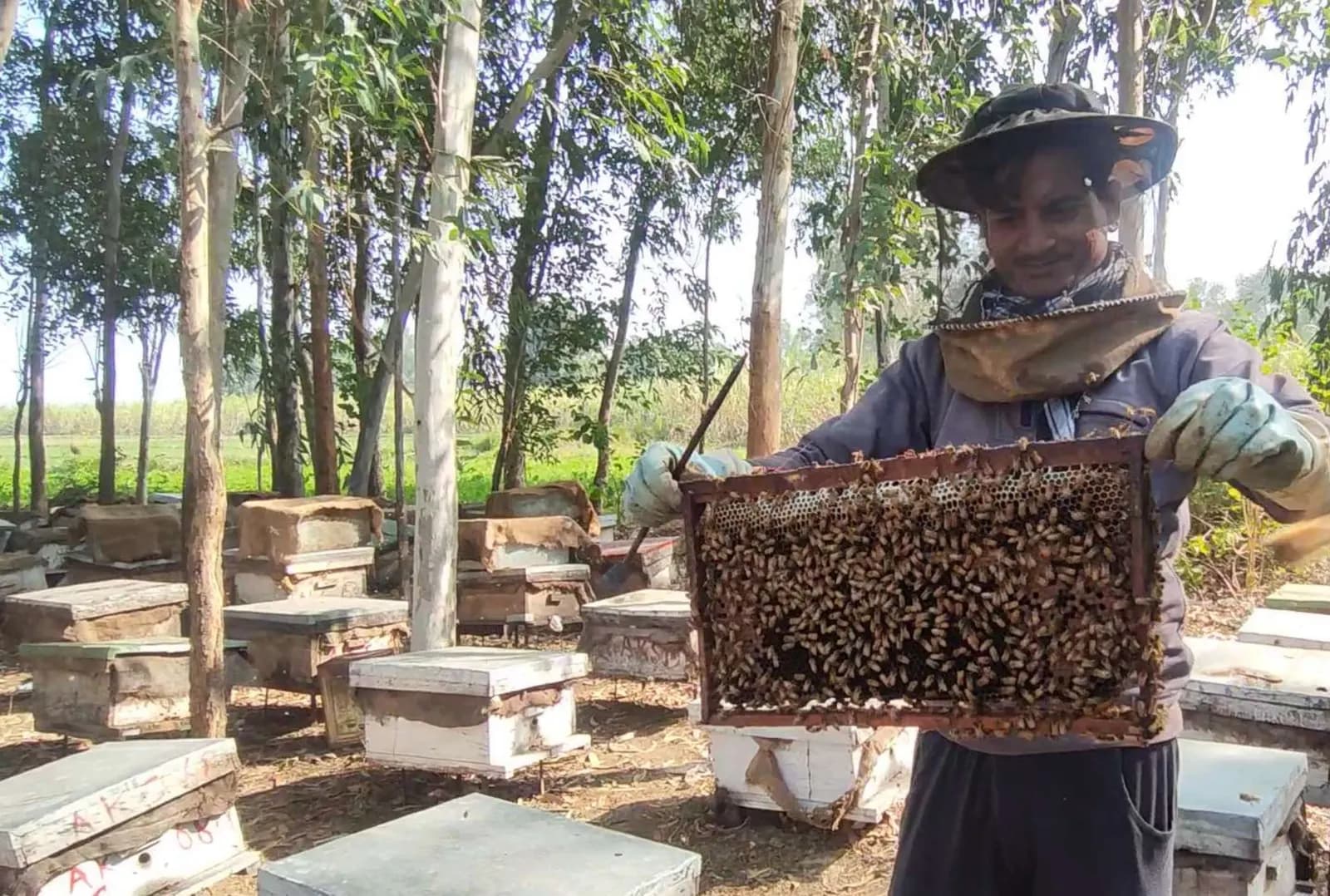
Commercial Italian-bee beekeepers in north India follow a broad annual circuit. Colonies build up on mustard and rapeseed from about December to February in Rajasthan, Haryana, Punjab and UP. Spring brings eucalyptus, berseem and fruit bloom, and many beekeepers move to Bihar for litchi honey in March–April. Sunflower, ajwain and other flows follow in places. The summer heat and monsoon are lean months, when colonies are parked in shade in sub-Himalayan or forest areas and fed sugar syrup. Apple growers in Himachal Pradesh and Jammu & Kashmir hire boxes for pollination in spring.
Migration multiplies yield but brings costs and risks: truck hire, a helper on the road, permission from landowners at each site, and losses from heat stress in transit. Southern beekeepers with Indian bees mostly stay put, harvesting from coconut, rubber, tamarind, coffee and forest flora, and earn more per kilo by selling directly.
MIDH, KVIC and NBHM: what support exists in 2026
MIDH pollination support. Under the Mission for Integrated Development of Horticulture, each state's horticulture mission, or a designated beekeeping agency, gives assistance for honey bee colonies, hives and equipment. The 2025 operational guidelines (Annexure V, item B.11) set these norms:
MIDH beekeeping norms (2025 guidelines)
₹4,000 per unit
Bee box with 8-frame colony
40%, up to 50 colonies
₹2,000 per hive
Empty bee hive
40%, up to 50 colonies
₹20,000 per set
Equipment set incl. 4-frame extractor
40%, one set
₹10 lakh (min. 2,000 colonies a year)
Bee breeder unit
40%, min. 2,000 colonies a year
Worked example. A farmer in Bihar buying 50 colonies, 50 empty hives and one equipment set qualifies for 40% of ₹2,00,000 (colonies), ₹1,00,000 (hives) and ₹20,000 (equipment) — ₹80,000 + ₹40,000 + ₹8,000 = ₹1,28,000 of assistance, if the district has a target and the colonies come from a supplier the state accepts. Many states route this through the horticulture department's beekeeping wing and expect the colonies to be bought from registered bee breeders.
KVIC Honey Mission. The Khadi and Village Industries Commission trains beneficiaries and distributes bee boxes with live colonies and toolkits, mostly to rural youth, tribal families and self-help groups. KVIC says it distributed 2,46,099 bee boxes and colonies between 2017-18 and 2025-26. Selection is through KVIC and state khadi board offices rather than an open portal — see our KVIC schemes guide. For a honey processing and packing unit, a PMEGP loan is the usual route.
National Beekeeping and Honey Mission (NBHM). NBHM is a central sector scheme implemented by the National Bee Board, with an outlay of ₹500 crore for FY 2020-21 to 2025-26. It works through three mini missions — productivity and pollination, post-harvest infrastructure (collection, processing, storage, branding), and research. By March 2025 it had sanctioned 6 large and 47 mini honey testing labs, 26 processing units and 97 beekeeper FPOs. NBHM mostly funds projects by agencies, FPOs, cooperatives and entrepreneurs rather than handing boxes to individuals. The approved period ended with 2025-26; as of October 2026 we found no official notice confirming its continuation or a new outlay, so check with the National Bee Board before building a proposal around it.
Madhukranti registration and fees
The National Bee Board runs the Madhukranti portal (madhukranti.in) for online registration and traceability of honey and other hive products. It asks every beekeeper, society, firm and company producing, processing, packing, marketing or exporting honey to register. As of October 2025 about 14,859 beekeepers, 269 societies, 150 firms and 206 companies had registered. Registration gives you a certificate with your colony count, which state departments, buyers and exporters increasingly ask for, and NBB uses the database for scheme targeting and training.
| Category | Colonies | Total fee (incl. SMS and convenience charges) |
|---|---|---|
| Beekeeper | 10–100 | ₹470 |
| Beekeeper | 101–250 | ₹720 |
| Beekeeper | 251–500 | ₹1,220 |
| Aggregator / trader or processor | — | ₹30,220 |
Larger beekeepers pay more — the chart rises to ₹10,220 for 1,001–2,000 colonies and beyond. The portal also has options to renew an expired registration and to add colonies, so update your record when you split boxes. In October 2026 the portal displayed a notice that certificates were being issued within 15 days while the system was upgraded. Keep your Aadhaar, bank details and a realistic colony count ready; an inflated count can embarrass you when an inspector or buyer checks.
Getting set up, in order. Train for a season first — a course from a KVK, the state horticulture department, an agricultural university or a KVIC centre, followed by a flow spent helping an experienced beekeeper. Then buy healthy colonies from a registered bee breeder or a reputed beekeeper, checking that each box has a laying queen, brood on several frames and no mites or wax moth; if you want MIDH assistance, apply before you buy, because purchases made before approval are usually not covered. Register on Madhukranti with your real colony count, agree apiary sites with farmers for each flow, talk to processors and traders before your first harvest, and take FSSAI registration before you sell packed honey under your own label.
FSSAI honey standards and testing
Honey is one of the most adulterated foods in the market, and its standard has been tightened to catch sugar syrups. FSSAI's standard (regulation 2.8.3 of the food product standards) defines honey as the natural sweet substance produced by honey bees from nectar or plant secretions, and says nothing may be added to honey sold as such. It must meet these key limits:
Key FSSAI purity parameters for honey
| Parameter | Limit |
|---|---|
Moisture | Max 20% |
Sucrose (most honeys) | Max 5% (10% for honeydew and Carvia callosa honey) |
Fructose : glucose ratio | 0.95–1.50 |
HMF (heat and age marker) | Max 80 mg/kg |
C4 sugar (cane/corn syrup) | Max 7% |
Pollen count and plant elements | Min 5,000 per gram |
2-AFGP marker (rice syrup) | Absent |
Foreign oligosaccharides | Max 0.7% peak area |
Moisture
- Limit
Max 20%
Sucrose (most honeys)
- Limit
Max 5% (10% for honeydew and Carvia callosa honey)
Fructose : glucose ratio
- Limit
0.95–1.50
HMF (heat and age marker)
- Limit
Max 80 mg/kg
C4 sugar (cane/corn syrup)
- Limit
Max 7%
Pollen count and plant elements
- Limit
Min 5,000 per gram
2-AFGP marker (rice syrup)
- Limit
Absent
Foreign oligosaccharides
- Limit
Max 0.7% peak area
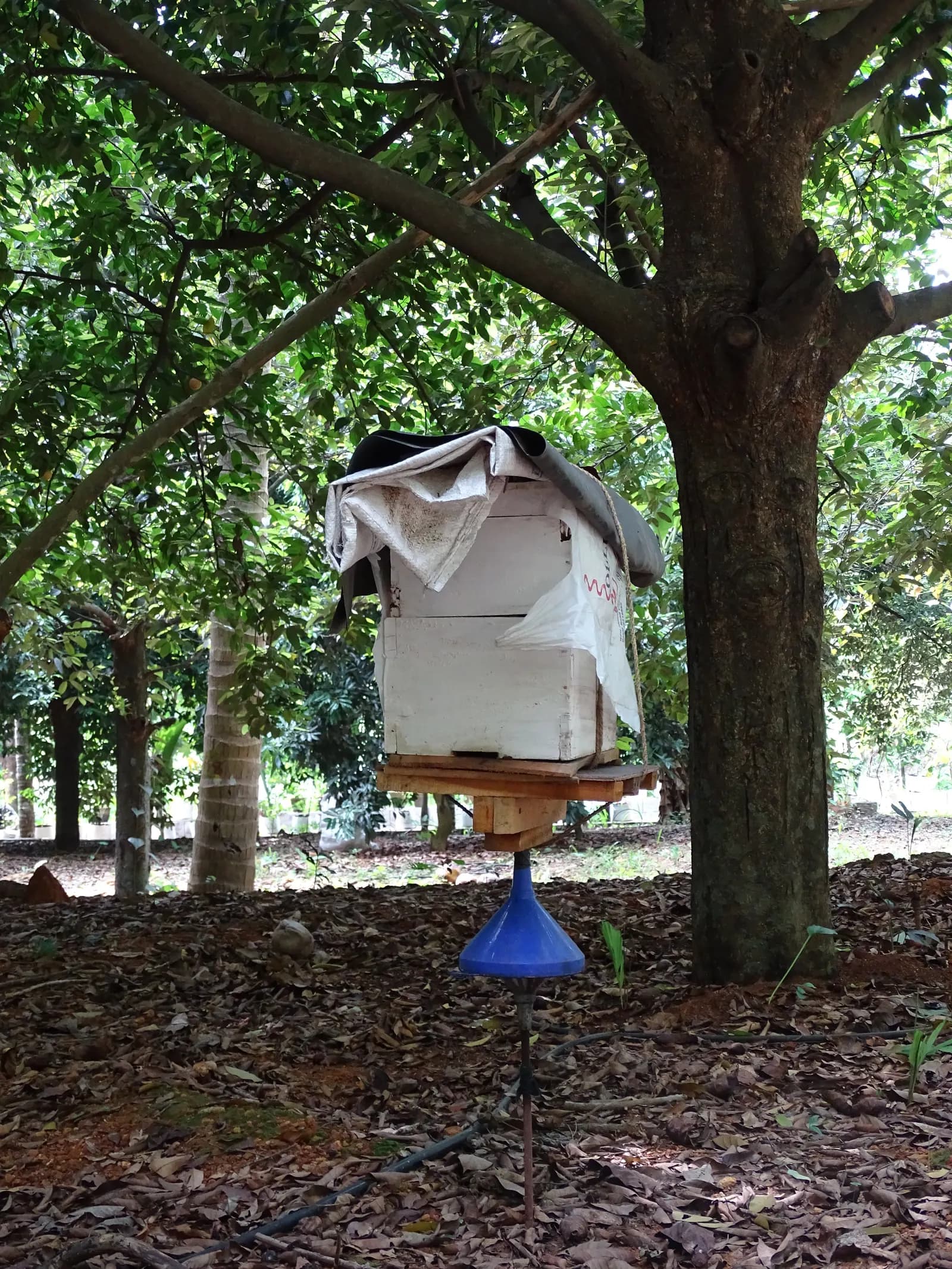
The standard also limits reducing sugars, water-insoluble matter and electrical conductivity, sets isotope-ratio tests that expose added sugars, bans heating honey so far that its essential composition changes, and requires honeydew honey, blends and Carvia callosa honey to be labelled as such. High moisture is the most common reason raw honey from small beekeepers fails — harvest only capped frames, and store honey in clean, food-grade, airtight containers.
FSSAI registration. Packing honey in jars or pouches and selling it under your own label is a food business: you need FSSAI registration — ₹100/year for turnover up to ₹1.5 crore — or a licence above that, plus label declarations under the Legal Metrology rules. Processors and exporters will in any case ask for test reports. NBHM has funded regional and district mini honey testing labs; using one for a pre-sale report on moisture, HMF and C4 sugar costs far less than a rejected lot. See our FSSAI registration guide.
NMR and export testing. Large importers, especially in the United States, screen honey with nuclear magnetic resonance (NMR) profiling to detect syrup adulteration and origin fraud, and Indian exporters have cited NMR testing costs as a burden. Exporters typically ask their supplying beekeepers and aggregators for traceable, registered sources and pay more for honey that clears these tests. If you plan to sell to exporters, expect your lots to be sampled.
GST on honey, beeswax and equipment
Since GST 2.0 took effect on 22 September 2025, honey and hive products are taxed as follows.
GST on honey and hive products (2026)
| Item | HSN | GST |
|---|---|---|
Natural honey, pre-packaged and labelled | 0409 | 5% |
Natural honey, loose or bulk (not pre-packaged and labelled) | 0409 | Nil (exempt) |
Live bee colonies | 0106 | Exempt (live insects) |
Beeswax | 1521 | 5% |
Bee-keeping machinery, e.g. extractors | 8436 | 5% |
Artificial honey | 1702 | 18% |
Natural honey, pre-packaged and labelled
- HSN
0409
- GST
5%
Natural honey, loose or bulk (not pre-packaged and labelled)
- HSN
0409
- GST
Nil (exempt)
Live bee colonies
- HSN
0106
- GST
Exempt (live insects)
Beeswax
- HSN
1521
- GST
5%
Bee-keeping machinery, e.g. extractors
- HSN
8436
- GST
5%
Artificial honey
- HSN
1702
- GST
18%
Packed honey sits in Schedule I of Notification 9/2025-Central Tax (Rate); loose honey and live insects are in the exemption list of Notification 10/2025. The 18% rate on artificial honey is one more reason no genuine beekeeper should blend syrup.
A beekeeper selling only bulk honey and colonies makes exempt supplies and doesn't have to register for GST. Once you sell packed, labelled honey or beeswax and taxable turnover crosses ₹40 lakh in most states (₹20 lakh in some special-category states), registration is compulsory — and exempt sales count toward that aggregate turnover. Registration lets you claim input tax credit on jars, labels and machinery, which matters at 5% output tax. Pollination rental is a service; check its treatment with your adviser if you charge for it at scale.
Exports and the minimum export price
If you grow into an aggregator or exporter, you need an Importer Exporter Code and registration with APEDA, which handles honey — see our APEDA registration guide. Natural honey (HS 04090000) is free to export but subject to a minimum export price of US$1,400 per tonne (FOB). The DGFT first set an MEP of US$2,000 a tonne, cut it to US$1,400 in August 2025, and has extended it several times — most recently, according to published reports of DGFT Notification 09/2026-27 dated 10 April 2026, until 31 December 2026. Check whether it is extended again before signing contracts for 2027 shipments. Most small beekeepers sell to exporters rather than exporting directly.
Worked ₹ plan: 50 Italian bee colonies
Here is a simple beekeeping business plan for a beekeeper in western UP starting with 50 Italian bee colonies, migrating to mustard and one spring flow, selling most honey in bulk and some in jars. All figures are MSMETOOLS estimates based on typical 2026 prices for colonies, equipment, sugar and honey; they are not official figures. Year one is shown after colonies are established.
| Item | One-time set-up (estimate) | Yearly (estimate) |
|---|---|---|
| 50 colonies in boxes at ₹4,000 | ₹2,00,000 | — |
| 25 spare hives for splits at ₹2,000 | ₹50,000 | — |
| Extractor, uncapping knife, containers | ₹20,000 | — |
| Veils, gloves, smokers, feeders, hive tools, stands | ₹20,000 | — |
| Training, Madhukranti, FSSAI, contingency | ₹10,000 | — |
| Total set-up | ₹3,00,000 | |
| Sugar for dearth feeding (10 kg a colony) | ₹22,500 | |
| Migration: truck hire and travel | ₹60,000 | |
| Seasonal helper | ₹60,000 | |
| Comb foundation, queens, medicines | ₹25,000 | |
| Jars, labels, testing | ₹35,000 | |
| Site payments, miscellaneous | ₹15,000 | |
| Total running cost | ₹2,17,500 | |
| Bulk honey: 1,000 kg at ₹150 | ₹1,50,000 | |
| Packed honey: 250 kg at ₹400 | ₹1,00,000 | |
| Sale of 30 split colonies at ₹3,000 | ₹90,000 | |
| Beeswax and pollination rental | ₹26,000 | |
| Profit before owner's labour and loan repayment | ₹1,48,500 |
That is about ₹12,000 a month on average. With MIDH assistance of around ₹1.28 lakh on the set-up, the payback falls to roughly a year. The plan assumes 25 kg of honey per colony; in a bad mustard year yields can halve, which wipes out most of the profit, while a good year with more packed sales can double it. Growth usually comes from keeping the splits rather than selling them: a beekeeper who grows from 50 to 150 colonies over three years, and packs a larger share of honey, earns several times more from the same skills. Test your own numbers with the break-even calculator.
The packed-honey premium. The gap between ₹150 a kilo in bulk and ₹350–450 a kilo in jars is where small beekeepers make their money. Capturing it needs FSSAI registration, a test report, decent labels and steady buyers, so start by packing 10–20% of your crop and grow the share as repeat customers build up.
Before your first season
0/8Common mistakes and how to avoid them
Buying too many colonies too soon. New beekeepers who start with 100 boxes often lose a third in the first summer. Start small, learn swarm control, feeding and pest management, then expand by splitting your own colonies.
Ignoring pesticide schedules. Agree with the farmers around your apiary to warn you before spraying, and avoid placing boxes next to crops sprayed heavily during flowering. A single spray of a systemic insecticide can kill foragers from dozens of boxes.
Harvesting unripe honey. Extracting uncapped honey raises moisture above 20%, causing fermentation and rejection by buyers. Harvest capped frames only.
Feeding sugar during the flow. Sugar fed while supers are on ends up in the honey and shows up in C4 and other tests. Feed only in dearth, and remove supers first.
Skipping registration and records. Madhukranti registration, a colony register, and records of where each lot was harvested make it easier to sell to processors and exporters at better prices.
What to do next
Speak to your district horticulture officer about this year's MIDH beekeeping targets, ask the KVIC or state khadi board office about the Honey Mission, and register on Madhukranti once you have colonies. Build your budget in the startup cost calculator. Bees also pair well with other farm businesses — see our guides to mushroom farming and plant nurseries, and our candle-making guide if you want to turn beeswax into a product.
Official links
- Madhukranti portal (National Bee Board)Register beekeepers, traders and processors
- Madhukranti fee chartSlab-wise registration fees
- MIDH Operational Guidelines 2025 (PDF)Annexure V B.11 — beekeeping norms
- FSSAI honey standard — Chapter 2.8 (PDF)Regulation 2.8.3 purity parameters
- Notification 9/2025-CT(Rate) (PDF)5% on packed honey, beeswax, bee-keeping machinery
- Notification 10/2025-CT(Rate) (PDF)Exemption for loose honey and live insects
This is general information, not legal or tax advice — confirm on the official source or with a professional.
Frequently asked questions
Our estimate for 50 Italian bee (Apis mellifera) colonies with boxes, 25 spare hives, an extractor set, veils, smokers and feeders is about ₹3 lakh in 2026. MIDH's own cost norms are ₹4,000 per unit for a box with an 8-frame colony, ₹2,000 per hive for an empty hive and ₹20,000 per set for an equipment set, with 40% assistance.
Under MIDH, State Horticulture Missions give 40% of the cost norm for bee colonies and hives up to 50 colonies per beneficiary, and for one equipment set. KVIC's Honey Mission distributes bee boxes with colonies and training to selected beneficiaries. The National Beekeeping and Honey Mission funds labs, processing units and FPO projects rather than individual boxes.
The National Bee Board asks every beekeeper, society, firm and company dealing in honey to register on Madhukranti so honey can be traced to its source, and registration is used to identify beneficiaries of beekeeping schemes. The fee depends on colonies: ₹470 for 10–100 colonies and ₹720 for 101–250.
Natural honey that is pre-packaged and labelled attracts 5% GST from 22 September 2025. Natural honey sold loose — not pre-packaged and labelled — is exempt (Nil (exempt)). Live bees are exempt as live insects, beeswax is 5%, and bee-keeping machinery is 5%.
FSSAI's honey standard caps moisture at 20%, sucrose at 5% for most honeys, HMF at 80 mg/kg and C4 sugar at 7%, requires a pollen count of at least 5,000 per gram and a fructose-to-glucose ratio of 0.95–1.50. The rice-syrup marker 2-AFGP must be absent and foreign oligosaccharides can't exceed 0.7%.
It depends on the bee, the flora and whether you migrate. As a planning estimate, Italian bee colonies moved to mustard, litchi, eucalyptus and other flows commonly give 20–35 kg a year; stationary colonies of Indian bees give much less, often under 10 kg. Treat any promise of 50 kg per box with suspicion.
Sources & verification
Figures on this page were checked against the sources below when it was last reviewed on 11 October 2026. Each rate and limit is stored once with its own official source and review date, and official update channels are monitored daily so changes are picked up. How we verify
- 1.MIDH Operational Guidelines 2025 (dated 31.12.2024) — Department of Agriculture & Farmers Welfare (hosted by NHB) · accessed 11 October 2026
- 2.National Beekeeping & Honey Mission — PIB backgrounder (November 2025) — Press Information Bureau · accessed 11 October 2026
- 3.Madhukranti portal — home and fee chart — National Bee Board · accessed 11 October 2026
- 4.FSSAI Compendium — Chapter 2.8 Sweetening agents including honey (Version 1, 01.09.2023) — FSSAI · accessed 11 October 2026
- 5.Notification No. 9/2025-Central Tax (Rate) — Ministry of Finance (Gazette of India) · accessed 11 October 2026
- 6.Notification No. 10/2025-Central Tax (Rate) — Ministry of Finance (Gazette of India) · accessed 11 October 2026
- 7.DGFT extends minimum export price on natural honey to 31 December 2026 — TaxGuru (secondary, reproducing DGFT Notification 09/2026-27) · accessed 11 October 2026
- 8.KVIC celebrates World Bee Day 2026 — Department of Information & Public Relations, Nagaland · accessed 11 October 2026
- 9.India reduces minimum export price for honey — The Tribune (secondary) · accessed 11 October 2026
MSMETOOLS is an independent platform and is not affiliated with any government agency, ministry or department.
Tools for this
Startup Cost Calculator
Estimate how much capital you need to launch.
Break Even Calculator
Find your break even point and units.
Profit Margin Calculator
Calculate profit, markup and margin for your products or services.
Business Plan Generator (US)
Create a professional business plan for US investors and banks.
Related guides
 Plant Nursery Business 2026: Subsidy, Licence & ProfitRead guide
 Mushroom Farming Business 2026: Subsidy, Cost & ProfitRead guide
 Fish Farming Business in India 2026: PMMSY Subsidy & ProfitRead guide
 Transport Business Plan 2026: Permits, GTA GST & Per-km CostRead guide
Official links open the government site in a new tab.