 Starting & growing a business
How to Start a Cleaning Business in the UK: the 2026 Guide
How to start a cleaning business in the UK in 2026: register with HMRC, insurance, COSHH, DBS checks, waste rules, pricing, staff costs and VAT, step by step.
 Edited by Sumeet YadavFounder & editor, MSMETOOLS · fact-checked against official sources
Contents (12)
- 1. Choose your type of cleaning and your customers
- 2. Register your cleaning business
- 3. Health and safety: COSHH, risk assessments and safe working
- 4. Insurance, DBS checks and trust
- 5. Waste carrier registration and commercial waste
- 6. What it costs to start a cleaning business
- 7. How to price your cleaning services
- 8. Finding your first clients
- 9. Taking on staff or subcontractors
- 10. VAT and growing the business
- 11. Common mistakes new cleaning businesses make
- 12. What to do next
A cleaning business is one of the cheapest and quickest businesses to start in the UK. You don't need a licence, a shop or a qualification, and many owners begin with a car, a caddy of products and a handful of regular clients. What separates a business that lasts from one that fizzles out is the groundwork: registering with HMRC on time, pricing so travel and products are covered, the right insurance, and the health and safety rules on chemicals. This guide covers each step for 2026, for domestic, end-of-tenancy and commercial cleaning, with worked examples in pounds.
Quick answer
To start a cleaning business in the UK, register as a sole trader with HMRC (free) or set up a limited company, buy basic equipment, take out public liability insurance, do a COSHH assessment for your products and set prices that cover travel time. No general licence is needed, but you must register as a waste carrier if you take other people's rubbish away.
Sole trader registration is free; register for Self Assessment by 5 October after the end of the tax year you started
Public liability cover is optional by law but expected by most clients; employers' liability is compulsory once you hire staff
Basic DBS check: £20 online (England and Wales)
Waste carrier registration: free if you only carry your own waste, otherwise £191.02 (England)
VAT only once taxable turnover passes £90,000 in a rolling 12 months
Choose your type of cleaning and your customers
Before buying anything, decide what kind of cleaning you'll do, because it shapes your equipment, insurance, pricing and paperwork. The main markets are quite different businesses.
Domestic (regular house cleaning). Weekly or fortnightly visits to private homes. Start-up costs are low, demand is steady and clients often stay for years. The downside is that each visit is short, so travel between homes eats into your day, and you'll handle keys and alarm codes.
End-of-tenancy and deep cleans. One-off, longer jobs for tenants, landlords and letting agents. These pay more per job but the work is lumpy, and agents often expect evidence of insurance, photos and a checklist that matches their inventory.
Commercial and office cleaning. Early-morning or evening contracts for offices, shops, surgeries and schools. Contracts are bigger and more predictable, but you'll be asked for risk assessments, method statements and higher insurance limits, and you'll usually need staff to cover the hours.
Specialist cleaning. Carpets and upholstery, windows, gutters, oven cleaning, pressure washing or after-builders cleans. These need specific machines and often extra training, especially for working at height.
Most people start with domestic cleaning and add higher-value services as they learn. Whatever you choose, test demand first: post in local community groups, ask friends who use a cleaner what they pay, and look at how busy local cleaners seem to be. If you can line up three or four regular clients before you buy equipment, you're starting from a much safer position. Our general guide on how to start a business in the UK covers business planning and testing ideas in more depth.
Starting a cleaning business at a glance
Step 1
Pick your market
Step 2
Register with HMRC
Step 3
Insurance and DBS
Step 4
COSHH and kit
Step 5
Set prices
Step 6
First clients
then staff, VAT and growth
Register your cleaning business
Sole trader or limited company?
Most cleaners start as sole traders. You register with HMRC for Self Assessment, keep records of income and expenses, and file one tax return a year. There's no fee and no Companies House filing. The trade-off is unlimited personal liability, which is one reason insurance matters.
A limited company costs £100 to register online with Companies House and brings annual accounts, a confirmation statement and usually payroll. It can make sense once profits are higher, when you're bidding for larger commercial contracts (some buyers prefer to contract with a company), or if you want to keep business risk separate from your home. Our sole trader vs limited company comparison runs the tax numbers at different profit levels.
Registering with HMRC
As a sole trader you must register for Self Assessment by 5 October after the end of the tax year you started, once your gross trading income passes the £1,000 trading allowance. If you start cleaning in November 2026, that falls in the 2026 to 2027 tax year, so you'd register by 5 October 2027 and file your first online return by 31 January 2028. HMRC posts you a Unique Taxpayer Reference, usually in around 15 days. The sole trader registration guide walks through every screen.
Register even if you're only cleaning a few hours a week alongside a job. Your salary uses up your personal allowance first, so cleaning profit may be taxed from the first pound. Put aside a share of every payment for tax so the first January bill, which may include a payment on account, doesn't come as a shock.
From April 2026, Making Tax Digital for Income Tax applies to sole traders whose qualifying income was over £50,000, falling to £30,000 from April 2027 and £20,000 from April 2028. A new cleaning business won't be caught in its first year, but if you plan to grow beyond about £20,000 of turnover, choose compatible bookkeeping software from the start.
Business name
You can trade under your own name or a business name. A sole trader's business name can't include "Limited" or "Ltd" and mustn't copy an existing business. Check Companies House, the trade mark register and whether the matching website domain and social media handles are free. Our business name generator helps you build a shortlist, and the guide to sole trader business names explains the rules.
Health and safety: COSHH, risk assessments and safe working
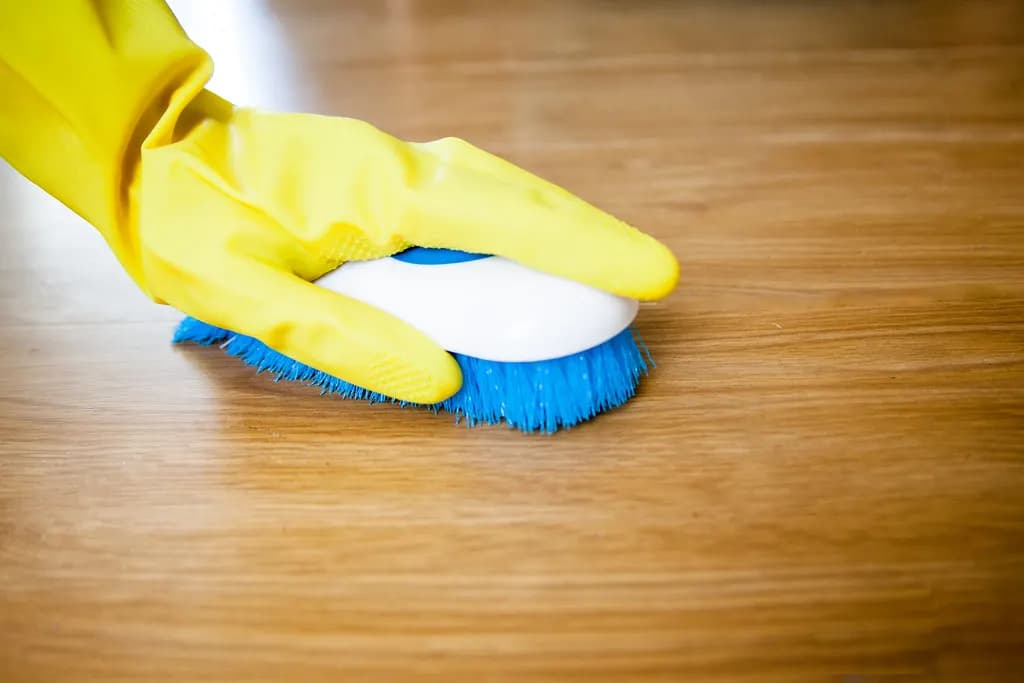
Cleaning products are hazardous substances. Bleach, descalers, oven cleaners and some disinfectants can burn skin and eyes, and mixing products such as bleach and acid-based cleaners can release toxic gas. The Control of Substances Hazardous to Health Regulations (COSHH) require you to assess those risks and control them. The Health and Safety Executive points out the main problems in cleaning: dermatitis from frequent wet work, asthma and allergic reactions from some ingredients, and burns from corrosive products.
A COSHH assessment for a small cleaning business doesn't need to be complicated. List every product you use, read the label and safety data sheet for each, note the hazards, and write down how you control them. Controls usually mean choosing the least hazardous product that does the job, diluting concentrates correctly, ventilating rooms, wearing suitable gloves and eye protection, storing products upright in their original containers, and never decanting chemicals into drinks bottles. If you employ anyone, you must train them on this, and if you have five or more employees, you must write your risk assessments down.
Self-employed cleaners still have duties where their work could put other people at risk, such as clients, children or pets in a home where you're using strong products. Think too about slips on wet floors, manual handling of heavy vacuum cleaners and buckets, lone working, and electrical safety of your equipment. If you clean windows or gutters, working at height is the biggest risk in the trade: use water-fed poles from the ground where possible instead of ladders.
Commercial clients will often ask for your risk assessments and COSHH records before awarding a contract, so keeping them tidy also helps you win work.
Insurance, DBS checks and trust
Insurance for a cleaning business
| Policy | Required by law? | Why cleaners buy it |
|---|---|---|
Public liability | No | Damage to clients' property or injury to others; most clients ask for it |
Employers' liability | Yes, once you employ anyone | Minimum £5 million cover; fine of £2,500 a day if missing |
Business car or van use | Yes, if you drive for work (motor insurance must cover the use) | Social-only policies won't cover driving between clients |
Key cover | No | Pays for new locks if a client's keys are lost |
Equipment cover | No | Theft of vacuums and machines from your vehicle |
Public liability
- Required by law?
No
- Why cleaners buy it
Damage to clients' property or injury to others; most clients ask for it
Employers' liability
- Required by law?
Yes, once you employ anyone
- Why cleaners buy it
Minimum £5 million cover; fine of £2,500 a day if missing
Business car or van use
- Required by law?
Yes, if you drive for work (motor insurance must cover the use)
- Why cleaners buy it
Social-only policies won't cover driving between clients
Key cover
- Required by law?
No
- Why cleaners buy it
Pays for new locks if a client's keys are lost
Equipment cover
- Required by law?
No
- Why cleaners buy it
Theft of vacuums and machines from your vehicle
Insurance
Public liability insurance covers you if you injure someone or damage a client's property, such as staining a carpet or knocking over an expensive vase. It isn't compulsory, but it's the policy most cleaning clients ask about, and letting agents and commercial buyers usually insist on it, often with a minimum limit written into the contract. Our guide to public liability insurance for sole traders explains how limits and excesses work.
Employers' liability insurance is a legal requirement as soon as you employ someone, including part-time and casual cleaners. Cover must be at least £5 million from an authorised insurer, and you can be fined £2,500 for each day you're not covered. The employers' liability guide covers the exemptions.
Other cover worth considering includes key cover (paying for new locks if you lose a client's keys), equipment cover, and business use on your car insurance, because a standard social policy won't cover driving between clients' homes. Cleaning-specific policies often bundle these together.
DBS checks and references
There's no general legal requirement for a domestic cleaner to have a criminal record check, but many clients ask for one, and it's an easy way to build trust. In England and Wales you can apply for a basic DBS check yourself online for £20; you'll need to prove your identity with GOV.UK One Login, and it usually takes up to three days. Scotland (Disclosure Scotland) and Northern Ireland (AccessNI) run their own basic checks.
Collect written references from early clients, and photograph your insurance certificate and DBS certificate so you can send them quickly when a new client asks.
Keys, alarm codes and client data
You'll hold names, addresses, phone numbers, keys and perhaps alarm codes. Keep keys labelled with a code rather than an address, store codes securely and never on the key fob, and agree in writing what happens if keys are lost. Holding personal information electronically usually means paying the ICO data protection fee, which is £52 a year for a micro business, unless the ICO's self-assessment says you're exempt.
Before your first paid clean
0/8Waste carrier registration and commercial waste
This is the rule most new cleaners miss. If your business transports waste, you must register as a waste carrier. In England you register with the Environment Agency: registration is usually free (lower tier) if you only carry waste you produce yourself, and otherwise costs £191.02 for an upper tier registration, renewed every three years for £130.25. You can get an unlimited fine if you should have registered and didn't. Wales, Scotland and Northern Ireland have separate registers run by Natural Resources Wales, SEPA and DAERA.
When does this affect a cleaner? Taking a bag of rubbish from an end-of-tenancy clean to the tip, clearing out a garage, or removing builders' dust and offcuts after an after-builders clean can all count. If you never take anything away and leave waste in the client's bins, you may not need to register, but check with the regulator if you're unsure.
If you clean commercial premises in England, be aware of Simpler Recycling. Workplaces with 10 or more full-time-equivalent staff have had to separate dry recycling, food waste and general waste since 31 March 2025, and micro-firms must do so by 31 March 2027. The legal duty sits with your client, but your cleaning routine needs to keep those streams separate, so ask how their bins are arranged before you quote.
What it costs to start a cleaning business
The start-up cost depends heavily on the type of cleaning. The figures below are our estimates for a solo cleaner who already owns a car and a phone, based on typical UK retail and online prices for equipment and products in 2026. They're not official figures; get your own quotes.
| Item | Domestic cleaning (estimate) | Commercial or specialist (estimate) |
|---|---|---|
| Vacuum cleaner, mop system, buckets, cloths, caddy | £150 – £400 | £400 – £3,000+ (commercial vacuums, carpet machines, water-fed poles) |
| First stock of cleaning products | £50 – £120 | £100 – £300 |
| Public liability insurance (first year) | £60 – £200 | £150 – £500+ |
| Basic DBS check | £20 | £20 per person |
| Leaflets, simple website, business cards | £50 – £250 | £100 – £500 |
| ICO data protection fee (if required) | £52 a year | £52 a year |
| Rough total | £350 – £1,050 | £800 – £4,500+ |
If money is tight, start with domestic cleaning, ask clients to supply bulky items such as their own vacuum, and reinvest early profits. If you need funding, a government-backed Start Up Loan offers £500 to £25,000 at 7.5% fixed, with free mentoring. The startup cost calculator helps you add up one-off and monthly costs.
Expenses such as products, equipment, insurance, phone and business mileage are allowable against your profit. You can claim mileage at 55p a mile for the first 10,000 business miles instead of actual car costs if you use the simplified method. Our allowable expenses guide lists what you can and can't claim.
How to price your cleaning services
Underpricing is the most common reason cleaning businesses fail. Your hourly rate has to cover not just your time in the client's home but travel between jobs, products, insurance, admin, holidays, sick days and tax.
A worked example
Say you plan to work 30 hours a week cleaning, with 6 hours of unpaid travel and admin on top, for 46 weeks a year (leaving six weeks for holidays, bank holidays and illness). You want to earn £22,000 a year before tax, and you expect business costs of £3,000 a year for products, insurance, mileage and phone.
That's £25,000 to recover from 30 × 46 = 1,380 billable hours, or about £18.10 an hour. If you charge less than that, either your income or your time off has to give. If you charge more, you build a buffer for quiet weeks and cancellations. Use the hourly rate calculator to try your own numbers and the break-even calculator to see how many regular clients you need.
Work out your cleaning hourly rate
Pricing models that work
- Hourly rate suits regular domestic cleans. Set a minimum visit length, often two or three hours, so short jobs are worth the travel.
- Fixed price per job suits end-of-tenancy and deep cleans. Quote by property size and condition, and photograph the property before and after.
- Monthly contract price suits commercial work. Build in a price review clause each year, because wage rates and product costs rise.
Put cancellation terms in writing. A common approach is charging in full for cancellations with less than 24 or 48 hours' notice, because you can't usually fill that slot. Send proper invoices from day one; the free invoice generator and our guide to sole trader invoices cover what to include.
Finding your first clients
Local reputation drives a cleaning business, so most clients come from nearby. Effective, low-cost routes include:
- A Google Business Profile with your service area, photos and early reviews.
- Local community groups and noticeboards, both online and in shops, libraries and community centres.
- Leaflets through doors in the streets where you already have clients, so new work clusters and travel time falls.
- Letting agents and landlords for end-of-tenancy work, who often need reliable cleaners at short notice.
- Small offices, surgeries and shops for commercial contracts; a polite visit with a written quote and your insurance certificate goes a long way.
Ask every happy client for a review and a referral. Route planning matters too: grouping clients by area can save hours each week, which is pure profit.

Taking on staff or subcontractors
When you have more work than hours, you can employ cleaners or use self-employed subcontractors. Both routes have rules.
Employing cleaners
Before the first payday you must register as an employer with HMRC and run payroll. You must pay at least the National Living Wage of £12.71 an hour for workers aged 21 and over, check every worker's right to work, arrange employers' liability insurance, give holiday pay and enrol eligible staff in a workplace pension.
Travel time is the trap. For minimum wage purposes, time a worker spends travelling between assignments, such as driving from one client's home to the next, counts as working time. Travel from home to the first job and from the last job home usually doesn't. If you pay cleaners only for time inside clients' homes, their average hourly pay can fall below the legal minimum once travel is added, and HMRC can order arrears and penalties. Build travel into your rotas and pay. Our National Minimum Wage guide covers the rates and the record-keeping rules.
Employing cleaners vs using self-employed cleaners
| Employees | Genuinely self-employed | |
|---|---|---|
Minimum wage | At least £12.71 an hour (21+), including travel between jobs | Not applicable — they set their own prices |
Payroll and PAYE | Yes — register as an employer | No — they file their own Self Assessment |
Holiday pay and pension | Yes | No |
Employers' liability insurance | Compulsory | They should hold their own public liability cover |
Control over how and when they work | You decide | They decide; they can send a substitute |
Minimum wage
- Employees
At least £12.71 an hour (21+), including travel between jobs
- Genuinely self-employed
Not applicable — they set their own prices
Payroll and PAYE
- Employees
Yes — register as an employer
- Genuinely self-employed
No — they file their own Self Assessment
Holiday pay and pension
- Employees
Yes
- Genuinely self-employed
No
Employers' liability insurance
- Employees
Compulsory
- Genuinely self-employed
They should hold their own public liability cover
Control over how and when they work
- Employees
You decide
- Genuinely self-employed
They decide; they can send a substitute
Using self-employed cleaners
Some cleaning firms work with self-employed cleaners instead. That only holds up if the cleaners are genuinely in business on their own account: they can choose which jobs to accept, set their own methods, use their own equipment and send a substitute. If you set their hours, supply everything and control how they work, they may be employees or workers in law, whatever your agreement says, which brings minimum wage, holiday pay and payroll duties. HMRC's Check Employment Status for Tax tool helps you test it.
VAT and growing the business
You must register for VAT once your taxable turnover goes over £90,000 in any rolling 12-month period. Cleaning services are standard-rated at 20%. Most household clients can't reclaim VAT, so crossing the threshold usually means raising prices by a fifth or accepting a lower margin. Commercial clients who are VAT-registered can reclaim it, so a business focused on offices feels the change much less.
A solo cleaner charging around £18 an hour is unlikely to reach the threshold. A firm with three or four cleaners can reach it quickly. Check your rolling 12-month turnover at the end of every month, not just at the tax year end, and read our VAT registration guide and the VAT Flat Rate Scheme guide before you get close.
Once you're established, growth usually comes from adding higher-margin services, winning a few anchor commercial contracts, or employing a small team while you move into quoting, quality checks and admin. Keep careful records of hours, mileage and product use per client; they show which clients are actually profitable.
Common mistakes new cleaning businesses make
- Pricing on a competitor's rate without checking your own costs. Work out what you need per hour first.
- Forgetting travel time. It shrinks your income and, for staff, can lead to minimum wage breaches.
- No written terms. Agree price, cancellations, keys, breakages and what's included before the first visit.
- Skipping COSHH. Mixing products, decanting chemicals or skipping gloves causes real injuries.
- Taking rubbish away without waste carrier registration. It's a common way cleaners break the law without knowing.
- Not setting tax aside. The first Self Assessment bill catches many new cleaners out.
- Treating staff as self-employed when they're not. The cost of getting employment status wrong can be large.
Official GOV.UK and regulator links
- Register for Self AssessmentSole traders
- Register as a waste carrier (England)Free lower tier or £191.02 upper tier
- COSHH and cleanersHSE guidance on cleaning chemicals
- Request a basic DBS check£20, England and Wales
- Employers' liability insuranceCompulsory once you employ staff
- Minimum wage for different types of workTravel time between jobs
- Register for VATThreshold £90,000
- Pay the data protection feeICO
What to do next
Decide your market, register with HMRC and arrange public liability insurance before your first paid clean. Then write your COSHH assessment, work out your hourly rate with the hourly rate calculator and send your first invoice with the invoice generator. If you're weighing up a company structure, start with the sole trader vs limited company comparison.
This is general information, not legal or tax advice — confirm on the official source or with a professional.
Frequently asked questions
No general licence is needed for domestic or office cleaning. You register with HMRC as self-employed (or set up a company), and you follow health and safety law, including COSHH for chemicals. If you take away clients' rubbish or other people's waste in your vehicle, register as a waste carrier with the Environment Agency or your nation's regulator first.
Registering as a sole trader is free. Our estimate for a solo domestic cleaner is roughly £300 to £1,000 for equipment, products, insurance and simple marketing, assuming you already have a car. Commercial or specialist cleaning, such as carpets or high-level windows, needs more expensive machines. These are estimates, not official figures; get your own quotes.
It isn't a legal requirement for most private domestic cleaning, but many clients and agencies ask for one. Self-employed cleaners in England and Wales can apply for a basic DBS check online for £20, and it usually arrives within a few days. Scotland and Northern Ireland have their own basic disclosure services.
No, public liability insurance isn't required by law, but most commercial clients, letting agents and many households will ask for it before you start. Employers' liability insurance is compulsory once you employ staff, with cover of at least £5 million and a fine of up to £2,500 for each day you're not covered.
Only when your taxable turnover goes over £90,000 in any rolling 12 months. Most solo domestic cleaners stay below it. Because household clients can't reclaim VAT, crossing the threshold usually means a price rise or lower margin, so watch your rolling total every month as you add staff.
Yes. Most cleaning businesses are run from home because the work happens at clients' premises. Using a room as an office rarely affects Council Tax or business rates, but storing large amounts of chemicals or equipment may affect your home insurance, so tell your insurer and check your tenancy or mortgage terms.
Sources & verification
Figures on this page were checked against the sources below when it was last reviewed on 13 October 2026. Each rate and limit is stored once with its own official source and review date, and official update channels are monitored daily so changes are picked up. How we verify
- 1.Set up a business — GOV.UK · accessed 13 October 2026
- 2.Register as a waste carrier, broker or dealer (England) — Environment Agency / GOV.UK · accessed 13 October 2026
- 3.COSHH and cleaners — key messages — Health and Safety Executive · accessed 13 October 2026
- 4.How to carry out a COSHH risk assessment — Health and Safety Executive · accessed 13 October 2026
- 5.Request a basic DBS check — GOV.UK / Disclosure and Barring Service · accessed 13 October 2026
- 6.Minimum wage for different types of work — GOV.UK · accessed 13 October 2026
- 7.NMWM08300 — Working time: time work: travelling time — HMRC · accessed 13 October 2026
- 8.Employers' liability insurance — GOV.UK · accessed 13 October 2026
- 9.Register for VAT — HMRC / GOV.UK · accessed 13 October 2026
- 10.Guide to the data protection fee — Information Commissioner's Office · accessed 13 October 2026
- 11.Simpler Recycling: workplace recycling in England — Defra / GOV.UK · accessed 13 October 2026
MSMETOOLS is an independent platform and is not affiliated with any government agency, ministry or department.
Tools for this
Freelance Hourly Rate Calculator
Work out the hourly rate you need to charge.
Startup Cost Calculator
Estimate how much capital you need to launch.
Invoice Generator
Create professional invoices with tax, logo and custom details.
Break Even Calculator
Find your break even point and units.
Related guides
 How to Start a Business in the UK (2026): 10 StepsRead guide
 How to Start a Cafe in the UK (2026): Licences, Costs & StepsRead guide
 How to Start an Online Shop in the UK (2026): Rules & StepsRead guide
 Starting a Food Business From Home in the UK (2026 Rules)Read guide
Official links open the government site in a new tab.