 GST & indirect tax
HSN Code for Cement and GST on Cement in 2026
HSN code for cement (2523) with OPC, PPC, white cement and clinker sub-codes, the 2026 GST rate after the cut to 18%, ITC for builders and a per-bag ₹ example.
 Edited by Sumeet YadavFounder & editor, MSMETOOLS · fact-checked against official sources
Contents (8)
- 1. HSN code for cement: 2523 and its sub-codes
- 2. How many HSN digits to put on a cement invoice
- 3. GST rate on cement: 28% to 18% under GST 2.0
- 4. Worked example: GST per bag and per project
- 5. Who can claim ITC on cement — dealers, contractors and builders
- 6. Cement and construction services: how the rates interact
- 7. Common mistakes on cement invoices
- 8. What to do next
Cement is one of the few building materials whose GST changed sharply under GST 2.0: the rate fell from 28% to 18% on 22 September 2025. This guide is for cement dealers, contractors, builders, precast and RMC units, and anyone building a house who wants to read a cement bill correctly. It gives the HSN code for cement and every sub-code (OPC, PPC, slag, white cement, clinker), how many digits you must show on an invoice, the current rate, who can claim input tax credit, and a per-bag ₹ example. Rates were checked against the GST Council's notifications in October 2026.
Quick answer
The HSN code for cement is 2523. Grey Portland cement (OPC, PPC, PSC) sits under 2523 29, white cement under 2523 21 00 and clinker under 2523 10 00. All of them attract 18% GST from 22 September 2025, down from 28%.
Invoice digits: 4-digit HSN (2523) if turnover is up to ₹5 crore; 6-digit HSN (e.g. 2523 29) above that
Intra-state: 9% CGST + 9% SGST; inter-state: 18% IGST
Dealers, works contractors and RMC/precast makers can claim the GST as ITC
Builders selling flats at 5% without ITC or 1% without ITC cannot — the cut lowers their cost directly
HSN code for cement: 2523 and its sub-codes
HSN heading 2523 covers "Portland cement, aluminous cement, slag cement, super sulphate cement and similar hydraulic cements, whether or not coloured or in the form of clinkers". Under India's 8-digit tariff the heading breaks down like this:
| Tariff item | Description | Common trade name | GST |
|---|---|---|---|
| 2523 10 00 | Cement clinkers | Clinker | 18% |
| 2523 21 00 | White cement, whether or not artificially coloured | White cement | 18% |
| 2523 29 10 | Ordinary Portland cement, dry | OPC 33/43/53 grade | 18% |
| 2523 29 20 | Ordinary Portland cement, coloured | Coloured OPC | 18% |
| 2523 29 30 | Portland pozzolana cement | PPC (fly-ash based) | 18% |
| 2523 29 40 | Portland slag cement | PSC | 18% |
| 2523 29 90 | Other Portland cement | e.g. composite cement | 18% |
| 2523 30 00 | Aluminous cement | Calcium aluminate cement | 18% |
| 2523 90 10 | Sagol, ashmoh | — | 18% |
| 2523 90 20 | High alumina refractory cement | Refractory cement | 18% |
| 2523 90 90 | Other hydraulic cements | — | 18% |
Because the 56th GST Council moved the whole of heading 2523 from 28% to 18%, the sub-code no longer changes the rate. It still matters for your GSTR-1 HSN summary, for e-way bills and for exports and imports, where customs duty does vary by tariff item.
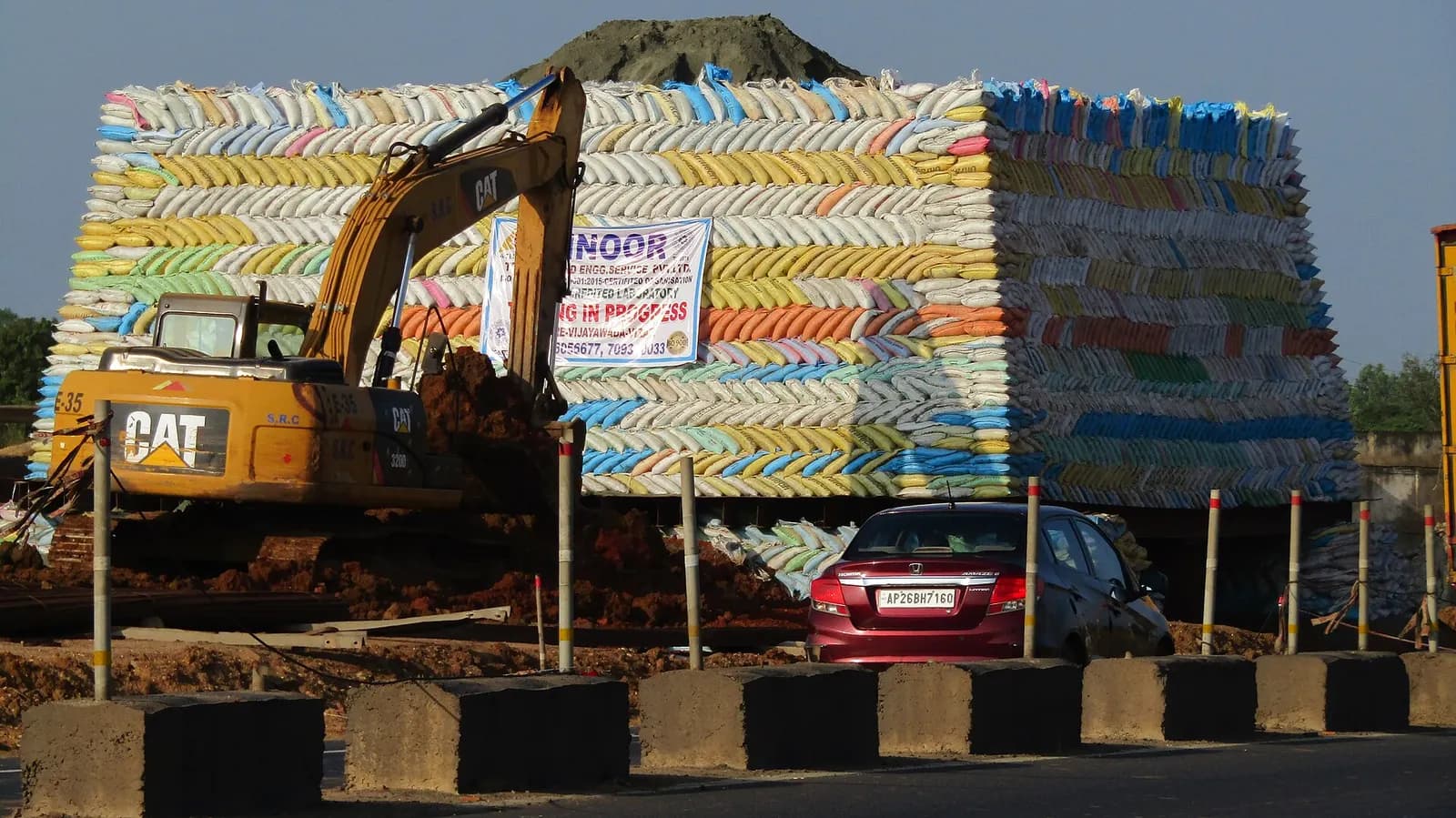
Cement bags. A bag of cement is billed under 2523 — the bag is packing. Empty bags are a different product: woven polypropylene sacks generally fall under heading 6305 and paper sacks under 4819, each with its own rate. Look them up in the HSN code finder.
How many HSN digits to put on a cement invoice
The number of digits depends on your aggregate turnover in the previous financial year, not on the product:
- Up to ₹5 crore: at least a 4-digit HSN — write 2523.
- Above ₹5 crore: at least a 6-digit HSN — 2523 29 for grey cement, 2523 21 for white cement, 2523 10 for clinker.
- Exports and imports: the full 8-digit tariff item on the shipping bill or bill of entry.
Since the May 2025 return period, Table 12 of GSTR-1 accepts HSN only from a drop-down list, split into B2B and B2C tabs — see our GSTR-1 guide. A dealer selling ₹1 crore of PPC a year would therefore report "2523" in Table 12; a manufacturer with ₹500 crore turnover would report "252329".
Moving cement in a truck? A consignment above ₹50,000 needs an e-way bill, and the HSN on it must match the invoice.
GST rate on cement: 28% to 18% under GST 2.0
Cement GST at a glance (2026)
18%
GST on cement (HSN 2523)
from 22 Sep 2025
28%
Rate until 21 Sep 2025
≈ 7.8%
Fall in a GST-inclusive price
if the base price is unchanged
Nil
Compensation cess on cement
Cement was in the top 28% slab from the launch of GST on 1 July 2017, alongside luxury goods — an anomaly for a basic building material. The 56th GST Council meeting (3 September 2025) recommended moving heading 2523 to the standard rate of 18%, and the change took effect on 22 September 2025 along with the rest of GST 2.0.
The cut covers clinker too, which matters for grinding units that buy clinker from integrated plants: their input and output now sit at the same 18%, so there's no credit build-up.
Bills raised around the rate change. For transactions straddling 22 September 2025 — say an advance paid in August for cement delivered in October — section 14 of the CGST Act decides the rate by comparing the dates of supply, invoice and payment, and the answer isn't always the new rate. If you have such a transaction still open, work it through with your accountant. For any fresh supply today, charge 18%.
How the bill splits:
- Dealer in Jaipur selling to a mason in Jaipur: 9% CGST + 9% SGST.
- Plant in Rajasthan selling to a dealer in Gujarat: 18% IGST.
Worked example: GST per bag and per project
From MRP to GST — one 50 kg bag of PPC
- 1
Start from the base price
Say the price before tax is ₹296.88 a bag. At the old 28% the GST was ₹83.12, so the bag sold at ₹380.
- 2
Apply the new rate
At 18%, GST on the same ₹296.88 is ₹53.44 — 9% CGST ₹26.72 + 9% SGST ₹26.72.
- 3
New GST-inclusive price
₹296.88 + ₹53.44 = ₹350.32. The buyer saves about ₹29.68 a bag (≈ 7.8%) if the base price stays the same.
Tip: To pull GST out of an inclusive price: GST = price × 18 ÷ 118. For ₹350.32 that gives ₹53.44.
- 4
Scale it to a project
A small house that uses 400 bags would save about 400 × ₹29.68 ≈ ₹11,872 in GST on cement alone.
Real prices move with brand, region and season, so the numbers above show the arithmetic, not a market price. Estimate how many bags you need with the concrete calculator, then check any rate with the GST calculator.
Who can claim ITC on cement — dealers, contractors and builders
The GST you pay on cement is only a cost if you can't claim it back as input tax credit.
| Buyer | Can claim ITC on cement? | Why |
|---|---|---|
| Cement dealer / distributor | Yes | Resells the same goods; output tax 18% |
| Works contractor billing 18% with ITC | Yes | Section 17(5)(c) allows credit when the output is itself a works contract service |
| RMC plant, precast, block or pipe maker | Yes | Cement is an input for taxable goods |
| Builder selling flats at 5% without ITC or 1% without ITC | No | Those rates come without ITC |
| Business building its own office or factory shed | No | Section 17(5)(d) blocks ITC on goods for constructing immovable property on own account (plant and machinery excepted) |
| Individual building a house | No | Not registered; GST is a final cost |
Example — dealer. A dealer buys 500 bags at ₹300 each (base) and pays ₹27,000 GST. He sells them at ₹330 each and charges ₹29,700 GST. He sets off the ₹27,000 credit and pays ₹2,700 in cash in his GSTR-3B.
Example — builder. A developer building under-construction flats buys the same 500 bags. The ₹27,000 GST can't be claimed; it becomes part of the project cost. That is why the cut from 28% helps builders and homebuyers most directly: at the old rate the same purchase carried ₹42,000 of unrecoverable tax.

Cement and construction services: how the rates interact
Residential projects. Since 1 April 2019, new residential projects pay GST at 1% without ITC on affordable homes (carpet area up to 60 sq m in metros or 90 sq m elsewhere, and value up to ₹45 lakh) and 5% without ITC on other homes, both without ITC. GST 2.0 didn't change these rates. Ready flats sold after the completion certificate attract no GST at all.
80% rule and cement from unregistered dealers. A promoter under these rates must buy at least 80% of inputs and input services from registered suppliers, or pay tax at 18% on the shortfall under reverse charge. Cement is treated more strictly: cement bought from an unregistered person is taxed under reverse charge in the month of receipt, whatever the 80% calculation shows (Notification 07/2019-CT(Rate)). So always buy cement against a proper GST invoice.
Works contracts. A contractor who builds for a client under a composite works contract generally charges 18% with ITC, so the cement cut lowers his cost but not his output rate. Certain government and specified works contracts have separate entries in Notification 11/2017-CT(Rate); check the current entry before you quote.
Cement products. Products made from cement have their own HSN codes and rates — for example articles of cement or concrete (blocks, pipes, tiles, poles) under heading 6810, and ready-mix concrete under 3824 50 10. Sand-lime bricks were cut from 12% to 5% in the same reform. Don't bill a concrete block as "cement".
Common mistakes on cement invoices
Before you raise a cement invoice
0/6What to do next
Update the rate and HSN in your billing software, then raise compliant bills with our invoice generator. If you're a contractor or dealer, make sure every cement purchase shows up in your GSTR-2B before you claim credit. New to GST? Start with our plain-English guide to what GST is.
This is general information, not legal or tax advice — confirm on the official source or with a professional.
Frequently asked questions
Cement falls under HSN heading 2523. In GST invoices, businesses with turnover up to ₹5 crore can use the 4-digit code 2523; larger businesses need at least 6 digits — 2523 29 for grey Portland cement (OPC, PPC, PSC), 2523 21 for white cement and 2523 10 for clinker. Exporters and importers use the full 8-digit tariff item, such as 2523 29 30 for Portland pozzolana cement.
Cement under HSN 2523 — OPC, PPC, slag cement, white cement, aluminous cement and clinker — attracts 18% GST. The rate was cut from 28% to 18% with effect from 22 September 2025 on the recommendation of the 56th GST Council. Within a state the bill shows 9% CGST and 9% SGST; inter-state sales carry 18% IGST.
Bags of cement use the cement code, 2523, because the bag is just packing. Empty bags are classified separately by material: woven polypropylene sacks are usually under heading 6305, and paper sacks under heading 4819. Check the exact entry and rate in the HSN code finder before invoicing empty bags.
A builder selling flats at the 5% without ITC or 1% without ITC rates cannot claim input tax credit, and section 17(5)(d) blocks ITC on cement used to construct your own building. A works contractor who bills a client 18% with ITC, a cement dealer and a precast or RMC manufacturer can claim the 18% GST on cement as credit.
White cement, whether or not artificially coloured, is classified under tariff item 2523 21 00. It attracts the same 18% GST as grey cement since 22 September 2025. Wall putty and other prepared finishing materials are not cement and are classified under their own headings.
Yes. The price of every bag already includes 18% GST, and an individual building a home can't claim it back because they aren't registered and the house isn't a taxable supply. The September 2025 cut from 28% therefore lowers your cost directly — roughly ₹30 a bag on a ₹380 bag if the dealer passes it on in full.
Sources & verification
Figures on this page were checked against the sources below when it was last reviewed on 7 October 2026. Each rate and limit is stored once with its own official source and review date, and official update channels are monitored daily so changes are picked up. How we verify
- 1.Recommendations of the 56th GST Council meeting (PIB press release with rate annexures) — GST Council / PIB · accessed 7 October 2026
- 2.Reporting of HSN codes in Table 12 of GSTR-1/1A (updated advisory) — GSTN · accessed 7 October 2026
- 3.ITC HS codes under heading 2523 — EximGuru · accessed 7 October 2026
- 4.Cement HSN code 2523: GST and import duty — EximPe · accessed 7 October 2026
- 5.Promoter's liability under reverse charge mechanism — TaxGuru · accessed 7 October 2026
- 6.GST on real estate and under-construction property in India (2026) — TaxGarden · accessed 7 October 2026
- 7.Section 17 – CGST Act, 2017 (apportionment of credit and blocked credits) — CBIC · accessed 7 October 2026
MSMETOOLS is an independent platform and is not affiliated with any government agency, ministry or department.
Tools for this
HSN Code Finder (India)
Find the correct HSN/SAC code for your product.
Construction Material Calculator
Estimate cement, sand and aggregate for slabs.
GST Calculator (India)
Calculate GST for your sales and purchases with current rates.
Invoice Generator
Create professional invoices with tax, logo and custom details.
Related guides
 How to Calculate GST in 2026: Formulas, Slabs & ExamplesRead guide
 GST on Painting & Works Contract 2026: 18% Rate, SAC & ITCRead guide
 GST on Bricks 2026: 6% vs 12%, Fly Ash & AAC Block RatesRead guide
 HSN Code for Corrugated Box & GST on Packaging 2026Read guide
Official links open the government site in a new tab.