 Finance & accounting
Quotation Format in 2026: What to Include, How to Show GST, and How to Make One in Excel or Word
Quotation format for 2026: the fields every quote needs, how to show GST, validity and payment terms, plus an Excel/Word walkthrough and a worked ₹ example.
 Edited by Sumeet YadavFounder & editor, MSMETOOLS · fact-checked against official sources
Contents (8)
- 1. What a quotation is — and when it binds you
- 2. Quotation format: the fields every quote should carry
- 3. How to show GST on a quotation
- 4. Validity, payment and other terms that protect you
- 5. How to make a quotation format in Excel or Word
- 6. Worked example: a GST quotation in ₹
- 7. Common quotation mistakes and how to avoid them
- 8. What to do next
A buyer sends an enquiry, and you have a day to reply with a price. What you send back — the quotation — decides whether you win the order, whether the buyer's accounts team can process it, and what you're held to if costs rise next month. This guide is for Indian manufacturers, traders, contractors and service businesses who quote regularly. It covers the fields a professional quotation should contain, how to show GST without creating confusion, validity and payment terms, when a quote becomes legally binding, and how to build a reusable quotation format in Excel or Word, with a worked ₹ example. GST and contract-law points were checked against the CGST Act and Rules and the Indian Contract Act in October 2026.
Quick answer
There is no government-prescribed quotation format in India. A good quotation shows your name, address and GSTIN, a quotation number and date, the buyer's details, a 'valid until' date, each item with HSN/SAC, quantity, rate, discount and taxable value, the GST rate and amount, the total, and clear payment and delivery terms, then a signature.
A quotation is not a GST document — no tax is due when you send it
GST is charged on the tax invoice, at the rate in force at the time of supply
Under the Contract Act, a quote lapses when its stated validity runs out
Composition dealers must not show GST on quotations
Free tool: build and download a GST quotation with the quotation generator
What a quotation is — and when it binds you
A quotation is a written statement of the price and terms on which you're willing to supply goods or services. Indian law doesn't define the word, and the CGST Act doesn't recognise it as a tax document: section 31 lists the tax invoice, bill of supply, receipt voucher, refund voucher and payment voucher, and a quotation isn't among them. Its legal weight comes from the Indian Contract Act, 1872.
Offer or invitation? Under section 2(a) of the Contract Act, a proposal is made when you signify your willingness to do something with a view to obtaining the other side's assent. A detailed quotation addressed to one buyer — fixed items, fixed prices, delivery date, payment terms, validity — usually reads as a proposal. A general price list or a rough budgetary figure usually reads as an invitation for the buyer to make an offer, typically by purchase order. Which one your document is depends on its wording and how specific it is, so if you don't want to be bound, say so: "budgetary estimate, subject to final confirmation".
From enquiry to invoice
Step 1
Buyer's enquiry / RFQ
Step 2
Your quotation
offer, with validity
Step 3
Purchase order
acceptance or counter-offer
Step 4
Advance + receipt voucher
if agreed
Step 5
Tax invoice
GST charged here
When the contract forms. Section 7 requires acceptance to be absolute and unqualified. A purchase order that repeats your quotation's terms is an acceptance, and a contract exists. A purchase order that changes the price, quantity, payment period or delivery date is a counter-offer; nothing binds you until you accept it, in writing or by conduct such as dispatching the goods. Read every PO against your quote before you act on it — our purchase order guide explains what to check.
Withdrawing a quote. Section 5 lets you revoke a proposal at any time before the buyer's acceptance is communicated to you, but not afterwards. Section 6 adds that a proposal lapses automatically when the time it prescribes for acceptance runs out — or, if it prescribes none, after a reasonable time. That's why a printed "valid until" date matters: it ends your exposure without any argument about what was reasonable. One regional twist: Uttar Pradesh amended section 5 so that, where an invitation (such as a tender) requires bids to stay open for a fixed period and you bid on that condition, you can't revoke your bid within that period.
Quotation format: the fields every quote should carry
Fields a professional quotation should have
0/12Most of these fields mirror what will later appear on your tax invoice under Rule 46 of the CGST Rules. That's deliberate. If the quotation already carries the correct HSN code, place of supply and tax split, the buyer's accounts team can raise a matching purchase order, and your invoice will reconcile with it line by line.
Quotation number. Unlike invoice numbers, quotation numbers aren't regulated, but a series such as KSF/Q/26-27/0087 lets you trace revisions and link the eventual PO and invoice. When you revise a quote, issue 0087-R1 rather than overwriting the original, so both sides know which version the order refers to.
Description and units. Describe goods precisely enough that nobody can argue later about what was priced — size, grade, make, finish. Express quantities in standard units. Section 11 of the Legal Metrology Act, 2009 prohibits quoting a price, or issuing a price list, invoice or similar document, in anything other than the standard units of weight, measure or numeration — kilograms, metres, litres, numbers — with an exception for exports. "Per running metre" or "per kg" is fine; "per bundle" with no weight is risky. For pre-packaged retail goods, remember that the printed retail sale price is a maximum price inclusive of all taxes, so a quotation to a consumer can't add GST on top of MRP.
HSN and SAC. Use the same code you'll put on the invoice. If your turnover is up to ₹5 crore, invoices to registered buyers need at least a 4-digit HSN code, and above ₹5 crore a 6-digit HSN code; quoting the same digits avoids queries. Our HSN code finder helps when you're unsure.
Buyer GSTIN and place of supply. These decide whether you charge CGST plus SGST or IGST. The first two digits of a GSTIN are the state code, so 29… means Karnataka. Ask for the GSTIN at the enquiry stage — it also tells you the buyer is genuine. You can check it on the GST portal's search taxpayer page.
How to show GST on a quotation
Showing GST correctly is where most quotation formats go wrong. Four rules keep you safe.
1. Quote the taxable value, then the tax. Show each line's price before tax, apply any discount before tax, and then show the GST rate and amount. That's how the invoice will work, and it lets a registered buyer see both the cost and the input tax credit they expect. A single "all-inclusive" figure is fine for consumers, but say "inclusive of GST at 18%" so there's no doubt.
2. Use the right tax type. If the place of supply is in your own state, split the tax equally into CGST and SGST (or UTGST); if it's in another state, charge IGST at the full rate. For goods, the place of supply is normally where the movement ends; for most business-to-business services it's the buyer's registered location. Getting this wrong on the quote usually carries straight through to the invoice, where it's expensive to fix.
How the tax line should read on your quote
| Your situation | What the quote shows |
|---|---|
Regular taxpayer, buyer in your state | Taxable value + CGST + SGST (rate split equally) |
Regular taxpayer, buyer in another state | Taxable value + IGST at the full rate |
Exempt or nil-rated item | Value with 0% / 'exempt' — no tax line |
Composition taxpayer | Plain price, no GST line, no 'GST extra' |
Not registered for GST | Plain price, no GST line |
Regular taxpayer, buyer in your state
- What the quote shows
Taxable value + CGST + SGST (rate split equally)
Regular taxpayer, buyer in another state
- What the quote shows
Taxable value + IGST at the full rate
Exempt or nil-rated item
- What the quote shows
Value with 0% / 'exempt' — no tax line
Composition taxpayer
- What the quote shows
Plain price, no GST line, no 'GST extra'
Not registered for GST
- What the quote shows
Plain price, no GST line
3. The rate on the quote isn't locked in. GST is charged when you supply, not when you quote. Section 14 of the CGST Act fixes the time of supply — and therefore the rate — by comparing the dates of supply, invoice and payment with the date a rate changes. Rates were restructured into slabs of 0%, 5%, 18% and 40% from 22 September 2025 under GST 2.0, and businesses with quotes open across that date had to re-price. A line such as "GST at the rate in force on the date of invoice" protects both sides.
4. Don't show GST you can't charge. A composition taxpayer cannot collect tax from customers; it issues a bill of supply carrying the words "composition taxable person, not eligible to collect tax on supplies" (Rule 5 of the CGST Rules). Its quotes should show a plain price with no GST line and no "GST extra". The same applies to a business that isn't registered — you can't add GST to a quote if you won't be issuing a tax invoice. If you sell exempt items such as fresh vegetables or unbranded grains, show them at 0% or "exempt" so the buyer isn't surprised by a missing tax line; see our bill of supply guide.
Because a quotation isn't a tax invoice, sending one creates no GST liability, it doesn't go into GSTR-1, and the buyer can't claim input tax credit on it. That changes the moment money moves. If the buyer pays an advance against your quote, the GST position depends on what you're supplying: for services, GST is due on the advance and you issue a receipt voucher under Rule 50; for goods, regular taxpayers have not paid GST on advances since Notification 66/2017-Central Tax, though the receipt voucher is still issued.
| Document | Purpose | Binding? | GST effect |
|---|---|---|---|
| Quotation | Price offer in reply to an enquiry | Becomes a contract if accepted unconditionally within validity | None |
| Estimate / budgetary quote | Rough cost for planning | Usually not — say "subject to confirmation" | None |
| Proforma invoice | Confirmed offer to release an advance or open an LC | Part of the contract once accepted | None |
| Purchase order | Buyer's order, accepting or countering the quote | Yes, once you accept it | None |
| Receipt voucher | Proof of advance received | Evidence of payment | GST on service advances |
| Tax invoice | Bill for the supply | Yes | Tax becomes payable |
Validity, payment and other terms that protect you
The terms block is short, but it's where you're protected when something goes wrong. Write them as numbered, plain sentences — buyers are more likely to read and accept six clear lines than a page of boilerplate.
Validity. Choose a period that matches how fast your costs move. Steel, copper, cotton and imported components can swing within weeks, so 7–15 days is common in those trades; services and stable-cost items often run 30–90 days. Print a date ("valid until 10-11-2026"), not "30 days", so nobody argues about when the clock started. For long projects, add a price-variation clause tied to a published index or a specific input, rather than promising a fixed price for months.
Payment terms. State the advance percentage, the stage payments and the due date for the balance, and the mode (bank transfer, UPI, cheque). If you're a micro or small enterprise registered on Udyam, the MSMED Act limits the payment period a buyer can agree to at 45 days from acceptance of the goods or services; agreed periods longer than that aren't enforceable, and late payers owe compound interest at 3× the RBI bank rate. Quoting your Udyam number on the quotation reminds buyers of this. Our MSME Samadhaan guide explains how to recover overdue payments.
Delivery, freight and installation. Say where delivery happens (your factory, the buyer's site, a transporter's godown), who pays freight and loading, and whether installation is included. If freight is in the price, it forms part of the taxable value and attracts the same GST rate as the goods when supplied together.
Exclusions. List what isn't included — civil work, scaffolding, permits, electricity at site, third-party inspection. Most disputes on contracting jobs come from an assumption nobody wrote down.
Warranty, cancellation and jurisdiction. A one-line warranty (period and what it covers), a cancellation clause for custom-made goods ("advance non-refundable once fabrication starts"), and a jurisdiction city are enough for most small businesses.
How to make a quotation format in Excel or Word
Excel suits businesses that quote many line items and want the arithmetic done for them; Word suits service quotes with more text than numbers. Either way, build one master template and save a copy for each quote.
Build a reusable quotation template in Excel
- 1
Set up the header
Rows 1–6: QUOTATION, your name, address, GSTIN, phone and email. To the right: quotation number, date, valid-until date, enquiry reference. Below: buyer name, address, GSTIN and place of supply (state code–name).
Tip: Put your own state code in a fixed cell, e.g. K1 = 27 for Maharashtra.
- 2
Create the item table
Columns: S.No, Description, HSN/SAC, Qty, Unit, Rate, Discount %, Taxable value, GST %, CGST, SGST, IGST, Line total. Leave 10–15 rows.
- 3
Add the formulas
Taxable value = ROUND(Qty × Rate × (1 − Discount%), 2). CGST and SGST = ROUND(Taxable × GST% ÷ 2, 2) if the buyer's state code equals yours; IGST = ROUND(Taxable × GST%, 2) otherwise.
- 4
Totals and terms
Sum each column, add a round-off line to the nearest rupee, show the total in words, then type the numbered terms and the signature block.
- 5
Lock and save
Or build it free with the quotation generatorProtect formula cells, use data validation for GST % and units, and save each quote as a PDF named by its number.
The tax switch. With your state code in K1, the buyer's GSTIN in B6 and the taxable value of the first item in H10 with its rate in I10, the formulas are: CGST =IF(VALUE(LEFT($B$6,2))=$K$1, ROUND(H10*I10/2,2), 0), the same for SGST, and IGST =IF(VALUE(LEFT($B$6,2))<>$K$1, ROUND(H10*I10,2), 0). For an unregistered buyer, type the state code in a separate cell and point the formulas at it instead.
Drop-downs. Data → Data Validation → List lets you restrict the GST column to the current slabs and the unit column to standard units (nos, kg, m, sq m, L). Typing 1.8 instead of 18 is the most common error in home-made templates, and a drop-down removes it.
Word users. Insert a table for the items and use a simple calculator or our GST calculator for the tax, then type the totals. Word's table formulas (=SUM(ABOVE)) work but don't update automatically, so check totals before sending. Save as PDF — an editable Word file invites changes you didn't make.
Google Sheets behaves like Excel for all of the above, and shares well with a sales team, though you'll still want to send the buyer a PDF.
Worked example: a GST quotation in ₹
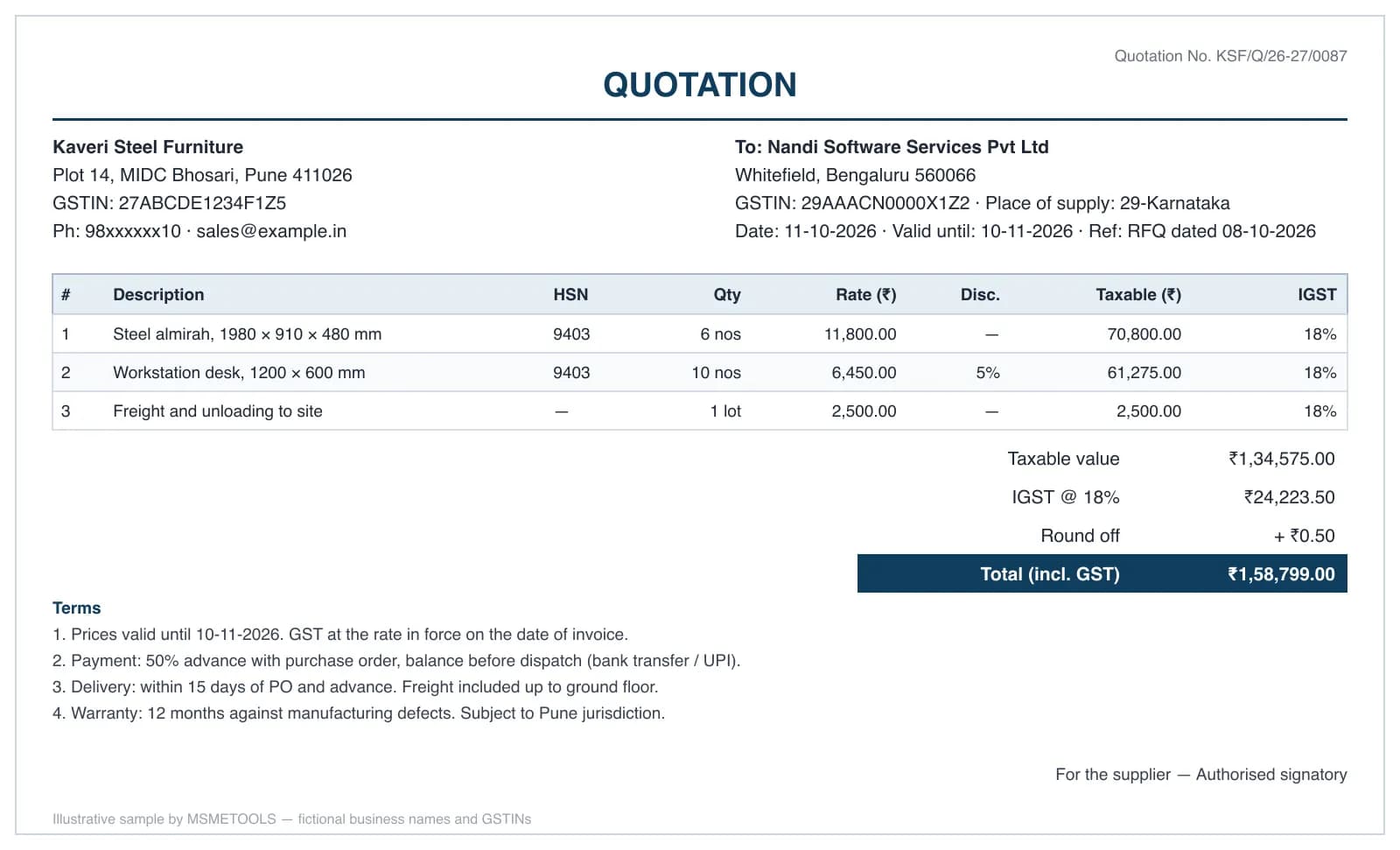
Kaveri Steel Furniture in Pune (GSTIN starting 27) receives an enquiry from a software company in Bengaluru (GSTIN starting 29) for six steel almirahs and ten workstation desks, delivered to site.
- Almirahs: 6 × ₹11,800 = ₹70,800
- Desks: 10 × ₹6,450 = ₹64,500, less a 5% volume discount of ₹3,225 = ₹61,275
- Freight and unloading: ₹2,500, taxed with the goods
- Taxable value: ₹1,34,575
Try it — add GST to your quoted value
Because the buyer is in Karnataka and the goods move from Maharashtra, the supply is inter-state and the quote shows IGST. At 18%, IGST is ₹24,223.50, making ₹1,58,798.50, rounded to ₹1,58,799 with a round-off of ₹0.50. The quotation is valid until 10 November 2026, asks for 50% with the purchase order and the balance before dispatch, and promises delivery within 15 days.
If the same order came from a buyer in Nagpur, the formulas would split the tax into CGST ₹12,111.75 and SGST ₹12,111.75 instead, with the same total. If the buyer pays the 50% advance of ₹79,399.50, Kaveri issues a receipt voucher; because this is a supply of goods and Kaveri is a regular taxpayer, no GST is paid on the advance — the full tax is paid when the tax invoice is raised at dispatch. Check the current rate for your own HSN before quoting; the 18% here is for illustration.
Common quotation mistakes and how to avoid them
No validity date. An open-ended quote can be accepted months later when your costs have risen; under section 6 you'd be arguing about what a "reasonable time" was. Always print a date.
Accepting a PO that isn't your quote. Buyers' purchase orders often carry their own standard terms — longer credit, penalty clauses, different delivery. If you dispatch against such a PO without objection, you've probably accepted its terms. Reply in writing to anything you don't agree to.
Wrong tax type or rate. Quoting CGST + SGST to an other-state buyer, or an old rate after a rate change, leads to an invoice the buyer rejects. Check the buyer's GSTIN and the current rate for each HSN every time.
GST added by a composition or unregistered business. It's not allowed, and buyers who later find they can't claim credit will dispute the price.
Vague descriptions. "MS railing — lump sum" invites a dispute over length, thickness and finish. Itemise and specify units.
Discounts after tax. Show discounts before computing tax. A post-tax "special discount" on the quote either confuses the invoice or ends up as a credit note you didn't plan for.
Official links
- Indian Contract Act, 1872Sections 2–7: proposal, acceptance, revocation
- Section 14 – change in rate of taxWhich rate applies around a rate change
- Rule 46 – tax invoice particularsFields your quote should mirror
- Rule 50 – receipt voucherWhen an advance is paid
- GST portal – search taxpayerVerify a buyer's GSTIN
What to do next
Build your template once, test it with a same-state and an other-state buyer, and keep a register of quotation numbers so you can match them to purchase orders and invoices. If you'd rather not maintain formulas, our free quotation generator produces a numbered GST quotation with HSN, tax split, validity and terms, and downloads it as a PDF. When the buyer accepts, convert it into a proforma invoice if they need one for an advance, and into a Rule 46 tax invoice when you supply.
This is general information, not legal or tax advice — confirm on the official source or with a professional.
Frequently asked questions
There is no government-prescribed format. A good quotation shows your business name, address and GSTIN; a quotation number and date; the buyer's name and address; a validity date; each item with description, HSN or SAC, quantity, unit, rate, discount and taxable value; the GST rate and amount; the total; and terms for payment, delivery, warranty and jurisdiction, followed by a signature.
No. A quotation is not a tax invoice, so issuing one creates no GST liability and the buyer cannot claim input tax credit on it. You show GST on a quote only so the buyer knows the full cost. The tax is charged on the tax invoice, at the rate in force at the time of supply — which may differ from the rate on the quote if rates change in between.
As long as the quotation says. Under section 6 of the Indian Contract Act, a proposal lapses when the time it prescribes for acceptance runs out, or after a reasonable time if it prescribes none. Most Indian businesses use 15, 30 or 90 days depending on how volatile their input costs are. Always print a clear 'valid until' date.
It can be. If a quotation is specific enough to be an offer and the buyer accepts it unconditionally — for example by a purchase order on the same terms — a contract forms. Until acceptance is communicated, you can withdraw it under section 5 of the Contract Act. A purchase order that changes the price or terms is a counter-offer, not an acceptance.
No. A composition taxpayer cannot collect GST from customers and issues a bill of supply, not a tax invoice. Its quotations should show prices without any GST line and should not say 'GST extra'. The composition tax is paid by the dealer on its own turnover.
A quotation is a price offer, often sent in answer to an enquiry and frequently one of several the buyer compares. A proforma invoice usually comes after the buyer has agreed in principle and is used to release an advance, open a letter of credit or get internal approval. Neither is a GST document; the tax invoice follows the supply.
Sources & verification
Figures on this page were checked against the sources below when it was last reviewed on 11 October 2026. Each rate and limit is stored once with its own official source and review date, and official update channels are monitored daily so changes are picked up. How we verify
- 1.The Indian Contract Act, 1872 (India Code) — Legislative Department, Government of India · accessed 11 October 2026
- 2.Section 14 – CGST Act, 2017 (change in rate of tax) — CBIC · accessed 11 October 2026
- 3.Section 31 – CGST Act, 2017 (tax invoice) — CBIC · accessed 11 October 2026
- 4.Rule 46 – CGST Rules (tax invoice) — CBIC · accessed 11 October 2026
- 5.Rule 5 – CGST Rules (conditions for composition levy) — CBIC · accessed 11 October 2026
- 6.Rule 50 – CGST Rules (receipt voucher) — CBIC · accessed 11 October 2026
- 7.Notification No. 66/2017 – Central Tax — CBIC (hosted by GST Council) · accessed 11 October 2026
- 8.The Legal Metrology Act, 2009 (FAOLEX copy of the Gazette text) — FAO FAOLEX · accessed 11 October 2026
MSMETOOLS is an independent platform and is not affiliated with any government agency, ministry or department.
Tools for this
Quotation Generator
Create professional quotes for clients.
Proforma Invoice Generator
Send advance invoices before supply.
Invoice Generator
Create professional invoices with tax, logo and custom details.
GST Calculator (India)
Calculate GST for your sales and purchases with current rates.
Related guides
 What Is a Proforma Invoice? GST Rules & Format (2026)Read guide
 What Is a Purchase Order? Meaning, Format & GST (2026)Read guide
 TReDS Platform 2026: Rules & How MSMEs Discount InvoicesRead guide
 PNB Digi MSME Loan 2026: Limits, Eligibility & How to ApplyRead guide
Official links open the government site in a new tab.