 GST & indirect tax
Receipt Voucher under GST (2026): Format, GST on Advances and Refund Vouchers
Receipt voucher in GST for 2026: Rule 50 fields, when GST is due on advances (services yes, goods no), refund vouchers under Rule 51 and a worked ₹ example.
 Edited by Sumeet YadavFounder & editor, MSMETOOLS · fact-checked against official sources
Contents (9)
- 1. What a receipt voucher is
- 2. When GST is payable on an advance
- 3. Receipt voucher format: the Rule 50 fields
- 4. Adjusting the advance against the final invoice
- 5. Refund vouchers: returning an advance (Rule 51)
- 6. Worked example: from advance to invoice in ₹
- 7. Who issues a receipt voucher — and who doesn't need one
- 8. Common mistakes with receipt vouchers
- 9. What to do next
A caterer takes ₹50,000 to book a wedding date. A software firm collects 30% before starting a project. A furniture shop takes ₹20,000 to confirm a sofa order. Each of these businesses has received money before supplying anything — and GST law says that money needs a document of its own, the receipt voucher, and sometimes tax as well. This guide is for registered businesses and their accountants. It explains the Rule 50 format, when GST is due on an advance (services: yes; goods: no for regular taxpayers), the rate and place-of-supply defaults, how the advance is adjusted against the final invoice in GSTR-1, and how to return an advance with a refund voucher under Rule 51, with worked ₹ examples checked against the CGST Act and Rules in October 2026.
Quick answer
Under section 31(3)(d) of the CGST Act, a registered person who receives an advance must issue a receipt voucher with the details in Rule 50. GST is payable on advances for services, in the month the money is received. Regular taxpayers pay no GST on advances for goods (Notification 66/2017-CT) but must still issue the voucher. If the advance is returned without a supply, issue a refund voucher under Rule 51.
Rate unknown at receipt? Pay tax at 18%
Intra- or inter-state unknown? Treat it as inter-state (IGST)
Report advances and adjustments in GSTR-1 and pay tax through GSTR-3B
Excess payment up to ₹1,000 can wait for the next invoice
Create one free with the receipt generator
What a receipt voucher is
Section 31 of the CGST Act sets out the documents GST recognises: the tax invoice, the bill of supply, and — under sub-section (3) — a group of vouchers. Clause (d) says that on receipt of an advance payment for any supply of goods or services, a registered person shall issue "a receipt voucher or any other document" containing the prescribed particulars, as evidence of the payment. Clause (e) adds the refund voucher for advances returned without a supply, and clause (g) the payment voucher a buyer issues when it pays an unregistered supplier under reverse charge.
The voucher does two jobs. Commercially, it's the customer's proof that the advance was paid and the terms on which it was taken. For tax, it fixes the amount and date on which GST becomes payable when the advance relates to a service, and it creates the trail that links the advance to the final tax invoice.
What counts as an advance. Any amount received before the supply is made and before the invoice is issued — a booking amount, a mobilisation advance on a contract, a deposit adjustable against the bill, an annual subscription collected upfront. A security deposit that will be refunded in full and isn't adjusted against the price is generally not consideration for the supply, so it isn't an advance in this sense; one that is adjusted against the final bill is.
A proforma invoice is not a receipt voucher. Buyers often pay against a proforma invoice or an accepted quotation, but neither document records the receipt. Once the money arrives, the voucher has to be issued.
When GST is payable on an advance
GST on advances — goods vs services
| Advance for services | Advance for goods | |
|---|---|---|
Receipt voucher needed? | Yes | Yes |
GST payable on the advance? | Yes — in the month received | No, for regular taxpayers (Notification 66/2017-CT) |
When is GST paid? | On the advance, then the balance on the invoice | Entirely on the invoice |
Tax shown on the voucher | Rate and amount | Usually shown as nil / payable on invoice |
Reported in GSTR-1 as an advance? | Yes, then adjusted | No tax liability to report |
Receipt voucher needed?
- Advance for services
Yes
- Advance for goods
Yes
GST payable on the advance?
- Advance for services
Yes — in the month received
- Advance for goods
No, for regular taxpayers (Notification 66/2017-CT)
When is GST paid?
- Advance for services
On the advance, then the balance on the invoice
- Advance for goods
Entirely on the invoice
Tax shown on the voucher
- Advance for services
Rate and amount
- Advance for goods
Usually shown as nil / payable on invoice
Reported in GSTR-1 as an advance?
- Advance for services
Yes, then adjusted
- Advance for goods
No tax liability to report
Services. Section 13 fixes the time of supply of services as the earlier of the invoice date (if issued on time) and the date the supplier receives payment. "Receipt of payment" means the date the payment is entered in your books or credited to your bank, whichever is earlier. An advance for a service is therefore a supply to the extent of the advance, and tax on it is payable for that month through GSTR-3B, due by the 20th of the next month for monthly filers. The GSTN's GSTR-1 FAQ confirms that suppliers are liable to pay tax on advances received for services and report them in GSTR-1.
Goods. Section 12 has the same "earlier of invoice or payment" rule for goods, which is why GST on goods advances was briefly payable in 2017. Notification 66/2017-Central Tax, dated 15 November 2017, notified that registered persons who haven't opted for the composition levy pay central tax on outward supplies of goods at the time of supply under section 12(2)(a) — the invoice date, or the last date by which the invoice should have been issued. In effect, advances for goods no longer attract GST for regular taxpayers. The notification is written for non-composition taxpayers, so a composition dealer receiving advances should confirm its own position with its adviser. Either way, section 31(3)(d) still requires the receipt voucher.
Mixed contracts. Where one advance covers both goods and services — say, a machine with installation and an annual maintenance contract — split it in proportion to the contract values, or treat the whole as following the principal supply if it's a genuinely composite supply. Write the basis on the voucher.
Small excess payments. If a customer pays up to ₹1,000 more than the invoice amount, sections 12 and 13 let you treat the date of the next invoice covering that excess as its time of supply. You don't have to issue a voucher and pay tax on, say, ₹640 of over-payment; adjust it on the next bill.
Receipt voucher format: the Rule 50 fields
Fields every receipt voucher needs (Rule 50)
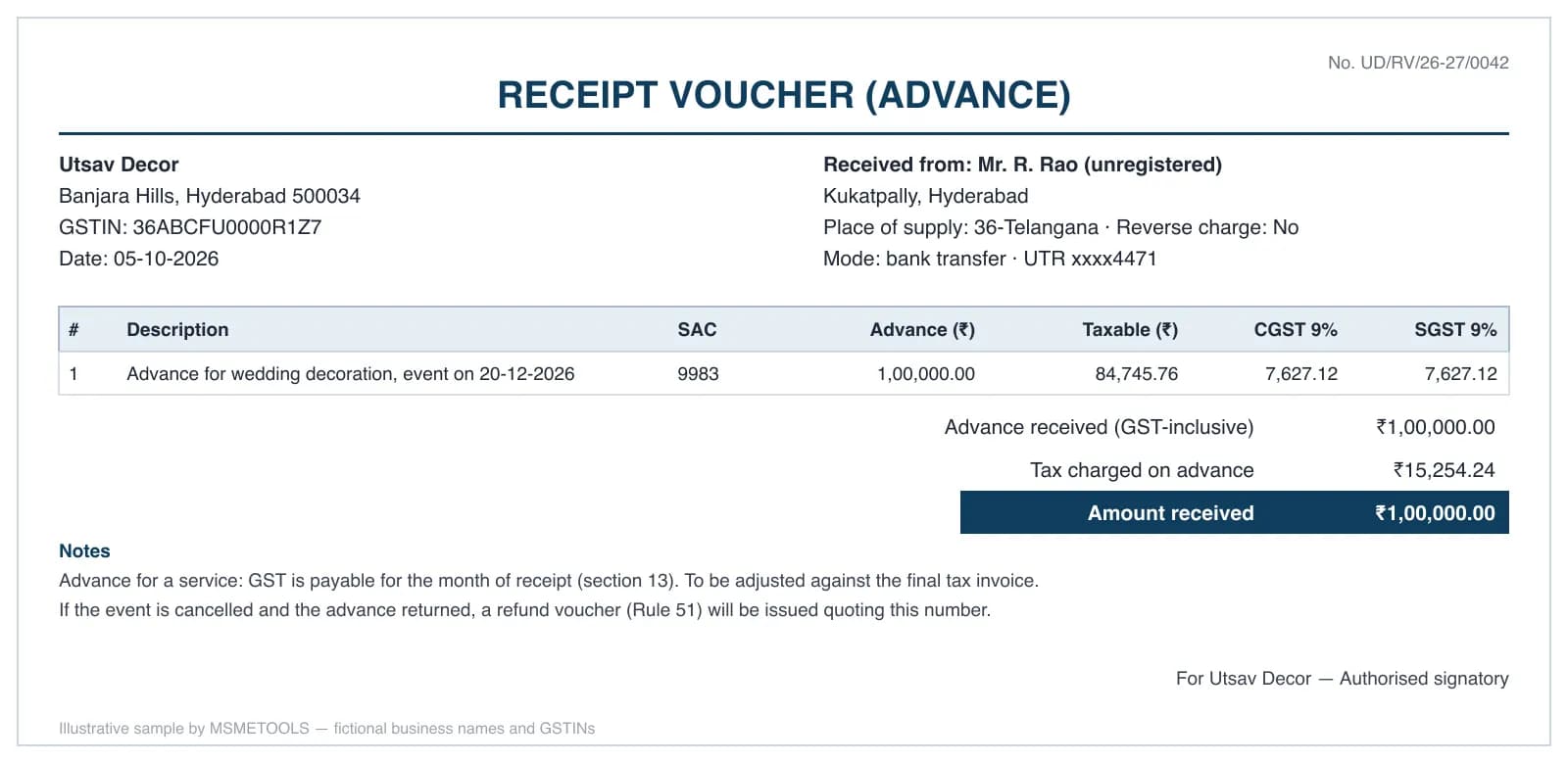
0/11Numbering. Use a separate series for receipt vouchers, such as UD/RV/26-27/0042. GSTR-1 Table 13 asks for the range of numbers issued and cancelled for each document type, and receipt, payment and refund vouchers each have their own row. Mixing them into your invoice series causes gaps that are hard to explain.
The two defaults in Rule 50. The proviso deals with advances taken before the details are settled. If the rate of tax isn't determinable when the advance comes in — for example, a deposit for "interiors" before the scope is fixed — tax is paid at 18%. If the nature of supply isn't determinable — you don't yet know whether the event will be in your state or another — the supply is treated as inter-state and IGST is charged. Both are corrected on the final invoice.
Is the advance tax-inclusive? Rule 50 asks for the amount of advance and the tax on it, but doesn't say whether the advance includes tax. Commercial practice, and what most customers expect, is to treat the amount received as inclusive: tax = advance × rate ÷ (100 + rate). If your contract says the advance is "plus GST", collect the tax on top and show both.
Adjusting the advance against the final invoice
When the supply is made, you issue a normal Rule 46 tax invoice for the full value and full tax — not just the balance. The invoice can show "less: advance received vide receipt voucher no. … dated …" below the total, so the customer sees the balance payable, but the taxable value and tax on the invoice are for the whole supply.
In GSTR-1, the mechanics are:
- In the month the advance is received, report it in the advances-received table (Table 11A), giving the tax rate and place of supply, so the tax on it is added to your liability. The GSTN's manual says the amount reported is net of advances against which invoices were already issued in the same return.
- In the month the invoice is issued, report the invoice in the B2B or B2C table as usual, and report the advance being adjusted in the advance-adjustment table (Table 11B). That reduces the liability for the month by the tax already paid on the advance.
- Report the voucher series in Table 13.
If the advance and the invoice fall in the same month, the GSTR-1 FAQ allows you to leave the advance out of Table 11A, because the invoice already carries the tax.
Changing rates. Section 14 decides which rate applies when an advance and the supply straddle a rate change. Where the service is supplied after the change and the invoice is issued after it but the advance was received before it, the time of supply is the invoice date — so the new rate applies to the whole supply, and the tax paid on the advance at the old rate is adjusted. Businesses that took advances before the rate restructuring of 22 September 2025 had to work through exactly this; read our GST 2.0 guide for the background.

Refund vouchers: returning an advance (Rule 51)
Sometimes the supply never happens: the event is cancelled, the order is withdrawn, the project is shelved. Section 31(3)(e) lets you issue a refund voucher to the person who paid when a receipt voucher was issued, no supply was made and no invoice was issued, and you return the advance.
Rule 51 lists the particulars: supplier's name, address and GSTIN; a serial number on the same 16-character rule; date; recipient's name, address and GSTIN or UIN if registered; the number and date of the receipt voucher being refunded; description of the goods or services; amount refunded; tax rate; the amount of tax paid on the advance being refunded; whether reverse charge applies; and a signature.
The refund voucher is what lets you recover the tax you paid on a service advance. Report it in the period of refund by reducing the advance liability in GSTR-1's advance tables, and list the voucher series in Table 13. Keep the bank proof of the refund with the voucher. If you keep part of the advance as a cancellation charge, only the portion actually returned goes on the refund voucher; whether the retained amount is taxed as a separate supply depends on your contract, so confirm the treatment with your adviser.
Payment vouchers are different. When you buy from an unregistered supplier in a case where you must pay tax under reverse charge, section 31(3)(f) requires you to issue a self-invoice and section 31(3)(g) a payment voucher when you pay. That's a buyer-side document; our reverse charge guide covers it.
Worked example: from advance to invoice in ₹
Utsav Decor in Hyderabad (GSTIN starting 36) books a wedding decoration job for a customer in Kukatpally on 5 October 2026 and receives ₹1,00,000 by bank transfer. The event is on 20 December 2026. The service is taxed at 18% and both parties are in Telangana.
How Utsav Decor handles the advance
- 1
Issue the receipt voucher on 5 October
Treating ₹1,00,000 as tax-inclusive: taxable value ₹84,745.76, CGST ₹7,627.12, SGST ₹7,627.12 (₹1,00,000 × 18 ÷ 118 = ₹15,254.24).
- 2
Pay tax for October
Report the advance in GSTR-1 for October and pay ₹15,254.24 through GSTR-3B for October.
- 3
Raise the tax invoice in December
Total job ₹2,50,000 + GST ₹45,000 = ₹2,95,000. The invoice shows the full value; less advance ₹1,00,000; balance payable ₹1,95,000.
- 4
Adjust in December's returns
Report the invoice and the advance adjustment. Tax payable for December on this job = ₹45,000 − ₹15,254.24 = ₹29,745.76.
A cancellation. Another customer paid Utsav ₹50,000 in October and cancels in November, and Utsav refunds the whole amount. Utsav had paid ₹7,627.12 of tax on it (₹3,813.56 CGST and ₹3,813.56 SGST). It issues refund voucher UD/RF/26-27/0003, quoting the original receipt voucher, the ₹50,000 refunded and the ₹7,627.12 tax, and reduces its advance liability in November's GSTR-1, which brings the tax back.
A goods advance. A furniture shop in the same city takes ₹20,000 towards a ₹60,000 sofa set. It issues a receipt voucher showing the advance and noting that tax is payable on the invoice, but pays no GST in that month. When the sofa is delivered, the tax invoice carries the full GST on ₹60,000, all of it payable that month.
Try it — split GST out of an inclusive advance
Who issues a receipt voucher — and who doesn't need one
Only for advances. A receipt voucher is for money received before the supply. When a customer pays an invoice you've already issued, there is no GST document to issue; an ordinary money receipt or a payment acknowledgement is enough, and many businesses simply mark the invoice paid.
Registered persons only. Section 31 applies to registered persons. A business that isn't registered for GST gives an ordinary receipt for advances and charges no tax. A composition taxpayer is registered, so it should issue a receipt voucher for advances, but it cannot collect tax from customers, so the voucher shows no tax.
Exports. If you export services under a letter of undertaking, the supply is zero-rated without payment of integrated tax, so no tax is paid on an advance from the foreign client either; issue the voucher in the agreed currency with the rupee equivalent, and keep the bank's foreign inward remittance record with it.
Signatures. Rule 50 asks for a signature or digital signature. Unlike Rules 46 and 49, which expressly excuse electronic invoices and bills of supply from a signature, Rule 50 has no such proviso, so sign electronic vouchers digitally or print and sign them. Vouchers generated by accounting software with a digital signature satisfy this.
Common mistakes with receipt vouchers
No voucher for goods advances. Because no tax is due, many traders skip the voucher altogether. Section 31(3)(d) still requires it, and it's the customer's only proof of the advance.
Charging GST on goods advances. Adding GST to an advance for goods inflates the customer's payment and confuses your returns. For regular taxpayers, the tax belongs on the invoice.
Forgetting the service advance until the invoice. Paying the tax only when the invoice is issued months later means interest under section 50 for the gap. Pay it for the month the advance was received.
Invoice only for the balance. Issuing a final invoice for ₹1,95,000 instead of ₹2,95,000 understates the supply and breaks the GSTR-1 adjustment. The invoice must carry the full value.
No refund voucher on cancellation. Without one, you have no basis to reverse the tax paid on a service advance.
Official links
- Rule 50 – receipt voucherFields and the 18% / inter-state defaults
- Rule 51 – refund voucherReturning an advance
- Section 13 – time of supply of servicesWhy service advances are taxed
- Notification 66/2017-Central TaxNo GST on goods advances for regular taxpayers
- GSTR-1 user manualReporting advances and adjustments
What to do next
Set up a separate receipt-voucher series, decide whether your advances are tax-inclusive and say so in your terms, and add a monthly check that every service advance has been taxed and every invoice adjusted. Our free receipt generator creates advance receipt vouchers with the tax split, and the invoice generator produces the final Rule 46 invoice with the advance shown below the total. For the reporting side, see our GSTR-1 guide.
This is general information, not legal or tax advice — confirm on the official source or with a professional.
Frequently asked questions
A receipt voucher is the document a registered person must issue under section 31(3)(d) of the CGST Act when it receives an advance for a future supply of goods or services. Rule 50 lists its contents: supplier and recipient details, a serial number, date, description, amount of the advance, tax rate and tax amount, place of supply, reverse-charge status and a signature.
Not for regular taxpayers. Since Notification 66/2017-Central Tax, registered persons who haven't opted for the composition scheme pay GST on goods only when the invoice is issued, not on advances. They must still issue a receipt voucher for the advance. For services, GST is payable on the advance in the month it's received.
Rule 50 says that if the rate of tax can't be determined when the advance is received, tax is paid at 18%. If the nature of supply — intra-state or inter-state — can't be determined, it is treated as an inter-state supply, so IGST is charged. The position is corrected when the final invoice is issued.
A refund voucher under section 31(3)(e) and Rule 51 is issued when an advance was received and a receipt voucher issued, but no supply is made and no invoice is issued, and the advance is returned. It quotes the original receipt voucher's number and date, the amount refunded, and the tax rate and amount, so the tax paid on the advance can be adjusted.
When you issue the tax invoice, it shows the full value and full tax. In GSTR-1 you report the invoice normally and report the advance being adjusted in the advance-adjustment table, which reduces the tax payable by the amount already paid on the advance. Only the balance tax is paid for the month of the invoice.
If a customer pays up to ₹1,000 more than the invoice amount, sections 12 and 13 let you treat the invoice date as the time of supply for that excess, at your option. You can then deal with it on the next invoice instead of paying tax on it as an advance.
Sources & verification
Figures on this page were checked against the sources below when it was last reviewed on 11 October 2026. Each rate and limit is stored once with its own official source and review date, and official update channels are monitored daily so changes are picked up. How we verify
- 1.Rule 50 – CGST Rules (receipt voucher) — CBIC · accessed 11 October 2026
- 2.Rule 51 – CGST Rules (refund voucher) — CBIC · accessed 11 October 2026
- 3.Section 31 – CGST Act (tax invoice, receipt and refund vouchers) — CBIC · accessed 11 October 2026
- 4.Section 12 – CGST Act (time of supply of goods) — CBIC · accessed 11 October 2026
- 5.Section 13 – CGST Act (time of supply of services) — CBIC · accessed 11 October 2026
- 6.Section 14 – CGST Act (change in rate of tax) — CBIC · accessed 11 October 2026
- 7.Notification No. 66/2017 – Central Tax — CBIC (hosted by GST Council) · accessed 11 October 2026
- 8.GSTR-1 user manual and FAQs — GSTN · accessed 11 October 2026
- 9.Form GSTR-1 (Table 13 – documents issued) — Commercial Taxes Department, Goa · accessed 11 October 2026
MSMETOOLS is an independent platform and is not affiliated with any government agency, ministry or department.
Tools for this
Payment Receipt Generator
Issue payment receipts in seconds.
Invoice Generator
Create professional invoices with tax, logo and custom details.
GST Calculator (India)
Calculate GST for your sales and purchases with current rates.
Quotation Generator
Create professional quotes for clients.
Related guides
 GST Invoice Format 2026: Rule 46 Fields & Excel Template GuideRead guide
 Reverse Charge Mechanism (RCM) in GST 2026: List & ExampleRead guide
 Bill of Supply under GST 2026: Rule 49 Format & When to UseRead guide
 TCS under GST 2026: 0.5% Rate, GSTR-8 & Seller CreditRead guide
Official links open the government site in a new tab.