 GST & indirect tax
Bill of Supply under GST (2026): Who Issues It, Rule 49 Format and Invoice-cum-Bill of Supply
Bill of supply in GST for 2026: who must issue it (composition and exempt supplies), Rule 49 fields, invoice-cum-bill of supply under Rule 46A and worked examples.
 Edited by Sumeet YadavFounder & editor, MSMETOOLS · fact-checked against official sources
Contents (10)
- 1. Who must issue a bill of supply
- 2. Bill of supply format: the Rule 49 fields
- 3. The composition dealer's declaration
- 4. Switching schemes: when your document changes
- 5. Invoice-cum-bill of supply (Rule 46A)
- 6. Moving goods on a bill of supply: e-way bills and transport
- 7. Reporting bills of supply in returns
- 8. Worked example: a composition grocer's bill in ₹
- 9. Common bill of supply mistakes
- 10. What to do next
A kirana store on the composition scheme, a dairy selling fresh milk and paneer, a clinic, a coaching class for school students, a seller of fresh vegetables — none of them charges GST on what they sell, yet if they're registered, they can't hand over just any bill. GST law gives them a specific document: the bill of supply. This guide is for composition taxpayers, businesses that sell exempt or nil-rated items, and the accountants who handle their books. It explains who must issue a bill of supply, every Rule 49 field, the composition declaration, when one combined invoice-cum-bill of supply is allowed, how these bills are reported, and two worked ₹ examples. All rules were checked against the CGST Act and Rules on CBIC's site in October 2026.
Quick answer
A bill of supply is issued instead of a tax invoice when no GST is charged: by composition taxpayers on all their sales, and by regular taxpayers on exempt, nil-rated or non-taxable supplies (section 31(3)(c)). Rule 49 lists its fields — supplier GSTIN, serial number, date, buyer details, HSN, description, value and signature — with no tax columns.
Composition dealers must print 'composition taxable person, not eligible to collect tax on supplies' at the top
Mixed taxable and exempt sale to an unregistered buyer? One invoice-cum-bill of supply is allowed (Rule 46A)
Exports are zero-rated — they need a tax invoice, not a bill of supply
Under ₹200 to an unregistered buyer who doesn't ask, a daily consolidated bill is enough
No input tax credit for the buyer on a bill of supply
Who must issue a bill of supply
Section 31(3)(c) of the CGST Act says that a registered person supplying exempted goods or services, or paying tax under section 10 (the composition levy), shall issue a bill of supply instead of a tax invoice. That gives two groups.
1. Composition taxpayers — for every sale. A business on the composition scheme pays tax at a flat percentage of its turnover from its own pocket — 1% for manufacturers and traders, 5% for restaurants, 6% for service providers under the services option. It cannot collect GST from customers, so every outward supply, taxable or not, goes on a bill of supply.
2. Regular taxpayers — for exempt supplies. Section 2(47) defines an exempt supply as one that attracts a nil rate, is wholly exempt under section 11 (or section 6 of the IGST Act), or is a non-taxable supply. So a regular-scheme business issues a bill of supply when it sells, for example, fresh milk (Nil), paneer (Nil), unprocessed vegetables, healthcare services by clinical establishments, or individual life and health insurance, which became Nil (exempt) from 22 September 2025. Our GST exemptions guide lists the main exempt categories.
The GST 2.0 effect. The rate restructuring of 22 September 2025 moved several items to nil — paneer, Indian breads and individual life and health insurance among them. Businesses that sold only those items switched from tax invoices to bills of supply overnight, and those selling a mix now issue both. If your software still prints "tax invoice" with a 0% tax line on a nil-rated item, change the document title.
Who doesn't issue one. Exports and supplies to SEZ units are zero-rated, not exempt; they go on a tax invoice with the export or SEZ endorsement, even when no tax is paid under a letter of undertaking. Businesses that aren't registered for GST fall outside section 31 and issue ordinary bills or cash memos. And Rule 49 says that any tax invoice or similar document issued under another law for a non-taxable supply — for example, a bill for alcoholic liquor issued under state excise or VAT law — is treated as a bill of supply.
Bill of supply vs tax invoice
| Bill of supply | Tax invoice | |
|---|---|---|
Used for | Exempt / nil-rated / non-taxable supplies; all sales by composition dealers | Taxable supplies by regular taxpayers, including zero-rated exports |
Governing rule | Section 31(3)(c), Rule 49 | Section 31(1)–(2), Rule 46 |
Tax rate and amount | Not shown | Shown — CGST/SGST or IGST |
Place of supply / reverse charge | Not required | Required |
Buyer's input tax credit | None | Available, subject to conditions |
Electronic copy signature | Not needed | Not needed |
Used for
- Bill of supply
Exempt / nil-rated / non-taxable supplies; all sales by composition dealers
- Tax invoice
Taxable supplies by regular taxpayers, including zero-rated exports
Governing rule
- Bill of supply
Section 31(3)(c), Rule 49
- Tax invoice
Section 31(1)–(2), Rule 46
Tax rate and amount
- Bill of supply
Not shown
- Tax invoice
Shown — CGST/SGST or IGST
Place of supply / reverse charge
- Bill of supply
Not required
- Tax invoice
Required
Buyer's input tax credit
- Bill of supply
None
- Tax invoice
Available, subject to conditions
Electronic copy signature
- Bill of supply
Not needed
- Tax invoice
Not needed
Bill of supply format: the Rule 49 fields
Fields every bill of supply needs (Rule 49)
0/9A bill of supply is a slimmer tax invoice. It drops the tax rate, tax amount, place of supply and reverse-charge fields, but keeps everything that identifies the parties, the goods and the value.
Serial number. The numbering rule is identical to invoices: up to 16 characters, only letters, numerals, hyphen and slash, and no repeats in the financial year. A regular taxpayer that issues both documents should run a separate series for bills of supply, such as LGS/BOS/26-27/0001, so the GSTR-1 document summary stays clean.
Buyer details. Rule 49 asks for the recipient's name, address and GSTIN "if registered". Because the provisos to Rule 46 apply to bills of supply too, the B2C relaxations carry over: for an unregistered buyer, the name and address are needed where the value is ₹50,000 or more, or on request.
HSN. Rule 49(e) requires the HSN code. Use the same code you'd use for a tax invoice — it's how the exemption or nil rate is identified, and a wrong code is the quickest way to have an "exempt" sale reclassified as taxable. Our HSN code finder helps.
Small sales. The proviso to section 31(3)(c) lets you skip a bill of supply for a supply under ₹200, and the Rule 46 proviso, applied through Rule 49, lets you issue one consolidated bill at the end of the day for all such sales to unregistered buyers who don't ask for a bill. A vegetable stall or tea counter on the composition scheme typically works this way.
Electronic bills and QR codes. An electronic bill of supply needs no physical signature. Rule 49 also lets the government require a QR code on bills of supply by notification; check whether any such notification applies to your business before relying on a plain format.
The composition dealer's declaration
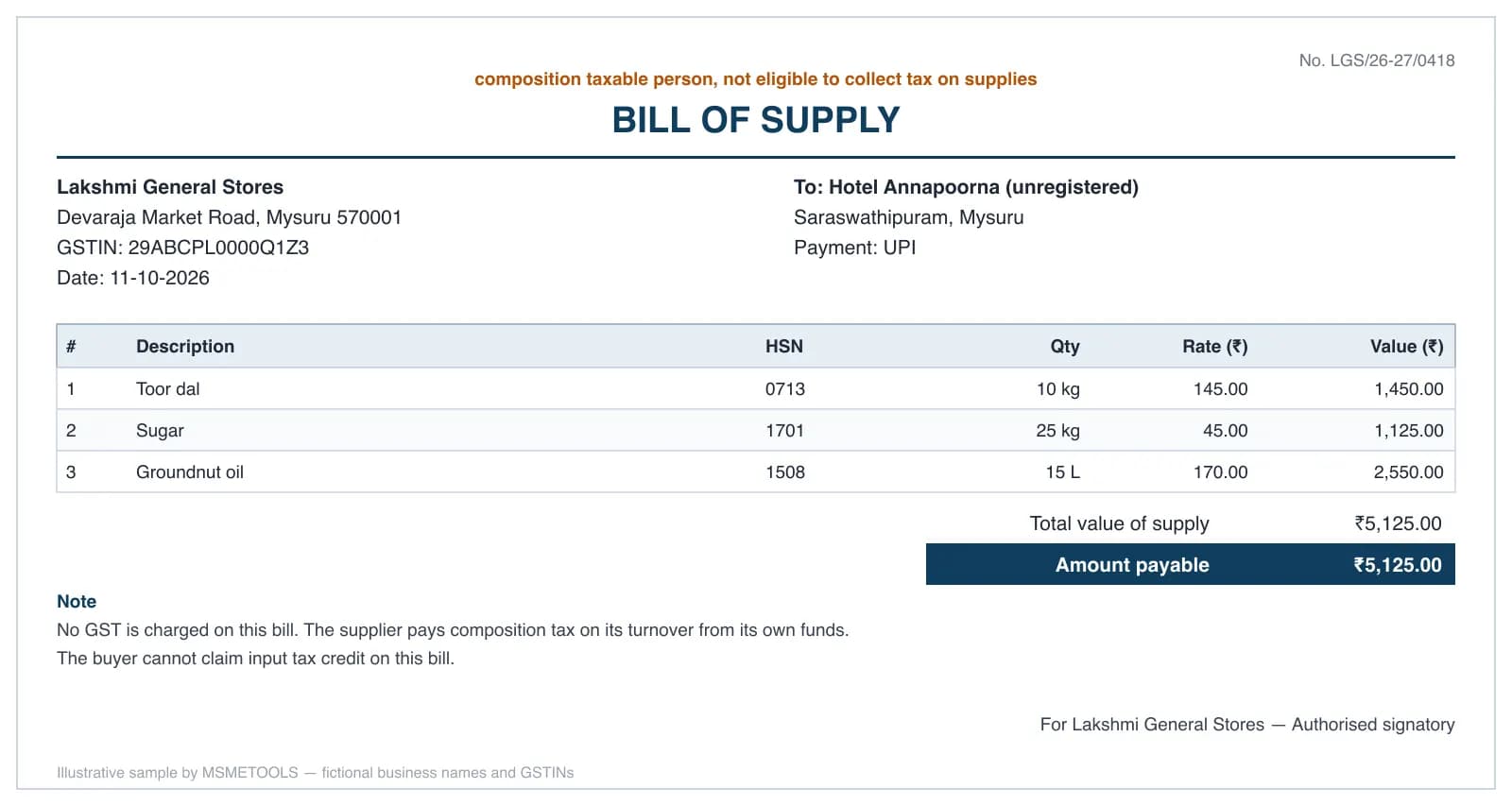
Rule 5(1)(f) of the CGST Rules makes a composition taxpayer print the words "composition taxable person, not eligible to collect tax on supplies" at the top of every bill of supply. Rule 5(1)(g) adds that the words "composition taxable person" must appear on a notice or signboard displayed prominently at the principal place of business and every additional place of business.
The declaration protects the buyer as much as the seller. It tells a registered customer that there's no credit to claim, and it tells an inspecting officer that the absence of tax is deliberate. Leaving it off, or worse, adding a GST line "for the customer's information", invites the question of whether tax was collected — and a composition dealer that collects tax it isn't entitled to can be asked to pay it over.
The composition tax itself. A composition trader pays tax on its turnover in the state — 1%, split equally between CGST and SGST — through Form CMP-08 each quarter, and files an annual return in GSTR-4. None of this appears on the bill of supply. The tax is a cost of the business, built into its prices.
Composition scheme at a glance (2026)
₹1.5 crore
Turnover limit for goods (most states)
1%
Tax on turnover — manufacturers and traders
5%
Tax on turnover — restaurants
18th of the month after the quarter
CMP-08 due date
quarterly
Switching schemes: when your document changes
The document you issue follows your scheme on the date of each supply, so a change of scheme mid-year changes your bill format on a specific day.
Leaving the composition scheme. If your turnover crosses the composition limit, or you opt out to sell to registered buyers who want credit, you become a regular taxpayer from the date of withdrawal. Every supply from that date goes on a tax invoice with GST, and you can claim credit on stock held on that day by filing Form ITC-01 within 30 days. Bills of supply issued before the switch stay as they are; don't re-issue them as tax invoices.
Joining the composition scheme. When you opt in from the start of a financial year, you must pay back the credit on inputs held in stock, semi-finished and finished goods, and capital goods through Form ITC-03 within 60 days, and from the effective date every sale goes on a bill of supply with the declaration. Change your signboard, update your billing software's template and start a new number series on the same day, so there's no overlap of tax invoices and bills of supply in one series.
Inter-state sales. A composition taxpayer can't make inter-state outward supplies of goods. If a customer in another state wants your goods, you either decline or leave the scheme first — issuing a bill of supply for an inter-state sale doesn't make it allowed.
Invoice-cum-bill of supply (Rule 46A)
A regular-scheme grocer, dairy or pharmacy often sells taxable and exempt items to the same customer at the same time. Issuing a tax invoice for the ghee and a separate bill of supply for the milk would be absurd at a retail counter, so Rule 46A, inserted by Notification 45/2017-Central Tax, allows a single "invoice-cum-bill of supply" where a registered person supplies taxable and exempt goods or services to an unregistered person.
Two conditions matter. First, it's only for unregistered buyers; a registered buyer still gets a tax invoice for the taxable items and a bill of supply for the exempt ones, because its input tax credit depends on a clean tax invoice. Second, since Notification 26/2022-Central Tax of 26 December 2022, the combined document must carry the particulars required by Rule 46 (or Rule 54 for certain services) and by Rule 49. In practice that means a tax-invoice layout with tax columns, where exempt or nil-rated lines show a nil rate and no tax.
Example. A dairy in Pune on the regular scheme sells to a household: 20 litres of fresh milk at ₹56 (₹1,120, nil-rated), 2 kg of paneer at ₹400 (₹800, nil-rated) and 1 litre of ghee for ₹620 taxable at 5%. One invoice-cum-bill of supply covers all three lines; tax appears only on the ghee — CGST ₹15.50 and SGST ₹15.50 — and the total is ₹2,571. Our GST on milk products guide has the current rates line by line.
| Line | HSN | Value (₹) | Rate | CGST (₹) | SGST (₹) |
|---|---|---|---|---|---|
| Fresh milk, 20 L | 0401 | 1,120.00 | Nil | — | — |
| Paneer, 2 kg | 0406 | 800.00 | Nil | — | — |
| Ghee, 1 L | 0405 | 620.00 | 5% | 15.50 | 15.50 |
| Total | 2,540.00 | 15.50 | 15.50 |
Grand total: ₹2,571.
Moving goods on a bill of supply: e-way bills and transport
A bill of supply is a valid document for the e-way bill: Rule 138 lets the e-way bill be generated on the basis of an invoice, a bill of supply or a delivery challan. The consignment value is the value declared on the document plus any tax charged, and Rule 138 specifically excludes the value of exempt goods where one document covers both exempt and taxable goods. So in a mixed load the e-way bill threshold of ₹50,000 is tested on the taxable portion only.
Where no e-way bill is needed — because the value is below the threshold or the goods are exempted from the requirement — Rule 55A says the person in charge of the vehicle must carry a copy of the bill of supply (or tax invoice). A driver carrying a load of a composition trader's goods with no document at all is the classic detention case.
Reporting bills of supply in returns
Regular taxpayers. Exempt, nil-rated and non-GST outward supplies are reported in a separate table of GSTR-1 (Table 8), split into inter-state and intra-state, registered and unregistered, and summarised in GSTR-3B. The document series is listed in Table 13. If you make exempt supplies and also claim input tax credit, section 17(2) of the CGST Act requires you to reverse the credit attributable to the exempt supplies, so keep the bills of supply well organised — they drive that calculation.
Composition taxpayers. There is no invoice-level reporting. Total turnover for the quarter goes into CMP-08 with the tax payable, and the annual GSTR-4 carries the year's summary. Your bills of supply are the source records for both and must be kept for 72 months from the due date of the annual return.
Which document for which sale?
Step 1
Composition dealer
every sale → bill of supply
Step 2
Regular dealer, exempt item
bill of supply
Step 3
Regular dealer, taxable item
tax invoice
Step 4
Mixed sale to unregistered buyer
invoice-cum-bill of supply
Step 5
Export / SEZ
tax invoice with endorsement
Worked example: a composition grocer's bill in ₹
Lakshmi General Stores in Mysuru is on the composition scheme. Hotel Annapoorna, an unregistered eatery nearby, buys 10 kg of toor dal at ₹145 (₹1,450), 25 kg of sugar at ₹45 (₹1,125) and 15 litres of groundnut oil at ₹170 (₹2,550). The bill of supply carries the composition declaration at the top, the store's GSTIN, a serial number, the date, HSN codes 0713, 1701 and 1508, and a total of ₹5,125 — with no tax line.
Lakshmi's own tax on this sale is 1% of ₹5,125 = ₹51.25, split equally between CGST and SGST and paid with the quarter's CMP-08 out of the store's margin. If the eatery had been registered and wanted input tax credit, it couldn't claim any on this bill — and if that mattered, it would buy from a regular-scheme supplier instead. That is the trade-off every composition dealer accepts.
Common bill of supply mistakes
Calling it a tax invoice. A composition dealer's bill titled "Tax Invoice" suggests tax was collected. Use the title "Bill of Supply" and the declaration.
Showing GST "for information". Even a 0% column or a note like "GST included" on a composition bill creates doubt. Leave tax off entirely.
Using a bill of supply for exports. Zero-rated supplies need a tax invoice with the export endorsement; a bill of supply undermines your refund or LUT position.
Combined documents for registered buyers. Rule 46A is only for unregistered recipients. Registered buyers get separate documents.
Missing HSN. Rule 49 requires it, and it's the evidence that the item is exempt.
Official links
What to do next
If you're on the composition scheme, fix your bill template once — declaration at the top, HSN on every line, no tax column — and keep a daily consolidated bill for small counter sales. If you're a regular taxpayer selling exempt items, run a separate bill-of-supply series and set up an invoice-cum-bill of supply format for mixed retail sales. Our free invoice generator handles taxable invoices, and the GST invoice format guide covers the Rule 46 side.
This is general information, not legal or tax advice — confirm on the official source or with a professional.
Frequently asked questions
A bill of supply is the document issued instead of a tax invoice when no GST is charged on a supply. Section 31(3)(c) of the CGST Act requires it from registered persons supplying exempt goods or services and from composition taxpayers. Rule 49 lists its contents — the same core details as an invoice, but with no tax rate or tax amount.
Two groups: composition taxpayers, for all their outward supplies, and regular registered taxpayers when they supply goods or services that are exempt, nil-rated or non-taxable. Exports and SEZ supplies are zero-rated, not exempt, so they go on a tax invoice. Unregistered businesses aren't covered by section 31 and issue ordinary bills.
Rule 49 requires the supplier's name, address and GSTIN; a serial number of up to 16 characters, unique for the financial year; the date; the recipient's name, address and GSTIN or UIN if registered; HSN code; description; value after discount or abatement; and a signature or digital signature, which isn't needed on an electronic bill of supply.
Rule 5(1)(f) of the CGST Rules requires a composition taxpayer to print the words 'composition taxable person, not eligible to collect tax on supplies' at the top of every bill of supply. It must also display 'composition taxable person' on a signboard at each place of business.
Under Rule 46A, a registered person selling both taxable and exempt goods or services to an unregistered customer may issue one combined document, called an invoice-cum-bill of supply, instead of two. Since 26 December 2022 it must contain the particulars of both Rule 46 (or Rule 54) and Rule 49. For a registered buyer, separate documents are still needed.
No. A bill of supply carries no tax, so there is nothing to claim. That's why registered buyers often prefer suppliers on the regular scheme — a composition dealer's bill gives them no credit, even though the dealer pays composition tax on its own turnover.
Sources & verification
Figures on this page were checked against the sources below when it was last reviewed on 11 October 2026. Each rate and limit is stored once with its own official source and review date, and official update channels are monitored daily so changes are picked up. How we verify
- 1.Rule 49 – CGST Rules (bill of supply) — CBIC · accessed 11 October 2026
- 2.Rule 46A – CGST Rules (invoice-cum-bill of supply) — CBIC · accessed 11 October 2026
- 3.Section 31 – CGST Act (tax invoice and bill of supply) — CBIC · accessed 11 October 2026
- 4.Section 2 – CGST Act (definitions) — CBIC · accessed 11 October 2026
- 5.Rule 5 – CGST Rules (conditions for composition levy) — CBIC · accessed 11 October 2026
- 6.Section 10 – CGST Act (composition levy) — CBIC · accessed 11 October 2026
- 7.Rule 138 – CGST Rules (e-way bill) — CBIC · accessed 11 October 2026
- 8.Rule 55A – CGST Rules (document to accompany goods) — CBIC · accessed 11 October 2026
MSMETOOLS is an independent platform and is not affiliated with any government agency, ministry or department.
Tools for this
Invoice Generator
Create professional invoices with tax, logo and custom details.
HSN Code Finder (India)
Find the correct HSN/SAC code for your product.
GST Calculator (India)
Calculate GST for your sales and purchases with current rates.
Quotation Generator
Create professional quotes for clients.
Related guides
 GST Composition Scheme 2026: Limit, Rates, CMP-08 & RulesRead guide
 Delivery Challan Format 2026: Rule 55 Fields & GST RulesRead guide
 GST Invoice Format 2026: Rule 46 Fields & Excel Template GuideRead guide
 Receipt Voucher in GST 2026: Rule 50 Format & Advance TaxRead guide
Official links open the government site in a new tab.