 Starting & growing a business
Xerox and Printing Shop Business in India (2026): Machines, Setup Cost, GST on Printing, Copyright Rules and a Worked Profit
Start a xerox and printing shop in 2026: machines and ₹ setup cost, per-page pricing, GST on printing (service vs goods), copyright limits and a worked profit.
 Edited by Sumeet YadavFounder & editor, MSMETOOLS · fact-checked against official sources
Contents (11)
- 1. What a xerox and printing shop sells
- 2. Machines and equipment: what to buy
- 3. Setup cost (estimate)
- 4. Cost per page and pricing
- 5. GST on photocopying and printing
- 6. Copyright: what you can and can't copy
- 7. Licences, e-waste and other registrations
- 8. Worked example: monthly profit and break-even
- 9. Funding a xerox and printing shop
- 10. Mistakes that sink new print shops
- 11. What to do next
A xerox shop near a college gate, a district court or a passport office is one of the most dependable small businesses in India. Students need notes and project reports, litigants need copies of every document in triplicate, and almost every government form asks for self-attested photocopies, passport photos and a printout of something downloaded from a portal. The business is simple to start, but the money is in the details: what each page really costs you in paper and toner, how many hours the machine actually runs, which add-on services you sell, and staying on the right side of GST and copyright law. This guide covers machines and setup cost, per-page costing and pricing, GST on photocopying and printing, copyright limits, licences and a worked monthly profit. Rules were checked against CBIC, the Copyright Office and CPCB in October 2026.
Quick answer
A small xerox and printing shop costs roughly ₹2.5–7 lakh to set up (our estimate), mostly for an A3 multifunction copier, a colour printer, binding and lamination machines, a computer and working capital. No special licence is needed beyond your state's Shops and Establishments registration and a trade licence where required. Photocopying and printing services are generally taxed at 18% once you register above ₹20 lakh turnover.
Paper and toner cost roughly 45–55 paise for a black-and-white A4 copy; location and volume decide profit
Printing with your paper and the customer's content: books and brochures are a service; printed envelopes and boxes are goods (Circular 11/11/2017-GST)
Copying whole copyrighted books for sale is infringement: imprisonment of six months to three years and a fine of ₹50,000 to ₹2 lakh
Worked example: break-even at about ₹4,750 of sales a day — roughly half a busy campus shop's takings
What a xerox and printing shop sells
The name says photocopies, but a modern shop earns from a mix of services. Plan your machines and space around the mix you expect.
- Black-and-white photocopies and printouts. The core: A4 and legal-size copies of documents, notes and forms, and printouts from customers' phones, email or pen drives.
- Colour prints and copies. Photos for forms, certificates, posters, project covers and invitation drafts. Fewer pages, much higher price per page.
- Finishing. Spiral or comb binding, lamination of certificates and ID documents, and cutting. These sell with almost every project report.
- Document services. Scanning to PDF, passport and stamp-size photos, typing and form-filling help, email and online application printing. Near government offices, these can matter as much as copying.
- Small-format printing jobs. Visiting cards, letterheads, bill books, rubber stamps (often outsourced) and small posters for local businesses. These are higher-value but involve design time and, for printed goods, different GST treatment.
- Stationery. Pens, files, folders, envelopes and A4 reams. Thin margins, but they bring people in.
Location decides the mix. A shop at a college gate lives on notes and project reports; one near a court or tehsil office on certified copies, affidavits and forms; one in a market on business printing.
Machines and equipment: what to buy
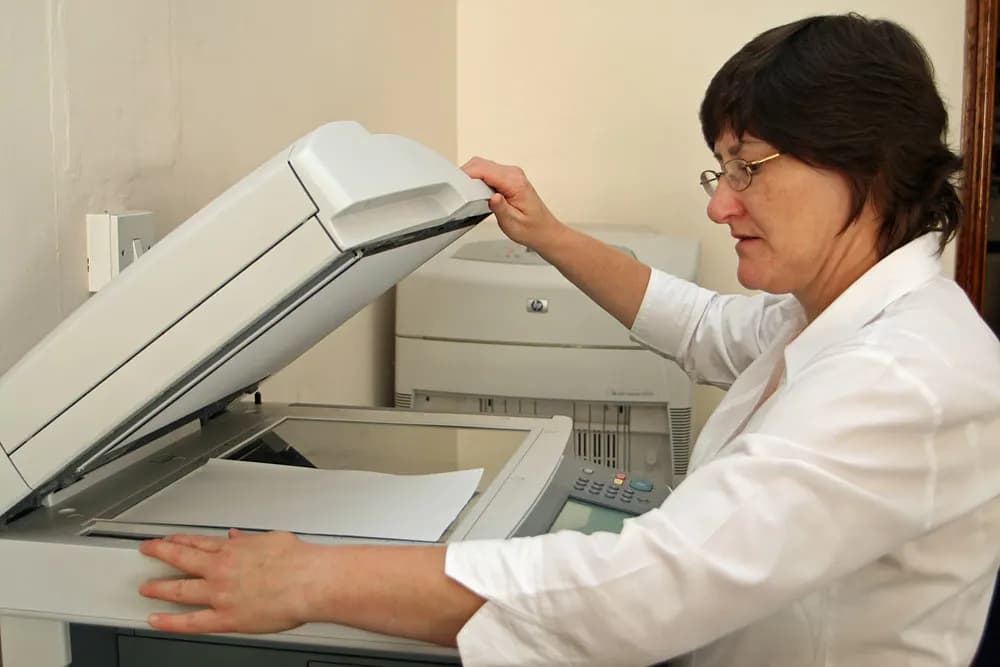
The copier. Most shops run an A3 black-and-white multifunction copier that copies, prints from a computer and scans. Speed is quoted in pages per minute (ppm); 25–35 ppm suits a neighbourhood shop, while a busy college shop needs 45 ppm or more and an automatic document feeder that copies both sides. Ask for the machine's duty cycle (pages a month it is built for), the drum and toner yield, and the dealer's cost per copy for service and consumables. Current IndiaMART listings show A3 black-and-white multifunction copiers at roughly ₹80,000 to ₹3.5 lakh, and colour copiers from about ₹75,000 for older models to ₹2.5 lakh and more; many lower-priced listings are used or refurbished machines.
New, refurbished or rented. Refurbished imported copiers dominate small shops because they cost less, but check the meter reading, the remaining life of the drum and fuser, and whether a technician nearby services that model. Dealers also rent copiers — listings show ₹2,500 to ₹7,500 a month — or offer cost-per-copy contracts where you pay for pages and they handle service and toner. A cost-per-copy plan protects a new shop from a surprise repair bill.
Colour. A colour laser printer or an ink-tank inkjet handles photos and colour pages. Ink-tank printers cost little to buy and run for photos, while colour lasers are faster for documents. A colour copier is worth it only near offices and institutes that print colour in volume.
Finishing and the rest. A spiral binding machine (manual models listed at about ₹2,000 to ₹10,000), an A3 pouch laminator (about ₹2,800 to ₹15,000), a paper cutter, a stapler and punch, a computer with a good scanner, a UPS or inverter for power cuts, a counter and shelves. Keep a second, smaller printer as a backup so the shop doesn't stop when the main copier is under repair.
Setup cost (estimate)
The table is a MSMETOOLS estimate for a 100–200 sq ft xerox and printing shop in a tier-2 city in 2026, based on the IndiaMART listings above. Metro rents, new branded copiers and colour copiers push the top end higher. Replace every line with real quotes in the startup cost calculator.
| Setup item | Estimated range | Worked plan | Basis / notes |
|---|---|---|---|
| Shop deposit and advance rent | ₹30,000 – ₹1,00,000 | ₹50,000 | 3–6 months' rent |
| Counter, shelves, wiring, lighting, signboard | ₹30,000 – ₹80,000 | ₹45,000 | Dedicated circuit for the copier |
| A3 B&W multifunction copier (refurbished or new) | ₹80,000 – ₹3,50,000 | ₹1,30,000 | IndiaMART listings |
| Colour laser or ink-tank printer | ₹15,000 – ₹60,000 | ₹25,000 | |
| Spiral binding machine and laminator | ₹5,000 – ₹25,000 | ₹12,000 | IndiaMART listings |
| Computer, scanner, UPS or inverter, backup printer | ₹40,000 – ₹90,000 | ₹55,000 | Power backup is essential |
| Opening stock: paper, toner, ink, spiral coils, pouches, stationery | ₹25,000 – ₹70,000 | ₹40,000 | |
| Registrations, billing software, launch | ₹5,000 – ₹20,000 | ₹8,000 | |
| Working capital (about two months of fixed costs) | ₹50,000 – ₹1,00,000 | ₹75,000 | |
| Total | ₹2,80,000 – ₹8,95,000 | ₹4,40,000 |
Cost per page and pricing
Profit in a xerox shop comes down to paise. Work out your own cost per page before you set prices, using the figures from your paper supplier and copier dealer.
- Paper. A 500-sheet ream of 70–75 gsm A4 copier paper divided by 500 gives the paper cost per sheet — typically 35–45 paise depending on brand and city. Remember paper now carries 18% GST, which you can claim back only if you're registered under the regular scheme. Our GST on paper guide explains the September 2025 change.
- Toner and drum. Divide the cost of a toner cartridge and the drum by their rated page yields at 5% coverage. For most A3 copiers this works out to roughly 8–15 paise a page; dense pages such as scanned notes use more.
- Service and spares. A service contract or your own repair spending, divided by monthly pages. Budget 3–5 paise a page.
- Electricity. A copier draws most power when warming up and copying; a few paise a page at commercial tariffs.
Add these up and a black-and-white A4 copy typically costs 45–55 paise in consumables. Colour pages cost several times more, mostly in toner or ink.
The table is a MSMETOOLS estimate of typical counter prices in 2026, built from that cost structure and common local practice; college areas and small towns sit at the lower end, metros and business districts at the upper end. Check five nearby shops before you set yours.
| Service | Typical counter price (estimate) |
|---|---|
| B&W photocopy or print, A4 single side | ₹1 – ₹3 |
| B&W, double side (per sheet) | ₹2 – ₹4 |
| B&W A3 or legal | ₹3 – ₹6 |
| Colour print, A4 | ₹10 – ₹30 |
| Passport photos (set of 6–8) | ₹50 – ₹100 |
| Spiral binding (by thickness) | ₹30 – ₹80 |
| Lamination, ID size / A4 | ₹10 – ₹20 / ₹30 – ₹60 |
| Scanning to PDF (per page) | ₹2 – ₹10 |
Two pricing habits help. Offer a lower rate for bulk orders that fill the machine's idle hours — coaching institutes, schools and lawyers' offices. And price add-ons sensibly: a ₹50 binding on a ₹100 project report is where your margin comes from.
GST on photocopying and printing
Registration. A print shop that supplies services must register once aggregate turnover crosses ₹20 lakh in a year (₹10 lakh in special category states). The higher ₹40 lakh limit is only for businesses that supply goods exclusively, so a shop that copies and prints uses the services threshold even if it also sells stationery. Our GST registration guide covers the steps.
Photocopying and printouts are services. When a customer brings a document or a file and you copy or print it on your paper, you are supplying printing and reproduction services under heading 9989. The general rate for that heading in Notification 11/2017–Central Tax (Rate) is 18% (9% CGST plus 9% SGST), and the September 2025 rate changes did not amend it. The same applies to scanning, lamination and binding sold with copies, which are usually part of one composite supply with printing as the principal service.
Service or goods? The printing circular. Bigger printing jobs raise a classification question that CBIC's Circular 11/11/2017-GST answers with the principal supply test:
- When you print books, pamphlets, brochures, annual reports and the like with the customer's content on your own paper, the printing is the principal supply, so it's a service under heading 9989.
- When you supply printed envelopes, letter cards, printed boxes, tissues, napkins or wallpaper carrying the customer's logo or design, made from your own paper, the goods are the principal supply, and you charge the GST rate for those goods under Chapter 48 or 49.
The services rate entry for heading 9989 also has concessional sub-entries for printing certain goods where only content is supplied by the publisher; check the current consolidated notification before quoting a publisher for book printing.
Job work at 5%. If a customer supplies the paper and you only print on it — say, a publisher sends its own paper for textbooks — that's job work. Since 22 September 2025, Notification 15/2025–Central Tax (Rate) taxes job-work printing of newspapers, books and periodicals, and of Chapter 48 or 49 goods that are themselves at 5% or nil, at 5%. See our GST on job work guide.
Which GST treatment applies to your job?
| Job | Whose paper | Treated as | GST |
|---|---|---|---|
Photocopies, printouts, scans for walk-in customers | Yours | Printing service, heading 9989 | 18% |
Pamphlets, brochures, reports with customer's content | Yours | Printing service, heading 9989 (Circular 11/11/2017) | Check current 9989 sub-entry; general rate 18% |
Printed envelopes or cartons with customer's logo | Yours | Goods, Chapter 48/49 | Rate of the goods |
Printing books on paper the publisher supplies | Customer's | Job work, heading 9988 | 5% |
Stationery sold over the counter | — | Goods | Rate for each item |
Photocopies, printouts, scans for walk-in customers
- Whose paper
Yours
- Treated as
Printing service, heading 9989
- GST
18%
Pamphlets, brochures, reports with customer's content
- Whose paper
Yours
- Treated as
Printing service, heading 9989 (Circular 11/11/2017)
- GST
Check current 9989 sub-entry; general rate 18%
Printed envelopes or cartons with customer's logo
- Whose paper
Yours
- Treated as
Goods, Chapter 48/49
- GST
Rate of the goods
Printing books on paper the publisher supplies
- Whose paper
Customer's
- Treated as
Job work, heading 9988
- GST
5%
Stationery sold over the counter
- Whose paper
—
- Treated as
Goods
- GST
Rate for each item
Composition. A small print shop with turnover up to ₹50 lakh can opt for the services composition scheme and pay 6% of turnover. You then can't charge GST on bills or claim input credit on the copier, paper and toner — a real loss, because paper now carries 18% and a copier purchase carries 18%. Composition can still suit a shop whose customers are mostly students and individuals who can't use credit anyway. Compare both in our composition scheme guide.
Worked example. A registered shop prints 200 pages of a project report at ₹2 a page and binds it for ₹50. The bill is ₹450 plus 18% GST of ₹81 (₹40.50 CGST + ₹40.50 SGST), or ₹531 in all. If you prefer round inclusive prices, ₹450 inclusive means a taxable value of ₹381 and GST of ₹69.
Copyright: what you can and can't copy
Photocopy shops sit close to copyright law, and publishers have taken action against shops that copy textbooks in bulk. The Copyright Act, 1957 lists acts that are not infringement in section 52. Two matter most to a xerox shop:
- Fair dealing for private or personal use, including research (section 52(1)(a)(i)) — a person copying limited material for their own study.
- Reproduction by a teacher or a pupil in the course of instruction (section 52(1)(i)) — material copied for teaching in a class.
These exceptions describe the purpose of the person making or ordering the copy. They do not let a shop run off dozens of copies of a whole textbook and sell them over the counter, keep a "master copy" of a popular guide to sell on demand, or copy and sell question banks and coaching material belonging to someone else. Knowingly infringing copyright, or abetting it, is an offence under section 63, punishable with imprisonment of six months to three years and a fine of ₹50,000 to ₹2 lakh, and the court can reduce the minimum only where the infringement was not for gain in trade or business. Copyright owners can also sue for damages and seize infringing copies.
A sensible shop policy: copy what customers bring for their own use, decline orders for multiple copies of entire copyrighted books or paid course material, don't keep stock of photocopied books for sale, and never copy currency notes, stamp papers or identity documents for anyone other than their holder.
Before you open
0/7Licences, e-waste and other registrations
A xerox shop needs only routine registrations. Every state's Shops and Establishments Act applies to commercial premises with staff; many states now need only an online intimation for small shops (Maharashtra, for example, requires full registration only from 20 or more workers). A municipal trade licence is needed in many cities. Free Udyam registration helps with bank loans.
Photocopiers and printers are listed equipment under the E-Waste (Management) Rules, 2022, but rule 2(c) excludes micro enterprises, which covers nearly every xerox shop. Even so, used toner cartridges, drums and dead machines shouldn't go in the municipal bin. Return cartridges to the dealer or a refiller, and sell old machines only to registered recyclers or refurbishers.
Worked example: monthly profit and break-even
Here's a sample plan for "Campus Copy Centre", a 150 sq ft shop opposite a college in a tier-2 city, run by the owner with one helper, open 26 days a month. All figures are illustrative estimates, before GST.
Revenue assumption (per day): 2,500 B&W pages at an average ₹1.50 (₹3,750); 300 colour prints at ₹12 (₹3,600); 15 spiral bindings at ₹50 (₹750); 30 laminations at ₹20 (₹600); scanning, photos and form printing ₹800. Total about ₹9,500 a day, or ₹2,47,000 a month.
Variable cost (per day): B&W pages at 50 paise (₹1,250); colour at ₹4 a page (₹1,200); binding coils and lamination pouches (₹450); photo paper and other consumables (₹200). About ₹3,100 a day, or ₹80,600 a month — roughly a third of sales.
| Fixed monthly cost | Amount (estimate) |
|---|---|
| Rent (150 sq ft near a college) | ₹20,000 |
| Helper | ₹13,000 |
| Electricity (commercial tariff, copier and AC) | ₹8,000 |
| Copier service contract and spares reserve | ₹6,000 |
| Internet, phone, software | ₹1,500 |
| Accountant and GST filing | ₹1,500 |
| Loan EMI (₹2.5 lakh, 11%, 3 years) | ₹8,200 |
| Owner's salary | ₹25,000 |
| Total fixed costs | ₹83,200 |
- Monthly contribution = ₹2,47,000 − ₹80,600 = about ₹1,66,400
- Profit after the owner's salary = ₹1,66,400 − ₹83,200 = about ₹83,200 a month
- Break-even = fixed costs ÷ contribution margin (₹1,66,400 ÷ ₹2,47,000 = 67%) = about ₹1,23,500 of sales a month, or roughly ₹4,750 a day — about half the plan
Those are good numbers for a busy campus shop, and they show why location is everything. The same shop doing 1,200 copies and 100 colour prints a day, with less binding, takes about ₹4,200 a day and falls just short of covering its costs. Exam seasons and admission months bring peaks; summer holidays bring troughs that your working capital has to cover. If students make up most of the trade, the 18% GST you'll charge after crossing the threshold is a direct hit on price, so plan for it before you grow.
Try it — print shop break-even (units = days of sales)
Funding a xerox and printing shop
- Mudra loans — collateral-free credit: Shishu up to ₹50,000, Kishore up to ₹5 lakh. A copier and fit-out usually fits Kishore. See our Mudra loan guide.
- PMEGP — a print shop is a service unit, so projects up to ₹20 lakh can get a margin-money subsidy of 15% (urban, general) up to 35% (rural, special categories). See our PMEGP guide.
- Dealer finance or rental — many copier dealers offer instalments or monthly rental with service included, which keeps the upfront cost low while you test the location.
Mistakes that sink new print shops
- Buying the cheapest copier without service support. A machine that's down for a week in exam season costs more than the saving.
- Not knowing your cost per page. Charging ₹1 a page when paper and toner cost 55 paise leaves almost nothing for rent and wages.
- Bulk-copying books for sale. It invites raids, seizures and criminal cases under the Copyright Act.
- No power backup. Every power cut is lost sales and, for copiers, extra wear from repeated warm-ups.
- Ignoring add-ons. Binding, lamination, photos and form help turn a ₹10 visit into a ₹100 one.
Official links
- CBIC Circular 11/11/2017-GST — printing contractsService vs goods for printed matter
- Notification 11/2017-CT(Rate) — services ratesHeading 9989 printing services
- Notification 15/2025-CT(Rate)Job-work printing at 5% from 22 September 2025
- Copyright Act, 1957 (Copyright Office)Sections 52 and 63
- E-Waste (Management) Rules, 2022Micro-enterprise exclusion
- GST portalRegistration and composition option
- Udyam Registration portalFree MSME registration
What to do next
Stand outside your shortlisted locations at opening and closing time and count the people walking past with papers in hand, then talk to two copier dealers about cost-per-copy plans before you buy anything. Work out your cost per page from real paper and toner quotes, test your prices in the break-even calculator, and when you register for GST, the free invoice generator handles the tax lines for bulk customers.
This is general information, not legal or tax advice — confirm on the official source or with a professional.
Frequently asked questions
Our estimate for a 100–200 sq ft xerox and printing shop near a college, court or government office in a tier-2 city is about ₹2.5 lakh to ₹7 lakh. That covers a refurbished or new A3 black-and-white multifunction copier, a colour laser or inkjet printer, a lamination and spiral binding machine, a computer, furniture, the first paper and toner stock and working capital. A shop starting with one refurbished copier can open for under ₹2 lakh.
Photocopying, printouts, scanning, lamination and binding for walk-in customers are services. Printing and reproduction services fall under heading 9989, where the general rate is 18%. Printing on paper the customer supplies for books, newspapers or Chapter 48/49 goods at 5% or nil is job work at 5%. Printed goods such as envelopes or boxes made from your own paper are taxed as goods.
Copying a whole book that is in copyright and selling copies is infringement, punishable under section 63 of the Copyright Act with imprisonment of six months to three years and a fine of ₹50,000 to ₹2 lakh. Section 52 allows fair dealing for private or personal use, including research, and reproduction by a teacher or pupil in the course of instruction, but those exceptions protect the user's purpose, not a shop selling pirated copies. Refuse bulk copying of textbooks for resale.
In our worked example, a shop near a college making 2,500 black-and-white copies and 300 colour prints a day, plus binding and lamination, earns about ₹83,000 a month after paying a helper and the owner a ₹25,000 salary; with half that volume it barely breaks even. Paper and toner are about 45–55 paise of a ₹1.50–₹2 copy, so volume, machine uptime and add-on services decide profit.
There is no special licence for photocopying. You need your state's Shops and Establishments registration or intimation, a municipal trade licence where your city requires one, GST registration once turnover crosses ₹20 lakh (or earlier if you sell stationery across states), and optionally free Udyam registration for bank loans.
Refurbished A3 copiers cost far less and suit a shop testing demand, but check the meter reading, drum and fuser life and local service support. New machines cost more but come with warranty and lower per-page cost, and many dealers offer cost-per-copy or rental plans. If you expect more than 2,000 copies a day, a new or recent machine with a service contract usually costs less over three years.
Sources & verification
Figures on this page were checked against the sources below when it was last reviewed on 9 October 2026. Each rate and limit is stored once with its own official source and review date, and official update channels are monitored daily so changes are picked up. How we verify
- 1.Circular No. 11/11/2017-GST — clarification on taxability of printing contracts — CBIC / GST Council · accessed 9 October 2026
- 2.Notification No. 11/2017-Central Tax (Rate) — rates for services — CBIC · accessed 9 October 2026
- 3.Notification No. 15/2025–Central Tax (Rate), 17 September 2025 — Ministry of Finance / Gazette of India · accessed 9 October 2026
- 4.The Copyright Act, 1957 (with amendments) — Copyright Office — Copyright Office, Government of India · accessed 9 October 2026
- 5.E-Waste (Management) Rules, 2022 — Ministry of Environment, Forest and Climate Change (copy hosted by CPCB) · accessed 9 October 2026
- 6.CGST Act 2017, section 22 — persons liable for registration — CBIC · accessed 9 October 2026
- 7.Photocopier machine listings — IndiaMART · accessed 9 October 2026
- 8.Spiral binding machine listings — IndiaMART · accessed 9 October 2026
- 9.Lamination machine listings — IndiaMART · accessed 9 October 2026
MSMETOOLS is an independent platform and is not affiliated with any government agency, ministry or department.
Tools for this
Break Even Calculator
Find your break even point and units.
Startup Cost Calculator
Estimate how much capital you need to launch.
GST Calculator (India)
Calculate GST for your sales and purchases with current rates.
Invoice Generator
Create professional invoices with tax, logo and custom details.
Related guides
 Beauty Parlour Business Plan 2026: Costs, GST & ProfitRead guide
 Mobile Repair Business 2026: Setup Cost, Tools, GST & RulesRead guide
 Laundry Machine Business 2026: Setup Cost, Price List & GSTRead guide
 Paper Bag Making Business 2026: Cost, Machines, GST & ProfitRead guide
Official links open the government site in a new tab.