 Starting & growing a business
Mobile Repair Shop Business in India (2026): Training, Tools, Parts, GST, E-Waste Rules and a Worked Profit
Start a mobile repair business in 2026: training, a tools list with ₹ costs, parts sourcing, 18% GST on repairs, e-waste and IMEI rules, and a worked monthly profit.
 Edited by Sumeet YadavFounder & editor, MSMETOOLS · fact-checked against official sources
Contents (12)
- 1. What a mobile repair business actually does
- 2. Training: how to learn mobile repair
- 3. Mobile repairing tools list and setup cost (estimate)
- 4. Sourcing parts: grades, wholesalers and warranty
- 5. Licences and registrations for a mobile repair shop
- 6. E-waste, batteries and IMEI rules
- 7. GST on mobile repair services
- 8. Mobile repair price list (estimate)
- 9. Worked example: monthly profit and break-even
- 10. Funding a mobile repair shop
- 11. Mistakes that sink new repair shops
- 12. What to do next
Almost every Indian adult carries a smartphone, and most of them will crack a screen, wear out a battery or ruin a charging port before they are ready to buy a new one. That steady stream of breakdowns is why a small counter in a market lane can support a family. A mobile repair business is cheap to open, but it is a skill business first: customers come back to the technician who fixed their phone properly the first time, quoted honestly and did not lose their data. This guide is for people in India planning a repair counter, a full repair shop or a doorstep service. It covers training, a tools list with rupee estimates, sourcing parts, GST on repairs, the Shops Act, e-waste and IMEI rules, pricing and a worked monthly profit. Rules were checked against CPCB, CBIC, DoT and state sources in October 2026.
Quick answer
You can start a mobile repair shop with ₹2.5–6 lakh (our estimate for a small counter shop in a tier-2 city) after three to six months of hands-on training. No special licence is needed: register under your state's Shops and Establishments Act, take a trade licence if your city asks for one, and register for GST once turnover crosses ₹20 lakh. Repairs are taxed at 18%.
Most money comes from screens, batteries and charging ports; chip-level board repair earns the best margins
Micro enterprises are outside the E-Waste Rules 2022, but buying, repairing and reselling used phones at scale makes you a 'refurbisher' who must register with CPCB
Changing an IMEI is a crime: up to three years' imprisonment, a fine of up to ₹50 lakh, or both
Worked example: break-even at about 4–6 repair jobs a day, depending on accessory sales
What a mobile repair business actually does
Before you choose a shop or buy tools, decide which jobs you will take, because that decides your training, your equipment and how much money you need to stock parts.
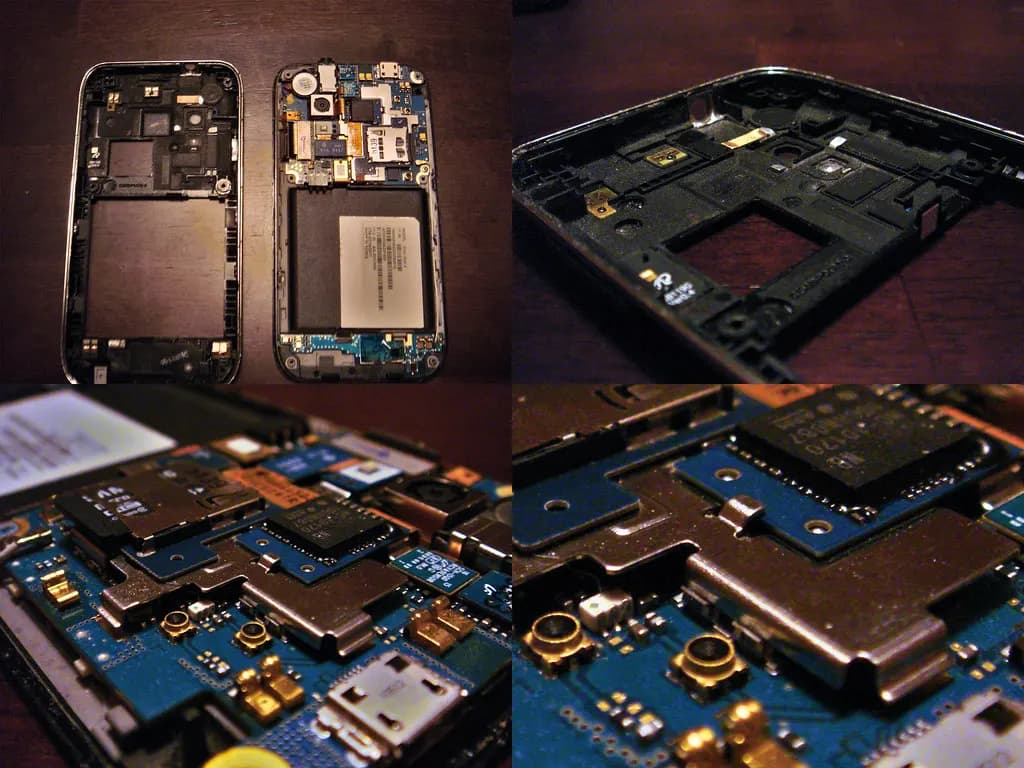
- Module-level repairs. Replacing a cracked display, a swollen battery, a loose charging port, a speaker, a camera or a back panel. These make up most of the walk-in work, need moderate skill and modest tools, and carry a margin on both the part and the labour.
- Software work. Flashing firmware, fixing boot loops, removing malware, backing up and restoring data, and setting up new phones. The tools are a computer and licensed software; the risk is data loss, so customers must sign off before you wipe a phone.
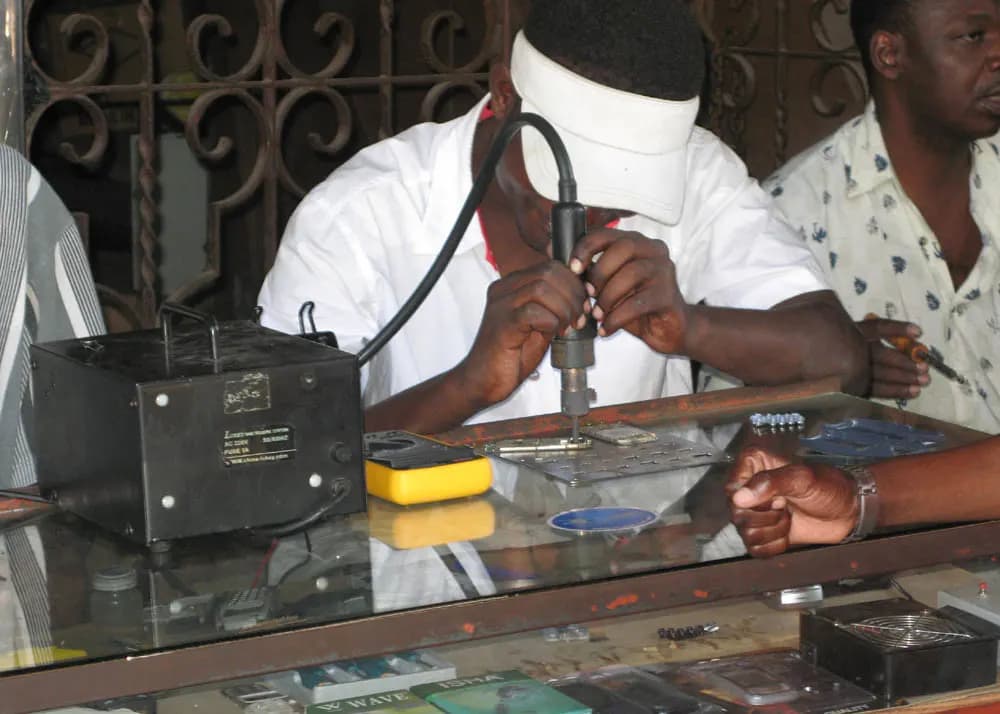
- Chip-level (board) repairs. Diagnosing a dead phone with a DC power supply and multimeter, replacing charging ICs, reballing chips and fixing water damage. This needs a microscope, a hot-air rework station and real experience, but a technician who can do it gets referrals from other shops.
- Accessories. Tempered glass, covers, chargers, cables and earphones. They add footfall and a margin of their own, and fitting a screen guard is a five-minute job that brings customers back.
Most new shops start with module repairs and accessories, then add board work once the technician is confident. Many experienced technicians also take "outsourced" jobs from smaller counters that cannot do chip-level work themselves.
Training: how to learn mobile repair
There is no licence or compulsory qualification to repair phones in India, but customers and phone owners trust a technician who can show training. The Telecom Sector Skill Council's Handheld Devices (Handset & Tablet) Technician qualification (TEL/Q2201) is pitched at NSQF level 4. Its standards cover diagnosing faults, replacing modules, chip-level repair, BGA reballing, OCA lamination of displays and flashing with dedicated tools, and they set a minimum job-entry age of 18. Courses mapped to such qualifications are run by skill-training partners, ITIs and some state skill missions, sometimes free under government programmes.
Private training institutes in electronics markets such as Delhi's Gaffar Market, Mumbai's Lamington Road or Bengaluru's SP Road advertise courses of one to three months. A short course teaches you the names of parts and the tools; it does not make you a technician. Plan on three to six months working beside an experienced repairer — paid or unpaid — before you open your own counter, and practise on dead phones bought as scrap before you touch a customer's handset.
Phone makers also run authorised service networks. Becoming an authorised service centre gives you brand training, genuine parts and warranty work, but it comes with investment, staffing and premises standards set by the brand. Most independent owners start on their own and apply later, once they have a track record.
Mobile repairing tools list and setup cost (estimate)
The table is a MSMETOOLS estimate for a 100–200 sq ft counter shop in a tier-2 city in 2026. Tool lines are based on current IndiaMART listings: common hot-air rework stations are listed at about ₹2,250 to ₹9,600, with premium stations around ₹38,000 to ₹40,000, and trinocular repair microscopes at about ₹12,000 to ₹25,000. Metro rents and imported tool brands cost more. Replace every line with your own quotes.
| Setup item | Estimated range | Worked plan | Basis / notes |
|---|---|---|---|
| Shop deposit and advance rent | ₹30,000 – ₹1,00,000 | ₹60,000 | 3–6 months' rent |
| Counter, glass display, workbench, ESD mat, lighting, wiring | ₹40,000 – ₹1,00,000 | ₹60,000 | Bright, shadow-free light at the bench |
| Hot-air rework and soldering station | ₹4,000 – ₹40,000 | ₹9,000 | IndiaMART listings |
| Stereo or trinocular microscope | ₹10,000 – ₹25,000 | ₹15,000 | IndiaMART listings; needed for board work |
| DC power supply, multimeter, USB tester | ₹4,000 – ₹12,000 | ₹7,000 | Diagnosing dead phones |
| Screen separator, OCA laminator, bubble remover | ₹15,000 – ₹60,000 | ₹25,000 | Only if you refurbish displays |
| Hand tools: precision screwdrivers, pry tools, tweezers, suction cups, adhesives, flux, solder, cleaning liquid | ₹5,000 – ₹15,000 | ₹8,000 | Replace consumables monthly |
| Laptop and licensed flashing/diagnostic software | ₹30,000 – ₹70,000 | ₹40,000 | Avoid cracked tools |
| Opening stock: displays, batteries, ports for popular models; accessories | ₹50,000 – ₹1,50,000 | ₹80,000 | Stock only fast-moving models |
| Shop registration, signboard, billing software, launch | ₹10,000 – ₹30,000 | ₹15,000 | |
| Working capital (about two months of fixed costs) | ₹60,000 – ₹1,20,000 | ₹90,000 | Slow first months |
| Total | ₹2,58,000 – ₹6,22,000 | ₹4,09,000 |
Two choices change the budget most. The first is display refurbishing: separating and re-laminating glass onto a working panel saves money on expensive displays, but the machines and a dust-free corner add ₹25,000 to ₹60,000, and poor lamination leads to comebacks. The second is stock. Holding displays for every model ties up lakhs; most shops keep parts only for the ten or fifteen best-selling models in their area and order the rest the same day from a wholesaler. Build your own budget in the startup cost calculator.
Sourcing parts: grades, wholesalers and warranty
Parts are the biggest variable cost and the biggest source of complaints, so know what you are buying.
- Original or service-pack parts come from the phone maker's service network or from distributors that buy service stock. They fit and perform like the factory part and cost the most.
- High-copy or compatible parts are made by third parties to fit a model. Quality ranges from excellent to poor; a cheap display may have weaker brightness, slower touch or higher battery drain.
- Pulled or refurbished parts come out of other phones — for example, a working panel from a phone with a dead board. They can be good value but carry more risk.
Wholesale markets in Delhi, Mumbai, Kolkata, Chennai, Hyderabad and Bengaluru, plus trade-only online suppliers, ship parts overnight to most towns. Buy from suppliers who give a GST invoice and a replacement warranty, test every display and battery before fitting, and tell the customer in writing which grade you are using. A simple rule prevents most arguments: offer two prices — original and compatible — and let the customer choose.
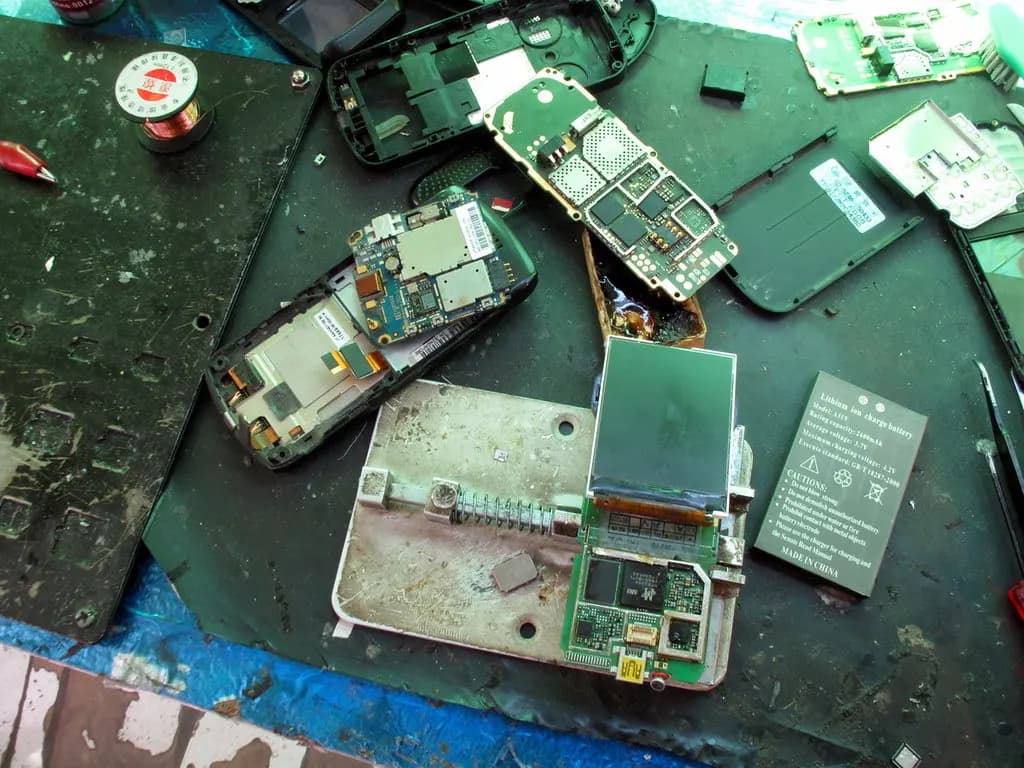
Batteries deserve extra care. A swollen or punctured lithium-ion battery can catch fire, so store spares in a metal box away from heat, never charge a damaged battery, and keep a sand bucket or a suitable extinguisher at the bench.
Licences and registrations for a mobile repair shop
A repair shop needs only routine registrations, but skipping them causes trouble with landlords, banks and the municipality.
- Shops and Establishments. Every state has its own Shops and Establishments Act, administered by the labour department. Requirements depend on headcount. In Maharashtra, for example, establishments with fewer than 20 workers now file only an online intimation, and registration is needed from 20 or more workers under the 2025 amendment effective 1 October 2025. Other states use different limits and fees; check your state labour portal. Our Tamil Nadu guide shows how one state handles it.
- Trade licence. Many municipal corporations require a trade licence for any shop. Ask at the ward office before you sign a lease.
- GST registration once you cross the threshold (see the next section) or earlier if suppliers and corporate customers ask for a GSTIN.
- Udyam registration is free and helps with bank loans and priority-sector lending. See our Udyam registration guide.
- Professional tax in states that levy it, once you employ staff or as an enrolled business owner.
- Trade mark if you plan to grow a brand or open branches; check the name is free first.
If your shop sells phones as well as repairing them, the same registrations apply. Selling new phones also means checking with your distributor that every handset's IMEI is registered, because phones with unregistered or tampered IMEIs can be blocked on networks.
E-waste, batteries and IMEI rules
Repair shops produce a steady stream of dead displays, boards, cables and batteries, and they handle phones whose identity is protected by law. Three sets of rules matter.
E-Waste (Management) Rules, 2022. These rules, in force since 1 April 2023 and amended in 2023 and 2024, define e-waste to include "rejects from manufacturing, refurbishment and repair processes", and mobile phones are listed equipment. But rule 2(c) says the rules do not apply to micro enterprises as defined in the MSMED Act — and almost every one- or two-counter repair shop is a micro enterprise. If your business grows beyond micro size, or you run a chain, the rules start to bite. A refurbisher — someone who repairs or assembles used equipment to extend its life "and selling the same in the market" — must register on the CPCB portal, hand repair waste to a registered recycler, upload the details, meet the BIS and MeitY standards for refurbished products and file quarterly and annual returns. Fixing a customer's own phone and handing it back is not refurbishing under this definition; buying used phones, repairing them and reselling them is.
A business that is not a micro enterprise and has used 1,000 units or more listed devices in a year is a bulk consumer, and must hand its e-waste only to a registered producer, refurbisher or recycler.
Do the E-Waste Rules 2022 apply to your shop?
| Your business | Covered? | What you must do |
|---|---|---|
Micro enterprise repairing customers' phones | No (rule 2(c)) | Good practice: give waste to a registered recycler |
Larger shop or chain repairing customers' phones | Yes, as a source of repair rejects | Send e-waste to registered recyclers; bulk-consumer rules if 1,000+ devices used |
Buying used phones, repairing and reselling (beyond micro size) | Yes — refurbisher | Register on the CPCB portal, file quarterly and annual returns, meet BIS/MeitY standards |
Dead lithium-ion batteries | No — Battery Waste Management Rules, 2022 | Store safely; hand to an authorised collector |
Micro enterprise repairing customers' phones
- Covered?
No (rule 2(c))
- What you must do
Good practice: give waste to a registered recycler
Larger shop or chain repairing customers' phones
- Covered?
Yes, as a source of repair rejects
- What you must do
Send e-waste to registered recyclers; bulk-consumer rules if 1,000+ devices used
Buying used phones, repairing and reselling (beyond micro size)
- Covered?
Yes — refurbisher
- What you must do
Register on the CPCB portal, file quarterly and annual returns, meet BIS/MeitY standards
Dead lithium-ion batteries
- Covered?
No — Battery Waste Management Rules, 2022
- What you must do
Store safely; hand to an authorised collector
Batteries. Waste batteries are excluded from the e-waste rules because they are covered by the separate Battery Waste Management Rules, 2022. In practice, keep dead lithium-ion batteries in a closed, non-flammable container and give them to an authorised collector or recycler.
Even when the rules don't apply to you, the practical answer is the same: keep a box for boards and displays and another for batteries, and hand them to a registered recycler or collection centre instead of the municipal bin or a scrap dealer who burns boards for metal. Some recyclers collect free from shops once you have enough volume.
IMEI tampering. The DoT has repeatedly warned that tampering with a telecom identifier such as an IMEI is an offence under section 42(3)(c) of the Telecommunications Act, 2023, punishable with up to three years' imprisonment, a fine of up to ₹50 lakh, or both. The offence is cognizable and non-bailable, abetting it carries the same punishment, and the Telecom Cyber Security Rules, 2024 bar anyone from possessing or dealing in hardware or software configured to change an IMEI. Customers sometimes ask a shop to "repair" a blocked IMEI, or to unlock a phone reported stolen. Refuse, record the request, and keep only legitimate service tools. Before buying any used phone, check that it is not reported lost or stolen on the DoT's Sanchar Saathi portal.
Before you open the counter
0/8GST on mobile repair services
Repair and maintenance services fall under heading 9987 and are taxed at 18% — 9% CGST plus 9% SGST within your state — with full input tax credit on the parts, tools and rent you pay GST on. Mobile phones, parts and accessories sold as goods also carry 18%, so a shop rarely has to juggle two rates. Our GST on mobile phones guide covers handsets and accessories in detail.
When a part is fitted. A screen replacement involves both a part and labour. Under the CGST Act, two or more supplies naturally bundled together, where one is the principal supply, form a composite supply taxed at the rate of the principal supply. For a repair, the service is usually the principal supply, so the whole bill is taxed at 18%. Showing the part and labour as separate lines on the invoice is good practice for the customer, but it does not change the rate here because both are 18%.
When to register. A business that supplies services must register once aggregate turnover crosses ₹20 lakh in a year (₹10 lakh in special category states). The higher ₹40 lakh limit is only for businesses that supply goods exclusively, so a shop that repairs as well as sells accessories uses the services threshold. Our GST registration guide covers the steps.
Composition. A small repair shop can choose the composition scheme instead of the regular scheme. If the shop is mainly a service business with turnover up to ₹50 lakh, the services composition option charges 6% of turnover. If it is mainly a trader in phones and accessories, the regular composition scheme for traders allows services of up to 10% of turnover or ₹5 lakh, whichever is higher. Composition means no GST on your bills and no input credit on the parts and tools you buy — a poor trade if you buy most parts with GST invoices. Compare both in our composition scheme guide.
Income tax. A proprietor can use presumptive taxation, declaring 8% of turnover as profit (6% on digital receipts) up to ₹2 crore. See our presumptive taxation guide.
Mobile repair price list (estimate)
Customers compare prices on WhatsApp and Google before they walk in, so publish a clear price list. The table is a MSMETOOLS estimate of typical charges at independent shops in 2026 for mid-range Android phones, including the part. It is corroborated by an online doorstep service that lists screen replacement from ₹1,499, battery from ₹1,199, charging port from ₹899 and motherboard repair from ₹2,999; walk-in shops in smaller towns usually charge less. Flagship and premium phones cost several times more because their displays do.
| Job (mid-range Android) | Typical customer price (estimate) | Typical part cost share |
|---|---|---|
| Tempered glass fitted | ₹100 – ₹300 | 20–40% |
| Charging port or sub-board | ₹400 – ₹1,000 | 30–50% |
| Battery replacement | ₹800 – ₹1,800 | 50–60% |
| Display (LCD) replacement | ₹1,200 – ₹3,000 | 55–70% |
| Display (AMOLED) replacement | ₹3,000 – ₹9,000 | 60–75% |
| Software flashing, data backup | ₹300 – ₹800 | Nil |
| Water damage cleaning (no parts) | ₹500 – ₹1,500 | Nil |
| Chip-level board repair | ₹800 – ₹3,500 | 10–25% |
Two policies matter as much as the prices. First, a diagnosis charge — many shops charge ₹100 to ₹300 to inspect a dead phone and waive it if the customer goes ahead. Second, a written warranty: state how long the part is covered (commonly 30 to 90 days for compatible parts), what voids it (physical or water damage), and that the shop is not responsible for data on phones that arrive dead. Print these on the job card the customer signs.
Worked example: monthly profit and break-even
Here's a sample plan for "QuickFix Mobiles", a 150 sq ft counter shop in a tier-2 city market, run by the owner-technician with one assistant, open 28 days a month. All figures are illustrative estimates, before GST.
Revenue assumption: 10 repair jobs a day at an average of ₹900 = ₹9,000 a day or ₹2,52,000 a month. Accessories and screen guards add ₹2,000 a day of sales at a 40% gross margin, or ₹22,400 a month of margin.
Variable cost of repairs: parts at about 45% of repair revenue (₹1,13,400) and consumables such as adhesive, flux and cleaning liquid at about 2% (₹5,040) — about ₹1,18,440, or ₹423 per job. Contribution per repair job is ₹477, and the accessory margin adds to it.
| Fixed monthly cost | Amount (estimate) |
|---|---|
| Rent (150 sq ft market shop) | ₹18,000 |
| Assistant technician | ₹15,000 |
| Electricity, internet, phone | ₹4,000 |
| Software subscriptions and tool replacement | ₹3,000 |
| Marketing (Google listing, local offers) | ₹2,000 |
| Accountant and GST filing | ₹2,000 |
| Loan EMI (₹2 lakh, 11%, 3 years) | ₹6,500 |
| Owner's salary | ₹25,000 |
| Total fixed costs | ₹75,500 |
- Monthly contribution = (₹2,52,000 − ₹1,18,440) + ₹22,400 = about ₹1,55,960
- Profit after the owner's salary = ₹1,55,960 − ₹75,500 = about ₹80,460 a month
- Break-even = (₹75,500 − ₹22,400 accessory margin) ÷ ₹477 = about 111 jobs a month, or 4 a day; without accessories, about 158 jobs or 6 a day
These numbers assume the shop is busy. A new counter often does three or four jobs a day for the first months, and part prices for popular models change monthly. Stress-test the plan at 8 jobs a day and a 50% parts share: profit falls to about ₹44,000 after the owner's salary. Comebacks — a display that fails within the warranty — cost the part twice and a customer, which is why quality parts pay for themselves.
Try it — repair shop break-even
Funding a mobile repair shop
- Mudra loans — collateral-free business loans through banks and NBFCs: Shishu up to ₹50,000, Kishore up to ₹5 lakh and Tarun up to ₹10 lakh. A repair shop budget usually fits Kishore. See the Mudra loan guide.
- PMEGP — repair shops are service units, so projects up to ₹20 lakh can get a margin-money subsidy of 15% (urban, general) up to 35% (rural, special categories). See our PMEGP guide.
- Supplier credit — established parts wholesalers give regular buyers a week or two of credit; ask once you have a track record.
Mistakes that sink new repair shops
- Opening before you can repair. A course certificate does not replace months at a bench. Early failures destroy word of mouth.
- No job card. Without the customer's signature on the condition of the phone, the part grade and the data-loss risk, every dispute becomes your word against theirs.
- Overstocking parts. Displays for slow-selling models become dead stock within a year as models change.
- Buying used phones without checks. Stolen phones and tampered IMEIs can bring the police to your counter. Check the IMEI and keep the seller's ID and a written sale note.
- Dumping e-waste. Boards and batteries in the municipal bin are a fire risk and a pollution problem; a recycler tie-up costs little.
Official links
- E-Waste (Management) Rules, 2022 (CPCB)Micro-enterprise exclusion, refurbisher duties
- CPCB — e-waste rules and amendments2023 and 2024 amendments
- CPCB EPR portal for e-wasteRefurbisher and recycler registration
- DoT caution on IMEI tampering (PIB)Section 42(3)(c), Telecommunications Act, 2023
- Sanchar SaathiCheck a used phone's IMEI before buying
- GST portalRegistration and composition option
- Udyam Registration portalFree MSME registration
What to do next
Spend a few weeks counting what comes into the shops near your chosen spot — which models, which faults, what they charge — and decide whether you will compete on speed, on board-level skill or on price. Put your rent, salaries and EMI into the break-even calculator, print a job card and warranty policy before your first customer, and turn the plan into a bank-ready document with the business plan generator. When you start billing, the free invoice generator handles GST lines.
This is general information, not legal or tax advice — confirm on the official source or with a professional.
Frequently asked questions
Our estimate for a 100–200 sq ft counter shop in a tier-2 city is about ₹2.5 lakh to ₹6 lakh. That covers deposit and fit-out, a hot-air rework and soldering station, a stereo microscope, a DC power supply, screen separating and laminating machines, hand tools, a starting stock of fast-moving parts and accessories, and two months of working capital. A shop that starts with screen, battery and charging-port jobs only can open for under ₹2 lakh.
Repair and maintenance services carry 18% GST. When you fit a part as part of the repair, the job is normally one composite supply with the repair as the main service, so the whole bill is taxed at 18%. Mobile parts and accessories sold over the counter are also 18%. You register once turnover crosses ₹20 lakh (₹10 lakh in special category states).
There is no special government licence to repair phones. You need your state's Shops and Establishments registration or intimation, a municipal trade licence where your city requires one, GST registration once you cross the threshold, and optionally free Udyam registration. If you buy, refurbish and resell used phones as a business that is not a micro enterprise, the E-Waste (Management) Rules, 2022 require registration as a refurbisher on the CPCB portal.
The E-Waste (Management) Rules, 2022 do not apply to micro enterprises as defined in the MSMED Act, which covers almost every single-counter repair shop. Larger repair chains are covered: anyone who repairs used phones and sells them must register as a refurbisher and send repair waste to a registered recycler. Every shop should still hand dead screens, boards and batteries to an authorised collector rather than the municipal bin.
No. Tampering with a phone's IMEI is an offence under section 42(3)(c) of the Telecommunications Act, 2023, punishable with up to three years' imprisonment, a fine of up to ₹50 lakh, or both. The Telecom Cyber Security Rules, 2024 also bar possessing hardware or software configured to alter IMEIs. Refuse any request to change or 'repair' an IMEI, and keep only flashing tools from the phone makers or reputable vendors.
In our worked example, a two-person shop doing 10 repair jobs a day at an average ticket of ₹900, plus accessory sales, earns about ₹80,000 a month after paying the owner a ₹25,000 salary; at 8 jobs a day with dearer parts it falls to about ₹44,000. Parts are about 45% of repair revenue. Earnings depend heavily on location, the mix of chip-level jobs, which carry high margins, and how many customers come back.
Sources & verification
Figures on this page were checked against the sources below when it was last reviewed on 9 October 2026. Each rate and limit is stored once with its own official source and review date, and official update channels are monitored daily so changes are picked up. How we verify
- 1.E-Waste (Management) Rules, 2022 (G.S.R. 801(E), 2 November 2022) — Ministry of Environment, Forest and Climate Change (copy hosted by CPCB) · accessed 9 October 2026
- 2.E-Waste (Management) Amendment Rules, 2023 and 2024 — Central Pollution Control Board · accessed 9 October 2026
- 3.Department of Telecommunications cautions citizens about consequences of IMEI tampering and telecom identifier misuse — PIB (Ministry of Communications) · accessed 9 October 2026
- 4.Notification No. 11/2017-Central Tax (Rate) — rates for services — CBIC · accessed 9 October 2026
- 5.CGST Act 2017, section 22 — persons liable for registration — CBIC · accessed 9 October 2026
- 6.Qualification Pack — Handheld Devices (Handset & Tablet) Technician, TEL/Q2201 v4.0 — Telecom Sector Skill Council (NSQC approved) · accessed 9 October 2026
- 7.Maharashtra Shops and Establishments (Amendment) Bill, 2025 — L.A. Bill No. LXXXIX of 2025 — PRS Legislative Research (Maharashtra Legislature text) · accessed 9 October 2026
- 8.SMD rework station listings — IndiaMART · accessed 9 October 2026
- 9.Microscope for mobile repairing listings — IndiaMART · accessed 9 October 2026
- 10.Phone repair service price list — Reuz · accessed 9 October 2026
MSMETOOLS is an independent platform and is not affiliated with any government agency, ministry or department.
Tools for this
Break Even Calculator
Find your break even point and units.
Startup Cost Calculator
Estimate how much capital you need to launch.
GST Calculator (India)
Calculate GST for your sales and purchases with current rates.
Invoice Generator
Create professional invoices with tax, logo and custom details.
Related guides
 Xerox and Printing Shop Business 2026: Cost, GST & ProfitRead guide
 Beauty Parlour Business Plan 2026: Costs, GST & ProfitRead guide
 GST on Mobile Phones 2026: 18% Rate, HSN 8517 & ITC RulesRead guide
 Event Management Business Plan 2026: Costs, GST & LicencesRead guide
Official links open the government site in a new tab.