 Starting & growing a business
How to Start a Tuition or Coaching Centre in India (2026): Guidelines, State Laws, GST and a Worked Profit
How to start a tuition or coaching centre in 2026: the 2024 central guidelines, state coaching laws, 18% GST, space and fire rules, fees and a worked monthly profit.
 Edited by Sumeet YadavFounder & editor, MSMETOOLS · fact-checked against official sources
Contents (11)
- 1. Choose your tuition model
- 2. The Ministry of Education's coaching guidelines (2024)
- 3. State coaching laws: Bihar, Haryana, Rajasthan and others
- 4. Premises, safety and the other registrations
- 5. GST on coaching and tuition
- 6. Income tax on tuition income
- 7. Setup cost (estimate)
- 8. Worked example: monthly profit and break-even
- 9. Funding a tuition centre
- 10. Mistakes that sink new tuition centres
- 11. What to do next
Tuition is one of the oldest small businesses in India. A teacher with a good reputation, a room and a whiteboard can fill evening batches for years, and families spend heavily on it: the government's 2025 education survey, as summarised by PRS, found about three in four secondary and higher-secondary students enrolled in private coaching. But coaching is no longer unregulated. The Ministry of Education issued national guidelines in 2024, several states have coaching laws, and GST applies once you grow. This guide is for teachers and first-time owners planning a home tuition, a neighbourhood tuition centre or a competitive-exam coaching institute. It covers the guidelines, state laws in Bihar, Haryana and Rajasthan, premises and safety, GST and income tax, setup costs and a worked monthly profit. Everything was checked against official and legislative sources in October 2026.
Quick answer
To start a tuition centre, pick your segment (school subjects or competitive exams), rent a safe, ventilated space of at least one square metre per student, register under your state's Shops and Establishments Act and any state coaching law, and charge 18% GST once turnover crosses ₹20 lakh. Budget roughly ₹3–8 lakh for a small centre (our estimate).
The Ministry of Education's coaching guidelines (16 January 2024) are advisory; states turn them into law
Bihar requires registration above more than 10 students (₹5,000 for 3 years); Haryana and Rajasthan have their own laws or bills
Publish fees, a pro-rata refund policy and batch sizes; no fee increase mid-course
Worked example: break-even at about 79 students with three paid teachers
Choose your tuition model
The model you choose decides which rules apply, how much space you need and what you can charge.
- Home tuition. A teacher takes small batches at home or at the student's home. It needs almost no investment and, in most states, no special registration, although Haryana's 2024 Act, for example, excludes individual home tuitions only up to 50 students a day. Growth is limited by the teacher's hours.
- Neighbourhood tuition centre (Classes 6–12). Two or three rooms in a market or residential area, school-subject batches in the evening, and three to six teachers. This is the most common small business format and the one in our worked example.
- Competitive-exam coaching. JEE, NEET, CUET, banking, SSC, state PSC or UPSC preparation for older students and graduates. Higher fees and longer courses, but it is the segment the state laws and central guidelines target most closely.
- Skill and hobby classes. Spoken English, computer courses, music, art or abacus. Some state laws exclude creative activities; Rajasthan's Bill, for example, leaves out sports, dance and theatre.
- Online or hybrid tuition. Live classes on video, recorded lectures and doubt-solving sessions. Low rent, but you compete with national edtech brands, and GST place-of-supply rules apply to students in other states.
Many centres start with school-subject batches and add a competitive-exam batch once they have teachers with a track record. Whatever you choose, decide early whether you'll take students under 16, because the central guidelines and some state laws treat younger students differently.
The Ministry of Education's coaching guidelines (2024)
On 16 January 2024 the Ministry of Education circulated Guidelines for Regulation of Coaching Center 2024 to all states and union territories. Education is on the concurrent list, so the guidelines are a model: they become binding when a state or union territory adopts them through its own law or rules. The Ministry's answer in the Rajya Sabha in July 2024 explained the reasons — unregulated centres, exorbitant fees, stress on students and suicides — and listed the core expectations.
- Fair fees. Fees must be fair and reasonable, and must not be increased while a course is running.
- Easy exit and refunds. A student who leaves mid-course should be able to exit easily and get a refund on a pro-rata basis.
- Mental well-being. Centres should prioritise counsellors and psychologists' support.
- No batch segregation. Students should not be split into batches by performance in a way that labels them.
- Not during school hours. Classes for students still in school must not clash with school timings, so regular attendance is not affected and "dummy schools" are discouraged.
- Workload. Coaching should not be excessive for a student.
The full guideline text also covers registration, a minimum age for enrolment (widely reported as 16 years or after the secondary school examination), tutor qualifications, misleading advertisements, infrastructure and penalties. We could not open the Ministry's PDF on the day we checked, so read those clauses on the Ministry of Education website before relying on them, and check what your own state has actually adopted.
How coaching regulation has developed
2001–2002
Goa and Uttar Pradesh pass early coaching laws
April 2010
Bihar Coaching Institute (Control & Regulation) Act, 2010
16 January 2024
Ministry of Education circulates coaching guidelines to states
30 May 2024
Haryana's Private Coaching Institutes Act, 2024 published
March–September 2025
Rajasthan Coaching Centres Bill introduced; Select Committee revises it
State coaching laws: Bihar, Haryana, Rajasthan and others
Several states regulate coaching through their own laws, and they differ sharply in who is covered.
Bihar. The Bihar Coaching Institute (Control & Regulation) Act, 2010 applies to any institute that coaches more than 10 students for competitive exams or academic support. You apply to the District Magistrate with a registration fee of ₹5,000; registration lasts three years and renewal costs ₹3,000. The application must state the curriculum, the maximum students per course, teachers' qualifications (at least graduates) and the fees in a prospectus. The premises must give at least one square metre per student, with furniture, lighting, drinking water, toilets, cleanliness, a fire extinguisher, medical treatment arrangements and cycle or vehicle parking. Penalties are ₹25,000 for the first offence and ₹1 lakh for the second, then cancellation.
Haryana. The Haryana Registration and Regulation of Private Coaching Institutes Act, 2024 covers institutes and tuition centres preparing students for competitive examinations, excluding individual home tuitions up to 50 students a day and regular courses of recognised institutions. Every covered institute must engage at least one full-time counsellor, must not publish misleading advertisements, and faces ₹25,000 for the first violation and ₹1 lakh for subsequent ones, then cancellation. The Act comes into force on a date the state notifies, so check with the district authority whether it is in force where you plan to open.
Rajasthan. Kota made Rajasthan the centre of the coaching debate. The Rajasthan Coaching Centres (Control and Regulation) Bill, 2025 was introduced in March 2025 and the Select Committee's revised version was presented on 1 September 2025. As recommended, it covers centres coaching more than 100 students, requires each branch to register for three years, sets infrastructure norms (one square metre per student, CCTV, fire and building safety certificates, separate toilets), a counselling system, fees payable in at least four instalments with pro-rata refunds of course, hostel and mess fees, classes of no more than five hours a day, and penalties of ₹50,000 for the first violation and ₹2 lakh for the second, then cancellation. Check the enacted text and rules before you open in Rajasthan.
Other states. PRS's comparison lists older laws in Goa (2001, covering more than five students and allowing the state to cap fees), Uttar Pradesh (2002, more than three students) and Manipur (2017). Other states rely on Shops Act, building and fire rules. Ask your district education office which law applies.
State coaching laws at a glance
| State | Who is covered | Registration | Penalties |
|---|---|---|---|
Bihar (2010 Act) | more than 10 students | ₹5,000, 3 years; renewal ₹3,000 | ₹25,000 for the first offence and ₹1 lakh for the second, then cancellation |
Haryana (2024 Act) | Competitive-exam coaching; home tuition up to 50 students a day excluded | With district authority | ₹25,000 for the first violation and ₹1 lakh for subsequent ones, then cancellation |
Rajasthan (2025 Bill) | more than 100 students | Each branch, 3 years | ₹50,000 for the first violation and ₹2 lakh for the second, then cancellation |
States without a coaching law | — | Shops Act, trade licence, fire and building rules | Under those laws |
Bihar (2010 Act)
- Who is covered
more than 10 students
- Registration
₹5,000, 3 years; renewal ₹3,000
- Penalties
₹25,000 for the first offence and ₹1 lakh for the second, then cancellation
Haryana (2024 Act)
- Who is covered
Competitive-exam coaching; home tuition up to 50 students a day excluded
- Registration
With district authority
- Penalties
₹25,000 for the first violation and ₹1 lakh for subsequent ones, then cancellation
Rajasthan (2025 Bill)
- Who is covered
more than 100 students
- Registration
Each branch, 3 years
- Penalties
₹50,000 for the first violation and ₹2 lakh for the second, then cancellation
States without a coaching law
- Who is covered
—
- Registration
Shops Act, trade licence, fire and building rules
- Penalties
Under those laws
Premises, safety and the other registrations
Whatever your state's coaching law says, the premises carry most of the risk. After deadly fires in coaching buildings in recent years, fire departments and municipal bodies inspect coaching centres closely.
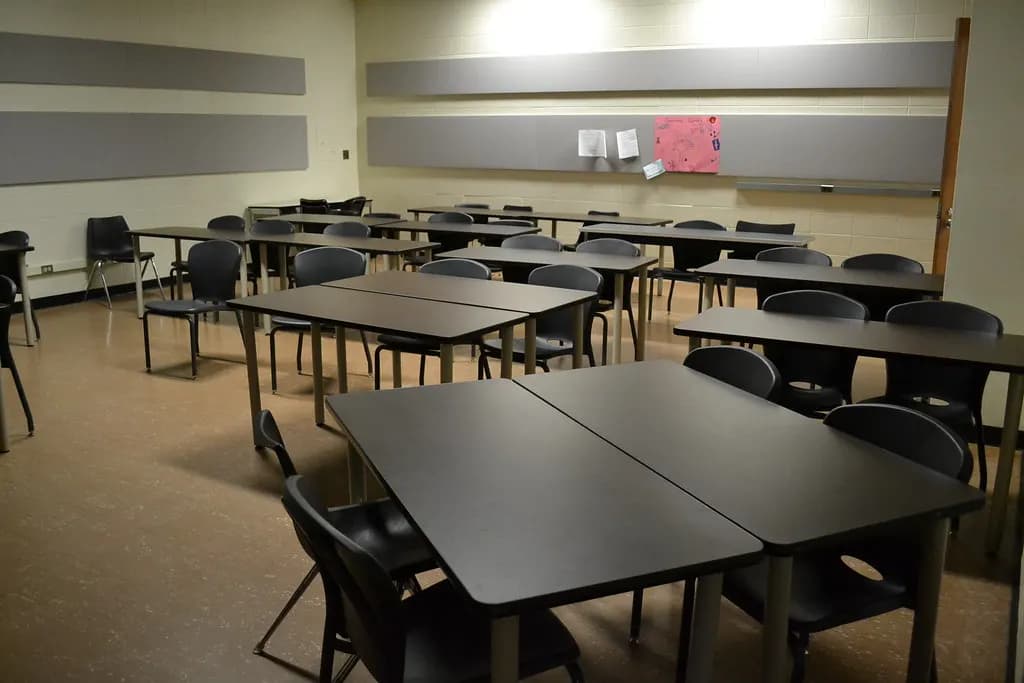
- Space. Plan on at least one square metre per student in a batch — the norm in the Bihar Act and the Rajasthan Bill — plus aisles and a clear exit. A 25-student batch needs a classroom of at least 25 sq m (about 270 sq ft) of usable floor.
- Fire safety. Extinguishers, emergency lighting, two exits where the building allows, and no classes in basements or on floors without a second staircase. A fire NOC is required for many commercial buildings and is usually demanded by the municipal body before it issues a trade licence; see our fire NOC guide.
- Building approval. Use premises approved for commercial or educational use. Classes in residential flats or stilt parking often fail inspection.
- Shops and Establishments. Commercial premises with staff need your state's Shops and Establishments registration or intimation through the labour department portal.
- Trade licence from the municipal corporation where required.
- CCTV, toilets and drinking water — required under the Rajasthan Bill and expected by parents anyway.
- Counselling. Haryana requires a full-time counsellor; elsewhere, a tie-up with a qualified counsellor and a written escalation process for students in distress is good practice and is what the central guidelines expect.
- Child safety. If you teach minors, police-verify every teacher and staff member, keep CCTV in common areas and adopt a written child-protection policy.
- Udyam registration is free and helps with bank loans; see our Udyam registration guide.
Before the first batch
0/7GST on coaching and tuition
Coaching and private tuition don't lead to a qualification recognised by law, so they fall outside the education exemption and are taxed at 18% — 9% CGST plus 9% SGST, or IGST for students in another state. The service code is SAC 999293 (commercial training and coaching). Fees charged by a recognised school or college to its own students are exempt, but that exemption follows the institution and the qualification, not the subject taught. Our GST on education guide explains the exemption in detail.
When to register. You must register once aggregate turnover crosses ₹20 lakh in a financial year (₹10 lakh in special category states). A home tutor with ₹6 lakh a year of fees doesn't need GST; a centre with 80 students paying ₹30,000 a year (₹24 lakh) does. Our GST registration guide covers the steps.
Inclusive or extra? Most parents compare the final figure. If your fee is ₹30,000 and you register, either charge ₹35,400 including GST or keep ₹30,000 inclusive, in which case your taxable value is ₹25,424 and GST is ₹4,576. Decide before you print the prospectus, because the guidelines and state laws frown on increases during a course.
Online students. For an unregistered student in another state, the place of supply is generally the student's address on record, so you charge IGST. Keep the student's state in your enrolment records.
Input tax credit. As a regular taxpayer you can claim credit for GST paid on rent, furniture, projectors, software and printed study material bought from registered suppliers, which partly offsets the 18%.
Composition. A small centre with turnover up to ₹50 lakh can choose the services composition scheme at 6% of turnover, without charging GST to students and without input credit. Because most students are families who can't claim credit anyway, composition often leaves more in your hands at small scale; compare both before you decide.
Income tax on tuition income
Running a tuition or coaching centre is treated as a business for income tax, not one of the specified professions such as medicine, law or accountancy. A resident proprietor can use presumptive taxation and declare 8% of gross receipts as profit, or 6% on receipts through banking or digital channels, as long as turnover stays within ₹2 crore (₹3 crore where cash receipts are small). From tax year 2026-27 this sits in section 58 of the Income-tax Act, 2025, the successor to section 44AD. Teachers employed by a school who also take private tuition report the tuition fees separately from salary. See our presumptive taxation guide.
Setup cost (estimate)
The table is a MSMETOOLS estimate for a 400–600 sq ft tuition centre in a tier-2 city with two classrooms of about 25 students each, in 2026. Metro rents and smart-classroom hardware cost more. Replace every line with your own quotes in the startup cost calculator.
| Setup item | Estimated range | Worked plan |
|---|---|---|
| Deposit and advance rent | ₹60,000 – ₹2,00,000 | ₹1,00,000 |
| Partitions, wiring, lighting, fans or AC, flooring | ₹50,000 – ₹2,00,000 | ₹80,000 |
| Desks and chairs for 50 students, teacher tables | ₹50,000 – ₹1,20,000 | ₹75,000 |
| Whiteboards, projector or smart panel | ₹20,000 – ₹1,50,000 | ₹40,000 |
| Fire extinguishers, emergency lights, CCTV, first aid | ₹20,000 – ₹50,000 | ₹30,000 |
| Reception, counselling corner, drinking water | ₹15,000 – ₹40,000 | ₹20,000 |
| Registrations, signboard, prospectus, website, launch | ₹20,000 – ₹60,000 | ₹35,000 |
| Working capital (two to three months of fixed costs) | ₹60,000 – ₹1,50,000 | ₹1,00,000 |
| Total | ₹2,95,000 – ₹9,70,000 | ₹4,80,000 |
Worked example: monthly profit and break-even
Here's a sample plan for "Concept Classes", a tuition centre for Classes 9–12 in a tier-2 city, run by the owner (who teaches maths) with three subject teachers. All figures are illustrative assumptions, not market data; the centre is below the GST threshold in year one.
Revenue assumption: 80 students paying an average of ₹2,500 a month (about ₹30,000 for a 12-month course paid in instalments) = ₹2,00,000 a month. Allow 5% for pro-rata refunds and drop-outs: ₹1,90,000.
Variable cost per student: printed notes and test papers ₹150, and a 2% payment-gateway and SMS cost of ₹50 — ₹200 a student, or ₹16,000. Contribution per student = ₹2,375 − ₹200 = about ₹2,175.
| Fixed monthly cost | Amount (estimate) |
|---|---|
| Rent (500 sq ft) | ₹25,000 |
| Three subject teachers (part-time, per-batch pay) | ₹60,000 |
| Receptionist / admin | ₹12,000 |
| Counsellor (visiting, two sessions a week) | ₹8,000 |
| Electricity, internet, water | ₹6,000 |
| Marketing (school-gate flyers, Google listing, social ads) | ₹6,000 |
| Software, accountant, maintenance | ₹4,000 |
| Owner's salary | ₹40,000 |
| Loan EMI (₹3 lakh, 11%, 3 years) | ₹10,000 |
| Total fixed costs | ₹1,71,000 |
- Monthly contribution = ₹1,90,000 − ₹16,000 = ₹1,74,000
- Profit after the owner's salary = ₹1,74,000 − ₹1,71,000 = about ₹3,000 a month
- Break-even = ₹1,71,000 ÷ ₹2,175 = about 79 students
That's the hard truth of a new centre: with three paid teachers, 80 students only just covers costs and the owner's salary. The plan works once batches fill. At 110 students the same centre makes about ₹68,000 a month after the owner's salary, because rent and most staff costs stay flat. That's why results, word of mouth and full batches matter more than discounts, and why many owners teach two subjects themselves in the first year. If the centre crosses ₹20 lakh in turnover, GST at 18% will either raise fees or cut margin, so plan the price before you grow past it.
Try it — tuition centre break-even
Funding a tuition centre
- Mudra loans — collateral-free credit through banks and NBFCs: Shishu up to ₹50,000, Kishore up to ₹5 lakh and Tarun up to ₹10 lakh. A small centre's fit-out usually fits Kishore. See our Mudra loan guide.
- PMEGP — educational and training services are generally eligible as service units up to ₹20 lakh; confirm with your District Industries Centre. See our PMEGP guide.
- Fees in advance — instalment plans keep cash flowing, but state laws and the guidelines expect pro-rata refunds, so don't spend advance fees as if they were earned.
Mistakes that sink new tuition centres
- Unsafe premises. A basement or a single-staircase upper floor can be sealed after a fire inspection, taking the term's fees with it.
- No written refund policy. Refund disputes go to consumer forums and, in states with coaching laws, to district committees with power to fine. Publish the policy before you collect fees.
- Misleading advertisements. Claiming toppers who studied elsewhere, or guaranteeing ranks, is banned by state laws and by consumer protection rules.
- Ignoring GST until it's late. Cross the threshold without registering and you owe 18% on fees you've already spent, plus interest.
- Overpromising to parents. Reasonable hours and batch sizes are what the guidelines expect; they're also what keeps teachers from quitting.
Official links
- Ministry of Education — Guidelines for Regulation of Coaching Center 2024Full text (blocked automated access when checked; open in a browser)
- Rajya Sabha answer on coaching regulation (July 2024)Status and key provisions
- Bihar Coaching Institute Act, 2010Registration, fees, penalties
- Haryana Private Coaching Institutes Act, 2024Counsellor and penalties
- Rajasthan Coaching Centres Bill, 2025 (PRS)Bill status and text
- GST portalRegistration and composition option
- Udyam Registration portalFree MSME registration
What to do next
Start with the students you can actually reach: talk to parents at two or three nearby schools, find out which subjects and classes are under-served, and run one trial batch before you sign a long lease. Ask your district education office whether a coaching law applies and what it requires, put your rent and teacher costs into the break-even calculator, and issue a proper fee receipt for every payment with the free receipt generator.
This is general information, not legal or tax advice — confirm on the official source or with a professional.
Frequently asked questions
It depends on your state. The Ministry of Education's coaching guidelines of 16 January 2024 are advisory and ask states to legislate. Bihar already requires registration for any institute coaching more than 10 students, with a fee of ₹5,000; Haryana's 2024 Act excludes home tuition up to 50 students a day. You also need your state's Shops and Establishments registration for commercial premises and GST once you cross the threshold.
Coaching and private tuition are taxable at 18% GST (SAC 999293, commercial training and coaching), because they don't lead to a qualification recognised by law. A tuition centre must register once aggregate turnover crosses ₹20 lakh (₹10 lakh in special category states). Below that, you can teach without charging GST.
The central guidelines are reported to advise against enrolling students below 16 years of age or before they finish the secondary school examination, but they bind only once a state turns them into law, and state laws differ. School-subject tuition for younger children is widespread and is not banned nationally. Check your state's coaching law and the Ministry of Education's guideline text before deciding which age groups to accept.
Our estimate for a 400–600 sq ft tuition centre in a tier-2 city, with two classrooms for about 25 students each, is ₹3–8 lakh: deposit, furniture, whiteboards, a projector or smart board, fire extinguishers, CCTV, a counselling corner, branding and two to three months of working capital. A home tuition setup for one batch at a time can start for under ₹50,000.
For income tax, running a coaching or tuition centre is treated as a business, not one of the specified professions. A proprietor can use presumptive taxation and declare 8% of receipts as profit (6% on digital receipts) if turnover is within ₹2 crore, filing ITR-4. Keep fee receipts and bank records either way.
The central guidelines call for an easy exit and a pro-rata refund of fees when a student leaves mid-course, and say fees can't be increased during a course. Rajasthan's 2025 Bill extends pro-rata refunds to hostel and mess fees and requires at least four instalment options. Publish your refund policy in the prospectus and on your website before you collect any fee.
Sources & verification
Figures on this page were checked against the sources below when it was last reviewed on 9 October 2026. Each rate and limit is stored once with its own official source and review date, and official update channels are monitored daily so changes are picked up. How we verify
- 1.Rajya Sabha Unstarred Question No. 983 — Coaching Industry (31 July 2024) — Ministry of Education (Rajya Sabha) · accessed 9 October 2026
- 2.Bihar Coaching Institute (Control & Regulation) Act, 2010 — Government of Bihar (copy hosted by PRS) · accessed 9 October 2026
- 3.Haryana Registration and Regulation of Private Coaching Institutes Act, 2024 — Government of Haryana (copy hosted by PRS) · accessed 9 October 2026
- 4.Legislative Brief — Rajasthan Coaching Centres (Control and Regulation) Bill, 2025 — PRS Legislative Research · accessed 9 October 2026
- 5.Rajasthan Coaching Centres (Control and Regulation) Bill, 2025 — bill status — PRS Legislative Research · accessed 9 October 2026
- 6.Rajasthan Coaching Centres (Control and Regulation) Bill, 2025 — Select Committee report with revised Bill — Rajasthan Legislative Assembly · accessed 9 October 2026
- 7.CGST Act 2017, section 22 — persons liable for registration — CBIC · accessed 9 October 2026
MSMETOOLS is an independent platform and is not affiliated with any government agency, ministry or department.
Tools for this
Break Even Calculator
Find your break even point and units.
Startup Cost Calculator
Estimate how much capital you need to launch.
GST Calculator (India)
Calculate GST for your sales and purchases with current rates.
Payment Receipt Generator
Issue payment receipts in seconds.
Related guides
 Tiffin Service Business 2026: FSSAI, GST, Cost & ProfitRead guide
 Event Management Business Plan 2026: Costs, GST & LicencesRead guide
 Taxi Cab Business in India 2026: Permits, GST & ProfitRead guide
 Agarbatti Making Business 2026: Machines, GST & ProfitRead guide
Official links open the government site in a new tab.