 GST & indirect tax
GST on Education in 2026: Exempt Fees, 18% Coaching, and What Changed for Books and Stationery
GST on education in 2026: when school and degree fees are exempt, 18% on coaching and edtech, nil-rated books and notebooks after GST 2.0, and worked ₹ fee examples.
 Edited by Sumeet YadavFounder & editor, MSMETOOLS · fact-checked against official sources
Contents (10)
- 1. Who counts as an "educational institution" under GST
- 2. What is exempt under entry 66
- 3. What is taxable at 18%: coaching, edtech and private courses
- 4. Books, notebooks and stationery after GST 2.0
- 5. Hostel, transport, canteen and uniforms
- 6. Worked fee examples
- 7. Boards, universities and affiliation fees
- 8. Common mistakes and how to fix them
- 9. Recent changes and what to watch
- 10. What to do next
Parents want to know whether the school or college fee they pay carries GST. Coaching centres, edtech start-ups and tutors want to know whether they must charge it. School suppliers want to know which bus, canteen and security contracts are exempt, and stationery shops want the post-September 2025 rates. This guide answers all of them. It explains who counts as an "educational institution", what is exempt under entry 66 of the services exemption notification, why coaching and online courses pay 18%, how books and stationery are taxed after GST 2.0, and how hostels, transport and canteens are treated — with worked ₹ fee examples. Everything was checked against CBIC notifications and circulars and the GST Council's decisions in October 2026.
Quick answer
Core education is exempt. Fees a school (pre-school to Class 12), a college or university teaching for a degree recognised by law, or an approved vocational institute charges its own students carry no GST under entry 66 of Notification 12/2017-CT(Rate). Coaching, tuition centres, edtech courses and private certificates are taxable at 18%. Since 22 September 2025, notebooks, pencils, sharpeners, erasers and maps are nil-rated.
Exempt: tuition, admission, exam and transport fees charged by a school or recognised college to its own students
Taxable at 18%: JEE/NEET/UPSC coaching, private tuition centres, online courses ending in a private certificate
Bus, canteen, security and cleaning contracts to a school are exempt only up to higher secondary
Stationery: notebooks Nil, pencils Nil, geometry boxes 5%; printed books Nil
Who counts as an "educational institution" under GST
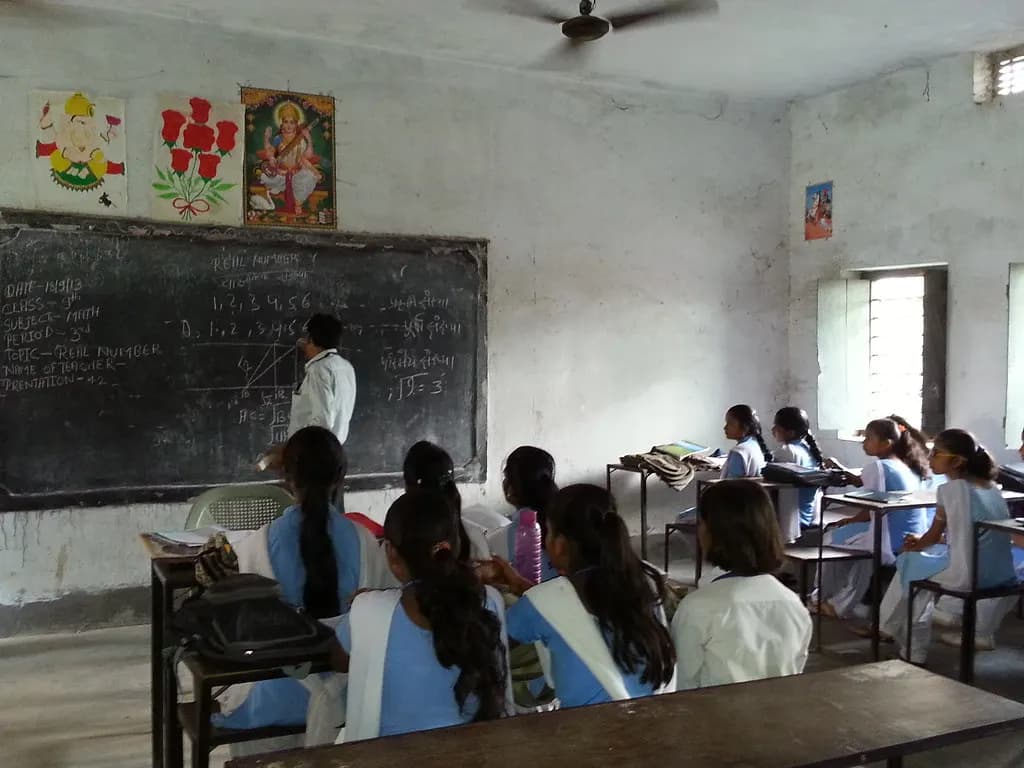
GST has no blanket exemption for "education". Instead, the exemption hangs on one definition. Clause 2(y) of Notification 12/2017–Central Tax (Rate) says an educational institution is one that provides:
- pre-school education and education up to higher secondary school or equivalent;
- education as part of a curriculum for obtaining a qualification recognised by any law for the time being in force; or
- education as part of an approved vocational education course.
The first limb covers every school from nursery to Class 12, whether government, aided or private, and whichever board it follows — CBSE, ICSE, a state board or IB. The second limb covers colleges and universities, but only for courses that lead to a qualification recognised by a central or state law: degrees from universities set up under an Act or recognised by the UGC, AICTE-approved diplomas, and similar. The third limb is narrow. An "approved vocational education course" means a course run by an industrial training institute or centre affiliated to the National or State Council for Vocational Training in trades notified under the Apprentices Act, 1961, or a Modular Employable Skill Course approved by the NCVT and run by a person registered with the Directorate General of Training.
The test looks at the course, not the label on the building. A private university that runs a recognised B.Tech and also a three-month "certificate in digital marketing" is an educational institution for the B.Tech, but the certificate course is taxable. Likewise, an institute calling itself an "academy" or "school of management" does not qualify unless its programme leads to a recognised qualification. This is where most disputes start, and advance rulings have consistently refused the exemption to private diplomas and coaching tied to competitive exams.
Central and state educational boards are a special case. The notification's explanation treats them as educational institutions only for conducting examinations for students. That is why board exam fees carry no GST, while other board income, such as affiliation, does.
Is this education fee exempt from GST?
Step 1
Who supplies it?
school, college, ITI, coaching centre, platform
Step 2
Pre-school to Class 12?
yes: exempt
Step 3
Qualification recognised by law?
yes: exempt
Step 4
NCVT/SCVT trade or MES course?
yes: exempt
Step 5
None of these
taxable at 18% above the threshold
What is exempt under entry 66
Entry 66 has three parts. Together they make most of a school's and a recognised college's fee receipts GST-free.
66(a) — services by an educational institution to its students, faculty and staff. This is the main exemption. It covers tuition, admission, registration and examination fees; library, laboratory and computer fees; sports and activity fees; and transport, hostel and mess charges where the institution itself supplies them to its own students. It does not matter that the fee is split into many heads on the fee receipt.
66(aa) — entrance examinations. Services by an educational institution by way of conducting an entrance examination against an entrance fee are exempt. Circular 151/07/2021-GST, issued after the 43rd Council meeting, confirmed that this extends to Central and State Boards, including bodies such as the National Board of Examinations, so no GST applies to fees they charge for conducting exams, including entrance exams.
66(b) — services to an educational institution. Some services bought by the institution are also exempt:
- transportation of students, faculty and staff;
- catering, including any mid-day meal scheme sponsored by the Central or a State Government;
- security, cleaning or housekeeping performed in the institution;
- services relating to admission to, or conduct of examination by, the institution; and
- supply of online educational journals or periodicals (added in 2018).
The provisos narrow this. Transport, catering and security/housekeeping are exempt only when supplied to an institution providing pre-school or education up to higher secondary. So a bus operator carrying students to a CBSE school charges no GST, but the same operator carrying students to an engineering college must charge GST at the passenger-transport rate. Admission and exam services, by contrast, are exempt for all educational institutions — Circular 151 gives online testing, result publication, printing of question papers and admit cards as examples. Online journals are exempt only when supplied to higher-education institutions, not to schools or ITIs.
What is taxable at 18%: coaching, edtech and private courses
Anything outside the definition is taxed at the standard rate of 18% (9% CGST + 9% SGST, or 18% IGST). In practice that sweeps in a large part of the education market:
- Coaching for competitive exams — JEE, NEET, CAT, CLAT, UPSC, banking and state PSC coaching. These prepare students for an exam but do not themselves lead to a recognised qualification. The SAC is 999293 (commercial training and coaching services).
- Private tuition centres and home-tuition platforms, including school-subject tuition by a business that is not the student's school.
- Online courses and edtech subscriptions that end in a private certificate, recorded-lecture libraries, doubt-solving apps and test series.
- Professional upskilling — coding bootcamps, language classes, soft-skills training and corporate training, unless run under a recognised scheme such as the NSDC skill-development schemes exempted by entry 69.
- Hobby and activity classes — music, dance, art and sports coaching outside a school curriculum.
Two exceptions matter. A tutor or coaching centre whose aggregate turnover stays below ₹20 lakh (or ₹10 lakh in the special-category states) does not need GST registration and therefore charges no GST — read our GST registration guide for the thresholds. And a course run by an educational institution as part of a recognised curriculum, even if delivered online, stays exempt, because the exemption follows the qualification, not the medium.
Many coaching institutes now tie up with schools in "integrated" programmes. If the school charges the student and the school curriculum is the main supply, the fee can be exempt; if the coaching company bills the parent or the school for its coaching, that bill is taxable at 18%. Look at who issues the receipt and what it is for.
Education fees and GST at a glance
| Fee or service | Who charges it | GST |
|---|---|---|
Tuition, admission, exam fees — Class 1 to 12 | School | Exempt (entry 66(a)) |
Degree fees — UGC-recognised university or affiliated college | College / university | Exempt (entry 66(a)) |
ITI trade course under NCVT/SCVT | ITI | Exempt (approved vocational course) |
Entrance exam fee | Board or institution conducting it | Exempt (entry 66(aa)) |
JEE / NEET / UPSC coaching | Coaching centre | 18% |
Online course with private certificate | Edtech platform | 18% |
School bus contract | Bus operator to a school (up to Class 12) | Exempt (entry 66(b)(i)) |
College bus contract | Bus operator to a college | Taxable at passenger-transport rate |
Affiliation fee | University to a college | 18% |
Tuition, admission, exam fees — Class 1 to 12
- Who charges it
School
- GST
Exempt (entry 66(a))
Degree fees — UGC-recognised university or affiliated college
- Who charges it
College / university
- GST
Exempt (entry 66(a))
ITI trade course under NCVT/SCVT
- Who charges it
ITI
- GST
Exempt (approved vocational course)
Entrance exam fee
- Who charges it
Board or institution conducting it
- GST
Exempt (entry 66(aa))
JEE / NEET / UPSC coaching
- Who charges it
Coaching centre
- GST
18%
Online course with private certificate
- Who charges it
Edtech platform
- GST
18%
School bus contract
- Who charges it
Bus operator to a school (up to Class 12)
- GST
Exempt (entry 66(b)(i))
College bus contract
- Who charges it
Bus operator to a college
- GST
Taxable at passenger-transport rate
Affiliation fee
- Who charges it
University to a college
- GST
18%
Books, notebooks and stationery after GST 2.0
Goods used in education were among the biggest winners of the 56th GST Council meeting. From 22 September 2025, the rates changed as follows (the Council's own table lists them under "Education"):
- Erasers (HSN 4016) — 5% to Nil.
- Exercise books, graph books, laboratory notebooks and notebooks (HSN 4820) — 12% to Nil.
- Pencils, including propelling pencils, crayons, pastels, drawing charcoal and tailor's chalk (HSN 9608/9609) — 12% to Nil.
- Pencil sharpeners (HSN 8214) — 12% to Nil.
- Printed maps, atlases, wall maps, hydrographic charts and globes (HSN 4905) — 12% to Nil.
- Mathematical boxes, geometry boxes and colour boxes (HSN 7310/7326) — 12% to 5%.
Printed books, including textbooks and children's picture books, were nil-rated before GST 2.0 and remain Nil. The uncoated paper used to make exercise books was also cut to nil. Other stationery — pens, staplers, files, office paper and printer cartridges — stays at the standard rate; our GST on paper guide covers the paper chain in detail.
For a stationery shop, nil-rated goods are not "exempt" in the sense of being outside GST — you still report them in GSTR-1 as nil-rated supplies — but you charge no tax on them. If most of your sales are now nil-rated, input tax on rent, fixtures and pens you buy for resale still needs apportioning under rules 42 and 43. Notebook manufacturers have pointed out that the nil rate leaves them unable to use credit on ink, glue, packaging and machinery; that is a known inverted-duty issue the Council has not yet addressed.

Hostel, transport, canteen and uniforms
These ancillary charges are where parents and suppliers get confused most often. The answer depends on who supplies the service and to whom.
Hostel and mess. When a school or a recognised college runs the hostel and mess for its own students, the charge is a service by an educational institution to its students and is exempt under entry 66(a). When a private operator runs a student hostel or PG, the exemption in entry 66 does not apply. Since 15 July 2024, however, accommodation services of up to ₹20,000 per person a month per person are exempt when supplied for a minimum continuous period of 90 days (Notification 04/2024–CT(Rate)). Most semester-long student hostels fall within this. Short stays, or rooms above the limit, are taxable; our GST on rent guide explains the rest of the residential-rent rules.
School transport. A school that runs its own buses and charges a transport fee is exempt under 66(a). A bus contractor billing the school is exempt under 66(b)(i) if the school teaches up to higher secondary. A contractor carrying students to a college is not covered by 66(b), so its invoice is taxable at the passenger-transport rates — 5% or 18% depending on the option chosen. Transport arranged directly between parents and a private van operator is a separate passenger-transport supply; small operators below the registration threshold charge no GST.
Canteen and catering. Mid-day meals and other catering supplied to a school up to Class 12 are exempt under 66(b)(ii). A catering contractor feeding a college canteen charges the restaurant rate of 5% (no input tax credit). Where the college itself runs the mess for its students, the mess charge is exempt.
Uniforms, bags and books sold through the school. Entry 66 exempts services. Goods are taxed at their own rates. Books are Nil and notebooks Nil anyway, but uniforms are garments — 5% for pieces up to ₹2,500 — and school bags carry their own rate. When a vendor sells these on the school premises, the vendor's invoice carries the GST.
Key education GST figures (2026)
18%
Coaching, edtech, private courses
SAC 999293
₹20,000 per person a month
Private hostel exemption limit
90-day minimum stay
Nil
Notebooks and exercise books
from 22 Sep 2025
₹20 lakh
Registration threshold for tutors
most states
Worked fee examples
1. A CBSE school, Class 9. Annual tuition ₹72,000, transport ₹18,000 (school-owned buses), activity and lab fees ₹6,000, and books bought from the school's appointed vendor for ₹4,500. The school's ₹96,000 of fees are services by an educational institution to its student — GST nil. The books are nil-rated goods — GST nil. If the vendor also supplies two uniform sets at ₹900 each, it charges 5% on ₹1,800, or ₹90.
2. A JEE coaching programme. A Kota institute charges ₹1,50,000 for a one-year classroom programme. It is a commercial coaching service — SAC 999293 — taxable at 18%. Within Rajasthan, the invoice shows CGST ₹13,500 and SGST ₹13,500: ₹27,000 GST, ₹1,77,000 in all. A student from Bihar who joins online is billed IGST of ₹27,000 instead, because the place of supply for an unregistered recipient is the recipient's address on record.
3. An edtech subscription. A Bengaluru platform sells a one-year data-science course with a private certificate for ₹30,000 plus GST. GST at 18% is ₹5,400, so the learner pays ₹35,400. If the same platform delivered an online MBA for a UGC-recognised university, with the university issuing the degree and charging the student, the university's fee would be exempt; the platform's fee to the university for running the technology would be taxable.
4. A private student hostel. A PG near a Pune college charges ₹14,000 a month for a room with meals, for the full ten-month academic year. The charge is within ₹20,000 per person a month and the stay exceeds 90 days, so no GST. A neighbouring premium hostel charging ₹24,000 a month is above the limit; it must charge GST on the whole amount.
5. A college bus contract. An operator bills an engineering college ₹4,00,000 a month for six buses with drivers and fuel. Because the institution is not a school, 66(b) does not apply. Under the concessional option the operator charges 5% (ITC only of input services in the same line of business) — ₹20,000 — and gets only limited credit; under the full-credit option it charges 18% with full ITC, or ₹72,000. Use our GST calculator to run your own figures.
Try it — 18% GST on a coaching fee
Boards, universities and affiliation fees
Board and university income splits into exempt and taxable pieces. Examination fees — including entrance exam fees — charged by Central and State Boards are exempt, and so are input services such as online testing, printing of question papers and result processing supplied to them, as Circular 151/07/2021-GST spells out. But the same circular says 18% applies to other board services, specifically accreditation of an institution or a professional and registration fees such as the FMGE screening fee, because those authorise someone to supply their own services rather than educate students.
Affiliation fees follow the same logic. A university that grants affiliation to colleges is not educating the college's students; it is providing a service to the college. Circular 177/09/2022-TRU and subsequent advance rulings treat affiliation as taxable at 18%, and the GST Council's own task-force note on university affiliation sets out that position. Universities that collected affiliation fees without GST have faced demands, so check your treatment if you run or advise one.
Services bought by universities and colleges are mostly taxable. Construction of a new hostel block, software licences, maintenance and consultancy all carry GST at their normal rates, and an exempt institution cannot claim input tax credit because its output is exempt. That cost goes into the fee structure.
Common mistakes and how to fix them
Treating every "institute" as exempt. The exemption follows the qualification. A private "diploma" that no law recognises is taxable. If you run one and have not charged GST, register, pay the tax with interest at 18% a year and start charging it; waiting for a notice only adds penalty.
Coaching centres charging GST only on part of the fee. Study material, test series and "registration" charged by a coaching centre are part of one composite coaching supply, taxed at 18%. Splitting the fee into heads does not reduce the tax.
Bus, canteen and security vendors to colleges claiming the school exemption. Entry 66(b)(i)–(iii) is limited to institutions up to higher secondary. A vendor serving a college must charge GST; a college that gets a "nil" invoice from a security agency may find the vendor reassessed and the cost passed back.
Schools charging GST on fees. Some schools register for GST because they sell goods or rent premises, and then wrongly charge GST on tuition. Fees to students are exempt; charging GST on them is a collection the parent can challenge.
Stationery shops still billing 12% on notebooks. The nil rate applies from 22 September 2025. Update the item master in your billing software and check the HSN codes with our HSN code finder.
Ignoring the 90-day condition for private hostels. The ₹20,000 per person a month exemption applies only to a minimum continuous stay of 90 days. Monthly-rolling agreements for short-stay guests do not qualify.
Check your education GST position
0/6Recent changes and what to watch
The biggest recent change for education was on the goods side: the September 2025 cut of school stationery to nil and geometry boxes to 5%. On services, the rates for education have been stable since 2018, when the entry 66 provisos were reworked to extend admission and exam services to all institutions and add online journals for higher education. The 2024 accommodation exemption took most student hostels out of GST. The 57th GST Council met on 8 October 2026 and did not change education rates; any process changes it recommended take effect only when notified.
Keep an eye on two open issues: the inverted-duty claims from notebook makers, and repeated requests from coaching bodies for a lower rate on competitive-exam coaching. Neither has been accepted so far.
Official links
- Notification 12/2017-CT(Rate) — exemptions (entry 66)Educational institution definition, entries 66–71
- Scheme of Classification of Services (SAC list)Heading 9992 education services
- 56th GST Council recommendations (PIB)Stationery rates from 22 September 2025
- Circular 151/07/2021-GST (Boards and exams)Exam fees exempt; accreditation at 18%
- GST portalRegistration and returns
What to do next
If you run a school or college, list every fee head and confirm each is a service to your own students; move vendor contracts for colleges onto GST invoices. If you run coaching or an edtech business, register once you approach ₹20 lakh, charge 18% on the full fee and use the invoice generator for compliant bills. Stationery retailers should update their rates to nil for school items. For the wider list of exempt services, see our guide to GST exemptions, and for how the September 2025 overhaul reshaped rates across the board, read GST 2.0.
This is general information, not legal or tax advice — confirm on the official source or with a professional.
Frequently asked questions
No. Services provided by an educational institution to its own students, faculty and staff are exempt under entry 66 of Notification 12/2017-Central Tax (Rate). A school offering pre-school or education up to higher secondary is an educational institution, so tuition, admission, exam, transport and activity fees it charges its own students carry no GST. Goods such as uniforms sold by an outside vendor are taxed separately.
Coaching and tuition that do not lead to a qualification recognised by law are taxable at the standard rate of 18%. That covers JEE, NEET and UPSC coaching, private tuition centres, spoken-English classes and most online test-prep courses. A coaching centre must register once its turnover crosses ₹20 lakh in most states.
Not for a degree or diploma recognised by law. A college or university teaching for a qualification recognised under a central or state law, such as a UGC-recognised degree or an AICTE-approved diploma, is an educational institution, so its fees to students are exempt. Courses that end in a private certificate are taxable at 18%.
From 22 September 2025, exercise books and notebooks are Nil, pencils and crayons Nil, sharpeners Nil, erasers Nil and printed maps and globes Nil. Geometry and colour boxes fell from 12% to 5%. Printed books were already nil-rated.
A hostel run by a school or college for its own students is exempt as a service by an educational institution. A private hostel or paying-guest facility is exempt where the charge is up to ₹20,000 per person a month and the stay is for at least 90 continuous days, under an exemption in force since 15 July 2024. Above that, 18% generally applies.
Education services fall under heading 9992. Primary education is 999220, secondary 999231, higher education 999241 to 999249, and commercial training and coaching 999293. Conduct of entrance examinations is 999295 and other educational support services 999299. The SAC does not decide whether GST applies; the exemption in entry 66 does.
Sources & verification
Figures on this page were checked against the sources below when it was last reviewed on 9 October 2026. Each rate and limit is stored once with its own official source and review date, and official update channels are monitored daily so changes are picked up. How we verify
- 1.Notification No. 12/2017 – Central Tax (Rate) (services exemptions) — CBIC · accessed 9 October 2026
- 2.Scheme of Classification of Services (Annexure to Notification 11/2017-CT(Rate)) — CBIC · accessed 9 October 2026
- 3.Recommendations of the 56th Meeting of the GST Council — PIB, Ministry of Finance · accessed 9 October 2026
- 4.Circular No. 151/07/2021-GST — GST on services by Central and State Boards (copy issued by HP Excise and Taxation Department) — CBIC / Government of Himachal Pradesh · accessed 9 October 2026
- 5.Taxability of affiliation fees of universities under GST — GST Council (Special Task Force note) · accessed 9 October 2026
- 6.CBIC exempts several services as recommended in the 53rd GST Council meeting — Taxmann · accessed 9 October 2026
- 7.Recommendations of the 56th GST Council meeting for the education sector — TaxGuru · accessed 9 October 2026
MSMETOOLS is an independent platform and is not affiliated with any government agency, ministry or department.
Tools for this
GST Calculator (India)
Calculate GST for your sales and purchases with current rates.
Invoice Generator
Create professional invoices with tax, logo and custom details.
HSN Code Finder (India)
Find the correct HSN/SAC code for your product.
Related guides
 Exemption from GST 2026: Exempt, Nil, Zero-Rated & ITC RulesRead guide
 GST on Paper 2026: HSN 4802–4823 Rates, Notebooks & BoxesRead guide
 GST on Rent 2026: Residential, Commercial, RCM & TDS RulesRead guide
 GST on Catering Services 2026: 5% vs 18%, SAC & ITC RulesRead guide
Official links open the government site in a new tab.