 Starting & growing a business
Event Management Business Plan (2026): Setup Cost, GST, Permissions and a Worked P&L
Event management business plan for India in 2026: setup costs, 18% GST and pure-agent billing, police, noise and music licences, pricing and break-even.
 Edited by Sumeet YadavFounder & editor, MSMETOOLS · fact-checked against official sources
Contents (11)
- 1. Choose a niche and a business model
- 2. Build your vendor network
- 3. Event management setup cost
- 4. Pricing your events
- 5. GST for an event management business
- 6. Permissions and licences for events
- 7. Worked example: monthly P&L and break-even
- 8. Funding an event management business
- 9. Event management business plan template
- 10. Mistakes that sink new event firms
- 11. What to do next
An event management business sells something the client can't see until the day itself — a wedding that runs on time, a product launch where the sound works, a conference where 300 people find their seats. Your job is to plan it, book and manage the vendors, handle the permissions and absorb the stress. This event management business plan is for planners, décor vendors and hospitality staff in India who want to set up their own firm. It covers the business model, an estimated setup cost table with its basis, pricing, GST, the permissions and music licences events need, funding, a worked monthly P&L with break-even in events per month, and a fill-in template. Rules were checked against GST Council, CPCB and Copyright Office sources in October 2026.
Quick answer
An event management business plan sets out your niche (weddings, corporate, social or public events), how you charge (fee or package), your vendor network, setup costs, permissions and how many events a month cover your fixed costs. Our estimate for a small firm with an office and décor stock is ₹6–20 lakh, most of it working capital. Event management carries 18% GST with input tax credit.
GST: 18% on SAC 998596; register above ₹20 lakh turnover (most states)
Loudspeakers need written permission and can't be used outdoors 10 pm to 6 am
Music: IPRS for songs and lyrics; RMPL or the label for sound recordings — religious ceremonies are exempt
Worked example: ₹4 lakh average event, about ₹48,000 net each; break-even ≈ 6 events a month
Choose a niche and a business model
Event management is a broad label. The firms that last pick one or two niches and become known for them:
- Weddings and social events — mehendi, sangeet, wedding, reception, birthdays, anniversaries. High emotion, high budgets, seasonal around wedding dates, and heavy on décor and coordination.
- Corporate events — conferences, dealer meets, product launches, offsites, award nights and annual days. Steadier through the year, paid on invoice terms, and judged on punctuality and production quality.
- Public and ticketed events — concerts, stand-up shows, festivals, exhibitions. The biggest permission load and the biggest risk, because you often fund the event and recover money through tickets and sponsors.
- Specialist services — décor only, stage and sound production, artist management, destination weddings, or kids' parties.
Then decide how you will be paid, because this drives your GST, your cash flow and your risk:
- Management fee — you plan and coordinate; the client signs and pays vendors directly. You charge a fixed fee or 10–20% of the budget. Low risk and low working capital, but smaller billing.
- Turnkey package — the client pays you one price and you pay every vendor. Higher billing and margin, but you carry vendor advances, price changes and the GST on the full amount.
- Hybrid — you sell décor, production and coordination yourself, and the client pays the venue and caterer directly. Many planners settle here because it keeps the large, low-margin items off their books.
Build your vendor network
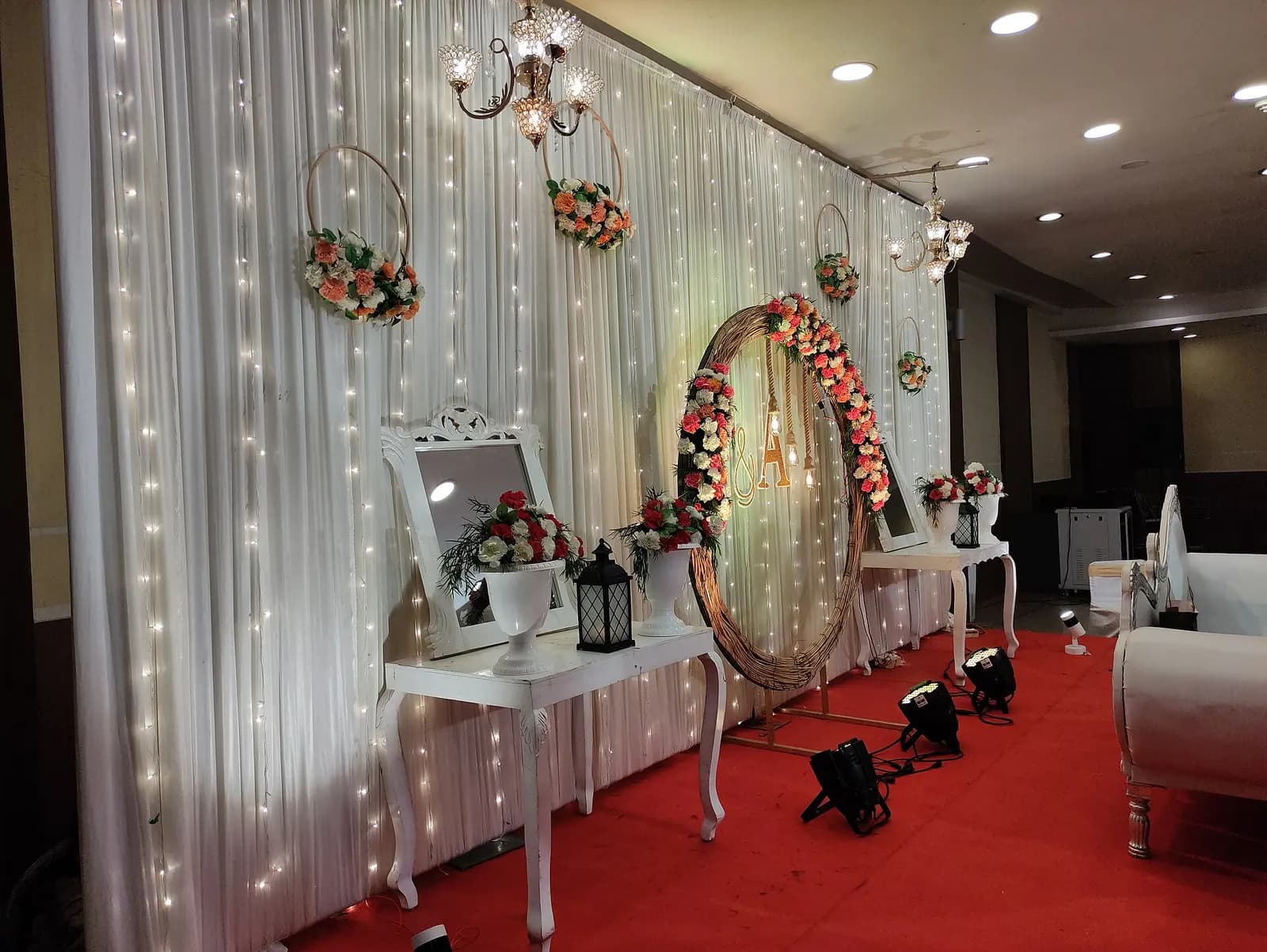
Your vendors are your production capacity. Before taking your first paid booking, line up at least two options in each category and agree rates in writing: venues and banquet halls, caterers, tent and pandal contractors, décor and florists, sound, lights and LED screens, DJs and artists, photographers and videographers, makeup artists, transport, security and housekeeping, and generator suppliers.
Agree three things with every vendor: a rate card valid for the season, the advance and payment schedule, and what happens if they cancel or fail on the day. Ask registered vendors for GST invoices in your name if you are billing the client on a package basis, because that is how you claim input tax credit. Keep a backup for every critical vendor; a DJ who doesn't show up at a sangeet is your problem, not his.
If your packages include food, read our catering business plan to understand how caterers price per plate and why they quote GST at 5% without credit.
Event management setup cost
The table below is a MSMETOOLS estimate for a small event management firm with a rented office, a basic décor inventory and a three-to-four-person team in a tier-2 city in 2026. The décor line is based on IndiaMART listings, where mid-range wedding stage backdrop sets are listed at roughly ₹25,000 to ₹50,000 and premium sets at ₹1.5 lakh to ₹2.8 lakh. Most new firms rent production equipment — sound, light, LED walls, trusses — per event rather than buying it.
| Setup item | Estimated range | Worked plan | Basis / notes |
|---|---|---|---|
| Office deposit and advance rent | ₹50,000 – ₹1,50,000 | ₹1,00,000 | Small office or studio; meeting space matters |
| Office furniture and fit-out | ₹50,000 – ₹2,00,000 | ₹1,00,000 | A presentable client corner |
| Laptops, phones, design and project software | ₹80,000 – ₹2,00,000 | ₹1,20,000 | 3D/décor visualisation helps sell |
| Own décor inventory: backdrops, props, drapes, stands, centrepieces | ₹1,00,000 – ₹5,00,000 | ₹2,50,000 | IndiaMART listings; build up slowly |
| Portfolio shoot, website, branding | ₹50,000 – ₹1,50,000 | ₹80,000 | Real event photos beat stock images |
| Launch marketing: wedding portals, social ads, venue tie-ups | ₹50,000 – ₹2,00,000 | ₹1,00,000 | |
| Registrations, GST set-up, event insurance | ₹20,000 – ₹60,000 | ₹30,000 | |
| Working capital: vendor advances, first months' costs | ₹2,00,000 – ₹5,00,000 | ₹3,00,000 | Clients pay in stages; vendors want advances |
| Total | ₹6,00,000 – ₹19,60,000 | ₹10,80,000 |
A home-based planner who works on a management-fee basis and rents everything can start with roughly ₹1–3 lakh by our estimate: a laptop, a phone, a portfolio, a website and enough cash for a few months of marketing. Use the startup cost calculator to build your own list.
Pricing your events
Price from the client's budget down, not from your costs up — then check that the margin works. A practical method:
- Break the event into line items: venue, décor, food, sound and light, entertainment, photography, logistics, permissions and contingency.
- Get vendor quotes for each line and add your margin by category. Planners commonly keep 10–20% on décor and production, and less on venues and catering, which clients can price-check easily.
- Add a coordination fee for your team's time — the number of planning meetings, site visits and on-the-day staff.
- Add GST on the total if you bill on a package basis, and show it separately on the quote.
Write the quote with clear inclusions, exclusions, a payment schedule (for example 40% on booking, 40% a week before, 20% on the day or within seven days for corporate clients) and a cancellation clause. The quotation generator produces a clean quote, and the GST calculator checks the tax line.
GST for an event management business
Event organisation and assistance services fall under SAC 998596 (heading 9985, support services) and are taxed at 18% with input tax credit. GST 2.0, which took effect on 22 September 2025, did not change this rate. The standard 18% means the GST you pay on décor, sound, tents and other vendor bills can be set off against the GST you collect.
When to register. Event management is a service, so you must register once aggregate turnover crosses ₹20 lakh in most states (₹10 lakh in special-category states). On a package model you reach that quickly — ten ₹2 lakh weddings is already ₹20 lakh. Corporate clients will usually insist on a GST invoice anyway. See our GST registration guide.
How GST flows through a package event
Step 1
Client pays package + 18% GST
Step 2
You pay vendors + their GST
Step 3
Set off vendor GST (ITC)
except blocked credits
Step 4
Pay the balance in GSTR-3B
monthly or quarterly
Package billing and catering. When you sell a single package — décor, sound, food and coordination for one price — it is generally treated as one composite supply taxed at the rate of the main service, which for an event manager is 18%. That can push the food portion from the caterer's 5% to 18%. Many planners avoid this by having the client contract and pay the caterer and venue directly, while they bill only décor, production and coordination. Credit on outdoor catering you buy is blocked except where it is used to make an onward supply of the same kind or forms part of a taxable composite supply — check your structure with a CA before quoting a big wedding.
Pure agent costs. Money you pay strictly on the client's behalf — for example a venue booked in the client's name and charged at cost — can be left out of your taxable value only if you meet the pure-agent conditions in Rule 33 of the CGST Rules: a contract that says you act as the client's agent, the client is liable for the supply, you don't use it yourself, and you recover only the actual amount shown separately on your invoice.
Place of supply. For events in India, the place of supply is the client's location if the client is GST-registered, and the event location if not. That decides whether you charge CGST plus SGST or IGST.
Ticketed events. If you sell tickets to a concert, award function or similar event, admission up to ₹500 per person is exempt; tickets above that carry 18%. Some states and municipalities also levy entertainment tax on shows, so check locally.
Composition and TDS. The composition scheme for service providers (turnover up to ₹50 lakh, tax at 6% of turnover) rarely suits event managers, because you lose input tax credit and corporate clients can't claim credit on your bills. Companies paying you for an event will deduct TDS on contract payments — 1% for individuals, 2% for firms — now under section 393 of the Income-tax Act 2025; see what is TDS. Learn how credits work in our input tax credit guide.
Permissions and licences for events
Permissions are where a plan meets the law, and they differ by state and city. The venue holds some of them; the organiser — you or your client — holds the rest. Put responsibility for each one in your contract.
Common event permissions in India
| Permission | When you need it | Usually from |
|---|---|---|
Loudspeaker / PA permission | Any amplified sound outdoors; no outdoor use 10 pm to 6 am except state-notified days | Police or district authority under the Noise Rules |
Police permission | Public events, processions, large gatherings, ticketed shows | Local police station or commissioner's licensing branch |
Fire safety clearance | Pandals, temporary structures, large indoor gatherings, fireworks | State fire service |
Temporary liquor licence | Alcohol served at a private or public event | State excise department |
FSSAI cover | Food stalls or caterers at the event | FoSCoS — the caterer or stall holder's licence |
Music licences | Recorded or live music at public and commercial events | IPRS; RMPL or the label for sound recordings |
Municipal / ground booking | Public grounds, roads, parking | Municipal corporation or local body |
Loudspeaker / PA permission
- When you need it
Any amplified sound outdoors; no outdoor use 10 pm to 6 am except state-notified days
- Usually from
Police or district authority under the Noise Rules
Police permission
- When you need it
Public events, processions, large gatherings, ticketed shows
- Usually from
Local police station or commissioner's licensing branch
Fire safety clearance
- When you need it
Pandals, temporary structures, large indoor gatherings, fireworks
- Usually from
State fire service
Temporary liquor licence
- When you need it
Alcohol served at a private or public event
- Usually from
State excise department
FSSAI cover
- When you need it
Food stalls or caterers at the event
- Usually from
FoSCoS — the caterer or stall holder's licence
Music licences
- When you need it
Recorded or live music at public and commercial events
- Usually from
IPRS; RMPL or the label for sound recordings
Municipal / ground booking
- When you need it
Public grounds, roads, parking
- Usually from
Municipal corporation or local body
Noise. Under rule 5 of the Noise Pollution (Regulation and Control) Rules, 2000, a loudspeaker or public address system needs written permission from the authority, and cannot be used at night — 10 pm to 6 am — except in closed premises such as auditoria, conference rooms, community halls and banquet halls. A state can allow use until midnight on cultural or religious festive occasions, until midnight on up to 15 days a year in total. Build your event schedule around these hours: an outdoor sangeet that starts at 8 pm has two hours of music unless the date is a notified one or you move indoors.
Music licences. Playing music at a public or commercial event uses two separate copyrights. The song — music and lyrics — is licensed by IPRS, the registered copyright society for musical and literary works. The sound recording is licensed by RMPL, the registered society for sound recordings, or directly by the record label. PPL, which represents many large labels, also issues licences, but in April 2025 a Delhi High Court bench held it could not do so without registering as or joining a copyright society; the Supreme Court stayed part of that order and the matter is still pending. Bona fide religious ceremonies are exempt under section 52(1)(za) of the Copyright Act, and a 2023 DPIIT notice said this covers weddings, but the Bombay High Court in August 2024 struck down a Goa circular built on that view. In practice: for corporate, ticketed and hotel events, get the licences or a written confirmation that the venue holds them; for weddings, ask the venue and your DJ what they hold.

Business registrations. Register under your state's Shops and Establishments law for your office, get free Udyam registration, and open a current account in the business name. Consider public liability insurance for events with large crowds or temporary structures, and event-cancellation cover for big ticketed shows.
Worked example: monthly P&L and break-even
Here's a sample plan for "Utsav Events", a turnkey wedding and corporate event firm in a tier-2 city with three staff plus the owner. All figures are illustrative estimates.
Revenue assumption: 8 events a month in season at an average package of ₹4,00,000 (before GST) = ₹32 lakh of billing.
Variable cost per event: vendor payments of about 85% of the package (₹3,40,000) plus ₹12,000 of freelance on-site crew, travel and consumables = ₹3,52,000. Net contribution per event = ₹48,000 (12%).
| Fixed monthly cost | Amount (estimate) |
|---|---|
| Office rent | ₹25,000 |
| Team: two coordinators, a designer, a sales executive | ₹1,00,000 |
| Local travel and site visits | ₹20,000 |
| Marketing: wedding portals, social ads, venue tie-ups | ₹40,000 |
| Software, phones, accountant | ₹10,000 |
| Décor storage, repairs and replacement | ₹10,000 |
| Loan EMI (₹5 lakh, 10%, 3 years) | ₹16,000 |
| Owner's salary | ₹50,000 |
| Total fixed costs | ₹2,71,000 |
- Monthly contribution = 8 × ₹48,000 = ₹3,84,000
- Profit after the owner's salary = ₹3,84,000 − ₹2,71,000 = about ₹1,13,000 a month
- Break-even = ₹2,71,000 ÷ ₹48,000 = about 5.6 events a month
Two lessons for your plan. First, the margin is thin as a share of billing: a vendor who raises a price by 5% after you have quoted wipes out almost half your contribution on that event, so lock vendor rates when you take the client's advance. Second, the off-season will have fewer than six events, so you need either corporate work through the year or a cash reserve. The GST also passes through your account: on each ₹4 lakh package you collect ₹72,000 at 18% and set off the GST on vendor invoices — keep that money aside for your monthly return.
Try it — event management break-even
Funding an event management business
- Mudra — collateral-free loans up to ₹10 lakh under Tarun (Tarun Plus up to ₹20 lakh for repeat borrowers). Banks will lend against your plan, quotes and past event records. See the Mudra loan guide.
- PMEGP — service projects up to ₹20 lakh with a margin-money subsidy of 15% to 35%. Confirm with your DIC or KVIC office that your activity is accepted before you build your plan around it. See the PMEGP guide.
- Stand-Up India — for women and SC/ST founders of a first enterprise, loans from ₹10 lakh to ₹1 crore.
- CGTMSE — collateral-free cover for micro and small enterprise loans through the CGTMSE scheme.
Our worked plan needs about ₹10.8 lakh: ₹5.8 lakh of the founder's money and a ₹5 lakh loan. Banks generally don't like funding working capital for a firm with no track record, so a planner who has worked for another company should bring references, a portfolio and bank statements showing past event income.
Event management business plan template
Tick off each line as you write your plan; the business plan generator can turn it into a document for your bank or partner.
Fill-in event management business plan
0/12Mistakes that sink new event firms
- Quoting before locking vendor rates. Peak-season prices rise fast. Get written quotes valid until the event date before you confirm the client's package.
- Taking the client's money but not the vendor's commitment. Pay vendor advances promptly after the client's advance, and get booking confirmations in writing.
- Ignoring the 10 pm rule. An outdoor party that has to stop its music early is the most common complaint. Plan timings and venues around it.
- Bundling everything into one invoice without checking GST. A single package can turn 5% food into 18% food; a pure-agent cost billed wrongly adds tax you can't recover.
- No written contract. Changes to guest count, décor and timings are normal; without a contract you absorb them.
- Building a big décor inventory too early. Storage, repair and transport costs add up. Rent until you know which pieces you reuse every month.
Official links
- GST portalRegistration, invoices and returns
- CPCB — Noise Pollution (Regulation and Control) Rules, 2000Loudspeaker rules and night-time limits
- Copyright Office — registered copyright societiesIPRS, RMPL and others
- PIB — ₹500 admission ticket exemptionGST on concerts and shows
- Udyam Registration portalFree MSME registration
- FoSCoS — FSSAI licensingCheck caterers' and food stalls' licences
What to do next
Write two sample packages — one wedding, one corporate — with real vendor quotes, then plug your fixed costs into the break-even calculator to see how many events you need each month. Register on Udyam, apply for GST registration before your first corporate booking, and send every quote from the quotation generator so payment terms and cancellation rules are in writing from day one.
This is general information, not legal or tax advice — confirm on the official source or with a professional.
Frequently asked questions
Our estimate for a small event management company with an office, a basic décor inventory and a three-to-four-person team in a tier-2 city is about ₹6 lakh to ₹20 lakh, most of it working capital for vendor advances and décor stock. A home-based planner who rents everything from vendors can start with roughly ₹1–3 lakh. These are estimates; replace each line with local quotes.
Event management — SAC 998596, organisation and assistance services for events, exhibitions, conventions and trade shows — is taxed at 18% with input tax credit. GST 2.0 from 22 September 2025 did not change it. Registration is compulsory once turnover crosses ₹20 lakh in most states, and corporate clients usually expect a GST invoice from the start.
For public events — concerts, corporate parties, ticketed shows, hotel and club events — you generally need public-performance licences: IPRS for musical and lyrical works, and a sound-recording licence from RMPL or the label that owns the recordings. Bona fide religious ceremonies are exempt under section 52(1)(za) of the Copyright Act, but courts have differed on wedding festivities, so confirm with the venue.
It depends on the event and the state. Common ones are police permission for public gatherings, written permission to use loudspeakers (banned outdoors between 10 pm to 6 am), fire safety clearance for pandals and temporary structures, a temporary liquor licence from the state excise department if alcohol is served, FSSAI cover for food stalls, and music licences. Start applications three to four weeks ahead.
Most charge either a management fee — a fixed amount or 10–20% of the event budget — or a package price that includes vendors, keeping the gap between what the client pays and what vendors cost. In our worked example, a planner earns about ₹48,000 net per ₹4 lakh event and needs about six events a month to cover an office, a small team and the owner's salary.
No. You can start as a sole proprietor with a PAN, bank account, Shops and Establishments registration and Udyam. Many planners later form an LLP or private limited company when they take bigger corporate contracts or bring in partners. Corporate clients will ask for GST registration, a PAN-linked bank account and sometimes MSME status for payment terms.
Sources & verification
Figures on this page were checked against the sources below when it was last reviewed on 7 October 2026. Each rate and limit is stored once with its own official source and review date, and official update channels are monitored daily so changes are picked up. How we verify
- 1.Recommendations of the 56th GST Council meeting (press release) — GST Council / PIB · accessed 7 October 2026
- 2.Notification No. 11/2017-Central Tax (Rate), with scheme of classification of services — CBIC · accessed 7 October 2026
- 3.GST Council recommends relief in GST on circus, dance and theatrical performances — PIB · accessed 7 October 2026
- 4.Noise Pollution (Regulation and Control) Rules, 2000 — Central Pollution Control Board · accessed 7 October 2026
- 5.Registered copyright societies — Copyright Office, Government of India · accessed 7 October 2026
- 6.Delhi High Court: PPL can't issue licences without registering as a copyright society — LiveLaw · accessed 7 October 2026
- 7.Supreme Court stays Delhi HC direction in PPL's plea — LiveLaw · accessed 7 October 2026
- 8.Bombay High Court quashes circular exempting music played at weddings from copyright action — Bar & Bench · accessed 7 October 2026
- 9.'Marriage melodies without royalties' — DPIIT issues public notice — S.S. Rana & Co. · accessed 7 October 2026
- 10.GST on event management services: rate, SAC code and impact — ClearTax · accessed 7 October 2026
- 11.Wedding stage backdrop listings — IndiaMART · accessed 7 October 2026
MSMETOOLS is an independent platform and is not affiliated with any government agency, ministry or department.
Tools for this
Break Even Calculator
Find your break even point and units.
Quotation Generator
Create professional quotes for clients.
Invoice Generator
Create professional invoices with tax, logo and custom details.
GST Calculator (India)
Calculate GST for your sales and purchases with current rates.
Related guides
 Catering Business Plan 2026: Per-Plate Cost, FSSAI & GSTRead guide
 How to Start a Tuition Centre in 2026: Rules, GST & ProfitRead guide
 Management Consulting Business 2026: GST, TDS & PricingRead guide
 Mobile Repair Business 2026: Setup Cost, Tools, GST & RulesRead guide
Official links open the government site in a new tab.