 Starting & growing a business
How to Become a Clothing Manufacturer in India in 2026: Machines, Costs, Licences, Subsidies and a Worked P&L
Start a clothing manufacturing unit in India in 2026: machine costs, Udyam, factory and labour rules, GST on garments, subsidies, RoSCTL exports and a worked P&L.
 Edited by Sumeet YadavFounder & editor, MSMETOOLS · fact-checked against official sources
Contents (10)
- 1. Choose your manufacturing model first
- 2. Where garment manufacturing clusters are
- 3. Machines and setup cost (estimates)
- 4. Registrations and licences
- 5. GST on garments for manufacturers
- 6. Subsidies and schemes open in 2026
- 7. Exporting garments: IEC, AEPC and RoSCTL
- 8. Worked example: monthly P&L for a 20-machine T-shirt unit
- 9. Common mistakes and how to avoid them
- 10. What to do next
People search "clothing manufacturer" for two reasons: they want to find one, or they want to become one. This guide is for the second group — tailors, traders, boutique owners and first-time founders who want to set up a garment manufacturing unit in India. It covers the business models (job work, CMT, full production and private label), what machines a small unit needs and roughly what they cost, the registrations from Udyam to a factory licence under the new Labour Codes, GST on garments after GST 2.0, the subsidies and export schemes open in October 2026, and a worked monthly P&L you can test with the calculator.
Quick answer
To become a clothing manufacturer in India, pick a model (job work, CMT or full-package), set up a stitching unit — about 20 machines for a viable small line — register on Udyam (free) and for GST, and follow factory and labour rules once you cross the worker thresholds. Garments sell at 5% GST up to ₹2,500 a piece and 18% above. A 20-machine basic-knitwear unit needs roughly ₹25–30 lakh including working capital (estimate) and breaks even at around 12,800 pieces a month in our example.
Machines for 20 operators: about ₹9 lakh with tables, irons and wiring (dealer-price estimate, October 2026)
Factory licence under the OSH Code from 20 or more workers with power (or your state's existing number); ESI from 10 or more employees, EPF from 20 or more employees
Central PLI is closed to new applicants; state textile policies (e.g. UP's 25% machinery subsidy) are the main capital support
Exports: IEC, AEPC membership, RoSCTL remission until 31 December 2026
Choose your manufacturing model first
Most garment units in India fall into one of four models, and the choice decides how much money you need and where your risk sits.
Job work (fabricator). You stitch garments from fabric and trims supplied by a brand or trader and charge per piece. You need machines, operators and a small space, but no money tied up in fabric. Rates are low and work comes in waves, so this suits a first unit of 5–15 machines. In GST terms you are supplying a job-work service on the principal's goods.
CMT (cut, make, trim). The buyer supplies fabric; you cut, stitch, finish and pack. You need a cutting section and finishing (thread trimming, checking, ironing, packing) as well as sewing. Margins are a little better than pure job work.
Full package (FOB). You buy the fabric and trims, make samples, produce and deliver finished garments at a fixed price per piece. This is where most of the money is made — and lost — because fabric is 50–60% of the cost and you carry it until the buyer pays. It needs merchandising skills and working capital.
Private label and own brand. You manufacture for retailers, D2C brands or your own label. "Private label clothing manufacturer" searches come from brands looking for exactly this. Order sizes are smaller, design input is higher and margins are better, but you need sampling ability and reliable quality.
Garment manufacturing models compared
| Model | Who buys fabric | Money needed | Risk | Typical start |
|---|---|---|---|---|
Job work | Principal (brand/trader) | Low — machines and wages | Idle machines between orders | 5–15 machines |
CMT | Buyer | Low to medium — adds cutting and finishing | Fabric wastage claims | 15–30 machines |
Full package (FOB) | You | High — fabric and trims for 60–90 days | Fabric, rejection, late payment | After steady buyers |
Private label / own brand | You | Medium to high — sampling and stock | Design misses, unsold stock | Small runs, higher margin |
Job work
- Who buys fabric
Principal (brand/trader)
- Money needed
Low — machines and wages
- Risk
Idle machines between orders
- Typical start
5–15 machines
CMT
- Who buys fabric
Buyer
- Money needed
Low to medium — adds cutting and finishing
- Risk
Fabric wastage claims
- Typical start
15–30 machines
Full package (FOB)
- Who buys fabric
You
- Money needed
High — fabric and trims for 60–90 days
- Risk
Fabric, rejection, late payment
- Typical start
After steady buyers
Private label / own brand
- Who buys fabric
You
- Money needed
Medium to high — sampling and stock
- Risk
Design misses, unsold stock
- Typical start
Small runs, higher margin
Most successful small units start with job work or CMT to learn production with someone else's fabric, then move to full-package orders once they have steady buyers.
Where garment manufacturing clusters are
Location decides your labour, fabric and buyers. Tiruppur (Tamil Nadu) is India's knitwear hub — T-shirts, innerwear, kids' wear — with a deep export base. Ludhiana (Punjab) dominates woollen knitwear, sweaters and winter wear, with growing sportswear. Surat (Gujarat) is the centre of synthetic fabric, sarees and dress material, with garmenting expanding. Delhi NCR (Okhla, Noida, Gurugram) and Bengaluru are woven-garment export centres; Mumbai and Kolkata have large domestic wholesale garment trades; Jaipur is known for printed and ethnic wear.
Being inside a cluster means trained operators, nearby fabric and trim suppliers, machine dealers who repair on the same day, and job-work subcontractors for embroidery or printing. Outside a cluster, land and wages may be cheaper and state subsidies higher, but you'll train your own workforce. Our guide on how to start a clothing business covers sourcing from these clusters if you're starting as a trader first.
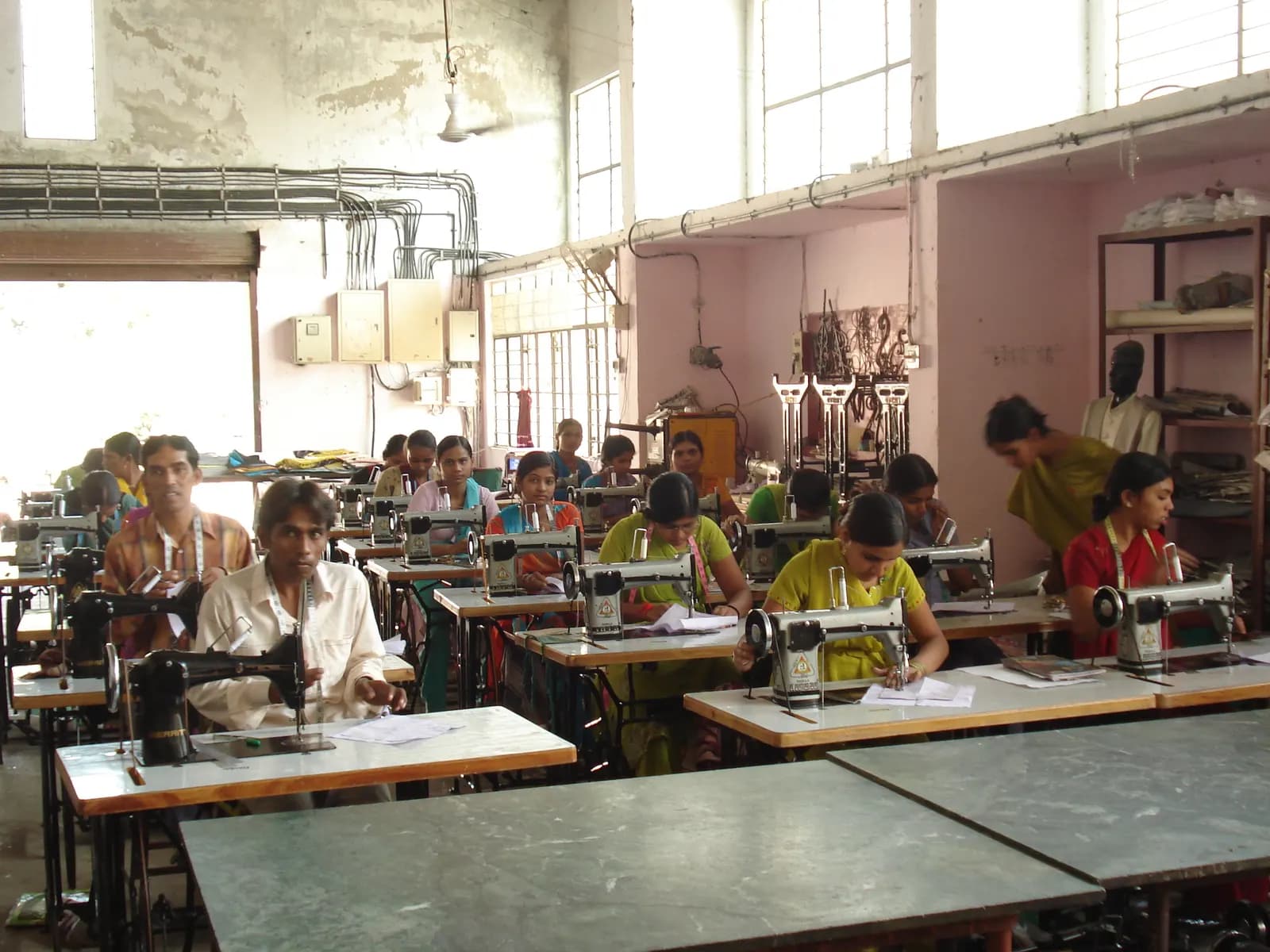
Machines and setup cost (estimates)
The machine mix depends on what you make. Knitwear (T-shirts, polos, track pants) needs more overlock and flatlock machines; woven garments (shirts, kurtis, trousers) need more single-needle lockstitch machines plus buttonhole and button-attaching machines. The figures below are estimates based on dealer listings seen in October 2026 for popular direct-drive models; they vary by brand, city and dealer discount, and exclude GST.
| Item for a 20-operator knitwear line | Qty | Estimated unit price | Estimated total |
|---|---|---|---|
| Single-needle lockstitch, direct drive | 15 | ₹20,000 | ₹3,00,000 |
| 4-thread overlock | 3 | ₹34,000 | ₹1,02,000 |
| Flatlock (for hems and cover stitch) | 2 | ₹40,000 | ₹80,000 |
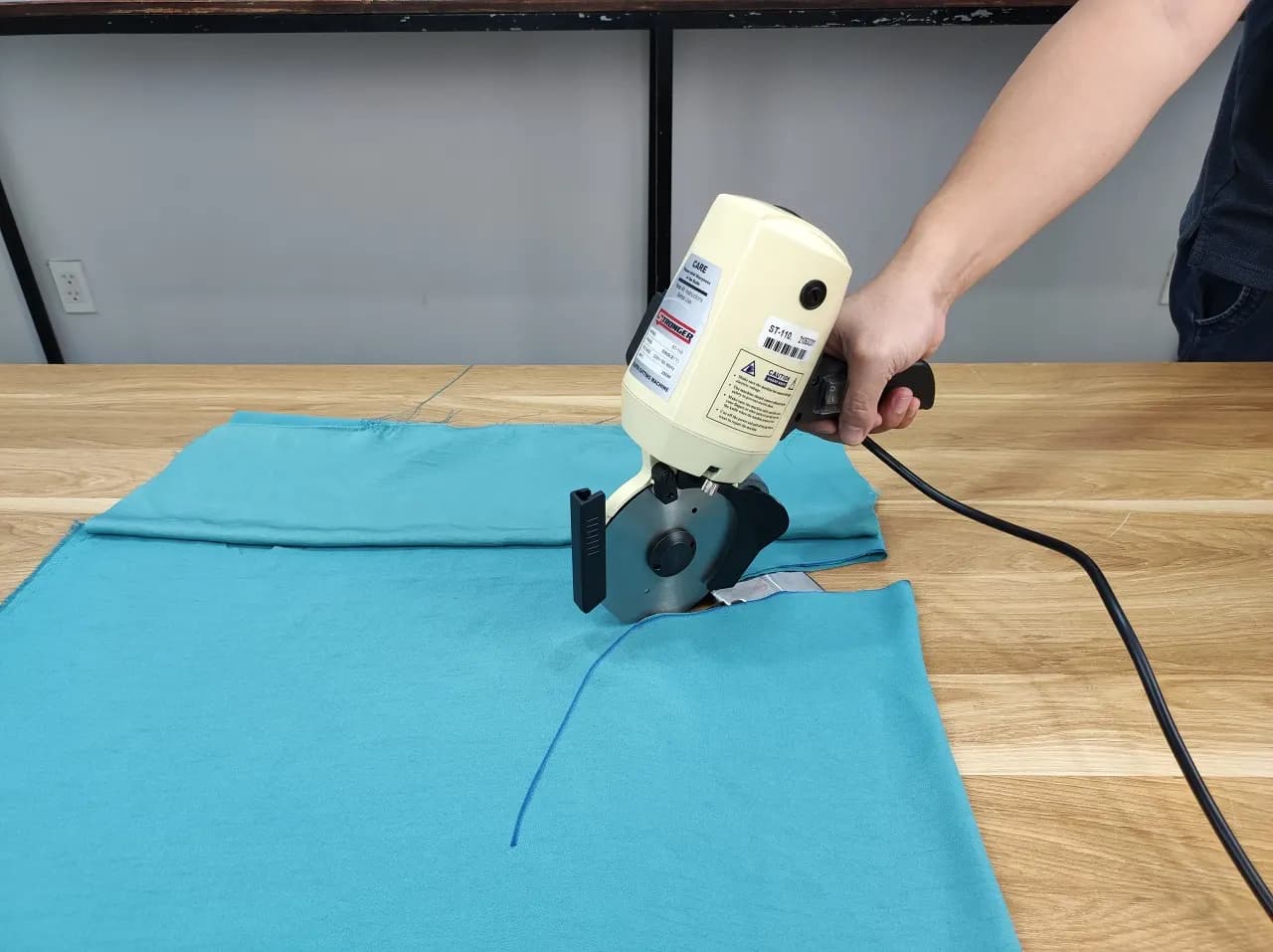
| Straight-knife cutting machine | 1 | ₹25,000 | ₹25,000 |
| Cutting tables, work tables, chairs, racks | — | — | ₹1,20,000 |
| Steam irons, ironing tables, small boiler | — | — | ₹60,000 |
| Wiring, lighting, fans, fire extinguishers | — | — | ₹1,50,000 |
| Computer, costing/ERP software, misc. | — | — | ₹50,000 |
| Total fixed assets | ₹8,87,000 |
For a woven-shirt line, add a computerised buttonhole machine (dealer listings around ₹2.2 lakh) and a button-attaching machine, and shift some overlocks to single-needle machines. Second-hand machines from cluster dealers can cut the bill by 30–50%, but check the motor, hook and feed dog, and get a repair commitment.
On top of fixed assets, budget a rent deposit (often three months), fit-out of the shed, and working capital — at least six weeks of fabric, trims and payroll, because buyers commonly pay 30–60 days after delivery. For the line above, that puts the total at roughly ₹25–30 lakh (estimate). A five-machine job-work unit in rented space can start for ₹2–3 lakh. Try your own numbers with our startup cost calculator.
Space. Plan roughly 100–150 sq ft per operator once you include cutting, finishing and storage — about 2,500–3,000 sq ft for 20 machines. Industrial or approved commercial zoning matters, because the factory licence, fire NOC and power connection all depend on it.
Registrations and licences
Garment units are lightly regulated compared with chemical or food plants, but the labour side gets real once you cross worker thresholds.
Registrations for a garment manufacturing unit
0/9Udyam. Register on the government portal, never through a paid agent; it's free. It gets you MSME status for priority-sector lending, collateral-free CGTMSE cover, the 45-day payment protection on what buyers owe you, and eligibility for most state incentives. See our Udyam registration guide.
Factory licence and the Labour Codes. The four Labour Codes took effect on 21 November 2025. Under the Occupational Safety, Health and Working Conditions (OSH) Code, a unit using power becomes a "factory" with 20 or more workers (40 or more workers without power), up from 10 and 20 under the old Factories Act. The Code keeps a proviso that a state's existing number continues until the state changes it, so check your state labour department before assuming you're exempt. Factories need a licence, and every establishment with 10 or more workers needs registration. Our factory licence guide has the state-by-state process.
ESI and EPF. ESI covers employees earning up to ₹21,000/month once you have 10 or more employees, with contributions of 3.25% (employer) and 0.75% (employee). EPF applies from 20 or more employees, at 12% of wages each side; note that the EPF wage ceiling is ₹25,000 a month. Garment operators almost all fall within ESI, so budget roughly 13% of the wage bill for employer contributions.
Minimum wages. Each state notifies minimum wages for tailoring and garment work, often by skill level and zone, revised with dearness allowance twice a year. In Delhi, for example, the skilled monthly minimum is ₹22,411. Pay, overtime and working-hour records are the first things an inspector checks. Our state pages — Delhi and others — list the current rates.
GST on garments for manufacturers
Since 22 September 2025, garments of Chapters 61 and 62 (knitted and woven) and made-ups of Chapter 63 attract 5% where the sale value is up to ₹2,500 a piece and 18% above it. The test is per piece on the transaction value, so a ₹2,400 shirt is at 5% and a ₹2,600 shirt at 18%.
For a manufacturer, the bigger issue is inverted duty. You buy fabric at 5%, but thread, zips, buttons, labels, elastic, polybags and cartons often come in at 18%, and machine spares and services also carry 18%. If you sell mostly sub-₹2,500 garments at 5%, input credit can pile up month after month. Section 54(3) of the CGST Act lets you claim a refund of the unused credit on inputs (not input services or capital goods) using the rule 89(5) formula. Our GST on garments guide has a full worked refund calculation.
Job workers charge GST on their processing charges, not on the principal's fabric. Small units selling locally to consumers can look at the composition scheme, which charges 1% of turnover for manufacturers, but B2B buyers usually want a regular GST invoice with credit, so most manufacturers stay in the normal scheme.
Subsidies and schemes open in 2026
Central support for small garment units has narrowed, and the state you set up in matters more than any single national scheme.
| Scheme | What it offers | Status in October 2026 |
|---|---|---|
| PLI Scheme for Textiles | Turnover-linked incentive for large MMF apparel and technical textile investments | Closed to new applications on 31 March 2026 |
| PM MITRA parks | Developed plots, plug-and-play sheds and common infrastructure in 7 mega parks (outlay ₹4,445 crore) | Allotment by each park's SPV; Virudhunagar's second cycle closed 17 July 2026 |
| Integrated Textile Programme incl. TEEM | Machinery and cluster modernisation support announced in Budget 2026-27 (₹1,500 crore for 2026-27) | Guidelines awaited — check texmin.gov.in |
| State textile/garment policies | Capital, interest, power, wage and freight subsidies | Open; terms vary by state |
| PMEGP, Mudra, CGTMSE | Loan-linked subsidy, small loans, collateral-free guarantee | Open |
PM MITRA. The seven parks are at Virudhunagar (Tamil Nadu), Warangal (Telangana), Navsari (Gujarat), Kalaburagi (Karnataka), Dhar (Madhya Pradesh), Lucknow (Uttar Pradesh) and Amravati (Maharashtra). They give land and shared utilities, not a cash subsidy. At Virudhunagar, the official park site lists a plot cost of ₹55.32 lakh an acre, 24-hour power and water, and plug-and-play facilities; its second allotment cycle closed on 17 July 2026. For a small unit, a plug-and-play shed in a park can be cheaper than building your own, so watch the park SPV's notices.
State policies — examples. Uttar Pradesh's Textile and Garmenting Policy 2022 offers a capital subsidy on plant and machinery of 15% for units employing fewer than 50 and 25% for those employing more, with an extra 10% in Poorvanchal and Bundelkhand, up to ₹100 crore a unit. It also offers 60% interest subsidy on machinery loans for seven years, a 10-year electricity duty exemption, a ₹3,200-per-worker-per-month employment subsidy for mega garmenting units outside Gautam Buddh Nagar and Ghaziabad, and freight reimbursement to port for new garmenting units. The policy was framed for five years from 2022, so confirm with the Directorate of Textiles that it is still accepting applications before you plan around it. Gujarat's Textile Policy 2024 (1 October 2024 to 29 September 2029) is reported to offer capital and interest subsidies plus monthly payroll assistance per worker for garment and apparel units, with higher support for women workers; check the exact rates in the government resolution with the Industries Commissionerate. Maharashtra, Tamil Nadu, Odisha and Madhya Pradesh have their own textile policies too.
Loans. PMEGP gives a margin-money subsidy on new manufacturing projects up to ₹50 lakh; Mudra loans go up to ₹20 lakh; and CGTMSE lets banks lend without collateral to micro and small units. Machinery support under the old ATUFS ended in 2022 — our Technology Upgradation Fund guide explains what replaced it.
Exporting garments: IEC, AEPC and RoSCTL
Export orders pay better and come in larger lots, but buyers audit factories for labour practices, fire safety and quality systems before they place them.
From first unit to first export order
- 1
Get an IEC
Apply on the DGFT portal with your PAN, address and bank details. The fee is ₹500. See our IEC registration guide.
- 2
Join the Apparel Export Promotion Council
AEPC membership gives you a Registration-cum-Membership Certificate (RCMC), needed to claim most export benefits, plus buyer-seller meets and trade fairs.
- 3
Prepare for buyer audits
Wage and attendance records, ESI/EPF, fire exits and extinguishers, first aid, no child labour, and a basic quality system. Many buyers use social-compliance audits before the first order.
- 4
Price the order with export benefits
Exports are zero-rated for GST — ship under LUT without paying IGST, or pay IGST and claim a refund. Apparel (Chapters 61, 62) and made-ups (63) get RoSCTL remission; other textiles get RoDTEP.
- 5
Ship and claim
File the shipping bill with the RoSCTL claim; the credit comes as a transferable e-scrip in your ICEGATE ledger, usable to pay customs duty or sell to importers.
RoSCTL status. The Rebate of State and Central Taxes and Levies scheme has run since 7 March 2019 to refund embedded taxes that GST doesn't — such as fuel and electricity duty — on apparel and made-ups. It has been extended in short steps in 2026: on 1 April to 30 September 2026 (or until approval under the 16th Finance Commission cycle), and then, as reported in early October, for three more months to 31 December 2026 at existing rates. RoDTEP, which covers other textile products, also runs to 31 December 2026. Price long-delivery orders carefully, because the scheme's continuation beyond December 2026 is not yet announced.
Worked example: monthly P&L for a 20-machine T-shirt unit
All figures are estimates for illustration, for a full-package unit making basic cotton round-neck T-shirts for a domestic brand. Your numbers will differ with location, product and buyer.
Output. A basic tee has a standard minute value (SMV) of roughly 9 minutes across all operations. With 20 operators, an 8-hour shift and 60% line efficiency, the line makes about 20 × 480 × 0.6 ÷ 9 = 640 pieces a day, or about 16,600 in 26 days. Allowing for changeovers and rejections, plan on 15,000 pieces a month.
Price and variable cost per piece. Selling price to the brand ₹150 (ex-GST, so 5% GST applies). Fabric about ₹78 (roughly 0.21 kg of dyed knitted cotton per piece including cutting waste); thread, labels, tags, polybag and carton about ₹17. Variable cost ₹95, contribution ₹55 a piece.
Fixed costs per month. Wages ₹4,54,000 (20 operators at ₹15,000, 2 cutters at ₹16,000, 6 helpers/checkers/ironers at ₹12,500, a supervisor at ₹25,000 and a merchandiser-accountant at ₹22,000); employer ESI/EPF about ₹59,000; rent for 3,000 sq ft ₹75,000; power ₹40,000; needles, oil and maintenance ₹15,000; sampling, admin and local transport ₹45,000; depreciation and interest ₹18,000. Total ₹7,06,000.
- Revenue at 15,000 pieces: ₹22,50,000
- Variable cost: ₹14,25,000
- Contribution: ₹8,25,000
- Fixed costs: ₹7,06,000
- Profit before tax: about ₹1,19,000 a month (5.3% of sales)
- Break-even: ₹7,06,000 ÷ ₹55 ≈ 12,840 pieces a month
At 12,000 pieces — 80% of plan — the unit loses about ₹46,000. That's why efficiency, rejection rates and getting paid on time matter more than the machine bill. A ₹5 rise in price, or a ₹5 cut in fabric cost through better marker planning, adds ₹75,000 a month at full output.
Try it — break-even for a garment unit
Common mistakes and how to avoid them
Buying machines before orders. Many first units buy 20 machines and then look for work. Line up at least one buyer or job-work contract first, and buy the machine mix that buyer's products need.
Underestimating working capital. Full-package orders tie up fabric money for 60–90 days from purchase to payment. Use Udyam to invoke the MSMED Act's 45-day payment rule with large buyers, consider TReDS for invoice discounting, and don't take full-package orders bigger than your working capital can carry.
Ignoring labour compliance until an audit. Missing ESI/EPF registration, unpaid overtime and no attendance records are the most common findings in buyer audits and labour inspections. Register as soon as you cross the thresholds and pay through the bank.
Pricing on fabric alone. New units often price as fabric + a fixed "making charge" and forget rejections (2–5%), sampling, freight and buyer discounts. Cost every style using SMV and your real line efficiency.
Missing the inverted-duty refund. Low-priced garment makers selling at 5% often leave lakhs of input credit unclaimed in the ledger. File the refund in time — the claim must be made within two years of the relevant date (for inverted-duty refunds, the due date of the GST return for that period).
What to do next
Decide your model and product, then cost one style end to end with SMV, fabric consumption and your local wage rates. Register on Udyam, check your state's textile policy and factory thresholds before you sign a lease, and test the P&L with the break-even calculator at 80% and 100% of planned output. If you'll sell sub-₹2,500 garments, read our GST on garments guide for the refund process before your first return.
Official links
- Udyam Registration portalFree MSME registration
- GST Council — rate changes from 22 Sep 2025 (PDF)Garment rates and ₹2,500 rule
- Ministry of TextilesPM MITRA, PLI, TEEM, RoSCTL notices
- PM MITRA Park Tamil Nadu (Virudhunagar)Plot allotment and costs
- UP Textile & Garmenting Policy 2022 (PDF)State incentives
- DGFT — IECImporter Exporter Code
- Shram Suvidha portalLabour registrations and returns
This is general information, not legal or tax advice — confirm on the official source or with a professional.
Frequently asked questions
A 20-machine stitching unit for basic knitwear needs roughly ₹9 lakh for machines, tables, irons and wiring, plus a rent deposit and about one and a half months of working capital — around ₹25–30 lakh in all. These are estimates based on October 2026 dealer prices and typical small-unit costs; a 5-machine job-work unit can start for ₹2–3 lakh.
Udyam registration (free), GST registration, and the shop or trade licence from your municipality. Once you use power with 20 or more workers (or the number your state still applies), you need a factory licence under the OSH Code. ESI applies at 10 or more employees and EPF at 20 or more employees. Add fire NOC, pollution consent if you wash, dye or print, and an IEC to export.
Garments with a sale value up to ₹2,500 a piece attract 5% GST, and those above ₹2,500 attract 18%, from 22 September 2025. Fabric is at 5% but trims and packing are often at 18%, so low-priced garment makers can build up excess input credit and claim an inverted-duty refund.
Central support is limited for small units: the textile PLI scheme stopped taking applications on 31 March 2026 and PM MITRA parks offer plots, not cash. The bigger subsidies come from state textile policies — for example, Uttar Pradesh's 2022 policy offers 25% capital subsidy on machinery for units employing over 50. PMEGP, Mudra and CGTMSE help with loans.
Yes. Get an IEC from DGFT (fee ₹500), register with the Apparel Export Promotion Council for an RCMC, and ship against a confirmed order. Exports of apparel and made-ups get tax remission under RoSCTL, extended to 31 December 2026; other textile products use RoDTEP. Exports are zero-rated for GST.
Small CMT and basic-garment units typically work on single-digit net margins; the worked example on this page earns about 5% of sales at 15,000 pieces a month and loses money below about 12,800 pieces. Margins improve with higher-value products, better line efficiency, lower rejection and your own brand or direct export orders.
Sources & verification
Figures on this page were checked against the sources below when it was last reviewed on 8 October 2026. Each rate and limit is stored once with its own official source and review date, and official update channels are monitored daily so changes are picked up. How we verify
- 1.GST Council press release — rate changes from 22 September 2025 (Chapters 61, 62, 63) — GST Council · accessed 8 October 2026
- 2.Occupational Safety, Health and Working Conditions Code, 2020 — Government of India (via DGMS) · accessed 8 October 2026
- 3.Highlights of U.P. Textile and Garmenting Policy 2022 — Invest UP, Government of Uttar Pradesh · accessed 8 October 2026
- 4.PM MITRA Park, Virudhunagar — land allotment status — SIPCOT / PM MITRA Park Tamil Nadu Ltd · accessed 8 October 2026
- 5.Appendix 2K — DGFT fee schedule (IEC) — Directorate General of Foreign Trade · accessed 8 October 2026
- 6.Ministry of Textiles extends RoSCTL Scheme till 31 December 2026 — Technical Textiles (trade press) · accessed 8 October 2026
- 7.Government announces extension of RoSCTL scheme for exports of apparel, garments and made-ups — All India Radio News · accessed 8 October 2026
- 8.Jack F4 and industrial overlock/flatlock machine listings — IndiaMART (dealer listings) · accessed 8 October 2026
- 9.Gujarat Textile Policy 2024 — highlights — Adroit Corporation (consultancy) · accessed 8 October 2026
MSMETOOLS is an independent platform and is not affiliated with any government agency, ministry or department.
Tools for this
Break Even Calculator
Find your break even point and units.
Startup Cost Calculator
Estimate how much capital you need to launch.
GST Calculator (India)
Calculate GST for your sales and purchases with current rates.
Related guides
 How to Start a Clothing Business in 2026: Costs & GSTRead guide
 How to Start a Boutique in India (2026): Cost, GST & NamesRead guide
 Laundry Machine Business 2026: Setup Cost, Price List & GSTRead guide
 How to Start a Jewellery Business in 2026: BIS, GST & PlanRead guide
Official links open the government site in a new tab.