 Starting & growing a business
Fish Farming Business in India (2026): PMMSY Subsidy, Pond vs Biofloc vs RAS, and a Worked Plan
Start a fish farming business in India in 2026: PMMSY 40%/60% subsidy and unit costs, KCC for fisheries, pond vs biofloc vs RAS, licences, GST and a ₹ plan.
 Edited by Sumeet YadavFounder & editor, MSMETOOLS · fact-checked against official sources
Contents (11)
- 1. Is fish farming a good business in India?
- 2. Choosing a system: pond, biofloc or RAS
- 3. PMMSY subsidy: how much you get and how it is calculated
- 4. PM-MKSSY: insurance incentive and NFDP registration
- 5. Kisan Credit Card and other loans for fish farming
- 6. Licences and registrations for a fish farm
- 7. GST and income tax on fish farming
- 8. Worked plan: a one-hectare composite carp pond
- 9. How to start a fish farming business: step by step
- 10. Common mistakes in fish farming
- 11. What to do next
India is the world's second-largest fish producer, and most of that growth has come from inland ponds and tanks rather than the sea. Fish production reached a record 197.75 lakh tonnes in 2024-25, up from 141.64 lakh tonnes five years earlier. This guide is for farmers with a pond or low-lying land, rural entrepreneurs looking at biofloc or recirculating tanks, and anyone writing a fish farming business plan for a bank. It covers the PMMSY subsidy and the unit costs it is calculated on, Kisan Credit Card for fisheries, how ponds, biofloc and RAS compare, the licences you need, GST, and a worked rupee plan.
Quick answer
A fish farming business raises fish in ponds, tanks or cages and sells them live or fresh. The main support is PMMSY: 40% of unit cost of a fixed unit cost for general applicants and 60% of unit cost for SC, ST and women — e.g. on ₹7 lakh per hectare for a new pond. Working capital comes from a Kisan Credit Card at 7% (4% with prompt repayment). Fresh fish and aquatic feed are GST-exempt.
Pond (composite carp) is the cheapest, lowest-risk start; biofloc and RAS need more capital and reliable power
Register on the National Fisheries Digital Platform and with your district fisheries office
Coastal and brackish-water farms must register with the Coastal Aquaculture Authority
PM-MKSSY pays 40% of the premium (max ₹25,000 per ha, ₹1 lakh per farmer) for aquaculture insurance
Is fish farming a good business in India?
Fish is a staple in eastern, north-eastern and coastal India and a growing protein source elsewhere, so local demand is broad. A pond can be built on land that is too low or waterlogged for crops, and composite carp culture — rohu, catla and mrigal stocked together so they feed at different depths — is well understood, with seed available in most districts. Andhra Pradesh, West Bengal, Odisha, Bihar and Uttar Pradesh have large inland fish farming clusters with feed dealers, harvest gangs and traders already in place.
The risks are real, though. Fish die in hours if dissolved oxygen falls on a cloudy, hot night. Disease can spread through a pond quickly. Prices swing with the season and with supply from Andhra Pradesh, which ships fish across the country. And unlike crops, fish are perishable at harvest — you need a buyer lined up before the net goes in.
Fish farming works as a business when four things line up: a reliable water source (canal, borewell or rain-fed pond that holds water year-round), good-quality seed from a registered hatchery, a feed and aeration plan matched to your stocking density, and a trader, retailer or market within a few hours' drive. If any of these is missing, start small or start with a lease on an existing pond before building your own.
Choosing a system: pond, biofloc or RAS
There are three main ways to farm fish inland, and they differ sharply in capital, risk and skill. PMMSY sets a unit cost for each; the figures below come from Table 1 of the PMMSY operational guidelines. Yields and margins are MSMETOOLS estimates based on typical stocking densities and farm-gate prices — your results depend heavily on management.
Pond vs biofloc vs RAS
| Earthen pond (composite carp) | Biofloc tanks | Recirculating aquaculture (RAS) | |
|---|---|---|---|
PMMSY unit cost | ₹7 lakh per hectare + inputs ₹4 lakh per hectare | ₹7.5 lakh (7 tanks, 4 m dia) | ₹7.5 lakh (small) to ₹25 lakh (medium) |
Land needed | 1 ha or more | About 1,000 sq ft per 7 tanks | Small shed; very little land |
Species | Rohu, catla, mrigal, pangasius | Tilapia, pangasius, vannamei | Pangasius, tilapia, high-value species |
Estimated yield | 4–8 tonnes/ha/year | 1.5–3 tonnes a year (7 tanks) | Up to 10 tonnes a crop (medium unit, design capacity) |
Power | Aerators at night | Aeration 24 hours | Pumps, filters, aeration 24 hours |
Risk | Low–medium | High (oxygen and floc failure) | High (equipment failure) |
Skill | Basic | Water-quality testing daily | Technical training essential |
PMMSY unit cost
- Earthen pond (composite carp)
₹7 lakh per hectare + inputs ₹4 lakh per hectare
- Biofloc tanks
₹7.5 lakh (7 tanks, 4 m dia)
- Recirculating aquaculture (RAS)
₹7.5 lakh (small) to ₹25 lakh (medium)
Land needed
- Earthen pond (composite carp)
1 ha or more
- Biofloc tanks
About 1,000 sq ft per 7 tanks
- Recirculating aquaculture (RAS)
Small shed; very little land
Species
- Earthen pond (composite carp)
Rohu, catla, mrigal, pangasius
- Biofloc tanks
Tilapia, pangasius, vannamei
- Recirculating aquaculture (RAS)
Pangasius, tilapia, high-value species
Estimated yield
- Earthen pond (composite carp)
4–8 tonnes/ha/year
- Biofloc tanks
1.5–3 tonnes a year (7 tanks)
- Recirculating aquaculture (RAS)
Up to 10 tonnes a crop (medium unit, design capacity)
Power
- Earthen pond (composite carp)
Aerators at night
- Biofloc tanks
Aeration 24 hours
- Recirculating aquaculture (RAS)
Pumps, filters, aeration 24 hours
Risk
- Earthen pond (composite carp)
Low–medium
- Biofloc tanks
High (oxygen and floc failure)
- Recirculating aquaculture (RAS)
High (equipment failure)
Skill
- Earthen pond (composite carp)
Basic
- Biofloc tanks
Water-quality testing daily
- Recirculating aquaculture (RAS)
Technical training essential
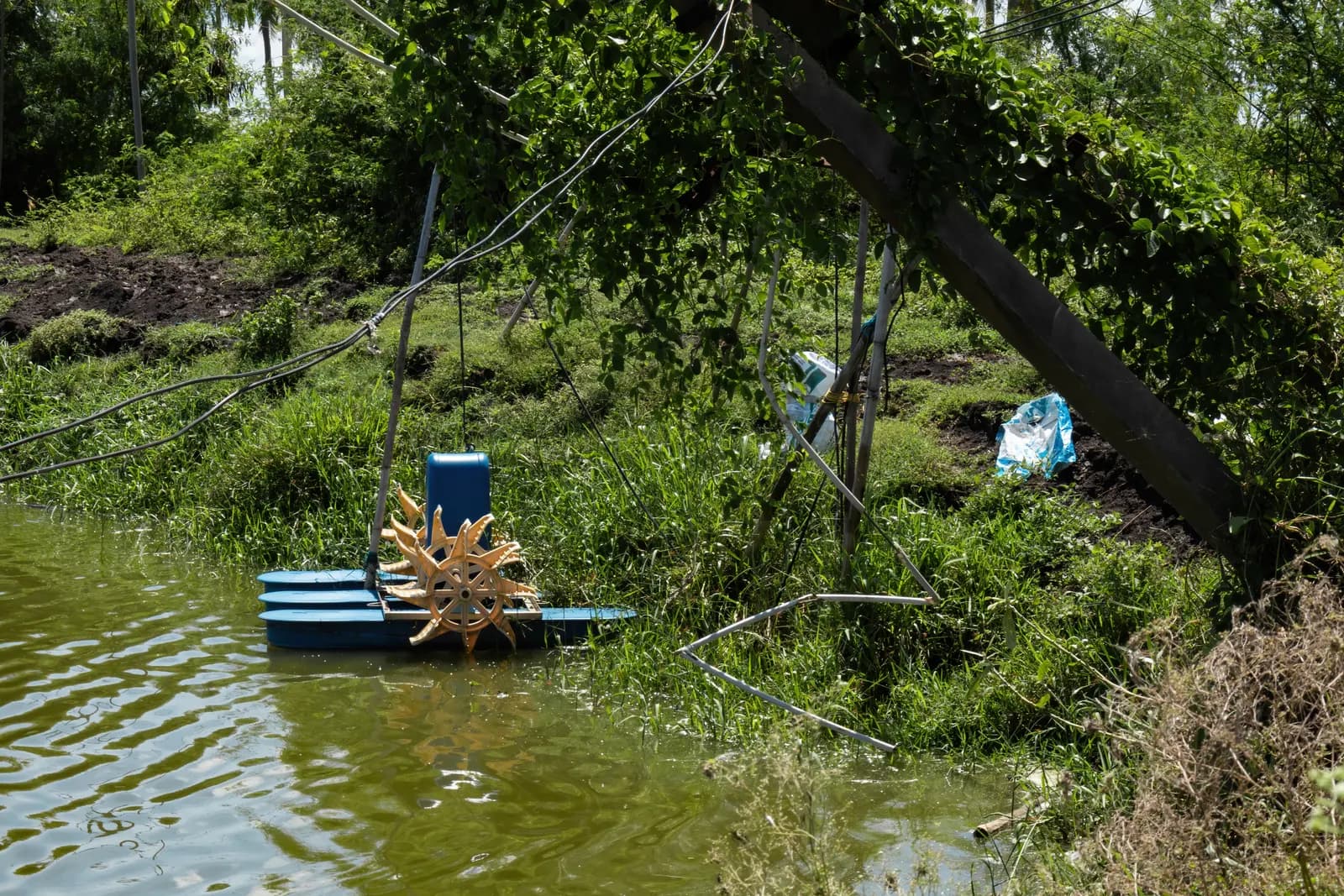
Earthen ponds suit first-time farmers. A one-hectare pond is typically 1.5–2 metres deep, with an inlet and outlet, a drainable bottom and strong bunds. You stock fingerlings, fertilise with cow dung and lime to grow natural food, feed a mix of rice bran and oil cake or pelleted feed, and harvest after 8–12 months. Polythene lining is optional; PMMSY allows extra assistance of up to ₹2 lakh a hectare for lined brackish and saline-area ponds.
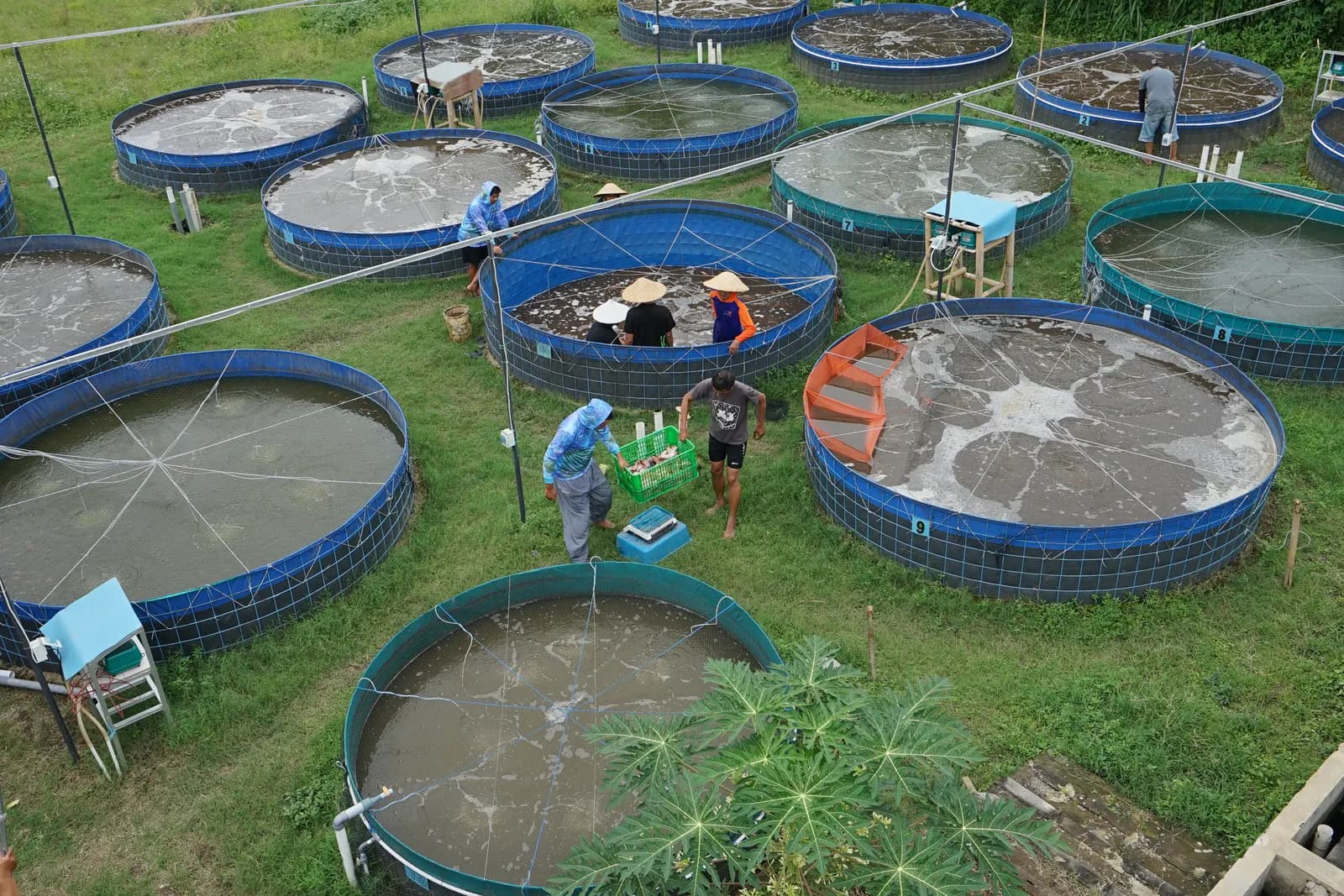
Biofloc grows fish at high density in lined circular tanks. Beneficial bacteria, fed with a carbon source such as molasses, convert fish waste into protein flocs the fish eat. It saves water and land, but the aerator must never stop. Many YouTube-driven biofloc projects of 2020–22 closed because of power cuts, poor seed and over-optimistic sales assumptions.
Recirculating aquaculture systems (RAS) filter and reuse the same water through mechanical and biological filters. PMMSY's design capacity for a medium RAS (six tanks of at least 30 m³) is 10 tonnes a crop, and a large RAS (eight tanks of 90 m³) is 40 tonnes. RAS gives the most control and the highest output per square metre, but it is a small factory: plan for a generator, spare pumps, trained staff and a buyer for steady volumes. By September 2026, PMMSY had supported 12,081 RAS units and 4,205 biofloc units.
PMMSY subsidy: how much you get and how it is calculated
The Pradhan Mantri Matsya Sampada Yojana, launched in September 2020, is the main source of capital support. It has a centrally sponsored part run by the states (which covers most individual farmer projects) and a central sector part run by the Department of Fisheries and the National Fisheries Development Board (NFDB).
The assistance rule. Under paragraph 5.2.2 of the guidelines, for individual and group projects the combined central and state assistance is limited to 40% of unit cost of the project or unit cost for general-category beneficiaries and 60% of unit cost for SC, ST and women. The Centre and state share that assistance 60:40 in most states and 90:10 in the North Eastern and Himalayan states; union territories get the full share from the Centre. The rest of the cost comes from you and your bank.
The unit cost cap. Assistance is calculated on the PMMSY unit cost, not on what you actually spend. If your pond costs ₹9 lakh a hectare but the unit cost is ₹7 lakh per hectare, the subsidy is worked out on ₹7 lakh.
PMMSY unit costs and assistance (selected items)
₹7 lakh per hectare
New freshwater grow-out pond
₹2.8 lakh general / ₹4.2 lakh SC-ST-women
₹4 lakh per hectare
Inputs for freshwater aquaculture
₹1.6 lakh / ₹2.4 lakh
₹7.5 lakh
Small RAS or 7-tank biofloc
₹3 lakh / ₹4.5 lakh
₹50,000
Backyard mini RAS
₹20,000 / ₹30,000
Other items in Table 1 include freshwater finfish hatcheries (₹25 lakh), new ponds for brackish-water and saline or alkaline areas (₹8 lakh a hectare), freshwater biofloc ponds of 0.1 hectare including inputs (₹14 lakh per 0.1 ha), reservoir cages (₹3 lakh each), ornamental fish units and fish transport vehicles. Your district fisheries officer has the full list and the targets your state has been sanctioned for the year.
Is PMMSY still running? It was approved for 2020-21 to 2024-25 and then extended to 2025-26. The Ministry's 10 September 2026 note says the scheme received a record ₹2,500 crore in the 2026-27 budget, and the PM-MKSSY sub-scheme runs to FY 2026-27 (scheme runs 2023-24 to 2026-27). Approvals now depend on your state's annual action plan, so ask the district office whether your activity has a target this year before you build.
How to apply. Applications go to the district fisheries officer (in some states through an online portal), with land or lease documents, a project report, a bank's consent to lend, caste or category certificate where relevant, and Aadhaar-linked bank details. After approval and construction, officials inspect the work and release the assistance, usually in instalments into the loan account.
PMMSY application at a glance
Step 1
District fisheries office
Step 2
Project report + bank consent
Step 3
State approval in annual plan
Step 4
Build and stock
Step 5
Inspection
assistance released to loan account
PM-MKSSY: insurance incentive and NFDP registration
The Pradhan Mantri Matsya Kisan Samridhi Sah-Yojana, approved in February 2024 with a ₹6,000 crore outlay, adds two things a new fish farmer should use.
First, register on the National Fisheries Digital Platform (NFDP). It gives fishers, fish farmers and fisheries enterprises a work-based digital identity, and it is the channel through which PM-MKSSY incentives are paid.
Second, insure your crop. PM-MKSSY pays a one-time incentive of 40% of the premium (max ₹25,000 per ha, ₹1 lakh per farmer) for farms of up to 4 hectares of water spread, for one crop cycle. For intensive systems such as RAS, biofloc, cages and raceways, the incentive is also 40% of the premium, up to ₹1 lakh for units up to 1,800 m³. SC, ST and women beneficiaries get an extra 10% of the incentive. Aquaculture insurance is still a young product, so compare what each policy actually covers — disease, floods, oxygen depletion — before buying.
Fisheries micro-enterprises such as feed mills, fish kiosks and processing units can also earn performance grants of up to 25% of investment or ₹35 lakh (35% or ₹45 lakh for SC, ST and women-owned enterprises), tied to measurable value-chain results.
Kisan Credit Card and other loans for fish farming
The Kisan Credit Card was extended to fishers and fish farmers in 2018-19 to cover working capital: seed, feed, fertiliser, lime, medicines, power, labour and harvesting. You need to own or lease a pond, tank or other water body. Loans up to ₹2 lakh need no collateral. Short-term loans carry 7% interest under the Modified Interest Subvention Scheme, falling to 4% if you repay on time, but the concession applies only up to ₹3 lakh in total across crop, animal husbandry and fisheries borrowing. The Union Budget 2025-26 announced a higher ₹5 lakh limit under the scheme; ask your bank whether it applies the higher limit to fisheries cards.
For the capital cost — digging the pond, tanks, aerators, sheds — banks give term loans that are tied to the PMMSY approval, with the assistance adjusted against the loan. A Mudra loan (up to ₹20 lakh) can fund a fish retail kiosk, vending van or small processing unit, and the Fisheries and Aquaculture Infrastructure Development Fund (FIDF) supports larger infrastructure through NABARD and other lenders. Our agriculture subsidy guide compares the main farm credit options.
Licences and registrations for a fish farm
There is no single "fish farming licence" for inland freshwater ponds, but several registrations apply depending on what you do:
- State fisheries department — register as a fish farmer to get PMMSY and state scheme benefits, and to buy seed from approved hatcheries. Several states also have their own inland fisheries acts governing leases and fishing rights.
- Pond leases — village and panchayat ponds and reservoirs are leased by the panchayat or fisheries department, usually through auction or to fishers' cooperatives. Get a written lease for at least five years before investing in it.
- Coastal Aquaculture Authority (CAA) — any coastal or brackish-water aquaculture, including shrimp farming, must be registered with the CAA. After the 2023 amendment, CAA registration is treated as permission under the Coastal Regulation Zone notification, and farming without registration is now a civil penalty rather than an offence carrying imprisonment. Registrations are renewed every five years.
- NFDP — free self-registration for PM-MKSSY benefits.
- Udyam — Free, useful for hatcheries, feed units and processing enterprises seeking MSME credit.
- FSSAI — needed once you process, pack, freeze or sell fish products under a label. See our FSSAI registration guide.
- Water and power — borewells in notified over-exploited areas may need groundwater permission; ask your state groundwater authority. Ask the electricity board which tariff applies to aquaculture in your state; some charge agricultural rates.
GST and income tax on fish farming
| Item | GST | Basis |
|---|---|---|
| Live fish, fish seed and prawn/shrimp seed | Nil (exempt) | Notification 2/2017-CT (Rate) |
| Fresh or chilled fish, crustaceans and molluscs | Nil (exempt) | Notification 2/2017-CT (Rate) |
| Aquatic feed, including shrimp and prawn feed | Nil (exempt) | Notification 2/2017-CT (Rate) |
| Frozen, dried or processed fish, pre-packaged and labelled | 5% | Notification 9/2025-CT (Rate), Sch. I |
| Made-up fishing nets | 5% | Notification 9/2025-CT (Rate), Sch. I |
A farmer who only sells live or fresh fish makes exempt supplies, and section 23(1)(a) of the CGST Act says a person supplying only exempt goods is not liable to register. Because feed and seed are also exempt, there is little GST in your input costs either — apart from equipment such as aerators, pumps, pipes and liners, on which you pay GST you cannot recover. Once you freeze, pack and label fish, or add a processing unit, you are making taxable supplies at 5% and need GST registration if you cross the threshold of ₹40 lakh or sell across states.
On income tax, fish farming is generally treated as a business rather than as exempt agricultural income, because it does not involve cultivation of land. Keep accounts, and ask your CA how your state's facts apply before you assume the income is tax-free.
Worked plan: a one-hectare composite carp pond
These figures are MSMETOOLS estimates for 2026 for a new pond in eastern or central India under PMMSY, using PMMSY unit costs for the project and typical farm-gate prices and feed rates for running costs. Adjust them to your district's seed, feed and fish prices.
Project cost (year 0). Pond construction ₹7 lakh per hectare plus first-crop inputs ₹4 lakh per hectare = ₹11 lakh. A general-category applicant receives 40% (₹4.4 lakh); a woman applicant receives 60% (₹6.6 lakh). The balance comes from your margin and a bank term loan.
| Yearly operation (₹) | Amount |
|---|---|
| Fish sold: 6,000 kg × ₹120/kg (farm gate) | 7,20,000 |
| Fingerlings: 8,000 × ₹3 | 24,000 |
| Feed: 9,000 kg × ₹35 (feed conversion 1.5) | 3,15,000 |
| Lime, manure, probiotics, medicines | 30,000 |
| Power for aerators and pumping | 35,000 |
| Labour (one part-time worker) | 72,000 |
| Harvest, ice and transport | 30,000 |
| Insurance and sundries | 20,000 |
| Total running cost | 5,26,000 |
| Operating profit | 1,94,000 |
After the loan. A general-category farmer who contributes ₹1.1 lakh and borrows ₹5.5 lakh over five years at about 10% pays roughly ₹1.4 lakh a year in EMIs, leaving about ₹54,000. A woman applicant who borrows ₹3.3 lakh pays about ₹84,000 a year and keeps about ₹1.1 lakh. Once the loan is repaid, the pond earns the full operating profit. Check EMIs in our EMI calculator.
What moves the result. Yield matters most: 4 tonnes instead of 6 cuts sales by ₹2.4 lakh while feed falls by only about ₹1 lakh, so operating profit drops to about ₹60,000 — less than half the general-category EMI. A ₹10 rise in farm-gate price adds ₹60,000. Selling part of the harvest directly to retailers or through your own kiosk at ₹160–180 a kilogram can add more than a better feed deal. Feed is about 60% of running cost, so feed conversion — how many kilograms of feed make a kilogram of fish — is the number to track every month.
Break-even. Treat labour, power, insurance and sundries plus a general-category EMI as fixed costs (₹2.67 lakh a year); the variable cost of ₹66.50 a kilogram is feed, seed, harvest and pond inputs. Break-even is about 5,000 kg — more than 80% of the expected harvest, which is why yield is the number to protect while the loan is running. Try your own figures in the break-even calculator.
How to start a fish farming business: step by step
From idea to first harvest
- 1
Check water, soil and market
Test that the site holds water year-round and that the soil is clay-rich. Visit the nearest fish market and two or three traders; note species, sizes and prices by month.
- 2
Train first
Take a short course at a Krishi Vigyan Kendra, state fisheries training centre or ICAR fisheries institute. Visit two working farms of the system you plan.
- 3
Register and plan
Register with the district fisheries office and on the National Fisheries Digital Platform. Prepare a project report using PMMSY unit costs.
- 4
Apply for PMMSY and bank finance
Submit the application with land or lease papers and the bank's consent; general applicants get 40% of unit cost, SC/ST/women 60% of unit cost.
- 5
Build and stock
Dig or line the pond, install aerators and an outlet, lime and fertilise, then stock certified fingerlings at the recommended density.
- 6
Insure and get a KCC
Buy aquaculture insurance (claim the PM-MKSSY 40% premium incentive) and apply for a Kisan Credit Card for feed and running costs.
- 7
Monitor and sell
Check oxygen, pH and fish growth weekly; sample-weigh monthly. Book buyers before harvest and harvest in phases if the market is soft.
Common mistakes in fish farming
Overstocking. More fingerlings do not mean more fish if oxygen and feed cannot keep up. Follow the stocking density your fisheries officer or training institute recommends for your system and aeration.
Cheap seed. Poor-quality or inbred fingerlings grow slowly and die easily. Buy from registered hatcheries, count a sample on delivery, and acclimatise seed before release.
No power backup. For biofloc and RAS, a power cut of a few hours at night can kill the crop. Budget for a generator or battery-backed aeration from day one.
Harvesting without a buyer. Fish must be sold within hours of harvest unless you have ice and cold storage. Line up traders or retailers and agree prices before netting.
Ignoring records. Track stocking, feed bags, mortality, water tests and sales. They show where money is leaking, support insurance claims, and help when you apply for a larger loan.
Official links
- PMMSY operational guidelinesFunding pattern and unit-cost tables
- PIB — Six years of PMMSY (10 Sep 2026)
- Department of FisheriesSchemes, PM-MKSSY and NFDP updates
- Coastal Aquaculture AuthorityRegistration of coastal and brackish-water farms
- National Fisheries Development BoardTraining and central-sector projects
What to do next
Start with the market and the water, then the money. Visit your district fisheries office to learn this year's PMMSY targets and the unit costs that apply, and build a project report in the business plan generator using the worked plan above as a template. Model your break-even in the break-even calculator at a lower yield and price than you hope for. If you are weighing fish against other livestock options, compare our poultry and dairy business plans.
This is general information, not legal or tax advice — confirm on the official source or with a professional.
Frequently asked questions
Under the Pradhan Mantri Matsya Sampada Yojana (PMMSY), government assistance for individual and group projects is 40% of unit cost for general-category applicants and 60% of unit cost for SC, ST and women, calculated on fixed unit costs — for example ₹7 lakh per hectare for a new grow-out pond and ₹7.5 lakh for a small RAS or seven-tank biofloc unit. Apply through your district fisheries office.
Fish are harvested in batches, so profit comes once or twice a year, not monthly. In our worked example, a one-hectare carp pond producing six tonnes a year earns roughly ₹1.9 lakh before loan repayment — about ₹16,000 a month on average. Well-managed ponds with good seed, feed and aeration do better; a single disease outbreak or a crash in prices can wipe out a year.
Sometimes, but margins are thin. Biofloc needs round-the-clock aeration, so power and backup are major costs, and survival falls sharply if the floc or oxygen fails. Our estimate for a seven-tank unit shows sales of about ₹4 lakh a year against similar running costs. It works best for farmers who can sell high-value species locally at a premium and who have reliable power.
Yes. Since 2018-19 the KCC covers fishers and fish farmers for working capital — seed, feed, fertiliser, power and labour. Loans up to ₹2 lakh need no collateral, and short-term loans carry 7% interest, or 4% with prompt repayment, within an overall concessional limit of ₹3 lakh. You need to own or lease a pond or tank.
Inland freshwater fish farming in your own pond usually needs no central licence, but you must register with the state fisheries department to get PMMSY support. Coastal and brackish-water farms, including shrimp farms, must register with the Coastal Aquaculture Authority. Leasing a village pond means a lease from the panchayat or fisheries department. Processing or packing fish needs FSSAI registration.
Live fish, fish seed and fresh or chilled fish are exempt from GST, and so is aquatic feed including shrimp and prawn feed. Frozen, dried or processed fish that is pre-packaged and labelled attracts 5%. A farmer selling only fresh fish makes exempt supplies and does not need GST registration.
Sources & verification
Figures on this page were checked against the sources below when it was last reviewed on 9 October 2026. Each rate and limit is stored once with its own official source and review date, and official update channels are monitored daily so changes are picked up. How we verify
- 1.Pradhan Mantri Matsya Sampada Yojana — Operational Guidelines — Department of Fisheries, Ministry of Fisheries, Animal Husbandry & Dairying (hosted by PIB) · accessed 9 October 2026
- 2.Six Years of Empowering India's Fisheries Sector under PMMSY (PIB, 10 September 2026) — Press Information Bureau · accessed 9 October 2026
- 3.Cabinet approves Pradhan Mantri Matsya Kisan Samridhi Sah-Yojana (8 February 2024) — Prime Minister's Office · accessed 9 October 2026
- 4.Kisan Credit Card: Fueling Growth in Agriculture (PIB explainer, 11 March 2026) — Press Information Bureau · accessed 9 October 2026
- 5.Coastal Aquaculture Authority (Amendment) Bill, 2023 passed by Parliament (PIB, 9 August 2023) — Ministry of Fisheries, Animal Husbandry & Dairying (copy on CAA website) · accessed 9 October 2026
- 6.CGST (Rate) notifications — Notification 2/2017 as amended — GST Council · accessed 9 October 2026
- 7.Notification No. 9/2025-Central Tax (Rate), 17 September 2025 — Ministry of Finance (Department of Revenue) · accessed 9 October 2026
- 8.CGST Act, 2017 — section 23 (persons not liable for registration) — CBIC · accessed 9 October 2026
MSMETOOLS is an independent platform and is not affiliated with any government agency, ministry or department.
Tools for this
Break Even Calculator
Find your break even point and units.
EMI Calculator
Calculate loan EMIs for business and personal loans.
Startup Cost Calculator
Estimate how much capital you need to launch.
Business Plan Generator (US)
Create a professional business plan for US investors and banks.
Related guides
 Dairy Farm Business Plan 2026: 10-Cow Costs, Loans & ProfitRead guide
 Poultry Farming Business Plan 2026: Costs, Subsidy & ProfitRead guide
 Goat Farming Business Plan 2026: Costs, NLM Subsidy & ProfitRead guide
 EV Charging Station Business 2026: Rules, Subsidy & ProfitRead guide
Official links open the government site in a new tab.