 Starting & growing a business
How to Start a Gym in 2026: Membership Laws, Startup Costs and a Gym Business Plan That Adds Up
How to start a gym in 2026: health club contract and bonding laws by state, click-to-cancel status, music licensing, insurance, equipment costs and membership math.
 Edited by Sumeet YadavFounder & editor, MSMETOOLS · fact-checked against official sources
Contents (11)
- 1. Choose your gym model first
- 2. Register the business and find a space
- 3. State health club laws: registration, bonds and cancellation rights
- 4. Click-to-cancel, auto-renewal and how members cancel
- 5. Music licensing, accessibility and safety
- 6. Insurance for a gym
- 7. How much does it cost to start a gym?
- 8. Gym business plan: membership economics that add up
- 9. Pre-opening checklist
- 10. Common mistakes when opening a gym
- 11. What to do next
Opening a gym looks simple from the outside: lease a space, buy equipment, sell memberships. The owners who are still open after three years understood something else. A gym is a fixed-cost business that sells recurring contracts, and in many states those contracts are regulated like consumer credit, with registration, bonds and cancellation rights. This guide is for anyone planning a gym, fitness studio or health club in 2026. It covers choosing a model, the state health club laws in Texas, New York and Florida, where the FTC's click-to-cancel rule stands, music licensing, accessibility, insurance, labelled equipment and startup cost estimates, and a membership break-even example you can drop into a gym business plan. Rules were checked against state and federal sources in October 2026.
Quick answer
To start a gym, pick a model and niche, form an LLC, get an EIN, lease a space zoned for fitness use, and register your membership contracts where your state requires it. Use contracts that follow your state's cancellation rules, license your music, insure the business and members' injuries, and build the plan around a break-even member count, not a revenue goal.
No federal gym license, but many states regulate membership contracts: Texas registration is $100 per location a year
Bonds or security protect prepaid members: $20,000 to $50,000 in Texas, $25,000 in Florida, from $50,000 in New York
The FTC click-to-cancel rule was vacated on July 8, 2025; a new rulemaking began March 11, 2026
Playing music needs public performance licenses; the broadcast exemption doesn't cover playlists
Our example gym breaks even at about 660 members paying $49 a month
Choose your gym model first
"Gym" covers businesses with very different economics, and your model decides the size of space you need, how many members you must sign and how much staff you carry. Pick the model before you look at spaces.
Common gym business models
| Model | Typical size | Pricing | What drives profit |
|---|---|---|---|
Low-cost, high-volume gym | 10,000–25,000 sq ft | Low monthly dues, annual fee | Thousands of members, low staffing, lots of cardio |
24-hour access gym | 3,000–8,000 sq ft | Mid-range dues, key fob access | Low staff hours; security and access control |
Strength or powerlifting gym | 2,000–6,000 sq ft | Mid to high dues | Loyal niche members, coaching add-ons |
Boutique studio (cycling, HIIT, yoga, pilates) | 1,500–3,500 sq ft | Class packs and unlimited memberships | Class fill rate and instructor cost |
Personal training studio | 800–2,500 sq ft | Per-session or packages | Trainer utilization; high revenue per member |
Franchise of any of the above | Set by franchisor | Set by franchisor | Brand marketing, minus royalties and fees |
Low-cost, high-volume gym
- Typical size
10,000–25,000 sq ft
- Pricing
Low monthly dues, annual fee
- What drives profit
Thousands of members, low staffing, lots of cardio
24-hour access gym
- Typical size
3,000–8,000 sq ft
- Pricing
Mid-range dues, key fob access
- What drives profit
Low staff hours; security and access control
Strength or powerlifting gym
- Typical size
2,000–6,000 sq ft
- Pricing
Mid to high dues
- What drives profit
Loyal niche members, coaching add-ons
Boutique studio (cycling, HIIT, yoga, pilates)
- Typical size
1,500–3,500 sq ft
- Pricing
Class packs and unlimited memberships
- What drives profit
Class fill rate and instructor cost
Personal training studio
- Typical size
800–2,500 sq ft
- Pricing
Per-session or packages
- What drives profit
Trainer utilization; high revenue per member
Franchise of any of the above
- Typical size
Set by franchisor
- Pricing
Set by franchisor
- What drives profit
Brand marketing, minus royalties and fees
A low-cost, high-volume gym needs a big box and thousands of members, so it suits experienced operators or franchises with buying power. Most independent owners do better with a niche that a big chain serves badly: a serious strength floor, a 24-hour neighborhood gym with low staff costs, a coaching gym for older adults, or a class studio. A niche lets you charge more than the chain down the road and gives members a reason to stay.
If you're considering a franchise, read the Franchise Disclosure Document carefully: royalties, marketing fund fees, required equipment packages and territory rules change the math. Our franchise guide explains the federal disclosure rules and what to check.
Register the business and find a space
Start with the registrations every business needs. An LLC is the usual structure for a gym because injury claims are a real risk and you want them to stay with the business. State LLC filing fees run $35 – $500, and an EIN from the IRS is Free ($0). Then get the city or county business license. Our guides to LLC registration, the EIN application and business licenses walk through each step.
The space is where most gym plans go wrong. Before you sign a lease, confirm with the city's zoning office that a gym or "health club" is allowed in that zone, and whether you need a conditional use permit. Ask the building department about the certificate of occupancy: a gym is usually an assembly occupancy under building codes, which can trigger more exits, sprinklers, restrooms and accessible showers than the previous retail tenant had. Ceiling height matters for racks and overhead presses, and floor loading matters for heavy equipment on an upper floor.
Negotiate the lease around your opening timeline. Ask for a rent-free build-out period, a tenant improvement allowance toward flooring, plumbing and HVAC, and the right to make noise and drop weights. Check parking: a gym's peak hours are early morning and evening, and a strip center that fills up at 6 p.m. will cost you members.
State health club laws: registration, bonds and cancellation rights
This is the part competitor guides skip. Many states treat a gym membership as a consumer contract that needs extra protection, because members pay in advance and gyms close. The rules usually cover four things: registering with a state agency, posting a bond or other security to protect prepaid members, a short cancellation window after signing, and limits on contract length and renewals. The three examples below show how much the rules differ.
| Texas (Health Spa Act) | New York (GBL Article 30) | Florida (health studios) | |
|---|---|---|---|
| Registration | Secretary of State, per location, $100 a year | No registration, but bond filed with the Department of State | FDACS, $300 a year per location |
| Security | $20,000 to $50,000 per location, scaled to prepaid memberships | $50,000 (contracts up to 12 months), $75,000 (up to 24), $150,000 (up to 36) | $25,000 per location |
| Cancellation after signing | until midnight of the third business day, refund within 30 days | three business days, refund within 10 business days | 3 days, excluding weekends and holidays, refund within 30 days |
| Contract limits | Exemption if no contract over 31 days, no initiation fee and no recurring debits | Maximum 36 months, total payments up to $3,600 a year | Initial term up to 36 months; renewals annual only |
Texas
Texas requires a health spa certificate of registration before you operate or sell memberships, and it's per location. The Secretary of State's FAQ defines a health spa as a business selling memberships for instruction in, or use of facilities for, a physical exercise program. Exclusions include nonprofits, member-owned private clubs, businesses that exclusively teach dance or aerobics, and rehabilitation facilities. The application (Form 3001) goes in with sample contracts and proof of security. Security scales with the prepaid memberships at that location: $20,000 if prepaid amounts are up to $20,000, then in $5,000 steps up to a $50,000 cap.
There are two ways out of the security requirement. The first is contract-based, and it's stricter than most owners expect: you can't sell contracts longer than 31 days, use promissory notes or installment contracts, take recurring bank debits, charge initiation fees, or take more than 31 days of prepayment. A typical monthly-draft gym with an enrollment fee doesn't qualify. The second route is for established operators, with assets above $50,000 per location, five years of substantially the same ownership or management, and no qualifying complaints about closures.

New York
New York's General Business Law Article 30 covers almost any business selling fitness instruction or facilities, including martial arts schools. If you sell memberships before opening, that money goes into escrow until the club opens. Before selling contracts, you file a bond, letter of credit or certificate of deposit with the Department of State, sized by the longest contract you sell, with more added for clubs with three or more locations. You're exempt if every payment a member owes is $150 or less, or if you offer a monthly option for each plan, monthly dues including any initiation fee don't exceed $150, the paid-in-full discount is 10% or less, terms are 12 months or less and there's no automatic renewal.
Every New York contract must include the "consumers right to cancellation" notice in bold type. After that window, members can still cancel if they die, become significantly disabled for more than six months, or move more than 25 miles from any of your clubs. Clubs with 500 members or more must keep an automated external defibrillator on site and have a trained person present during business hours.
Florida
Florida health studios register each location with the Department of Agriculture and Consumer Services and post security before they get a local business tax receipt. The security can drop to $10,000 if your outstanding contracts total under $5,000. You're exempt if members pay direct monthly with the number of payments equal to the months in the contract, or if you sell only a single contract of 30 days or less with no renewal. Florida contracts can't be described as lifetime contracts, and members can cancel if you close or move more than five driving miles away without offering a comparable facility within five miles.
Other states have their own versions, often in their consumer protection codes. California, for example, caps health studio contracts at three years, and payments can't run past the contract term (Civil Code §1812.84). Search your state's statutes for "health club", "health spa" or "health studio" and confirm with the attorney general's consumer protection office before you print contracts.
Click-to-cancel, auto-renewal and how members cancel
Gym cancellations are the most common membership complaint, and the rules here moved fast. The FTC finalized an amended Negative Option Rule in October 2024, nicknamed "click to cancel", which would have required cancellation to be as easy as sign-up. The Eighth Circuit vacated it on July 8, 2025, finding the FTC skipped a required preliminary regulatory analysis. On March 11, 2026 the FTC published an advance notice of proposed rulemaking asking whether to keep the old, narrow rule, adopt parts of the 2024 rule, or rely on education and enforcement instead. The comment period closed in April 2026. As of October 2026, no proposed rule text has been published.
Click-to-cancel and auto-renewal rules — timeline
October 2024
FTC finalizes amended Negative Option Rule (click to cancel)
July 1, 2025
California's amended automatic renewal law takes effect
July 8, 2025
Eighth Circuit vacates the FTC rule
March 11, 2026
FTC restarts with an advance notice of proposed rulemaking
October 2026
No proposed rule text yet; ROSCA and state laws still apply
That doesn't mean anything goes. The Restore Online Shoppers' Confidence Act (ROSCA) still applies when you sell memberships online with automatic renewal: disclose the material terms clearly before taking billing information, get the member's express informed consent, and provide a simple way to stop recurring charges. The FTC has continued to bring ROSCA cases.
State law is often stricter. California's amended automatic renewal law, in effect for contracts made or renewed from July 1, 2025, requires express consent to renewal terms, annual reminders and an online cancellation path for members who signed up online. Many other states have automatic renewal laws of their own. The practical answer is the same everywhere: let members cancel online or by email if they joined online, confirm cancellations in writing, and stop billing promptly. A gym that makes cancellation hard tends to see the cost in chargebacks, bad reviews and attorney general complaints.
Music licensing, accessibility and safety
Music
Music in a gym is a public performance under copyright law, and you need permission. Most gyms get it from the performing rights organizations, which license the composition side of songs: ASCAP, BMI, SESAC and GMR each represent different songwriters, so a gym usually needs more than one. Their fitness rates generally depend on whether you play background music only or use music in classes, and on class participants or square footage. A commercial background music service that bundles these licenses is the simplest route for many small gyms.
Two misunderstandings cause most problems. First, a personal streaming subscription isn't licensed for business use. Second, the small-business exemption in 17 U.S.C. §110(5) only covers radio and TV broadcast transmissions. For non-restaurant businesses it applies without equipment limits under 2,000 gross square feet, with speaker and screen limits above that size. It doesn't cover playlists, streaming apps or instructors' class mixes.
Accessibility
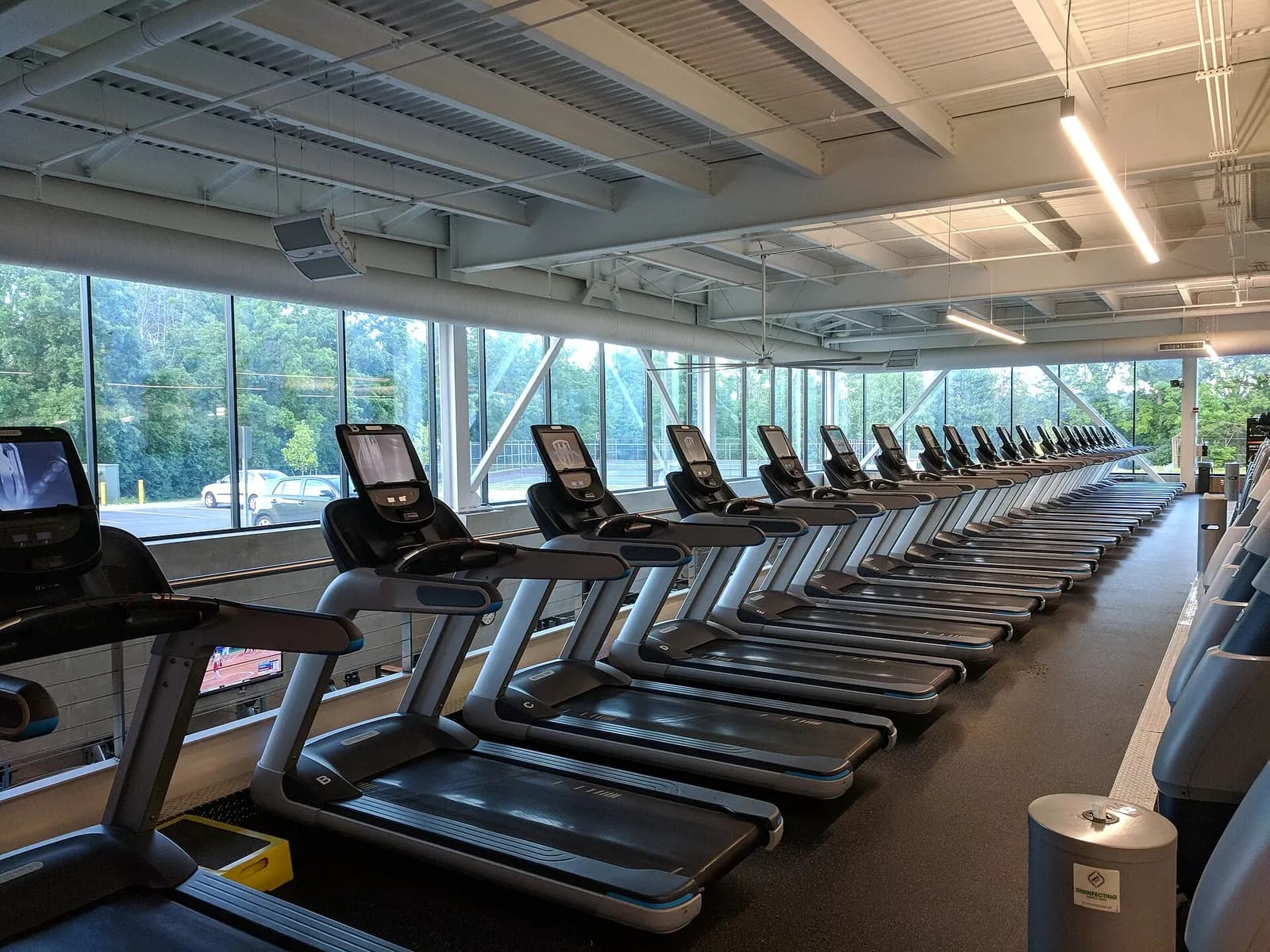
Under the 2010 ADA Standards, at least one of each type of exercise machine and equipment needs a clear floor space of at least 30 by 48 inches, served by an accessible route, so a wheelchair user can transfer onto it or use it seated. The machines themselves don't have to be modified, and clear spaces can overlap. Plan this into your floor layout early, because adding aisle width later means removing equipment. Locker rooms, showers and restrooms also have accessibility requirements that your architect should cover in the build-out.
Safety
Get a written waiver and release drafted for your state, have members complete a health questionnaire, and train staff in CPR and AED use even where it isn't required. Inspect and log equipment maintenance; cables, pulleys and treadmill belts are the usual failure points and the usual subject of injury claims. If you employ staff, OSHA's general duty rules apply, including safe cleaning chemical handling.
Insurance for a gym
Insurance isn't optional in practice: your landlord, lender and franchisor will require it. Plan for these lines, and get quotes from a broker who handles fitness businesses.
- General liability, covering member and visitor injuries, usually with landlord additional insured endorsements.
- Professional liability, covering injuries tied to training advice or instruction. Make sure it covers independent trainers or require them to carry their own.
- Property and equipment, including business interruption, which pays fixed costs if a fire or flood closes you.
- Workers' compensation, required in most states once you have employees.
- Abuse and molestation coverage if you run youth programs, and cyber liability if you store member payment data.
Premiums vary widely with location, square footage, member count, hours and claims history. Ask brokers what drives price in your state and whether 24-hour unstaffed access changes the premium.
How much does it cost to start a gym?
There's no official figure for gym startup costs, so the table below is our estimate. It's based on typical commercial equipment list prices and dealer quotes, and on build-out costs for second-generation retail space. Treat every line as a range to replace with real quotes.
| Item (6,000 sq ft neighborhood gym) | Estimate | Notes |
|---|---|---|
| Build-out: flooring, locker rooms, HVAC, electrical | $150,000–$360,000 | About $25–$60 per sq ft; lower with a tenant improvement allowance |
| Strength equipment: racks, benches, dumbbells, machines | $60,000–$150,000 | Used equipment often 40%–60% of new price |
| Cardio: treadmills, bikes, rowers, ellipticals | $50,000–$120,000 | Commercial treadmills about $5,000–$12,000 each new |
| Access control, cameras, front desk, software setup | $10,000–$25,000 | Essential for 24-hour access |
| Licenses, registration, security deposit, legal | $15,000–$35,000 | Includes lease deposit and state bond premium |
| Pre-opening marketing and presale | $15,000–$30,000 | Founding member campaign |
| Working capital (3–6 months of fixed costs) | $90,000–$180,000 | Covers losses while membership builds |
| Total | About $400,000–$850,000 | Smaller studios: about $75,000–$250,000 |
Equipment financing and leasing are common, which turns part of the equipment line into monthly payments. If you're seeking an SBA loan, expect the lender to require an equity injection; our SBA 7(a) loan guide covers start-up requirements, and our startup business loans guide compares other options. You can usually deduct equipment in the year you place it in service under Section 179 or bonus depreciation; see our depreciation guide.
Gym business plan: membership economics that add up
A gym business plan follows the standard sections in our business plan guide: executive summary, company description, market analysis, organization, services, marketing, funding request and financial projections. What lenders and investors look for in a gym plan is the membership math: how many members you need to break even, how fast you'll get there, and how many you lose each month.
The market analysis
Map every gym, studio and community center within a 10- to 12-minute drive, since most members won't travel farther. Record each competitor's monthly price, enrollment fee, hours, size and niche, and read their reviews for complaints you can solve. Then estimate how many residents and workers live within that radius. A plan that shows "there are 40,000 adults within 3 miles and four gyms, none of them with a serious strength floor" is far more convincing than national industry statistics.
The worked example
The example below is illustrative; every number is an assumption to replace. A 6,000-square-foot 24-hour gym charges $49 a month. Fixed costs are $31,000 a month: rent $9,000, staff wages and payroll taxes $11,000, equipment loan payments $3,000, utilities $2,500, marketing $2,000, cleaning and repairs $1,200, insurance $600, software and access control $500, music licensing $250 and other overhead $950. Variable cost is about $2 per member per month for card processing and cleaning supplies. For context, the BLS median pay for fitness trainers and instructors was $22.67 an hour in May 2025; the staff line assumes a part-time manager and front desk cover, with the owner unpaid.
Each member contributes about $47 a month ($49 minus $2). Divide $31,000 by $47 and the gym needs about 660 members to break even. At 900 members, it brings in $44,100 a month and earns about $11,300 a month before owner pay and tax, roughly $135,600 a year.
Try it — members needed to break even
Now add churn, the number most first-time plans leave out. If 4% of members cancel each month, a gym with 800 members loses 32 a month and must sign at least 32 new members just to hold steady. Show this in your projections: start from your presale count, add expected monthly sign-ups, subtract churn, and see which month you cross 660. If the answer is after your working capital runs out, you need a cheaper space, a higher price or a bigger presale.
Secondary revenue changes the picture. Personal training, small-group coaching, day passes, merchandise and recovery services (sauna, cold plunge) add revenue without needing much more floor space. A gym with 700 members and a personal training program that nets $8,000 a month is a much safer business than one relying on dues alone.
Pre-opening checklist
Before you open the doors
0/10Common mistakes when opening a gym
Signing the lease before running the numbers. Rent is the biggest fixed cost after staff. Work out your break-even member count for each space you consider, and walk away from a space that needs more members than your market can supply.
Selling presale memberships without the required security. Presales are the best way to fund an opening, but in New York the money goes into escrow, and in Texas and Florida you need registration and security before you sell. Selling first and registering later puts the contracts themselves at risk: New York says contracts are unenforceable against the buyer if you haven't met the bond rules.
Copying a national chain's contract. Contracts written for another state often have the wrong cancellation wording, renewal terms or notice address. Pay a local lawyer once to get a compliant template.
Underestimating churn. A gym that adds 60 members a month and loses 4% a month will plateau far below where a simple growth line suggests. Budget for constant marketing.
Treating trainers as independent contractors when you control their work. If you set their schedules, assign clients and set prices, they may be employees. Our 1099 vs W-2 guide explains the tests.
Official links
- Texas Secretary of State — health spa FAQsRegistration, security and exemptions
- New York Department of State — health club financial requirementsArticle 30 text: escrow, bonds, contract limits
- New York GBL §624 — cancellation rightsCurrent cancellation and refund text
- Florida Statutes §501.017 — health studio contractsCancellation, term limits, closures
- FTC — Negative Option RuleStatus of click-to-cancel rulemaking
- U.S. Access Board — sports facilities guideExercise equipment clear floor space
What to do next
Decide your model and niche, then price three spaces against a break-even member count before you sign anything. Use the break-even calculator with your own rent and staffing numbers, and build the full plan with the business plan generator. Check your state's health club rules with the attorney general's consumer office, and have your contract reviewed before you sell a single presale membership. If you're also considering wellness services, our med spa business plan covers the medical side.
This is general information, not legal or tax advice — confirm on the official source or with a professional.
Frequently asked questions
There's no federal gym license. You need the usual business registrations, a local business license and a certificate of occupancy for the space. Many states also regulate the membership contracts you sell. Texas requires a health spa certificate of registration for each location ($100 a year), Florida requires health studio registration ($300 per location) and New York requires a bond before you sell most contracts.
There's no official figure. Our estimate for a leased 6,000-square-foot neighborhood gym is roughly $400,000 to $850,000, driven by build-out, equipment and several months of working capital. A 1,500- to 2,500-square-foot strength or boutique studio typically needs $75,000 to $250,000. Buying used equipment and taking a space with existing showers can cut the total sharply.
No. The FTC's 2024 click-to-cancel rule was vacated by the Eighth Circuit on July 8, 2025, and the FTC started over with an advance notice of proposed rulemaking on March 11, 2026. No new rule text has been proposed. But ROSCA still governs online sign-ups, and state laws such as California's automatic renewal law already require easy cancellation.
Yes, if you play recorded music to members. Playing music in a gym is a public performance, so you need licenses from the performing rights organizations (ASCAP, BMI, SESAC and GMR) or a commercial music service that includes them. Personal streaming accounts don't allow business use, and the small-business exemption in copyright law covers only radio and TV broadcasts.
It depends on your fixed costs and dues. In our worked example, a gym with $31,000 of monthly fixed costs, $49 monthly dues and about $2 of variable cost per member breaks even at about 660 members. At 900 members it earns roughly $11,300 a month before owner pay and tax. Churn of 3% to 5% a month means you must sign up new members just to stand still.
It can be, but it's capital-heavy and fixed-cost driven. Rent and loan payments arrive whether members show up or not, and members cancel all the time. Gyms that work usually have a clear niche (strength, 24-hour access, classes, older adults), sign members before opening, add personal training revenue, and keep the lease and equipment budget in line with a realistic member count.
Sources & verification
Figures on this page were checked against the sources below when it was last reviewed on 9 October 2026. Each rate and limit is stored once with its own official source and review date, and official update channels are monitored daily so changes are picked up. How we verify
- 1.California Civil Code § 1812.84 — contracts for health studio services (term may not exceed three years) — California Legislature (statute text via public.law) · accessed 9 October 2026
- 2.Frequently asked questions for health spas — Texas Secretary of State · accessed 9 October 2026
- 3.Texas Occupations Code §702.151 and §702.307 — Texas Legislature (via Public.Law) · accessed 9 October 2026
- 4.Health Club Services Financial Requirements (General Business Law Article 30) — New York Department of State · accessed 9 October 2026
- 5.General Business Law §624 — Rights of cancellation of contracts for services — New York State Senate · accessed 9 October 2026
- 6.Florida Statutes §501.015, §501.016 and §501.017 — Florida Legislature · accessed 9 October 2026
- 7.Negative Option Rule — Federal Trade Commission · accessed 9 October 2026
- 8.FTC seeks public comment in response to advance notice of proposed rulemaking regarding negative option marketing practices — Federal Trade Commission · accessed 9 October 2026
- 9.California expands automatic renewal law: new requirements now in effect — Barnes & Thornburg (secondary) · accessed 9 October 2026
- 10.17 U.S. Code §110 — Limitations on exclusive rights: exemption of certain performances and displays — Legal Information Institute (U.S. Code) · accessed 9 October 2026
- 11.Guide to the ADA Standards, Chapter 10: Sports facilities — U.S. Access Board · accessed 9 October 2026
- 12.Fitness trainers and instructors — U.S. Bureau of Labor Statistics · accessed 9 October 2026
MSMETOOLS is an independent platform and is not affiliated with any government agency, ministry or department.
Tools for this
Break Even Calculator
Find your break even point and units.
Business Plan Generator (US)
Create a professional business plan for US investors and banks.
Startup Cost Calculator
Estimate how much capital you need to launch.
Profit Margin Calculator
Calculate profit, markup and margin for your products or services.
Related guides
 Med Spa Business Plan 2026: Ownership Rules & NumbersRead guide
 How to Start a Bakery Business in 2026: Home to StorefrontRead guide
 Car Wash Business Plan 2026: Water Rules, Costs & MembersRead guide
 Franchise Meaning: How Franchises Work, FDD & Fees (2026)Read guide
Official links open the government site in a new tab.