 Finance & accounting
Depreciation Meaning: How to Calculate It and Write Off Business Assets in 2026
Depreciation meaning for small businesses: straight-line and MACRS examples, the 2026 Section 179 limit, 100% bonus depreciation, the $2,500 safe harbor.
 Edited by Sumeet YadavFounder & editor, MSMETOOLS · fact-checked against official sources
Contents (10)
- 1. What depreciation means in business
- 2. What you can and can't depreciate
- 3. How to calculate depreciation on your books
- 4. Tax depreciation: how MACRS works
- 5. Section 179 and bonus depreciation in 2026
- 6. The de minimis safe harbor: expensing small purchases
- 7. Reporting depreciation on Form 4562
- 8. Depreciation recapture when you sell
- 9. Common depreciation mistakes
- 10. What to do next
Buy a $84,000 machine and your bank balance drops by $84,000 the day you pay. Your profit doesn't, at least not on paper, because the machine will earn money for years. Depreciation is the system that matches that cost to those years. This guide explains the depreciation meaning in plain English, shows how to calculate it with straight-line and the IRS's MACRS tables, and walks through the 2026 write-off options. Those include the Section 179 deduction, 100% bonus depreciation and the de minimis safe harbor. It closes with what happens at tax time when you sell.
Quick answer
Depreciation spreads the cost of a physical business asset, such as equipment, vehicles, computers or buildings, over its useful life. Each year's share is a deductible, non-cash expense. For taxes, most US businesses use MACRS, or write the asset off at once with Section 179 or bonus depreciation.
Straight-line: (cost − salvage value) ÷ useful life
2026 Section 179 limit: $2,560,000, phasing out above $4,090,000
Bonus depreciation: 100% for qualified property acquired after January 19, 2025
Items up to $2,500 per invoice or item can be expensed under the de minimis safe harbor
Land can't be depreciated; claims go on Form 4562
What depreciation means in business
In everyday speech, depreciation means something losing value, like a new car the moment you drive it off the lot. In accounting it means something narrower: allocating the cost of a long-lived asset to the periods that benefit from it. It's a matching exercise, not a valuation. A van on your books at $18,000 after three years of depreciation might sell for $25,000 or $12,000. The book figure only tells you how much of its cost you haven't yet expensed.
Under US GAAP, property, plant and equipment are recorded at cost and depreciated over their estimated useful lives in a "systematic and rational" way. Each year's charge appears on the income statement as depreciation expense. The running total builds up on the balance sheet as accumulated depreciation, a contra-asset that's subtracted from the asset's cost to give its net book value.
Two features make depreciation different from most expenses:
- It's non-cash. The cash went out when you bought the asset (or goes out as loan payments). Depreciation lowers profit and tax without touching your bank balance that year. That's why lenders add it back when they work out cash flow or EBITDA.
- It's a fixed cost. Depreciation on a machine is the same whether you run it one shift or three, which is why the SBA lists it alongside rent and insurance as a fixed cost in break-even planning.
Depreciation applies to tangible assets you can touch. The equivalent for intangible assets such as patents, goodwill or franchise rights is amortization.
Depreciation limits at a glance (2026)
$2,560,000
Section 179 maximum
Tax years beginning 2026
$4,090,000
Section 179 phase-out starts
Dollar-for-dollar reduction
100%
Bonus depreciation
Property acquired after Jan 19, 2025
$2,500
De minimis safe harbor
Per item/invoice, no audited statements
$32,000
Section 179 cap on heavy SUVs
2026
What you can and can't depreciate
The IRS lets you depreciate property only if all four of these are true:
- You own it. That includes property you're buying on a loan. A capital lease can count; an ordinary rental doesn't, since you deduct rent instead.
- You use it in your business or in an income-producing activity. A laptop used 70% for business is 70% depreciable.
- It has a determinable useful life. It wears out, decays, becomes obsolete or gets used up.
- It's expected to last more than one year.
You cannot depreciate land (including the cost of clearing, grading and landscaping it), inventory you hold for sale, property you place in service and dispose of in the same year, or personal-use property. Section 197 intangibles are amortized, not depreciated.
Depreciation starts when an asset is placed in service, meaning ready and available for its intended use. It doesn't start when you pay for it. A food truck bought in December but not outfitted and licensed until February starts depreciating in February. It ends when you've recovered the full cost or when you retire the asset, whichever comes first.
How to calculate depreciation on your books
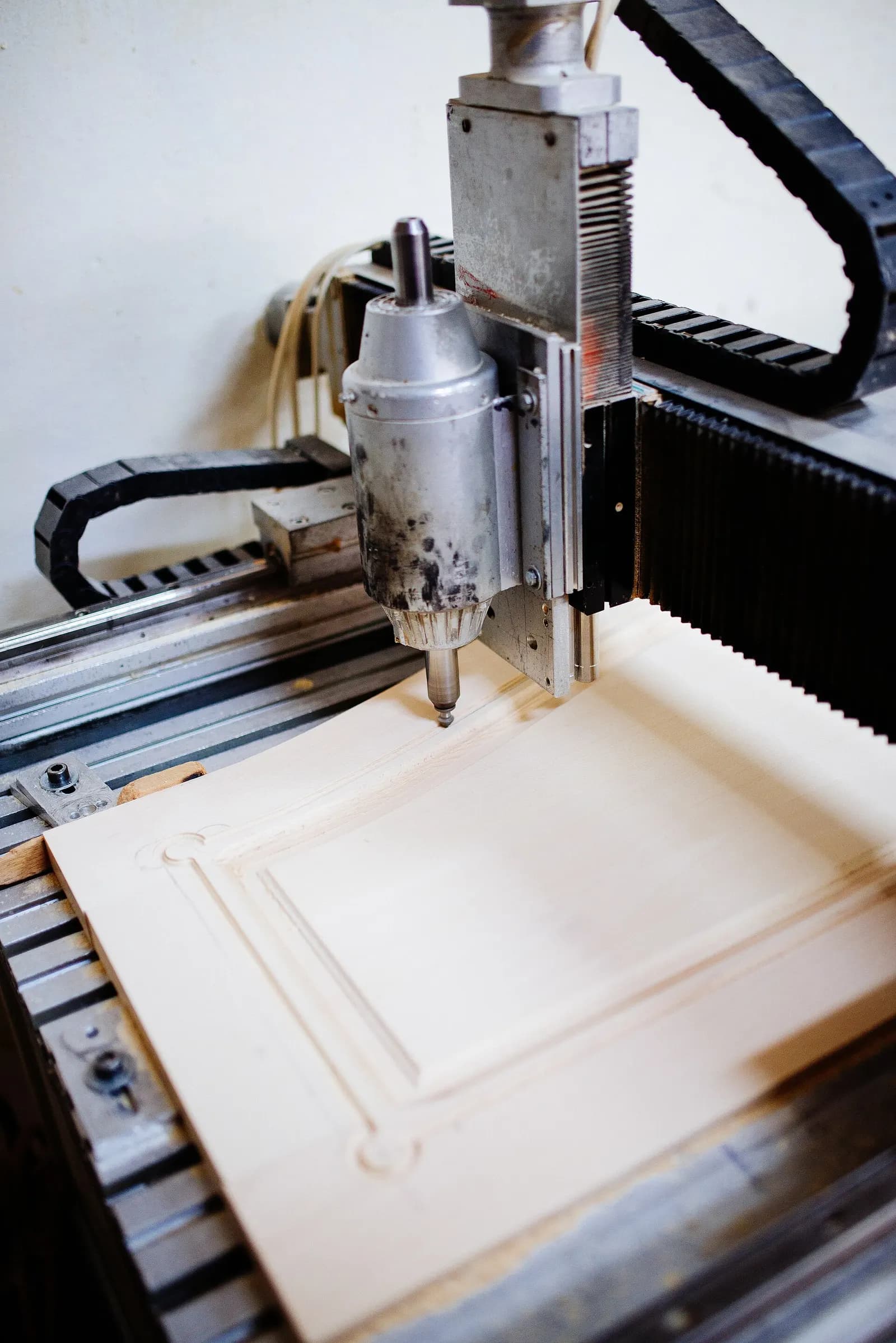
Your financial statements (the "book" side) can use any reasonable method. Three are common. We'll use one asset to compare them: a cabinet shop buys an $84,000 CNC router in January, expects to use it for seven years and sell it for about $8,400 at the end.
Straight-line depreciation
The simplest and most widely used method gives the same expense every year:
Annual depreciation = (cost − salvage value) ÷ useful life
($84,000 − $8,400) ÷ 7 = $10,800 a year, or $900 a month.
| Year | Depreciation | Accumulated depreciation | Net book value |
|---|---|---|---|
| Start | — | — | $84,000 |
| 1 | $10,800 | $10,800 | $73,200 |
| 2 | $10,800 | $21,600 | $62,400 |
| 3 | $10,800 | $32,400 | $51,600 |
| 4 | $10,800 | $43,200 | $40,800 |
| 5 | $10,800 | $54,000 | $30,000 |
| 6 | $10,800 | $64,800 | $19,200 |
| 7 | $10,800 | $75,600 | $8,400 |
At the end of year seven the router sits on the books at its $8,400 salvage value. If the shop buys it mid-year, it simply takes a partial first year: for a router placed in service on July 1, year one is $5,400.
Declining balance
Accelerated methods front-load the expense, which matches assets that lose usefulness fastest when new, such as computers and vehicles. Double-declining balance applies twice the straight-line rate to the remaining book value each year. For a seven-year life, that rate is 2 ÷ 7 = 28.57%:
- Year 1: $84,000 × 28.57% = $24,000
- Year 2: $60,000 × 28.57% = $17,143
- Year 3: $42,857 × 28.57% = $12,245
You stop once book value reaches salvage, and most businesses switch to straight-line partway through when that gives a bigger charge.
Units of production
If wear depends on use rather than time, depreciate per unit of output. Suppose the router is expected to run 20,000 hours. The rate is ($84,000 − $8,400) ÷ 20,000 = $3.78 per hour. A year with 3,500 hours of cutting carries $13,230 of depreciation. A slow year with 1,800 hours carries $6,804. This method suits trucks (per mile) and production equipment well, but you need reliable usage logs.
Tax depreciation: how MACRS works
For your federal return, you can't pick any method you like. Most property placed in service after 1986 must use the Modified Accelerated Cost Recovery System (MACRS). It ignores salvage value, assigns every asset to a property class with a fixed recovery period, and uses IRS percentage tables. Most businesses use the General Depreciation System (GDS). The Alternative Depreciation System (ADS) uses longer, straight-line periods and is required in some cases, such as listed property used 50% or less for business.
| Recovery period | Typical assets | Default method |
|---|---|---|
| 3 years | Certain tractor units, some special tools | 200% declining balance |
| 5 years | Computers, office machines, cars and light trucks, research equipment | 200% declining balance |
| 7 years | Office furniture and fixtures, most machinery, property with no assigned class life | 200% declining balance |
| 15 years | Qualified improvement property, land improvements (fences, parking lots), restaurant property | 150% declining balance |
| 27.5 years | Residential rental buildings | Straight-line, mid-month |
| 39 years | Nonresidential real property: offices, shops, warehouses | Straight-line, mid-month |
Conventions: when the first year starts
MACRS doesn't count from the exact purchase date. It uses conventions:
- Half-year convention (the default): all equipment placed in service during the year is treated as placed in service at mid-year, so you get half a year of depreciation in year one, whatever the actual date.
- Mid-quarter convention: required if more than 40% of the depreciable basis of all property you placed in service during the year (excluding real property) was placed in service in the last three months of the year. This stops owners from buying everything in December and claiming half a year. Each asset is then treated as placed in service at the midpoint of its quarter.
- Mid-month convention: used for buildings. They're treated as placed in service in the middle of the month.
The router under MACRS
The CNC router is 7-year property. Using IRS Table A-1 (half-year convention), the deduction runs over eight tax years because of the half-year start:
| Tax year | Table rate | Deduction |
|---|---|---|
| 1 | 14.29% | $12,003.60 |
| 2 | 24.49% | $20,571.60 |
| 3 | 17.49% | $14,691.60 |
| 4 | 12.49% | $10,491.60 |
| 5 | 8.93% | $7,501.20 |
| 6 | 8.92% | $7,492.80 |
| 7 | 8.93% | $7,501.20 |
| 8 | 4.46% | $3,746.40 |
The total is the full $84,000, since MACRS recovers the entire cost with no salvage value. The book and tax schedules now differ, which is normal: your tax preparer reconciles the two each year.
Section 179 and bonus depreciation in 2026
Most small businesses never run an asset through the full MACRS schedule, because two rules let them deduct most or all of the cost in year one.
Section 179 expensing
Section 179 lets you elect to deduct the cost of qualifying property in the year you place it in service. That includes machinery, equipment, vehicles, off-the-shelf software, furniture and certain building improvements such as roofs, HVAC and security systems. For tax years beginning in 2026, the maximum is $2,560,000. It's reduced dollar for dollar once you place more than $4,090,000 of Section 179 property in service in the year. For 2025, after the One Big Beautiful Bill Act, the figures were $2,500,000 and $4,000,000.
Three limits matter in practice:
- Business income limit. Section 179 can't create a loss. The deduction is capped at your taxable income from active trades or businesses, and anything above that carries forward to future years.
- More than 50% business use. Vehicles, computers and other listed property must be used more than half the time for business. If business use later drops to 50% or below, part of the deduction is recaptured.
- Heavy SUVs (6,001–14,000 pounds gross vehicle weight) are capped at $32,000 under Section 179 for 2026.
Bonus (special) depreciation
The special depreciation allowance, usually called bonus depreciation, is automatic unless you elect out. It applies to new and used property with a MACRS recovery period of 20 years or less, plus qualified improvement property and certain software. The One Big Beautiful Bill Act reinstated the 100% allowance for qualified property acquired and placed in service after January 19, 2025. For the first tax year ending after that date, you can elect a reduced 40% rate instead if a smaller deduction suits you better. Property acquired before January 20, 2025 keeps the old phase-down rate of 40% if placed in service in 2025.
Unlike Section 179, bonus depreciation has no dollar cap and no income limit. It can create or increase a net operating loss. The law also added a new 100% allowance for qualified production property: nonresidential buildings used in manufacturing and production, where construction began after January 19, 2025 and the building was placed in service after July 4, 2025.
Writing off the $84,000 router in year one: three routes
| MACRS only | Section 179 | 100% bonus | |
|---|---|---|---|
Year-one deduction | $12,003.60 | Up to $84,000 (if business income allows) | $84,000 |
Limited by business income? | No | Yes — excess carries forward | No — can create a loss |
Choose asset by asset? | — | Yes, pick items and amounts | Elect out by whole property class |
State tax match? | Usually | Many states cap or decouple | Many states decouple |
Best when | You expect higher income later | You want precise control | Large purchases or a loss year |
Year-one deduction
- MACRS only
$12,003.60
- Section 179
Up to $84,000 (if business income allows)
- 100% bonus
$84,000
Limited by business income?
- MACRS only
No
- Section 179
Yes — excess carries forward
- 100% bonus
No — can create a loss
Choose asset by asset?
- MACRS only
—
- Section 179
Yes, pick items and amounts
- 100% bonus
Elect out by whole property class
State tax match?
- MACRS only
Usually
- Section 179
Many states cap or decouple
- 100% bonus
Many states decouple
Best when
- MACRS only
You expect higher income later
- Section 179
You want precise control
- 100% bonus
Large purchases or a loss year
Which should you use?
Bigger isn't always better. A deduction is worth more in a year when you're in a higher bracket, so if this year is lean and you expect strong profits next year, regular MACRS may save more tax overall. Watch your state too: many states don't follow federal bonus depreciation or set lower Section 179 limits, so you may need a separate state depreciation schedule. Also remember the trade-off against quarterly estimated taxes: a big year-one deduction lowers this year's bill and raises future ones, because there's nothing left to depreciate.
The de minimis safe harbor: expensing small purchases
For low-cost items you don't need depreciation at all. Under the de minimis safe harbor election, a business without an applicable financial statement (audited statements, or ones filed with the SEC or a government agency) can deduct tangible items costing up to $2,500 per invoice or per item. Businesses with an applicable financial statement can go up to $5,000. The $2,500 level has applied since 2016, when IRS Notice 2015-82 raised it from $500.
To use it:
- Have an accounting policy, written if you have an applicable financial statement, to expense items below your threshold, and actually expense them in your books.
- Attach a statement titled "Section 1.263(a)-1(f) de minimis safe harbor election" to your timely filed return (including extensions) each year, with your name, address and taxpayer ID.
- Remember that it doesn't cover inventory or land, and that the election applies to all qualifying items that year, not just the ones you choose.
A dental practice buying eight $1,900 laptops on one invoice ($15,200 in total) can expense them all under the safe harbor, because the test is per item when the invoice itemizes them. There's no Form 4562 entry and no recapture tracking. Two companion safe harbors also help with repairs: the routine maintenance safe harbor and the small taxpayer safe harbor for building repairs. The second applies if your average gross receipts are $10 million or less, the building's unadjusted basis is $1 million or less, and the year's repair spending stays under the lesser of $10,000 or 2% of that basis.
Reporting depreciation on Form 4562
You file Form 4562, Depreciation and Amortization, with your return if in that year you:
- Place property in service and claim depreciation for it
- Claim a Section 179 deduction, including a carryover
- Claim depreciation on any vehicle or other listed property, whatever year you bought it
- Claim a vehicle deduction on a form other than Schedule C
- Begin amortizing costs
- File a corporate return other than Form 1120-S and claim any depreciation
Part I is Section 179, Part II is bonus depreciation, Part III is MACRS, Part V is listed property and Part VI is amortization. File a separate Form 4562 for each business or activity. If you only have depreciation on older assets and none of the triggers above apply, you can report it directly on your return without the form. Our business tax filing guide shows where the totals flow on each return type.
Depreciation recapture when you sell
Depreciation lowers your basis in the asset. When you sell, the IRS compares the price with that reduced basis, and part of the gain is taxed as if you'd never taken the deduction.
Equipment and vehicles (Section 1245 property): gain up to the total depreciation claimed, including Section 179 and bonus, is ordinary income, not a capital gain. Say the cabinet shop expensed the full $84,000 router with bonus depreciation, leaving a basis of zero, and sells it three years later for $50,000. All $50,000 is ordinary income. If it sold for $90,000, $84,000 would be recaptured as ordinary income and the extra $6,000 would be a Section 1231 gain.
Buildings (Section 1250 property): because buildings use straight-line, there's generally no ordinary recapture. The gain attributable to depreciation is "unrecaptured Section 1250 gain," taxed at a maximum of 25% for individuals. Any remaining gain gets regular long-term capital gain rates.
Sales of business property go on Form 4797. Recapture is the reason to keep a depreciation schedule for every asset, even fully expensed ones, until you dispose of it.
Common depreciation mistakes
Avoid these depreciation errors
0/8The last-but-one item surprises people. If you forgot to claim depreciation, your basis still drops by the amount you could have claimed, so you'd pay recapture on deductions you never received. The fix is usually Form 3115 (change in accounting method) to catch up the missed depreciation in the current year, not a pile of amended returns.
Official references
- IRS — Publication 946MACRS tables, Section 179, special depreciation allowance
- IRS — Instructions for Form 4562Who must file and line-by-line help
- IRS — Tangible property regulations FAQDe minimis, routine maintenance and small taxpayer safe harbors
- IRS — Rev. Proc. 2025-322026 Section 179 limits
- IRS — About Form 4797Sales of business property and recapture
- IRS — Publication 334Tax guide for small business
What to do next
List every asset you bought this year with its cost, placed-in-service date and business-use percentage. Flag items under $2,500 for the safe harbor, then decide with your preparer between Section 179, bonus and regular MACRS for the rest. Do that before year-end, while you can still time purchases around the mid-quarter rule. If the purchase is financed, run the payment through the EMI calculator and see how loan amortization differs from asset depreciation in our amortization guide.
This is general information, not legal or tax advice — confirm on the official source or with a professional.
Frequently asked questions
Depreciation is how a business spreads the cost of a long-lasting physical asset, such as a truck, machine or computer, over the years it's used, instead of expensing the whole price in the month it was bought. Each year's share is an expense that lowers profit and taxable income, even though no cash leaves the business that year.
For tax years beginning in 2026, you can expense up to $2,560,000 of qualifying equipment and software under Section 179. The limit starts shrinking dollar for dollar once you place more than $4,090,000 of qualifying property in service during the year. The deduction also can't exceed your taxable business income; any excess carries forward.
Yes, for qualified property acquired and placed in service after January 19, 2025. The One Big Beautiful Bill Act restored the 100% special depreciation allowance for most new and used equipment with a recovery period of 20 years or less. Property acquired under a binding contract before January 20, 2025 follows the older phase-down rates.
It's an annual election that lets you deduct low-cost tangible items immediately instead of depreciating them. If you don't have audited or other applicable financial statements, you can expense items costing up to $2,500 per invoice or per item, provided you also expense them in your books. You make the election with a statement attached to your timely filed return.
You compare the sale price with the asset's adjusted basis (cost minus depreciation claimed). For equipment, any gain up to the depreciation you took, including Section 179 and bonus, is recaptured and taxed as ordinary income. For buildings, the part of the gain from straight-line depreciation is taxed at up to 25%. Sales are reported on Form 4797.
No. Land doesn't wear out or get used up, so the IRS doesn't allow depreciation on it, and that includes clearing, grading and landscaping costs tied to the land. When you buy a building, split the price between the building, which you can depreciate, and the land underneath it, which you can't, usually using the property tax assessment or an appraisal.
Sources & verification
Figures on this page were checked against the sources below when it was last reviewed on 8 October 2026. Each rate and limit is stored once with its own official source and review date, and official update channels are monitored daily so changes are picked up. How we verify
- 1.Publication 946 (2025), How To Depreciate Property — IRS · accessed 8 October 2026
- 2.Rev. Proc. 2025-32 (2026 inflation adjustments) — IRS · accessed 8 October 2026
- 3.Tangible property final regulations — FAQ — IRS · accessed 8 October 2026
- 4.Instructions for Form 4562 (2025) — IRS · accessed 8 October 2026
- 5.Topic no. 409, Capital gains and losses — IRS · accessed 8 October 2026
- 6.Publication 334 (2025), Tax Guide for Small Business — IRS · accessed 8 October 2026
- 7.Principles of Accounting, Volume 2 — contribution margin and fixed costs (depreciation as a fixed cost) — OpenStax (Rice University) · accessed 8 October 2026
- 8.Calculate your startup costs (break-even analysis) — U.S. Small Business Administration · accessed 8 October 2026
MSMETOOLS is an independent platform and is not affiliated with any government agency, ministry or department.
Tools for this
Federal Tax Calculator (US)
Estimate federal income tax for individuals and businesses.
EMI Calculator
Calculate loan EMIs for business and personal loans.
Startup Cost Calculator
Estimate how much capital you need to launch.
Break Even Calculator
Find your break even point and units.
Related guides
 Amortization Meaning (2026): Loans, Intangibles & Tax RulesRead guide
 EBITDA Meaning (2026): Formula, Margin & Worked ExampleRead guide
 Equipment Financing 2026: Loans vs Leases & Section 179Read guide
 How to Collect Unpaid Invoices (2026): Steps, Letters & CourtRead guide
Official links open the government site in a new tab.