 GST & indirect tax
Delivery Challan Format under GST (2026): When to Use It, Mandatory Fields, Copies and E-way Bill Rules
Delivery challan format for 2026: when GST Rule 55 allows a challan instead of an invoice, every mandatory field, copies, e-way bill rules and a job work example.
 Edited by Sumeet YadavFounder & editor, MSMETOOLS · fact-checked against official sources
Contents (9)
- 1. What a delivery challan is, and when you can use one
- 2. Delivery challan format: the Rule 55 fields
- 3. Copies, signatures and keeping records
- 4. Delivery challan and the e-way bill
- 5. Job work challans: deadlines, ITC-04 and returns
- 6. Goods on approval, samples and repairs
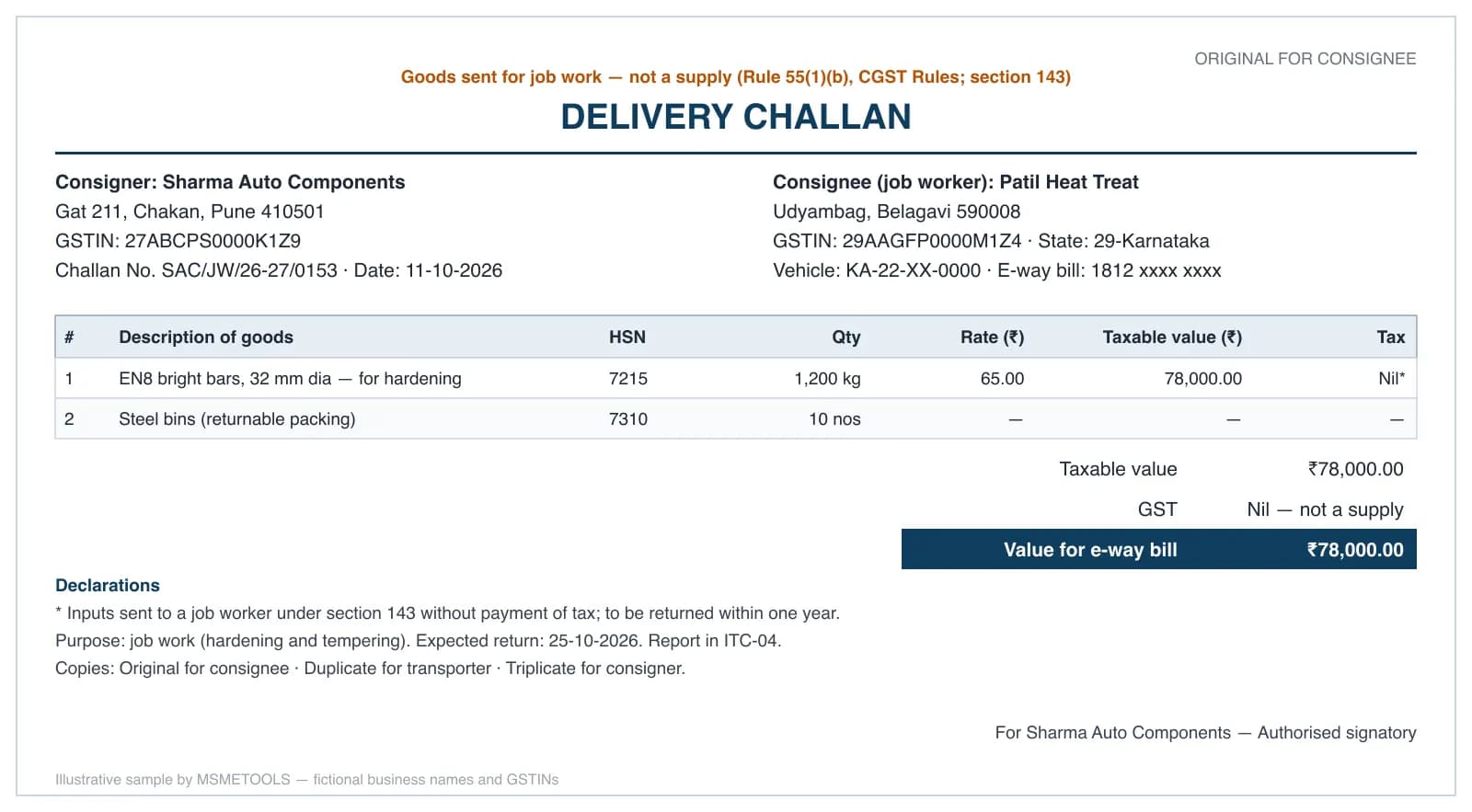
- 7. Worked example: a job work challan in ₹
- 8. Common delivery challan mistakes
- 9. What to do next
Not every movement of goods is a sale. Steel goes to a job worker for heat treatment, a jeweller carries pieces to a customer for approval, a gas tanker leaves before anyone knows how much it will deliver, a machine goes back to its maker for repair. GST still wants a document on every one of those trucks — and in these cases the document is a delivery challan, not a tax invoice. This guide is for manufacturers, traders, transporters and accountants. It explains exactly when Rule 55 of the CGST Rules allows a challan, every field it must carry, how many copies to print, how it works with the e-way bill, and the job work deadlines it starts, with a worked ₹ example. All rules were checked on CBIC's site in October 2026.
Quick answer
A delivery challan is issued instead of a tax invoice when goods move without a sale at that moment — for job work, for reasons other than supply (approval, repair, exhibition, same-GSTIN transfers), for liquid gas of unknown quantity, and for goods sent in batches or knocked-down condition. Rule 55 lists its fields: number and date, consigner and consignee details with GSTIN, HSN, description, quantity, value, tax where applicable, place of supply and signature.
Serial number up to 16 characters, unique for the financial year
E-way bill on the challan above ₹50,000 — and for inter-state job work at any value
Three copies: consignee, transporter, consigner
Inter-state branch transfers need a tax invoice, not a challan
Make one free with the delivery challan generator
What a delivery challan is, and when you can use one
Section 31 of the CGST Act ties the tax invoice to a supply: for goods, it's issued before or at the time of removal for supply. When goods leave without being supplied, there's nothing to invoice, but the goods still need a document in transit. Rule 55 fills that gap. It lets the consigner issue a serially numbered delivery challan "in lieu of invoice" at the time of removal in four situations.
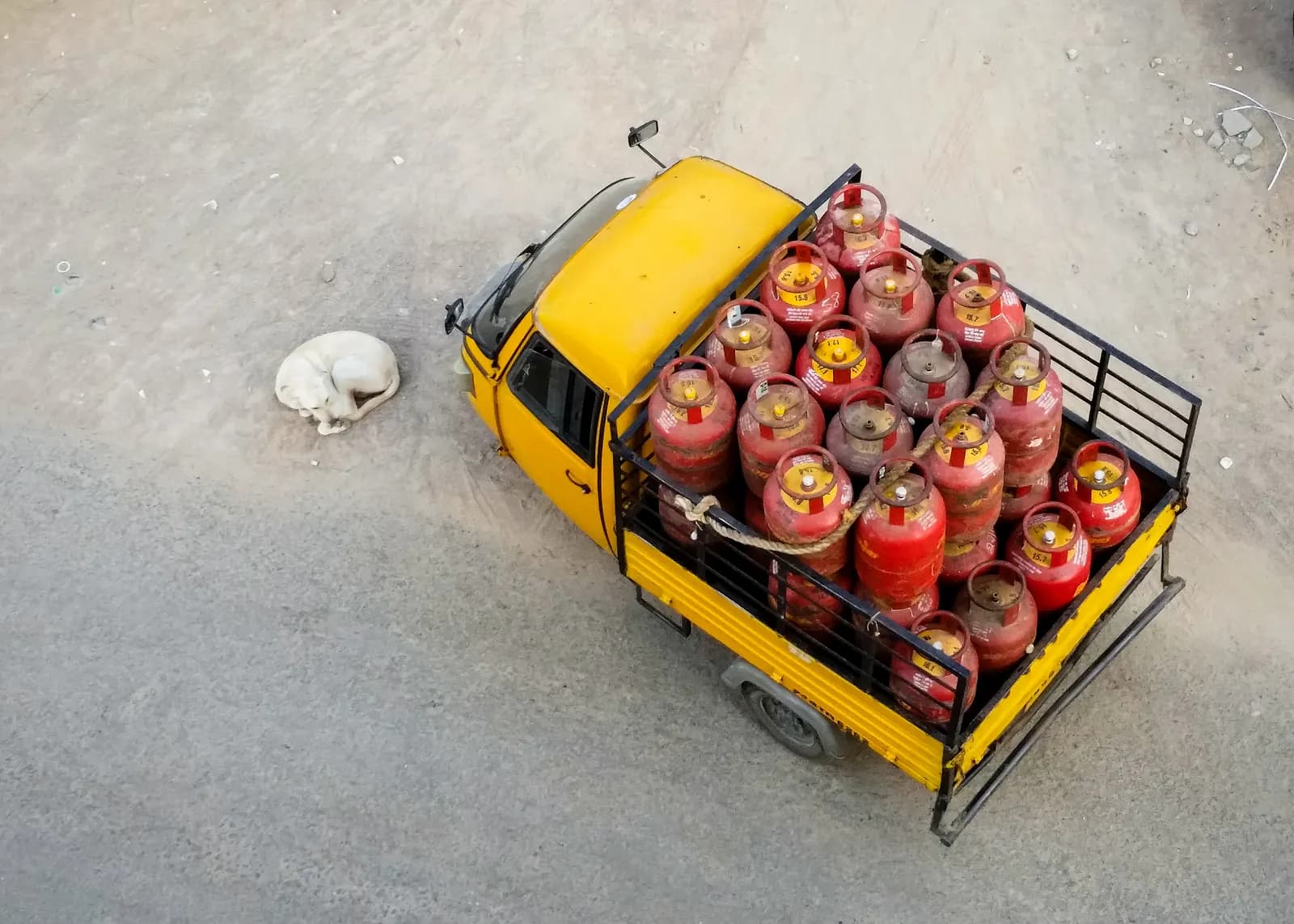
1. Liquid gas whose quantity isn't known at removal. A tanker of LPG, oxygen or nitrogen leaves the plant to fill several customers' tanks, and the quantity each receives is measured on delivery. The challan carries a provisional quantity, and the tax invoice follows once the delivered quantity is known.
2. Job work. Inputs, semi-finished goods or capital goods sent to a job worker for processing — plating, machining, heat treatment, stitching, dyeing — move on a challan, because the principal still owns them. Rule 45 adds that the challan issued by the principal must contain the Rule 55 details, and that a job worker sending goods on to another job worker, or back to the principal, may issue a challan or endorse the principal's one with the quantity and description.
3. Transportation for reasons other than supply. This is the widest category: goods sent on approval or sale-or-return, goods sent for repair or testing, samples and exhibition stock, returnable packing such as drums and pallets, tools and moulds sent to a vendor, and movements between two places of business under the same GSTIN.
4. Other supplies notified by the Board. The rule allows CBIC to add cases. In addition, Rule 55(5) uses challans for goods sent in completely or semi-knocked-down condition or in batches or lots — the invoice is issued before the first consignment, and each later lot travels on a challan referring to it.
Invoice or challan? Decide in four questions
Step 1
Are the goods being sold now?
Step 2
Yes → tax invoice
or bill of supply if no tax
Step 3
No → is the receiver a separate GSTIN?
branch in another state, agent
Step 4
Yes → tax invoice
Schedule I supply
Step 5
No → delivery challan
Rule 55
Where a challan is not enough. Two situations catch businesses out. First, a branch in another state has its own GST registration and is a "distinct person"; under Schedule I of the CGST Act, a supply between distinct persons in the course of business is taxable even without consideration. Sending stock from your Pune factory to your own Bengaluru depot therefore needs a tax invoice with IGST, which the Bengaluru registration can claim as credit. A transfer from the Pune factory to a Pune godown under the same GSTIN, by contrast, goes on a challan. Second, Schedule I also treats goods sent by a principal to an agent who will sell them on the principal's behalf as a supply, so consignment stock sent to a commission agent generally goes on an invoice too.
Delivery challan format: the Rule 55 fields
Fields every delivery challan needs (Rule 55)
0/9Numbering. The challan number follows the same rule as invoice numbers: not more than 16 characters, in one or more series, and unique within the financial year. Keep challans in their own series — for example SAC/JW/26-27/0153 for job work and SAC/DC/26-27/0041 for other movements — because they're reported separately in Table 13 of GSTR-1, which has four challan rows: job work, supply on approval, liquid gas, and other cases not by way of supply.
Value. Even when no tax is charged, show a taxable value — normally the cost or the price at which you'd sell the goods. The value matters for three reasons: the e-way bill is triggered by it, the job worker's insurance and liability depend on it, and if goods sent for job work aren't returned in time they're treated as supplied on the day they left, at that value.
Tax columns. Show tax only where the movement is for supply to the consignee and the invoice will follow — liquid gas, lots against a single invoice, or goods on approval where you choose to show the expected tax. For job work and other non-supply movements, write "Nil — not a supply" so nobody assumes tax was missed.
Purpose and return date. Rule 55 doesn't require it, but every good challan says why the goods are moving ("for hardening", "on approval", "for repair under warranty") and, for returnable goods, the expected return date. Checkpoint officers ask the first question; your stores team needs the second.
Copies, signatures and keeping records
Rule 55(2) prescribes triplicate copies where goods move for supply: the original marked ORIGINAL FOR CONSIGNEE, the duplicate DUPLICATE FOR TRANSPORTER, and the triplicate TRIPLICATE FOR CONSIGNER. For job work and other non-supply movements the rule doesn't spell out the copies, but the same three-copy set is standard practice, and it's what the receiving gate, the driver and your own stores all expect.
The challan must be signed. A digitally signed challan from software is fine, but if you print from Excel, sign or stamp each copy before the vehicle leaves. Keep the consigner copy with the job worker's acknowledgement of receipt — a signed and dated copy, or an endorsement — because that's your evidence when ITC-04 or an audit asks where the goods are. Like every other GST record, challans must be kept for 72 months from the due date of the annual return.
Pre-printed books vs software. Carbon challan books from the local printer are still common and perfectly legal, provided every field is filled in and the numbering stays continuous. Their weak point is the register: someone has to copy every challan into a spreadsheet for ITC-04 and Table 13. A delivery challan generator or accounting software keeps the register for you.
Delivery challan and the e-way bill
Rule 55(3) says goods moving on a challan must be declared under Rule 138 — the e-way bill rule. Rule 138 applies to movements "in relation to a supply", "for reasons other than supply" and inward supplies from unregistered persons, so non-sale movements are covered just like sales. In practice:
Threshold. An e-way bill is needed when the consignment value exceeds ₹50,000. The consignment value is the value declared in the invoice, bill of supply or delivery challan, plus any tax charged on that document. Some states set different limits for movements within the state, so check your state's notification for intra-state trips.
Inter-state job work at any value. Rule 138 has a specific proviso: where a principal in one state sends goods to a job worker in another state, the e-way bill must be generated by the principal, or the job worker if registered, irrespective of the value of the consignment. A ₹15,000 lot of castings going from Gujarat to Maharashtra for machining still needs one.
Document type. On the e-way bill portal, pick the transaction sub-type that describes the movement — such as job work, SKD/CKD/lots, for own use, exhibition or fairs, or recipient not known — and select "Delivery Challan" as the document type. Use the challan number and date exactly as printed. E-way bills can't be generated for documents older than 180 days, so don't let challans sit in a drawer.
No e-way bill needed — but carry the document. Rule 138(14) lists cases where no e-way bill is required, and two matter for challans. Goods moving up to 20 km from your premises to a weighbridge and back need no e-way bill if they travel on a Rule 55 challan. And goods listed in the Annexure to Rule 138 — including jewellery and other Chapter 71 articles, other than imitation jewellery — are outside the central e-way bill requirement, though some states run their own rules for gold moving within the state. Where no e-way bill is needed, Rule 55A still requires the person in charge of the vehicle to carry the invoice or bill of supply, and for challan movements you should carry the challan.
Which document goes on the vehicle?
| Movement | Document | E-way bill |
|---|---|---|
Sale to a customer | Tax invoice (or bill of supply) | Above the threshold |
Inputs to job worker, same state | Delivery challan | Above the threshold |
Inputs to job worker, other state | Delivery challan | Always, any value |
Goods on approval | Delivery challan + invoice book | Above the threshold |
Stock to own branch, other state | Tax invoice with IGST | Above the threshold |
Godown to factory, same GSTIN | Delivery challan | Above the threshold |
To weighbridge and back, ≤20 km | Delivery challan | Not required |
Sale to a customer
- Document
Tax invoice (or bill of supply)
- E-way bill
Above the threshold
Inputs to job worker, same state
- Document
Delivery challan
- E-way bill
Above the threshold
Inputs to job worker, other state
- Document
Delivery challan
- E-way bill
Always, any value
Goods on approval
- Document
Delivery challan + invoice book
- E-way bill
Above the threshold
Stock to own branch, other state
- Document
Tax invoice with IGST
- E-way bill
Above the threshold
Godown to factory, same GSTIN
- Document
Delivery challan
- E-way bill
Above the threshold
To weighbridge and back, ≤20 km
- Document
Delivery challan
- E-way bill
Not required
Job work challans: deadlines, ITC-04 and returns
The challan you raise for job work starts a clock under section 143 of the CGST Act. Inputs must come back to you — or be supplied from the job worker's premises — within one year, and capital goods within three years. The Commissioner can extend these by up to one more year and two more years respectively on sufficient cause. Moulds and dies, jigs and fixtures, and tools are exempt from the return deadline, so a die you've parked at your vendor's press shop doesn't become a deemed sale after three years.
If goods don't come back in time. Rule 45(4) treats them as supplied by you to the job worker on the day they were originally sent out. You must report that supply in GSTR-1 and pay tax with interest from the dispatch date. Keeping return dates on the challan and checking the register monthly prevents this.
ITC-04. Details of challans for goods sent to and received from job workers are reported in Form GST ITC-04 by the 25th of the month after the period. If your aggregate turnover in the previous year exceeded ₹5 crore, ITC-04 is half-yearly (April–September and October–March); otherwise it's annual. The challan number is the key that ties dispatches to returns.
The job worker's side. The job worker doesn't charge GST on your goods, but does charge GST on the job work service, on a tax invoice. Job work on goods belonging to a registered person is generally taxed at 18% (9% CGST + 9% SGST, or 18% IGST), with concessional rates for specified sectors such as textiles. Our GST on job work guide lists the rates and the principal's input tax credit position.

Goods on approval, samples and repairs
Sale on approval. Section 31(7) lets you defer the invoice for goods sent on approval or sale-or-return: it's issued when the buyer accepts or six months from removal, whichever is earlier. Circular 10/10/2017-GST confirmed that such goods can move on a delivery challan, with an e-way bill where applicable, both within the state and to another state, and that the person carrying them may take an invoice book along to bill the buyer on the spot. If a supplier registered in Rajasthan sells approval goods to a buyer in Delhi, the supply is inter-state and attracts IGST. Unsold goods come back on the same challan's return endorsement.
Samples and exhibitions. Free samples sent to customers aren't a supply to them if no consideration is involved and they aren't between related or distinct persons, so a challan is used; note that input tax credit on goods given away as free samples is blocked under section 17(5). Goods sent to a trade fair in another state move on a challan with the "exhibition or fairs" sub-type; anything sold at the fair is invoiced there.
Repairs and warranty replacements. A faulty machine sent back to its maker moves on your challan; the repaired machine returns on the repairer's challan or with its tax invoice for the repair charges. A free warranty replacement part is generally sent on a challan too, since no separate consideration is charged.
Worked example: a job work challan in ₹
Sharma Auto Components in Chakan, Maharashtra, sends 1,200 kg of EN8 bright bars to Patil Heat Treat in Belagavi, Karnataka, for hardening. The bars cost ₹65 per kg, so the challan shows a taxable value of ₹78,000, HSN 7215, tax "Nil — not a supply", place of supply 29-Karnataka, and an expected return date two weeks later. Ten returnable steel bins go on the same challan without value.
The job work lot from dispatch to return
Day 0
Challan SAC/JW/26-27/0153 raised; e-way bill generated; bars leave Chakan
Day 2
Patil Heat Treat signs the triplicate as received
Day 14
Bars return on Patil's challan with its tax invoice for job work
25th after the ITC-04 period
Dispatch and receipt reported in ITC-04
1 year from Day 0
Deadline — unreturned inputs become a deemed supply
Because the job worker is in another state, an e-way bill is compulsory regardless of value; here the ₹78,000 value would have crossed the threshold anyway. Sharma generates it with sub-type "Job Work" and document type "Delivery Challan" and quotes the number on the challan. The driver carries the duplicate copy; Patil keeps the original and signs the triplicate as acknowledgement.
When the hardened bars return, Patil sends them on its own challan referring to Sharma's challan number, along with a tax invoice for its service — say 1,200 kg at ₹14 per kg = ₹16,800 plus IGST at 18% (9% CGST + 9% SGST, or 18% IGST) — which Sharma can claim as input tax credit. Sharma's ITC-04 shows the challan going out and the matching receipt; if the bars were still at Belagavi after one year, Sharma would have to treat them as supplied on the original dispatch date and pay tax with interest.
Common delivery challan mistakes
Using a challan for an inter-state branch transfer. This is the most expensive mistake: the movement is a taxable supply, the receiving branch has no invoice to claim credit on, and the goods can be detained in transit. Use a tax invoice.
No value or a token value. A challan reading "₹1" or "no commercial value" for goods worth lakhs invites detention and makes the e-way bill wrong. Declare a realistic value.
One series for everything. Mixing invoices, job work challans and approval challans in one number series makes Table 13 and ITC-04 hard to prepare. Run separate series.
Forgetting the return. Goods that quietly stay at a job worker past the deadline become a deemed supply with interest. Track return dates.
Skipping the e-way bill on small inter-state job work lots. The value threshold doesn't apply to them.
Official links
What to do next
Set up separate challan series for job work, approval and other movements, print three copies with the correct markings, and keep a register with return dates so ITC-04 and GSTR-1 Table 13 take minutes rather than days. Our free delivery challan generator produces a Rule 55 challan with HSN, value, purpose and copy labels. When goods are actually sold, switch to a GST tax invoice — or a bill of supply if no tax is charged — and read the e-way bill guide for validity and Part B rules.
This is general information, not legal or tax advice — confirm on the official source or with a professional.
Frequently asked questions
A delivery challan is the document a consigner issues under Rule 55 of the CGST Rules when goods move without a tax invoice — for job work, for reasons other than supply (such as sending goods on approval, for repair or for exhibition), for liquid gas whose quantity isn't known at removal, and in a few other cases. It records what is moving, its value and where it's going, and it supports the e-way bill.
Rule 55 requires the challan date and number (up to 16 characters), the consigner's name, address and GSTIN, the consignee's name, address and GSTIN or UIN if registered, HSN code and description, quantity (provisional if not known), taxable value, tax rate and amount where the movement is for supply to the consignee, place of supply for inter-state movement, and a signature.
Yes, when the consignment value exceeds ₹50,000, because Rule 138 covers movements for reasons other than supply as well as supplies. For goods sent by a principal in one state to a job worker in another, an e-way bill is needed whatever the value. The e-way bill is generated using the challan number and date as the document.
Only if the branch is under the same GSTIN, which means it's in the same state. A branch in another state has a separate registration and is a distinct person, so a transfer to it is a supply under Schedule I of the CGST Act even without consideration, and needs a tax invoice with GST — not a challan.
Rule 55 says the challan is prepared in triplicate where goods move for supply: original for the consignee, duplicate for the transporter and triplicate for the consigner. Most businesses follow the same three-copy practice for job work and other non-supply movements, because the transporter and the receiver both need a copy.
Usually not. Moving goods to a job worker, sending them for repair or on approval, or moving them between places under the same GSTIN isn't a supply, so no tax is charged; the challan shows the value only. Tax is shown on a challan only where the goods are moving for supply to the consignee and the invoice follows, as with liquid gas or goods in batches.
Sources & verification
Figures on this page were checked against the sources below when it was last reviewed on 11 October 2026. Each rate and limit is stored once with its own official source and review date, and official update channels are monitored daily so changes are picked up. How we verify
- 1.Rule 55 – CGST Rules (transportation of goods without issue of invoice) — CBIC · accessed 11 October 2026
- 2.Rule 55A – CGST Rules (invoice or bill of supply to accompany goods) — CBIC · accessed 11 October 2026
- 3.Rule 45 – CGST Rules (inputs and capital goods sent to job worker) — CBIC · accessed 11 October 2026
- 4.Section 143 – CGST Act (job work procedure) — CBIC · accessed 11 October 2026
- 5.Rule 138 – CGST Rules (e-way bill) — CBIC · accessed 11 October 2026
- 6.Section 31 – CGST Act (tax invoice) — CBIC · accessed 11 October 2026
- 7.Circular No. 10/10/2017-GST – goods moved for supply on approval basis — CBIC (hosted by GST Council) · accessed 11 October 2026
- 8.Form GSTR-1 (Table 13 – documents issued) — Commercial Taxes Department, Goa · accessed 11 October 2026
- 9.Schedule I – CGST Act (supply without consideration), reproduced — CGGST (Saraswat Associates) · accessed 11 October 2026
MSMETOOLS is an independent platform and is not affiliated with any government agency, ministry or department.
Tools for this
Delivery Challan Generator (India)
Create delivery challans easily.
Invoice Generator
Create professional invoices with tax, logo and custom details.
HSN Code Finder (India)
Find the correct HSN/SAC code for your product.
GST Calculator (India)
Calculate GST for your sales and purchases with current rates.
Related guides
 GST Invoice Format 2026: Rule 46 Fields & Excel Template GuideRead guide
 GST on Job Work 2026: Rates, Section 143 & ITC-04 RulesRead guide
 Bill of Supply under GST 2026: Rule 49 Format & When to UseRead guide
 E-Way Bill 2026: Limit, Validity, Rules & How to GenerateRead guide
Official links open the government site in a new tab.