 Starting & growing a business
How to Start a Food Truck Business in 2026: Truck, Permits, Costs and Break-Even
How to start a food truck business in 2026: concept, truck vs trailer, commissary and health rules, fire code, permits in TX, CA, FL and NYC, costs and break-even.
 Edited by Sumeet YadavFounder & editor, MSMETOOLS · fact-checked against official sources
Contents (13)
- 1. Start with a concept that works on a truck
- 2. Truck, trailer or cart?
- 3. The kitchen: plan review and equipment
- 4. Fire code: propane, hoods and generators
- 5. The commissary and health rules
- 6. Food truck permits: state examples
- 7. Startup costs for a food truck
- 8. Insurance for a food truck
- 9. Pricing your menu
- 10. Worked example: food truck break-even
- 11. Taxes for a food truck
- 12. Mistakes to avoid when starting a food truck
- 13. What to do next
A food truck looks like the cheap way into the restaurant business, and in some ways it is: no dining room, no long lease, and the freedom to move to where the customers are. But a truck is also a commercial kitchen on wheels, regulated by the health department, the fire marshal and the city's parking and vending rules, and tied to a commissary you pay for every month. This guide is for cooks, caterers and first-time owners working out how to start a food truck business in 2026. It walks through the concept, choosing a truck or trailer, the commissary and health rules, fire code, permits in Texas, California, Florida and New York City, startup costs, insurance, pricing and a worked break-even. Everything was checked against health departments, fire officials, the SBA and the IRS in October 2026.
Quick answer
To start a food truck business, pick a concept with a short menu that works from a small kitchen, test it at events, choose a truck or trailer that can pass plan review, sign a commissary agreement, get your health license, fire inspection and local permits, insure the vehicle and business, and price every item from its food cost.
Most owners spend about $60,000–$200,000 to launch (estimate), driven by the vehicle
Plan on a commissary: California trucks must report to one each operating day
Texas: one statewide DSHS license since July 1, 2026; Type III $876 + $500 inspection
Fire code: propane for cooking limited to 200 pounds of propane capacity; park 10 feet from buildings
Florida bars cities and counties from charging their own food truck permit fees
Start with a concept that works on a truck
The best food truck menus are short, fast and built around one or two pieces of equipment. A taco truck with a flat-top and a steam well can serve hundreds of people at lunch; a menu that needs a fryer, a grill, an oven and a dozen garnishes will bottleneck at the window. Aim for five to eight items you can hand over in three to five minutes, with ingredients that cross over between dishes so you carry less stock and waste less.
Before you buy anything, test demand. Cater a few office lunches, run a pop-up at a brewery, or rent a booth at a farmers market under a temporary event permit. Track what sells, how long each order takes and what customers will pay. That data feeds straight into your food truck business plan, which you'll need for any lender and which forces you to work out where you'll park on a Tuesday afternoon in February.
Think about your weekly route from the start. Strong food truck businesses rarely rely on street parking alone. They mix weekday lunch at offices, hospitals or campuses, evening slots at breweries and apartment complexes, weekend events and festivals, and private catering, which often brings the best margins because the guest count is guaranteed.
Truck, trailer or cart?
Your vehicle is the biggest cost and the biggest operational decision.
A step van or box truck is the classic food truck: self-propelled, quick to set up and easy to move between two or three spots a day. A concession trailer costs less because there's no engine to buy or repair, and it can stay parked at a brewery or market for days, but you need a tow vehicle and more setup time. A cart or kiosk is the lowest-cost entry for simple menus like coffee, hot dogs or shaved ice, though many cities cap cart permits or restrict where carts can stand. Leasing a truck lowers the upfront cost and lets you test the business before you commit.
Food truck vs trailer vs cart
| Food truck | Concession trailer | Cart or kiosk | |
|---|---|---|---|
Typical vehicle cost (estimate) | Used about $46,800; new fitted about $109,500 | Less than a comparable truck | Lowest |
Moves between spots daily | Easy | Slower; needs a tow vehicle | Limited |
Menu complexity | Full cooking line | Full cooking line | Simple items |
Maintenance risk | Engine and kitchen | Kitchen and tow vehicle | Low |
Best for | Multi-stop daily routes | Fixed spots, markets, events | Coffee, snacks, high-foot-traffic sites |
Typical vehicle cost (estimate)
- Food truck
Used about $46,800; new fitted about $109,500
- Concession trailer
Less than a comparable truck
- Cart or kiosk
Lowest
Moves between spots daily
- Food truck
Easy
- Concession trailer
Slower; needs a tow vehicle
- Cart or kiosk
Limited
Menu complexity
- Food truck
Full cooking line
- Concession trailer
Full cooking line
- Cart or kiosk
Simple items
Maintenance risk
- Food truck
Engine and kitchen
- Concession trailer
Kitchen and tow vehicle
- Cart or kiosk
Low
Best for
- Food truck
Multi-stop daily routes
- Concession trailer
Fixed spots, markets, events
- Cart or kiosk
Coffee, snacks, high-foot-traffic sites
Truck figures are Restroworks' 2026 averages. Whatever you buy, get two inspections before you pay: a mechanic for the vehicle, and your local health department's plan review requirements for the kitchen. A cheap used truck that can't pass plan review, because it lacks the right sinks, water capacity, hood or surfaces, can cost more to fix than a better truck would have cost to buy.
The kitchen: plan review and equipment
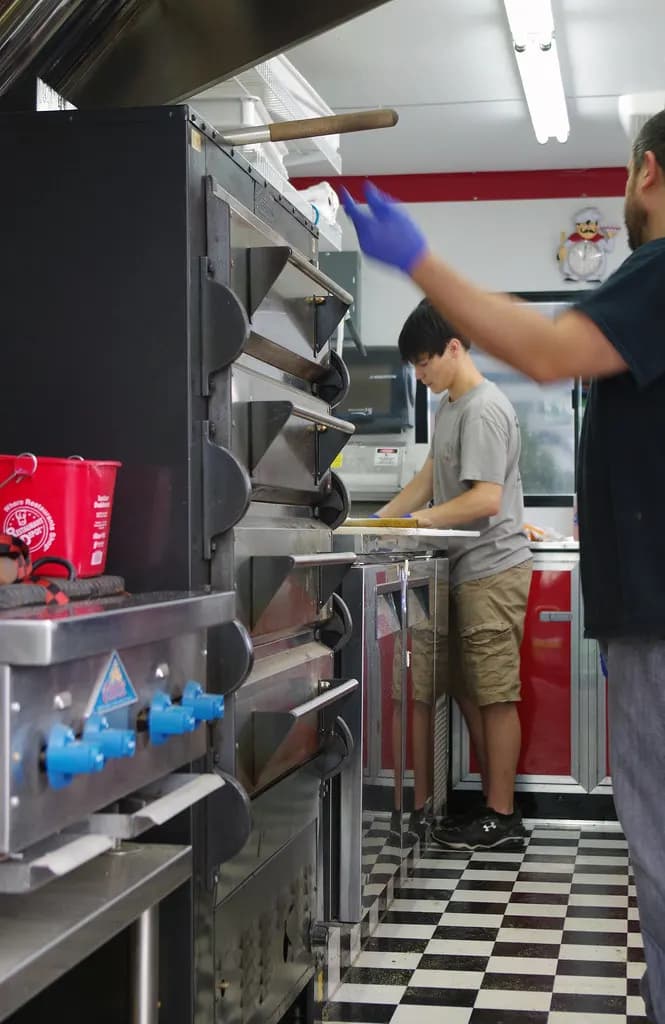
Before a health department will license a truck, it usually reviews plans or inspects the vehicle against its mobile food rules. Expect to need a three-compartment sink for washing equipment, a separate handwashing sink with hot water, fresh and wastewater tanks sized for your menu, refrigeration that keeps food at 41°F (5°C) or less, hot holding at 135°F (57°C) or above, smooth cleanable surfaces and approved food equipment. California counties, for example, require mobile food facilities to be built to NSF/ANSI Standard 59 and to carry state Housing and Community Development certification.
Buying from an experienced builder in your state helps, because they know what local plan reviewers want. If you buy used from another state, ask for the previous health permit and plan approval, and budget for upgrades. Restroworks puts individual equipment at roughly $2,000 to $6,000 for a griddle, $1,500 to $4,000 for a fryer and $5,000 to $10,000 for a hood with fire suppression, and a full vehicle wrap at $2,500 to $5,000. The wrap is your sign, menu board and billboard in one, so it's worth doing well.
Fire code: propane, hoods and generators
Fire officials inspect food trucks separately from the health department in most places, and their checklist comes from the International Fire Code's section on mobile food preparation vehicles, as adopted and amended locally. If you cook anything that produces grease-laden vapors, you need an exhaust hood and an automatic fire suppression system over the cooking line, plus portable fire extinguishers. LP-gas containers that fuel the cooking appliances are limited to 200 pounds of propane capacity in total, must be securely mounted and restrained, and the vehicle needs a listed LP-gas alarm near the gas system.
When you set up, the code expects the truck to sit at least 10 feet from buildings, combustible materials, other vehicles and other cooking operations, with wheel chocks in place. Many cities require an annual fire permit or inspection sticker before you can operate, and events often check it at the gate. Austin, for example, charges a separate fire inspection fee of $222. Keep your suppression system serviced on schedule and your extinguisher tags current, because an out-of-date tag is one of the easiest ways to fail an inspection.
The commissary and health rules
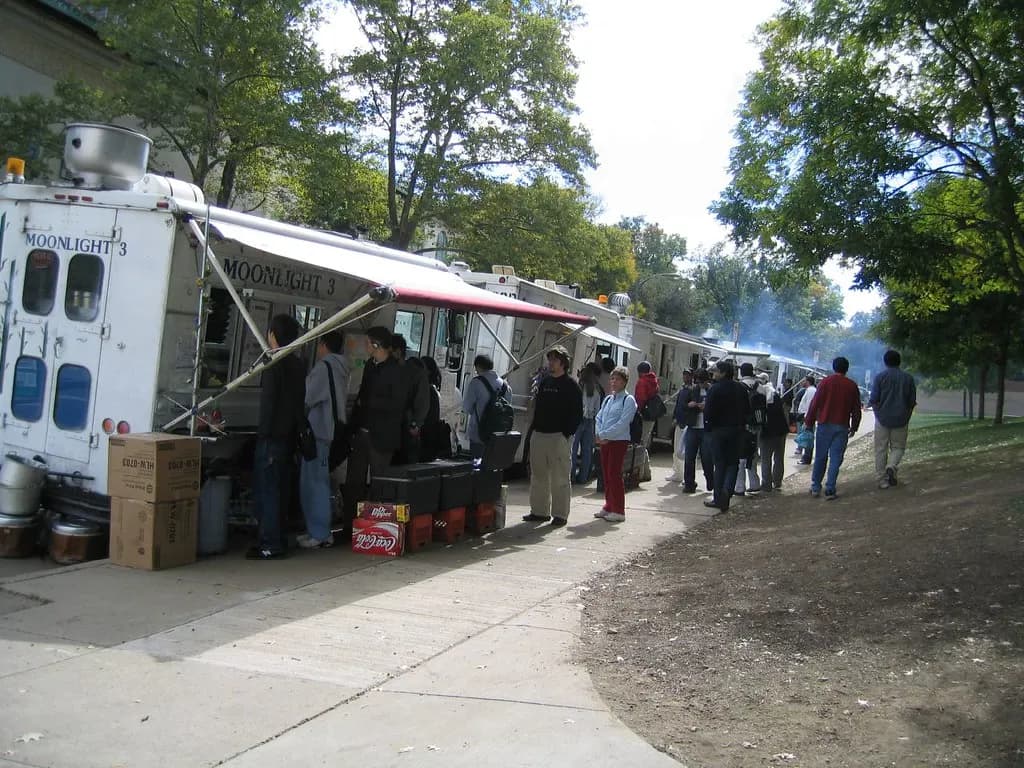
In most of the country, a food truck isn't allowed to operate on its own. Health codes treat it as an extension of a permanent, inspected kitchen called a commissary, where you store food and supplies, do bulk prep, fill potable water, dump wastewater and grease, and clean equipment. Los Angeles County defines a mobile food facility as a vehicle "used in conjunction with a commissary or other permanent food facility," and California counties require trucks to report to the commissary at least once each operating day and to be stored there.
Commissary options include shared-use commercial kitchens, which rent space and parking by the month, restaurants that rent out off-hours kitchen time, and dedicated food truck commissaries with power hookups and water stations. Whatever you choose, you'll need a signed commissary agreement for your license application, and your monthly fee becomes one of your biggest fixed costs.
Other health rules follow the FDA Food Code as your state has adopted it. At least one person on the truck typically needs a food handler card or a certified food protection manager credential, depending on the state and the menu. In California, if your truck stops in one place for more than an hour, it must be within 200 feet travel distance of an approved toilet and handwashing facility your staff can use, usually documented with a restroom agreement. Los Angeles County also requires trucks to file route sheets showing where and when they operate, and it posts letter grades on trucks.
Before your first service
0/8Food truck permits: state examples
Food truck licensing is intensely local, but a few state rules shape everything. Our food truck business license guide covers the city-level detail for Los Angeles, Austin, New York City and Portland; here's the big picture.
Texas. Since July 1, 2026, the Texas Department of State Health Services has licensed all mobile food vendors statewide, replacing city and county health permits. The fee depends on what you sell: Type I (non-TCS foods such as prepackaged ice cream) $309, Type II (coffee, snow cones, hot dogs) $618 + $400 inspection and Type III (cooking, such as taco, burger or barbecue trucks) $876 + $500 inspection. New vendors can't operate until they pass the pre-licensing inspection, and the license lasts one year from the pre-licensing inspection. Local fire inspections, zoning and parking rules still apply.
California. Trucks are permitted by the county or city environmental health agency where they're based, after plan check, and must work from a commissary, meet NSF/ANSI 59 construction and carry state HCD certification. Los Angeles County's annual permit for a high-risk truck is $761 a year, with a plan check fee of $741. Cities then decide where trucks can park and for how long.
Florida. Food trucks are licensed by the state's Division of Hotels and Restaurants as mobile food dispensing vehicles. State law preempts local licensing: cities and counties can't require their own license, registration or permit, can't charge their own permit fees, and can't ban food trucks across their whole jurisdiction. They can still regulate where and how trucks operate, and many still require a local business tax receipt.
New York City. Everyone who works on a truck needs a personal Mobile Food Vending License, $50 (two years), after a food protection course costing $53. The truck itself needs a separate unit permit, and permit supply has long been the bottleneck. Local Law 54 of 2026 expanded supervisory licenses to 2,200 a year (2,000 + 200 with permits) from July 1, 2026.
Everywhere, you'll also need the standard business setup: an LLC or DBA, a free EIN, a sales tax permit for prepared food, commercial vehicle registration and any city business license. Our business licenses guide explains how to find the local layer.
Startup costs for a food truck
Here's a typical budget for a used, already built-out truck. These are estimates based on Restroworks' 2026 cost guide, Insureon's median premiums and the state fees above; city permits, the truck's condition and your menu move them most.
| Startup item | Estimated cost | Basis |
|---|---|---|
| Used truck with kitchen | $40,000–$100,000 | Restroworks average about $46,800 before retrofits |
| Repairs, equipment upgrades and plumbing | $5,000–$25,000 | Hood and suppression $5,000–$10,000; plumbing $2,000–$5,000 |
| Vehicle wrap and menu boards | $2,500–$5,000 | Restroworks |
| Licenses, plan review, fire inspection, permits | $1,000–$5,000 | State and local fees above; more in high-cost cities |
| Business setup (LLC, legal) | $300–$1,500 | $35 – $500 LLC filing |
| POS hardware and software setup | $500–$2,000 | Plus $50–$150 a month for software |
| Opening food, packaging and smallwares | $2,500–$5,000 | First two weeks of stock |
| Insurance deposits | $1,000–$3,000 | Commercial auto and liability |
| Working capital (about 3 months) | $10,000–$30,000 | Fixed costs and repairs during the ramp-up |
| Total | About $63,000–$177,000 | Restroworks: $50,000–$250,000 all-in |
A new custom truck can push the total well past $200,000, while a trailer or cart can bring it down sharply. SBA microloans of up to $50,000 can cover equipment, inventory and working capital, and SBA 7(a) loans and equipment financing can fund the vehicle itself. Model your own budget in the startup cost calculator.
Insurance for a food truck
A personal auto policy won't cover a business vehicle, and a restaurant policy won't cover the road. Most trucks carry commercial auto insurance, general liability, coverage for the kitchen equipment, and workers' compensation once they have employees. Insureon's median premiums for its food truck customers are about $209 a month for commercial auto, $37 for general liability, $96 for a business owner's policy and $46 for workers' compensation. Events, breweries and private lots usually ask for a certificate of insurance naming them as additional insured, so have your agent ready to issue them quickly.
Pricing your menu
Price each item from its plate cost: the ingredients and packaging that go into one serving. Many operators aim for food and packaging at around 25% to 35% of the menu price, then check the result against what customers will pay at their spots. Use the food cost calculator to cost each recipe, and recheck it whenever supplier prices change.
Price for speed and the average ticket, not just margin per item. Combos that add a drink or a side lift the ticket without slowing the line. Round prices make cash and card payments faster. Event organizers often charge a flat fee or a percentage of sales, so build that into your event pricing or negotiate a minimum guarantee. For catering, quote per person with a minimum, and take a deposit when the booking is confirmed.
Worked example: food truck break-even
Here's an illustrative month for a used truck working 22 service days, with the owner cooking and one part-time employee. The figures are assumptions for the example, not industry averages.
The average ticket is $14. Variable cost per order is $4.62: food and packaging at 30% ($4.20) and card fees at 3% ($0.42). That leaves $9.38 per order toward fixed costs.
Fixed monthly costs are $11,042: commissary rent and parking ($900), fuel, propane and generator ($1,200), insurance ($300), a loan payment on $70,000 over five years at about 11% ($1,522), a maintenance and repair reserve ($500), permits and event fees ($450), POS software and marketing ($300), a part-time employee at about 25 hours a week including payroll taxes ($1,870) and an owner's salary of $4,000.
Try it — food truck break-even (orders per month)
Break-even is $11,042 ÷ $9.38, or about 1,177 orders a month: roughly 54 a day over 22 service days. At 70 orders a day (1,540 a month), the truck earns about $14,450 toward fixed costs and keeps about $3,400 a month on top of the owner's salary, before income tax. A $1 increase in the average ticket adds about $1,490 a month at that volume after card fees, and one large catering job a week can matter more than a slow street day.
The biggest risks sit outside the spreadsheet. A breakdown takes the business offline completely, which is why the repair reserve matters. Weather and seasons can cut sales sharply in some regions, and a lost lunch spot can take weeks to replace, so build relationships with several hosts.
Taxes for a food truck
Prepared food is taxable in most states, so register for a sales tax permit before your first sale and set your POS to collect the right rate for each location, which can change as you move between cities. As a sole proprietor or single-member LLC you report profit on Schedule C and pay self-employment tax of 15.3%.
The truck and kitchen equipment are major deductions. Section 179 allows you to expense qualifying equipment up to $2,560,000 in the year it's placed in service, and bonus depreciation is 100% for qualifying property under current law; vehicles have their own rules, so ask your accountant how they apply to your truck. You can also deduct up to $5,000 of startup costs in your first year. Keep mileage, fuel and commissary records from day one.
Mistakes to avoid when starting a food truck
- Buying a truck before checking plan review. A cheap truck that fails health or fire inspection isn't cheap.
- A menu that's too long. Every extra item slows the window and adds waste.
- No commissary lined up. You can't get licensed without one in most places.
- Relying on street parking alone. Build a route of private lots, events and catering.
- Skipping the repair reserve. A breakdown means zero revenue until it's fixed.
- Ignoring local vending rules. Time limits and restaurant buffers vary street by street.
- Under-pricing events. Event fees and slow periods must be in the price.
Official links
- Texas DSHS — Mobile food vendorsStatewide license types and fees
- LA County Public Health — Food trucks and cartsPermits, plan check, route sheets
- Florida Statutes §509.102State preemption of food truck permits
- NYC — Mobile food vending licensePersonal license and course
- Arlington County — Mobile food preparation vehiclesIFC Section 319 fire requirements
- SBA — MicroloansFinancing up to $50,000
- IRS Publication 946Section 179 and depreciation
What to do next
Test your menu at a few events, then call your local health department and fire marshal to ask what they need for plan review and inspection before you shop for a truck. Line up a commissary and get a quote for commercial auto insurance. Then write up your numbers in a food truck business plan and run them through the break-even calculator with your own rent, loan and wages.
This is general information, not legal or tax advice — confirm on the official source or with a professional.
Frequently asked questions
Most new food truck businesses spend about $60,000 to $200,000, depending mainly on the vehicle. Restroworks' 2026 guide puts a used truck at around $46,800 and a fully fitted new truck at around $109,500, with total all-in budgets of $50,000 to $250,000. A concession trailer or cart costs less but needs a tow vehicle and has its own permit rules. These are estimates, not official figures.
Usually yes. Most health codes treat a food truck as an extension of a permanent kitchen: you prep, store food, fill fresh water, dump wastewater and clean equipment at an approved commissary. California, for example, requires mobile food facilities to operate from a commissary and report there at least once each operating day. Some areas allow fully self-contained trucks with fewer commissary visits, so ask your health department.
Typically a business registration and EIN, a mobile food vendor health permit or license, plan review of the truck, a fire inspection for propane and cooking equipment, a sales tax permit, vehicle registration and commercial insurance, plus local parking or vending permits. Texas now issues one statewide DSHS license (Type III $876 + $500 inspection), and Florida bars local food truck permit fees. See our food truck license guide for city details.
Where local zoning, parking and vending rules allow, with the property owner's permission on private land. Cities often limit how long you can stay in one public spot, how close you can park to restaurants, and where you can operate at night. In California, a truck stopped for more than an hour must be within 200 feet of an approved toilet and handwashing facility. Breweries, offices, events and private lots are the easiest starting points.
It varies with location, menu and days worked. In our worked example, a truck with a $14 average ticket, about 33% food, packaging and card costs, and $11,042 of monthly fixed costs including a $4,000 owner salary breaks even at about 1,177 orders a month (54 a day over 22 days). At 70 orders a day it keeps about $3,400 a month on top of the owner's salary.
Usually, because a trailer has no engine or drivetrain to buy and maintain. The trade-offs: you need a vehicle that can tow it, setup takes longer, and some cities and events treat trailers differently from trucks. A trailer suits operators who park at the same brewery, market or private lot for days at a time, while a truck suits operators who move between several lunch and dinner spots.
Sources & verification
Figures on this page were checked against the sources below when it was last reviewed on 13 October 2026. Each rate and limit is stored once with its own official source and review date, and official update channels are monitored daily so changes are picked up. How we verify
- 1.Mobile food vendors — Texas Department of State Health Services · accessed 13 October 2026
- 2.Food trucks and carts — Los Angeles County Department of Public Health · accessed 13 October 2026
- 3.Summary of mobile food facility regulations — County of Sonoma Environmental Health · accessed 13 October 2026
- 4.Florida Statutes §509.102 — Mobile food dispensing vehicles; preemption — Florida Legislature · accessed 13 October 2026
- 5.Mobile food preparation vehicles — Arlington County Fire Marshal (IFC Section 319) · accessed 13 October 2026
- 6.Mobile food vending license — NYC Department of Health and Mental Hygiene (NYC Business) · accessed 13 October 2026
- 7.SBA Microloans — U.S. Small Business Administration · accessed 13 October 2026
- 8.Publication 946 — How to depreciate property — Internal Revenue Service · accessed 13 October 2026
- 9.Food truck cost — Restroworks (secondary) · accessed 13 October 2026
- 10.Food truck insurance cost — Insureon (secondary) · accessed 13 October 2026
MSMETOOLS is an independent platform and is not affiliated with any government agency, ministry or department.
Tools for this
Startup Cost Calculator
Estimate how much capital you need to launch.
Break Even Calculator
Find your break even point and units.
Food Cost Calculator
Calculate food cost, menu pricing and profit margins.
Menu Profitability Checker
Find the most profitable items on your menu.
Related guides
 Food Truck Business Plan 2026: Template, Costs & ExampleRead guide
 Food Truck Business License 2026: Permits & Costs by CityRead guide
 How to Start a Bakery Business in 2026: Home to StorefrontRead guide
 How to Open a Hair Salon in 2026: Licenses & CostsRead guide
Official links open the government site in a new tab.