 Starting & growing a business
Food Truck Business Plan (2026): Sections, Startup Costs and a Worked Example
Write a food truck business plan in 2026: 9 sections with a worked taco-truck example, startup costs, permits, commissary rules, financing and break-even.
 Edited by Sumeet YadavFounder & editor, MSMETOOLS · fact-checked against official sources
Contents (8)
- 1. What goes in a food truck business plan
- 2. Worked example: a taco truck plan in Texas
- 3. How much does it cost to start a food truck?
- 4. Food truck permits, health rules and the commissary
- 5. Financing a food truck
- 6. Revenue forecast and break-even
- 7. Mistakes that sink food truck plans
- 8. What to do next
A food truck looks like a cheap way into the restaurant business, until you price the truck, the commissary, the permits and the slow Tuesdays. A good food truck business plan forces those numbers onto paper before you sign for a vehicle, and it's the first thing a lender or investor will ask to see. This guide walks through each section of a plan with a worked example for a taco truck, sourced startup cost ranges, the permit and commissary rules health departments enforce, financing options, and the break-even math that decides whether the truck pays you. Rules and fees were checked against SBA and health-department sources in October 2026.
Quick answer
A food truck business plan follows the SBA's standard format: executive summary, company description, market analysis, management, menu, marketing, funding request and financial projections. What makes it a food truck plan is the detail on locations, the commissary, permits and a break-even point in customers per day.
Startup budgets typically run about $50,000–$200,000; a used truck can start under $30,000
Most health departments require an approved commissary and a plan review before the permit
Texas switched to one statewide mobile food vendor license from July 1, 2026
SBA microloans go up to $50,000; 7(a) loans can finance the truck
Show break-even in tickets per day, not just annual revenue
What goes in a food truck business plan
The SBA describes two formats. A traditional plan has nine sections and is what banks and SBA lenders expect. A lean plan fits on one page and is enough if you're self-funding and want a working document. Write the lean version first, then expand it into the traditional plan once you're seeking money.
The nine sections, adapted for a food truck
- 1
Executive summary
One page: concept, where and when you'll sell, how much you need, and your projected revenue and break-even. Write it last.
- 2
Company description
Choosing an LLCLegal structure, owners, the problem you solve (no quick quality lunch in an office park, late-night food near bars) and your edge.
- 3
Market analysis
Your target customers, the sites and events you'll work, competing trucks and restaurants, and local rules on where trucks may park.
- 4
Organization and management
Who cooks, who drives, who runs the books, and the certified food manager the health department requires.
- 5
Menu and service
A tight menu of 6–10 items, target food cost per item, prep done at the commissary versus on the truck, and service speed.
- 6
Marketing and sales
Social media schedule posting, catering and private events, office-park and brewery partnerships, loyalty offers.
- 7
Funding request
How much you need, from whom, for what, and over what term.
- 8
Financial projections
Startup budget, monthly profit and loss for year one, three-year summary, cash flow and a break-even analysis.
- 9
Appendix
Truck quote and inspection, commissary agreement, permit list, menu costing, resumes, letters of intent from event organizers.
Worked example: a taco truck plan in Texas
Here's how the core sections read for an imagined truck, "Norte Tacos," in a mid-sized Texas city. Swap in your own concept and numbers; the figures below are illustrative assumptions you should replace with local quotes.
Executive summary. Norte Tacos is a single-truck LLC serving griddled tacos and aguas frescas to office parks at lunch (Monday to Friday) and breweries in the evening (Thursday to Saturday). We're asking for $74,000 of a $109,000 startup budget. Projected year-one revenue is about $400,000, with break-even at roughly 90 tickets per service day.
Market analysis. Three office parks within 15 minutes of our commissary have 6,000 workers and no on-site cafeteria. Two breweries without kitchens have agreed to host us on weekend evenings. We'll compete with two taco trucks already on the brewery circuit by focusing on fast lunch service (under 4 minutes per order) and pre-ordering.
Menu. Seven items, average ticket $14, target food and paper cost of 32%. All proteins are marinated and portioned at the commissary to cut on-truck labor.
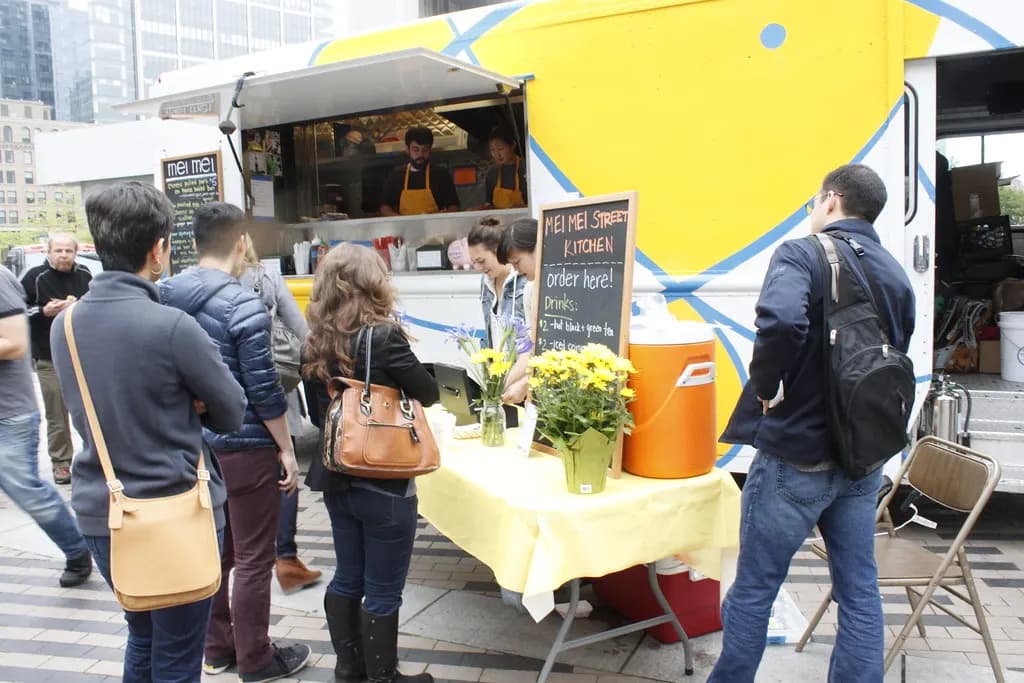
Management. Owner-operator with eight years of line-cook experience holds the certified food manager credential; one full-time and one part-time employee hold food handler cards. A bookkeeper handles monthly accounts and sales tax returns.
How much does it cost to start a food truck?
Published estimates vary widely because the truck itself does. Square puts typical startup costs at $50,000 to $200,000 including truck, permits, equipment and opening inventory, and says a budget operator can start for under $30,000 with a used truck and few upgrades. The U.S. Chamber of Commerce's CO— cites $50,000 to $200,000 for the truck alone, depending on new or used. Treat any single "average" number with caution and get quotes.
Here is Norte Tacos' startup budget, built from that range:
| Startup item | Budget | Notes |
|---|---|---|
| Used truck with built-out kitchen | $75,000 | Get a pre-purchase mechanical and kitchen inspection |
| Repairs, upgrades and vinyl wrap | $10,000 | Wrap doubles as your main advertising |
| Licenses, permits, plan review, fire inspection | $2,000 | Texas Type III state license $876 + $500 inspection, plus city and fire fees |
| POS hardware, tablet, card reader | $1,500 | Plus monthly software fees |
| Opening food, paper and smallwares | $3,000 | First two weeks of stock |
| Insurance deposits (commercial auto, liability) | $2,500 | Events and private sites often ask for a certificate of insurance |
| Working capital (about 3 months of fixed costs) | $15,000 | Covers slow months and repairs |
| Total | $109,000 |
Run your own version in the startup cost calculator. The single biggest swing is the truck: a new custom build can double the total, while a trailer or cart can cut it sharply but limits your menu and locations.
Food truck permits, health rules and the commissary
Food trucks are regulated mainly by your county or city health department, using state food codes that are largely based on the FDA Food Code. The Food Code isn't federal law itself; it's a model that states and localities adopt, which is why rules and fees differ so much from place to place. Plan on these approvals:
- Business license and tax registration with your city or county and a state sales tax permit. Our business license guide covers how to find each one.
- Plan review and health permit. You submit plans of the truck's kitchen, a menu and standard operating procedures, then the truck is inspected before a permit is issued. In Los Angeles County, a high-risk truck such as a taco or BBQ truck pays a $741 plan check fee and a $761 a year annual health permit under the fee schedule effective March 6, 2024. Trucks there must also display a letter grade and report their route and schedule.
- Commissary agreement. Most jurisdictions require trucks that handle open food to operate from an approved commissary (Texas calls it a central preparation facility). LA County defines it as a facility where food is stored and prepared, utensils are cleaned, waste is disposed of and potable water is obtained, and it evaluates the commissary as part of approving your truck.
- Fire inspection for propane, generators and cooking equipment, often with a fire suppression system over fryers and griddles.
- Food safety certificates: usually at least one certified food manager per business, and food handler cards for staff. Austin, for example, requires a posted food manager certificate and handler cards within 60 days of hire.
- Vehicle and parking rules: commercial registration and insurance, plus city rules on where and how long you can park, distance from restaurants, and event or park permits.
Texas's new statewide license
Under House Bill 2844, Texas replaced city-by-city health permits with a single state mobile food vendor license issued by the Department of State Health Services from July 1, 2026. The fee depends on risk type:
| Texas license type | What it covers | State fee |
|---|---|---|
| Type I | No time/temperature-controlled (TCS) foods, e.g. prepackaged ice cream | $309 |
| Type II | Prepackaged TCS food or limited prep, e.g. coffee, snow cones, hot dogs | $618 + $400 inspection |
| Type III | Cooking, hot and cold holding, cooling or reheating, e.g. taco, BBQ, burger trucks | $876 + $500 inspection |
The license runs for one year from the pre-licensing inspection. It replaces the local health permits, not every local rule: Austin, for example, still points vendors to the city and county fire marshals for fire inspections. Check with your city before you plan a route.

Financing a food truck
Lenders look at three things: your plan's numbers, your credit and cooking experience, and how much of your own money you're putting in. Common routes:
Food truck financing options
| Option | Typical size | Good for | Watch out for |
|---|---|---|---|
Owner savings / family | Any | Down payment, working capital | Put family loans in writing |
SBA microloan | Up to $50,000 | Equipment, inventory, working capital | Rates around 8%–13%; max 7 years; can't refinance debt |
SBA 7(a) loan | Larger amounts | Buying the truck, equipment, working capital | More paperwork; personal guarantee |
Equipment / vehicle financing | Cost of the truck | Truck and kitchen equipment | Truck is the collateral; shorter terms |
Truck lease or rent-to-own | Monthly payments | Testing the concept | Higher total cost; check who maintains it |
Owner savings / family
- Typical size
Any
- Good for
Down payment, working capital
- Watch out for
Put family loans in writing
SBA microloan
- Typical size
Up to $50,000
- Good for
Equipment, inventory, working capital
- Watch out for
Rates around 8%–13%; max 7 years; can't refinance debt
SBA 7(a) loan
- Typical size
Larger amounts
- Good for
Buying the truck, equipment, working capital
- Watch out for
More paperwork; personal guarantee
Equipment / vehicle financing
- Typical size
Cost of the truck
- Good for
Truck and kitchen equipment
- Watch out for
Truck is the collateral; shorter terms
Truck lease or rent-to-own
- Typical size
Monthly payments
- Good for
Testing the concept
- Watch out for
Higher total cost; check who maintains it
Norte Tacos' funding request: $35,000 owner equity and a $74,000 SBA 7(a) loan for the truck, upgrades and working capital, assumed at 10.75% over 10 years, or about $1,010 a month. Our SBA 7(a) loan guide explains current rate caps, fees and documents.
Revenue forecast and break-even
This is the section lenders read most closely. Build revenue from the bottom up: service days × customers per service × average ticket. Don't start from a target income and work backward.
Norte Tacos, monthly forecast (22 service days):
- Revenue: 110 tickets a day × $14 × 22 days = $33,880
- Variable costs: food and paper 32% plus card processing about 3% = 35% of sales
- Contribution margin: 65%, or $9.10 per $14 ticket
| Fixed monthly cost | Amount |
|---|---|
| Commissary rent | $1,000 |
| Staff wages and payroll taxes | $8,500 |
| Fuel, propane and generator | $1,500 |
| Insurance | $400 |
| Loan payment | $1,010 |
| Maintenance and repairs reserve | $600 |
| Permits, event and site fees | $500 |
| POS software, marketing | $400 |
| Owner's salary | $4,000 |
| Total | $17,910 |
Break-even = fixed costs ÷ contribution per ticket = $17,910 ÷ $9.10 = 1,968 tickets a month, or about 90 a day across 22 service days (about $27,550 in monthly sales). At the forecast 110 a day, the truck makes about $22,020 in contribution, or roughly $4,100 a month profit after paying the owner's salary.
That cushion is thin: lose 20 customers a day in a rainy month and you're at break-even. That's why strong plans add catering and private events, which carry higher average tickets and guaranteed minimums.
Try it — food truck break-even
Check your menu pricing with the food cost calculator so each item hits your target food cost before you plug it in here.
Mistakes that sink food truck plans
- Buying the truck before the permits. Some jurisdictions won't approve a used truck's layout without expensive changes. Get plan review requirements first.
- Ignoring the commissary cost and drive time. A cheap commissary 45 minutes away costs you hours every day.
- Forecasting every day like your best day. Use realistic averages and model a bad month.
- Underestimating downtime. A truck off the road for a week of repairs earns nothing; keep a maintenance reserve.
- Skipping the insurance math. Events and private sites often require certificates of insurance naming them.
- No exit for the slow season. In cold-weather cities, plan for catering or a reduced winter schedule.
Official links
- SBA — Write your business planTraditional and lean plan formats
- SBA — MicroloansUp to $50,000 through intermediaries
- SBA — 7(a) loansTruck, equipment and working capital
- Texas DSHS — Mobile food vendorsStatewide license from July 1, 2026
- LA County Public Health — Food trucksExample county permit process and fees
- FDA — Food Code 2022Model code most states base their rules on
What to do next
Call your county or state health department and ask for the mobile food plan review packet before anything else; it tells you what your truck and commissary must have. Then build your numbers in the break-even calculator, draft the plan with the business plan generator, and line up your business licenses.
This is general information, not legal or tax advice — confirm on the official source or with a professional. Permit fees and rules are set locally and change, so confirm the current fee schedule with your health department.
Frequently asked questions
Most published estimates put the total between about $50,000 and $200,000, including the truck, kitchen equipment, permits and opening inventory. Square notes budget operators can start for under $30,000 with a used truck and minimal upgrades. A realistic plan for a used, fully equipped truck lands near $100,000 once you add a wrap, permits, insurance and three months of working capital.
In most US jurisdictions, yes. Health departments usually require a truck that prepares open food to operate from an approved commissary, a permitted kitchen where you prep and store food, fill fresh water, dump wastewater and grease, and clean equipment. Los Angeles County inspects the commissary as part of the truck's approval, and you submit a commissary contract with your plans.
Typically a business license, a mobile food health permit from the county or state, a fire inspection for propane and cooking equipment, a sales tax permit, vehicle registration and commercial auto insurance, plus food manager and food handler certificates. Many cities add vending or parking rules. Texas moved to a single statewide mobile food vendor license from July 1, 2026.
It can be, but margins are thin. In our worked example, a taco truck selling about 110 tickets a day at $14 clears roughly $4,100 a month after paying the owner a $4,000 salary, and breaks even at about 90 tickets a day. Weather, event bookings, food cost and staff hours move that number more than anything else, which is why your plan needs a break-even calculation.
Yes. SBA microloans of up to $50,000 through nonprofit intermediaries can fund equipment, inventory and working capital, and SBA 7(a) loans can finance the truck itself. Lenders will want a business plan with financial projections, a personal financial statement and usually some owner equity. Equipment financing secured by the truck is another common route.
Sources & verification
Figures on this page were checked against the sources below when it was last reviewed on 7 October 2026. Each rate and limit is stored once with its own official source and review date, and official update channels are monitored daily so changes are picked up. How we verify
- 1.Write your business plan — U.S. Small Business Administration · accessed 7 October 2026
- 2.Microloans — U.S. Small Business Administration · accessed 7 October 2026
- 3.7(a) loans — U.S. Small Business Administration · accessed 7 October 2026
- 4.Mobile Food Vendors — Texas Department of State Health Services · accessed 7 October 2026
- 5.Food Service Trucks, Trailers, and Boats — Los Angeles County Department of Public Health · accessed 7 October 2026
- 6.New Mobile Food Facility Fees (summary) and New Construction Process roadmap — Los Angeles County Department of Public Health · accessed 7 October 2026
- 7.Mobile Food Vendors — City of Austin Public Health · accessed 7 October 2026
- 8.FDA Food Code 2022 — U.S. Food and Drug Administration · accessed 7 October 2026
- 9.How to start a food truck business — Square · accessed 7 October 2026
- 10.How to open a food truck business — U.S. Chamber of Commerce (CO—) · accessed 7 October 2026
MSMETOOLS is an independent platform and is not affiliated with any government agency, ministry or department.
Tools for this
Break Even Calculator
Find your break even point and units.
Startup Cost Calculator
Estimate how much capital you need to launch.
Food Cost Calculator
Calculate food cost, menu pricing and profit margins.
Business Plan Generator (US)
Create a professional business plan for US investors and banks.
Related guides
 How to Start a Food Truck Business in 2026: Costs & RulesRead guide
 Coffee Shop Business Plan 2026: Outline, Costs & ExampleRead guide
 How to Start a Catering Business in 2026: Permits & CostsRead guide
 How to Start a Coffee Shop in 2026: Permits, Costs & StepsRead guide
Official links open the government site in a new tab.