 Starting & growing a business
Food Truck Business License in 2026: Every Permit You Need, With City Examples
Food truck business license guide for 2026: the full permit stack — health permit, commissary, fire inspection, vending rules — with LA, Austin, NYC, Portland fees.
 Edited by Sumeet YadavFounder & editor, MSMETOOLS · fact-checked against official sources
Contents (9)
- 1. The food truck permit stack
- 2. Food truck licenses in Los Angeles
- 3. Food truck licenses in Austin and the rest of Texas
- 4. Food truck licenses in New York City
- 5. Food truck licenses in Portland, Oregon
- 6. Florida and California: statewide rules that shape local permits
- 7. Worked example: first-year permit budget and break-even
- 8. Mistakes that delay food truck permits
- 9. What to do next
There is no single "food truck business license". What you need is a stack of approvals from different offices: the city that taxes your business, the health department that inspects your kitchen, the fire marshal who checks your propane, the commissary that services your truck, and whoever controls the curb where you want to park. Miss one and you can be shut down on your busiest day. This guide is for anyone in the US planning a food truck, trailer or cart in 2026. It lays out the full permit stack, then shows how it works in four very different places, Los Angeles, Austin, New York City and Portland, with fees as each agency publishes them, plus Florida's statewide rule. Fees and rules were checked on official sites in October 2026.
Quick answer
A food truck needs a business registration and local business license or tax account, a sales tax permit, a mobile food health permit (usually after a plan review and inspection), an approved commissary, a fire inspection if it uses propane or cooking equipment, food manager and handler certificates, and local vending or parking permits. Budget roughly $1,500 to $3,000 for first-year permits in most cities, before insurance and commissary rent.
Texas: one statewide DSHS license since July 1, 2026; a Type III truck pays $876 + $500 inspection
Los Angeles County: $741 plan check and $761 a year for a high-risk truck
New York City: $50 (two years) vendor license; truck permits have waiting lists
Portland (Multnomah County): $760 (Class IV $920) cart license in 2026
Florida preempts local food truck licensing to the state
The food truck permit stack
Every jurisdiction names these differently, but the layers are nearly always the same. Work through them in order, because several depend on the one before: the health department wants your commissary agreement, and the fire marshal often wants your health application number.
Food truck licenses and permits, in the order you'll need them
- 1
Register the business
LLC registrationSole proprietorship or LLC ($35 – $500 state fee), an EIN (Free ($0)) and a DBA if you trade under a brand name.
- 2
Get a city or county business license or tax account
Business licenses guideWhere your business is based, and in some cities, every city where you sell.
- 3
Register for sales tax
Prepared food is taxable in most states; register before your first sale.
- 4
Sign a commissary agreement
A permitted kitchen for prep, storage, water, wastewater, grease and cleaning.
- 5
Submit plans and get the health permit
Truck layout, equipment specs, menu and procedures; then a pre-permit inspection.
- 6
Pass the fire inspection
Propane system, extinguishers, hood suppression over grills and fryers.
- 7
Get food safety certificates
A certified food manager for the business and food handler cards for staff.
- 8
Get vending, parking and event permits
Street vending rules, private-lot permission, park and event permits.
The vehicle itself needs commercial registration and commercial auto insurance; personal auto policies don't cover a business vehicle. Insureon's medians for its food truck customers give a sense of cost: general liability about $37 a month ($440 a year), commercial auto about $209 a month ($2,509 a year), and workers' compensation about $46 a month once you have employees. Events and private lots usually want a certificate of insurance naming them.
Business license and tax registration
This is the "business license" most people mean. It's issued by your city or county, sometimes as a business tax registration rather than a licence, and it's separate from the health permit. In the City of Los Angeles, for example, businesses register with the Office of Finance for a Business Tax Registration Certificate (BTRC). Portland requires every business operating in the city to register with the Revenue Division within 60 days and file a business license tax return, although businesses with gross receipts under $75,000 in 2026 owe no tax, a threshold that rises to $100,000 from 2027. Our business licenses guide explains how to find your local requirement.
Prepared food is taxable in most states, so register with your state revenue department before your first sale. Texas sales tax permits are Free (see our Texas sales tax permit guide), California seller's permits are Free (see our California sales tax guide), and New York's Certificate of Authority is Free but must be obtained at least 20 days before you start selling. Trucks that sell across city lines charge the rate where the sale happens.
Health permit, plan review and commissary
The health permit is the core licence and the slowest. You submit plans showing the truck's layout and equipment, a menu and your food safety procedures, then the truck is inspected before a permit is issued. Most health codes in the US are based on the FDA Food Code, adopted with local changes, so the requirements look similar but fees and paperwork differ.
The commissary is where many first-time owners get stuck. Most health departments require trucks that handle open food to operate from an approved commissary, a permitted kitchen where you prep and store food, fill potable water, dump wastewater and grease, and clean equipment. Expect to sign an agreement before you apply for the health permit. Commissary rent is a recurring cost that belongs in your food truck business plan, and its location sets your daily driving time.
Fire inspection
If the truck carries propane or has any appliance that produces grease-laden vapors, the local fire authority will inspect it, usually once a year. Inspectors check the propane system and cylinder storage, gas detectors, extinguishers, and an automatic hood suppression system over grills and fryers. Trucks serving only prepackaged food or drinks without cooking equipment are often exempt.
Food truck licenses in Los Angeles
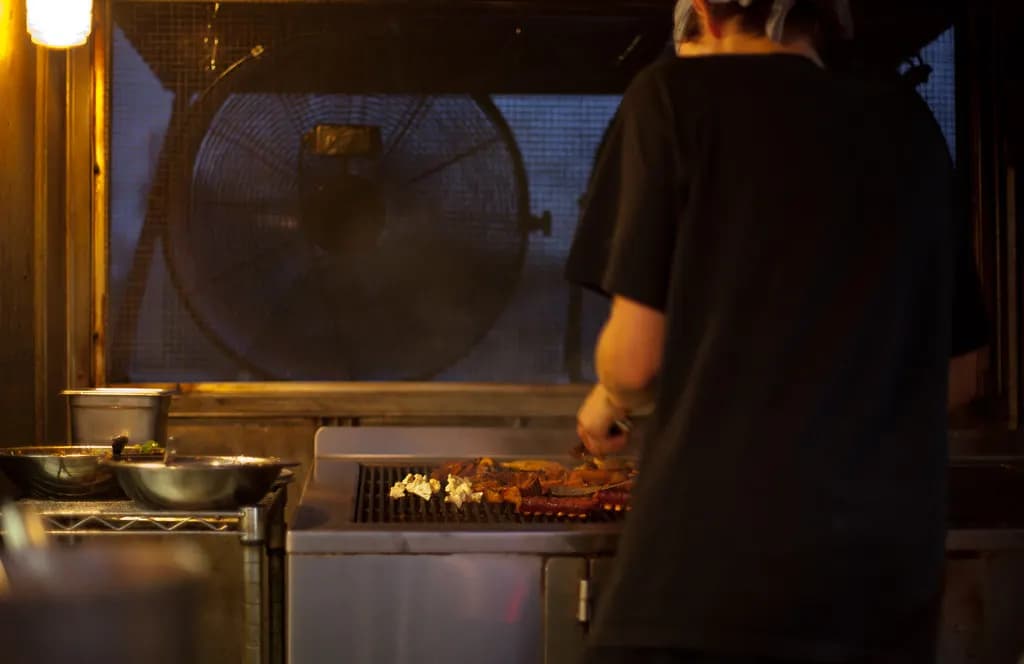
In Los Angeles County, the Department of Public Health permits and inspects all mobile food facilities, except in Long Beach, Pasadena and Vernon, which run their own environmental health departments. Under the fee schedule that took effect on March 6, 2024, a high-risk truck, one that cooks or prepares unpackaged food such as a taco or BBQ truck, pays a $741 plan check fee for a new build and a $761 a year annual health permit. Lower-risk trucks pay less.
Two operating rules catch new LA operators. First, every approved truck must display a letter grade and a certification sticker showing it is a permitted food facility. Second, under County Code 8.04.403 you must file a route sheet listing the address and arrival and departure times of every location where you sell, and update it when the route changes significantly; failing to do so can lead to suspension or revocation of your permit. The commissary is evaluated as part of the truck's approval, and the county's roadmap includes submitting a commissary agreement with your plans.
On top of the county health permit, register with the City of Los Angeles Office of Finance for a BTRC if you're based in or sell in the city, get a California seller's permit, and make sure every food handler gets a California food handler card within 30 days of hire. Cities across LA County also set their own parking and street vending rules, so check each city where you plan to sell.
Food truck licenses in Austin and the rest of Texas
Texas changed its system on July 1, 2026. Under House Bill 2844, passed on May 26, 2025, every mobile food vendor must now hold a license from the Texas Department of State Health Services (DSHS) to operate a food vending vehicle anywhere in the state, replacing the city-by-city health permits vendors used to need. The license type depends on what you do with food:
| DSHS license type | What it covers | Fees due at application |
|---|---|---|
| Type I | No time/temperature-controlled food, e.g. prepackaged ice cream or snacks | $309 |
| Type II | Limited handling, e.g. coffee, snow cones, hot dogs | $618 + $400 inspection |
| Type III | Cooking and hot holding, e.g. burger, BBQ, taco trucks | $876 + $500 inspection |
The license lasts one year from the pre-licensing inspection. Routine inspections are charged separately ($500 for Type III). Vendors who already held a local Texas permit could keep operating while their DSHS application was processed; brand-new vendors can't operate until the pre-licensing inspection is complete.
The state license replaces local health permits, not every local rule. In Austin, the Austin Fire Department still processes applications, collects fees and inspects any unit with propane or an appliance that produces grease-laden vapors; Travis County's fire marshal covers units outside the city. The fire inspection fee is $222, and an annual permit is issued when the unit passes; miss or fail the appointment and you pay again. Units inspected after May 1, 2022 need a Class 1 hood fire suppression system with a current semi-annual tag, a Class K extinguisher, a propane alarm, and a propane system inspection report from a licensed LPG plumber. Austin also requires at least one certified food manager per food business, with the certificate posted, and food handler certificates for every employee within 60 days of hire.
The permit stack in four cities (2026)
| Los Angeles | Austin | New York City | Portland | |
|---|---|---|---|---|
Health licence from | LA County Public Health | Texas DSHS (statewide) | NYC Health Dept (license + unit permit) | Multnomah County |
Published health fees | $741 plan check + $761 a year a year | $876 + $500 inspection (Type III) | $50 (two years) license + $53 course | $760 (Class IV $920) + $790 plan review |
Fire inspection | Local fire authority | Austin Fire, $222 | Check FDNY rules if you use propane | Local fire authority |
Watch out for | Route sheets, letter grades | Hood suppression on newer units | Unit permit waiting lists | Pod lot utilities and wastewater |
Health licence from
- Los Angeles
LA County Public Health
- Austin
Texas DSHS (statewide)
- New York City
NYC Health Dept (license + unit permit)
- Portland
Multnomah County
Published health fees
- Los Angeles
$741 plan check + $761 a year a year
- Austin
$876 + $500 inspection (Type III)
- New York City
$50 (two years) license + $53 course
- Portland
$760 (Class IV $920) + $790 plan review
Fire inspection
- Los Angeles
Local fire authority
- Austin
Austin Fire, $222
- New York City
Check FDNY rules if you use propane
- Portland
Local fire authority
Watch out for
- Los Angeles
Route sheets, letter grades
- Austin
Hood suppression on newer units
- New York City
Unit permit waiting lists
- Portland
Pod lot utilities and wastewater
Food truck licenses in New York City
New York City separates the person from the truck. Every vendor who prepares or sells food needs a Mobile Food Vending License, a photo ID badge issued by the Health Department. It costs $50 (two years), plus $53 for the required Food Protection Course for Mobile Food Vendors, and you apply in person by appointment at the Department of Consumer and Worker Protection's licensing center with ID, proof of address and clearance of any outstanding fines. There's no waiting list for the license, and honorably discharged veterans pay no license fee.
The truck or cart needs a Mobile Food Vending Unit Permit, and that's the bottleneck: the city caps permits and keeps waiting lists, except for restricted-area permits for locations such as private property. In January 2026 the City Council overrode a mayoral veto to enact Local Law 54 of 2026, which from July 1, 2026 makes 2,200 a year (2,000 + 200 with permits) supervisory licenses available each year through 2031, up from 445 a year, with most reserved for boroughs outside Manhattan. The same law tightened enforcement: three violations of certain time, place and manner rules within a year now lead to escalating suspensions and then revocation, and vendors must keep a two-foot area around their unit free of litter.
Add a New York Certificate of Authority for sales tax, and read the city's time, place and manner rules before choosing a corner, since they decide where a permitted truck may actually stop and sell. Many new operators start on private lots, at events or with restricted-area permits while they wait for a citywide permit.
Food truck licenses in Portland, Oregon
Portland is famous for food cart "pods" on private lots, and its licensing reflects that. Multnomah County Environmental Health licenses mobile units by class, from Class I (prepackaged food) to Class IV (full cooking). For 2026, the license is $760 (Class IV $920), and plan review for a new or remodeled unit is $790. The county has already announced increases from January 1, 2027: $810 (Class IV $980) for the license and $845 for plan review. Submit plans before you buy or build a cart, since a unit that doesn't meet code is expensive to fix.

Your Portland business license tax account comes from the city's Revenue Division, and Oregon has no general sales tax, which simplifies pricing. Before signing a lease at a pod, ask the lot owner what utilities, wastewater disposal and commissary arrangements are included, because those determine what the county will approve and what you'll pay each month.
Florida and California: statewide rules that shape local permits
Florida takes the opposite approach to New York. Under section 509.102 of the Florida Statutes, licensing of mobile food dispensing vehicles is preempted to the state. Cities and counties can't require a separate license, registration or permit, can't charge their own permit fees, and can't ban food trucks from their entire jurisdiction. You license the vehicle through the Department of Business and Professional Regulation's Division of Hotels and Restaurants instead. Local governments can still regulate how and where trucks operate, such as zoning and parking, so check the rules where you plan to sell, and confirm the current DBPR license fee when you apply. Our Florida business license guide covers the other state and local registrations.
California regulates mobile food facilities under the California Retail Food Code, enforced by county environmental health departments such as LA County's, so you deal with the county where you're based and may need approvals from others where you sell. You'll also need a seller's permit from the CDTFA, food handler cards for staff, a city business license or tax registration, and approval from the local fire authority.
Worked example: first-year permit budget and break-even
Here's an imagined Type III taco truck based in Austin, run by the owner with one part-time helper, selling about 22 days a month. First-year licensing and compliance costs come to roughly $2,500: the DSHS license and pre-licensing inspection ($876 + $500 inspection), the Austin Fire Department inspection ($222), a Texas LLC filing ($300), a food manager certification and handler cards (about $150, our estimate), and propane system inspection and suppression service (about $400, our estimate). The sales tax permit is free.
Monthly fixed costs total about $9,036: central preparation facility rent ($900, our estimate), permits and inspections spread over twelve months ($170), general liability and commercial auto insurance at Insureon's medians ($246), the truck loan ($1,200), fuel, propane and generator ($900), POS and phone ($120), the helper ($2,000) and an owner's salary of $3,500.
With an average ticket of $14 and variable costs of $5 per ticket (food and paper at about 32%, plus card fees), each sale contributes $9. Break-even is $9,036 ÷ $9, or about 1,004 tickets a month, roughly 46 a day over 22 selling days. Permits are a small share of the total, but missing one costs far more: a failed fire inspection means paying $222 again and losing selling days while you wait.
Try it — food truck break-even in tickets per month
Mistakes that delay food truck permits
- Buying a truck before plan review. A used truck built for another county may need costly changes to pass yours.
- No commissary agreement. Most health departments won't issue a permit without one.
- Skipping the fire inspection. Health approval doesn't cover propane and suppression systems.
- Assuming one permit covers every city. Outside Texas and Florida, each county or city may need its own approval.
- Ignoring route and location rules. LA requires route sheets; NYC enforces strict curb rules with escalating suspensions.
- Forgetting sales tax. Prepared food is taxable in most states, and the rate follows where you sell.
- Letting certificates lapse. Food manager certificates, fire tags and suppression service all have expiry dates.
Official links
- Texas DSHS — Mobile food vendorsStatewide license since July 1, 2026
- Austin Fire — Mobile food vending inspectionsFee and equipment checklist
- LA County Public Health — Food trucksPermits, route sheets, commissary
- NYC Business — Mobile Food Vending LicenseVendor license and course
- NYC Council — Local Law 54 of 2026Supervisory license expansion
- Multnomah County — 2027 health license feesFood cart license and plan review
- Portland City Code 7.02.400Business license tax exemption
- Florida Statutes s. 509.102State preemption for food trucks
What to do next
Call the health department and fire marshal where your truck will be based before you buy a vehicle, ask for their plan review checklist, and line up a commissary. Then register the business, open your sales tax account, and build the permit costs into your food truck business plan. Check your numbers in the break-even calculator and price your menu with the food cost calculator.
This is general information, not legal or tax advice — confirm on the official source or with a professional.
Frequently asked questions
Usually a stack of five or six: business registration and a city or county business license or tax registration, a sales tax permit, a mobile food health permit with plan review, a commissary agreement, a fire inspection for propane and cooking equipment, and food manager and handler certificates. Many cities add vending, parking or location permits, and the truck needs commercial registration and insurance.
It depends on the jurisdiction. A Texas Type III truck such as a taco or BBQ truck pays $876 + $500 inspection to DSHS, and Austin's fire inspection adds $222. Los Angeles County charges a $741 plan check and $761 a year for a high-risk truck. Budget roughly $1,500 to $3,000 for first-year permits, before insurance and commissary rent.
In most places, yes. Health departments generally require trucks that prepare open food to operate from an approved commissary, called a central preparation facility in Texas, where you store and prep food, fill fresh water, dump wastewater and grease, and clean equipment. Los Angeles County evaluates the commissary as part of the truck's approval, and Austin asks for a central preparation facility contract.
Not for health permits any more. Since July 1, 2026, Texas has issued a single statewide mobile food vendor license through DSHS under House Bill 2844, replacing city and county health permits. Local fire inspections, zoning, parking and business rules still apply, so Austin trucks with propane or grease-producing cooking equipment still need an Austin Fire Department inspection.
No. Florida law preempts the licensing of mobile food dispensing vehicles to the state: cities and counties may not require a separate license, registration or permit or charge their own permit fees, and may not ban food trucks from their entire jurisdiction. You license through the Division of Hotels and Restaurants, and local governments can still regulate where and how trucks operate.
The personal Mobile Food Vending License has no waiting list and costs $50 (two years), but truck and cart permits have long waiting lists. Local Law 54 of 2026 expanded supply, making 2,200 a year (2,000 + 200 with permits) supervisory licenses available from July 1, 2026 through 2031, so new vendors have a clearer route than before.
Sources & verification
Figures on this page were checked against the sources below when it was last reviewed on 9 October 2026. Each rate and limit is stored once with its own official source and review date, and official update channels are monitored daily so changes are picked up. How we verify
- 1.Mobile Food Vendors — Texas Department of State Health Services · accessed 9 October 2026
- 2.Mobile Food Vendors — City of Austin Public Health · accessed 9 October 2026
- 3.Mobile Food Vending Fire Inspections — Austin Fire Department · accessed 9 October 2026
- 4.Food Service Trucks, Trailers, and Boats — Los Angeles County Department of Public Health · accessed 9 October 2026
- 5.New Mobile Food Facility Fees (summary) — Los Angeles County Department of Public Health · accessed 9 October 2026
- 6.Mobile Food Vending License — NYC Business (City of New York) · accessed 9 October 2026
- 7.Int. 431-B (Local Law 54 of 2026) — New York City Council · accessed 9 October 2026
- 8.2027 Fee Changes for Health Licenses — Multnomah County · accessed 9 October 2026
- 9.2026 Fee Changes for Health Licenses — Multnomah County · accessed 9 October 2026
- 10.Portland City Code 7.02.400 — Exemptions — City of Portland · accessed 9 October 2026
- 11.Florida Statutes section 509.102 — The Florida Senate · accessed 9 October 2026
- 12.Food truck insurance cost — Insureon (secondary) · accessed 9 October 2026
MSMETOOLS is an independent platform and is not affiliated with any government agency, ministry or department.
Tools for this
Break Even Calculator
Find your break even point and units.
Startup Cost Calculator
Estimate how much capital you need to launch.
Food Cost Calculator
Calculate food cost, menu pricing and profit margins.
Sales Tax Calculator (US)
Calculate sales tax for all US states and cities.
Related guides
 Food Truck Business Plan 2026: Template, Costs & ExampleRead guide
 How to Start a Food Truck Business in 2026: Costs & RulesRead guide
 How to Start a Catering Business in 2026: Permits & CostsRead guide
 Cottage Food Law 2026: State Rules, Limits & LabelsRead guide
Official links open the government site in a new tab.