 Starting & growing a business
How to Start a T-Shirt Business in 2026: Printing Methods, Kids' Clothing Rules, IP Risks and Margins
How to start a t-shirt business in 2026: screen print vs DTG vs print-on-demand, CPSIA rules for kids' shirts, trademark and copyright risks, sales tax and margins.
 Edited by Sumeet YadavFounder & editor, MSMETOOLS · fact-checked against official sources
Contents (9)
- 1. Choose your printing method
- 2. Set up the business
- 3. Labels on every shirt: FTC textile rules
- 4. Kids' t-shirts: CPSIA testing and certificates
- 5. Trademark and copyright: the risk that closes shops
- 6. Sales tax on t-shirts
- 7. T-shirt margins: two labelled examples
- 8. Common mistakes and how to avoid them
- 9. What to do next
A t-shirt business is one of the easiest product businesses to start, which is exactly why it's crowded. The founders who last pick a printing method that matches their order sizes, price with every fee counted, and avoid the two legal problems that close shops overnight: designs that borrow someone else's intellectual property, and kids' shirts sold without the safety testing federal law requires. This guide is for anyone in the US starting a t-shirt business in 2026, from a print-on-demand shop to a garage screen printer, and was checked against CPSC, FTC, USPTO and state tax sources in October 2026.
Quick answer
To start a t-shirt business, choose a niche and original designs, pick a production method (print-on-demand for no inventory, screen printing for bulk orders, DTG or heat transfer for short runs), form an LLC, register for sales tax, and price each shirt with blank, printing, platform and shipping costs included. Kids' shirts need CPSIA testing and a Children's Product Certificate.
Print-on-demand: no inventory, lower margin; screen printing: high setup, cheap per shirt at volume
Kids' shirts (12 and under): lab-tested prints, lead limits of 100 ppm total and 90 ppm (0.009%) in coatings, tracking labels
Never print logos, characters or lyrics you don't own; statutory damages reach $150,000 per work if willful
Trademark your brand name for $350 per class
Our $28 print-on-demand example leaves about $11.90 per sale before ads
Choose your printing method
The method you pick sets your startup cost, your margin per shirt and the kind of orders you can take. There's no best method, only a best fit for your order sizes.
Print-on-demand (POD). A fulfillment company prints and ships each shirt after a customer orders it, using DTG or similar printing. You upload designs, connect your store or marketplace, and pay only when you sell. There's no inventory or equipment, so it's the lowest-risk way to test designs, but the per-shirt cost is the highest, quality varies by supplier, and you don't control shipping times. It's similar in structure to dropshipping.
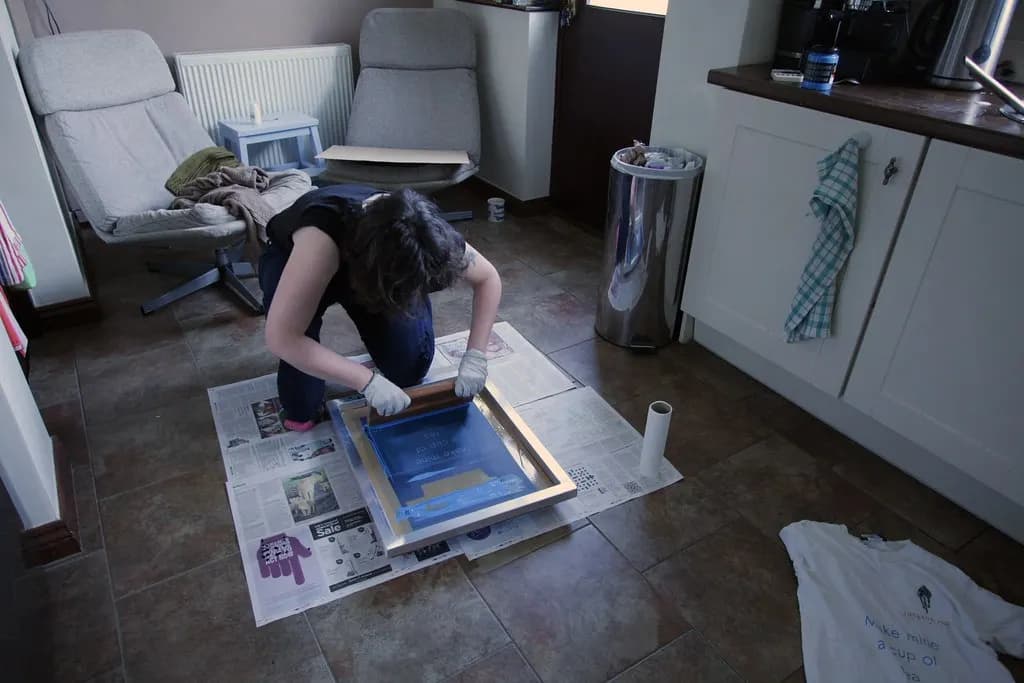
Screen printing. Ink is pushed through a mesh screen, one screen per color. Setup takes time and money for every design and color, but once a design is set up, each extra shirt is cheap and the print is durable. It's the standard for bulk orders: teams, schools, events, businesses and bands. A manual press in a garage is a common starting point.
Direct-to-garment (DTG). An inkjet-style printer prints full-color designs straight onto the shirt. There's almost no setup per design, so it suits one-offs and photo-style art, but the printer is expensive, needs regular maintenance, and the per-shirt ink and pretreatment cost doesn't fall much with volume.
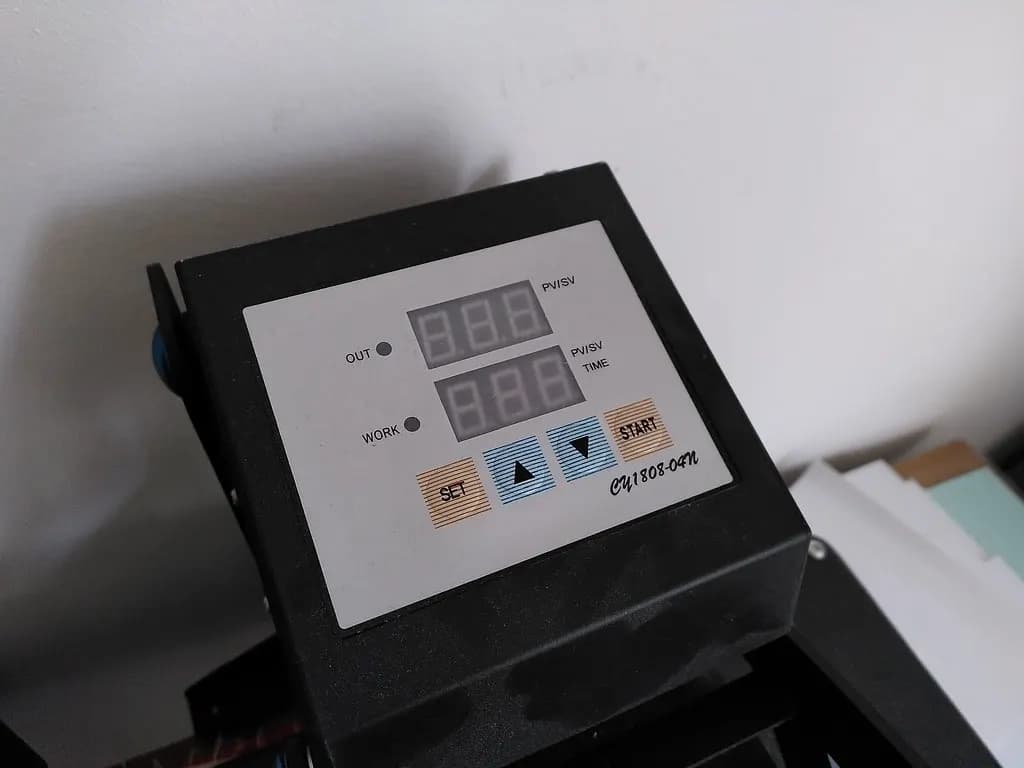
Heat transfers (vinyl, DTF, sublimation). Designs are printed or cut onto a transfer and applied with a heat press. Startup is cheap and runs can be very small. Direct-to-film (DTF) transfers can be bought ready-made from transfer suppliers, so you only need a heat press. Sublimation works only on light-colored polyester.
Printing methods compared (estimates)
| Method | Startup cost (estimate) | Best order size | Main trade-off |
|---|---|---|---|
Print-on-demand | Close to $0 plus samples | 1 shirt at a time | Lowest margin, least control |
Screen printing (manual) | A few thousand dollars | 24+ shirts per design | Setup per color and design |
DTG printer | Several thousand to tens of thousands | 1–50 shirts, full color | Machine cost and maintenance |
Heat transfer / DTF | Hundreds for a heat press | 1–24 shirts | Slower per shirt, feel of the print |
Print-on-demand
- Startup cost (estimate)
Close to $0 plus samples
- Best order size
1 shirt at a time
- Main trade-off
Lowest margin, least control
Screen printing (manual)
- Startup cost (estimate)
A few thousand dollars
- Best order size
24+ shirts per design
- Main trade-off
Setup per color and design
DTG printer
- Startup cost (estimate)
Several thousand to tens of thousands
- Best order size
1–50 shirts, full color
- Main trade-off
Machine cost and maintenance
Heat transfer / DTF
- Startup cost (estimate)
Hundreds for a heat press
- Best order size
1–24 shirts
- Main trade-off
Slower per shirt, feel of the print
Startup figures are our estimates for new entry-level equipment, not quotes; used presses and printers cost less, and prices vary widely by brand and capacity. Many owners combine methods: POD for an online catalog, plus screen printing or transfers for local bulk orders, which pay faster and in bigger chunks.
Set up the business
Form an LLC so a claim over a defective product or an infringing design stays with the business; state filing fees run $35 – $500, and an EIN costs Free ($0). Our LLC registration guide covers the steps. If you print at home, check your city's home occupation rules; screen printing uses inks, emulsion and cleaning chemicals, and some cities restrict manufacturing activity, chemical storage or customer pickups in residential zones.
Choose where you'll sell. Your own store on a platform such as Shopify gives you customer data and control; marketplaces such as Etsy and Amazon bring buyers but charge fees on every sale and set rules on what you can list. Our guides to selling on Etsy, selling on Amazon and ecommerce platforms compare the options. Bulk local orders, by contrast, usually come through direct relationships with schools, teams and businesses, and need only quotes and invoices.
Labels on every shirt: FTC textile rules
Clothing sold in the US needs a label showing fiber content (such as "100% cotton"), country of origin, and the identity of the manufacturer or another business handling it, by name or by its Registered Identification Number (RN). A separate FTC rule requires care instructions. Blank shirts from a wholesale supplier already carry these labels, so if you print on them and leave the label in, you're covered.
Problems start when you relabel. Many brands tear out the blank maker's tag and add their own neck print or woven label. The FTC allows this, but the new label must carry all the required information from the original, including fiber content and country of origin, and it must identify your company or RN. A retailer that removes a required label must also keep records for three years showing what the original label said and where the product came from. An RN is optional but makes labeling simpler; you apply for one through the FTC's RN site.
Online listings have their own rule: the FTC requires mail-order and internet product descriptions to state the country of origin, and it must match the label. "Made in USA" on its own is allowed only when the shirt was made entirely in the US from US-made materials. A design printed in the US on an imported blank doesn't qualify; the FTC's guidance uses "Made in U.S.A. and Imported" for products made in the US from imported materials.
| Label item | Required? | Example |
|---|---|---|
| Fiber content by generic name and % | Yes | "100% cotton" |
| Country of origin | Yes | "Made in Honduras" |
| Manufacturer or dealer name or RN | Yes | "RN 123456" or your company name |
| Care instructions | Yes (FTC Care Labeling Rule) | "Machine wash cold" |
| Size and brand | Your choice | Neck print or woven label |
Kids' t-shirts: CPSIA testing and certificates
If you sell shirts designed or intended primarily for children 12 and under, federal children's product safety rules apply, and this is the part most t-shirt guides skip. The domestic manufacturer or importer of a children's product must issue a Children's Product Certificate (CPC) based on testing by a third-party laboratory accepted by the Consumer Product Safety Commission. When you buy blank kids' shirts and print on them, you're changing the product, so treat yourself as the manufacturer of the finished shirt.
Lead. Accessible components of children's products can't contain more than 100 ppm of lead, and paint and similar surface coatings on children's articles are limited to 90 ppm (0.009%). CPSC rules list textiles colored only with dyes among materials determined not to exceed the lead limits, which is why plain kids' blanks are relatively simple. But that determination excludes textiles with treatments or applications that aren't entirely dyes, and the rule specifically names inks used in after-treatment applications such as screen prints, transfers and decals. In plain terms: your print is what needs testing, along with any snaps, zippers or rhinestones. Ask your lab which lead standard applies to your ink, and use component testing so one passing ink result can support many designs.
Flammability. Clothing textiles must meet the federal flammability standard, but plain-surface fabrics weighing 2.6 ounces per square yard or more, and fabrics made entirely of acrylic, modacrylic, nylon, olefin, polyester or wool, are exempt from testing. Standard jersey tees are plain-surface fabric, so the weight of your blank often settles this; check the spec sheet. Children's sleepwear has much stricter rules, so never market a printed tee as pajamas or sleepwear.
Tracking labels. Children's products need permanent distinguishing marks on the product and its packaging, where practicable, showing the manufacturer or private labeler, where and when it was made, and batch or run information. A printed or sewn label with your name, location, month and year, and a batch code meets the idea; keep the batch records that match it.
Small batch relief. A business whose total gross revenue from consumer products in the prior year was $1,436,864 or less, and that made no more than 7,500 units of the same product, can register as a small batch manufacturer on SaferProducts.gov. Registration is yearly. It relieves some tests, but lead in paint and similar surface coatings still requires third-party testing, and you must still issue a CPC.
Before you sell a kids' t-shirt
0/7Importing finished kids' shirts brings one more 2026 change: from July 8, 2026, importers of most regulated consumer products must file certificates electronically with U.S. Customs and Border Protection. If a print-on-demand supplier makes your kids' shirts, ask in writing who certifies them, and get a copy of the CPC; if you can't, consider limiting your catalog to adult sizes.
Trademark and copyright: the risk that closes shops
Most t-shirt shops that get shut down are taken down for intellectual property, not product safety. Three rules keep you out of trouble.
Don't print what you don't own. Team names and logos, brand marks, cartoon and movie characters, celebrity photos, song lyrics and memes built on copyrighted images are all owned by someone. Selling them without a licence is infringement, even if you changed the colors or added a joke. Copyright law lets an owner claim statutory damages of $750 to $30,000 per work per work, up to $150,000 if the infringement was willful, and marketplaces remove listings and suspend shops after repeated complaints. Designs you buy or commission should come with a written licence or assignment that covers printing on apparel.
Protect your own designs. Your original artwork is protected by copyright as soon as it's created, but registering it with the Copyright Office before an infringement, or soon after publication, unlocks statutory damages and attorney's fees if someone copies it. Keep your original files and dates.
Trademark the brand, not the slogan on the front. A trademark protects the name or logo that identifies your shirts as yours, typically used on the neck label, hang tags and website. The USPTO charges $350 per class for each class of goods, and its own fee page uses t-shirts as an example of goods that sit in a single class; describing goods in free-form text instead of the USPTO's ID Manual adds $200 per class. A phrase printed large on the front of a shirt is often seen as decoration rather than a brand, so expect pushback if you try to trademark a slogan used only that way. Search the USPTO database before you name your brand, so you don't build on a name someone else owns.
Sales tax on t-shirts
Clothing is tangible goods, so it's taxable in most states and you'll need a sales tax permit where you have nexus. A handful of states exempt clothing fully or below a price cap. New York exempts clothing and footwear sold for less than $110 per item from its 4% state tax, with local taxes exempt only where the county or city opts in. Massachusetts exempts clothing up to $175 per item. Check each state's definition: printed promotional shirts usually count as clothing, but bags, hats and accessories may not.
Online sellers also face economic nexus. After the Supreme Court's 2018 Wayfair decision, states can require out-of-state sellers to collect tax once sales into the state pass a threshold, commonly $100,000 a year, while California and Texas use $500,000. Marketplaces such as Etsy and Amazon collect and remit sales tax on sales made through them, which removes most of the burden for marketplace-only sellers; your own store needs its own registrations once you cross thresholds. Bulk orders for schools and charities may be exempt if the buyer gives you a valid exemption certificate, so collect and file it. Our sales tax guide explains the math.
T-shirt margins: two labelled examples
Every margin below uses illustrative assumptions, not supplier quotes. Plug in your real costs before setting prices.
Print-on-demand on Etsy. You sell a shirt for $28 and charge shipping separately. The POD supplier charges $13 to print the shirt. Etsy fees on the $28 item are the $0.20 listing fee, the 6.5% transaction fee ($1.82) and payment processing of 3% + $0.25 ($1.09), about $3.11 in all; Etsy also charges its transaction fee on shipping. That leaves about $11.90 per shirt, roughly 42% of the item price, before ads, samples and returns. If Etsy's offsite ads bring the sale, a 15% ad fee ($4.20) cuts profit to about $7.70.
Screen-printed bulk order. A local team orders 100 shirts with a two-color front print at $14 each, $1,400 in total. Blanks cost $4 each ($400), ink, emulsion and supplies run $60, and two screens and setup take about $80 of materials. Labor is 5 hours. Material costs are $540, leaving $860 before labor and overhead, or $8.60 a shirt. The same design reordered next season costs less, because the screens can be reused.
Try it — profit per shirt after marketplace fees
The lesson from both examples: the margin per shirt is decent, but it's small in dollars. A POD brand making $11.90 a shirt needs about 420 sales to make $5,000, and paid ads can easily cost $5–$15 per sale for a new brand. That's why many successful shops build an audience before launching, sell bundles and higher-priced items like hoodies, and add bulk orders that bring hundreds of dollars per job. Our markup calculator and cost of goods sold guide help you price consistently.
Common mistakes and how to avoid them
The most common mistake is selling borrowed IP. "It's just a parody" and "I changed it 20%" aren't defenses you can count on. If a design leans on someone else's character, logo or lyrics, drop it.
The second is adding kids' sizes without thinking about CPSIA. A toddler version of your best seller turns you into a children's product manufacturer, with testing, certificates and tracking labels. Price that in or stay with adult sizes.
The third is ignoring fees. Marketplace, payment, ad and shipping costs can take a third of the price, and many new sellers set prices from the blank cost alone. Build a cost sheet per product that includes every fee.
The fourth is buying an expensive printer before proving demand. Test designs through print-on-demand or outsourced screen printing, then bring production in-house once you know your volumes. The fifth is weak quality control: order samples from every POD supplier, wash-test them, and check print placement before you photograph and list. Bad reviews about faded prints or wrong sizes are hard to recover from.
Launch in six steps
- 1
Pick a niche and make original designs
Choose an audience you understand and create, buy or commission designs with a written licence.
- 2
Choose a method
Start with print-on-demand or transfers to test; add screen printing for bulk orders.
- 3
Register the business
LLC registration guideForm an LLC, get an EIN and register for sales tax where you have nexus.
- 4
Handle labels and kids' rules
Keep or replace FTC labels correctly; test and certify any kids' shirts before selling.
- 5
Price with every fee
Marketplace profit calculatorAdd blank, print, platform, payment, ad and shipping costs, then set a target margin.
- 6
Launch and reorder winners
Photograph samples, list, track which designs sell and reorder or restock only those.
Official links
- CPSC — Children's Product CertificateWho certifies and what to include
- CPSC — Small batch manufacturersAnnual registration and testing relief
- CPSC — Total lead contentLead limits for children's products
- FTC — Textile labeling guideFiber, origin and RN rules
- USPTO — Trademark feesApplication cost per class
- New York — clothing exemptionUnder $110 per item
What to do next
Start small: pick a niche, make five to ten original designs and test them through print-on-demand before buying equipment. Price each shirt with the marketplace profit calculator, register your LLC and sales tax, and decide early whether you'll sell kids' sizes. When bulk orders start coming in, use the quotation generator to send clear quotes with setup fees shown.
This is general information, not legal or tax advice — confirm on the official source or with a professional.
Frequently asked questions
It depends on the method. Print-on-demand needs almost no upfront money beyond samples, a store and design work, because a supplier prints each order after it's sold. In our labelled estimates, a manual screen-printing setup with a press, screens, exposure unit and flash dryer costs a few thousand dollars, and a direct-to-garment printer ranges from several thousand to tens of thousands. Add an LLC fee of $35 – $500 and samples.
Not without a licence. Sports team names, brand logos, cartoon characters, movie quotes and song lyrics are usually protected by trademark or copyright, and marketplaces remove listings and suspend shops over complaints. Copyright infringement can bring statutory damages of $750 to $30,000 per work, and up to $150,000 per work if willful. Sell your own original designs, or licensed or public domain artwork.
Usually, yes, for the parts that aren't plain dyed fabric. Children's shirts for ages 12 and under need a Children's Product Certificate based on testing at a CPSC-accepted lab. CPSC rules treat plain textiles colored only with dyes as not exceeding lead limits, but screen prints, transfers and other after-treatment applications aren't covered by that determination, so the print must be tested against the lead limits.
In most states, yes, because clothing is tangible goods and generally taxable. Some states exempt clothing fully or below a price cap: New York exempts items under $110 from its state tax, and Massachusetts exempts clothing up to $175. Online sellers also have to watch economic nexus thresholds in other states, though marketplaces collect tax for you on their sales.
It can be, but margins vary by method. In our labelled print-on-demand example, a $28 shirt on Etsy leaves about $11.90 per sale before advertising, roughly 42%. Screen printing earns higher margins per shirt on bulk orders but needs volume to cover setup. Most t-shirt brands fail on marketing, not printing, so budget for advertising and photography from the start.
If you plan to build a brand, yes, once you've checked the name is free. A USPTO application costs $350 per class for each class, and clothing such as t-shirts falls in one class. Using free-form text instead of the USPTO's ID Manual adds $200 per class. A trademark protects your brand name or logo, not a design printed on the front of a shirt, which is protected by copyright.
Sources & verification
Figures on this page were checked against the sources below when it was last reviewed on 9 October 2026. Each rate and limit is stored once with its own official source and review date, and official update channels are monitored daily so changes are picked up. How we verify
- 1.Children's Product Certificate (CPC) — U.S. Consumer Product Safety Commission · accessed 9 October 2026
- 2.Total lead content — U.S. Consumer Product Safety Commission · accessed 9 October 2026
- 3.16 CFR 1500.91 — Determinations regarding lead content — Code of Federal Regulations (via LII) · accessed 9 October 2026
- 4.16 CFR 1303.1 — Lead-containing paint ban — Code of Federal Regulations (via LII) · accessed 9 October 2026
- 5.Small batch manufacturers and third-party testing — U.S. Consumer Product Safety Commission · accessed 9 October 2026
- 6.15 U.S.C. 2063(a)(5) — Tracking labels for children's products — U.S. Code (via LII) · accessed 9 October 2026
- 7.16 CFR 1610.1 — Standard for the flammability of clothing textiles — Code of Federal Regulations (via LII) · accessed 9 October 2026
- 8.Threading Your Way Through the Labeling Requirements Under the Textile and Wool Acts — Federal Trade Commission · accessed 9 October 2026
- 9.Trademark fee information — U.S. Patent and Trademark Office · accessed 9 October 2026
- 10.17 U.S.C. 504 — Remedies for infringement: damages — U.S. Code (via LII) · accessed 9 October 2026
- 11.Tax Bulletin ST-530: Clothing and footwear — New York State Department of Taxation and Finance · accessed 9 October 2026
MSMETOOLS is an independent platform and is not affiliated with any government agency, ministry or department.
Tools for this
Marketplace Profit Calculator
Profit after Amazon, Etsy, Shopify and Flipkart fees.
Markup Calculator
Turn cost and markup into a selling price.
Profit Margin Calculator
Calculate profit, markup and margin for your products or services.
Startup Cost Calculator
Estimate how much capital you need to launch.
Related guides
 How to Start a Dropshipping Business (2026): US RulesRead guide
 White Label Meaning (2026): vs Private Label, OEM & RulesRead guide
 How to Sell on Etsy in 2026: Fees, Setup & What SellsRead guide
 How to Start a Vending Machine Business in 2026: CostsRead guide
Official links open the government site in a new tab.