 GST & indirect tax
GST on Petrol and Petroleum Products in 2026: Why Fuel Is Outside GST
Is there GST on petrol in 2026? No — petrol, diesel, ATF, crude and natural gas are outside GST. Excise, state VAT, a Delhi price build-up and ITC rules.
 Edited by Sumeet YadavFounder & editor, MSMETOOLS · fact-checked against official sources
Contents (8)
- 1. Is there GST on petrol? Why fuel sits outside GST
- 2. How petrol is taxed: excise plus state VAT
- 3. What's inside a litre of petrol in Delhi
- 4. State VAT on petrol and diesel: state by state
- 5. ATF, natural gas, CNG and LPG
- 6. ITC and fuel: what businesses can and cannot claim
- 7. Will petrol come under GST? The Council debate so far
- 8. What to do next
There is no GST on petrol — but there is plenty of tax. This guide is for drivers who want to know what they pay at the pump, and for business owners, transporters and fuel-station dealers who need to know what can and cannot be claimed back. It explains why petrol, diesel, aviation turbine fuel (ATF), crude oil and natural gas sit outside GST, how central excise and state VAT are charged instead, what a litre of petrol in Delhi carries in tax in October 2026, how state rates differ, the input tax credit (ITC) consequences, and where the debate on bringing fuel into GST stands after the 57th GST Council. Figures come from the Petroleum Planning & Analysis Cell (PPAC) and the GST law.
Quick answer
Petrol, diesel, ATF, crude oil and natural gas are not under GST in 2026. The Centre charges excise duty — ₹11.90 per litre on petrol and ₹7.80 per litre on diesel since 27 March 2026 — and each state charges VAT on top. Because no GST is charged, businesses get no input tax credit on fuel.
Legal basis: Article 279A(5) and section 9(2) of the CGST Act — GST starts only on a date the Council recommends
Delhi VAT: 19.40% on petrol, 16.75% + ₹250/kl air ambience charge on diesel
Delhi pump price on 8 Oct 2026: ₹102.12 per litre petrol, ₹95.20 per litre diesel
Inside GST: domestic LPG 5%; commercial LPG, lubricants and bitumen 18%
57th GST Council (8 Oct 2026): no move on fuel
Is there GST on petrol? Why fuel sits outside GST
GST replaced most indirect taxes in July 2017, but five petroleum products were deliberately kept out at the start. The 101st Constitutional Amendment brought them inside the constitutional definition of GST and then, in Article 279A(5), left it to the GST Council to "recommend the date on which the goods and services tax be levied" on petroleum crude, high-speed diesel, motor spirit (petrol), natural gas and aviation turbine fuel. Section 9(2) of the CGST Act mirrors this: central tax on those five goods applies only from a date the government notifies on the Council's recommendation. No such date has ever been recommended.
The same amendment kept the states' power to tax the sale of these five goods, together with alcohol for human consumption, under Entry 54 of the State List. That is why every state charges its own VAT or sales tax on petrol and diesel, and why rates vary so widely. The Centre, for its part, continues to levy excise duty on their manufacture under the Central Excise Act.
The GST rate notification confirms the split from the other side. Notification 9/2025–Central Tax (Rate), the GST 2.0 goods schedule, taxes petroleum oils under heading 2710 at 18% but expressly excludes "kerosene PDS, petrol, diesel and ATF which are not in GST". So lubricating oil, furnace oil and other products from the same refinery are inside GST, while the main fuels are not.
| Product | Under GST? | Tax charged instead / GST rate |
|---|---|---|
| Petrol (motor spirit) | No | Central excise + state VAT |
| Diesel (high-speed diesel) | No | Central excise + state VAT |
| Aviation turbine fuel | No | Excise 11% + state VAT |
| Crude petroleum | No | Excise and cess on crude |
| Natural gas, CNG, piped gas | No | State VAT; excise on CNG |
| Domestic LPG (IOC, HPCL, BPCL) | Yes | 5% |
| Commercial LPG, other petroleum gases | Yes | 18% |
| PDS kerosene | Yes | 5% |
| Lubricants, furnace oil, bitumen, petroleum coke | Yes | 18% |
How petrol is taxed: excise plus state VAT
Two layers of tax sit in the price of every litre. The first is the Centre's excise duty, a fixed amount per litre made up of four parts. According to PPAC's tariff table as on 27 March 2026, unbranded petrol carries basic excise duty of ₹1.40, special additional excise duty (SAED) of ₹3.00, the Agriculture Infrastructure and Development Cess of ₹2.50, and the Road and Infrastructure Cess of ₹5.00 — a total of ₹11.90 per litre. Diesel carries ₹1.80 basic duty, ₹4.00 AIDC and ₹2.00 road cess, with no SAED, a total of ₹7.80 per litre. Branded premium fuels pay slightly more basic duty.
Those figures are the result of a large cut this year. On 27 March 2026, as international crude prices jumped, the government reduced SAED by ₹10 a litre on both fuels — from ₹13 to ₹3 on petrol and to nil on diesel — so total excise fell from ₹21.90 to ₹11.90 per litre on petrol and from ₹17.80 to ₹7.80 per litre on diesel. Pump prices were held at the time; the cut mainly absorbed losses at the public-sector oil companies.
The second layer is state VAT or sales tax. Most states charge a percentage, some add a fixed amount per litre or a cess, and several set a minimum rupee amount per litre. Because VAT is charged on a price that already includes central excise, the state tax is partly a tax on the Centre's tax — one reason fuel taxes compound.
What's inside a litre of petrol in Delhi
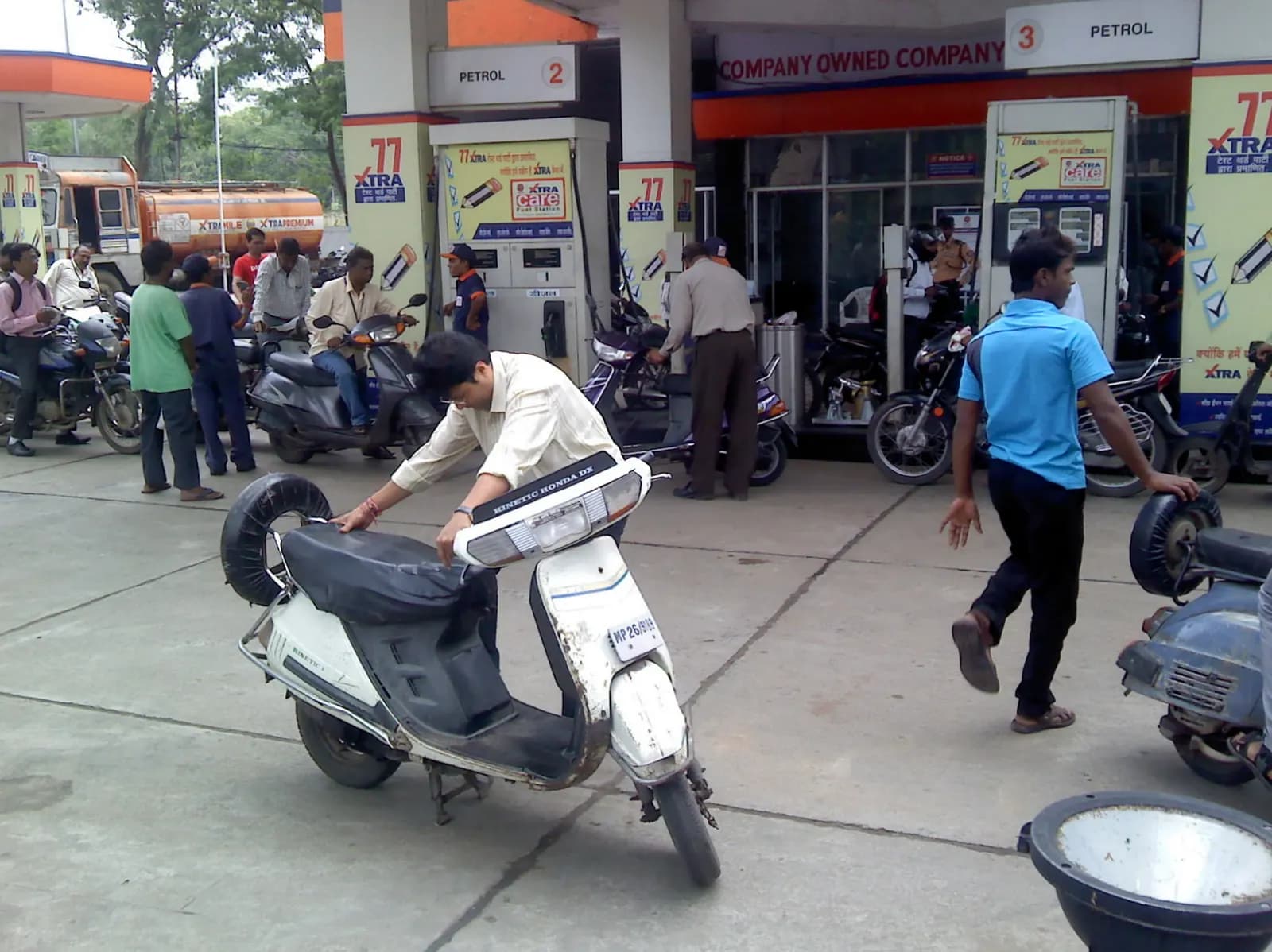
Delhi is the usual reference point because its taxes are simple: VAT of 19.40% on petrol, levied on the price including the dealer's commission. On 8 October 2026, PPAC's daily table shows petrol at ₹102.12 per litre and diesel at ₹95.20 per litre in Delhi.
Delhi price build-up (our calculation from PPAC rates):
| Component (per litre) | Petrol | Diesel |
|---|---|---|
| Price before excise and VAT (oil company price, freight, dealer commission) | ₹73.63 | ₹73.53 |
| Central excise duty | ₹11.90 | ₹7.80 |
| Delhi VAT (19.40% petrol; 16.75% + ₹0.25 diesel) | ₹16.59 | ₹13.87 |
| Pump price, 8 Oct 2026 | ₹102.12 | ₹95.20 |
| Total tax per litre | ₹28.49 (27.9%) | ₹21.67 (22.8%) |
We worked backwards from the official pump price and VAT rate, so the split between the oil company's price, freight and dealer commission is rounded; Indian Oil, BPCL and HPCL publish exact build-ups on their websites. The pattern matters more than the paisa: in Delhi today, roughly ₹28 of every ₹102 spent on petrol is tax, with the state's VAT now larger than the Centre's excise after the March 2026 cut.
A business example. A Delhi courier firm runs 12 diesel vans, each using about 400 litres a month. That is 4,800 litres at ₹95.20 per litre, or ₹4,56,960 a month, of which about ₹1,04,000 is excise and VAT. None of it can be claimed as GST credit. Compare the same firm's monthly van servicing bill of ₹60,000 plus 18% GST: the ₹10,800 of GST there is creditable in the normal way.
State VAT on petrol and diesel: state by state
Because VAT is a state tax, the same litre of petrol costs very different amounts across the country. PPAC's statement of state taxes, updated on 12 August 2026, shows the spread. A few examples:
| State / UT | VAT on petrol | VAT on diesel |
|---|---|---|
| Delhi | 19.40% | 16.75% + ₹250/kl air ambience charge |
| Maharashtra (incl. Mumbai) | 25% + ₹5.12/litre | 21% |
| Telangana | 35.20% | 27% |
| Rajasthan | 29.04% + ₹1,500/kl road development cess | 17.30% + ₹1,750/kl cess |
| Karnataka | 29.84% | 21.17% |
| Tamil Nadu | 13% + ₹11.52/litre | 11% + ₹9.62/litre |
| Uttar Pradesh | 19.36% or ₹14.85/litre, whichever is higher | 17.08% or ₹10.41/litre |
| Gujarat | 13.7% + 4% cess | 14.9% + 4% cess |
| Andaman & Nicobar | 1% | 1% |
Telangana's 35.20% is the highest headline percentage, and Andaman & Nicobar's 1% the lowest. Mumbai pays 25% + ₹5.12/litre on petrol, which is why its pump price of ₹111.21 per litre on 8 October 2026 was about ₹9 higher than Delhi's. PPAC also notes that in Delhi, Gujarat, Punjab, Haryana, Madhya Pradesh, Rajasthan and a few other states and UTs, VAT is charged on the dealer's commission too.
For fleet operators and transporters crossing state lines, these differences are a real cost lever. A truck that fills its tank in a lower-VAT state before entering a higher-VAT one saves tax legally, which is why highway fuel stations near state borders often see heavy diesel sales.
ATF, natural gas, CNG and LPG
Aviation turbine fuel is the third big fuel outside GST. It carries basic excise duty of 11% of its value — 2% for supplies to scheduled commuter airlines at regional connectivity scheme airports — plus state VAT. Airlines cannot set this tax off against the GST they collect on fares, which is a large part of why the industry has long pressed for ATF to be brought into GST. Aviation gasoline (Avgas) used by small piston aircraft is inside GST at 18%, because the exclusion names only petrol, diesel, ATF and PDS kerosene. Our GST on air tickets guide explains how this feeds through to fares.
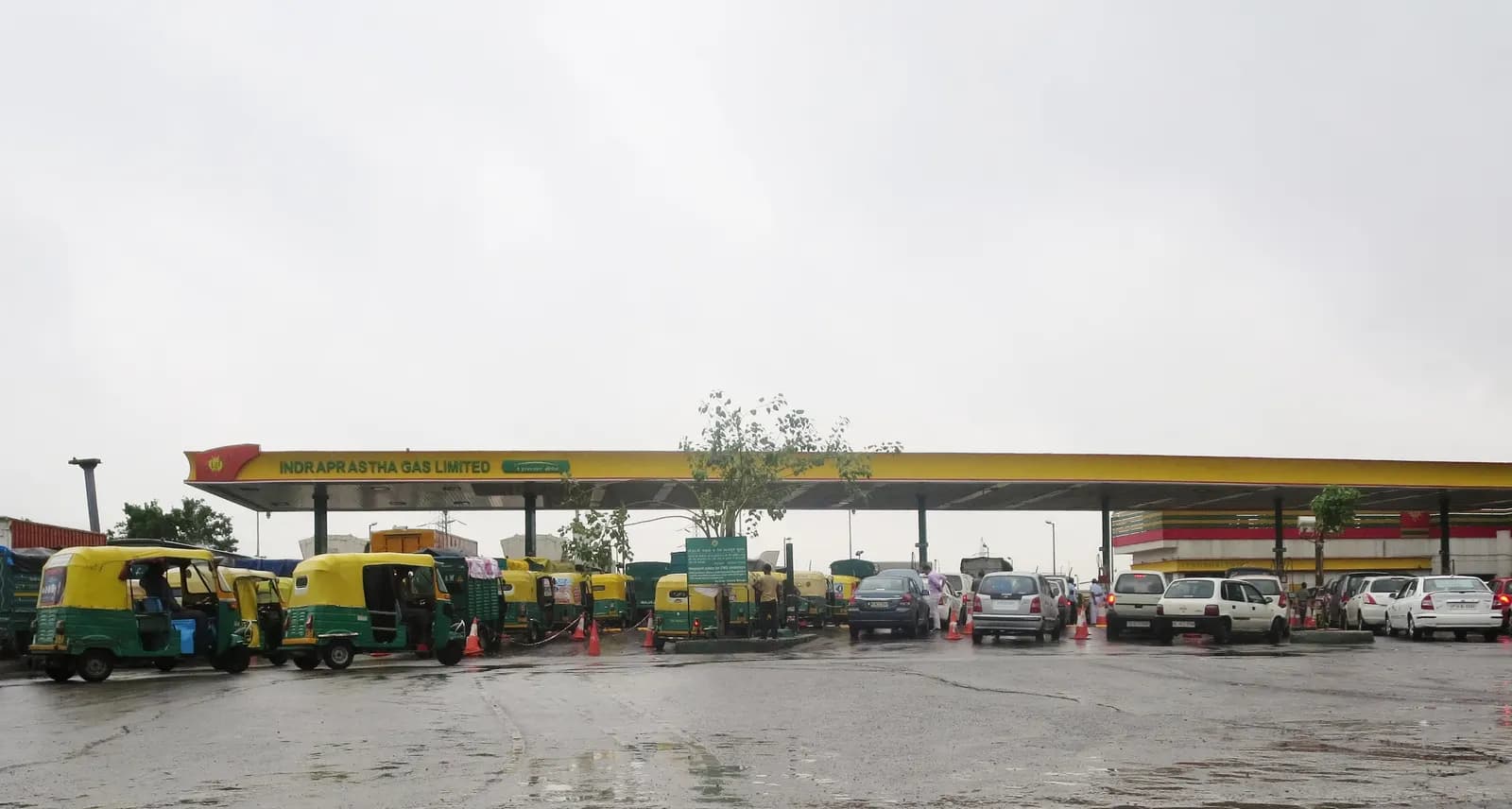
Natural gas — including CNG for vehicles and piped natural gas for homes and industry — is also outside GST. PPAC's table shows no excise on natural gas in gaseous form and 14% excise on compressed natural gas, with state VAT on top. A CNG station is therefore in the same position as a petrol pump for GST purposes.
LPG is different. It is a petroleum gas but not one of the five excluded products, so it is fully inside GST. Domestic LPG supplied by Indian Oil, HPCL or BPCL to household customers attracts 5%, and commercial cylinders used by restaurants and businesses carry 18%. A restaurant can claim the GST on commercial LPG as input tax credit unless it pays GST at a rate that bars credit.
ITC and fuel: what businesses can and cannot claim
Because petrol, diesel, ATF and natural gas are not taxed under GST, there is no GST on a fuel bill and nothing to claim. The excise and VAT built into the price are not "input tax" under the GST law, so they cannot be set off against your GST liability. For a transporter, a construction firm running generators on diesel, or a factory using natural gas, fuel is a full cost, and the taxes inside it end up in the price of what you sell. This is the "tax on tax" effect that inclusion in GST would remove.
What you can still claim is the GST on everything around the fuel: vehicle servicing and repairs, tyres, spare parts, lubricants, toll-related services, and the GST charged by a goods transport agency. If you hire a truck with fuel included, the transporter's own GST rate decides your credit — see our GST on freight guide.
Vehicle running costs — what carries creditable GST
| Cost | Tax on the bill | ITC for a registered business? |
|---|---|---|
Petrol, diesel, CNG | Excise + state VAT | No — no GST charged |
Engine oil, coolant, lubricants | 18% GST | Yes, if used for business |
Servicing and repairs of goods vehicles | 18% GST | Yes |
Servicing of cars with up to 13 seats | 18% GST | Blocked unless used for passengers, resale or driver training |
Tyres and spare parts for goods vehicles | GST at the part's rate | Yes |
Petrol, diesel, CNG
- Tax on the bill
Excise + state VAT
- ITC for a registered business?
No — no GST charged
Engine oil, coolant, lubricants
- Tax on the bill
18% GST
- ITC for a registered business?
Yes, if used for business
Servicing and repairs of goods vehicles
- Tax on the bill
18% GST
- ITC for a registered business?
Yes
Servicing of cars with up to 13 seats
- Tax on the bill
18% GST
- ITC for a registered business?
Blocked unless used for passengers, resale or driver training
Tyres and spare parts for goods vehicles
- Tax on the bill
GST at the part's rate
- ITC for a registered business?
Yes
Fuel bills, fuel cards and reimbursements
A pump receipt for petrol or diesel shows no GST line because none is charged, and it is not a GST tax invoice. That is fine for income-tax purposes — fuel is a deductible business expense when it is used for business — but it means the bookkeeping entry is a plain expense with no credit to record. If the same receipt includes engine oil or a car wash, ask the dealer for a separate GST invoice for those items carrying your GSTIN, or the GST on them is lost.
Fleet fuel cards issued by oil companies and banks work the same way. The monthly statement lists litres and rupees for fuel, with no GST to claim on those lines; any card fees, annual charges or loyalty-programme services billed by the issuer are services that carry 18% GST and can be claimed on a proper invoice. When you reimburse employees for fuel used on business trips, you are reimbursing a cost, not buying a supply on which GST was charged, so there is nothing to claim either.
For petrol pump and CNG station dealers, being outside GST creates two compliance points:
- Registration. A person engaged only in supplying goods that are not liable to tax does not need GST registration. But most pumps also sell lubricants, coolant or other taxable goods, or earn commission, rent or service income. GST law counts non-taxable supplies such as petrol and diesel sales as "exempt supply", and aggregate turnover includes exempt supplies. So a dealer whose lubricant sales are small can still cross the ₹40 lakh registration threshold once fuel sales are counted.
- ITC reversal. Credit on inputs and services used for both taxable and non-taxable sales — dispenser maintenance, canopy lighting, security, accounting software — must be split. Under section 17(2) and the CGST Rules, the share relating to exempt turnover (fuel sales) is reversed, and only the share relating to taxable sales such as lubricants is kept. Credit on items used only for lubricant sales is kept in full; credit on items used only for fuel is not available.
GST checklist for a fuel-station dealer
0/5Will petrol come under GST? The Council debate so far
The question returns whenever pump prices rise, and the answer has been the same since 2017: the GST Council has not recommended a date. At its 45th meeting in Lucknow in September 2021, the Council discussed the issue after a court direction and concluded that it was not the time to bring petroleum products into GST. After the 53rd meeting in June 2024, Finance Minister Nirmala Sitharaman said the Centre's intention was to levy GST on petrol and diesel, that the legal provision already exists, and that the states must come together to agree on a rate.
The obstacle is revenue. Fuel VAT is one of the largest tax sources a state still controls, and the GST compensation that once cushioned states ended long ago, with compensation cess itself abolished on 1 February 2026. A single GST rate would also limit the states' ability to change fuel taxes on their own. Any recommendation needs agreement in the Council, where the states hold two-thirds of the voting weight.
The 57th GST Council met on 8 October 2026. Reports of its outcome describe process reforms — automated registration and refunds, wider input tax credit, decriminalisation — and no rate changes; petroleum inclusion does not feature. The Finance Minister also said rate questions will now be taken up once a year at a dedicated meeting, so any future move on fuel would likely come through that route.
Petrol and GST — key moments
Sep 2016
101st Constitutional Amendment: Council to recommend a date for GST on five petroleum products
1 Jul 2017
GST starts; petrol, diesel, ATF, crude and natural gas left outside
Sep 2021
45th Council (Lucknow): not the time to include petroleum products
Jun 2024
53rd Council: FM says Centre favours inclusion; states to decide the rate
27 Mar 2026
Excise cut by ₹10/litre: petrol ₹11.90 per litre, diesel ₹7.80 per litre
8 Oct 2026
57th Council: no rate changes, fuel not on the reported agenda
What would inclusion mean for prices? Nobody can say until a rate is chosen. As an illustration only, Delhi petrol's pre-tax price of about ₹73.63 would become about ₹86.88 with 18% GST, or about ₹103.08 with the 40% special rate. A rate that kept tax revenue at today's level would leave the price roughly where it is. The clearer benefit would be for businesses, which could claim credit on fuel and remove the cascading tax from transport costs.
Official links
- PPAC — Central excise on petroleum productsExcise components for petrol, diesel, ATF and gas
- PPAC — State VAT/sales tax ratesEvery state's tax on petrol, diesel, kerosene and LPG
- PPAC — Pump prices in metro citiesDaily prices in Delhi, Mumbai, Chennai, Kolkata
- Section 9, CGST ActSection 9(2): GST on fuels only from a notified date
- 101st Constitutional Amendment ActArticle 279A(5)
- Notification 9/2025–CT(Rate)GST rates on LPG, lubricants, bitumen and kerosene
What to do next
If you run vehicles for your business, budget fuel as a full cost and make sure you are claiming the GST on servicing, tyres and parts — our input tax credit guide explains the conditions. Fuel-station dealers should review their registration and credit reversal with the checklist above. For how GST works on the vehicles themselves, see GST on cars, and for the basics of the tax, what is GST. We update this page when excise, VAT or the Council's position changes.
This is general information, not legal or tax advice — confirm on the official source or with a professional.
Frequently asked questions
No. Petrol, diesel, aviation turbine fuel, crude oil and natural gas are not taxed under GST. Section 9(2) of the CGST Act says GST on them starts only from a date the GST Council recommends, and no date has been set. Instead the Centre levies excise duty — ₹11.90 per litre on petrol since 27 March 2026 — and each state levies VAT, such as 19.40% in Delhi.
At the Delhi price of ₹102.12 per litre on 8 October 2026, about ₹28.50 is tax: ₹11.90 per litre of central excise and roughly ₹16.59 of Delhi VAT at 19.40%. That is about 28% of the pump price. Our VAT figure is calculated from the official rate; the oil companies publish the exact build-up.
No. Because no GST is charged on petrol or diesel, there is no GST to credit. The excise duty and state VAT inside the price cannot be set off against GST either, so fuel is a full cost to a business. GST on vehicle repairs, tyres and lubricants follows the normal ITC rules.
Including it needs the GST Council to recommend a date, and the states, which earn a large share of their own tax revenue from fuel VAT, have not agreed. The Finance Minister said in June 2024 that the Centre intends to bring petrol and diesel under GST and that the states must decide the rate. The 57th Council meeting in October 2026 did not take the issue up.
CNG and piped natural gas are natural gas, so they are outside GST like petrol. Aviation turbine fuel is also outside GST and carries 11% excise plus state VAT. LPG is inside GST: 5% for domestic cylinders supplied by IOC, HPCL and BPCL, and 18% for commercial LPG.
It depends on the rate the Council picks. Using the Delhi pre-tax price of about ₹73.63, petrol taxed at 18% GST alone would cost about ₹87, and at 40% about ₹103. Those are illustrations only: states would need to replace lost VAT revenue, and a GST rate on fuel could be combined with an extra levy, so no one can promise a lower price.
Sources & verification
Figures on this page were checked against the sources below when it was last reviewed on 9 October 2026. Each rate and limit is stored once with its own official source and review date, and official update channels are monitored daily so changes are picked up. How we verify
- 1.The Constitution (One Hundred and First Amendment) Act, 2016 — GST Council / Ministry of Law · accessed 9 October 2026
- 2.Section 9 – CGST Act, 2017 (levy and collection) — CBIC · accessed 9 October 2026
- 3.Central Excise and Customs Tariff Table on Major Petroleum Products (as on 27.03.2026) — Petroleum Planning & Analysis Cell, Ministry of Petroleum and Natural Gas · accessed 9 October 2026
- 4.Statement showing the actual rates of state taxes/GST on petroleum products (12.08.2026) — Petroleum Planning & Analysis Cell · accessed 9 October 2026
- 5.Retail selling price of petrol and diesel in metro cities (posted 8 October 2026) — Petroleum Planning & Analysis Cell · accessed 9 October 2026
- 6.Notification No. 9/2025–Central Tax (Rate), 17 September 2025 (Gazette of India) — Ministry of Finance / Gazette of India · accessed 9 October 2026
- 7.Centre cuts fuel excise by Rs 10 per litre, shields consumers from price spike — Madhyamam · accessed 9 October 2026
- 8.Intention of Centre to levy GST on petrol, diesel; states will have to decide on rate: FM — DT Next (PTI) · accessed 9 October 2026
- 9.Time not yet ripe for petrol, diesel to come under GST: Council — Deccan Herald · accessed 9 October 2026
- 10.GST Council scraps officials' arrest powers, raises prosecution threshold — Forbes India · accessed 9 October 2026
MSMETOOLS is an independent platform and is not affiliated with any government agency, ministry or department.
Tools for this
Related guides
 GST on Cars 2026: 18% vs 40% Rates, EVs, Used Cars & ITCRead guide
 What Is GST? Goods and Services Tax in India Explained (2026)Read guide
 GST on Liquor 2026: Why Alcohol Is Outside GST & Bar BillsRead guide
 Bill of Supply under GST 2026: Rule 49 Format & When to UseRead guide
Official links open the government site in a new tab.