 GST & indirect tax
GST on Liquor in 2026: Why Alcohol Is Taxed by States, What GST Still Applies and How a Bar Bill Is Split
GST on liquor in 2026: why alcohol for drinking is outside GST, state excise and VAT, ENA after the 2024 amendment, GST on bar food and a worked ₹ bar bill.
 Edited by Sumeet YadavFounder & editor, MSMETOOLS · fact-checked against official sources
Contents (10)
- 1. Is GST applicable on liquor? The constitutional answer
- 2. How liquor is taxed instead: state excise, VAT and fees
- 3. What is outside GST and what is inside
- 4. ENA after the 2024 amendment and the Supreme Court ruling
- 5. GST on inputs, packaging and job work for liquor makers
- 6. Bars and restaurants: how food and liquor are billed
- 7. Worked example: a bar bill in ₹
- 8. Input tax credit reversal for bars and hotels that sell liquor
- 9. Common mistakes and how to avoid them
- 10. What to do next
If you run a bar, a hotel restaurant, a liquor shop or a business that supplies a distillery, "GST on liquor" isn't a simple yes-or-no question. The drink itself is outside GST, but almost everything around it — bottles, labels, job work, transport, the food on the same table — is inside. This guide explains the constitutional reason liquor stays with the states, how excise and VAT work instead, what changed for extra neutral alcohol in 2024, how a bar bill is split between GST and VAT with a worked ₹ example, and why bars and hotels may need to reverse input tax credit. Everything was checked against the Constitution, the CGST Act, CBIC notifications and GST Council releases in October 2026.
Quick answer
There is no GST on alcoholic liquor for human consumption — beer, wine, whisky, rum and every other drink. States tax it through state excise duty and VAT/sales tax instead. GST does apply to inputs and services around liquor, and to the food and soft drinks served in bars.
Legal basis: Article 366(12A) of the Constitution and section 9(1) of the CGST Act
ENA or rectified spirit used to make potable liquor: outside GST since 1 November 2024; industrial ENA: 18%
Job work for liquor manufacturers: 18% GST
Bar bill: food at 5% (no input tax credit) (or 18% with ITC in high-tariff hotels) + state VAT on the liquor
Is GST applicable on liquor? The constitutional answer
GST in India rests on the Constitution (One Hundred and First Amendment) Act, 2016. That amendment inserted Article 366(12A), which defines "goods and services tax" as any tax on the supply of goods or services or both, except taxes on the supply of alcoholic liquor for human consumption. Because the definition itself carves liquor out, neither Parliament nor the GST Council can levy GST on it without amending the Constitution again.
The same amendment rewrote Entry 54 of the State List. States can still tax the sale of alcoholic liquor for human consumption (along with petrol, diesel, crude, natural gas and aviation fuel) through their own sales tax or VAT laws. Entry 51 of the State List, untouched by GST, lets states levy excise duty on alcoholic liquors manufactured or produced in the state. Between them, those two entries are why your bar bill shows VAT on the drinks and why a bottle costs very different amounts in Goa, Delhi and Karnataka.
The GST laws simply follow the Constitution. Section 9(1) of the CGST Act levies central tax on all intra-state supplies "except on the supply of alcoholic liquor for human consumption", and each state's SGST Act and the IGST Act carry the same exclusion. The CGST Act calls such a transaction a non-taxable supply — section 2(78) — and section 2(47) counts non-taxable supplies as exempt supplies. That classification matters for input tax credit and turnover, as you'll see below.
"Human consumption" is the key phrase. Alcohol that isn't meant to be drunk — denatured spirit, industrial alcohol, alcohol-based sanitisers, perfumes, medicinal preparations — is ordinary goods under GST and is taxed at its own HSN rate.
How liquor is taxed instead: state excise, VAT and fees
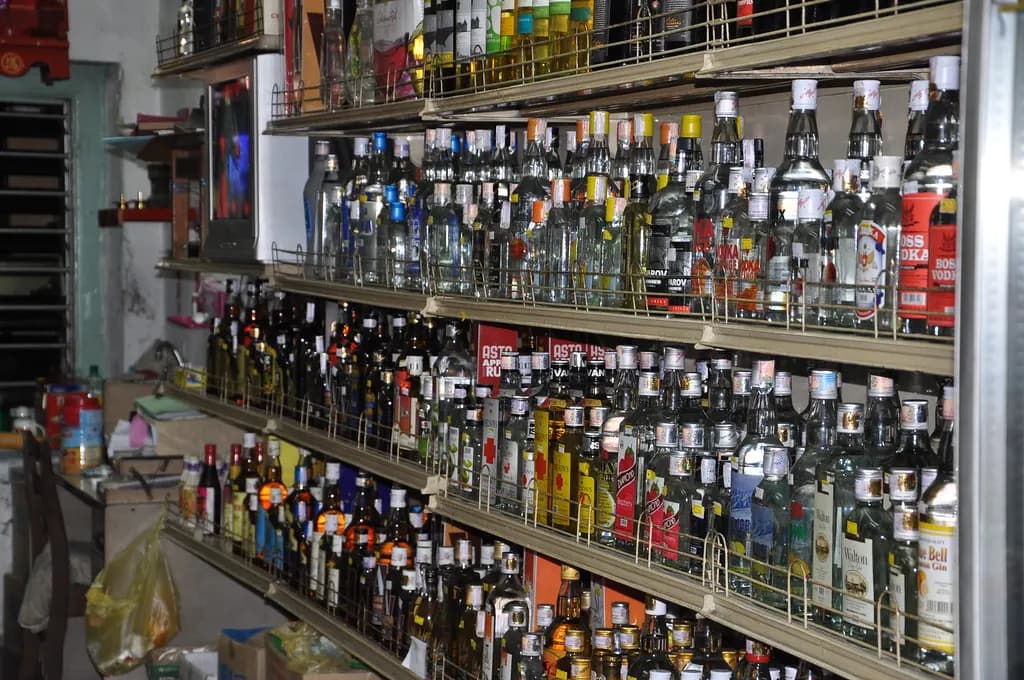
Each state runs its own liquor regime, and the structure is usually layered. A typical bottle carries some combination of:
State excise duty. Charged on manufacture or on import into the state, often per bulk litre or per proof litre, and frequently banded by price slab or by type (country liquor, Indian-made foreign liquor, beer, wine). Some states add special or additional excise levies on top.
Licence and permit fees. Distilleries, breweries, bottling plants, wholesalers, retail vends, bars and clubs each pay annual licence fees, and states revise them almost every excise year. Label registration and import pass fees are common too.
VAT or sales tax. Charged when the liquor is sold, by the manufacturer, the wholesaler, the retailer or the bar, at state rates. Several states charge a different VAT rate for liquor served in bars than for bottles sold at shops. Maharashtra, for example, raised VAT on liquor served in permit rooms from 5% to 10% from November 2023, according to news reports of the state's government resolution, while star hotels there pay a higher rate.
Other state levies. Some states add cesses for specific purposes such as cow welfare, social security or infrastructure, or set a minimum retail price.
Because none of these is GST, none of them gives or uses GST input tax credit. A liquor manufacturer can't set off the GST it paid on glass bottles against state excise, and a bar can't use GST credit to pay VAT on drinks. Each state's excise department publishes its own rates, usually in the annual excise policy that takes effect in April. Check your state's excise and commercial tax websites for the current rates; they change more often than GST rates do.
What is outside GST and what is inside
The line between "liquor" and "everything around it" is where most mistakes happen. Here is how the main items fall in 2026.
| Item | GST position | Who taxes it |
|---|---|---|
| Beer, wine, whisky, rum, vodka, gin, toddy, feni, country liquor (for drinking) | Outside GST | State excise + state VAT/sales tax |
| Un-denatured ENA / rectified spirit used to make potable liquor | Outside GST from 1 November 2024 | State (excise, VAT where levied) |
| ENA / rectified spirit for industrial use | 18% GST | Centre and states under GST |
| Job work for manufacture of alcoholic liquor | 18% GST | GST |
| Bottles, caps, labels, cartons, machinery bought by a distillery | GST at each item's own rate | GST (no credit against excise) |
| Food and non-alcoholic drinks in a restaurant or bar | 5% (no input tax credit), or 18% with ITC at specified premises | GST |
| Hotel room in the same bill | 5% without ITC up to ₹7,500 a night; 18% with ITC above | GST |
| Denatured spirit, sanitiser, alcohol-based perfume | GST at the product's HSN rate | GST |
Two of these deserve a closer look: ENA, because it was disputed for years, and job work, because many brand owners get their liquor made by a contract bottler.
ENA after the 2024 amendment and the Supreme Court ruling
How extra neutral alcohol left GST
1 July 2017
GST starts; section 9(1) excludes only 'alcoholic liquor for human consumption'. Whether ENA is covered becomes a dispute
7 October 2023
52nd GST Council recommends keeping ENA used for potable liquor outside GST, and 18% on industrial ENA
22 June 2024
53rd GST Council recommends amending section 9(1) of the CGST Act
16 August 2024
Finance (No. 2) Act 2024 enacted; section 114 amends section 9(1)
23 October 2024
Supreme Court (9 judges, 8:1) holds that 'intoxicating liquor' in Entry 8 of the State List includes industrial alcohol
1 November 2024
Amendment in force (Notification 17/2024-Central Tax): un-denatured ENA/rectified spirit for potable liquor is outside GST
Extra neutral alcohol (ENA) is the high-purity spirit that distilleries make from molasses or grain. Most of it is blended and diluted into whisky, rum, vodka and gin; some goes to chemicals, pharma and sanitisers. Because ENA isn't itself fit to drink, the Centre's view after 2017 was that it was taxable under GST, while several states taxed it under their own laws as a raw material of liquor. Distillers faced the risk of being taxed twice.
The 52nd GST Council meeting in October 2023 settled the policy: ENA used to make alcoholic liquor for human consumption should be outside GST, while a separate tariff line for industrial rectified spirit would carry 18%. The 53rd meeting in June 2024 recommended the law change, and section 114 of the Finance (No. 2) Act, 2024 added the words "and un-denatured extra neutral alcohol or rectified spirit used for manufacture of alcoholic liquor, for human consumption" to section 9(1). CBIC brought it into force from 1 November 2024.
Separately, on 23 October 2024 a nine-judge bench of the Supreme Court decided State of Uttar Pradesh v. Lalta Prasad Vaish. By 8:1 it held that "intoxicating liquor" in Entry 8 of the State List isn't limited to drinkable alcohol and includes industrial alcohol, overruling the 1990 Synthetics and Chemicals decision. That ruling is about the states' power to regulate alcohol; it doesn't move industrial ENA out of GST, which still applies at 18%. What it does is confirm that states can regulate the whole chain, so expect state excise rules — permits, pass fees, movement controls — to reach further into industrial alcohol too.
What this means in practice: a distillery selling ENA to a bottler of potable liquor doesn't charge GST from 1 November 2024; one selling the same spirit to a sanitiser maker does. The amendment doesn't say it applies to earlier periods, so tax demands for 2017–2024 have been contested case by case. If you have an old demand on ENA supplies, take professional advice rather than assuming it falls away.
GST on inputs, packaging and job work for liquor makers
GST around a liquor plant (2026)
Nil
GST on the liquor itself
state excise + VAT apply
18%
Job work for alcoholic liquor
no 5% food job-work rate
18%
Industrial ENA / rectified spirit
not for drinking
No ITC
Credit on inputs
output is a non-taxable supply
A distillery or brewery still buys a long list of taxable things: glass bottles, PET bottles, crown caps, labels, cartons, machinery, plant repairs, transport, advertising and professional services. GST applies to each of them at its own rate. Because the liquor it sells is a non-taxable supply, the manufacturer generally can't claim input tax credit on inputs used to make it — section 17(2) of the CGST Act limits credit to taxable supplies. The GST paid becomes a cost, and that cost is built into the ex-factory price on which states then levy excise and VAT. That cascading is one reason the industry has long asked for liquor to come under GST.
Job work. Many liquor brands are made under contract: the brand owner supplies the ENA and recipe and a bottling unit blends, bottles and packs it. The 45th GST Council decided in September 2021 that alcoholic liquor isn't a "food product" for the concessional food job-work rate, so job work for alcoholic liquor carries 18%. Notification 15/2025-Central Tax (Rate) retained that rate (9% CGST + 9% SGST) when GST 2.0 took effect on 22 September 2025. The bottler charges GST on its job charges; the brand owner, whose output is non-taxable, can't use that GST as credit.
Registration. A business that supplies only non-taxable goods doesn't have to register under GST — section 23 excludes persons engaged exclusively in non-taxable or wholly exempt supplies. A liquor shop that sells nothing but sealed bottles is in that position. The moment it also sells soft drinks, snacks or ice above the threshold, it needs GST registration for those items. Aggregate turnover, which decides the ₹40 lakh goods threshold and other limits, includes exempt supplies — and exempt supplies include non-taxable supplies — so the liquor sales count towards it.
Bars and restaurants: how food and liquor are billed
A bar or restaurant that serves alcohol makes two different kinds of supply at the same table. Food, soft drinks, mocktails and other non-alcoholic items are a restaurant service under GST. Liquor is a sale taxed by the state. The bill has to keep the two apart so that GST isn't charged on liquor and VAT isn't charged on food.
The GST rate on the food side depends on where the restaurant is. A standalone restaurant, café, pub or bar pays 5% (no input tax credit) — 2.5% CGST + 2.5% SGST, with no input tax credit. A restaurant inside a hotel where any room was priced above ₹7,500 a night in the previous year is a "specified premises" and charges 18% with ITC. GST 2.0 didn't change either rate. Our GST on food guide and hotel room GST guide explain both in detail.
The liquor side carries state VAT at whatever rate your state sets for on-premise consumption. In most states the bar issues a separate VAT bill for the liquor, or one printed bill with two clearly separate sections. Rule 49 of the CGST Rules recognises this: an invoice issued under another law for a non-taxable supply is treated as a bill of supply for GST purposes, so the VAT invoice for liquor is enough on the GST side.
Composite supply doesn't pull liquor into GST. Some owners ask whether a "food plus drinks" package should be taxed as one composite restaurant service at 5%. It shouldn't. GST can't be levied on liquor at all, so even in a package deal you need to split the price between the GST part and the liquor part on a reasonable basis — typically the menu prices — and charge VAT on the liquor share. Banquet packages with an open bar work the same way.
Worked example: a bar bill in ₹
Take a group dinner at a standalone bar-restaurant (not in a high-tariff hotel), in a state where — for illustration — VAT on liquor served in bars is 10%. Your state's rate may differ.
| Line | Amount (₹) | Tax | Tax amount (₹) |
|---|---|---|---|
| Food (starters, mains) | 2,400 | GST 5% (no input tax credit) | 120 |
| Soft drinks and mocktails | 400 | GST 5% (no input tax credit) | 20 |
| GST bill subtotal | 2,800 | CGST ₹70 + SGST ₹70 | 140 |
| Beer and whisky (bar menu) | 3,000 | State VAT 10% (illustrative) | 300 |
| Total payable | 6,240 |
The GST invoice shows ₹2,800 taxable value and ₹140 GST. The VAT bill shows ₹3,000 and ₹300 VAT. If you're a business guest, you can't claim GST credit on the restaurant portion anyway, because restaurant service at 5% (no input tax credit) is supplied without credit and section 17(5) blocks credit on food and beverages in most cases.
The same dinner in a hotel restaurant where rooms go above ₹7,500 a night: the food side becomes ₹2,800 × 18% = ₹504 GST (₹252 CGST + ₹252 SGST), and the liquor side carries the state's VAT rate for hotels, which in some states is higher than for ordinary bars. The total would be ₹6,604 or more.
A common billing error is to add GST at 5% on the entire ₹5,800. That overcharges the customer ₹150 in GST on liquor that isn't taxable under GST, and the bar still owes VAT on the drinks. It also overstates GST turnover and can trigger a mismatch with the VAT return. Use our GST calculator on the food subtotal only.
Input tax credit reversal for bars and hotels that sell liquor
If a restaurant pays 5% (no input tax credit) without credit, it has no credit to reverse — liquor sales make no difference to its GST credit. The issue arises for hotels, specified-premises restaurants, clubs, banquet operators and caterers that charge 18% with credit and also sell liquor.
Because liquor is a non-taxable supply, section 2(47) treats it as an exempt supply. Under section 17(2) and Rule 42, credit on common inputs and input services — rent, electricity-related services, housekeeping, software, advertising, repairs — has to be split, and the share attributable to exempt turnover reversed. In February 2023 the West Bengal Authority for Advance Ruling confirmed this for a Kolkata lounge bar that ran restaurant, catering and banquet services: it had to reverse credit under Rule 42 for its liquor sales. An advance ruling binds only the applicant, but it reflects how officers read the law.
Does liquor turnover cut your GST credit?
Step 1
Restaurant at 5%
no ITC taken — nothing to reverse
Step 2
Hotel / specified premises at 18%
ITC taken
Step 3
Sells liquor too?
non-taxable = exempt supply
Step 4
Rule 42 reversal
common credit × exempt share
Step 5
Annual true-up
by September return
Example. A hotel's restaurant and bar division has ₹60 lakh of taxable food and beverage turnover and ₹40 lakh of liquor turnover in a month. Common input services carry ₹18,000 of GST. Exempt turnover is 40% of the total, so roughly ₹7,200 of that credit must be reversed in GSTR-3B (Rule 42 works on the tax period with an annual true-up, so the exact figure follows that formula). Credit used only for the taxable food side — such as kitchen ingredients billed with GST for the 18% outlet — stays fully available; credit used only for liquor, such as bar glassware, isn't available at all.
Common mistakes and how to avoid them
Charging GST on liquor. It's the most frequent error on bar bills and in banquet quotes. Keep liquor on a separate VAT bill or section, and keep its value out of the GST invoice.
Missing GST registration because "liquor is exempt". A liquor business that sells only alcohol needn't register, but a bar's food, a shop's snacks or a club's membership fees are taxable. Watch the aggregate turnover, which includes liquor sales, against the registration threshold.
Not reversing credit. Hotels and specified-premises outlets that claim 18% credit and sell liquor need a monthly Rule 42 reversal and an annual true-up. Leaving it out invites interest at 18% a year on wrongly used credit if an audit finds it.
Treating industrial ENA as outside GST. Only ENA used to make liquor for human consumption is outside GST. Sales to sanitiser, pharma or chemical makers carry 18%, and the invoice should show the correct tariff line. Use the HSN code finder to confirm the classification.
Assuming job work is 5%. Contract bottling and blending for liquor brands carry 18%, not the concessional food job-work rate.
Official links
- Section 9 – CGST Act (levy, liquor exclusion)CBIC tax information portal
- 101st Constitution Amendment ActArticle 366(12A), Entry 54
- Notification 17/2024-Central TaxENA amendment in force from 1 Nov 2024
- 52nd GST Council recommendationsENA policy, industrial ENA at 18%
- Rule 42 and Rule 49 – CGST RulesBill of supply for non-taxable supplies
- CBIC rate notificationsWatch for changes to job work or ENA entries
What to do next
If you run a bar or hotel restaurant, check that your billing software keeps liquor and food on separate tax lines, and test it with a mixed order before the next VAT and GST returns. Hotels and clubs that claim credit should set up the Rule 42 reversal in their monthly GSTR-3B. For food-side rates, see our GST on food guide; for the credit rules in general, read the input tax credit guide; and for the other big item kept out of GST, see GST on petrol. Planning a new outlet? The restaurant business plan covers licences, including the bar licence.
This is general information, not legal or tax advice — confirm on the official source or with a professional.
Frequently asked questions
No. Alcoholic liquor for human consumption is outside GST under Article 366(12A) of the Constitution and section 9(1) of the CGST Act. States tax it instead through state excise duty and VAT or sales tax. GST still applies to many things around liquor — bottles, packing, job work, transport and the food and soft drinks served in bars.
When GST was introduced in 2017, the 101st Constitution Amendment deliberately kept alcohol for human consumption with the states. Excise and VAT on liquor are among the largest own-tax revenues for most states, and they wanted full control over the rate. The GST Council can't add liquor by itself — it would need another constitutional amendment.
No. Beer, wine, whisky, rum, vodka, toddy, feni and other drinks meant for human consumption all count as alcoholic liquor, so none of them attracts GST. They carry state excise duty and state VAT or sales tax, which vary widely from state to state and are often charged at different rates for beer, wine and spirits.
The two parts are taxed separately. Food and non-alcoholic drinks attract GST at the restaurant rate — 5% (no input tax credit) in a standalone restaurant, or 18% with ITC in a hotel with room tariffs above ₹7,500. Liquor attracts state VAT instead. Most bars issue two bills or two clearly separate sections on one bill.
It depends on the use. Since 1 November 2024, un-denatured ENA or rectified spirit used to make alcoholic liquor for human consumption is outside GST under the amended section 9(1). ENA or rectified spirit for industrial use — sanitisers, chemicals, pharma — stays in GST at 18%.
Usually yes, where they claim credit at all. Liquor is a non-taxable supply, which the CGST Act treats as an exempt supply, so credit on common inputs must be split under section 17(2) and Rule 42. The West Bengal AAR confirmed this for a lounge bar in 2023. A standalone restaurant paying 5% (no input tax credit) takes no credit, so it has nothing to reverse.
Sources & verification
Figures on this page were checked against the sources below when it was last reviewed on 9 October 2026. Each rate and limit is stored once with its own official source and review date, and official update channels are monitored daily so changes are picked up. How we verify
- 1.The Constitution (One Hundred and First Amendment) Act, 2016 — GST Council · accessed 9 October 2026
- 2.Section 9 – CGST Act, 2017 (levy and collection) — CBIC · accessed 9 October 2026
- 3.Notification No. 17/2024 – Central Tax — CBIC (hosted by GST Council) · accessed 9 October 2026
- 4.Recommendations of 52nd GST Council Meeting (7 Oct 2023) — PIB — Ministry of Finance · accessed 9 October 2026
- 5.Recommendations of 53rd GST Council Meeting (22 Jun 2024) — PIB — Ministry of Finance · accessed 9 October 2026
- 6.Notification No. 15/2025 – Central Tax (Rate) — CBIC (copy on Taxo) · accessed 9 October 2026
- 7.Advance Ruling No. 22/WBAAR/2022-23 — Karnani FNB Specialities LLP — West Bengal Authority for Advance Ruling (hosted by GST Council) · accessed 9 October 2026
- 8.Rule 49 – CGST Rules (bill of supply) — CBIC · accessed 9 October 2026
- 9.Regulating Industrial Alcohol judgement: Supreme Court upholds states' regulatory power under Entry 8 — Supreme Court Observer · accessed 9 October 2026
- 10.Maharashtra Govt raises VAT on liquor in permit rooms by 5% — Taxscan · accessed 9 October 2026
MSMETOOLS is an independent platform and is not affiliated with any government agency, ministry or department.
Tools for this
GST Calculator (India)
Calculate GST for your sales and purchases with current rates.
Invoice Generator
Create professional invoices with tax, logo and custom details.
HSN Code Finder (India)
Find the correct HSN/SAC code for your product.
Related guides
 GST on Petrol 2026: Why Fuel Is Outside GST & Taxes PaidRead guide
 Hotel Room GST Rate 2026: 5% vs 18%, ₹7,500 Rule & ITCRead guide
 GST on Food 2026: Restaurant & Food Item Rates After GST 2.0Read guide
 GST on Cigarettes 2026: 40% on RSP, Excise, Bidi & Pan MasalaRead guide
Official links open the government site in a new tab.