 GST & indirect tax
HSN/SAC Code for Freight and GST on Transport in 2026: GTA Rates, RCM and Exemptions
HSN/SAC code for freight and GST on transport in 2026: GTA at 5% under RCM or 18% with ITC after GST 2.0, Annexure V, exemptions and worked ₹ examples.
 Edited by Sumeet YadavFounder & editor, MSMETOOLS · fact-checked against official sources
Contents (10)
- 1. HSN and SAC codes for freight and transport
- 2. Who is a GTA — and why it matters
- 3. GST rates on GTA and freight after GST 2.0
- 4. Annexure V and Annexure VI: opting in and out of forward charge
- 5. Exemptions: when no GST applies to freight
- 6. Freight on a sales invoice: taxed at the goods' rate
- 7. Worked examples: shipper and transporter
- 8. Freight, e-way bills and documents
- 9. Common mistakes and how to fix them
- 10. What to do next
Freight is one of the most confusing lines on a GST invoice. The same lorry load can be taxed at 5% under reverse charge, at 5% or 18% under forward charge, at the rate of the goods, or not at all — depending on who carries it, who pays for it and how it is billed. This guide is for manufacturers and traders who pay freight, transporters and goods transport agencies who bill it, and accountants who need the right SAC code. It covers the SAC/HSN codes for every mode, the GTA rates after GST 2.0, reverse charge, Annexure V and VI, the exemptions, the e-way bill link and worked ₹ examples. All rates were checked against CBIC notifications and the GST Council's September 2025 decisions in October 2026.
Quick answer
Freight is a service, so it uses a SAC code under heading 9965 (goods transport) or 9967 (supporting services). Road freight is 996511; goods transport agency (GTA) services by road are 996791. A GTA charges 5% without ITC — usually paid by the business recipient under reverse charge — or opts for 18% with ITC under forward charge (this replaced the 12% option from 22 September 2025).
Freight on your own sales invoice is taxed at the goods' rate, not as a separate service
Truck owners who don't issue a consignment note are not GTAs — their freight is exempt
Forward-charge option: Annexure V between 1 January and 31 March for the next year
Small loads exempt: up to ₹1,500 per carriage or ₹750 per consignee
HSN and SAC codes for freight and transport
Goods are classified by HSN codes; services by SAC (Services Accounting Codes), which GST forms also call "HSN" for services. That is why people search for an "HSN code for freight" — the answer is a six-digit SAC starting with 99. The official list is the Scheme of Classification of Services annexed to Notification 11/2017–Central Tax (Rate).
| SAC | Description (CBIC classification) | Typical use |
|---|---|---|
| 9965 | Goods transport services (heading) | Four-digit code in GSTR-1 HSN summary for smaller taxpayers |
| 996511 | Road transport services of goods, including letters, parcels, live animals, household and office furniture, containers, by trucks, trailers, refrigerated vehicles, man- or animal-drawn vehicles or any other vehicle | Road freight |
| 996512 | Railway transport services of goods, including intermodal containers and bulk cargo | Rail freight, container trains |
| 996513 | Transport of petroleum, natural gas, water and other goods via pipeline | Pipeline transport |
| 996521 | Coastal and transoceanic water transport of goods | Sea freight |
| 996522 | Inland water transport of goods | River and canal cargo |
| 996531 | Air transport of letters, parcels and other goods | Air freight |
| 9967 | Supporting services in transport (heading) | — |
| 996711 / 996719 | Container handling; other cargo and baggage handling | Loading, unloading, port handling |
| 996712 / 996713 | Customs house agent services; clearing and forwarding services | CHA and C&F agents |
| 996721 / 996729 | Refrigerated storage; other storage and warehousing | Cold chain, warehousing |
| 996791 | Goods transport agency services for road transport | GTA freight by road |
| 996792 | Goods transport agency services for other modes | GTA arranging rail, sea or air |
| 996793 | Other goods transport services | — |
| 996812 / 996813 | Courier services; local delivery services | Couriers, last-mile delivery |
996511 or 996791 for a GTA? Both codes appear on GTA invoices in practice. The classification places GTA services by road under 996791, while 996511 describes the transport itself. The rate does not depend on which of the two you use — it depends on whether the supplier is a GTA and which option it has chosen — but use one code consistently, and if you are a GTA, prefer 996791. In the GSTR-1 HSN summary, taxpayers with aggregate turnover up to ₹5 crore report 4-digit HSN digits (9965 or 9967) and larger ones 6-digit HSN. Look up any other code with our HSN code finder.
Who is a GTA — and why it matters
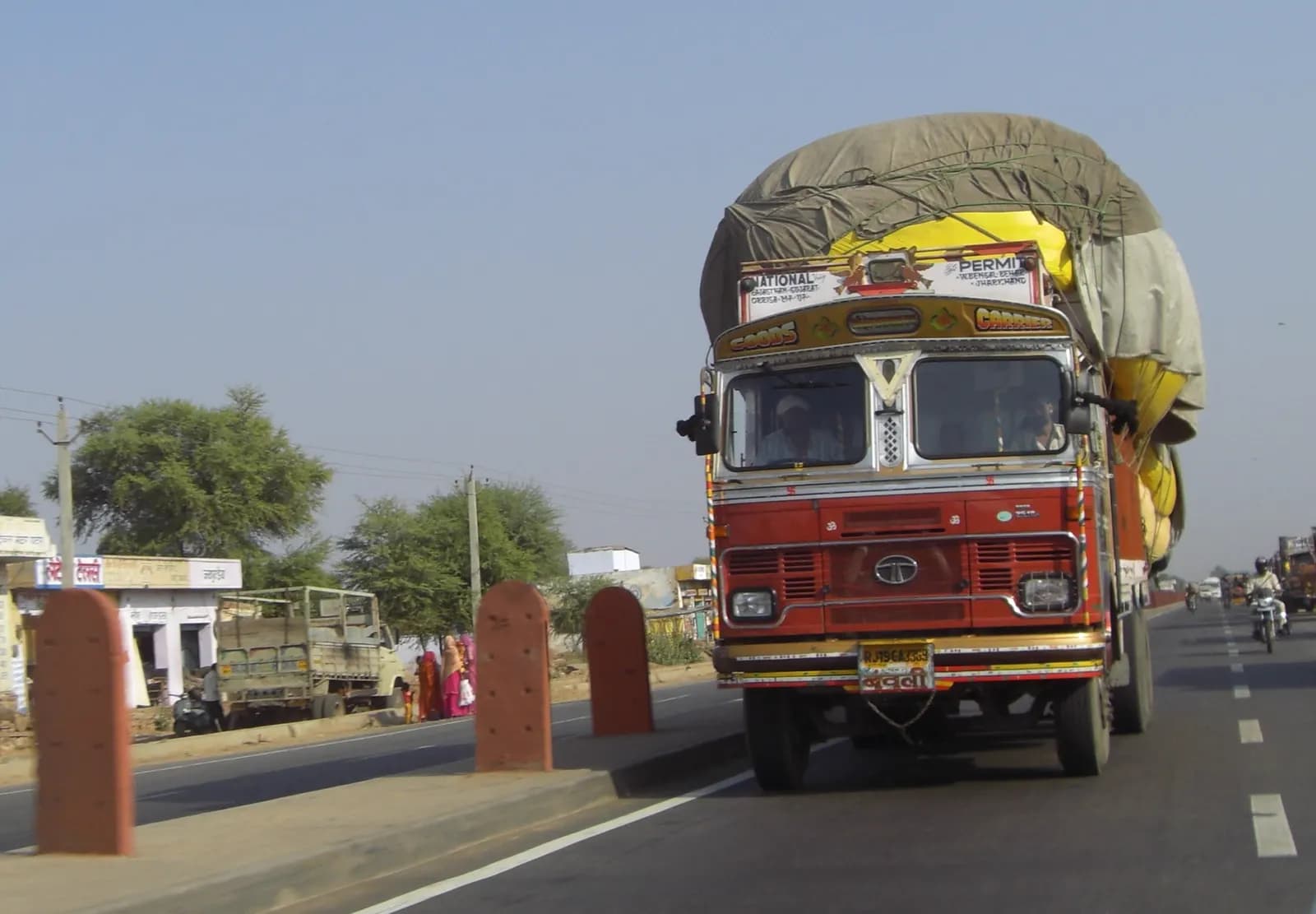
A goods transport agency is defined in Notification 12/2017–Central Tax (Rate) as any person who provides a service in relation to transport of goods by road and issues a consignment note, by whatever name called — a lorry receipt (LR), bilty or GR. The consignment note is the test. It shows the transporter has taken responsibility for the goods until delivery.
Three things follow from that definition:
- Individual truck operators who don't issue a consignment note are not GTAs. Entry 18 of the same notification exempts transport of goods by road, except by a GTA or a courier agency. So a farmer's tractor-trolley hire or a single-truck owner paid per trip without an LR is outside GST.
- Renting a truck with a driver is a different service. Hiring a goods carriage with an operator, with fuel included, is "renting of goods carriage" under heading 9966, taxed at 5% with credit of input services in the same line of business, or 18% with full credit, after GST 2.0. Hiring a vehicle to a GTA is exempt (entry 22).
- Couriers and local delivery are under heading 9968 at 18%. From 22 September 2025, local delivery through an e-commerce platform is excluded from GTA services and, where the delivery partner is not registered, the platform pays GST at 18% under section 9(5).
GST rates on GTA and freight after GST 2.0
The 56th GST Council meeting kept the 5% merit rate for GTA services but replaced the 12% forward-charge option with 18% with full input tax credit, from 22 September 2025. The Council's FAQ puts it simply: GTA transport "will continue to be taxed at the merit rate of 5% with no ITC", with "the option of charging GST at the standard rate of 18% with full ITC". The Council chose not to exempt GTA services, reasoning that an exemption would cut off transporters' credit and make freight costlier.
Freight and transport rates before and after 22 September 2025
| Service | Before 22 Sep 2025 | From 22 Sep 2025 |
|---|---|---|
GTA — reverse or forward charge, no ITC | 5% | 5% without ITC |
GTA — forward charge with full ITC | 12% | 18% with ITC |
Container transport by rail (other than Indian Railways) | 12% with ITC | 5% without ITC, or 18% with ITC |
Multimodal transport within India | 12% with ITC | 5% with restricted ITC if no air leg; 18% with ITC otherwise |
Pipeline transport of gas, crude, petrol, diesel, ATF | 5% / 12% | 5% without ITC, or 18% with ITC |
Renting of goods carriage with operator (fuel included) | 12% with ITC | 5% with input-service ITC, or 18% with ITC |
Courier and local delivery | 18% | 18% |
Third-party insurance of goods carriages | 12% with ITC | 5% with ITC |
Trucks and lorries (HSN 8704) | 28% | 18% |
GTA — reverse or forward charge, no ITC
- Before 22 Sep 2025
5%
- From 22 Sep 2025
5% without ITC
GTA — forward charge with full ITC
- Before 22 Sep 2025
12%
- From 22 Sep 2025
18% with ITC
Container transport by rail (other than Indian Railways)
- Before 22 Sep 2025
12% with ITC
- From 22 Sep 2025
5% without ITC, or 18% with ITC
Multimodal transport within India
- Before 22 Sep 2025
12% with ITC
- From 22 Sep 2025
5% with restricted ITC if no air leg; 18% with ITC otherwise
Pipeline transport of gas, crude, petrol, diesel, ATF
- Before 22 Sep 2025
5% / 12%
- From 22 Sep 2025
5% without ITC, or 18% with ITC
Renting of goods carriage with operator (fuel included)
- Before 22 Sep 2025
12% with ITC
- From 22 Sep 2025
5% with input-service ITC, or 18% with ITC
Courier and local delivery
- Before 22 Sep 2025
18%
- From 22 Sep 2025
18%
Third-party insurance of goods carriages
- Before 22 Sep 2025
12% with ITC
- From 22 Sep 2025
5% with ITC
Trucks and lorries (HSN 8704)
- Before 22 Sep 2025
28%
- From 22 Sep 2025
18%
The three GTA options
1. 5% under reverse charge (the default). The GTA charges no GST on its invoice. The recipient pays 5% in cash through its GSTR-3B (Table 3.1(d)) and, if eligible, claims the same amount back as credit in Table 4A(3). The GTA cannot claim credit on its own purchases for these services.
2. 5% under forward charge. The GTA opts through Annexure V, charges 5% on its invoice and pays it itself. No credit for the GTA. This suits GTAs serving customers who don't want the paperwork of reverse charge.
3. 18% under forward charge with full credit. The GTA opts through Annexure V, charges 18% with ITC and claims credit on trucks, tyres, spares, repairs, insurance and other taxable inputs. Diesel and petrol are outside GST, so the largest single cost of a transporter carries no credit — which is why most GTAs stay at 5%.
Who must pay under reverse charge. Notification 13/2017–Central Tax (Rate) makes the recipient liable when it is a factory registered under the Factories Act, a registered society, a co-operative society, any GST-registered person, a body corporate, a partnership firm or association of persons, or a casual taxable person. The person paying the freight is treated as the recipient. If the recipient is none of these — for instance, an unregistered individual — the GTA service is exempt under entry 21A of the exemption list.
Annexure V and Annexure VI: opting in and out of forward charge
A GTA that wants to pay GST itself — at 5% or 18% — must declare it in Annexure V. Since 2024 this is filed online: on the GST portal, go to Services → User Services → GTA → Opting Forward Charge Payment by GTA (Annexure V).
- Existing GTAs file between 1 January and 31 March of the preceding financial year. For FY 2027-28, that window is 1 January to 31 March 2027.
- New GTAs file within 45 days of applying for registration or one month of getting it, whichever is later, under Notification 5/2023–Central Tax (Rate).
- The choice continues. Once filed, forward charge is treated as opted for the next and later years. You don't refile every year.
- To go back to reverse charge, file Annexure VI in the same 1 January–31 March window for the following year.
The option, once exercised, applies for the whole financial year; you cannot switch mid-year. A GTA that has opted for forward charge must charge GST on its invoices, mention that it is paying under forward charge, and stop relying on customers' reverse-charge payments. Customers should keep a copy of the GTA's Annexure V acknowledgement or a declaration on the invoice, so they know not to pay reverse charge on the same freight.
GTA option calendar
1 Jan – 31 Mar 2026
Existing GTAs file Annexure V (opt for forward charge) or Annexure VI (revert to RCM) for FY 2027-28
1 Apr
Chosen option applies for the whole financial year
45 days from applying (or 1 month from grant)
Deadline for a newly registered GTA to file Annexure V
Every month
Recipient pays RCM in GSTR-3B by the 20th of the next month if the GTA has not opted for forward charge
Exemptions: when no GST applies to freight
Entries 18 to 22 of Notification 12/2017–Central Tax (Rate) exempt several kinds of transport. The most useful for businesses are:
GTA transport of specified goods (entry 21) — no GST when a GTA carries, in a goods carriage:
- agricultural produce;
- milk, salt and food grain, including flour, pulses and rice;
- organic manure;
- newspapers or magazines registered with the Registrar of Newspapers;
- relief materials for victims of disasters, calamities, accidents or mishaps;
- defence or military equipment.
Small consignments (entry 21) — no GST where the freight charged for a consignment in a single carriage does not exceed ₹1,500, or where freight for all goods for a single consignee does not exceed ₹750.
GTA services to unregistered persons (entry 21A) — exempt, except where the recipient is one of the business types listed for reverse charge.
Road transport other than by a GTA or courier (entry 18) — exempt, as explained above.
Rail or vessel transport of specified goods (entry 20) — relief materials, defence equipment, newspapers, railway equipment, agricultural produce, milk, salt, food grain and organic manure.
Air freight on imports up to the customs station (entry 19) — exempt.

Freight on a sales invoice: taxed at the goods' rate
When you sell goods and deliver them, and show freight as a line on the same invoice, you are not supplying a separate transport service. The sale with delivery is a composite supply whose principal supply is the goods, so the whole invoice — goods plus freight — is taxed at the rate of the goods. Section 15 of the CGST Act also includes incidental charges made by the supplier in the taxable value.
So a Rajkot pump manufacturer selling a ₹2,00,000 pump at 18% with ₹5,000 freight charges GST on ₹2,05,000 — ₹36,900 — and uses the pump's HSN, not a freight SAC. If it sold cement or apparel taxed at another rate, the freight would follow that rate.
This only works when the seller is the one supplying the delivery. If the buyer arranges and pays its own transporter, the freight is a separate GTA service between the transporter and the buyer.
Reimbursing freight as a "pure agent". If you pay a GTA on your customer's behalf and recover the exact amount, you may be able to treat it as a pure-agent expense outside your taxable value — but only if all the conditions in Rule 33 of the CGST Rules are met, including the customer being liable to pay the GTA and authorising you. In most sales, freight is your cost and part of the value.
Worked examples: shipper and transporter
Shipper paying reverse charge. Sharma Auto Components, a Ludhiana factory registered under GST, sends parts to a customer in Pune through a GTA that has not opted for forward charge. The LR shows freight of ₹40,000.
- The GTA's invoice shows ₹40,000 and no GST, with a note that tax is payable by the recipient under reverse charge.
- Sharma Auto pays 5% — ₹2,000 — in cash through Table 3.1(d) of its GSTR-3B. For a registered recipient the place of supply of GTA services is the recipient's location; the GTA is also in Punjab, so this is CGST ₹1,000 + SGST ₹1,000. Had the GTA been registered in Haryana, it would be IGST ₹2,000.
- In the same return it claims ₹2,000 as input tax credit in Table 4A(3), because freight is used in its business.
Net cost: zero GST, but ₹2,000 of cash is paid before credit can be used — reverse-charge tax cannot be paid from the credit ledger. If the freight had been ₹1,200 for a single carriage, the entry 21 exemption would apply and no GST would be due at all.
Transporter choosing between 5% and 18%. Shree Ganesh Roadways in Indore has annual freight receipts of ₹1 crore, almost all from registered manufacturers. Its yearly costs include diesel of ₹45 lakh (no GST), and tyres, spares, repairs, insurance and office costs of ₹15 lakh on which it pays ₹2.5 lakh of GST.
- 5% (reverse charge): customers pay ₹5 lakh of GST and claim it back. The transporter's ₹2.5 lakh of input GST is a cost it cannot recover.
- 18% (forward charge): the transporter charges ₹18 lakh, claims ₹2.5 lakh of credit and pays ₹15.5 lakh in cash. Its costs fall by ₹2.5 lakh, but customers must pay 18% upfront and wait to claim it — and any unregistered or exempt customer simply pays more.
For Shree Ganesh, 18% is worth it only if it can pass the cash-flow burden to customers or in a year it buys a new truck. A ₹40 lakh truck at 18% carries ₹7.2 lakh of GST — claimable only under the 18% option. Remember the choice must be made by 31 March for the whole next year.
Use our GST calculator to run the numbers for your own lanes.
Deciding how GST applies to a freight bill
Step 1
Who supplied transport?
you as seller, a GTA, or a truck owner
Step 2
Seller delivering own goods
goods' rate on whole invoice
Step 3
Truck owner, no LR
exempt (entry 18)
Step 4
GTA with LR
check entry 21 exemptions
Step 5
Forward charge opted?
yes: 5% or 18% on invoice; no: recipient pays 5% RCM
Freight, e-way bills and documents
GST on freight and the e-way bill are separate obligations, but they meet on the road. An e-way bill is needed before goods worth more than ₹50,000 move in a motor vehicle; its Part B carries the vehicle number or the transporter's document number — the same LR that makes the transporter a GTA. A GTA enrols on the e-way bill portal to get a transporter ID if it isn't GST-registered.
Keep these documents together for every consignment: the tax invoice or delivery challan, the e-way bill, the LR or bilty, the GTA's freight invoice with the reverse-charge or forward-charge declaration, and your GSTR-3B working showing the RCM paid. An officer checking a reverse-charge claim will ask for the LR and the payment proof.
Keep with every consignment
0/6Common mistakes and how to fix them
Paying RCM on freight from a GTA that has opted for forward charge. You pay twice. Check the GTA's invoice for GST charged; if it charged 5% or 18%, don't also pay RCM. If you already did, take advice on recovering it — the cleanest fix is to agree in advance, in writing, which option each transporter follows.
Not paying RCM because the GTA "didn't charge GST". That is exactly when RCM applies. Missed reverse charge must be paid with interest at 18% a year in a later GSTR-3B; the credit can be claimed in the same return.
Using credit to pay RCM. Reverse-charge tax must be paid in cash. Credit can be claimed only after the tax is paid.
Using a freight SAC on your own sales invoice. When you deliver your own goods, freight takes the HSN and rate of the goods.
GTA charging 12%. The 12% option no longer exists for services after 21 September 2025. A GTA still billing at 12% should correct its invoices; its customers should not claim credit on a rate that isn't notified.
Missing the Annexure V window. If a GTA misses 31 March, it stays on reverse charge for the whole next year. Diarise January.
Official links
- GST portal – GTA Annexure V / VIServices → User Services → GTA
- Scheme of Classification of Services (SAC list)Headings 9965, 9967, 9968
- Notification 12/2017-CT(Rate) — exemptionsEntries 18–22, GTA definition
- Notification 13/2017-CT(Rate) — reverse chargeRecipients liable for GTA RCM
- 56th GST Council recommendations (PIB)Transport rates from 22 September 2025
- E-way bill portalGenerate and update Part B with LR details
What to do next
If you pay freight, list your transporters, check which have opted for forward charge and set up reverse charge in your accounting software for the rest. If you run a GTA, work out your input GST for the year and decide between 5% and 18% before 31 March. Find the right codes with the HSN code finder, raise correct freight bills with the invoice generator, and read our guides to input tax credit and e-way bills.
This is general information, not legal or tax advice — confirm on the official source or with a professional.
Frequently asked questions
Freight is a service, so it uses a SAC code under heading 9965 (goods transport services) or 9967 (supporting transport services). Road transport of goods is 996511, and goods transport agency services for road transport are 996791. Rail freight is 996512, sea freight 996521 and air freight 996531. If you charge freight on your own sales invoice, use the HSN of the goods instead.
A goods transport agency can charge 5% without ITC — paid by the recipient under reverse charge, or by the GTA under forward charge if it opts — or 18% with ITC under forward charge. The 18% option replaced the old 12% option from 22 September 2025. Under the 5% option the GTA cannot claim input tax credit.
If the GTA has not opted for forward charge, the recipient pays 5% without ITC under reverse charge when it is a factory, a society, a co-operative society, a GST-registered person, a body corporate, a partnership firm or AOP, or a casual taxable person. The recipient pays in cash through GSTR-3B and can claim the same amount as ITC if eligible.
An existing GTA that wants to pay GST under forward charge files Annexure V on the GST portal between 1 January and 31 March for the next financial year. A new GTA files within 45 days of applying for registration or one month of getting it, whichever is later. The option then continues each year until the GTA files Annexure VI to return to reverse charge.
Yes, at the rate of the goods. When you sell goods and deliver them, charging freight on the same invoice, transport is part of a composite supply whose principal supply is the goods. The freight is added to the taxable value and taxed at the goods' rate, not under a separate freight SAC code.
No. Transport of goods by road is exempt unless it is provided by a goods transport agency or a courier agency (entry 18 of Notification 12/2017-CT(Rate)). An individual truck owner who carries goods without issuing a consignment note is not a GTA, so the freight is exempt and neither party pays GST on it.
Sources & verification
Figures on this page were checked against the sources below when it was last reviewed on 7 October 2026. Each rate and limit is stored once with its own official source and review date, and official update channels are monitored daily so changes are picked up. How we verify
- 1.Scheme of Classification of Services (Annexure to Notification 11/2017-CT(Rate)) — CBIC · accessed 7 October 2026
- 2.Recommendations of the 56th Meeting of the GST Council — PIB, Ministry of Finance · accessed 7 October 2026
- 3.FAQs on the decisions of the 56th GST Council — PIB, Ministry of Finance · accessed 7 October 2026
- 4.Notification No. 12/2017 – Central Tax (Rate) (services exemptions) — CBIC · accessed 7 October 2026
- 5.Notification No. 13/2017 – Central Tax (Rate) (reverse charge on services) — CBIC · accessed 7 October 2026
- 6.Advisory on functionalities available on the GST portal for GTA taxpayers — TaxGuru (reproducing GSTN advisory of 1 January 2024) · accessed 7 October 2026
- 7.How a GTA can pay GST on forward charge — ClearTax · accessed 7 October 2026
MSMETOOLS is an independent platform and is not affiliated with any government agency, ministry or department.
Tools for this
HSN Code Finder (India)
Find the correct HSN/SAC code for your product.
GST Calculator (India)
Calculate GST for your sales and purchases with current rates.
Invoice Generator
Create professional invoices with tax, logo and custom details.
Related guides
 GST Rate on Transport Services 2026: Bus, Cab, Rail & HireRead guide
 GST on Courier Services 2026: 18% Rate, SAC & GTA vs CourierRead guide
 GST on Manpower Supply 2026: 18% Rate, SAC & RCM RulesRead guide
 GST on Air Tickets 2026: Economy 5%, Business 18% & ITCRead guide
Official links open the government site in a new tab.