 Finance & accounting
Gold Loan for Business in 2026: RBI's New Rules, Published Rates and the Risks
Gold loan for business in 2026: RBI's 2025 rules (85/80/75% LTV, 12-month bullet cap), MSME collateral rules, published rates, auction risks and a ₹ example.
 Edited by Sumeet YadavFounder & editor, MSMETOOLS · fact-checked against official sources

Contents (8)
- 1. What counts as a gold loan for business
- 2. RBI's 2025 gold-loan rules that affect business borrowers
- 3. Gold loans, the collateral-free rule and priority sector
- 4. Published rates and charges (October 2026)
- 5. Worked example: a ₹6 lakh gold loan for festival stock
- 6. If you can't repay: notice, auction and your rights
- 7. Risks to weigh before choosing a gold loan
- 8. What to do next
A gold loan is often the fastest money a small business can raise: walk in with jewellery, walk out the same day with cash in your bank account, no balance sheet required. But RBI rewrote the rulebook for gold loans in 2025, and the new directions — fully in force since April 2026 — change how much you can borrow, how bullet loans work, how your gold is valued and what happens at auction. This guide explains those rules for business borrowers, shows published rates from a bank and an NBFC, and works through a ₹ example including what happens when gold prices fall.
Quick answer
You can take a gold loan for business from a bank, co-operative bank or NBFC. Under RBI's Lending Against Gold and Silver Collateral Directions, 2025, business gold loans are "income-generating" loans: the lender's policy sets the maximum LTV, which must be maintained throughout. The tiered caps of 85% / 80% / 75% apply to consumption loans.
Lenders must assess repayment capacity when your total gold loans exceed ₹2.5 lakh
Gold is valued at the lower of the 30-day average or previous day's price for its purity — stones count for nothing
Bullet consumption loans are capped at 12 months; interest is counted in LTV
Gold must be returned within 7 working days of repayment, or the lender pays ₹5,000 a day
MSEs can't be forced to pledge gold for loans up to ₹20 lakh
What counts as a gold loan for business
RBI's directions sort every gold or silver loan into one of two buckets, and which bucket your loan falls into decides some of the rules.
An income-generating loan is one "extended for the purpose of productive economic activities, such as farm credit, loans for business or commercial purposes, loans for creation or acquisition of productive assets." A shopkeeper pledging jewellery to buy festival stock, a farmer pledging gold for seeds and fertiliser, a workshop owner pledging coins to pay for a lathe — all income-generating.
A consumption loan is everything else — weddings, medical bills, school fees, travel.
The directions apply to all of these at commercial banks (including small finance banks and regional rural banks, but not payments banks), urban and rural co-operative banks, and all NBFCs including housing finance companies. They took effect at each lender when it adopted them, and no later than 1 April 2026. Loans sanctioned before a lender adopted the new rules continue under the old ones until they are renewed. For commercial banks, the gold-lending rules now also sit in RBI's consolidated Commercial Banks – Credit Facilities Directions, 2025.
Because the bucket matters, a lender will ask what the money is for and may want proof: GST registration, Udyam certificate, purchase invoices, a land record for a farm loan. Each lender's credit policy must specify the documentation it needs for loans it wants to classify as priority-sector lending, which is why banks are more particular about paperwork on "agri" and "MSME" gold loans than on a plain personal gold loan.

RBI's 2025 gold-loan rules that affect business borrowers
Loan-to-value (LTV)
RBI's table of maximum LTV ratios applies to consumption loans, based on the total consumption gold loans a borrower has with that lender:
| Total consumption gold loan per borrower | Maximum LTV |
|---|---|
| Up to ₹2.5 lakh | 85% |
| Above ₹2.5 lakh and up to ₹5 lakh | 80% |
| Above ₹5 lakh | 75% |
For income-generating loans, the directions do not set a number. Instead, each lender's board-approved credit policy must state the maximum LTV, what it will do if LTV is breached, and its valuation and purity standards. In practice many lenders run their business schemes at or below the same tiers — Muthoot Finance's published schemes, for example, use 85%, 80% and 75% LTV for the ₹2.5 lakh, ₹5 lakh and higher bands. Whatever the ratio, it must be maintained throughout the loan, not just on day one. That is the rule that bites when gold prices fall.
How your gold is valued
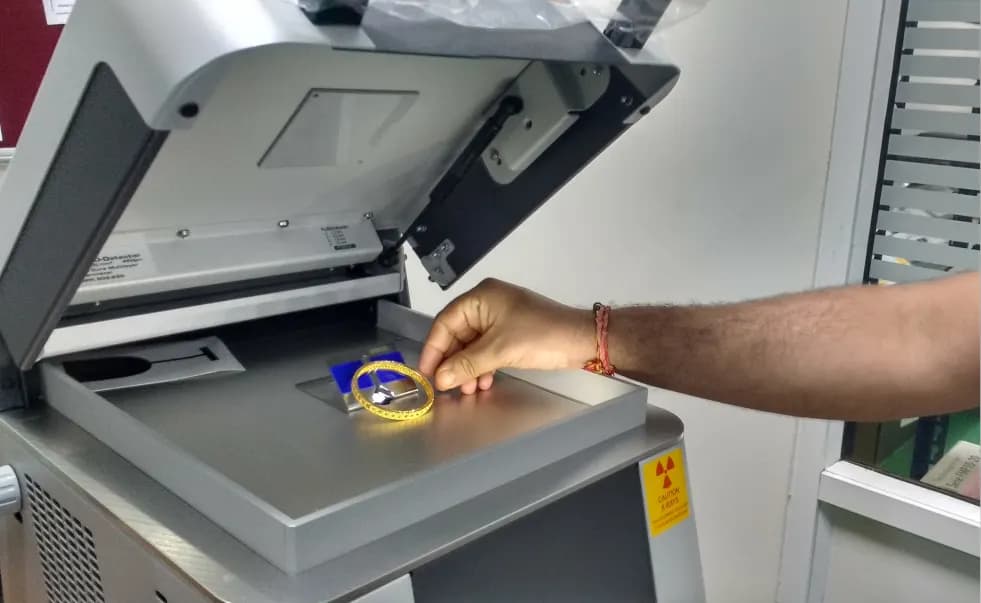
Valuation follows a set formula. The lender uses the lower of the average closing price over the previous 30 days and the previous day's closing price, for gold of that purity, as published by the India Bullion and Jewellers Association or a SEBI-regulated commodity exchange. Only the intrinsic gold content counts — stones, gems, lac, strings and fastenings are deducted. The lender must publish its valuation method on its website, assay your jewellery in your presence, and give you a certificate showing purity in carats, gross and net weight, deductions, any damage, a photo and the value at sanction.
Credit assessment above ₹2.5 lakh
For small loans, lenders may keep the light-touch process gold loans are known for. But when your total gold-backed loans with a lender exceed ₹2.5 lakh, it must carry out a detailed credit assessment, including your repayment capacity. For a business, that means bank statements, GST returns or ITRs — have them ready if you are borrowing more than a couple of lakh.
Bullet repayment and renewal
A bullet loan is one where you pay both principal and interest at the end. For consumption loans, RBI caps the tenor of bullet-repayment gold loans at 12 months. For every bullet loan, the LTV calculation uses the total amount repayable at maturity — principal plus the interest that will accrue — which means the amount you can borrow on a bullet loan is lower than on a loan where you pay interest monthly.
Renewals and top-ups are allowed only on your formal request, after a credit assessment, within the permissible LTV, and only if the loan is a standard (non-overdue) asset. A bullet loan can be renewed only after you pay the accrued interest. The old practice of rolling a gold loan over year after year without paying any interest is gone.
RBI gold-loan limits at a glance
1 kg
Max gold ornaments pledged per borrower
silver ornaments: 10 kg
50 grams
Max gold coins pledged per borrower
silver coins: 500 g
7 working days
To return gold after repayment
90% (85% after two failed auctions)
Minimum auction reserve price
What lenders can't lend against — or for
Lenders may not give a loan to buy gold in any form, or to buy gold ETFs or gold mutual fund units, and may not lend against primary gold such as bars and bullion or against gold-backed financial assets. Only jewellery, ornaments and coins are eligible collateral. Aggregate pledges are capped at 1 kg of gold ornaments and 50 grams of gold coins per borrower.
There is one important carve-out for business. A scheduled commercial bank, or a Tier 3 or 4 urban co-operative bank, may give need-based working capital to borrowers who use gold or silver as a raw material in manufacturing or industrial processing — a jewellery maker, for example — and may accept that gold as security. The bank must ensure the borrower is not holding gold for investment or speculation. This proviso was added by RBI's amendment of 29 September 2025. If you run a jewellery business, see our guide on starting a jewellery business.
Gold loans, the collateral-free rule and priority sector
Micro and small enterprises have a protection that matters here. Banks may not take collateral security on loans of up to ₹20 lakh to MSE units — a limit RBI raised from ₹10 lakh for loans sanctioned or renewed from 1 April 2026, and which banks may extend to ₹25 lakh for units with a good record. A bank that asks you to pledge jewellery as a condition of a ₹12 lakh working capital loan is breaching that mandate.
RBI's February 2026 amendment adds one nuance: accepting gold and silver that a borrower pledges voluntarily for a loan within the collateral-free limit is not treated as a violation. In other words, you may choose a gold loan because it is quicker or cheaper — but the choice must be yours. If you would rather keep your jewellery, ask for a collateral-free MSE loan, with a CGTMSE guarantee if needed; our MSME loan guide explains how. For farm loans, a similar collateral-free ceiling of ₹2 lakh applies.
Gold loans for agriculture and for micro and small enterprises can also count towards a bank's priority-sector targets if they meet RBI's classification rules — banks have a sub-target for micro-enterprise lending within priority sector. That is why "agri gold loan" and "MSME gold loan" schemes ask for end-use documents such as a land record, crop details, Udyam certificate or invoices. Keep them: they also help you show a lender that the loan is income-generating.
Gold loan vs collateral-free MSE loan
| Business gold loan | Collateral-free MSE loan | |
|---|---|---|
Security | Pledge of jewellery or coins | None up to ₹20 lakh (CGTMSE above) |
Speed | Often same day | Days to weeks; needs appraisal |
Paperwork | KYC; repayment-capacity check above ₹2.5 lakh | Financials, GST returns, bank statements, Udyam |
Main risk | Price fall → part-repayment demand or auction | Default hits credit score; guarantee claims |
Best for | Short, urgent gaps with a clear repayment source | Recurring working capital or larger needs |
Security
- Business gold loan
Pledge of jewellery or coins
- Collateral-free MSE loan
None up to ₹20 lakh (CGTMSE above)
Speed
- Business gold loan
Often same day
- Collateral-free MSE loan
Days to weeks; needs appraisal
Paperwork
- Business gold loan
KYC; repayment-capacity check above ₹2.5 lakh
- Collateral-free MSE loan
Financials, GST returns, bank statements, Udyam
Main risk
- Business gold loan
Price fall → part-repayment demand or auction
- Collateral-free MSE loan
Default hits credit score; guarantee claims
Best for
- Business gold loan
Short, urgent gaps with a clear repayment source
- Collateral-free MSE loan
Recurring working capital or larger needs
Published rates and charges (October 2026)
Gold loan pricing ranges very widely depending on the lender, the amount, the tenor and whether you pay interest monthly or at the end. Here is what two lenders published when we read their pages on 9 October 2026.
HDFC Bank discloses the rates it actually charged. For gold loans disbursed in January–March 2026, the bank's IRR ranged from 9.00%–19.00% (average 10.86%) and the APR — which adds fees — from 9.01%–19.08% (average 11.10%). Its charges page lists a processing fee of up to 1% of the disbursal amount plus GST, a valuation charge of ₹350 to ₹1,500 per packet depending on loan size, renewal charges of ₹500 or ₹750, premature closure charges of 2% within 30 days and 1% from 31 to 180 days (nil after 180 days), auction charges of ₹1,500 and 18% a year on delayed instalments. For business borrowers, two lines matter most: micro and small enterprises borrowing up to ₹5 lakh pay no processing fee if they submit the Udyam certificate before disbursal, and fixed-rate gold loans up to ₹50 lakh to MSEs carry no foreclosure or prepayment charge when repaid from the business's own funds.
Muthoot Finance, an NBFC, publishes scheme-wise rates. Its high-value scheme for ₹5 lakh to ₹5 crore at 75% LTV quotes 14% a year with a rebate if all interest is paid monthly; other schemes quote base rates up to 24% a year with rebates that bring the effective rate down to roughly 12%–13% if interest is paid within one to three months. Its page says the minimum rate starts from 9% a year when interest is serviced monthly, and standard tenure is 12 months.
Two things to take from this. First, compare APR, not the headline — rebates, processing fees and valuation charges change the real cost. Second, at most lenders paying interest monthly is cheaper than letting it accumulate on a bullet basis, and under RBI's rules it also lets you borrow more against the same gold.
Worked example: a ₹6 lakh gold loan for festival stock
Ramesh runs an agri-inputs and hardware shop in Coimbatore and needs about ₹6 lakh for six months to stock up before the season. He pledges family jewellery with a gross weight of 100 grams of 22-carat gold.
Step 1 — valuation. The assayer deducts 6 grams for stones and fastenings, leaving a net 94 grams of 22-carat gold. Suppose the lender's reference price for 22-carat gold — the lower of the 30-day average and yesterday's IBJA close — is ₹10,000 a gram. (This figure is only for illustration; use the price on the day you borrow.) Value: 94 × ₹10,000 = ₹9,40,000.
Step 2 — LTV. His lender's policy for business gold loans above ₹5 lakh uses 75% LTV, matching the tier RBI sets for larger consumption loans. Maximum loan with monthly interest payments: 75% × ₹9,40,000 = ₹7,05,000.
Step 3 — if he chooses bullet repayment. On a 12-month bullet loan, the LTV test uses principal plus interest due at maturity. At 10.86% a year — HDFC Bank's disclosed average for January–March 2026, used here only as a reference — the most he can borrow is ₹7,05,000 ÷ 1.1086 = ₹6,35,937. Paying interest monthly instead lets him borrow up to ₹7,05,000 against the same jewellery; at the same rate, interest on ₹6,00,000 is about ₹5,430 a month.
Step 4 — the price-fall risk. Say Ramesh takes ₹6,35,937 on a bullet basis, and four months later the gold price drops 10% to ₹9,000 a gram. His gold is now worth ₹8,46,000, and 75% of that is ₹6,34,500. With interest accruing, he owes about ₹6,58,958 — above the permitted 75%. Under RBI's rule that LTV must be maintained throughout, his lender's policy will require him to pay down part of the loan or add more gold. If he can't, and the loan goes into default, the lender can auction after giving notice.
Compare with a term loan — EMI on ₹6 lakh over 12 months
If you can't repay: notice, auction and your rights
RBI's directions set out what a lender must do before selling your gold:
- Notice first. The lender must give you adequate notice to repay before starting the auction, and keep a record of the notice and acknowledgement. If you can't be traced even after a public notice, it may auction only after one month from that notice.
- Public auction. The auction must be advertised in at least two newspapers — one in the regional language and one national daily — and held first in the same district as the branch. The lender and its related parties may not bid.
- Reserve price. At least 90% (85% after two failed auctions) of the current value, calculated with the same valuation rules.
- Accounting and refund. The lender must give you full details of the sale value and dues adjusted, and refund any surplus within seven working days of receiving the auction proceeds. It may recover any shortfall under the loan agreement.
If the lender damages your jewellery it must pay for repairs; if gold is lost or found short in quantity or purity, it must compensate you. Gold left unclaimed for two years after full repayment is treated as unclaimed, and lenders must run drives to trace the owners.
Before you pledge gold for your business
0/7Risks to weigh before choosing a gold loan
Price risk you can't control. Gold loans are safest when gold is rising. A sharp fall can trigger a demand for part-repayment at the worst possible time for your business. Borrow below the maximum LTV to leave a buffer.
Rollover trap. A business that keeps a gold loan running for years, renewing each time, pays more interest than a cheaper term loan would cost. RBI's rule that bullet renewals need accrued interest paid first is meant to stop silent rollovers.
Family assets at stake. Jewellery often belongs to family members. RBI requires the lender to obtain a declaration that you are the rightful owner — make sure that is true, and that everyone whose jewellery is pledged understands the auction risk.
Unregulated lenders. RBI requires regulated lenders to handle and store gold only in their own branches, by their own employees. Pledging with an unregulated pawnbroker or a "doorstep" agent who takes gold away puts it outside these protections. Check the lender on RBI's lists of banks and NBFCs.
Cash rules. Lenders should generally disburse into your bank account and receive repayment in the lender's account, following KYC and income-tax limits on cash loans and repayments. A large cash disbursal is a red flag.
Interest on a gold loan used for your business is a business expense like interest on any other business loan, so keep the trail showing where the money went. And if you deal in gold yourself, remember that buying and selling jewellery has its own GST treatment.
Official links
- RBI Lending Against Gold and Silver Collateral Directions, 2025LTV, bullet loans, valuation, auction and compensation rules
- RBI Commercial Banks – Credit Facilities Directions, 2025Consolidated directions for commercial banks
- RBI Lending to MSME Sector (Amendment) Directions, 2026₹20 lakh collateral-free limit; voluntary gold pledge
- RBI Complaint Management SystemComplain about a bank or NBFC that won't release gold or overcharges
What to do next
Before you pledge, check whether a collateral-free MSME loan or an unsecured business loan would do the job — you may not need to risk your jewellery at all. If a gold loan is the right fit, get two or three Key Facts Statements, compare the APR, and choose monthly interest payment where you can. For a short seasonal gap, a business overdraft may cost less, and our working capital guide helps you size the gap first.
This is general information, not legal or tax advice — confirm on the official source or with a professional.
Frequently asked questions
For consumption gold loans, RBI's Lending Against Gold and Silver Collateral Directions cap LTV at 85% where the borrower's total loan is up to ₹2.5 lakh, 80% above ₹2.5 lakh up to ₹5 lakh, and 75% above ₹5 lakh. For income-generating loans such as business gold loans, each lender's board-approved policy sets the maximum LTV, and the ratio must be maintained throughout the loan.
Yes. RBI's directions explicitly cover income-generating gold loans — loans for business or commercial purposes, farm credit and buying productive assets. Banks, co-operative banks and NBFCs all offer them. For loans above ₹2.5 lakh, the lender must assess your repayment capacity, so keep GST returns, bank statements or ITRs ready, along with Udyam registration if you are an MSME.
A bullet loan is one where principal and interest are both paid at maturity. RBI caps the tenor of bullet-repayment consumption gold loans at 12 months, counts the full amount repayable at maturity — principal plus interest — when checking LTV, and allows renewal only after you pay the accrued interest and only if the loan is standard and within LTV.
It varies widely. HDFC Bank disclosed that gold loans it gave in January–March 2026 carried interest of 9.00%–19.00% (average 10.86%). Muthoot Finance's published schemes, read on 9 October 2026, quote headline rates from about 10.5% to 24% a year with rebates that lower the effective rate if you pay interest monthly. Always compare the APR, not the headline.
On the same day, and in any case within 7 working days of full repayment. If the delay is the lender's fault, RBI's directions require it to pay you ₹5,000 a day of delay. The lender must also verify the returned jewellery against the assay certificate it gave you at the time of the loan.
No. Banks must not take collateral on loans of up to ₹20 lakh to micro and small enterprises sanctioned or renewed from 1 April 2026. RBI's February 2026 amendment says accepting gold or silver that a borrower pledges voluntarily is not a breach of that rule — but the pledge has to be your choice, not a condition of the loan.
Sources & verification
Figures on this page were checked against the sources below when it was last reviewed on 9 October 2026. Each rate and limit is stored once with its own official source and review date, and official update channels are monitored daily so changes are picked up. How we verify
- 1.RBI (Lending Against Gold and Silver Collateral) Directions, 2025 (as amended 29 September 2025) — Reserve Bank of India · accessed 9 October 2026
- 2.RBI (Commercial Banks – Credit Facilities) Directions, 2025 (updated as on 1 October 2026) — Reserve Bank of India · accessed 9 October 2026
- 3.Lending to MSME Sector (Amendment) Directions, 2026 — RBI/2025-26/206 — Reserve Bank of India · accessed 9 October 2026
- 4.RBI FAQs on MSME lending — Reserve Bank of India · accessed 9 October 2026
- 5.HDFC Bank — Gold Loan Rate of Interest and Charges (October 2026) — HDFC Bank · accessed 9 October 2026
- 6.Muthoot Finance — Gold Loan Interest Rate — Muthoot Finance (NBFC) · accessed 9 October 2026
- 7.RBI Press Release on Lending to MSME Sector (Amendment) Directions (9 February 2026) — Reserve Bank of India · accessed 9 October 2026
MSMETOOLS is an independent platform and is not affiliated with any government agency, ministry or department.
Tools for this
EMI Calculator
Calculate loan EMIs for business and personal loans.
Loan Eligibility Calculator
Check your business loan eligibility based on income and existing loans.
Working Capital Calculator
Check working capital, current and quick ratios.
Related guides
 Unsecured Loan for Business 2026: Limits, Rates & EligibilityRead guide
 Business Overdraft 2026: FD, Property & GST OD ExplainedRead guide
 Loan Against Property 2026: LTV, Rates, Fees & RBI RulesRead guide
 SIDBI Loan for MSME 2026: Schemes, Limits & How to ApplyRead guide
Official links open the government site in a new tab.