 GST & indirect tax
GST on Gold in 2026: Rate, Making Charges, Old Gold Exchange and a Worked Bill
GST on gold in 2026 is 3% on jewellery, coins and bars — making charges included. See HSN codes, old-gold exchange rules and a worked ₹1 lakh bill.
 Edited by Sumeet YadavFounder & editor, MSMETOOLS · fact-checked against official sources

Contents (9)
- 1. GST rate on gold in 2026
- 2. Making charges: 3% or 5%?
- 3. Worked example: GST on a gold jewellery bill
- 4. Old gold exchange: how GST works
- 5. Gold coins, bars, digital gold and imported gold
- 6. GST for jewellers: what changes on your side
- 7. Quick ₹ examples for other gold purchases
- 8. Mistakes buyers and jewellers make
- 9. What to do next
Whether you're buying a wedding set, a 10-gram coin or running a jewellery counter, the GST line on a gold bill confuses almost everyone. Is it 3% or 5%? Does the old gold you trade in reduce the tax? This guide gives the current rate with the notification behind it, explains making charges and old-gold exchange properly, walks through a full ₹ bill, and covers what jewellers have to get right on their side.
Quick answer
GST on gold is 3% — 1.5% CGST + 1.5% SGST, or 3% IGST — on jewellery, coins, bars and biscuits. When you buy jewellery from a shop, making charges are part of the price and also carry 3%, not 5%. GST 2.0 (22 September 2025) did not change any of this.
Jewellery (HSN 7113), bars (7108), coins (7118): 3%
Making charges on a jeweller's sale: 3% as part of the jewellery value
Job work for a registered jeweller: 5%; labour on an individual's own gold: generally 18%
Old gold exchanged: GST still on the full value of the new piece
Selling your personal old gold: no GST
GST rate on gold in 2026
Gold sits in a special low-rate schedule. Notification 9/2025-Central Tax (Rate) — the GST 2.0 rate notification effective from 22 September 2025 — kept precious metals at 1.5% central tax, matched by 1.5% state tax. That's 3% in total, the same as before the overhaul. GST 2.0 collapsed most goods into 5% and 18% slabs, but bullion and jewellery were left alone.
| Item | HSN | GST |
|---|---|---|
| Gold bars, biscuits, granules, powder | 7108 | 3% |
| Gold jewellery and parts | 7113 | 3% |
| Goldsmiths' wares (utensils, idols) | 7114 | 3% |
| Gold coins | 7118 | 3% |
| Silver (unwrought/semi-manufactured) and silver jewellery | 7106 / 7113 | 3% |
| Imitation jewellery | 7117 | 3% |
| Cut and polished diamonds | 7102 | 1.5% |
| Rough or simply sawn diamonds | 7102 | 0.25% |
| Job work (making) for a registered business | SAC 9988 | 5% |
| Labour on an individual customer's own gold | SAC 9988 | Generally 18% (see below) |
On an intra-state sale the 3% splits into equal CGST and SGST. On an online order shipped from another state, it's charged as IGST at the same total. The rate doesn't vary by city: "GST on gold in Delhi" or "in Kolkata" is the same 3%. Prices differ only because the daily gold rate and making charges differ.
Use the HSN code finder if your item is a mixed piece — for example, gold with studded stones.
Making charges: 3% or 5%?
This is the most common mistake on the internet, so let's be precise.
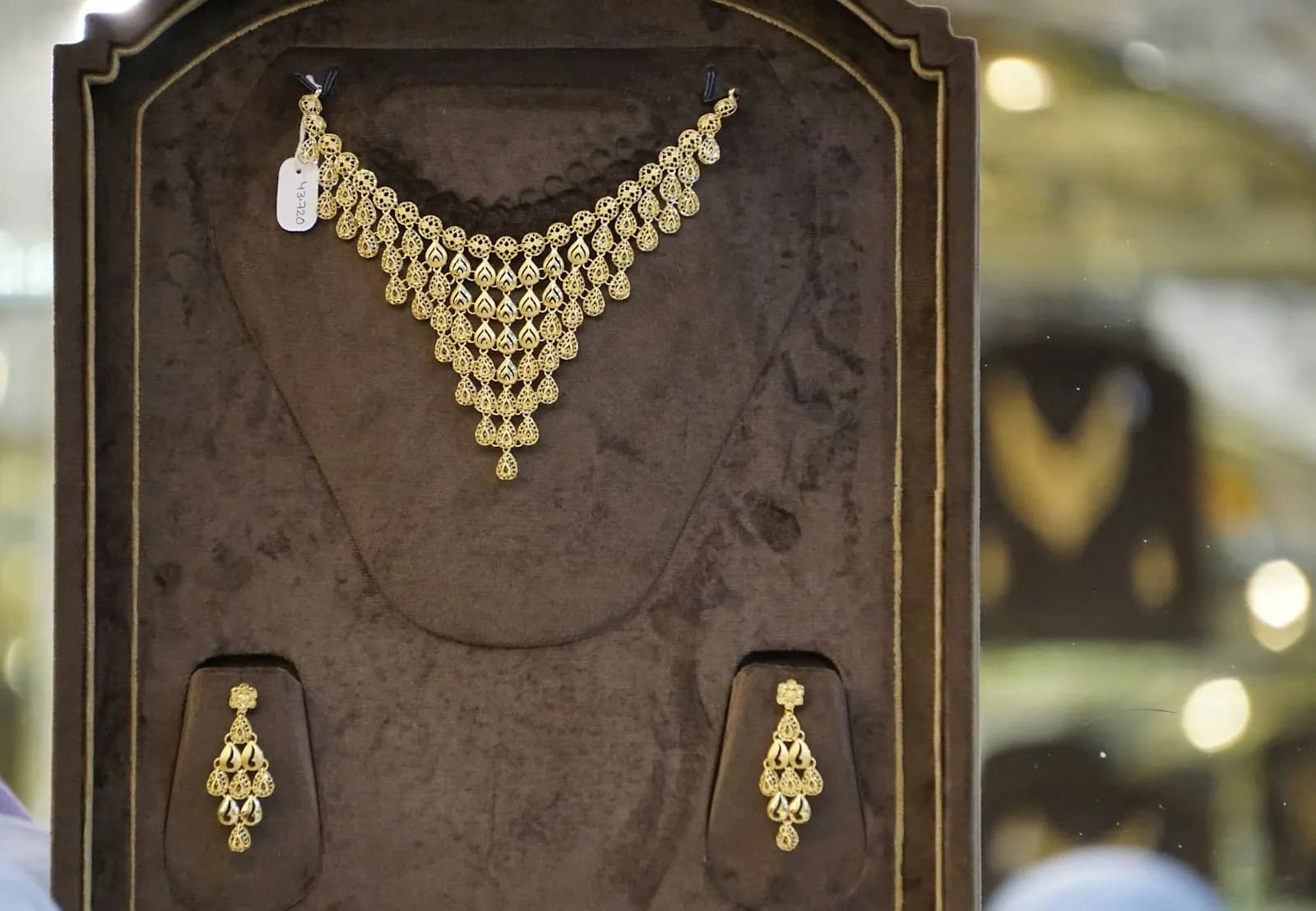
Buying finished jewellery from a jeweller. The jeweller is selling you a good — a necklace. Under Section 15 of the CGST Act, the taxable value is the whole price you pay for that good. Gold value, making charges, wastage, stone-setting and hallmarking recovered on the bill are all part of it. Splitting the bill into lines doesn't change what is being sold. The whole amount carries 3%.
Giving your own gold to a goldsmith. If you hand over an old chain and pay a karigar to make a new bangle from it, the goldsmith isn't selling you gold. That labour is a service under heading 9988. Notification 11/2017-Central Tax (Rate) taxes job work on Chapter 71 goods other than diamonds at 2.5% CGST + 2.5% SGST = 5% — but under section 2(68) of the CGST Act, "job work" means processing goods that belong to another registered person. So the 5% fits a karigar working for a registered jeweller. When an individual customer brings their own gold, the labour generally falls under the residual services entry at 18% instead — practice varies, so a jeweller billing this should confirm the rate with their adviser. A goldsmith below the GST registration threshold won't charge GST at all.
So 5% (or 18%) belongs only on a pure labour bill. If a shop selling you new jewellery shows 5% on its making-charge line, ask why.
Worked example: GST on a gold jewellery bill
Assume 10 grams of 22-carat jewellery at an illustrative gold rate of ₹10,000 per gram, with 12% making charges. Check the day's rate at your jeweller; the method doesn't change.
| Line | Calculation | Amount (₹) |
|---|---|---|
| Gold value | 10 g × ₹10,000 | 1,00,000 |
| Making charges | 12% of gold value | 12,000 |
| Taxable value | 1,12,000 | |
| CGST @ 1.5% | 1.5% × 1,12,000 | 1,680 |
| SGST @ 1.5% | 1.5% × 1,12,000 | 1,680 |
| Total payable | 1,15,360 |
The formula: GST = (gold value + making charges) × 3%. If the jeweller is in another state and ships to you, the same ₹3,360 appears as IGST.
Try your own numbers below — the preset applies 3% on ₹1,00,000.
Try it — GST on gold
Old gold exchange: how GST works
Swapping old jewellery for new is how most Indian families buy gold. The GST treatment has two parts.
1. You selling old gold. When an individual sells personal jewellery, it isn't a supply "in the course or furtherance of business", so there's no GST. The jeweller also doesn't pay reverse charge: since February 2019, reverse charge on purchases from unregistered persons applies only to notified categories, and gold isn't one. What you receive is the gold value after the jeweller's purity test and any deduction.
2. You buying new jewellery. The old gold is how you pay for part of the new piece — consideration in kind, not a discount. GST is on the transaction value of the new jewellery, i.e. its full price.
Exchange example — ₹60,000 of old gold against the ₹1,12,000 piece above
| Correct treatment | Common mis-billing | |
|---|---|---|
Taxable value | ₹1,12,000 (full value of new jewellery) | ₹52,000 (new minus old) |
GST @ 3% | ₹3,360 | ₹1,560 |
Old gold adjusted | ₹60,000 | ₹60,000 |
Cash you pay | ₹55,360 | ₹53,560 |
Risk | None | Jeweller under-pays GST; exposed on audit |
Taxable value
- Correct treatment
₹1,12,000 (full value of new jewellery)
- Common mis-billing
₹52,000 (new minus old)
GST @ 3%
- Correct treatment
₹3,360
- Common mis-billing
₹1,560
Old gold adjusted
- Correct treatment
₹60,000
- Common mis-billing
₹60,000
Cash you pay
- Correct treatment
₹55,360
- Common mis-billing
₹53,560
Risk
- Correct treatment
None
- Common mis-billing
Jeweller under-pays GST; exposed on audit
Some counters still bill the net. As a buyer you aren't liable for the jeweller's short payment, but a properly billed invoice is what you'll want for insurance, resale and any later tax questions.
Can jewellers use the margin scheme on old gold? Rule 32(5) of the CGST Rules lets dealers in second-hand goods pay GST only on their margin. The Kerala Authority for Advance Ruling (Best Money Gold Jewelry Ltd) held that gold can't be "second-hand" because its value doesn't fall with use, so full value applies. Earlier Karnataka rulings (Attica Gold, Aadhya Gold) had allowed the margin scheme where gold was resold without processing. Advance rulings bind only the applicant, so jewellers should take advice before relying on either.
Gold coins, bars, digital gold and imported gold
Coins and bars from a jeweller or bank. Same 3% on the sale price. There are usually no making charges, so GST is close to 3% of the metal value.
Digital gold. You're buying physical gold stored in a vault on your behalf, so 3% is built into the purchase price. When you sell it back on the app, no GST is deducted from you.
Gold ETFs and sovereign gold bonds. These are securities, not goods, so there's no GST on the investment itself.
Imported gold. Importers pay customs duty of about 15% (10% BCD + 5% AIDC) since 13 May 2026, when Customs Notifications 15–17/2026 raised it from 6% (5% BCD + 1% AIDC, in force from 24 July 2024 and left unchanged in Budget 2026-27). Check the current tariff entry before you price an import. On top of that comes IGST of 3%, which a registered importer can claim as input tax credit. A bullion importer needs an Import Export Code to file the bill of entry.
GST for jewellers: what changes on your side
If you sell gold, the buyer-side rules above are your output tax. A few points are specific to the trade:
Jeweller's GST checklist
0/8Because karigars bill making at 5% while your sale is taxed at 3%, input credit can pile up if most of your purchases are labour. Plan your pricing and cash flow for that. To start billing, see our GST registration guide and create compliant bills with the invoice generator.
Quick ₹ examples for other gold purchases
Using the same illustrative ₹10,000 per gram:
- 10-gram gold coin from a bank, no making charge. Taxable value ₹1,00,000 → GST ₹3,000 → you pay ₹1,03,000. If the bank adds a ₹1,500 minting premium, that's part of the coin's price too: GST becomes ₹3,045.
- Diamond ring: 4 g of 18K gold plus a diamond. A studded ring is still jewellery under HSN 7113, so the whole ring — gold, diamond and making — is taxed at 3%. The lower diamond rates apply only to loose stones traded between dealers.
- Remaking an old bangle with a karigar. You supply 15 g of your own gold and pay ₹6,000 labour. If the karigar is GST-registered, the labour for an individual customer is generally taxed at 18% — ₹1,080 on ₹6,000 (₹300 if your adviser accepts the 5% job-work rate). An unregistered karigar charges no GST. There's no GST on your own gold.
What a proper jeweller's invoice should show
A valid GST tax invoice for jewellery should carry the jeweller's GSTIN, your name and state, the HSN code (7113 for jewellery), gross and net weight, purity, gold rate per gram, making charges, taxable value, and CGST/SGST or IGST shown separately. If old gold was exchanged, it should show the old gold's weight, purity and value as an adjustment after tax. Hallmarked pieces should list their HUID numbers so the invoice matches the jewellery.
Mistakes buyers and jewellers make
- Charging 5% on making charges for a finished piece. The whole jewellery bill is 3%.
- Netting old gold before tax. GST applies to the full value of the new item.
- Assuming GST 2.0 cut gold rates. Gold and silver were left at 3% from 22 September 2025.
- Paying GST when selling personal jewellery. Individuals don't charge GST; check any deduction on the jeweller's buy-back slip is for purity, not "GST".
- Not asking for a tax invoice. A proper GST invoice with HUID hallmark details protects resale value and insurance claims.
What to do next
Before you buy, ask the jeweller for the gold rate, making-charge percentage and the GST line separately, then check the arithmetic with the GST calculator. If you're a jeweller, make sure your billing software applies 3% to the full value and records exchanged gold correctly. Most disputes start from those two lines.
This is general information, not legal or tax advice — confirm on the official source or with a professional.
Frequently asked questions
GST on gold is 3% — 1.5% CGST plus 1.5% SGST on a sale within your state, or 3% IGST across states. It applies to gold jewellery (HSN 7113), bars and biscuits (7108) and coins (7118). The GST 2.0 overhaul of 22 September 2025 left this rate unchanged.
When you buy finished jewellery from a jeweller, making charges are part of the price of the jewellery, so the whole bill — gold value plus making — is taxed at 3%. The 5% rate is the job-work rate: it applies to a separate labour charge for processing gold that belongs to a GST-registered business. If you are an individual giving your own gold to a goldsmith, the labour is generally taxed as an ordinary service at 18% when the goldsmith is registered — confirm with your adviser.
No. An individual selling personal jewellery isn't making a supply in the course of business, so there is no GST on the sale and no reverse charge for the jeweller. If the jeweller resells or remelts that gold, GST applies on the jeweller's later sale. You may owe capital gains tax on the profit, which is separate from GST.
GST is charged on the full value of the new jewellery. The old gold you hand over is part-payment, not a discount. So on a ₹1,12,000 new piece with ₹60,000 of old gold exchanged, GST is 3% of ₹1,12,000 (₹3,360) and you pay ₹55,360 in cash.
Gold in unwrought, semi-manufactured or powder form — bars, biscuits, granules — is HSN 7108. Gold jewellery is 7113, goldsmiths' wares such as utensils are 7114, and gold coins are 7118. All four sit in the 3% schedule of Notification 9/2025-Central Tax (Rate).
Digital gold is a purchase of physical gold held in a vault for you, so 3% GST is built into the buy price. Gold ETFs and sovereign gold bonds are securities, not goods, so no GST is charged on buying them — only brokerage-related service charges may carry GST.
Sources & verification
Figures on this page were checked against the sources below when it was last reviewed on 7 October 2026. Each rate and limit is stored once with its own official source and review date, and official update channels are monitored daily so changes are picked up. How we verify
- 1.Notification No. 9/2025-Central Tax (Rate), 17 September 2025 — Schedule IV (1.5%) — Ministry of Finance (copy hosted by ICAI GST & Indirect Taxes Committee) · accessed 7 October 2026
- 2.GST goods and services rates — CBIC · accessed 7 October 2026
- 3.Notification No. 11/2017-Central Tax (Rate) — services rates, S. No. 26 job work — CBIC · accessed 7 October 2026
- 4.GST and margin scheme on second-hand gold jewellery — Kerala AAR (Best Money Gold Jewelry Ltd) — TaxGuru · accessed 7 October 2026
- 5.GSTN advisory on e-way bill generation for goods under Chapter 71 — TaxGuru (GSTN advisory, 7 February 2025) · accessed 7 October 2026
- 6.Government revises customs duty structure on gold, silver and precious metals imports — effective 13 May 2026 (Notifications 15–17/2026-Customs) — A2Z Taxcorp (secondary; confirm on CBIC) · accessed 11 October 2026
- 7.Budget 2026-27 keeps customs duty unchanged for gold and silver — A2Z Taxcorp LLP · accessed 7 October 2026
- 8.GST 2.0 leaves gold, silver jewellery untouched at 3% — Prabhudas Lilladher · accessed 7 October 2026
MSMETOOLS is an independent platform and is not affiliated with any government agency, ministry or department.
Tools for this
GST Calculator (India)
Calculate GST for your sales and purchases with current rates.
HSN Code Finder (India)
Find the correct HSN/SAC code for your product.
Invoice Generator
Create professional invoices with tax, logo and custom details.
Related guides
 GST on Footwear 2026: 5% up to ₹2,500, 18% Above, HSN 64Read guide
 GST on Batteries 2026: Lithium-ion, Lead-acid & EV RatesRead guide
 GST on Cosmetics 2026: 5% Toiletries, 18% Make-up, HSN 33Read guide
 GST on Diamonds 2026: 0.25% Rough, 1.5% Polished, 3% JewelleryRead guide
Official links open the government site in a new tab.