 Finance & accounting
How to Calculate EMI for a Business Loan in 2026: Formula, Schedule and the Costs Behind It
Calculate EMI for a business loan in 2026: the formula, a worked ₹10 lakh amortisation table, flat vs reducing rates, APR in the KFS, prepayment and repo rules.
 Edited by Sumeet YadavFounder & editor, MSMETOOLS · fact-checked against official sources
Contents (11)
- 1. What an EMI is and why the split keeps changing
- 2. The EMI formula, worked by hand
- 3. A full amortisation schedule for ₹10 lakh
- 4. Tenure: lower EMI, higher total cost
- 5. The flat-rate trap
- 6. Fees, APR and the Key Facts Statement
- 7. How repo rate changes move your EMI
- 8. Prepayment: what you save and what you can be charged
- 9. Common mistakes when comparing EMIs
- 10. After you sign
- 11. What to do next
You've been offered a business loan and want to know what you'll actually pay each month — and whether that number is honest. This guide shows how to calculate EMI for a business loan by hand, in Excel and with our calculator, then walks through a full ₹10 lakh repayment schedule. It also covers the parts that change the real cost: flat-rate quotes, processing fees and the APR in the Key Facts Statement, prepayment rules that changed on 1 January 2026, and what the October 2026 repo rate hike does to a floating-rate instalment. It's written for proprietors, partners and directors of small businesses in India comparing offers from banks and NBFCs.
Quick answer
EMI = P × r × (1 + r)^n ÷ [(1 + r)^n − 1], where P is the loan, r the monthly rate (annual % ÷ 1,200) and n the number of months. ₹10 lakh at 12% for 36 months gives an EMI of ₹33,214 and total interest of ₹1,95,715. In Excel: =PMT(12%/12,36,-1000000).
Compare loans on the APR in the Key Facts Statement, not the headline rate — fees push 12% to about 13.4%
A flat rate of 7% for three years costs about the same as a 12.8% reducing rate
Floating MSE loans reset at least once every three months; the repo rate is now 5.50%
No prepayment penalty on floating-rate MSE business loans from banks sanctioned from 1 January 2026
What an EMI is and why the split keeps changing
An equated monthly instalment is a fixed payment that covers two things: the interest due for that month and a slice of the principal. The total stays the same every month, but the mix shifts. Early on, most of each EMI goes to interest because the outstanding balance is large. As the balance falls, the interest part shrinks and more of the EMI repays principal. That is why a borrower who closes a loan halfway through has usually repaid much less than half the principal.
This structure applies to term loans — machinery loans, vehicle loans, unsecured business loans from NBFCs, loans against property, Mudra term loans and most digital business loans. It does not apply to cash credit or overdraft limits, where you pay interest each month only on the amount you actually used, calculated on the daily balance, and repay the principal when the limit is reviewed or whenever cash comes in. A dropline overdraft sits in between: the limit falls by a fixed amount each month, so it behaves like an EMI loan for planning purposes even though interest is charged on usage.
Lenders charge interest on the reducing balance for EMI loans. RBI has also told banks and NBFCs, in its April 2024 instructions on charging interest, to start interest only from the date the money actually reaches you, to charge only for the days the loan is outstanding in the month of disbursement or closure, and not to charge interest on the full amount if they collect instalments in advance. If your first EMI looks higher than the schedule predicts, check those three points first.
The EMI formula, worked by hand
The formula looks forbidding, but each piece has a plain meaning:
EMI = P × r × (1 + r)^n ÷ [(1 + r)^n − 1]
- P is the principal — the amount sanctioned, before any fee is deducted.
- r is the monthly interest rate as a decimal: the annual rate divided by 12 and by 100. At 12% a year, r = 0.01.
- n is the number of monthly instalments: 36 for three years, 60 for five.
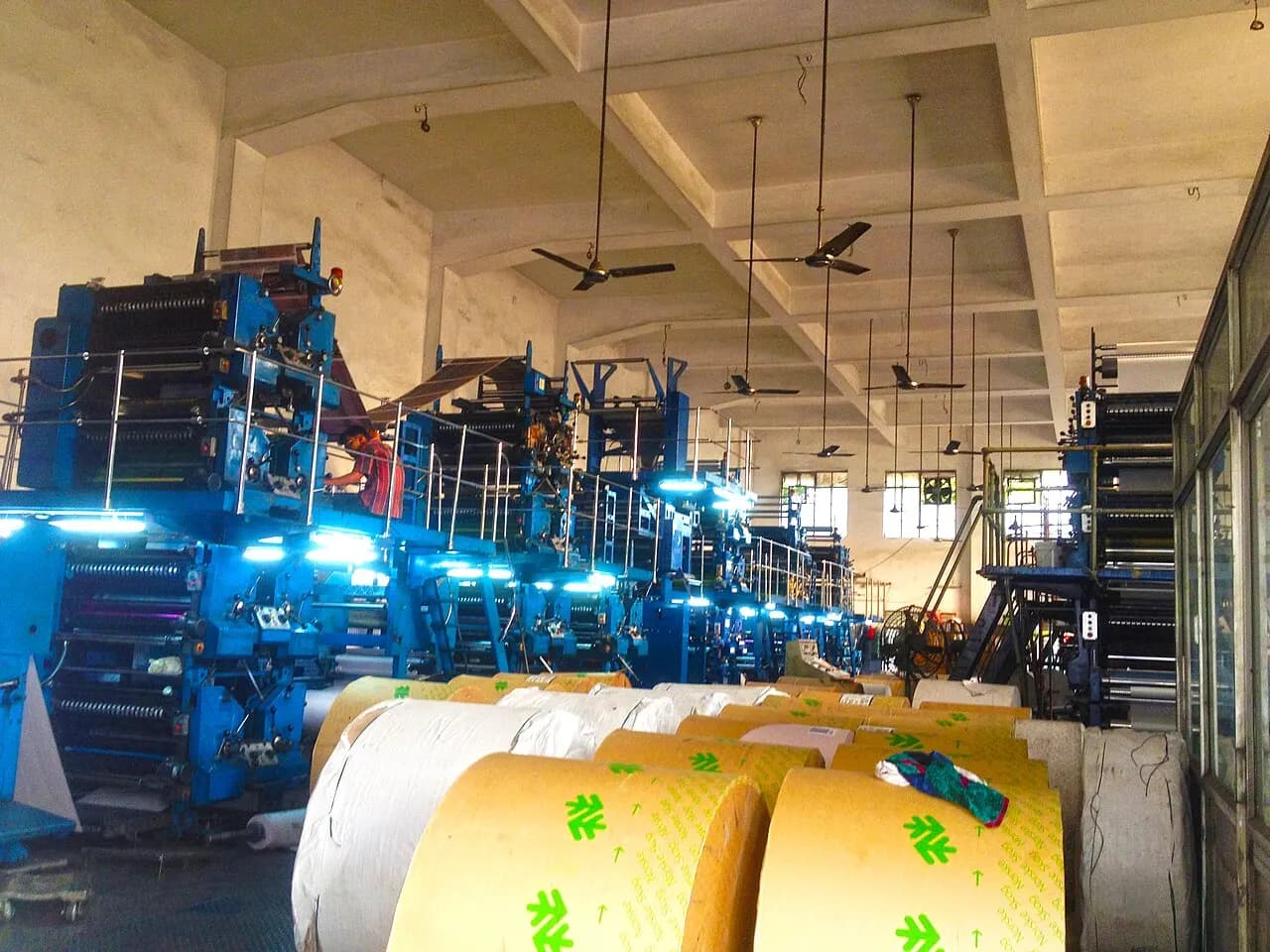
Take a printing business in Bhubaneswar that borrows ₹10,00,000 at 12% a year for 36 months to buy a second-hand offset machine. First work out (1 + r)^n, which is 1.01 raised to the power 36, or about 1.43077. Multiply the top line: 10,00,000 × 0.01 × 1.43077 = 14,307.7. The bottom line is 1.43077 − 1 = 0.43077. Divide: 14,307.7 ÷ 0.43077 = ₹33,214 a month.
Over 36 months you pay 33,214 × 36 = ₹11,95,715, so the total interest is ₹1,95,715. That figure is the number to hold against the extra profit the machine will earn. If the new machine brings in ₹45,000 of extra margin a month, the loan pays for itself with room to spare; if it brings in ₹30,000, the business is subsidising the machine from its other income for three years.
In Excel or Google Sheets, the PMT function does the same job: =PMT(12%/12, 36, -1000000) returns 33,214.31. The minus sign on the loan amount simply makes the answer come out positive. To find how many months a given EMI takes, use =NPER(rate/12, EMI, -loan); to find the rate hidden in an EMI someone has quoted you, use =RATE(months, EMI, -loan)*12. That last function is the most useful of the three when you're checking a lender's figures, as the flat-rate section below shows.
A full amortisation schedule for ₹10 lakh
Every month, the interest part is the opening balance multiplied by the monthly rate. The rest of the EMI reduces the principal. Here are the first three months and the year-end positions for the ₹10 lakh, 12%, 36-month loan.
| Month | Opening balance | Interest (1%) | Principal repaid | Closing balance |
|---|---|---|---|---|
| 1 | ₹10,00,000 | ₹10,000 | ₹23,214 | ₹9,76,786 |
| 2 | ₹9,76,786 | ₹9,768 | ₹23,446 | ₹9,53,339 |
| 3 | ₹9,53,339 | ₹9,533 | ₹23,681 | ₹9,29,658 |
| 12 | ₹7,31,483 | ₹7,315 | ₹25,899 | ₹7,05,584 |
| 24 | ₹4,03,014 | ₹4,030 | ₹29,184 | ₹3,73,830 |
| 36 | ₹32,885 | ₹329 | ₹32,885 | ₹0 |
Rolled up by year, the pattern is clearer. In year one you pay ₹3,98,572 in EMIs, of which ₹1,04,156 is interest and only ₹2,94,416 is principal. Year two splits ₹66,817 interest to ₹3,31,755 principal. In year three, interest falls to ₹24,742 and the remaining ₹3,73,830 of principal is cleared. More than half the total interest is paid in the first twelve months.
Two practical consequences follow. First, a prepayment early in the loan saves far more interest than the same prepayment late in the loan. Second, the interest column is what your accountant books as a finance cost in the profit and loss account; the principal column reduces the loan liability on the balance sheet. Ask your lender for the repayment schedule every year and give it to whoever prepares your accounts and income-tax return — interest on a business loan is a deductible business expense, principal is not.
Tenure: lower EMI, higher total cost
Stretching the tenure is the quickest way to make an EMI affordable, and the most expensive. On the same ₹10 lakh at 12%:
₹10 lakh at 12% — three tenures
| Tenure | EMI | Total interest | Interest as % of loan |
|---|---|---|---|
3 years (36 months) | ₹33,214 | ₹1,95,715 | 19.6% |
5 years (60 months) | ₹22,244 | ₹3,34,667 | 33.5% |
7 years (84 months) | ₹17,653 | ₹4,82,830 | 48.3% |
3 years (36 months)
- EMI
₹33,214
- Total interest
₹1,95,715
- Interest as % of loan
19.6%
5 years (60 months)
- EMI
₹22,244
- Total interest
₹3,34,667
- Interest as % of loan
33.5%
7 years (84 months)
- EMI
₹17,653
- Total interest
₹4,82,830
- Interest as % of loan
48.3%
Going from three to seven years cuts the EMI by almost half but more than doubles the interest. The right tenure is the shortest one your cash flow can comfortably carry in a weak month, not an average one. A useful rule many bankers apply is the debt service coverage ratio: your annual cash profit before interest and depreciation, divided by the year's total loan instalments, should stay comfortably above 1. Banks typically look for something around 1.25 or more on term loans, although the exact level is set by each bank's credit policy rather than by regulation.
Match the tenure to the asset as well. A delivery van you'll replace in five years shouldn't be on a seven-year loan, and a working capital need that turns over in 90 days belongs in a cash credit or invoice-finance limit rather than a three-year EMI. Using a long term loan for short-term needs is one of the commonest reasons small firms end up short of cash even when the business is profitable.
The flat-rate trap
Some NBFCs, dealers and loan agents quote a flat rate. Under a flat rate, interest is calculated on the original loan amount for the whole tenure, as if you never repaid any of it. The arithmetic is simple, which is part of the appeal: ₹10 lakh at 7% flat for three years is ₹70,000 of interest a year, ₹2,10,000 in total, so the EMI is (10,00,000 + 2,10,000) ÷ 36 = ₹33,611.
That EMI is higher than the ₹33,214 you'd pay at a 12% reducing rate. Put the flat-rate EMI into Excel's RATE function — =RATE(36, 33611, -1000000)*12 — and the true reducing-balance rate comes out at about 12.8%. The "7%" offer is the more expensive of the two.

As a rough guide, a flat rate is worth a little under double its face value on a reducing basis for tenures of three to five years. On ₹10 lakh, an 8% flat rate over three years means an EMI of ₹34,444 and an equivalent reducing rate of about 14.6%; a 7% flat rate over five years means an EMI of ₹22,500 and a reducing rate of about 12.5%. The longer the tenure, the bigger the gap between the flat figure and the real cost in rupees, because you pay flat interest on money you returned years earlier.
You shouldn't have to do this conversion yourself any more. For retail and MSME term loans sanctioned from 1 October 2024, RBI requires every regulated lender — banks, NBFCs and co-operative banks — to give a Key Facts Statement that states the Annual Percentage Rate. The APR is computed on the actual cash flows, so a flat-rate loan can't hide behind its headline number in the KFS. If a lender or agent gives you only a flat rate and no KFS, treat that as a warning sign.
Fees, APR and the Key Facts Statement
The interest rate is only part of the cost. Processing fees, documentation charges, stamp duty, valuation and legal fees, insurance bundled with the loan and credit-guarantee fees all add to what you pay. Most are deducted from the disbursement, so you receive less than the sanctioned amount while paying EMI on the full amount.
Take the same ₹10 lakh at 12% for three years with a 2% processing fee. The fee is ₹20,000, plus 18% GST of ₹3,600, so ₹9,76,400 actually reaches your account. The EMI stays ₹33,214. Solving for the rate that links ₹9,76,400 today to 36 payments of ₹33,214 gives about 13.4% a year on the fee alone, or about 13.7% if you also count the GST. If your business is GST-registered and the fee is a business expense, you can usually claim input tax credit on that GST, which is why the lower figure is the fairer comparison for most borrowers. Ask for the APR shown in your own KFS, because the lender's sheet will include every charge it levies.
What the Key Facts Statement must give you
APR
Annual cost of credit — interest plus all charges
with a computation sheet
three working days
Minimum time the KFS terms stay open
loans of 7 days or more
Full schedule
Repayment schedule for the whole tenure
Nil
Charges not listed in the KFS that can be levied without your explicit consent
The KFS rules come from RBI's April 2024 circular on Key Facts Statements, which applies to all new retail and MSME term loans from 1 October 2024, including fresh loans to existing customers. For commercial banks the same requirements are now carried in RBI's consolidated Responsible Business Conduct Directions, 2025. The KFS must be in a standard format, in a language you understand, with a unique proposal number, an APR computation sheet and the amortisation schedule. Third-party charges collected at actual cost — insurance or legal fees, for instance — must be shown and included in the APR. The most valuable line for a borrower: any fee or charge not mentioned in the KFS cannot be charged at any stage of the loan without your explicit consent.
Digital loans follow the same rules with extra protections. Under RBI's Digital Lending Directions, 2025, the KFS and the signed loan documents must be sent automatically to your registered email or SMS when the loan is executed. The money must go straight to your bank account and repayments straight to the lender's — not through an app's pool account. Lending apps' fees are paid by the lender, not you. And there's a cooling-off period of at least 1 day, set by the lender's board, during which you can exit by repaying the principal and the proportionate APR without a penalty; only a reasonable one-time processing fee disclosed in the KFS can be retained.
Penal charges are another line to read. Since 1 January 2024, RBI has required lenders to levy any penalty for a missed EMI or a breach of terms as a fixed penal charge, not as extra interest added to your rate, and penal charges cannot be capitalised — no interest is charged on them. The amount and the reasons must be in the KFS and the loan agreement.
How repo rate changes move your EMI
Most bank loans to micro and small enterprises are floating-rate and linked to an external benchmark — almost always the RBI repo rate. Since October 2019, RBI has required banks to link new floating-rate loans to MSEs to an external benchmark and to reset the rate at least once every three months. Your rate is the bank's external benchmark lending rate (repo plus the bank's spread) plus a credit-risk premium that depends on your rating and security. The spread and premium stay fixed for the loan unless your credit profile changes substantially; the repo part moves with RBI.
RBI's Monetary Policy Committee raised the repo rate by 25 basis points to 5.50% on 7 October 2026. Here is what that does to a typical machinery loan:
A 25 bps repo hike on a ₹25 lakh, five-year loan at 10.5%
Step 1
Original EMI ₹53,735
Step 2
After 12 months: ₹20.99 lakh outstanding
Step 3
Rate resets to 10.75% at next quarter
Step 4
Option A: EMI rises to about ₹53,988
+₹254 a month, tenure unchanged
Step 5
Option B: EMI unchanged
tenure stretches by about one instalment
Which option you get depends on your loan agreement and the bank's policy. Raising the EMI costs about ₹12,180 more interest over the remaining four years in this example; keeping the EMI and stretching the tenure costs slightly more, about ₹15,200, because the principal comes down more slowly. For a business with steady cash flow, asking the bank to raise the EMI rather than extend the tenure usually saves money. When the repo rate falls, the reverse applies — keeping the old EMI and letting the tenure shorten saves the most interest.
Fixed-rate business loans, common with NBFCs and some digital lenders, don't change with the repo rate. They're easier to budget, but they're usually priced higher and — importantly — the 2026 prepayment protection described below covers floating-rate loans, so a fixed-rate loan can still carry a foreclosure charge if the lender discloses it.
Prepayment: what you save and what you can be charged
Prepaying part of a loan is the most reliable way to cut interest. Back to the ₹10 lakh, 12%, 36-month loan: after 12 months the outstanding balance is ₹7,05,584. If you pay down ₹2 lakh then, you have two choices. Keep the EMI at ₹33,214 and the loan closes in about 17 more months instead of 24, saving roughly ₹45,900 of interest. Or keep the tenure and the EMI falls to about ₹23,800, saving roughly ₹26,000. Reducing the tenure saves more; reducing the EMI eases cash flow.
The rules on charges changed in your favour on 1 January 2026. Under RBI's Pre-payment Charges on Loans Directions, 2025, for floating-rate loans to individuals and micro and small enterprises taken for business purposes and sanctioned or renewed on or after that date:
| Situation | Rule from 1 January 2026 |
|---|---|
| Commercial banks (not SFBs, RRBs or LABs), Tier 4 UCBs, NBFC-UL, all-India FIs | No pre-payment charge at all |
| Small finance banks, RRBs, Tier 3 UCBs, state and central co-operative banks, NBFC-ML | No charge on loans up to ₹50 lakh |
| Part or full prepayment, any source of funds | Covered — no minimum lock-in |
| Prepayment at the lender's request | No charge |
| Cash credit / overdraft not renewed | No charge if you give notice within the agreed period and close on the due date |
| Any charge that is allowed | Must be in the sanction letter, agreement and KFS — otherwise it can't be levied |
Loans outside those boundaries — fixed-rate loans, loans to medium enterprises, larger loans from the second group of lenders, and loans sanctioned before 2026 that haven't been renewed — follow the lender's board-approved policy, and the charge must be based on the amount prepaid. Check the KFS before you sign rather than when you want to prepay.
Common mistakes when comparing EMIs
The most frequent error is comparing EMIs instead of costs. Two offers can have the same EMI with very different tenures, fees and insurance add-ons; only the APR in each KFS, at the same tenure, puts them on equal terms. Ask every lender for a KFS for the same amount and tenure, and compare the APR and the total amount payable.
The second is ignoring the margin. Banks rarely fund 100% of a machine or project — a 20–25% contribution from you is common — so the loan, and therefore the EMI, may be a fifth smaller than the price of the asset. Plan for the margin money from your own funds, not from a second, more expensive loan.
The third is forgetting what isn't in the EMI: the credit-guarantee fee on a CGTMSE-backed loan (charged annually on the outstanding amount), insurance premiums, annual review charges on cash credit limits, and GST on all fees. The fourth is borrowing against a projection: lenders assess your capacity on past GST returns, bank statements and ITRs, and an EMI that only works if next year's sales double is the one that ends in an SMA tag on your credit report. Our MSME loan eligibility guide explains how banks size a loan to your cash flows.
Checking a business loan offer in five steps
- 1
Get the KFS
Ask for the Key Facts Statement for the exact amount and tenure. It must show the APR, all fees and the full repayment schedule.
- 2
Re-calculate the EMI
Open the EMI calculatorUse the formula, =PMT() or our EMI calculator on the sanctioned amount and stated rate. A mismatch usually means a flat rate or an add-on.
- 3
Convert any flat rate
Run =RATE(months, EMI, -loan)*12 to find the true reducing rate, then compare with the APR.
- 4
Read the rate-reset and prepayment clauses
Check the benchmark (repo/EBLR or MCLR), reset frequency, EMI-or-tenure choice on a rate change, and any prepayment charge.
- 5
Stress-test your cash flow
Can the business pay the EMI in its weakest month and after a 0.5% rate rise? If not, shorten the amount or lengthen the tenure before signing.
After you sign
Keep the KFS, sanction letter and repayment schedule together, and diarise the reset dates if your loan is floating. After each RBI policy announcement — the MPC meets six times a year — check the next statement to see whether the bank has changed your EMI or your tenure, and ask for an updated schedule. If interest has been charged from before the actual disbursement date, for a whole month when the money arrived mid-month, or on instalments you paid in advance, ask for a refund citing RBI's April 2024 instructions on charging interest.
If a lender levies a charge that isn't in your KFS or ignores the prepayment rules, complain in writing to its grievance redressal officer first. If it doesn't resolve the complaint within 30 days, or you're unhappy with the reply, you can go to the RBI Ombudsman through the Complaint Management System at cms.rbi.org.in.
Official links
- RBI — Key Facts Statement for Loans & AdvancesKFS, APR and repayment schedule rules
- RBI — Pre-payment Charges on Loans Directions, 2025No prepayment charges on floating MSE loans from 1 Jan 2026
- RBI — Digital Lending Directions, 2025Cooling-off, direct disbursal, KFS on app loans
- RBI — Fair Practices Code: Charging of InterestInterest from disbursement date only
- RBI — Penal Charges in Loan AccountsPenal charges, not penal interest
- RBI Complaint Management SystemOmbudsman complaints
What to do next
Run your own numbers in the EMI calculator at two or three tenures, then check how much a lender is likely to sanction with the loan eligibility calculator. When you have KFS documents from two lenders, compare the APRs side by side. For how banks price and secure MSME loans, read the MSME loan guide and the term loan guide; for specific lenders, see our guides to SBI and HDFC Bank business loans.
This is general information, not financial or legal advice — confirm the terms on the official source or with your lender.
Frequently asked questions
EMI = P × r × (1 + r)^n ÷ [(1 + r)^n − 1], where P is the loan amount, r is the monthly interest rate (annual rate ÷ 12 ÷ 100) and n is the number of monthly instalments. For ₹10 lakh at 12% a year over 36 months, r is 0.01 and the EMI works out to about ₹33,214. Banks use this reducing-balance formula for term loans.
Use =PMT(rate/12, months, -loan). For ₹10 lakh at 12% over three years, type =PMT(12%/12, 36, -1000000) and Excel returns ₹33,214. To build a schedule, interest for each month is the opening balance × rate ÷ 12, principal is EMI minus interest, and the closing balance is the opening balance minus principal.
A flat rate charges interest on the original loan amount for the whole tenure, even as you repay it. A reducing rate charges interest only on what you still owe. A 7% flat rate on a three-year loan costs about the same as a 12.8% reducing rate, so always convert a flat quote before comparing it with a bank's rate.
Yes, if your loan is floating-rate and linked to an external benchmark such as the repo rate. Banks must reset such rates at least once every three months, so a repo change reaches your loan at the next reset. The bank either raises the EMI or extends the tenure — the October 2026 25-basis-point hike adds about ₹254 a month on a ₹21 lakh balance with four years left.
The Annual Percentage Rate is the yearly cost of credit including interest and all other charges, such as processing fees. Banks and NBFCs must show it in the Key Facts Statement for MSME term loans sanctioned from 1 October 2024. A loan at 12% with a 2% processing fee has an APR of roughly 13.4% over three years.
Not on floating-rate loans to individuals and micro and small enterprises for business purposes sanctioned or renewed from 1 January 2026, if the lender is a commercial bank, Tier 4 urban co-operative bank, NBFC-UL or all-India financial institution. Small finance banks, RRBs and some others can't charge on such loans up to ₹50 lakh. Fixed-rate loans follow the lender's disclosed policy.
Sources & verification
Figures on this page were checked against the sources below when it was last reviewed on 9 October 2026. Each rate and limit is stored once with its own official source and review date, and official update channels are monitored daily so changes are picked up. How we verify
- 1.RBI — Key Facts Statement (KFS) for Loans & Advances (RBI/2024-25/18, 15 April 2024) — Reserve Bank of India · accessed 9 October 2026
- 2.RBI (Commercial Banks – Responsible Business Conduct) Directions, 2025 (updated as on 1 October 2026) — Reserve Bank of India · accessed 9 October 2026
- 3.RBI (Pre-payment Charges on Loans) Directions, 2025 — Reserve Bank of India · accessed 9 October 2026
- 4.RBI (Digital Lending) Directions, 2025 — Reserve Bank of India · accessed 9 October 2026
- 5.RBI — Fair Practices Code for Lenders – Charging of Interest (29 April 2024) — Reserve Bank of India · accessed 9 October 2026
- 6.RBI — Fair Lending Practice – Penal Charges in Loan Accounts (18 August 2023) — Reserve Bank of India · accessed 9 October 2026
- 7.RBI — External Benchmark Based Lending (RBI/2019-20/53, 4 September 2019) — Reserve Bank of India · accessed 9 October 2026
- 8.Reserve Bank of India — current policy rates (home page) — Reserve Bank of India · accessed 9 October 2026
MSMETOOLS is an independent platform and is not affiliated with any government agency, ministry or department.
Tools for this
EMI Calculator
Calculate loan EMIs for business and personal loans.
Loan Eligibility Calculator
Check your business loan eligibility based on income and existing loans.
Compound Interest Calculator
Calculate future value of your investments.
Related guides
 Unsecured Loan for Business 2026: Limits, Rates & EligibilityRead guide
 HDFC Business Loan 2026: Rates, Fees & EligibilityRead guide
 Term Loan for Business 2026: Tenure, EMI, DSCR & RulesRead guide
 What Is Break-Even Point? Formula & Examples in ₹ (2026)Read guide
Official links open the government site in a new tab.