 Starting & growing a business
Catering Business Plan (2026): Setup Cost, FSSAI Licence, GST and Per-Plate Profit
Catering business plan for India in 2026: setup cost table, FSSAI licence caterers need, 5% GST on outdoor catering, staffing, per-plate costing and break-even.
 Edited by Sumeet YadavFounder & editor, MSMETOOLS · fact-checked against official sources
Contents (11)
- 1. Pick your catering format first
- 2. Menu, packages and pricing per plate
- 3. Catering equipment and setup cost
- 4. FSSAI licence and other permissions for caterers
- 5. GST on outdoor catering
- 6. Staffing a catering business
- 7. Worked example: monthly P&L and break-even
- 8. Funding a catering business
- 9. Catering business plan template
- 10. Mistakes that sink new caterers
- 11. What to do next
Catering is one of the few food businesses where you know your sales before you cook: the client books a date, agrees a menu and a guest count, and pays an advance. That makes it easier to start than a restaurant — but a catering business plan still has to answer hard questions about kitchen space, staff on event days, transport, the right FSSAI licence, GST and the lean months between wedding seasons. This guide is for home cooks, halwais and restaurant staff in India who want to run outdoor and event catering. It gives an estimated setup cost table with its basis, the licences, the GST rule, staffing ratios, a per-plate cost build-up and a worked monthly P&L with break-even. Rules were checked against FSSAI and GST Council sources in October 2026.
Quick answer
A catering business plan sets out your format (home, central-kitchen outdoor caterer or institutional), your menu and per-plate prices, setup costs, licences, staffing and the plates you must sell each month to cover fixed costs. Our estimate for an outdoor caterer with a rented kitchen is ₹9–29 lakh. Caterers need an FSSAI state licence — there is no basic-registration option — and outdoor catering carries 5% (no input tax credit) GST.
FSSAI: caterers need a state licence up to ₹50 crore turnover, fee ₹5,000 a year
GST: 5% (no input tax credit) on outdoor catering; 18% with ITC only at specified premises (hotels above ₹7,500 a room-night)
Price per plate from recipe cost + disposables + fuel + event staff + transport, then add fixed costs and margin
Worked example: 12 events of 250 plates a month earns about ₹86,000 after the owner's salary; break-even ≈ 2,270 plates
Pick your catering format first
The format decides your kitchen, your licence paperwork, your staff and how lumpy your cash flow will be. Most Indian caterers fit one of four models:
- Home-based party caterer — birthday parties, poojas, kitty parties and small office lunches for 20–100 guests, cooked in your own kitchen and delivered in insulated containers. Lowest cost, but your kitchen and domestic gas supply cap the orders you can accept.
- Outdoor event caterer with a central kitchen — weddings, receptions, engagements, housewarmings and corporate events for 100–1,000 guests. You prepare in a rented kitchen and often cook the main dishes on site. This is the model in our worked plan.
- Institutional or contract caterer — daily meals for offices, factories, hostels, hospitals or schools on a monthly contract. Steady volumes and lower margins; clients usually ask for GST invoices, food safety records and sometimes a security deposit.
- Specialist caterer — live counters (chaat, dosa, pasta, tandoor), regional cuisine, Jain or sattvic menus, or healthy corporate boxes. Smaller orders at higher prices, often subcontracted to bigger caterers and event planners.
Many caterers combine two models: institutional contracts pay the kitchen rent and permanent staff, and weddings bring the profit. If you are considering a delivery-only food brand instead, see our cloud kitchen guide.
Menu, packages and pricing per plate
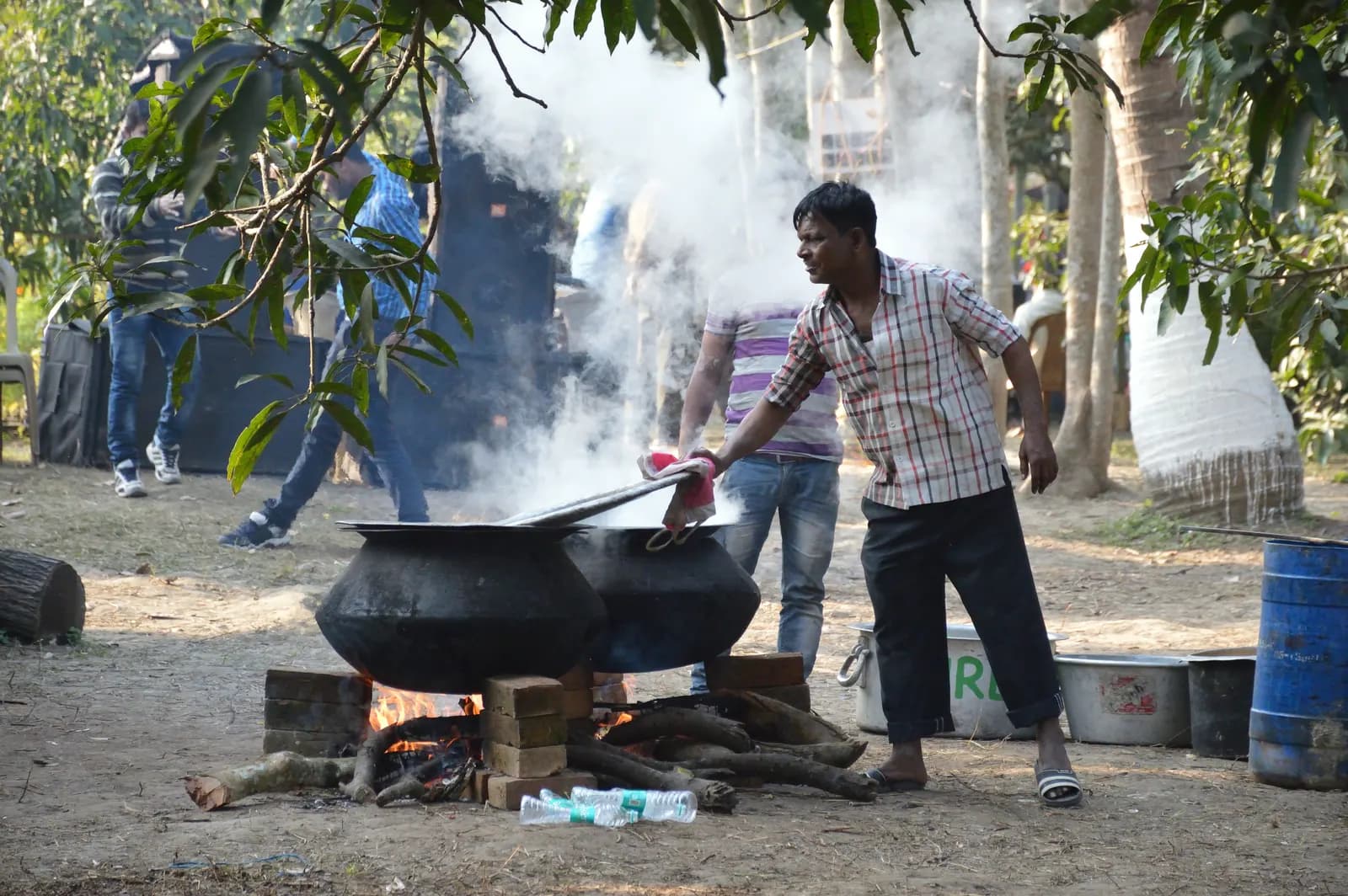
Clients compare caterers on the per-plate price, so build your menu as two or three packages rather than an open list. A typical north Indian wedding package might be a welcome drink, two starters, paneer and two vegetable dishes, dal, rice or pulao, breads, raita, salad and two desserts; a "premium" package adds live counters and more starters. Write down portion sizes for each dish per guest, because that is what you will cost and what your head cook will follow.
To price a plate, cost each dish by ingredient weight for 100 guests, divide by 100, and add the per-guest share of everything that varies with the event:
- Food cost — ingredients for every dish in the package, including oil, spices and a 5–8% buffer for extra guests.
- Disposables or crockery — disposable plates and glasses, or the washing and breakage of your own crockery.
- Fuel — commercial LPG, diesel for a generator if the venue has no power, or wood and charcoal for tandoors.
- Event-day staff — waiters, helpers and cleaners paid per event, plus their travel and meals.
- Transport — trips for vessels, food and staff; long-distance venues need a separate charge.
Then add your share of fixed costs and a margin. In our example, a ₹300 veg wedding plate has about ₹182 of variable cost, leaving ₹118 to pay the kitchen, permanent staff and the owner. The food cost calculator costs each recipe, and the quotation generator turns a package into a quote the client can sign.
Always quote a minimum guaranteed number of plates and a per-plate rate for guests above it. Wedding guest counts swing by 15–20%, and without a minimum you carry the cost of food that is cooked but never eaten.
Catering equipment and setup cost
The table below is a MSMETOOLS estimate for an outdoor caterer with a rented 600–1,000 sq ft central kitchen in a tier-2 city, serving events of 100–500 guests in 2026. The serving-equipment line is based on current IndiaMART listings, where stainless steel chafing dishes are listed at roughly ₹1,250 to ₹10,800 a piece depending on size and finish. Kitchen deposits, fit-out and vehicles vary most by city — replace each line with real quotes.
| Setup item | Estimated range | Worked plan | Basis / notes |
|---|---|---|---|
| Kitchen deposit and advance rent | ₹1,00,000 – ₹2,00,000 | ₹1,50,000 | 3–6 months' rent |
| Kitchen fit-out: washable floor and walls, drains, exhaust, platforms, wiring | ₹1,50,000 – ₹4,00,000 | ₹2,50,000 | FSSAI hygiene conditions shape this |
| Cooking equipment: commercial bhattis and burners, large vessels, kadhais, tandoor | ₹1,50,000 – ₹4,00,000 | ₹2,50,000 | Buy for your typical event, hire for peaks |
| Serving equipment: 20–40 chafing dishes, counters, ladles, trolleys | ₹1,00,000 – ₹3,00,000 | ₹1,80,000 | IndiaMART listings |
| Crockery and cutlery for 250–300 covers, or start with disposables | ₹75,000 – ₹2,00,000 | ₹1,20,000 | Many start with hire |
| Refrigeration: deep freezers, upright chiller | ₹60,000 – ₹1,50,000 | ₹1,00,000 | Paneer, dairy, marinated meat |
| Delivery vehicle (used pickup) — or hire per event | ₹0 – ₹7,00,000 | ₹4,50,000 | Hiring avoids this capital |
| Uniforms, caps, gloves, insulated containers, first-aid and fire extinguishers | ₹20,000 – ₹50,000 | ₹30,000 | |
| FSSAI licence, trade licence, branding, tasting sessions, website | ₹30,000 – ₹75,000 | ₹50,000 | |
| Working capital (advance purchases, off-season months) | ₹2,00,000 – ₹4,00,000 | ₹3,00,000 | About two months of fixed costs |
| Total | ₹8,85,000 – ₹28,75,000 | ₹18,80,000 |
A home caterer needs much less: larger vessels, a commercial burner if your gas connection allows it, insulated food carriers, a deep freezer, packaging and the FSSAI licence — roughly ₹50,000 to ₹2 lakh by our estimate. Rent chafing dishes and crockery for the first few events instead of buying them. Build your own list in the startup cost calculator.
FSSAI licence and other permissions for caterers
Here is where most online catering plans are wrong. From 1 April 2026 FSSAI categorises food businesses by turnover, with basic registration up to ₹1.5 crore for most kinds of business. But FSSAI's kind-of-business list, updated on 1 April 2026, treats a caterer — a food service business that prepares, stores, serves or transports food for a group at a ceremony, celebration, ritual or institution — differently: it has no basic-registration row.
FSSAI category for food-service businesses (from 1 April 2026)
| Kind of business | Turnover | What you need | Fee |
|---|---|---|---|
Caterer (events, ceremonies, institutions) | Up to ₹50 crore | State licence | ₹5,000 a year |
Caterer | Above ₹50 crore | Central licence | ₹7,500 a year |
Restaurant | Up to ₹1.5 crore | Basic registration | ₹100/year |
Restaurant | Above ₹1.5 crore up to ₹50 crore | State licence | ₹5,000 a year |
Caterer (events, ceremonies, institutions)
- Turnover
Up to ₹50 crore
- What you need
State licence
- Fee
₹5,000 a year
Caterer
- Turnover
Above ₹50 crore
- What you need
Central licence
- Fee
₹7,500 a year
Restaurant
- Turnover
Up to ₹1.5 crore
- What you need
Basic registration
- Fee
₹100/year
Restaurant
- Turnover
Above ₹1.5 crore up to ₹50 crore
- What you need
State licence
- Fee
₹5,000 a year
So even a home-based caterer doing small parties should apply for a state licence on FoSCoS, choosing "caterer" as the kind of business. A tiffin service that only distributes packed meals may fit FSSAI's food-vending categories instead — pick the category that matches what you actually do, because inspectors check your activity against your licence. Licences now have perpetual validity, so you don't renew them, but the annual fee continues and hygiene, medical-fitness and record-keeping duties apply in full. Our FSSAI registration guide covers the FoSCoS steps and documents.
Beyond FSSAI, a catering business usually needs:
- Trade or health trade licence for the kitchen from the municipal corporation, municipality or panchayat.
- Shops and Establishments registration or intimation with the state labour department for the kitchen and office.
- Commercial LPG connections for the kitchen — domestic cylinders are not meant for commercial cooking — and fire safety clearance where your local fire service requires it for kitchens using multiple cylinders.
- Venue-specific permission for open-flame cooking, generators or tandoors at farmhouses and lawns. The venue or the event organiser usually holds it, but confirm in writing.
- GST registration once you cross the threshold (next section), and free Udyam registration to access MSME benefits and priority-sector lending.
Train at least one supervisor through FSSAI's FoSTaC food-safety training and keep medical-fitness certificates for food handlers. Corporate and institutional clients increasingly ask for both before signing a contract.
GST on outdoor catering
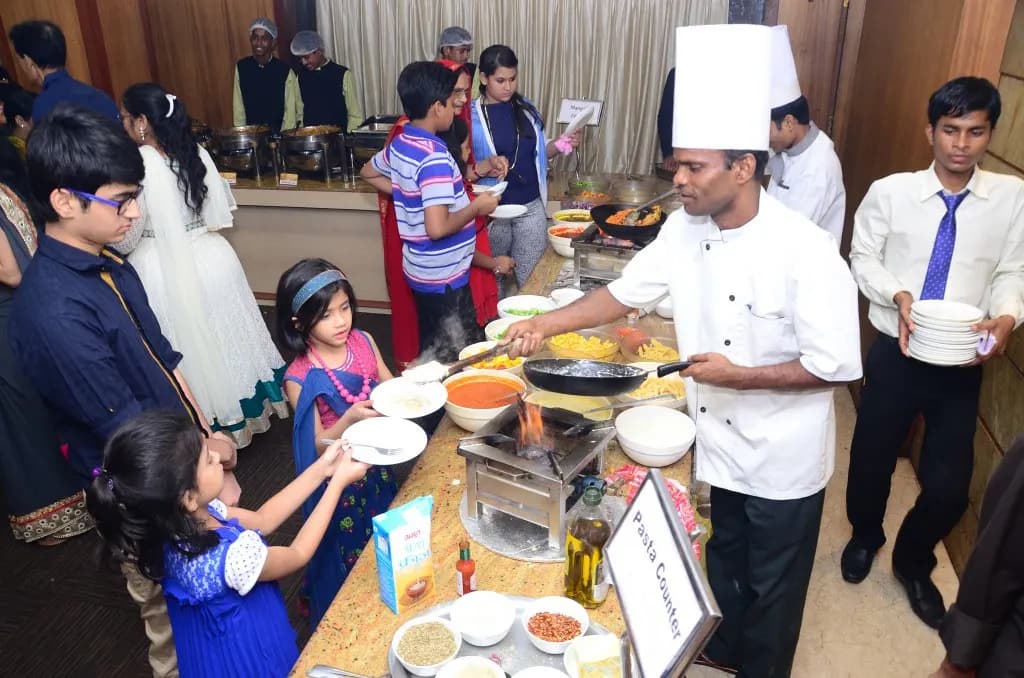
Outdoor catering sits under heading 9963 in Notification 11/2017-Central Tax (Rate). Since 1 October 2019, catering supplied anywhere other than a specified premises has been taxed at 5% — 2.5% CGST plus 2.5% SGST — on condition that the caterer does not take input tax credit. GST 2.0, which took effect on 22 September 2025, left this rate where it was.
- Outdoor catering for weddings, parties and corporate events — at homes, lawns, farmhouses or banquet halls: 5% (no input tax credit), with no input tax credit.
- Catering at a specified premises — a hotel where any room was supplied above ₹7,500 a day in the previous year, or one that opted in: 18% with ITC, with credit.
- Catering, including mid-day meals, supplied to a school (pre-school to higher secondary): exempt.
From 1 April 2025, Notification 05/2025 defines a specified premises by the actual value of hotel rooms supplied in the preceding financial year, or by a declaration the hotel files. A caterer cannot declare its own kitchen or a client's lawn a specified premises, and advance rulings have held that a caterer outside such premises cannot simply charge 18% to claim credit on equipment. The practical result: your GST on purchases — vessels, chafing dishes, LPG, vehicle repairs — is a cost, so build it into your prices.
When to register. Catering is a service, so the registration threshold is ₹20 lakh of aggregate turnover in most states (₹10 lakh in special-category states). Many corporate and institutional clients will only deal with a registered caterer, so you may register earlier by choice. Once registered, you charge 5% on every bill, including the advance, and file monthly or quarterly returns.
Composition option. Food-service suppliers can opt for the composition scheme up to ₹1.5 crore of turnover and pay 5% of turnover with simpler returns. Since the regular rate is also 5% without credit, the gain is mainly lighter paperwork, but you can't issue tax invoices or collect GST separately from clients — a drawback with corporate buyers. Discuss it with your CA; our GST on food guide explains the restaurant and catering entries in detail.
TDS on contracts. Companies, firms and other businesses that hire you for events must deduct TDS on contract payments — 1% if you are an individual or HUF, 2% for a firm or company — once a single bill crosses ₹30,000 or the year's total crosses ₹1,00,000. From 1 April 2026 this rule sits in section 393 of the Income-tax Act 2025 (formerly section 194C). Ask clients for Form 16A-type certificates and claim the credit in your return; see what is TDS.
How a catering order runs
- 1
Enquiry and tasting
Confirm date, venue, guest count and budget; invite the client for a tasting of two or three dishes from the package.
- 2
Quote and contract
Send a written quote with menu, minimum guaranteed plates, per-plate rate, GST, inclusions (staff, crockery, transport) and cancellation terms.
Tip: Take 30–50% advance to fund purchases.
- 3
Purchase and prep
Buy fresh produce two days before, dry goods earlier; marinate and pre-cut in the licensed kitchen.
- 4
Event day
Load vessels and staff, cook main dishes on site, run counters, and keep a head count at the entrance.
- 5
Settle and review
Collect the balance against the final count within a week, record wastage and leftovers, and ask for a review and photos.
Staffing a catering business
Catering labour has two layers. The permanent team — a head cook, two or three assistant cooks, a store-keeper or helper and an event supervisor — preps in the kitchen every day and is paid monthly. The event-day team — waiters, counter staff, dishwashers and loaders — is hired per event, usually through a labour contractor or a pool of regulars, and paid per event.
A workable planning ratio for a seated or buffet wedding is one waiter or counter person for every 20–25 guests, one cook for every 100–150 guests on the main dishes, plus a helper per live counter and two to four cleaners. For 250 guests that means 10–12 waiters, two or three cooks on site, and four to six helpers — at ₹600–₹900 per head per event in most tier-2 cities, by our estimate. Confirm local rates before you quote.
The four Labour Codes, in force since 21 November 2025, now govern wages, social security and contract labour. Pay at least your state's minimum wage for the skill level, keep attendance and payment records for event staff, and register for ESI and EPF once your headcount crosses the thresholds. If you hire event staff through a contractor, check that the contractor pays them properly — as the principal employer you can be held responsible if they don't. Our Delhi and Uttar Pradesh minimum wage guides show how state rates are set.
Worked example: monthly P&L and break-even
Here's a sample plan for "Annapurna Caterers", an outdoor caterer with a rented 800 sq ft central kitchen in a tier-2 city. All figures are illustrative estimates.
Revenue assumption: 12 events a month averaging 250 plates = 3,000 plates at an average of ₹300 a plate (veg wedding and party menus) = ₹9,00,000 a month before GST.
Variable cost per plate: food ₹125, disposables and crockery washing ₹15, fuel ₹10, event-day staff ₹25, transport ₹7 = ₹182. Contribution per plate = ₹118 (about 39%).
| Fixed monthly cost | Amount (estimate) |
|---|---|
| Kitchen rent (800 sq ft) | ₹35,000 |
| Permanent staff: head cook, two assistant cooks, helper, supervisor | ₹1,11,000 |
| Electricity and water | ₹12,000 |
| Vehicle running and maintenance | ₹25,000 |
| Marketing (Google listing, Instagram, wedding portals, tastings) | ₹10,000 |
| Phone, billing, accountant, FSSAI fee | ₹6,000 |
| Equipment repair and replacement reserve | ₹8,000 |
| Loan EMI (₹10 lakh, 10%, 5 years) | ₹21,000 |
| Owner's salary | ₹40,000 |
| Total fixed costs | ₹2,68,000 |
- Monthly contribution = 3,000 × ₹118 = ₹3,54,000
- Profit after the owner's salary = ₹3,54,000 − ₹2,68,000 = about ₹86,000 a month
- Break-even = ₹2,68,000 ÷ ₹118 = about 2,270 plates a month, or roughly nine 250-guest events
That's a peak-season month. In the off-season — the monsoon months and periods with few wedding dates in your region — bookings can fall to four or five events, and the same fixed costs produce a loss of ₹1–1.5 lakh. That is why the working capital line matters, and why many caterers add an office-lunch or hostel contract that pays the kitchen rent all year. Every ₹10 of food cost you save per plate adds ₹30,000 a month at this volume; every 10% of guests who don't turn up without a minimum guarantee costs you the food for 300 plates.
Try it — catering break-even
Funding a catering business
- Mudra — collateral-free loans up to ₹10 lakh under Tarun (Tarun Plus up to ₹20 lakh for repeat borrowers who repaid on time). Suits equipment and working capital. See the Mudra loan guide.
- PMEGP — catering is a service activity, so projects up to ₹20 lakh qualify. The margin-money subsidy ranges from 15% (urban, general) to 35% (rural, special categories such as women and SC/ST), and you contribute 10% or 5%. See the PMEGP guide.
- Stand-Up India — for women and SC/ST founders of a first enterprise, loans from ₹10 lakh to ₹1 crore; suits a larger kitchen with a vehicle.
- CGTMSE cover — banks can lend to micro enterprises without collateral under the CGTMSE scheme, for a guarantee fee.
Our worked plan needs about ₹18.8 lakh: ₹8.8 lakh of savings and a ₹10 lakh loan. Hiring a vehicle instead of buying one cuts the project to about ₹14.3 lakh and brings it within PMEGP's service ceiling with room to spare. Banks will ask for your plan, quotes for the equipment, the FSSAI licence or application, and evidence of past orders — photos, client references and bank statements from home catering help a first-time applicant.
Catering business plan template
Tick off each line as you write your plan; the business plan generator can turn it into a document for your bank.
Fill-in catering business plan
0/12Mistakes that sink new caterers
- Quoting without a minimum guarantee. If the client books 400 plates and 300 people turn up, you've paid for 100 plates of food. Fix a minimum, and bill extras at the per-plate rate.
- Applying for the wrong FSSAI category. A basic registration filed as a "restaurant" or "home kitchen" does not cover event catering. Choose "caterer" and take the state licence.
- Forgetting that GST credit is gone. At 5% without ITC, the 18% GST on your chafing dishes and the GST on LPG are costs. Price them in rather than discovering them at year end.
- Under-costing event-day labour and transport. Waiters' travel, meals, late-night returns and a second vehicle trip often add ₹10–15 a plate.
- No written contract. Verbal bookings lead to disputes over menu changes, extra guests, breakage and cancellation. Use a one-page agreement every time.
- Running out of cash in the off-season. Plan for three lean months a year; take institutional work or office lunches to keep your team busy.
Official links
- FoSCoS — FSSAI licensing portalApply for a state licence as 'caterer'
- FoSCoS kind-of-business eligibility (updated 1 April 2026)Caterer row: state / central licence
- Notification 05/2025-Central Tax (Rate)Specified premises definition
- GST portalRegistration and returns
- Udyam Registration portalFree MSME registration
- PMEGP e-portal (KVIC)Apply for PMEGP
What to do next
Cost your top two packages dish by dish in the food cost calculator, then plug your kitchen rent, permanent staff and EMI into the break-even calculator to see how many plates and events you need each month. Apply for your FSSAI state licence on FoSCoS before the first paid event, register on Udyam, and send your first quotes from the quotation generator so every booking starts with clear terms.
This is general information, not legal or tax advice — confirm on the official source or with a professional.
Frequently asked questions
Our estimate for an outdoor caterer with a rented central kitchen in a tier-2 city, serving events of 100–500 guests, is about ₹9 lakh to ₹29 lakh. The biggest swing items are a delivery vehicle, serving equipment and working capital. A home-based caterer taking small party orders can start with roughly ₹50,000 to ₹2 lakh. Treat these as estimates and replace each line with local quotes.
FSSAI's kind-of-business list, updated on 1 April 2026, has no basic-registration option for the 'caterer' category. A caterer with turnover up to ₹50 crore needs a state licence, with a fee of ₹5,000 a year, and a central licence above that. Apply on FoSCoS before your first paid event; licences now have perpetual validity but the annual fee continues.
Outdoor catering for weddings, parties and corporate events is taxed at 5% (no input tax credit), the same as restaurant service. Only catering supplied at a specified premises — a hotel that charged more than ₹7,500 a day for any room in the previous year, or one that opted in — is taxed at 18% with ITC. A caterer cannot choose 18% just to claim input tax credit.
Cost the menu by ingredient weight for the guest count, add disposables or crockery washing, fuel, event-day waiters and helpers, and transport, then divide by plates. Add your share of fixed costs — kitchen rent, permanent cooks and loan EMI — and a margin. In our worked example a ₹300 veg wedding plate costs about ₹182 in variable costs.
It can be, because you buy ingredients only after an order and take an advance. The risk is seasonality: wedding muhurats, festivals and the off-season swing bookings sharply. In our example a caterer doing 12 events of 250 plates a month earns about ₹86,000 after paying the owner ₹40,000, and breaks even at roughly 2,270 plates a month.
Yes, many caterers begin by cooking for small parties and offices from home. You still need an FSSAI state licence for catering, and your home kitchen becomes the licensed premises, so it must meet FSSAI hygiene conditions. Check your housing society and local municipal rules on commercial use, and move to a rented kitchen once orders regularly exceed what your kitchen and gas supply can handle.
Sources & verification
Figures on this page were checked against the sources below when it was last reviewed on 7 October 2026. Each rate and limit is stored once with its own official source and review date, and official update channels are monitored daily so changes are picked up. How we verify
- 1.FoSCoS — Kind of Business eligibility criteria (updated 01.04.2026) — FSSAI · accessed 7 October 2026
- 2.FSSAI order dated 13 March 2026 — revised turnover thresholds — FSSAI · accessed 7 October 2026
- 3.FAQs on FSS (Licensing and Registration) Amendment Regulations, 2026 — FSSAI · accessed 7 October 2026
- 4.Notification No. 05/2025-Central Tax (Rate), 16 January 2025 — GST Council / Ministry of Finance · accessed 7 October 2026
- 5.Notification No. 11/2017-Central Tax (Rate), as amended — CBIC · accessed 7 October 2026
- 6.Recommendations of the 56th GST Council meeting (press release) — GST Council / PIB · accessed 7 October 2026
- 7.GST on Education Services (flyer) — GST Council · accessed 7 October 2026
- 8.Changes in CGST rates of various services w.e.f. 01.10.2019 — TaxGuru · accessed 7 October 2026
- 9.No option for 18% GST as outdoor catering falls under mandatory 5% entry: AAR Tamil Nadu — TaxGuru · accessed 7 October 2026
- 10.Stainless steel chafing dish listings — IndiaMART · accessed 7 October 2026
MSMETOOLS is an independent platform and is not affiliated with any government agency, ministry or department.
Tools for this
Break Even Calculator
Find your break even point and units.
Food Cost Calculator
Calculate food cost, menu pricing and profit margins.
Quotation Generator
Create professional quotes for clients.
Startup Cost Calculator
Estimate how much capital you need to launch.
Related guides
 Bakery Business Plan 2026: Costs, FSSAI, GST & ProfitRead guide
 How to Start a Cloud Kitchen in India (2026): Costs & LicencesRead guide
 Pickle Making Business 2026: FSSAI, GST, PMFME & ProfitRead guide
 Cost of Mineral Water Plant in 2026: Setup, Licences & P&LRead guide
Official links open the government site in a new tab.