 Income tax
Form 1099-K in 2026: Thresholds, Payment Apps and How to Reconcile It
Form 1099-K in 2026: the restored $20,000/200 threshold, card vs app payments, state $600 rules, and how to reconcile 1099-K totals with gross receipts.
 Edited by Sumeet YadavFounder & editor, MSMETOOLS · fact-checked against official sources
Contents (11)
- 1. What Form 1099-K is and who sends it
- 2. The 1099-K threshold in 2026: back to $20,000 and 200
- 3. Backup withholding and the August 2026 final rules
- 4. Personal payments vs business income
- 5. Worked example: reconciling 1099-Ks with gross receipts
- 6. If a 1099-K is wrong, or you shouldn't have received one
- 7. State 1099-K rules can be stricter
- 8. Paying contractors by card or app? No double reporting
- 9. Common mistakes with Form 1099-K
- 10. How the 1099-K connects to your other taxes
- 11. What to do next
Every January, a wave of small sellers, freelancers and side hustlers open an email from a marketplace or payment app that says "your Form 1099-K is ready," and then wonder why the number is so much bigger than what landed in their bank account. This guide explains what Form 1099-K reports, the threshold that applies in 2026 after the One Big Beautiful Bill Act reset it, why card payments and app payments are treated differently, how to separate personal payments from business sales, and how to reconcile the form with your gross receipts line by line. Each rule was checked against IRS pages, the Form 1099-K instructions and the August 2026 final regulations in October 2026.
Quick answer
Form 1099-K reports the gross payments you received through credit cards and through payment apps or online marketplaces in a calendar year. For apps and marketplaces, a form is required only when your payments exceed $20,000 and more than 200 transactions. Card payments you accept directly are reported at any amount. The form shows gross receipts, not profit, and not every amount on it is taxable.
The $600 rule is gone: OBBBA restored the $20,000/200 test retroactively in July 2025
Box 1a is gross, before refunds, fees, chargebacks or discounts
Business income is taxable even when no 1099-K arrives
Some states, including Massachusetts at $600 (any number of transactions), still require forms at lower amounts
Due to you by January 31; current form revision December 2026
What Form 1099-K is and who sends it
Form 1099-K, Payment Card and Third Party Network Transactions, is an information return. It doesn't calculate tax. It tells you and the IRS how much money passed through a payment system to you during the year, so the IRS can match it against what you report.
The forms are filed by payment settlement entities. There are two kinds. A merchant acquiring entity, usually a bank, settles credit, debit and stored-value card transactions for merchants. A third party settlement organization (TPSO) runs a network that settles payments between buyers and sellers who aren't related to it: payment apps, online marketplaces, ride-share and delivery platforms, and ticket resale sites. The instructions exclude healthcare networks, in-house accounts payable departments and automated clearing houses from the TPSO definition, which is why a plain ACH transfer or wire from a client doesn't produce a 1099-K.
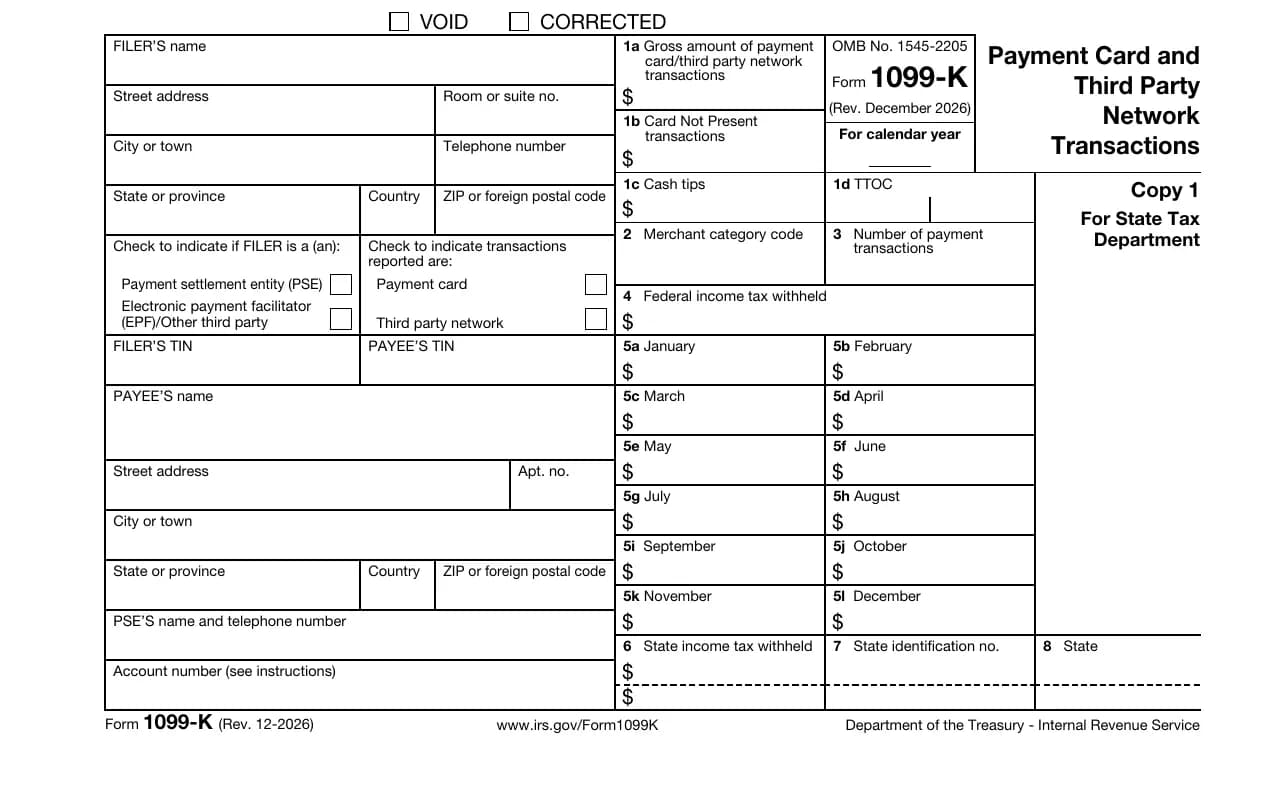
The form you receive lists the filer, your name and taxpayer identification number, the gross amount in box 1a, the "card not present" portion in box 1b (online, phone and keyed-in sales), the number of transactions in box 3, any federal backup withholding in box 4, and a month-by-month breakdown in boxes 5a to 5l. The December 2026 revision adds two boxes created by the One Big Beautiful Bill Act's tips provisions: box 1c for cash tips included in box 1a and box 1d for the Treasury tipped occupation code.
The 1099-K threshold in 2026: back to $20,000 and 200
The threshold has been one of the most confusing numbers in small-business tax, because it changed on paper several times without ever really taking effect. The American Rescue Plan Act of 2021 cut the TPSO threshold from $20,000 and 200 transactions to $600 with no transaction count. The IRS then delayed that change twice and announced a phase-down instead, with a $5,000 threshold for 2024, $2,500 for 2025 and $600 from 2026.
The One Big Beautiful Bill Act, signed on July 4, 2025, wiped that schedule out. Section 70432 restored the pre-ARPA test retroactively, as if the ARPA change had never happened, for calendar years beginning after December 31, 2021. The IRS confirmed in Fact Sheet 2025-08 (October 23, 2025) that a TPSO doesn't have to file a 1099-K for a payee unless gross payments exceed $20,000 and the number of transactions exceeds 200. Both conditions must be met. A tutor paid $30,000 in 150 app payments doesn't trigger a federal form; neither does a reseller with $15,000 across 900 sales.
How the federal 1099-K threshold changed
| Calendar year | What was planned | What applies after OBBBA |
|---|---|---|
2022–2023 | $600 under ARPA (then delayed) | $20,000 and more than 200 transactions |
2024 | $5,000 (IRS transition) | $20,000 and more than 200 transactions |
2025 | $2,500 (IRS transition) | $20,000 and more than 200 transactions |
2026 onward | $600 | $20,000 and more than 200 transactions |
Card payments (any year) | No threshold | No threshold |
2022–2023
- What was planned
$600 under ARPA (then delayed)
- What applies after OBBBA
$20,000 and more than 200 transactions
2024
- What was planned
$5,000 (IRS transition)
- What applies after OBBBA
$20,000 and more than 200 transactions
2025
- What was planned
$2,500 (IRS transition)
- What applies after OBBBA
$20,000 and more than 200 transactions
2026 onward
- What was planned
$600
- What applies after OBBBA
$20,000 and more than 200 transactions
Card payments (any year)
- What was planned
No threshold
- What applies after OBBBA
No threshold
Two things haven't changed. First, there's no threshold for payment card transactions. If customers tap or swipe a card on your terminal, or pay by card on your own website, the processor reports every dollar on a 1099-K, the IRS says, no matter how many payments you got or how much they were. Second, a platform may send you a form below the threshold. Some do so because of state rules, some because their systems are set up that way. Receiving one when you're under $20,000 isn't an error, and not receiving one when you're over doesn't excuse the income.
Backup withholding and the August 2026 final rules
A payment app that doesn't have your correct taxpayer identification number may have to withhold 24% from your payouts and send it to the IRS. That's backup withholding, and it shows up in box 4. OBBBA made a matching change to the backup withholding rules, and Treasury and the IRS published final regulations, T.D. 10053, in the Federal Register on August 10, 2026, for payments in calendar years beginning after December 31, 2024.
Under those rules, a TPSO generally doesn't backup-withhold on third party network payments until your payments in the year cross both parts of the threshold. The regulations' own example: if a seller who hasn't given a TIN receives 201 payments totalling $20,000.01, the platform withholds on the whole 201st payment and every payment after it that year. There's a catch for the following year. If any of your payments were reportable in the prior year, the platform withholds from the first dollar in the current year, even if you stay below the threshold. The simple fix is to give each platform a correct W-9 when it asks; our W-9 guide explains which name and number to use.
Personal payments vs business income
Payment apps carry a lot of money that isn't income. The IRS lists the common examples: a roommate paying you their share of rent, friends splitting a restaurant bill, a relative sending a birthday gift. These shouldn't be reported on a 1099-K and aren't taxable. When the app lets you, tag those payments as personal (often "friends and family") rather than "goods and services," which keeps them out of the platform's 1099-K total.
Is a payment on your 1099-K taxable?
Step 1
Payment for goods or services you sell, or rent you collect?
Step 2
Yes → business income
Schedule C (or E); deduct fees and refunds
Step 3
Gift or repayment of a shared personal cost?
not taxable; ask filer to correct
Step 4
Personal item sold for more than you paid?
gain on Form 8949 / Schedule D
Step 5
Personal item sold at a loss?
not taxable, not deductible; net to zero on Schedule 1 or Form 8949
Business payments are the opposite. Sales of products, fees for services, tips and rent you collect as a landlord are income whether they arrive by app, card, check or cash. The risk comes when one account handles both. A freelance photographer who uses the same payment app for client invoices and for splitting vacation costs with friends will find both in the app's transaction history, and if the business part pushes them over the threshold, the platform may simply report the whole goods-and-services total.
The fix is structural. Use a separate business profile or account for business payments, ask clients to pay as goods and services (which also gets you the app's seller protections), and keep personal transfers in a personal account. It makes the year-end reconciliation a five-minute job instead of a weekend of scrolling.
Selling your own used belongings sits in between. If you sell a couch, a bike or concert tickets through a marketplace, the proceeds may land on a 1099-K. A sale for more than you paid is a taxable gain, reported on Form 8949 and Schedule D. A sale for less than you paid isn't taxable, but the loss isn't deductible either. The IRS gives you two ways to show it: report the payment and an equal adjustment in the entry space at the top of Schedule 1 (Form 1040) so it nets to zero, or report the sale and the loss on Form 8949. If you do this regularly to make money, buying items to resell, it's a business and belongs on Schedule C.

Worked example: reconciling 1099-Ks with gross receipts
Dana runs a one-person ceramics business in Ohio as a sole proprietor. In 2026 she sells through an online marketplace, takes cards on a mobile reader at craft fairs, accepts some payments through a payment app, and takes a little cash. Here's what arrives in January and how it ties to her return.
| Channel | 1099-K? | Box 1a / gross | Refunds | Platform / card fees |
|---|---|---|---|---|
| Online marketplace (612 orders) | Yes, over $20,000 and 200 | $46,800 (incl. $3,900 shipping charged to buyers) | $1,100 | $5,600 |
| Card reader at craft fairs (140 sales) | Yes, card payments have no threshold | $8,450 | $0 | $250 |
| Payment app, business profile (90 payments) | No, under both tests | $3,200 | $0 | $95 |
| Cash at fairs | No | $1,150 | $0 | $0 |
| Total | $59,600 | $1,100 | $5,945 |
Dana reports $59,600 on Schedule C line 1 as gross receipts, not just the $55,250 that appeared on her two 1099-Ks. The app and cash income are taxable without a form. She enters the $1,100 of refunds on line 2 as returns and allowances. The $5,945 of fees go on the expense lines (commissions and fees, plus merchant fees), and her actual postage of $3,700 goes under supplies or shipping, which offsets the $3,900 of shipping she collected. Her cost of clay, glaze and kiln firing goes through Part III, cost of goods sold.
The result is that the IRS sees $55,250 of 1099-K income, Dana's line 1 shows $59,600, and the difference is explained by her own records of app and cash sales. A gross receipts figure lower than the total of your 1099-Ks is what tends to trigger a matching notice. A higher one, supported by records, is normal.
The monthly boxes 5a to 5l are your best tool when the totals don't tie. Compare each month to your bank deposits from that platform: payouts will be lower by the fees and refunds, and a month that's out by a large amount usually points to a chargeback, a reserve held by the platform, or a payout that landed in the next month.
If a 1099-K is wrong, or you shouldn't have received one
Mistakes happen: personal payments tagged as business, a duplicate form from a platform migration, a shared card terminal reported under one owner's number, or a form issued to you for an account that isn't yours. The IRS's instructions are consistent. Contact the issuer, which is the company listed as "filer" in the top-left box, and ask for a corrected form, showing zero if none of it should have been reported. Keep the original form and all correspondence, and don't call the IRS to fix it, because only the filer can correct it.
Don't hold your return waiting for a correction. If the corrected form doesn't arrive in time, report the incorrect amount in the entry space at the top of Schedule 1 (Form 1040) and back it out in the same area, so the IRS sees you've accounted for the form. If the payments are yours but the TIN on the form is wrong, report the income on your return as normal and ask for a corrected form for the future.
Fixing an incorrect Form 1099-K (summary)
- 1
Identify the filer
The company named in the FILER box issued the form, and only it can correct it.
- 2
Ask for a corrected form
Explain what's wrong (personal payments, duplicate, wrong account) and ask for a corrected 1099-K, showing zero if nothing should have been reported.
Tip: Keep the original form and every email or chat transcript.
- 3
File on time anyway
If the correction doesn't arrive, report the amount in the entry space at the top of Schedule 1 (Form 1040) and back it out there, so the return accounts for the form.
- 4
Don't contact the IRS
The IRS says corrections must come from the filer, not from the IRS.
Businesses that share a terminal or sold a business mid-year have extra work. The IRS expects the person whose TIN is on the form to report the income they received and, where they collected money on behalf of someone else, to file information returns showing the amounts paid on to the other party. Keep the shared-terminal agreement or the business sale contract with your tax records.
State 1099-K rules can be stricter
OBBBA changed only the federal rule. States set their own information return requirements, and several never adopted the federal $20,000 level. Massachusetts requires TPSOs to report payments to anyone with a Massachusetts address once the year's total reaches $600 (any number of transactions), regardless of the number of transactions, using the gross amount with no adjustments. The Massachusetts DOR is explicit that its notice is not a new tax, only a record that payments were made.
Payment platforms' own published guidance lists lower state thresholds for several other states, commonly $600 for Vermont, Maryland, Virginia and the District of Columbia and $1,000 for Illinois. Those figures come from the platforms rather than state law we've verified, and states can change them, so confirm with your state revenue department. In practice, a seller in one of those states may receive a 1099-K at a much lower level than the federal rule suggests, and the copy goes to the state, not necessarily to the IRS.
Paying contractors by card or app? No double reporting
The 1099-K system also affects you as a payer. If you pay a freelancer by credit card or through a payment app's goods-and-services feature, you don't include that payment on a Form 1099-NEC. The Form 1099-MISC and 1099-NEC instructions say card and third party network payments are reported, if at all, by the payment settlement entity on Form 1099-K. Payments by check, direct bank transfer or cash still count toward the $2,000 1099-NEC threshold that applies to 2026 payments.
That makes your accounts payable records important: tag each contractor payment with its method. A freelancer you paid $1,500 by card and $1,000 by ACH only needs a 1099-NEC if the ACH portion alone reaches the threshold, and here it doesn't. Foreign freelancers paid through platforms are a separate topic; see W-8 vs W-9.
1099-K calendar
During the year
Give each platform a correct W-9; tag personal payments as personal
January 31
Platforms and card processors must furnish Form 1099-K for the prior year
End of February
Paper filing deadline for filers sending 1099-K to the IRS
March 31
Electronic filing deadline with the IRS
April 15
Individual return due; reconcile 1099-K totals with Schedule C
Common mistakes with Form 1099-K
The most expensive mistake is reporting only what's on your 1099-Ks. If your app or cash sales stay below the threshold, they're still income, and the IRS can reconstruct income from bank deposits when forms don't tell the whole story. Report all gross receipts and keep the records that show where they came from.
The second mistake is reporting the box 1a number as profit and forgetting the deductions. Platform fees, card processing charges, refunds and the shipping you paid are all legitimate offsets, but the IRS won't apply them for you. A seller who copies box 1a straight to taxable income can overpay income and self-employment tax by thousands of dollars.
The third is ignoring a form that looks wrong. An unexplained difference between 1099-K totals and your return can generate an automated notice months later. Fixing it with the issuer in February costs far less time than answering a CP2000 letter in the autumn.
The fourth is using one personal app account for everything. Mixed accounts make it hard to prove which payments were gifts, and they can push your business payments over the threshold when the platform counts everything tagged goods and services. Open a business profile and route business payments there.
Before you file: 1099-K checklist
0/8How the 1099-K connects to your other taxes
Income on a 1099-K usually flows into your self-employment tax and your quarterly estimated payments. A seller who expects to owe $1,000 or more for the year generally needs to pay estimated tax during the year; our quarterly estimated taxes guide covers the dates and the safe harbors. If you sell on a marketplace, the marketplace profit calculator shows what you actually keep per order after fees, which is the number to price from. Starting out on Etsy? See how to sell on Etsy for setting up a shop with clean records from day one.
Official links
- IRS — Understanding your Form 1099-KWho gets one and why
- IRS — What to do with Form 1099-KReporting, personal sales, errors
- IRS — Form 1099-K FAQsFact Sheet 2025-08 updates
- IRS — Instructions for Form 1099-KFor filers; box definitions
- Federal Register — T.D. 10053Backup withholding on third party network transactions
- Massachusetts DOR — 1099-K FAQsState $600 rule
What to do next
Before January, separate personal and business payment accounts, make sure each platform has a correct W-9, and export a year-to-date sales report from every channel. When the forms arrive, reconcile them against your own gross receipts using the method above rather than copying box 1a. If the numbers don't tie, start with the monthly boxes and the platform's fee and refund reports.
This is general information, not legal or tax advice — confirm on the official source or with a professional.
Frequently asked questions
For payment apps and online marketplaces (third party settlement organizations), the federal threshold is $20,000 and more than 200 transactions in a calendar year. The One Big Beautiful Bill Act restored that level retroactively in July 2025, cancelling the planned drop to $600. Payments you accept directly by credit, debit or gift card have no threshold at all, and some states, such as Massachusetts, require forms at $600 (any number of transactions).
Not automatically. The form reports gross payments, not income. Business sales are taxable, but gifts, repayments from friends for shared expenses, and personal items sold for less than you paid aren't. Equally, business income is taxable even if you never receive a 1099-K, for example because you stayed under the $20,000 and more than 200 transactions app threshold.
Box 1a is the gross amount of payment transactions, with no reduction for refunds, platform fees, credits, discounts or chargebacks, and it often includes shipping you charged buyers. Your books show what you actually kept. Report the gross figure as gross receipts and deduct refunds, fees and shipping costs in the right places, so your return reconciles to the form.
Ask the issuer (the 'filer' named on the form) for a corrected form showing zero, and keep the original plus your correspondence. Don't wait for the correction to file. If it doesn't arrive, the IRS says to report the amount in the entry space at the top of Schedule 1 (Form 1040) for income and adjustments, which zeroes it out. Don't contact the IRS for corrections.
No. Payments made by credit card, debit card or through a payment app as a third party network transaction aren't reported on Form 1099-NEC or 1099-MISC; the card company or app is responsible for any Form 1099-K. Payments by check, ACH bank transfer or cash still count toward the $2,000 1099-NEC threshold.
Payment settlement entities must furnish Form 1099-K to payees by January 31 for the previous calendar year. They file with the IRS by the end of February on paper or by March 31 electronically. Most platforms post the form in your account dashboard, so check there in late January before you file.
Sources & verification
Figures on this page were checked against the sources below when it was last reviewed on 9 October 2026. Each rate and limit is stored once with its own official source and review date, and official update channels are monitored daily so changes are picked up. How we verify
- 1.IRS issues FAQs on Form 1099-K threshold under the One, Big, Beautiful Bill; dollar limit reverts to $20,000 (IR-2025-107) — Internal Revenue Service · accessed 9 October 2026
- 2.Understanding your Form 1099-K — Internal Revenue Service · accessed 9 October 2026
- 3.What to do with Form 1099-K — Internal Revenue Service · accessed 9 October 2026
- 4.Instructions for Form 1099-K (Rev. December 2026) — Internal Revenue Service · accessed 9 October 2026
- 5.General Instructions for Certain Information Returns — Internal Revenue Service · accessed 9 October 2026
- 6.T.D. 10053 — Backup Withholding on Third Party Network Transactions (final regulations, 2026-16269) — Federal Register / U.S. Treasury and IRS · accessed 9 October 2026
- 7.Instructions for Forms 1099-MISC and 1099-NEC — Internal Revenue Service · accessed 9 October 2026
- 8.Frequently asked questions about Form 1099-K notices from third party payment processors — Massachusetts Department of Revenue · accessed 9 October 2026
- 9.KPMG TaxNewsFlash — Final regulations: backup withholding on third party network transactions — KPMG LLP · accessed 9 October 2026
MSMETOOLS is an independent platform and is not affiliated with any government agency, ministry or department.
Tools for this
Payment Processing Fee Calculator
Calculate Stripe, PayPal, Square and gateway fees.
Marketplace Profit Calculator
Profit after Amazon, Etsy, Shopify and Flipkart fees.
Federal Tax Calculator (US)
Estimate federal income tax for individuals and businesses.
Related guides
 Small Business Tax Deductions & Filing Guide 2026 (US)Read guide
 What Is a W-9 Form? 2026 Guide: Who Needs It & How to Fill ItRead guide
 How to File Quarterly Taxes in 2026: Dates & Safe HarborRead guide
 Form 2553 S Corp Election (2026): Deadline & Late ReliefRead guide
Official links open the government site in a new tab.