 Income tax
W-8 vs W-9 Form: W-8BEN, W-8BEN-E and W-9 Explained for US Businesses in 2026
W-8 vs W-9 form for 2026: who signs a W-8BEN, W-8BEN-E or W-9, when a US business owes 30% withholding, treaty claims, Form 1042-S and 3-year validity.
 Edited by Sumeet YadavFounder & editor, MSMETOOLS · fact-checked against official sources
Contents (11)
- 1. W-8 vs W-9: the one question that decides it
- 2. The rule most guides skip: where the work is done
- 3. When a US business has to withhold 30%
- 4. How a foreign contractor fills out Form W-8BEN
- 5. W-8BEN-E: when the contractor is a company
- 6. Worked example: an Austin startup with four contractors
- 7. Validity, renewals and changes in circumstances
- 8. Filing Form 1042-S and Form 1042
- 9. Common mistakes and how to fix them
- 10. Recent changes to watch
- 11. What to do next
Hiring a designer in Manila, a developer in Kraków or an agency in London is now routine for small US businesses, and so is the onboarding email that ends with "please send a W-8BEN." This guide is for the US business doing the paying. It explains which form each payee signs (W-9, W-8BEN or W-8BEN-E), when you actually owe the IRS 30% withholding, how treaty claims work, when Form 1042-S is due, how long a W-8 stays valid, and how to handle the awkward cases: US citizens abroad, contractors who travel to the US, and people who won't sign. Every rule was checked against IRS forms, instructions and Publication 515 in October 2026.
Quick answer
Form W-9 is for US persons; the W-8 forms are for foreign persons. A US citizen, green card holder or US entity gives you a W-9 with their SSN or EIN. A foreign individual gives you a W-8BEN, and a foreign company gives you a W-8BEN-E, to certify foreign status and claim any treaty rate. You keep the form; nobody sends it to the IRS.
Foreign contractors working entirely abroad earn foreign-source income: no 30% withholding, no 1099, no 1042-S, but collect the W-8BEN anyway
Work physically done in the US is US-source: withhold 30% unless a treaty exemption is claimed (Form 8233)
Withheld tax is reported on Form 1042-S and Form 1042, due March 15
A W-8BEN is valid through the last day of the third calendar year after the year it is signed
Current revisions: W-8BEN October 2021, W-8BEN-E October 2021, W-9 March 2024
W-8 vs W-9: the one question that decides it
The whole choice turns on a single question: is the person you're paying a US person for tax purposes? If yes, they sign a W-9. If no, they sign a form from the W-8 family. Nothing else, including where the money is sent, which currency you pay in, or what the contract says, changes that answer.
A US person includes US citizens wherever they live, green card holders, individuals who meet the substantial presence test, and partnerships, corporations, LLCs, estates and trusts formed in the United States. Everyone and everything else is foreign. A US citizen freelancing from a beach in Portugal is a US person and gives you a W-9. A Portuguese citizen who moved to Austin and now meets the substantial presence test is also a US person and gives you a W-9. A Canadian living in Toronto is foreign and gives you a W-8BEN.
Within the W-8 family, the main split is between individuals and entities. The W-8BEN is for individuals, which includes sole proprietors because a sole proprietorship isn't a separate entity. The W-8BEN-E is for foreign companies, partnerships and other entities. Three less common forms cover special cases: W-8ECI for foreign persons whose income is effectively connected with a US trade or business, W-8EXP for foreign governments and tax-exempt organizations, and W-8IMY for intermediaries such as banks acting for others.
| Form W-9 | Form W-8BEN | Form W-8BEN-E | |
|---|---|---|---|
| Who signs | US citizens, resident aliens, US entities | Foreign individuals (incl. sole proprietors) | Foreign corporations, partnerships, other entities |
| Main purpose | Give the payer a correct TIN | Certify foreign status, claim treaty rate | Same, plus FATCA (chapter 4) status |
| Tax ID | SSN, ITIN or EIN (required) | US TIN or foreign TIN, only when required | US TIN, GIIN or foreign TIN, when required |
| Current revision | March 2024 | October 2021 | October 2021 |
| Payer reports on | Form 1099-NEC / 1099-MISC | Form 1042-S, only if US-source income | Form 1042-S, only if US-source income |
| How long it lasts | Until information changes | through the last day of the third calendar year after the year it is signed | Same as W-8BEN for most payees |
| Sent to the IRS? | No, payer keeps it | No, payer keeps it | No, payer keeps it |
The table hides one detail that trips up a lot of businesses: a foreign person who owns a single-member US LLC. The LLC is a disregarded entity, so for tax purposes the payee is the foreign owner, who should give you a W-8BEN (or W-8BEN-E if the owner is a company), not a W-9 in the LLC's name. Our W-9 guide covers the US side of that line in detail.
The rule most guides skip: where the work is done
Here is the fact that makes paying most foreign freelancers far simpler than people expect. Under the source rules in IRS Publication 515, pay for personal services is sourced to the place where the services are performed, regardless of where the contract was signed, where the payment is made or where the payer lives. The 30% withholding regime for nonresident aliens applies only to US-source income.
So if a graphic designer in the Philippines designs your packaging from her home office in Cebu, the fee is foreign-source income. You don't withhold 30%, you don't file a Form 1042-S, and you don't issue a Form 1099-NEC, because she isn't a US person. Your obligations are to pay the invoice, keep good records, and hold a signed W-8BEN that proves why you treated her as foreign.
The answer flips the moment work is physically performed in the United States. If that same designer flies to Chicago for a three-day brand workshop, the fee for those three days is US-source income from independent personal services, reported under income code 17, and the default rule is 30% withholding. A short trip counts. The IRS also treats a payment as US-source if its source can't be determined when you pay it, such as an advance for services not yet performed, so a large upfront deposit to someone whose work location is unclear deserves a written statement of where the work will happen.

Other kinds of payments follow different source rules, and that's where the W-8 really earns its place. Royalties are generally sourced to where the licensed property is used, so paying a foreign photographer a licence fee for images used on your US website is US-source income. Interest and dividends paid by US companies are US-source too. For these payments the 30% rate applies unless a treaty reduces it, and the treaty claim lives on the W-8BEN or W-8BEN-E.
When a US business has to withhold 30%
When you pay US-source fixed or periodic income (the IRS calls it FDAP income) to a foreign person, you are a withholding agent. That status comes with personal liability: Publication 515 says plainly that a withholding agent is liable for any tax it was required to withhold and didn't. If the foreign payee later pays the tax themselves, you're off the hook for the tax but can still owe interest and penalties.
The default rate is 30% of the gross payment, with no deduction for the contractor's expenses. It can be reduced or eliminated in three main ways:
- A tax treaty claim on the W-8BEN (Part II) or W-8BEN-E (Part III), for income such as royalties, interest and dividends.
- Form 8233, which a nonresident alien individual gives you to claim a treaty exemption on pay for independent personal services performed in the US. Publication 515 says Form 8233, not the W-8BEN, is the form for treaty claims based on independent personal services or business profits articles. It needs a US taxpayer ID, a new form each tax year, and your signed acceptance mailed to the IRS within 5 days.
- Form W-8ECI, when the income is effectively connected with the payee's own US trade or business and they will file a US return.
Publication 515 also warns that many treaty exemptions for contractors who visit the US depend on facts you can't know until the year ends, such as whether the person stays under a day-count limit (often 183 days). In those cases you may have to withhold at 30% anyway, and the contractor files Form 1040-NR to get the over-withheld tax back.
If you can't tie a payment to valid documentation, you must apply the IRS presumption rules. Depending on the facts, they can treat the payee as a US person subject to 24% backup withholding or as a foreign person subject to 30%. You can never apply a reduced treaty rate on a presumption, because treaty rates require documentation. This is why experienced payers simply don't release the first payment until a valid form is on file.
Which form, and do you withhold?
Step 1
Is the payee a US person (citizen, green card, substantial presence, US entity)?
Step 2
Yes → Form W-9
1099-NEC if paid $2,000+ in the year
Step 3
No → W-8BEN (individual) or W-8BEN-E (entity)
collect before the first payment
Step 4
Was the work performed, or the property used, in the US?
Step 5
No → foreign-source
no withholding, no 1042-S, keep the W-8
Step 6
Yes → US-source
withhold 30% unless treaty/8233/W-8ECI; file 1042-S
How a foreign contractor fills out Form W-8BEN
You'll often need to walk a contractor through the form, because the W-8BEN looks more intimidating than it is. Most freelancers working from abroad need only Part I and the signature. Send them the current October 2021 revision from IRS.gov rather than an old PDF from your files.
Line 1 is the individual's own name. A foreign person who owns a disregarded entity still puts their own name here. Line 2 is country of citizenship. Line 3 is the permanent residence address in the country where they are resident for income tax purposes; the instructions bar a P.O. box, an in-care-of address or a bank's address. Line 4 is a mailing address only if it's different.
Line 5 asks for a US SSN or ITIN, but only "if required." For a typical contractor who works abroad and claims no treaty benefit, it isn't. The instructions require a US TIN mainly for partners in US partnerships, certain annuity exemptions, and some treaty claims. Line 6a is the foreign tax identifying number (FTIN) from the contractor's home country; it's required for account holders at US financial institutions, and a treaty claimant can use it instead of a US TIN. Line 6b is a checkbox for people whose country doesn't legally require them to have an FTIN. Line 8, date of birth, is mainly for financial account holders, though many payers ask for it anyway.
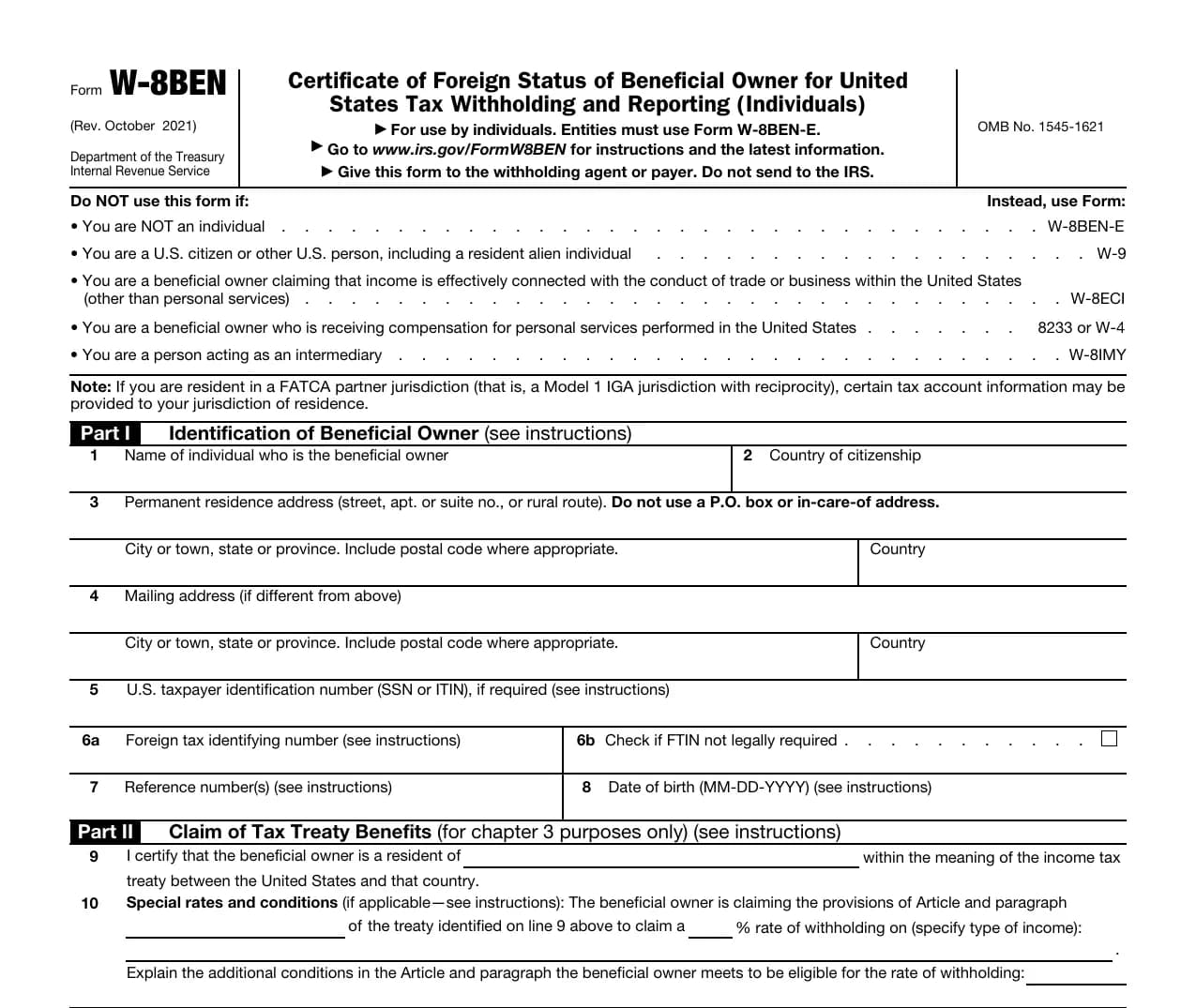
Part II is the treaty claim. Line 9 names the country of residence under the treaty. Line 10 is used only when a treaty benefit has extra conditions, such as a specific article, rate and type of income; the instructions require it for business profits not attributable to a permanent establishment, for students and researchers, and for remittance-based claims. A designer working entirely from abroad doesn't need Part II at all, because there's no US-source income to reduce.
Part III is the signature, under penalties of perjury, with the date in MM-DD-YYYY format. Electronic signatures are allowed if your system records that an authorized person signed electronically, for example with a time and date stamp; the instructions say that simply typing a name into the signature line is not an electronic signature.
W-8BEN-E: when the contractor is a company
Agencies, studios and consultancies abroad usually invoice through a company, and a company signs the W-8BEN-E. It runs to eight pages and 30 parts, which scares people, but a typical small operating business completes only a handful of lines.
Part I identifies the entity: name, country of organization, and on line 4 its chapter 3 status, which for most businesses is "corporation" or "partnership" as classified under US tax principles, not local law. Line 5 asks for the entity's chapter 4 (FATCA) status. An ordinary trading company that isn't a bank, fund or insurer is usually an active NFFE (non-financial foreign entity) and completes the short certification in Part XXV, confirming that less than half of its gross income and assets are passive. Part III is the treaty claim, which adds a limitation on benefits (LOB) check on line 14b that individuals don't face, and line 15 for special rates.
A foreign entity that's disregarded for US tax purposes generally doesn't sign its own W-8BEN-E; its owner provides the documentation instead. If you receive a W-8BEN-E with half the boxes ticked or a status that doesn't match the business you're dealing with, ask for a corrected form. You're allowed to rely on a W-8 only if you have no reason to know it's wrong.
Worked example: an Austin startup with four contractors
Here is how one small business would handle four common payees during 2026. The figures are illustrative, but the rules applied are the ones in Publication 515 and the Form 1042 instructions.
| Payee | Form | Where work is done | Fees in 2026 | Withholding | Reporting |
|---|---|---|---|---|---|
| Ana, UX designer living in Lisbon, Portuguese citizen | W-8BEN | Portugal | $24,000 | None (foreign-source) | None; keep W-8BEN |
| Kenji, consultant in Osaka, flies to Austin for a 4-day workshop | W-8BEN + Form 8233 if claiming treaty exemption | US (4 days) | $6,000 | $1,800 at 30% without a valid treaty claim | Form 1042-S (income code 17) + Form 1042 |
| A UK design studio Ltd | W-8BEN-E (active NFFE) | UK | $40,000 | None (foreign-source) | None; keep W-8BEN-E |
| Jake, US citizen developer living in Mexico City | W-9 | Mexico | $15,000 | None (valid TIN given) | Form 1099-NEC |
Ana's fees are entirely foreign-source, so the only paperwork is the W-8BEN. Nobody receives a tax form from you. Ana reports the income to the Portuguese tax authority under her own country's rules.
Kenji is the case that needs care. His $6,000 is for services performed in the US, so it's US-source. To pay him in full he must give you a Form 8233 for the year claiming a treaty exemption, with a US taxpayer ID (SSN or ITIN, or a copy of his pending ITIN application). You sign to accept it, mail a copy to the IRS within 5 days, and wait at least 10 days for any IRS objection before relying on it, so this has to start weeks before the workshop. If he doesn't, you withhold $1,800 and pay him $4,200. Because the withheld $1,800 sits between $200 and $2,000 at month end, the Form 1042 instructions require you to deposit it electronically within 15 days after the end of that month. If undeposited tax reaches $2,000 at the end of a quarter-monthly period, the deadline shrinks to three business days. You then file Form 1042-S for Kenji and the annual Form 1042 by March 15 of the following year. Either way, a Form 1042-S is filed, showing the exemption or the tax withheld.
The UK studio is a company working in the UK, so its fees are foreign-source and it documents itself on a W-8BEN-E. Jake is a US citizen, so he signs a W-9 even though he lives in Mexico, and his $15,000 is reported on Form 1099-NEC because it exceeds the $2,000 threshold for 2026 payments. His address abroad doesn't change that.
Kenji's US-performed invoice without a treaty claim
$6,000
Gross fee for 4 days in Austin
US-source, income code 17
$1,800
Withheld at 30%
deposit within 15 days after month end
$4,200
Net paid to Kenji
he can claim a refund on Form 1040-NR if a treaty applies
March 15
Form 1042-S and Form 1042 due
of the following year
Validity, renewals and changes in circumstances
A W-8BEN doesn't last forever. Under the instructions it generally remains valid from the date it's signed through the last day of the third calendar year after the year it is signed. The IRS's own example: a form signed on September 30, 2015 stayed valid through December 31, 2018. Applied to today, a form signed anytime in 2026 expires on December 31 of the third year after that. A form signed on January 2 and one signed on December 30 of the same year expire on the same day, which makes it easy to run a single renewal sweep each autumn.
The form stops being reliable earlier if a change in circumstances makes any certification wrong. The contractor must notify you within 30 days and give you a new form. Changes that count include moving to the United States, moving out of the treaty country they claimed, becoming a US citizen or resident, or starting to meet the substantial presence test (in which case they owe you a W-9 instead). A move within the same foreign country, or to another foreign country when no treaty claim depends on it, generally isn't a change in circumstances.
You also need a separate form for each withholding agent. A contractor can't hand you a copy of the W-8BEN they signed for another client; it has to be addressed to you, even if the content is identical.
Key dates for businesses paying foreign persons
Before first payment
Collect a signed W-8BEN, W-8BEN-E or W-9
Within 15 days after month end
Deposit withheld tax of $200 to under $2,000
3 business days after quarter-monthly period
Deposit if undeposited tax reaches $2,000
March 15
Form 1042-S to recipients and IRS; Form 1042 to IRS
Within 30 days of a change
Payee must give you a new form
December 31, third year after signing
W-8BEN expires; request a fresh one
Filing Form 1042-S and Form 1042
You file Forms 1042-S and 1042 only if you paid foreign persons US-source income that's subject to chapter 3 or chapter 4 reporting. A business whose foreign contractors all work abroad usually has nothing to file, which surprises owners who assumed every foreign payment needs a form.
When you do have reportable payments, Form 1042-S goes to each recipient and to the IRS by March 15 of the following year. Form 1042, the annual return that totals all your withholding, is due the same day. If you must file 10 or more information returns of any type in the year (counting 1099s and W-2s together), you must e-file. The 2026 Form 1042-S instructions add that the IRS's IRIS platform must be used to e-file 2026 Forms 1042-S, due in March 2027, because the older FIRE system is being retired after tax year 2026. Form 8809 gives an automatic 30-day extension to file 1042-S with the IRS, and Form 7004 extends Form 1042, but neither extends the time to pay.
Late deposits carry the standard failure-to-deposit penalty: 2% if 1 to 5 days late, 5% if 6 to 15 days late and 10% after that, rising to 15% if you still haven't paid 10 days after an IRS demand notice.
Common mistakes and how to fix them
The first mistake is asking a US citizen abroad for a W-8BEN. Citizenship controls, not location. If a contractor tells you they're American, get a W-9 and treat them like any other US contractor.
The second is assuming every foreign payment needs 30% withholding. Businesses that withhold on foreign-source service fees take money they had no right to withhold and leave the contractor with a refund problem that's very hard to solve from abroad. Ask where the work is performed before you withhold anything.
The third is the opposite: ignoring a contractor's US visit. Two weeks of on-site work in your office is US-source income, and without a valid Form 8233 or treaty documentation the 30% rule applies to that portion. Split the invoice by location if part of the work happens in the US.
The fourth is accepting incomplete or stale forms. An unsigned form, a P.O. box on line 3, a treaty claim without a country on line 9, or a form more than three calendar years old can't be relied on. Calendar a renewal check, and ask for a new form when an address on an invoice suddenly changes country.
The fifth is collecting forms insecurely. A W-8BEN contains a full name, address, date of birth and tax number. Use a secure portal or encrypted upload, limit access, and keep the forms for as long as you keep the related payment records.
Foreign contractor onboarding checklist
0/7Recent changes to watch
The W-8BEN and W-8BEN-E themselves haven't changed since the October 2021 revisions, which added line 6b for people with no foreign TIN and new certifications for partnership interest transfers. The IRS form pages listed no draft revisions as of October 2026. The bigger 2025–2026 changes sit around the forms. The One Big Beautiful Bill Act raised the Form 1099-NEC threshold to $2,000 for payments after December 31, 2025, which matters for the US citizens abroad who give you a W-9, and the IRS is moving 1042-S e-filing to IRIS for 2026 forms. If you also accept card or app payments from foreign customers, see our Form 1099-K guide for how platform reporting interacts with foreign status.
Official links
- IRS — About Form W-8BENCurrent form and revision
- IRS — Instructions for Form W-8BENLine-by-line rules and validity
- IRS — Instructions for Form W-8BEN-EFor foreign entities
- IRS — Publication 515Withholding on nonresident aliens and foreign entities
- IRS — Instructions for Form 1042-SReporting US-source income of foreign persons
- IRS — Instructions for Form 1042Deposit rules and annual return
- IRS — About Form W-9For US persons
What to do next
Add a status question to your contractor onboarding: "Are you a US citizen, green card holder or US resident?" Route yes answers to a W-9 and no answers to a W-8BEN or W-8BEN-E, and ask every foreign contractor where they'll do the work. For US contractors, our W-9 guide and 1099 vs W-2 guide cover reporting and classification. Paying in another currency? The currency converter helps you record invoices in dollars consistently.
This is general information, not legal or tax advice — confirm on the official source or with a professional.
Frequently asked questions
Form W-9 is signed by US persons (citizens, resident aliens and US entities) to give a payer their taxpayer identification number for 1099 reporting. The W-8 series is signed by foreign persons to certify that they are not US persons: individuals use Form W-8BEN and entities use Form W-8BEN-E. A W-8 can also claim a reduced tax treaty rate. Neither form is sent to the IRS; the payer keeps it.
Yes, you should still collect one before the first payment. Fees for services performed entirely outside the United States are foreign-source income, so no 30% withholding, Form 1042-S or Form 1099 applies. The signed W-8BEN is your evidence that the person is foreign and why you didn't issue a 1099 or apply backup withholding. Keep it with your payment records.
Generally from the date it's signed through the last day of the third calendar year after the year it is signed. A form signed on June 1, 2026 stays valid until December 31, 2029. It becomes invalid sooner if the contractor's circumstances change, for example if they move to the United States or become a US resident, and they must tell you within 30 days.
No. A US citizen is a US person wherever they live, so they give you a Form W-9, not a W-8BEN. The same applies to green card holders and anyone who meets the substantial presence test. If a US citizen contractor living abroad earns $2,000 or more from you in 2026, you issue a Form 1099-NEC as you would for a contractor in the US.
Usually not for a contractor who works abroad and claims no treaty benefit. Line 5 asks for an SSN or ITIN only where required, mainly for certain treaty claims and partnership situations. A person claiming treaty benefits generally needs either a US TIN on line 5 or a foreign tax ID on line 6a. Many foreign freelancers simply enter their home-country tax number on line 6a.
Without valid documentation you have to apply the IRS presumption rules, which can treat the payee as a US person subject to 24% backup withholding, or as a foreign person subject to 30% withholding on US-source income. As the withholding agent you are personally liable for tax you should have withheld, so most businesses don't pay until the form arrives.
Sources & verification
Figures on this page were checked against the sources below when it was last reviewed on 9 October 2026. Each rate and limit is stored once with its own official source and review date, and official update channels are monitored daily so changes are picked up. How we verify
- 1.About Form W-8 BEN, Certificate of Foreign Status of Beneficial Owner for United States Tax Withholding and Reporting (Individuals) — Internal Revenue Service · accessed 9 October 2026
- 2.Instructions for Form W-8BEN (Rev. October 2021) — Internal Revenue Service · accessed 9 October 2026
- 3.About Form W-8 BEN-E and Instructions for Form W-8BEN-E (10/2021) — Internal Revenue Service · accessed 9 October 2026
- 4.Publication 515 (2026), Withholding of Tax on Nonresident Aliens and Foreign Entities — Internal Revenue Service · accessed 9 October 2026
- 5.Instructions for Form 1042 (2025) — Internal Revenue Service · accessed 9 October 2026
- 6.Instructions for Form 1042-S (2026) — Internal Revenue Service · accessed 9 October 2026
- 7.NRA withholding — Internal Revenue Service · accessed 9 October 2026
- 8.Form W-9 (Rev. March 2024) and Instructions for the Requester of Form W-9 — Internal Revenue Service · accessed 9 October 2026
- 9.Instructions for Form 8233 — Internal Revenue Service · accessed 9 October 2026
- 10.Reporting payments to independent contractors — Internal Revenue Service · accessed 9 October 2026
MSMETOOLS is an independent platform and is not affiliated with any government agency, ministry or department.
Tools for this
Invoice Generator
Create professional invoices with tax, logo and custom details.
Currency Converter
Convert between 180+ currencies with live exchange rates.
Freelance Hourly Rate Calculator
Work out the hourly rate you need to charge.
Related guides
 What Is a W-9 Form? 2026 Guide: Who Needs It & How to Fill ItRead guide
 1099 vs W-2 in 2026: Contractor or Employee? Tests & TaxesRead guide
 Form 1099-K (2026): $20,000 Threshold, Apps & ReportingRead guide
 How to File Quarterly Taxes in 2026: Dates & Safe HarborRead guide
Official links open the government site in a new tab.