 Income tax
What Is a W-9 Form? Who Asks for It and How to Fill It Out in 2026
What a W-9 form is in 2026: who asks for it, how to fill each line of the March 2024 revision, 24% backup withholding, new 1099 thresholds and safe sending.
 Edited by Sumeet YadavFounder & editor, MSMETOOLS · fact-checked against official sources
Contents (10)
- 1. What is a W-9 form?
- 2. Who asks for a W-9, and when
- 3. W-9 vs W-2 vs 1099 vs W-8BEN
- 4. How to fill out a W-9, line by line
- 5. Backup withholding: the 24% that kicks in without a W-9
- 6. The W-9 and the new 1099 thresholds
- 7. W-9 vs W-8BEN: foreign contractors
- 8. Is it safe to send a W-9? Security tips
- 9. Common W-9 mistakes
- 10. What to do next
The first time a new client asks you for a "W-9 before we can pay you," it can feel like a strange request for your Social Security number. It's routine, and it's how US tax reporting works. This guide explains what Form W-9 is, who asks for it and why, how to fill out each line of the current revision, what backup withholding means, how the form ties into the new 1099 thresholds in 2026, when a foreign contractor should use a W-8BEN instead, and how to send it without exposing your identity. All details were checked against IRS forms and pages in October 2026.
Quick answer
Form W-9 (Request for Taxpayer Identification Number and Certification) is a one-page IRS form a US person or business fills out to give a payer their legal name, tax classification, address and taxpayer identification number (SSN or EIN). The payer keeps it and uses it to file 1099 information returns. You don't send it to the IRS.
Current version: Rev. March 2024, which added line 3b for foreign partners
Without a valid TIN, payers must withhold 24% of payments (backup withholding)
1099-NEC reporting threshold for 2026 payments: $2,000 (was $600)
Foreign persons use Form W-8BEN or W-8BEN-E, not a W-9
Send it through an encrypted portal or secure upload, never plain email
What is a W-9 form?
Form W-9 is an IRS form that collects the information a business needs to report payments it makes to you. Its full title is Request for Taxpayer Identification Number and Certification. When you sign it, you certify under penalties of perjury that:
- The taxpayer identification number (TIN) you gave is correct, or you're waiting for one.
- You're not subject to backup withholding (or you cross this item out if the IRS has told you that you are).
- You're a US citizen or other US person.
- Any FATCA exemption code you entered is correct.
The W-9 is not a tax return and doesn't calculate any tax. It's an information-gathering form: the payer keeps it on file and uses it to prepare information returns such as Form 1099-NEC or 1099-MISC, which go to you and to the IRS. The IRS says the form is also used for real estate transactions, mortgage interest you paid, the acquisition or abandonment of secured property, cancellation of debt and IRA contributions.
Who asks for a W-9, and when
You'll most often get a W-9 request when you're about to be paid as a non-employee. Common requesters:
- Clients of freelancers, contractors and consultants, before the first invoice is paid
- Businesses paying rent, royalties or prizes reportable on Form 1099-MISC
- Banks and brokers opening interest-bearing or investment accounts (1099-INT, 1099-DIV, 1099-B)
- Payment platforms and marketplaces that may have to issue Form 1099-K
- Lenders and title companies in real estate or debt cancellation situations
If you run a business, the IRS recommends getting a W-9 from each independent contractor before you pay them. It's far easier to collect at onboarding than to chase in January when 1099s are due.

W-9 vs W-2 vs 1099 vs W-8BEN
People mix these forms up constantly. Here's how they fit together:
| Form | Who fills it out | Who receives it | Purpose |
|---|---|---|---|
| W-9 | A US contractor, vendor or account holder | The payer, who keeps it | Provides name, TIN and certifications |
| W-4 | An employee | The employer | Sets income tax withholding from wages |
| W-2 | The employer | The employee and the Social Security Administration | Reports wages and taxes withheld |
| 1099-NEC | The payer | The contractor and the IRS | Reports non-employee compensation |
| W-8BEN | A foreign individual | The payer, who keeps it | Certifies foreign status and treaty claims |
| W-8BEN-E | A foreign entity | The payer, who keeps it | Same, for companies |
The short version: a W-9 means you're being paid as a contractor or vendor, not an employee. If you're an employee, you fill out a W-4 and receive a W-2 instead. If a company asks for a W-9 but sets your hours, tools and methods like an employee, the classification may be wrong; see the IRS's worker classification guidance.
How to fill out a W-9, line by line
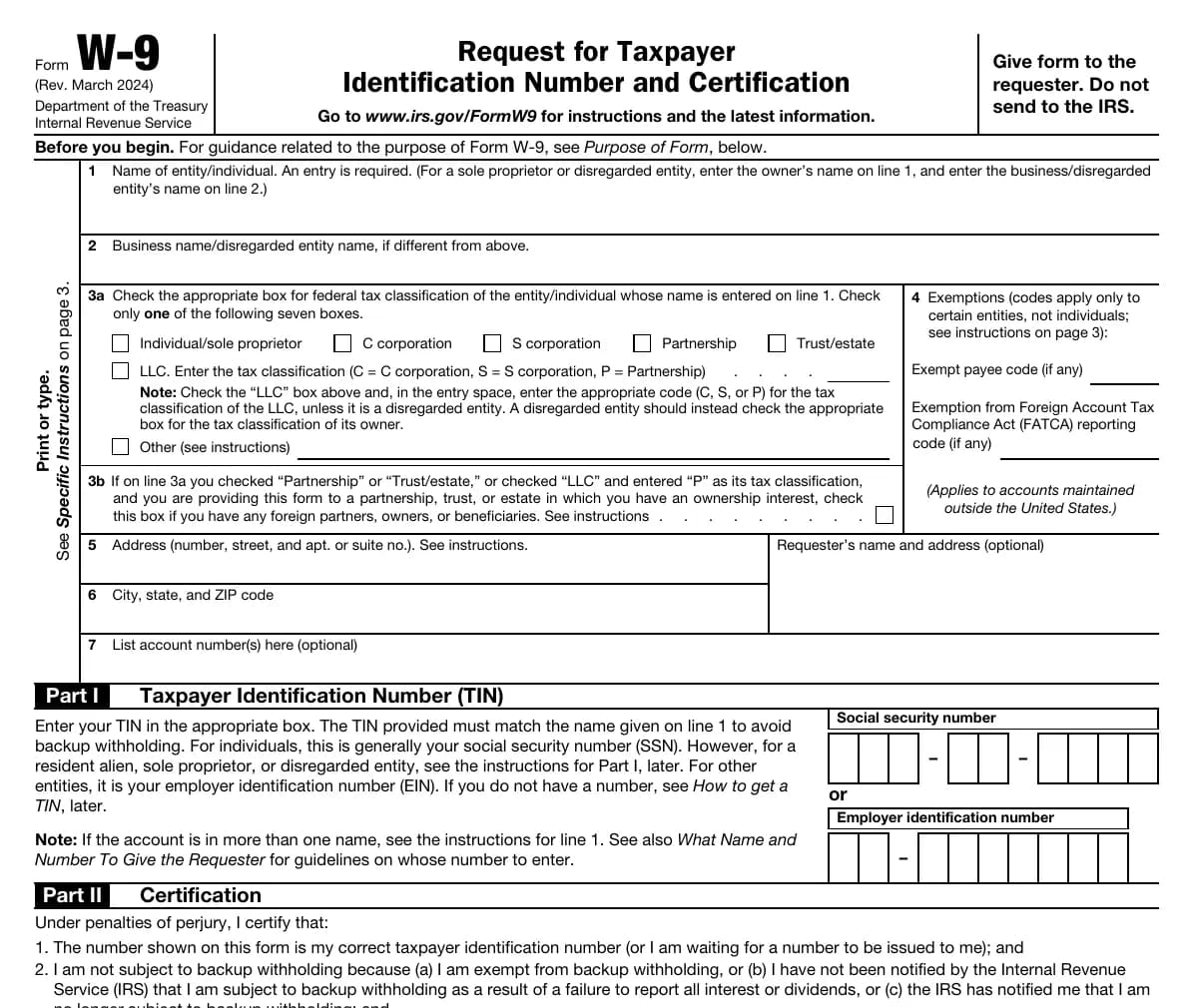
The current form is Rev. March 2024. Download it from IRS.gov rather than using an old copy a client attached, so you have the version with line 3b.
Completing Form W-9
- 1
Line 1 — Name
Required. Enter the name on your tax return. Sole proprietors and single-member LLCs that are disregarded entities enter the owner's name here, not the business name.
- 2
Line 2 — Business name
Your business name, trade name, DBA or disregarded entity name, if it's different from line 1. Leave blank if not.
- 3
Line 3a — Federal tax classification
Check one of seven boxes: individual/sole proprietor, C corporation, S corporation, partnership, trust/estate, LLC or other. An LLC taxed as a corporation or partnership checks LLC and writes C, S or P. A disregarded single-member LLC checks the box for its owner (usually individual/sole proprietor).
Tip: If your LLC has elected S corp status, check LLC and enter S.
- 4
Line 3b — Foreign partners (new)
Only for partnerships, trusts/estates and LLCs taxed as partnerships that are giving the W-9 to another flow-through entity they own part of. Check the box if you have any direct or indirect foreign partners, owners or beneficiaries.
- 5
Line 4 — Exemptions
Most individuals and small businesses leave this blank. Exempt payee codes are for organizations such as tax-exempt entities, governments and some corporations; FATCA codes apply only to accounts held outside the US.
- 6
Lines 5 and 6 — Address
The mailing address where you want to receive your 1099. Use the address the IRS has for you.
- 7
Line 7 — Account numbers (optional)
Only if the requester needs to match the form to specific accounts.
- 8
Part I — Taxpayer identification number
Enter an SSN or an EIN, and make sure it matches the name on line 1. Individuals use an SSN (or ITIN if not eligible for one); entities use an EIN.
- 9
Part II — Sign and date
Sign as a US person. Cross out item 2 only if the IRS has notified you that you're currently subject to backup withholding for underreporting interest or dividends.
Which TIN goes on the form?
| You are… | Name on line 1 | TIN in Part I |
|---|---|---|
| Freelancer or sole proprietor, no EIN | Your name | Your SSN |
| Sole proprietor with an EIN | Your name (business on line 2) | SSN or EIN |
| Single-member LLC (disregarded) | Owner's name (LLC on line 2) | Owner's SSN, or owner's EIN if they have one |
| LLC taxed as a partnership or corporation | LLC's legal name | LLC's EIN |
| Corporation (C or S) | Corporation's name | Corporation's EIN |
| Resident alien not eligible for an SSN | Your name | Your ITIN |
Don't have a number yet? Apply, write "Applied For" in Part I, and sign. For interest, dividends and certain readily tradable instruments, you generally have 60 days to provide the TIN before backup withholding starts; for other payments, like contractor fees, withholding can apply until you provide it. Getting an EIN is free and usually instant online; see our EIN guide.
Backup withholding: the 24% that kicks in without a W-9
Backup withholding is the IRS's enforcement tool for missing or wrong TINs. A payer must withhold 24% of reportable payments when:
- You don't give a TIN, or you give one the IRS says is incorrect
- The IRS notifies the payer that you underreported interest or dividends
- You don't certify that you're exempt from backup withholding, where certification is required
It can apply to most payments reported on 1099s and W-2G, including contractor fees, interest, dividends, broker proceeds and gambling winnings. It isn't an extra tax: you claim the amount as federal income tax withheld on your return. But it ties up cash. On a $5,000 invoice, a client applying backup withholding would send you $3,800 and pay $1,200 to the IRS.
To stop it, fix the cause: give the payer a correct, signed W-9 or resolve the underreporting with the IRS.
Penalties tied to the W-9
- $50 for each failure to give a requester your correct TIN, unless it's due to reasonable cause
- $500 civil penalty for a false statement with no reasonable basis that results in no backup withholding
- Criminal penalties for willfully falsifying certifications
- Requesters who misuse or disclose TINs in violation of federal law can face civil and criminal penalties too
The W-9 and the new 1099 thresholds
The One Big Beautiful Bill Act (OBBBA), signed in July 2025, changed the reporting thresholds that decide whether a payer must issue a 1099 based on your W-9:
1099 reporting thresholds before and after OBBBA
| Form | Payments through 2025 | Payments in 2026 | Notes |
|---|---|---|---|
1099-NEC (contractor pay) | $600 | $2,000 | May be indexed for inflation from 2027 |
1099-MISC (rents, royalties, other) | $600 for most boxes | $2,000 for those boxes | Same OBBBA change |
1099-K (payment apps, marketplaces) | $20,000 and 200 transactions | $20,000 and more than 200 transactions | OBBBA restored the old threshold retroactively |
1099-NEC (contractor pay)
- Payments through 2025
$600
- Payments in 2026
$2,000
- Notes
May be indexed for inflation from 2027
1099-MISC (rents, royalties, other)
- Payments through 2025
$600 for most boxes
- Payments in 2026
$2,000 for those boxes
- Notes
Same OBBBA change
1099-K (payment apps, marketplaces)
- Payments through 2025
$20,000 and 200 transactions
- Payments in 2026
$20,000 and more than 200 transactions
- Notes
OBBBA restored the old threshold retroactively
Two practical points:
- Payers still collect W-9s from everyone. A payer can't know at onboarding whether a contractor will cross $2,000 in the year, and a signed W-9 is what protects both sides from backup withholding.
- Lower reporting doesn't mean lower tax. If you're paid $1,500 and get no 1099, the income is still taxable. Keep your own records; our invoice generator creates numbered invoices you can reconcile against payments.
For payers, Forms 1099-NEC are due to recipients and the IRS by January 31. Payments to corporations generally aren't reported on 1099-NEC, except for attorneys' fees and a few other cases.
W-9 vs W-8BEN: foreign contractors
Only US persons sign a W-9: US citizens, resident aliens, and US partnerships, corporations, LLCs, estates and trusts. If you hire a freelancer who is a nonresident alien living abroad, ask for Form W-8BEN (current revision October 2021). It certifies that they're a foreign person and lets them claim any tax treaty benefit. Foreign companies use Form W-8BEN-E.
Payments of non-employee compensation to nonresident aliens are reported on Form 1042-S rather than 1099-NEC, and withholding rules can apply. A US entity owned by a foreign person also needs care: a disregarded US LLC with a foreign owner shouldn't give a W-9 in its own right.
Is it safe to send a W-9? Security tips
A completed W-9 contains everything an identity thief wants: your name, address and SSN or EIN. Before you send one:
Before you send a W-9
0/6The W-9 instructions themselves warn about phishing: the IRS doesn't start contact with taxpayers by email or ask for PINs or passwords that way. Forward suspicious IRS-themed emails to [email protected]. If you're the business collecting W-9s, store them like any other sensitive record: limited access, encrypted storage and a retention policy.
Common W-9 mistakes
- Name and TIN don't match. Line 1 must match the name the IRS has for the number in Part I. A disregarded LLC putting the LLC's name on line 1 with the owner's SSN is the classic mismatch.
- Using an outdated form. Old revisions lack line 3b and the current classification instructions.
- Wrong LLC box. An LLC with an S election checks LLC and writes S, not the S corporation box.
- Forgetting to update. Give clients a new W-9 when your name, TIN, entity type or tax classification changes, for example after electing S corp status.
- Unsigned forms. The certification is required for many payments; an unsigned W-9 can leave the payer unable to rely on it.
Official links
- IRS — About Form W-9Download the current form
- IRS — Instructions for the Requester of Form W-9For businesses collecting W-9s
- IRS — Backup withholdingRate and how to stop it
- IRS — Instructions for Forms 1099-MISC and 1099-NECThresholds and deadlines
- IRS — About Form W-8BENFor foreign individuals
- IRS — Reporting payments to independent contractorsPayer checklist and IRIS e-filing
What to do next
If you're a freelancer, get a free EIN so you can keep your SSN off client paperwork, then keep a signed, current W-9 PDF ready to send securely. If you pay contractors, add a W-9 (or W-8BEN) to your onboarding checklist and track payments so you know who crosses $2,000 by year-end. Pricing your services? The hourly rate calculator builds self-employment tax into your rate.
This is general information, not legal or tax advice — confirm on the official source or with a professional.
Frequently asked questions
Form W-9 is how a US person gives their correct name and taxpayer identification number (SSN or EIN) to a business that has to report payments to the IRS. The business uses it to prepare information returns such as Form 1099-NEC, 1099-MISC, 1099-INT or 1099-K. It also certifies that you're a US person and whether you're subject to backup withholding.
No. You give the completed W-9 to the person or business that asked for it, and they keep it in their records. The form itself says 'Give form to the requester. Do not send to the IRS.' The requester then uses your details when filing information returns with the IRS.
If you're a sole proprietor with an EIN, the instructions let you enter either your SSN or your EIN. A single-member LLC that's a disregarded entity enters the owner's SSN, or the owner's EIN if the owner has one. An LLC taxed as a partnership or corporation, and any corporation, enters the entity's EIN. Many freelancers use an EIN to avoid handing out their SSN.
The payer generally must start backup withholding at 24% of reportable payments until you provide a correct TIN. You can also face a $50 IRS penalty for each failure to furnish your TIN, unless you have reasonable cause. Many businesses simply won't pay a new contractor until they have a signed W-9.
Not for 2026 payments. The One Big Beautiful Bill Act raised the Form 1099-NEC and 1099-MISC threshold to $2,000 for payments made after December 31, 2025, and it may be adjusted for inflation from 2027. Payments in 2025 and earlier used $600. Businesses still collect W-9s from all contractors, because they can't know in advance who will cross it in a year.
Form W-9 is only for US persons: citizens, resident aliens and US entities. Foreign individuals give a Form W-8BEN instead, to certify foreign status and claim any tax treaty benefits; foreign entities use Form W-8BEN-E. Payments to foreign contractors are generally reported on Form 1042-S, not Form 1099-NEC.
Sources & verification
Figures on this page were checked against the sources below when it was last reviewed on 7 October 2026. Each rate and limit is stored once with its own official source and review date, and official update channels are monitored daily so changes are picked up. How we verify
- 1.About Form W-9, Request for Taxpayer Identification Number and Certification — Internal Revenue Service · accessed 7 October 2026
- 2.Form W-9 (Rev. March 2024) with instructions — Internal Revenue Service · accessed 7 October 2026
- 3.Instructions for the Requester of Form W-9 — Internal Revenue Service · accessed 7 October 2026
- 4.Backup withholding — Internal Revenue Service · accessed 7 October 2026
- 5.Instructions for Forms 1099-MISC and 1099-NEC — Internal Revenue Service · accessed 7 October 2026
- 6.Form 1099-NEC and independent contractors (FAQs) — Internal Revenue Service · accessed 7 October 2026
- 7.IRS issues FAQs on Form 1099-K threshold under the One, Big, Beautiful Bill — Internal Revenue Service · accessed 7 October 2026
- 8.Reporting payments to independent contractors — Internal Revenue Service · accessed 7 October 2026
- 9.About Form W-8 BEN — Internal Revenue Service · accessed 7 October 2026
MSMETOOLS is an independent platform and is not affiliated with any government agency, ministry or department.
Tools for this
Invoice Generator
Create professional invoices with tax, logo and custom details.
Freelance Hourly Rate Calculator
Work out the hourly rate you need to charge.
Federal Tax Calculator (US)
Estimate federal income tax for individuals and businesses.
Related guides
 W-8 vs W-9 Form (2026): W-8BEN, W-8BEN-E & Who SignsRead guide
 Small Business Tax Deductions & Filing Guide 2026 (US)Read guide
 1099 vs W-2 in 2026: Contractor or Employee? Tests & TaxesRead guide
 Form 2553 S Corp Election (2026): Deadline & Late ReliefRead guide
Official links open the government site in a new tab.