 Income tax
Form 2553 S Corp Election in 2026: Deadline, Eligibility and How to File
Form 2553 S corp election for 2026: the 2 months 15 days deadline, who can elect, shareholder consents, fax numbers, late relief under Rev. Proc. 2013-30 and salary.
 Edited by Sumeet YadavFounder & editor, MSMETOOLS · fact-checked against official sources
Contents (10)
- 1. What Form 2553 does
- 2. Who can elect S corporation status
- 3. The deadline: 2 months and 15 days, counted properly
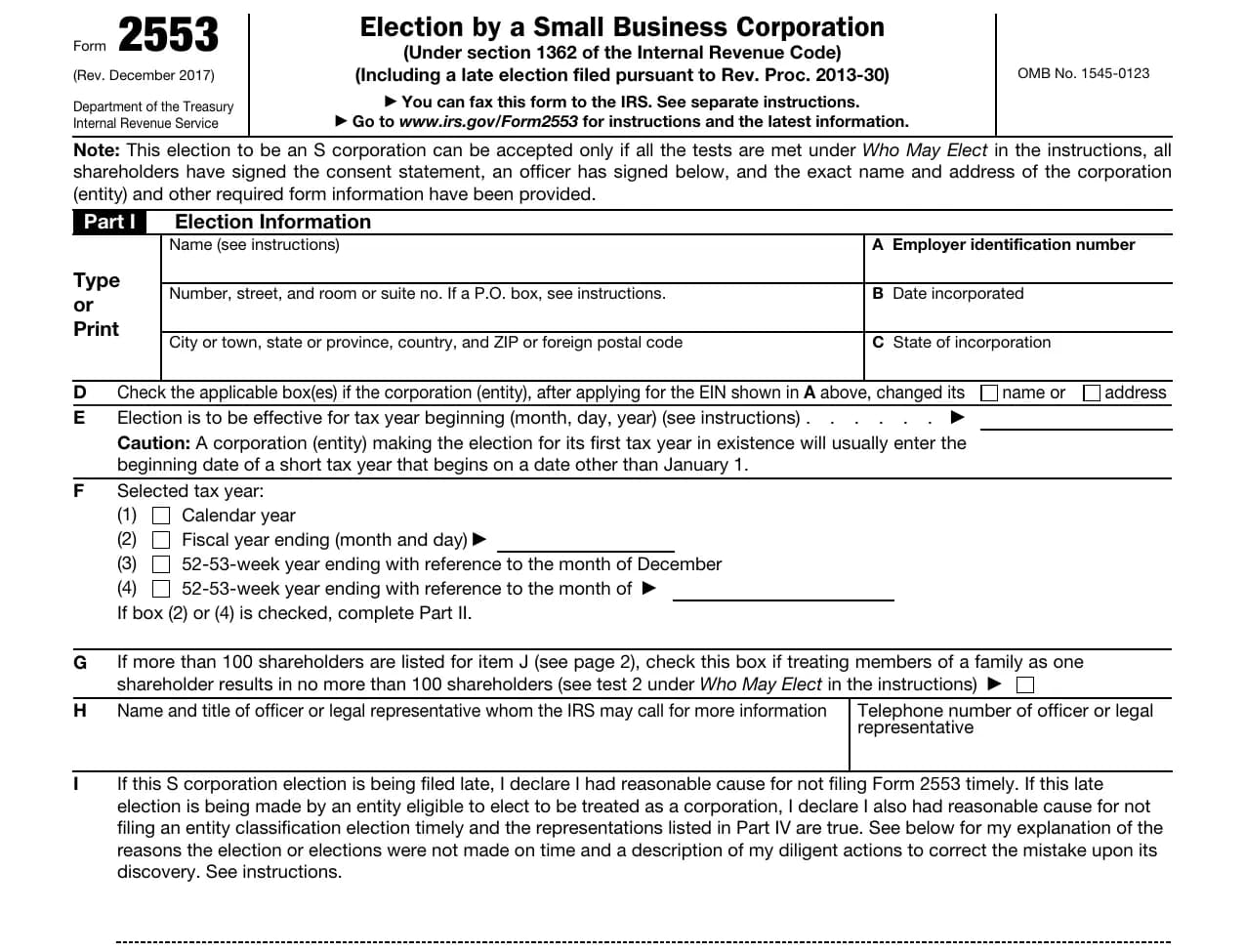
- 4. How to fill out Form 2553
- 5. Where to send it
- 6. Missed the deadline? Late election relief under Rev. Proc. 2013-30
- 7. Worked example: Priya's consulting LLC
- 8. After the election: payroll, reasonable salary and new filings
- 9. State rules and other things to check
- 10. What to do next
Electing S corporation status is the single most common tax move a profitable LLC owner makes, and it all happens on a two-page IRS form: Form 2553, Election by a Small Business Corporation. Get the timing, the consents or the signature wrong and the IRS can reject it, leaving you taxed as a sole proprietor or partnership for another year. This guide covers who can elect, how to count the "2 months and 15 days" deadline with real dates, how to fill out and send the form, what to do if you missed the deadline, and the payroll and reasonable-salary obligations that start the day the election takes effect. Everything was checked against the Form 2553 instructions and IRS pages in October 2026. If you're still deciding whether the election is worth it, start with our LLC vs S corp comparison.
Quick answer
Form 2553 is how a corporation or an eligible LLC elects to be taxed as an S corporation. File it no more than 2 months and 15 days after the start of the tax year for the election to cover that year, or any time in the year before. Every shareholder must consent and an officer must sign. Missed the deadline? Rev. Proc. 2013-30 usually lets you fix it within 3 years and 75 days.
Eligibility: domestic, no more than 100 shareholders, only allowed shareholder types, one class of stock
An LLC doesn't need a separate Form 8832; Form 2553 covers both
File by fax (855-887-7734 or 855-214-7520) or mail; expect an answer in about 60 days
Current form: Rev. December 2017; there's no online filing
Owners who work in the business must take a reasonable salary through payroll
What Form 2553 does
An S corporation isn't a type of company you register with your state. It's a federal tax status under subchapter S of the Internal Revenue Code. A corporation, or an LLC eligible to be taxed as one, elects it by filing Form 2553 under section 1362(a). Once the election is effective, the business generally doesn't pay federal income tax itself. It files Form 1120-S and passes its profit or loss through to the owners on Schedule K-1, much like a partnership.
The reason owners bother is payroll tax. A sole proprietor or LLC member pays 15.3% self-employment tax on 92.35% of net earnings. An S corporation owner who works in the business is an employee: they pay Social Security and Medicare tax only on the salary the company pays them, and the rest of the profit can come out as distributions that carry no payroll tax. That split is where the savings come from, and it's also why the IRS insists the salary be reasonable.
For an LLC, the Form 2553 instructions confirm that an eligible entity that meets the S corporation tests is treated as a corporation from the election's effective date and doesn't need to file Form 8832, the separate entity classification election. Your LLC keeps its state status, its operating agreement and its liability protection. Only the federal tax treatment changes.
Who can elect S corporation status
The instructions list eight tests, and the IRS's S corporation page summarizes the same rules. Your business must meet all of them on the effective date and for as long as the election lasts:
- Domestic. It must be a US corporation or a US entity eligible to be treated as a corporation.
- No more than 100 shareholders. A married couple and their estates count as one, and members of a family can be treated as one shareholder too.
- Only allowed shareholders. Individuals, estates, certain trusts, and exempt organizations under section 401(a) or 501(c)(3). Partnerships, corporations and multi-member LLCs taxed as partnerships can't own shares.
- No nonresident alien shareholders. One foreign owner without US residency disqualifies the company.
- One class of stock. All shares must carry identical rights to distributions and liquidation proceeds. Differences in voting rights alone are allowed.
- Not an ineligible corporation, such as certain banks, insurance companies or a DISC.
- A permitted tax year, usually the calendar year, unless you can establish a business purpose or make a section 444 election.
- Every shareholder consents to the election.
The one-class-of-stock rule catches many LLCs, because operating agreements often give members unequal rights to distributions or special allocations. Before filing, ask whoever drafted your agreement to check that distributions follow ownership percentages. An LLC owned through a single-member LLC can still qualify if that LLC is a disregarded entity owned by an eligible individual; the instructions say to list the owner, not the LLC, as the shareholder.
The deadline: 2 months and 15 days, counted properly
For the election to apply to a tax year, you must file Form 2553 no more than 2 months and 15 days after the start of the tax year, or at any time during the tax year before it. File after that and, without relief, the election simply takes effect the following year.
The instructions count it precisely. The 2-month period starts on the day the tax year begins and ends at the close of the day before the same date two calendar months later; if that date doesn't exist, it ends on the last day of the month. Then you add 15 days. The IRS's own examples: a calendar-year company that starts on January 7 has until March 21; an existing calendar-year company electing for next year has until March 15; a company that starts on November 8 has until January 22.
For a brand-new company, the tax year starts on the earliest of three dates: the date it first had shareholders or owners, the date it first had assets, or the date it began doing business. That's not always the date on your formation certificate. If you put money in the company bank account before the state approved your filing, the clock may have started then. A new company also can't file before its first tax year begins; an election filed too early is invalid.
Form 2553 deadlines with real dates
New LLC, first owner and assets on February 9, 2026
2-month period ends April 8; file by April 23, 2026
Existing calendar-year LLC, wants S status from January 1, 2027
File any time during 2026, or by March 15, 2027
Election intended for January 1, 2026 but never filed
Rev. Proc. 2013-30 relief available until about mid-March 2029 (3 years and 75 days)
Within 60 days of filing
IRS acceptance or rejection letter expected
March 15 following the first S year
First Form 1120-S due for a calendar-year S corporation
The safest habit is to file in the autumn for the following January. Filing during the prior year removes any doubt about when the year started, gives you time to set up payroll before the first salary payment, and leaves room to fix a rejection.
How to fill out Form 2553
The form runs four pages, but most small businesses complete only Part I. Download the current December 2017 revision from IRS.gov. There is no e-file option; the IRS takes it by fax or mail.
Completing Part I of Form 2553
- 1
Name, address and EIN (item A)
EIN application guideUse the exact legal name from your articles or certificate of formation. If you don't have an EIN yet, apply first; online EINs are issued immediately.
- 2
Items B–D — Date and state of incorporation
For an LLC, use the date the state formed it and the state of formation. Tick item D if the name or address changed since you got the EIN.
- 3
Item E — Effective date
The first day of the tax year you want S status to start. For a new company's first year, the earliest of first shareholders, first assets or first business.
Tip: The deadline is counted from this date, so pick it deliberately.
- 4
Item F — Tax year
Most small businesses tick calendar year. A fiscal year means completing Part II and possibly a business-purpose request with a user fee.
- 5
Items G–H — Shareholder count and contact
Tick G only if you're using the family-member rule to stay within 100. Item H names the officer the IRS can call.
- 6
Item I — Late election explanation
Leave blank if you're on time. If you're late, explain the reasonable cause and what you did once you found the mistake.
- 7
Officer signature
Signed and dated by the president, vice president, treasurer, chief accounting officer or another authorized officer. An LLC usually has a managing member sign with a title such as 'member' or 'manager'. An unsigned form is not timely filed.
- 8
Columns J–N — Shareholders and consents
List every shareholder with their address, shares or ownership percentage and acquisition date, SSN or EIN, and tax year end. Each one signs and dates column K, or a separate consent statement attached to the form.
Consents trip up more elections than anything else. For an election filed before the effective date, only people who own shares on the filing date must consent. For one filed on or after the effective date, everyone who owned shares at any time between the effective date and the filing date must consent, including someone who has since sold out. Spouses with a community property interest in the shares both sign, as do joint tenants and tenants in common. A minor's consent is given by a legal representative or parent. Missing one consent can invalidate the election, though the regulations allow some late consents to be cured.
Where to send it
Fax or mail the original signed form to the IRS service center for the state where your principal business is located. Faxing is faster and gives you a transmission report; if you fax, keep the original signed form with your permanent records.
| Principal business located in | Mail to | Fax |
|---|---|---|
| CT, DE, DC, GA, IL, IN, KY, ME, MD, MA, MI, NH, NJ, NY, NC, OH, PA, RI, SC, TN, VT, VA, WV, WI | Department of the Treasury, Internal Revenue Service, Kansas City, MO 64999 | 855-887-7734 |
| AL, AK, AZ, AR, CA, CO, FL, HI, ID, IA, KS, LA, MN, MS, MO, MT, NE, NV, NM, ND, OK, OR, SD, TX, UT, WA, WY | Department of the Treasury, Internal Revenue Service, Ogden, UT 84201 | 855-214-7520 |
If you mail it, use certified mail with a postmarked receipt or an IRS-designated private delivery service. The instructions list what counts as proof of filing if the IRS later says it never received the form: a certified or registered mail receipt, a copy with an IRS received or accepted stamp, or an IRS letter confirming acceptance.
The IRS says you should generally get a decision within 60 days. The acceptance notice states the effective date. If you hear nothing within 2 months of faxing or mailing (5 months if you asked for a fiscal year in box Q1), call 1-800-829-4933 rather than assuming it went through. Keep the acceptance letter forever; lenders, buyers and future accountants will ask for it.

Missed the deadline? Late election relief under Rev. Proc. 2013-30
Late S elections are so common that the IRS created a simplified fix in Rev. Proc. 2013-30, with no user fee. It covers late S corporation elections, the related trust and subsidiary elections, and a late entity classification election that was meant to take effect on the same date, which is the usual situation for an LLC.
A corporation qualifies if all of these are true: it intended to be an S corporation from the date on line E; it failed to qualify solely because Form 2553 wasn't filed on time; it had reasonable cause and acted diligently to fix the problem once discovered; Form 2553 is filed within 3 years and 75 days of the line E date; and every person who was a shareholder between that date and the filing date gives a statement that they reported their income consistently with S status. Signing column K satisfies that last requirement.
To claim relief, write "FILED PURSUANT TO REV. PROC. 2013-30" in the top margin of page 1 and explain the reasonable cause and your corrective actions on line I or an attached statement. Typical reasonable-cause explanations are that the owners relied on an adviser who failed to file, or believed the form had been filed. You can file the late election on its own, or attach it to the current Form 1120-S if all earlier 1120-S returns have been filed, in which case the 1120-S needs the heading "INCLUDES LATE ELECTION(S) FILED PURSUANT TO REV. PROC. 2013-30."
Late Form 2553: which route?
Step 1
Missed the 2 months and 15 days deadline
Step 2
Within 3 years and 75 days of the intended date, with reasonable cause
Rev. Proc. 2013-30, no fee
Step 3
Later, but 1120-S filed consistently and 6+ months passed with no IRS objection
Rev. Proc. 2013-30 exception
Step 4
Neither applies
private letter ruling (user fee) or start S status next year
There's also a route for businesses past the 3-year-and-75-day window. A corporation that meets the first three conditions can still get relief if it and all shareholders reported consistently with S status for every year, at least 6 months have passed since it filed its first Form 1120-S, and the IRS didn't raise any problem with S status within 6 months of that return being timely filed. Outside both routes, the only option is a private letter ruling, which carries a substantial user fee.
Worked example: Priya's consulting LLC
Priya is a marketing consultant in Charlotte, North Carolina, operating as a single-member LLC since 2022. In 2026 she expects about $120,000 of net profit, and a salary survey for her role and region supports a reasonable salary of around $65,000. She wants S status from January 1, 2027.
Because her LLC already exists on a calendar year, she can file Form 2553 any time during 2026 or by March 15, 2027. She files in November 2026 by fax to the Kansas City number, since North Carolina is in the eastern group, with line E as January 1, 2027, the calendar-year box ticked, and herself as sole shareholder signing both as officer (managing member) and in column K. Because she files before the effective date, only current owners must consent. The acceptance letter arrives in January.
The rough payroll tax arithmetic is the reason she's doing it. As a sole proprietor, her self-employment tax would be about $16,955: $120,000 × 92.35% × 15.3%. As an S corporation, Social Security and Medicare on a $65,000 salary total $9,945 (both halves at 15.3%), leaving the other $55,000 as distributions. That's about $7,000 less in payroll tax before costs. Against it she'll pay for a payroll service, a separate Form 1120-S, and any state fees; as an estimate, small businesses commonly spend low four figures a year on these, based on typical payroll-provider and tax-preparer pricing. Her QBI deduction will also shrink, because S corp salary isn't qualified business income. Our LLC vs S corp guide runs the full calculation, including income tax.
Priya's rough payroll tax comparison
$16,955
Self-employment tax as an LLC
$120,000 × 92.35% × 15.3%
$9,945
FICA on a $65,000 S corp salary
employee + employer halves
≈ $7,000
Payroll tax saved before costs
less payroll, 1120-S and state costs
$55,000
Paid as distributions
no Social Security or Medicare tax
After the election: payroll, reasonable salary and new filings
Once the election is effective, a working owner becomes an employee of their own company. The IRS is explicit that an S corporation must pay reasonable compensation to a shareholder-employee for services before making non-wage distributions, and it can reclassify distributions as wages if the salary is too low. Courts look at training and experience, duties, time devoted to the business, dividend history, what comparable businesses pay for similar services, compensation agreements and any formula used. The IRS also points to where gross receipts come from: profit generated by the owner's personal services points toward wages; profit from other employees or equipment supports distributions.
That salary runs through real payroll. You withhold income tax and the employee share of FICA, pay the employer share, deposit on schedule, and file Form 941 every quarter, Form 940 annually and a W-2 at year end. Our Form 941 guide explains deposit schedules, and how to pay yourself from an LLC covers salary and distributions together. Health insurance premiums the company pays for a more-than-2% shareholder are added to their W-2 wages but aren't subject to Social Security, Medicare or FUTA when paid under a qualifying plan.
The business files Form 1120-S by March 15 for a calendar year (the 15th day of the third month after year end) and gives each shareholder a Schedule K-1. Don't file Form 1120-S for any year before the election takes effect; keep filing your existing return until then.
State rules and other things to check
The federal election doesn't automatically carry over everywhere. Some states require their own S election form, and New York City doesn't recognize S status for its general corporation tax. California taxes S corporations at 1.5% of net income, with a minimum franchise tax. Check your state revenue department's rules before you assume the federal election is all you need, and register for state payroll withholding and unemployment accounts before the first salary payment.
The election stays in place until it's revoked or terminated. Revocation requires the consent of shareholders holding more than half the shares. If S status ends, the corporation generally needs IRS consent to re-elect before the fifth tax year after the termination took effect. An S corporation also loses its status automatically if it breaks an eligibility rule, for example by admitting a corporate or nonresident alien owner or issuing shares with different distribution rights, so build those limits into your operating agreement and any future investment deal.
Before you fax Form 2553
0/8Official links
- IRS — About Form 2553Current form and instructions
- IRS — Instructions for Form 2553Eligibility, deadline, late relief, consents
- IRS — Where to file Form 2553Addresses and fax numbers
- IRS — Rev. Proc. 2013-30 (IRB 2013-36)Late election relief
- IRS — S corporationsRequirements and filings
- IRS — S corporation compensationReasonable salary rules
What to do next
Decide on the effective date first, then work backward to the filing date, and line up payroll before the first salary payment. If you haven't formed the entity yet, our LLC registration guide covers the state side, and the federal tax calculator helps you model salary against distributions before you commit.
This is general information, not legal or tax advice — confirm on the official source or with a professional.
Frequently asked questions
To have the election apply to a tax year, file Form 2553 no more than 2 months and 15 days after the start of the tax year, or at any time during the tax year before. For a calendar-year business that already exists, that means by March 15. A new company counts from the date it first had shareholders, assets or began business, so a company that starts on February 9 has until April 23.
Yes. An LLC that is eligible to be taxed as a corporation can file Form 2553 directly. The Form 2553 instructions say an eligible entity that meets the tests is treated as a corporation from the election's effective date and doesn't need to file Form 8832 separately. The LLC stays an LLC under state law; only its federal tax treatment changes.
Rev. Proc. 2013-30 gives simplified relief, with no IRS user fee, if you file within 3 years and 75 days of the intended effective date, had reasonable cause, and acted diligently once you found the mistake. Write 'FILED PURSUANT TO REV. PROC. 2013-30' at the top of the form and explain the reasonable cause on line I. Otherwise the election takes effect the following year.
A corporate officer authorized to sign, such as the president or treasurer, signs the election, and every shareholder must consent in column K or on an attached consent statement. For an election filed on or after the effective date, anyone who owned shares at any point from that date until filing must consent. Spouses with community property interests both sign.
The instructions say you should generally hear within 60 days. If you haven't been notified of acceptance or non-acceptance within 2 months of faxing or mailing it (5 months if you requested a fiscal year in box Q1), call the IRS at 1-800-829-4933. Keep the acceptance letter permanently; it's your proof of S status.
If you work in the business, yes. The IRS requires an S corporation to pay a shareholder-employee reasonable compensation for their services before taking non-wage distributions. That salary runs through payroll with income tax withholding and Social Security and Medicare tax, reported on Form 941 and a W-2. Distributions labelled as dividends can be reclassified as wages if salary is unreasonably low.
Sources & verification
Figures on this page were checked against the sources below when it was last reviewed on 9 October 2026. Each rate and limit is stored once with its own official source and review date, and official update channels are monitored daily so changes are picked up. How we verify
- 1.Instructions for Form 2553 (Rev. December 2020) — Internal Revenue Service · accessed 9 October 2026
- 2.About Form 2553, Election by a Small Business Corporation — Internal Revenue Service · accessed 9 October 2026
- 3.Where to file your taxes for Form 2553 — Internal Revenue Service · accessed 9 October 2026
- 4.Rev. Proc. 2013-30 (Internal Revenue Bulletin 2013-36) — Internal Revenue Service · accessed 9 October 2026
- 5.S corporations — Internal Revenue Service · accessed 9 October 2026
- 6.S corporation compensation and medical insurance issues — Internal Revenue Service · accessed 9 October 2026
- 7.Instructions for Form 1120-S (2025) — Internal Revenue Service · accessed 9 October 2026
- 8.Form 2553 (Rev. December 2017) — Internal Revenue Service · accessed 9 October 2026
MSMETOOLS is an independent platform and is not affiliated with any government agency, ministry or department.
Tools for this
Federal Tax Calculator (US)
Estimate federal income tax for individuals and businesses.
Salary Slip Generator
Create professional salary slips in seconds.
LLC Name Checker (US)
Check business name availability in your state.
Related guides
 LLC vs S Corp 2026: Tax Savings, Salary Rules & When to ElectRead guide
 How to Pay Yourself From an LLC in 2026: Draws vs SalaryRead guide
 How to File Quarterly Taxes in 2026: Dates & Safe HarborRead guide
 Form 1099-K (2026): $20,000 Threshold, Apps & ReportingRead guide
Official links open the government site in a new tab.