 Finance & accounting
Amortization Meaning: Loan Schedules, Intangible Assets and the IRS Rules
Amortization meaning for small businesses: a $60,000 loan schedule, the 15-year Section 197 rule, startup cost write-offs and amortization vs depreciation.
 Edited by Sumeet YadavFounder & editor, MSMETOOLS · fact-checked against official sources
Contents (12)
- 1. What amortization means: two uses of one word
- 2. How a loan amortization schedule works
- 3. How loan payments are recorded and deducted
- 4. Amortization of intangible assets: what qualifies
- 5. The 15-year rule: Section 197 intangibles
- 6. Startup and organizational cost amortization
- 7. Research and software costs after the 2025 law change
- 8. Amortization vs depreciation
- 9. Book amortization under GAAP: the 10-year goodwill option
- 10. Reporting amortization on Form 4562
- 11. Common amortization mistakes and how to fix them
- 12. What to do next
If you've signed an equipment loan, bought another company or spent money getting a business off the ground, you have already met amortization, even if nobody used the word. This guide explains the amortization meaning in plain English for US small business owners. It covers both sides: how a loan amortization schedule splits each payment between interest and principal, and how you write off intangible assets such as goodwill, customer lists and startup costs under IRS rules. You'll see worked dollar examples and the forms involved, along with the places where owners most often get it wrong.
Quick answer
Amortization means spreading a cost or a debt over time in scheduled pieces. For a loan, each equal payment covers that period's interest and pays down part of the principal until the balance hits zero. For an intangible asset, you expense its cost evenly over its useful life instead of all at once.
Loan example: $60,000 at 8.5% for 5 years = $1,230.99 a month, $13,859.51 total interest
Goodwill, customer lists and non-competes bought with a business: tax amortization over 15 years (IRC §197)
Startup costs: deduct up to $5,000 in year one, amortize the rest over 180 months
Amortization = intangibles; depreciation = physical assets. Both go on Form 4562
What amortization means: two uses of one word
The word comes from the old French amortir, "to kill off," and that's a fair description of both of its business meanings. Something large is reduced to nothing in planned, regular steps.
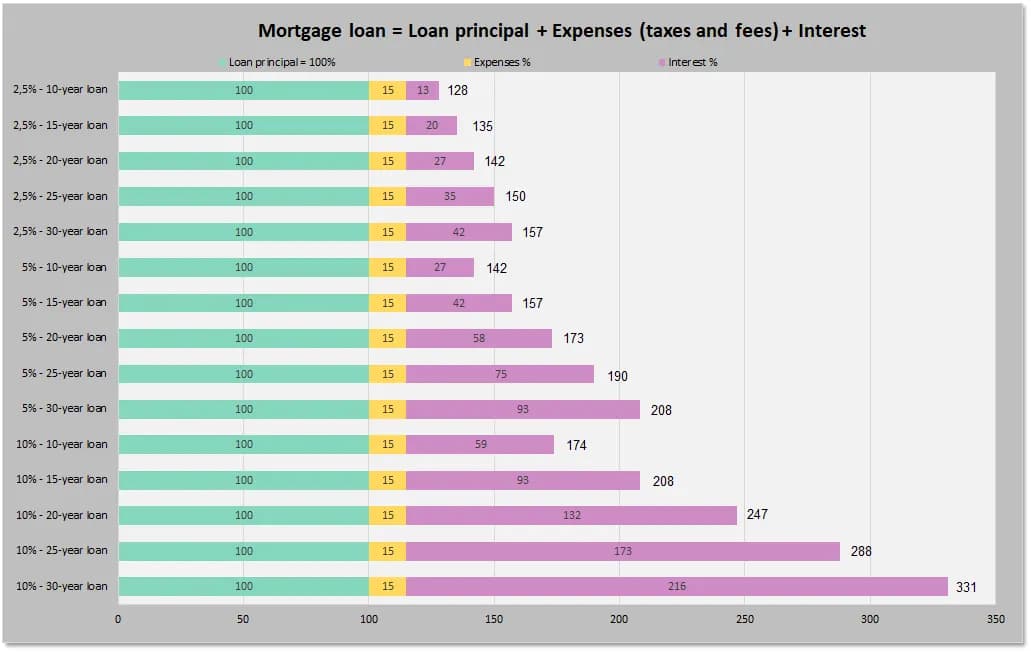
Loan amortization is the repayment side. When a lender amortizes a loan, it sets one fixed payment that, if you make it every month for the whole term, pays off the full balance plus interest exactly on the last due date. The Consumer Financial Protection Bureau describes the pattern: early payments are mostly interest because the balance is high, and later payments are mostly principal because there's little balance left to charge interest on. Most term loans work this way, including SBA 7(a) loans, equipment financing and commercial mortgages.
Asset amortization is the accounting and tax side. When you pay for something you can't touch but that will help you earn money for years, such as a franchise right, a patent, a customer list or the goodwill in a business you bought, you don't expense it all in the month you pay. You spread the cost over the asset's useful life, usually in equal amounts. That yearly slice is the amortization expense on your profit and loss statement.
The two meanings share a shape (a big number, a schedule, a declining balance) but they sit in different places in your books. Loan amortization shows up on the balance sheet as a falling liability, with only the interest hitting your income statement. Asset amortization shows up as a falling asset value on the balance sheet and as an expense on the income statement. Keep that difference in mind, because mixing them up is one of the most common bookkeeping errors in small companies.
How a loan amortization schedule works
An amortization schedule is a table with one row per payment. Each row shows the payment, the part that goes to interest, the part that goes to principal and the balance left afterward. Three numbers drive it: the amount borrowed, the interest rate and the number of payments.
The fixed monthly payment comes from the standard annuity formula:
Payment = P × r ÷ (1 − (1 + r)^−n)
where P is the loan amount, r is the monthly rate (annual rate ÷ 12) and n is the number of monthly payments. You don't need to do this by hand. Any loan calculator, including the one below, uses the same math.
Each month the split is worked out in two steps:
- Interest for the month = remaining balance × monthly rate.
- Principal repaid = fixed payment − that month's interest.
Then the new balance = old balance − principal repaid, and the process repeats. Because interest is always calculated on a shrinking balance, the interest portion falls a little every month and the principal portion rises by the same amount.
Worked example: a $60,000 equipment loan
Say a landscaping company finances a $60,000 skid steer and trailer at 8.5% a year over five years, with 60 monthly payments. The monthly rate is 0.085 ÷ 12 = 0.7083%, and the fixed payment works out to $1,230.99. Here are the first three months and the last two:
| Payment | Interest | Principal | Balance after |
|---|---|---|---|
| 1 | $425.00 | $805.99 | $59,194.01 |
| 2 | $419.29 | $811.70 | $58,382.31 |
| 3 | $413.54 | $817.45 | $57,564.86 |
| … | … | … | … |
| 59 | $17.26 | $1,213.74 | $1,222.33 |
| 60 | $8.66 | $1,222.33 | $0.00 |
Over the five years the company pays $73,859.51 in total, so $13,859.51 is interest. The yearly view shows how the mix shifts. In year one, $4,714 of the payments is interest and $10,058 is principal. By year five, interest has dropped to $658 and principal is $14,114.
Try it — monthly payment on a $60,000 equipment loan
Change the rate or the term to see how the total interest moves. Stretching the same loan to seven years lowers the payment but adds thousands in interest. A shorter term does the opposite.
Paying extra: how prepayment changes the schedule
Because interest is charged on the remaining balance, any extra principal you pay early saves interest on every month that follows. In the example above, adding $200 a month to the $1,230.99 payment clears the loan in 50 months instead of 60 and cuts total interest from about $13,860 to about $11,444, a saving of roughly $2,400. Before you prepay, read your note for a prepayment penalty. Many bank term loans don't have one, but some equipment leases and SBA loans with terms of 15 years or more do charge a fee for early payoff in the first years.
Other repayment shapes to recognize
Not every loan is fully amortizing. A balloon loan uses payments calculated as if the loan ran 20 years but makes the remaining balance due after, say, five, so you have to refinance or pay a lump sum. An interest-only period means none of your early payments reduce principal. With negative amortization, the payment is smaller than the interest, the shortfall is added to the balance and the debt grows. If you're comparing financing offers, ask each lender for the full amortization schedule. It's the clearest way to see what you'll owe and when.
How loan payments are recorded and deducted
Only part of each loan payment is a business expense. The interest is deductible as business interest. The principal is not, because it's simply returning money you borrowed. You don't deduct the equipment through the loan payments either: you recover its cost through depreciation, Section 179 or bonus depreciation, which are covered in our depreciation guide.
In the example above, the company's year-one deduction for the loan is $4,714 of interest, not the $14,772 it actually paid the bank. The other $10,058 reduces the loan liability on the balance sheet. Your bookkeeping should split every payment with the lender's schedule, or with the year-end interest statement the lender sends, rather than booking the whole payment as an expense.
Very large businesses face a cap on how much interest they can deduct under Section 163(j), but businesses whose average annual gross receipts sit at or below $32 million are exempt from that limit for 2026. The EBITDA guide explains how that cap works.
Amortization of intangible assets: what qualifies
Intangible assets are things of value without a physical form. In accounting and tax terms, you amortize them when two conditions are met: you paid for them, and they have a useful life of more than one year. Typical small business examples include:
- Goodwill and going concern value bought as part of a business acquisition
- Customer lists, patient files, subscriber lists and supplier relationships acquired with a business
- Covenants not to compete signed by a seller when you buy their business
- Franchise fees, trademarks and trade names you acquire
- Patents, copyrights and formulas you purchase
- Licenses and permits granted by a government (for example, a liquor license bought with a bar)
- Startup and organizational costs (covered below)
A few intangibles are not amortized under the 15-year rule. Land and interests in land don't qualify. Neither do shares or partnership interests, existing leases of tangible property, or debt. Off-the-shelf software that you buy separately (not as part of acquiring a business) is generally written off over 36 months under the depreciation rules instead.
Self-created intangibles are the big exclusion for small owners. The goodwill you build by serving customers well for 20 years can't be amortized, because you never paid a separate price for it. The same goes for a customer list you compiled yourself. The costs of building them were already deducted as ordinary expenses such as marketing, wages and rent. The statute does make exceptions for some self-created items, such as a franchise or trademark, a government license, or a non-compete created as part of acquiring a business.
The 15-year rule: Section 197 intangibles
For federal tax, most purchased business intangibles fall under Section 197 of the Internal Revenue Code. The rule is simple and strict. You amortize the cost evenly over 15 years (180 months), starting with the later of the month you acquired the asset or the month the business begins. No faster method is allowed, the period doesn't depend on the asset's real useful life, and no other depreciation or amortization deduction is permitted for the same asset.
That 15-year period applies even when common sense says the asset will last a much shorter time. A three-year non-compete from a seller is still written off over 15 years for tax purposes. That's why buyers and sellers negotiate hard over how a purchase price is allocated.
Worked example: buying a small business
Maria buys a neighborhood HVAC company on April 10 for $500,000. Buyer and seller agree to allocate the price as follows (each side reports the allocation on IRS Form 8594):
| Asset | Allocated price | Tax treatment |
|---|---|---|
| Vans and tools | $120,000 | Depreciation (MACRS, Section 179 or bonus) |
| Parts inventory | $30,000 | Cost of goods sold as parts are used |
| Customer list and service contracts | $90,000 | Section 197 — 15 years |
| Seller's 3-year non-compete | $40,000 | Section 197 — 15 years |
| Goodwill | $220,000 | Section 197 — 15 years |
The three Section 197 assets total $350,000. Spread over 180 months, that's $1,944.44 a month, or $23,333 a year for a full year. Maria's first tax year runs April through December, nine months, so her first-year amortization is 9 × $1,944.44 = $17,500. She'll claim $23,333 each year after that until the last few months of year 16.
Notice how the allocation shifts her tax bill. Every dollar moved from goodwill into vans and tools can often be written off in year one through Section 179 or bonus depreciation, rather than over 15 years. The IRS expects the allocation to reflect fair market values, so make sure it's supported by an appraisal or a reasonable basis rather than tax wishes.
Selling or abandoning a Section 197 asset
Two rules catch owners out. First, if you dispose of one Section 197 intangible from an acquisition at a loss while keeping others from the same deal, you can't deduct that loss. It is added to the basis of the intangibles you keep instead. Second, when you sell, gain up to the amortization you've already claimed is recaptured as ordinary income, just like depreciation on equipment. An anti-churning rule also stops related parties from re-buying goodwill from each other just to restart amortization.
Startup and organizational cost amortization
The costs of investigating and setting up a new business before it opens aren't ordinary deductions. Think market research, travel to look at locations, pre-opening advertising, training staff before launch, and legal fees to form an LLC or corporation. The tax code treats them as two separate buckets: startup costs (Section 195) and organizational costs (Section 248 for corporations, Section 709 for partnerships and multi-member LLCs).
For each bucket, the rule is:
- Deduct up to $5,000 in the year the business begins.
- Reduce that $5,000 dollar for dollar by the amount the bucket's total exceeds $50,000.
- Amortize whatever is left evenly over 180 months, beginning with the month the business opens.
For costs paid after September 8, 2008, you're treated as having made the election automatically. Just claim the deduction and amortization on your return, and no separate statement is required.
Startup cost write-off — three openings compared
| Startup costs | Year-one deduction | Monthly amortization of the rest | Year-one total (opens July 1) |
|---|---|---|---|
$12,000 (consultant) | $5,000 | $7,000 ÷ 180 = $38.89 | $5,233 |
$52,000 (café) | $3,000 ($5,000 − $2,000 over the limit) | $49,000 ÷ 180 = $272.22 | $4,633 |
$80,000 (clinic) | $0 (over $55,000) | $80,000 ÷ 180 = $444.44 | $2,667 |
$12,000 (consultant)
- Year-one deduction
$5,000
- Monthly amortization of the rest
$7,000 ÷ 180 = $38.89
- Year-one total (opens July 1)
$5,233
$52,000 (café)
- Year-one deduction
$3,000 ($5,000 − $2,000 over the limit)
- Monthly amortization of the rest
$49,000 ÷ 180 = $272.22
- Year-one total (opens July 1)
$4,633
$80,000 (clinic)
- Year-one deduction
$0 (over $55,000)
- Monthly amortization of the rest
$80,000 ÷ 180 = $444.44
- Year-one total (opens July 1)
$2,667
The café row works like this. Its $52,000 of startup costs is $2,000 over the threshold, so the up-front deduction drops from $5,000 to $3,000. The other $49,000 is spread over 180 months at $272.22 a month. The café opened on July 1, so it claims six months of amortization ($1,633) plus the $3,000 deduction in its first year. At $55,000 or more of startup costs, the up-front deduction disappears completely and everything is amortized, as the clinic row shows. Organizational costs get their own separate $5,000 allowance on the same terms, so an LLC's formation legal fees don't eat into the startup cost allowance.
Costs you pay to acquire assets, such as the espresso machine or the building, aren't startup costs. They're depreciated. Neither are interest, taxes or research costs, which follow their own rules.
Research and software costs after the 2025 law change
The One Big Beautiful Bill Act changed how research and experimental (R&E) costs are treated, and that matters to software studios, product developers and many manufacturers. Under the new Section 174A, domestic research costs paid or incurred in tax years beginning after 2024 can be deducted immediately again. You can still choose to capitalize them and amortize them over at least 60 months if spreading the deduction suits you better. Foreign research costs must still be amortized over 15 years.
For 2022 through 2024, domestic R&E had to be amortized over five years. The new law and Rev. Proc. 2025-28 let businesses write off the leftover balance in their first tax year beginning after 2024, or split it over two years. Small businesses that met the gross receipts test also had a retroactive option to amend 2022–2024 returns, but its outer deadline was July 6, 2026, so for most owners that window has now closed. If you developed software or products in those years and haven't dealt with the unamortized balance, talk to your tax preparer about the remaining catch-up options.
Amortization vs depreciation
Both spread a cost over the years an asset helps you earn income. The differences come down to what kind of asset you have and which rules apply.
Amortization vs depreciation at a glance
| Amortization | Depreciation | |
|---|---|---|
Applies to | Intangible assets: goodwill, patents, customer lists, franchise rights, startup costs | Tangible assets: vehicles, machinery, computers, furniture, buildings |
Usual method | Straight-line, equal amounts | MACRS accelerated for tax; straight-line common on books |
Salvage value | Generally none | Considered on books; ignored under MACRS |
Tax period | 15 years for §197 assets; 180 months for startup costs | 3 to 39 years by asset class |
Immediate write-off? | Only the startup cost allowance and §174A research | Section 179 and bonus depreciation |
IRS form | Form 4562, Part VI | Form 4562, Parts I–V |
Applies to
- Amortization
Intangible assets: goodwill, patents, customer lists, franchise rights, startup costs
- Depreciation
Tangible assets: vehicles, machinery, computers, furniture, buildings
Usual method
- Amortization
Straight-line, equal amounts
- Depreciation
MACRS accelerated for tax; straight-line common on books
Salvage value
- Amortization
Generally none
- Depreciation
Considered on books; ignored under MACRS
Tax period
- Amortization
15 years for §197 assets; 180 months for startup costs
- Depreciation
3 to 39 years by asset class
Immediate write-off?
- Amortization
Only the startup cost allowance and §174A research
- Depreciation
Section 179 and bonus depreciation
IRS form
- Amortization
Form 4562, Part VI
- Depreciation
Form 4562, Parts I–V
Both are non-cash expenses. They lower your taxable income without any money leaving the bank that year. That's why lenders and buyers add them back when they calculate EBITDA: the D and the A in that acronym.
Book amortization under GAAP: the 10-year goodwill option
What you claim on your tax return and what you show in GAAP financial statements can differ. Under US GAAP (ASC 350), finite-lived intangibles such as a customer list are amortized over their estimated useful life, which might be five or seven years rather than the tax code's flat 15. Public companies don't amortize goodwill at all. They test it for impairment each year instead.
Private companies have a simpler choice. The FASB's Private Company Council created an alternative (ASU 2014-02) that lets a private company amortize goodwill straight-line over 10 years, or less if a shorter life can be justified. Impairment then only has to be tested when a triggering event happens, such as losing a major customer. Many small companies with reviewed or audited statements use it because it avoids costly annual valuations. Your CPA will pick the policy, and it applies to all of the company's goodwill, not just selected deals.
The result is a timing difference. Maria's $220,000 of goodwill might be expensed at $22,000 a year on her books but deducted at $14,667 a year on her tax return. That gap is normal and is tracked as a deferred tax item if she files GAAP statements.
Reporting amortization on Form 4562
Amortization goes on Part VI of Form 4562, Depreciation and Amortization:
- Line 42: amortization that begins in the current tax year. List each item with its description, start date, amortizable amount, Code section (for example §197 or §195), period and this year's deduction.
- Line 43: amortization of costs that began in earlier years. If Form 4562 isn't otherwise required, you can report this amount straight on the "Other deductions" or "Other expenses" line of your return.
- Line 44: the total, which carries to your Schedule C, Form 1065, 1120-S or 1120.
Keep the purchase agreement, the Form 8594 allocation and a running amortization schedule for each asset. When you sell the business you'll need them to work out the adjusted basis and the recapture.
Amortization records to keep
0/6Common amortization mistakes and how to fix them
Expensing the whole loan payment. Only interest is deductible. If your bookkeeper has been coding full payments to an expense account, reclassify the principal to the loan liability and adjust your depreciation separately.
Deducting purchased goodwill in one year. It has to go over 15 years for tax. If you've already deducted it all, an amended return or an accounting method change (Form 3115) is usually the fix, depending on how many years have passed.
Forgetting the start month. Section 197 and startup amortization both start in a specific month, not at the beginning of the year. Claiming 12 months for an asset bought in October overstates the deduction.
Missing the startup phase-out. As the café example shows, the $5,000 deduction disappears quickly once costs pass $50,000. Add up the full pre-opening spend before you claim it.
Leaving unamortized costs behind when you close. If you shut the business down for good before startup costs are fully amortized, you can generally deduct the remaining balance as a loss in the final year.
Official references
- IRS — Instructions for Form 4562Part VI amortization: Section 197, startup costs, Section 174A
- IRS — About Form 4562Download the current form
- IRS — About Form 8594Asset acquisition statement for business purchases
- IRS — Publication 583Startup costs and record keeping
- 26 U.S.C. § 197Amortization of goodwill and certain other intangibles
- CFPB — What is amortization?How payments split between interest and principal
What to do next
Pull your loan statements and run each one through the EMI calculator to check that your books split interest and principal correctly. If you bought a business or opened one this year, list every intangible and pre-opening cost with its start month, then build the 15-year and 180-month schedules before your preparer asks for them. For the physical assets in the same deal, read our depreciation guide. If you're financing equipment, our SBA 7(a) loan guide explains terms that keep payments manageable.
This is general information, not legal or tax advice — confirm on the official source or with a professional.
Frequently asked questions
Amortization means spreading something out over time. For a loan, it is paying the balance down with equal scheduled payments that each cover that month's interest plus some principal. For an intangible asset such as goodwill or a customer list, it is writing the cost off as an expense in equal slices over its useful life instead of all at once.
Interest is charged on the balance you still owe, and the balance is highest at the start. On a $60,000 loan at 8.5% over five years, the first $1,230.99 payment includes $425 of interest and only about $806 of principal. As the balance falls, the interest share shrinks and more of the same fixed payment reduces the debt.
Goodwill bought as part of a business purchase is a Section 197 intangible, so for federal tax you deduct it in equal monthly amounts over 15 years (180 months), starting with the month you acquired it. Goodwill you build yourself, by growing your own business, cannot be amortized. Private companies may use a separate 10-year option on their books under GAAP.
They work the same way but apply to different assets. Depreciation spreads the cost of physical property such as vehicles, machinery and buildings. Amortization spreads the cost of intangible assets such as patents, franchise rights, software and goodwill, and usually uses the straight-line method with no salvage value. Both show up on IRS Form 4562.
You can deduct up to $5,000 of startup costs and $5,000 of organizational costs in the year your business opens. Each $5,000 allowance shrinks dollar for dollar once that category of costs passes $50,000. Anything you can't deduct right away is amortized evenly over 180 months, starting with the month the business begins operating.
Negative amortization happens when your scheduled payment is smaller than the interest charged for the period. The unpaid interest is added to the loan balance, so you owe more over time instead of less. It shows up in some payment-option mortgages and deferred-payment loans. Check your loan's amortization schedule to confirm every payment reduces principal.
Sources & verification
Figures on this page were checked against the sources below when it was last reviewed on 8 October 2026. Each rate and limit is stored once with its own official source and review date, and official update channels are monitored daily so changes are picked up. How we verify
- 1.Instructions for Form 4562 (2025) — Part VI, Amortization — IRS · accessed 8 October 2026
- 2.26 U.S. Code § 197 — Amortization of goodwill and certain other intangibles — U.S. Government Publishing Office · accessed 8 October 2026
- 3.Publication 583, Starting a Business and Keeping Records — IRS · accessed 8 October 2026
- 4.Publication 946 (2025), How To Depreciate Property — IRS · accessed 8 October 2026
- 5.Publication 334 (2025), Tax Guide for Small Business — IRS · accessed 8 October 2026
- 6.What is amortization and how could it affect my mortgage? — Consumer Financial Protection Bureau · accessed 8 October 2026
- 7.Goodwill — private company alternative (ASU 2014-02) white paper — HCVT (CPA firm) · accessed 8 October 2026
- 8.OBBBA transition rules for research expenditures (Rev. Proc. 2025-28) — California Society of CPAs · accessed 8 October 2026
MSMETOOLS is an independent platform and is not affiliated with any government agency, ministry or department.
Tools for this
EMI Calculator
Calculate loan EMIs for business and personal loans.
Loan Eligibility Calculator
Check your business loan eligibility based on income and existing loans.
Business Valuation Calculator
Estimate what your business is worth.
Startup Cost Calculator
Estimate how much capital you need to launch.
Related guides
 Depreciation Meaning (2026): Methods, MACRS & Section 179Read guide
 EBITDA Meaning (2026): Formula, Margin & Worked ExampleRead guide
 Equipment Financing 2026: Loans vs Leases & Section 179Read guide
 Documents Needed for a Business Loan (2026 Checklist)Read guide
Official links open the government site in a new tab.