 GST & indirect tax
GST on Renting of Motor Vehicles in 2026: 5% or 18%, Reverse Charge for Companies, Self-Drive and ITC Rules
GST on renting of motor vehicles in 2026: 5% or 18% for cars with driver and fuel, reverse charge for companies, self-drive, ITC blocks and ₹ examples.
 Edited by Sumeet YadavFounder & editor, MSMETOOLS · fact-checked against official sources

Contents (9)
- 1. The rate options for renting with a driver
- 2. Reverse charge when a company hires the vehicle
- 3. Paying reverse charge: invoices, timing and returns
- 4. Input tax credit: the section 17(5) block
- 5. Self-drive rentals and long-term leases
- 6. Electric vehicles and the 57th Council
- 7. Worked examples in rupees
- 8. Common mistakes and how they are fixed
- 9. What to do next
Companies hire cars with drivers for employees and guests, factories hire buses for shifts, traders hire trucks by the month, and tourists rent self-drive cars by the day. GST treats each of these differently. This guide explains GST on renting of motor vehicles in 2026 for rental operators and for the businesses that hire from them: the 5% and 18% options after GST 2.0, reverse charge when the customer is a company, goods carriages, self-drive rentals and leases, the input tax credit block in section 17(5), registration and worked rupee examples, all checked against CBIC notifications in October 2026.
Quick answer
Renting a passenger vehicle with driver and fuel is taxed at 5% (ITC only of input services in the same line of business) or 18% with full ITC, at the operator's option — the 18% option replaced 12% on 22 September 2025. When a body corporate hires from a proprietor, firm or other non-corporate supplier who does not charge the higher rate, the company pays the 5% under reverse charge. Goods carriages with fuel: 5% with ITC of input services in the same line or 18% with full ITC. Self-drive: classified as rental without operator; see below.
Credit on hiring cars up to 13 seats is blocked by section 17(5) for most businesses
Bus hire (more than 13 seats) and truck hire are not blocked
Other rentals with an operator: 18%
57th Council (8 Oct 2026) recommended a 5% option for electric vehicles — not yet notified
The rate options for renting with a driver
Rental of vehicles with an operator falls under heading 9966 ("rental services of transport vehicles with operators"), SAC 996601, at serial 10 of Notification 11/2017-Central Tax (Rate). Three items matter.
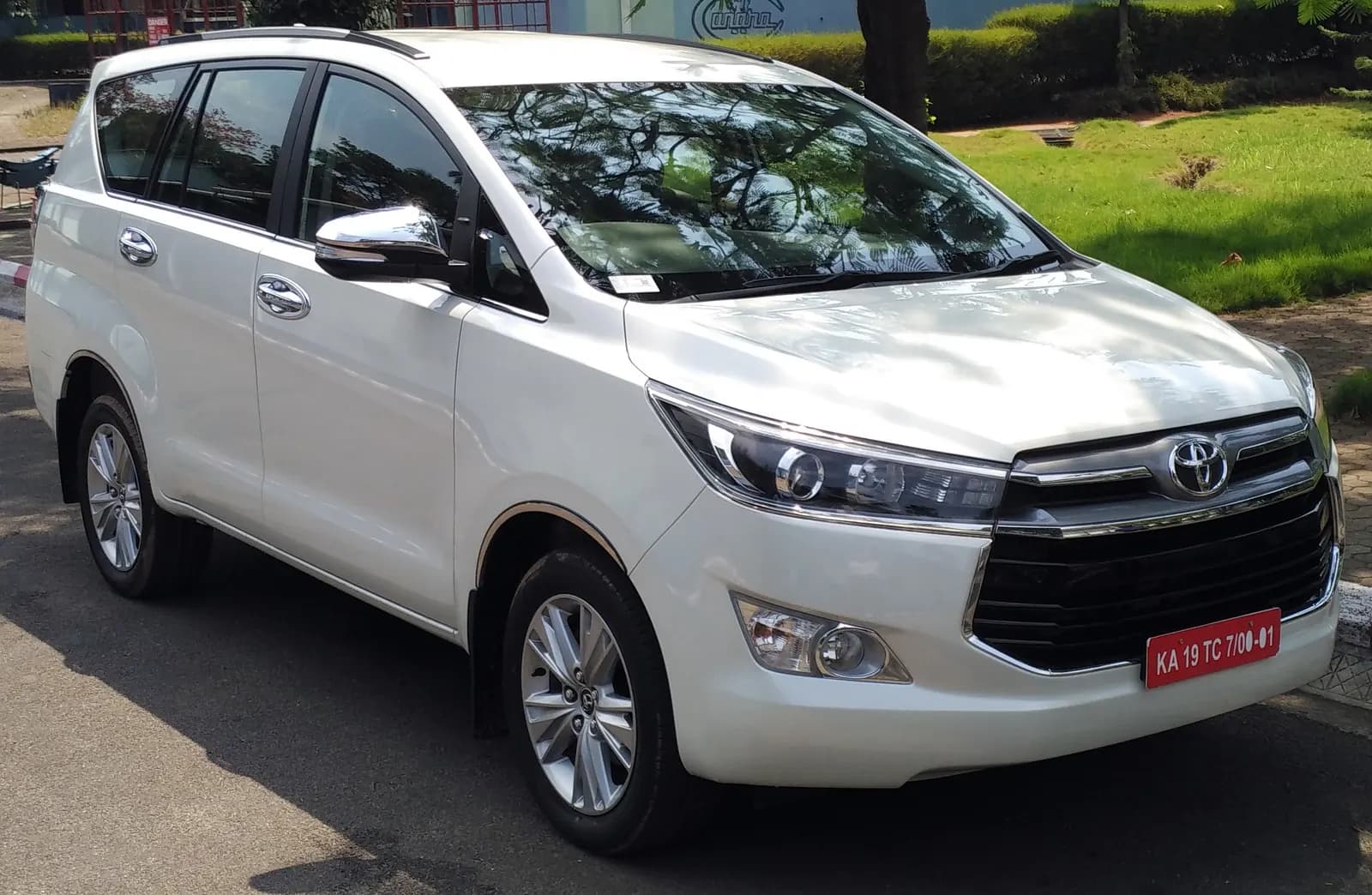
Item (i): renting of any motor vehicle designed to carry passengers where the cost of fuel is included in the consideration. This covers cars, MUVs, tempo travellers and buses hired with a driver for a day, a month or a contract term, fuel included. The operator chooses between 5% (ITC only of input services in the same line of business) and 18% with full ITC. Under the 5% option it may take credit only of input services in the same line of business — a vehicle hired from another operator who transports passengers or rents motor vehicles — and not of its own cars, tyres, repairs or office costs. Under the 18% option it takes full credit. Notification 15/2025-CT(R) changed the higher option from 6% to 9% central tax, that is from 12% to 18% in total, from 22 September 2025.
Item (ia): renting of a goods carriage where the cost of fuel is included. Before September 2025 this was 12% only. Notification 15/2025 substituted it with two options: 5% with ITC of input services in the same line — with that credit capped at tax at 5% even if the supplier charged more — or 18% with full ITC with full credit.
Item (iii): rental of transport vehicles with operators, other than the above — for example, a car or bus hired with a driver where the customer pays for fuel separately — at 18%. The 5% option exists only where fuel is in the price, so a "dry" hire with driver cannot use it.
Passenger transport on a per-trip basis — a cab ride, a bus ticket, a tour — is a different entry, serial 8 under heading 9964, though for vehicles with fuel it carries the same 5%/18% options. Our GST on transport services guide covers that side.
| What is hired | Entry | GST | Credit for the operator |
|---|---|---|---|
| Car, MUV or bus with driver and fuel | 10(i) | 5% (ITC only of input services in the same line of business) or 18% with full ITC | Same-line input services only / full |
| Truck or tempo with driver and fuel | 10(ia) | 5% with ITC of input services in the same line or 18% with full ITC | Same-line, capped at 5% / full |
| Any vehicle with driver, fuel paid by customer | 10(iii) | 18% | Full |
| Self-drive or lease without driver | 17 (heading 9973) | See self-drive section | Full |
Reverse charge when a company hires the vehicle
Entry 15 of Notification 13/2017-CT(R), in the form substituted by Notification 29/2019-CT(R) from 1 January 2020, puts one category of vehicle hire under reverse charge. The service is renting of any motor vehicle designed to carry passengers where the cost of fuel is included, provided to a body corporate. The supplier is any person other than a body corporate who supplies the service to a body corporate and does not issue an invoice charging central tax at the higher rate. The recipient — the one who pays the tax — is any body corporate located in India.
CBIC explained the intention in Circular 130/49/2019-GST. The Council wanted reverse charge only where operators use the low-rate option, so that operators choosing the full-credit rate keep their credit chain. When the supplier charges the higher rate on its invoice, the company pays that tax to the supplier and there is no reverse charge; when it does not, the company pays the tax itself under reverse charge at 5%.
The entry still describes the higher rate as central tax "at the rate of 6 per cent", the figure that applied when it was drafted. Notification 15/2025 raised the higher option to 9% central tax but, as far as we could find, did not amend entry 15. Read with the circular, the sensible reading is that an operator charging the new 18% with full ITC on its invoice takes the company out of reverse charge, and an operator billing under the 5% option leaves the company liable. Watch for a corrective notification, and record which option each operator uses.
Three definitional points decide whether the entry applies. "Body corporate" takes its meaning from section 2(11) of the Companies Act, 2013: companies, including foreign companies, are body corporates, and LLPs are generally treated as body corporates because the LLP Act makes them one; proprietorships, partnership firms, co-operative societies and trusts generally are not, so they never pay under this entry. The supplier must not itself be a body corporate — a private limited cab company always charges tax on its own invoice. And the vehicle must be a passenger vehicle with fuel included; goods carriages are outside entry 15.
Who pays GST on a passenger vehicle hired with fuel?
Step 1
Is the customer a body corporate?
no → operator charges 5% or 18% on its invoice
Step 2
Is the operator a body corporate?
yes → operator charges tax
Step 3
Does the operator charge 18% on its invoice?
yes → customer pays operator, no RCM
Step 4
Customer pays 5% under reverse charge
self-invoice if operator unregistered
Paying reverse charge: invoices, timing and returns
A company liable under entry 15 pays the tax in cash through the electronic cash ledger; credit balances cannot be used. The time of supply for reverse-charge services is the earlier of the payment date and the date immediately after 60 days from the supplier's invoice. If the operator is unregistered, the company issues a self-invoice within 30 days of receiving the service under rule 47A, and a payment voucher when it pays. The liability goes in Table 3.1(d) of GSTR-3B.
Whether the company can then take the same amount back as credit depends on section 17(5), discussed below. For most companies hiring cars for executives, the reverse-charge tax is a cost. Our reverse charge guide covers the mechanics for all RCM services, and the GSTR-3B guide shows the tables.
Operators whose customers are all body corporates under reverse charge may not need to register at all. Notification 5/2017-Central Tax exempts from registration persons engaged only in supplies on which the whole tax is payable by the recipient under reverse charge. An operator with a single private hotel client, or with turnover above ₹20 lakh from non-corporate customers, needs a GSTIN.
Input tax credit: the section 17(5) block
Section 17(5)(a) of the CGST Act blocks credit on motor vehicles for transportation of persons with an approved seating capacity of not more than 13, including the driver, except when used for further supply of such vehicles, transportation of passengers or imparting driving training. Section 17(5)(b)(i) extends the block to leasing, renting or hiring of those vehicles, except when used for the same purposes. Two provisos open it again: credit is available where the inward supply is used to make an outward taxable supply of the same category, or as an element of a taxable composite or mixed supply; and credit is available where a law in force obliges the employer to provide the service to employees.
In practice:
- A company hiring cars for staff or executives cannot claim the GST, whether paid under reverse charge or to the operator, unless a law requires it to provide the transport.
- A rent-a-cab or travel company that hires cars from another operator to fulfil its own rental contracts can claim credit, because it supplies the same category of service. This is the same-line credit the 5% option allows.
- A company hiring buses for shifts is outside the block, because a bus seats more than 13. If the operator charges 18% with full ITC, the company claims it in full.
- Truck and tempo hire for goods is outside the block, since goods vehicles are not in clause (a).
- A tour operator that bundles a hired car into a taxable tour package can use the composite-supply proviso.
Can the customer claim credit on vehicle hire?
| Hire | Customer | Credit |
|---|---|---|
Car or MUV (up to 13 seats) for staff or guests | Any business | Blocked, unless a law requires it |
Car or MUV (up to 13 seats) | Rent-a-cab or travel operator re-supplying it | Allowed (same category) |
Bus or coach (more than 13 seats) | Any business | Allowed |
Truck or tempo for goods | Any business | Allowed |
Car included in a taxable tour package | Tour operator | Allowed (composite supply proviso) |
Car or MUV (up to 13 seats) for staff or guests
- Customer
Any business
- Credit
Blocked, unless a law requires it
Car or MUV (up to 13 seats)
- Customer
Rent-a-cab or travel operator re-supplying it
- Credit
Allowed (same category)
Bus or coach (more than 13 seats)
- Customer
Any business
- Credit
Allowed
Truck or tempo for goods
- Customer
Any business
- Credit
Allowed
Car included in a taxable tour package
- Customer
Tour operator
- Credit
Allowed (composite supply proviso)
The 57th GST Council on 8 October 2026 recommended removing several section 17(5) blocks — on outdoor catering, health and life insurance, telecom towers and others — but, in the summaries we have seen, not the block on motor vehicle hire. That recommendation has not been notified as of October 2026.
Self-drive rentals and long-term leases
When the customer drives, there is no operator, so serial 10 does not apply and the 5% option is not available. The service falls under heading 9973, leasing or rental services without operator, at serial 17 of Notification 11/2017. That serial has two possible homes for a car rental. Item (viia), "leasing or renting of goods", takes the same rate as a sale of the like goods; item (viii), the residual entry for leasing or rental without operator, is at 18%.
In 2025 the Kerala Authority for Advance Ruling, in the case of EVM Passenger Cars India (AR No. KER/27/2025), held that a self-drive rent-a-car service is leasing or renting of goods under item (viia), so the rate follows the car's own GST rate. Since 22 September 2025 that means 18% for petrol, LPG or CNG cars up to 1,200 cc and diesel cars up to 1,500 cc that are no longer than 4 metres, 40% for larger cars and SUVs, and 5% for electric cars. An advance ruling binds only the applicant and its officers, and many self-drive operators charge 18% across their fleets. If yours includes SUVs, the gap between 18% and 40% is large enough to take advice or seek your own ruling.
Long-term leases of cars to companies follow the same logic: the lessor's rentals generally take the vehicle's rate under item (viia) or the "transfer of right to use goods" item. The 57th Council recommended a clarification on how statutory and ancillary recoveries in vehicle leases — registration charges, road tax, insurance, FASTag — are to be treated. Lessees remain subject to the section 17(5) block on cars. Our GST on cars guide explains the vehicle rates.

Electric vehicles and the 57th Council
The 5% option in serial 10(i) is written for vehicles "where the cost of fuel is included". Operators running electric fleets have argued over whether battery charging counts as fuel. The 57th GST Council recommended an explicit option to pay 5% with restricted credit on passenger transport and on rental of motor vehicles with operator where the vehicle is electric and the charging cost is included in the price. Until it is notified, an EV operator billing at 5% relies on reading charging as fuel; the safer course is to keep the reasoning on file or use the 18% with full ITC option. Watch CBIC's rate notifications for the change.
Worked examples in rupees
A company hiring cars from a proprietor. A Pune software company (a private limited company) hires three cars with drivers and fuel from a proprietor operator for ₹2,40,000 a month. The proprietor does not charge GST. Entry 15 applies: the company pays 5% of ₹2,40,000 = ₹12,000 in cash under reverse charge. The cars are for executives, so section 17(5) blocks the credit and the ₹12,000 is a cost. Total monthly cost: ₹2,52,000.
The same hire at 18%. If the proprietor opts for 18% with full ITC, the invoice shows ₹43,200 of GST and the company pays ₹2,83,200, with no reverse charge and no credit. For a customer that cannot claim credit, the 5% route is ₹31,200 a month cheaper. The operator gains credit on its own costs under the 18% option, so it may price lower; compare the all-in quotes, not just the rates.
A partnership firm hiring the same cars. A partnership firm is not a body corporate, so there is no reverse charge. A registered proprietor operator using the 5% option charges ₹12,000 on its invoice.
A factory hiring buses. A Chennai manufacturer hires two 40-seat buses with fuel for shift workers at ₹1,50,000 a month from an operator who charges 18% with full ITC: ₹27,000. Buses seat more than 13, so section 17(5) does not apply and the manufacturer claims the ₹27,000 as credit.
A trader hiring a truck. A Ludhiana wholesaler hires a truck with driver and diesel for ₹90,000 a month. The owner uses the 5% option and charges ₹4,500 on the invoice. This is not a GTA service, so there is no GTA reverse charge, and credit on goods-vehicle hire is not blocked.
A self-drive weekend rental. A tourist rents a compact petrol hatchback for ₹6,000 for two days. On the Kerala ruling's reasoning the rental carries 18% — ₹1,080. A large SUV at ₹12,000 would carry 40%, ₹4,800, on the same reasoning; an operator charging a flat 18% would collect ₹2,160.
Compare 5% and 18% on a monthly hire
Common mistakes and how they are fixed
Still invoicing at 12%. The 12% option ended on 21 September 2025. An operator using it under-charges against the 18% option or over-charges against the 5% option. Customers should ask for corrected invoices, and operators should amend their returns.
Companies ignoring reverse charge. Officers match "vehicle hire" and "travel" expenses in company accounts with reverse-charge tax in GSTR-3B. Missing tax is recovered with interest at 18% a year from the due date. Pay it through DRC-03 as soon as you find a gap.
Claiming credit on car hire. A company that pays 18% to the operator and claims it as credit, without a statutory obligation or a same-line supply, will have the credit reversed with interest. Keep bus and truck hire, where credit is allowed, in separate ledgers.
Using the 5% option without fuel. If the customer pays for fuel, the entry is 10(iii) at 18%. Write fuel into the contract price if you want the 5% option.
Applying entry 15 to firms and LLPs incorrectly. LLPs are body corporates and pay under reverse charge; partnership firms and proprietors are not. Check the customer's constitution, not just its GSTIN.
Vehicle hire GST checklist
0/7What to do next
If you run a rental business, decide your option for each customer group: 5% suits body corporate customers who cannot claim credit, while 18% suits customers who can, such as bus-hire clients and tour operators. If you hire vehicles, sort your vendors by constitution and option and check that reverse charge was paid where due. Our taxi business guide covers permits and running a fleet, the GST on cars guide covers buying vehicles, and the GST calculator helps compare quotes.
This is general information, not legal or tax advice — confirm on the official source or with a professional.
Frequently asked questions
Renting a passenger vehicle with a driver, where fuel is included in the price, is taxed at 5% (ITC only of input services in the same line of business), or 18% with full ITC, at the operator's choice, under serial 10(i) of Notification 11/2017-CT(R). The 18% option replaced 12% from 22 September 2025. Other rentals with an operator are 18%.
Yes, in one case. Entry 15 of Notification 13/2017-CT(R) makes a body corporate pay GST under reverse charge when it hires a passenger vehicle with fuel included from a supplier other than a body corporate who does not charge GST at the higher, full-credit rate. In practice, if a proprietor or partnership firm bills a company without GST under the 5% option, the company pays the 5% itself. Partnership firms, LLPs and individuals are not body corporates for this entry.
Usually not. Section 17(5)(b)(i) of the CGST Act blocks credit on leasing, renting or hiring of motor vehicles with seating capacity of up to 13 including the driver, unless the company itself transports passengers, rents out vehicles or trains drivers, or a law obliges it to provide the transport to employees. Hire of buses and other vehicles seating more than 13, and of goods vehicles, is not blocked.
Self-drive rental, with no driver, falls under heading 9973 (leasing or rental without operator), not the 5%/18% cab-rental entry. The Kerala Authority for Advance Ruling held in 2025 that it is 'leasing or renting of goods' taxed at the same rate as the vehicle — now 18% for small cars, 40% for larger ones and 5% for electric cars. Many operators charge a flat 18%, so confirm the position for your fleet.
Renting a goods carriage with the cost of fuel included is taxed at 5% with ITC of input services in the same line or, since 22 September 2025, 18% with full ITC at the supplier's option, under serial 10(ia). This is a rental, not a goods transport agency service, so the GTA reverse charge does not apply. Credit on goods-vehicle hire is not blocked by section 17(5).
Rental of road vehicles including buses, coaches, cars, trucks and other motor vehicles with operator is SAC 996601 under heading 9966. Leasing or rental of transport equipment without an operator, such as self-drive cars, falls under group 99731 of heading 9973. Passenger transport by cab or bus on a trip basis is under heading 9964.
Sources & verification
Figures on this page were checked against the sources below when it was last reviewed on 11 October 2026. Each rate and limit is stored once with its own official source and review date, and official update channels are monitored daily so changes are picked up. How we verify
- 1.Notification No. 15/2025–Central Tax (Rate), Gazette of India, 17 September 2025 — Ministry of Finance (Gazette of India) · accessed 11 October 2026
- 2.Notification No. 11/2017–State Tax (Rate), consolidated as amended (Telangana Commercial Taxes Department) — Commercial Taxes Department, Government of Telangana · accessed 11 October 2026
- 3.Notification No. 13/2017–State Tax (Rate), consolidated as amended (Telangana Commercial Taxes Department) — Commercial Taxes Department, Government of Telangana · accessed 11 October 2026
- 4.Circular No. 130/49/2019-GST — Reverse charge on renting of motor vehicles — CBIC (GST Council website) · accessed 11 October 2026
- 5.CGST Act, 2017 — section 17 (blocked credits) — CBIC Tax Information Portal · accessed 11 October 2026
- 6.56th GST Council press release — services rate changes (September 2025) — GST Council · accessed 11 October 2026
- 7.Self-drive car rental falls under leasing or renting of goods for GST: AAR (EVM Passenger Cars India, KER/27/2025) — StudyCafe · accessed 11 October 2026
- 8.Indirect Tax Alert — Recommendations of the 57th GST Council meeting (9 October 2026) — BDO India · accessed 11 October 2026
MSMETOOLS is an independent platform and is not affiliated with any government agency, ministry or department.
Tools for this
GST Calculator (India)
Calculate GST for your sales and purchases with current rates.
Invoice Generator
Create professional invoices with tax, logo and custom details.
Related guides
 GST Rate on Transport Services 2026: Bus, Cab, Rail & HireRead guide
 Reverse Charge Mechanism (RCM) in GST 2026: List & ExampleRead guide
 GST on Security Services 2026: RCM Rules, 18% Rate & SACRead guide
 GST on Air Tickets 2026: Economy 5%, Business 18% & ITCRead guide
Official links open the government site in a new tab.