 GST & indirect tax
GST Rate on Transport Services in 2026: Buses, Cabs, Rail, Metro and Vehicle Hire
GST rate on transport services in 2026: exempt non-AC buses and metro, 5% on AC buses, AC rail and cabs, 5% or 18% options, app rides and ₹ examples.
 Edited by Sumeet YadavFounder & editor, MSMETOOLS · fact-checked against official sources
Contents (10)
- 1. Passenger transport rates at a glance
- 2. Stage carriage, contract carriage and radio taxi — the words that decide the rate
- 3. The 5% or 18% choice for cab and bus operators
- 4. App-based rides: Ola, Uber, Rapido and bus platforms
- 5. Renting a vehicle with a driver (rent-a-cab)
- 6. Rail, metro and waterways
- 7. Worked examples
- 8. Registration, place of supply and invoices
- 9. Common mistakes
- 10. What to do next
"GST on transport" covers two very different businesses: moving goods and moving people. This guide is about passenger transport — buses, cabs, autos, trains, metro and vehicles hired with a driver — for operators deciding what to charge, companies checking their travel and cab bills, and travellers wondering why one ticket shows GST and another doesn't. For freight, lorry receipts and goods transport agencies, see our separate GST on freight guide. Below you'll find the exemptions, the 5% and 18% options after GST 2.0, app-based rides, vehicle hire, reverse charge, SAC codes and worked ₹ examples, all checked against CBIC notifications in October 2026.
Quick answer
Everyday public transport is exempt: ordinary non-AC buses, metro, monorail, auto-rickshaws and metered cabs hailed on the street, and sleeper/second-class rail. AC buses, radio taxis and AC or first-class rail are taxed at 5% without ITC. Cabs and buses with fuel, and vehicles hired with a driver, pay 5% (ITC only of input services in the same line of business) (limited credit) or, by choice, 18% with full ITC with full credit — the 18% option replaced 12% on 22 September 2025.
App-booked rides: the platform pays GST under section 9(5), not the driver
Non-AC buses on tour, charter or private hire are taxable, not exempt
Economy air travel 5%; premium and business 18%
Goods transport (GTA) is separate: 5% without ITC or 18% with ITC
Passenger transport rates at a glance
The rates come from two CBIC notifications: Notification 11/2017–Central Tax (Rate), which fixes the rate for each service (serial 8 for passenger transport, serial 10 for vehicle rental), and Notification 12/2017–Central Tax (Rate), which exempts certain services altogether. The 56th GST Council changed only the higher "full credit" option, from 12% to 18%, with effect from 22 September 2025, through Notification 15/2025–CT(Rate). The 57th Council meeting on 8 October 2026 did not change transport rates.
| Service | GST rate | Credit for the operator | Legal basis |
|---|---|---|---|
| Stage carriage bus, non-AC | Exempt | — | Exemption entry 15(c) |
| Contract carriage, non-AC (not tourism, charter or hire; not radio taxi) | Exempt | — | Entry 15(b) |
| Metro, monorail, tramway; inland waterways | Exempt | — | Entry 17(b), (c) |
| Auto-rickshaw, e-rickshaw, metered cab (not booked via app) | Exempt | — | Entry 17(e) |
| Rail — sleeper, second class, general | Exempt | — | Entry 17(a) |
| Rail — first class or AC coach | 5% | Limited (credit on goods not used to pay tax) | Serial 8(i) |
| AC stage carriage, AC contract carriage (not motorcab), radio taxi | 5% without ITC | No | Serial 8(ii) |
| Passenger transport by any motor vehicle, fuel included | 5% (ITC only of input services in the same line of business) or 18% with full ITC | Input services in same line only / full | Serial 8(vi) |
| Renting of passenger vehicle with operator, fuel included | 5% (ITC only of input services in the same line of business) or 18% with full ITC | Input services in same line only / full | Serial 10(i) |
| Air, economy class | 5% | Input services in same line only | Serial 8 |
| Air, other than economy | 18% | Full | Serial 8(v) |
| Other passenger transport | 18% | Full | Serial 8 residual |
Air travel is covered in more depth in our GST on flight tickets guide.
Stage carriage, contract carriage and radio taxi — the words that decide the rate
The bus and taxi entries borrow their vocabulary from the Motor Vehicles Act, 1988, and the meaning matters.
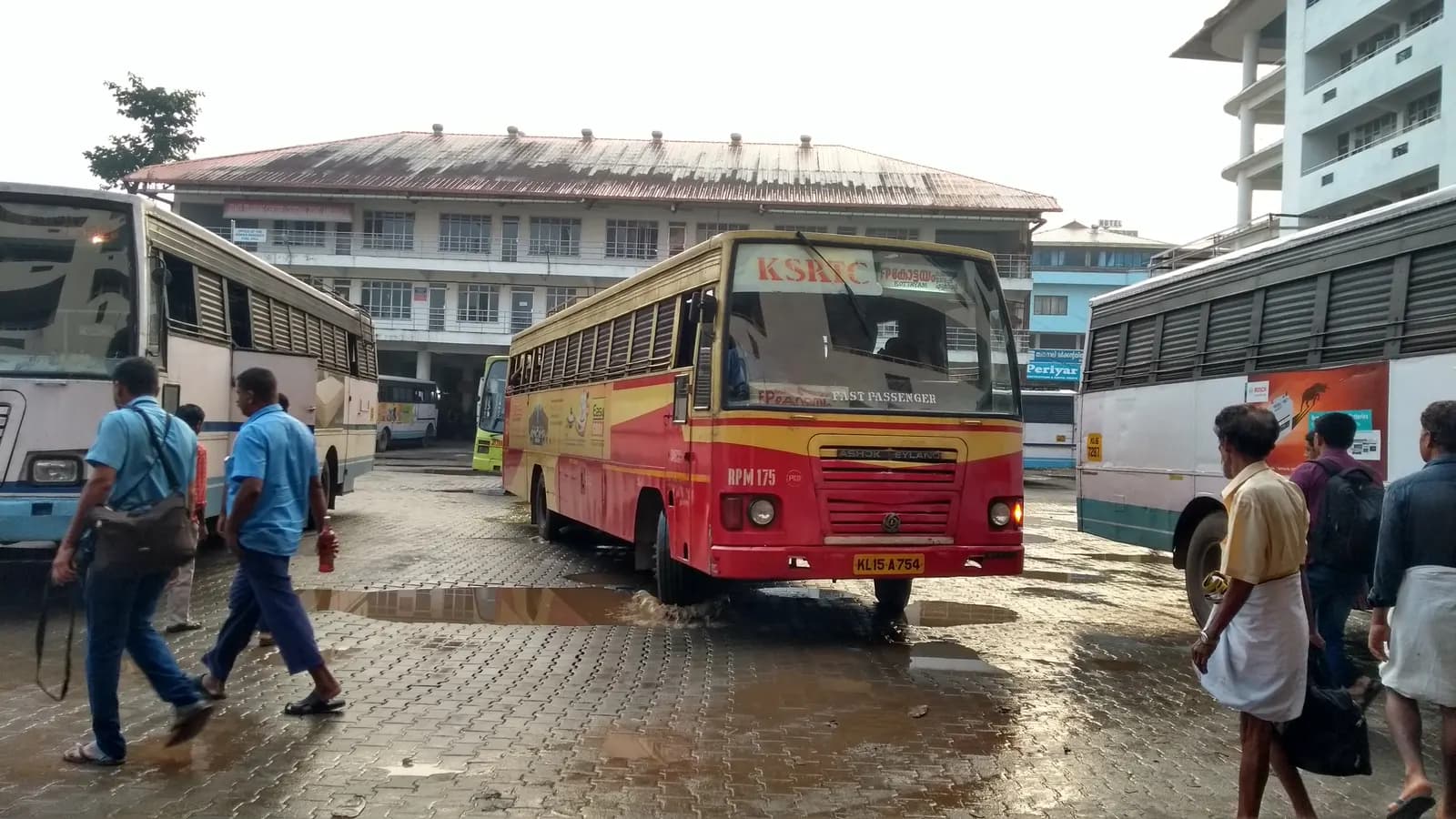
A stage carriage is a vehicle carrying passengers for hire or reward at separate fares paid by or for individual passengers, for the whole journey or for stages of it — the ordinary route bus that picks up and drops people along the way. Most state transport corporation buses, city buses and private route buses are stage carriages. If the bus is non-AC, the ride is exempt; if it is AC, the fare carries 5% without ITC.
A contract carriage is hired as a whole under a contract, for a fixed or agreed rate, to carry passengers from one point to another without picking up or setting down along the way — tourist buses, school vans, office shuttles, and taxis. A non-AC contract carriage is exempt only if it is not used for "tourism, conducted tour, charter or hire". So a non-AC van that runs a regular staff route under a monthly contract can be exempt, but the same van hired for a family wedding or a pilgrimage tour is taxable.
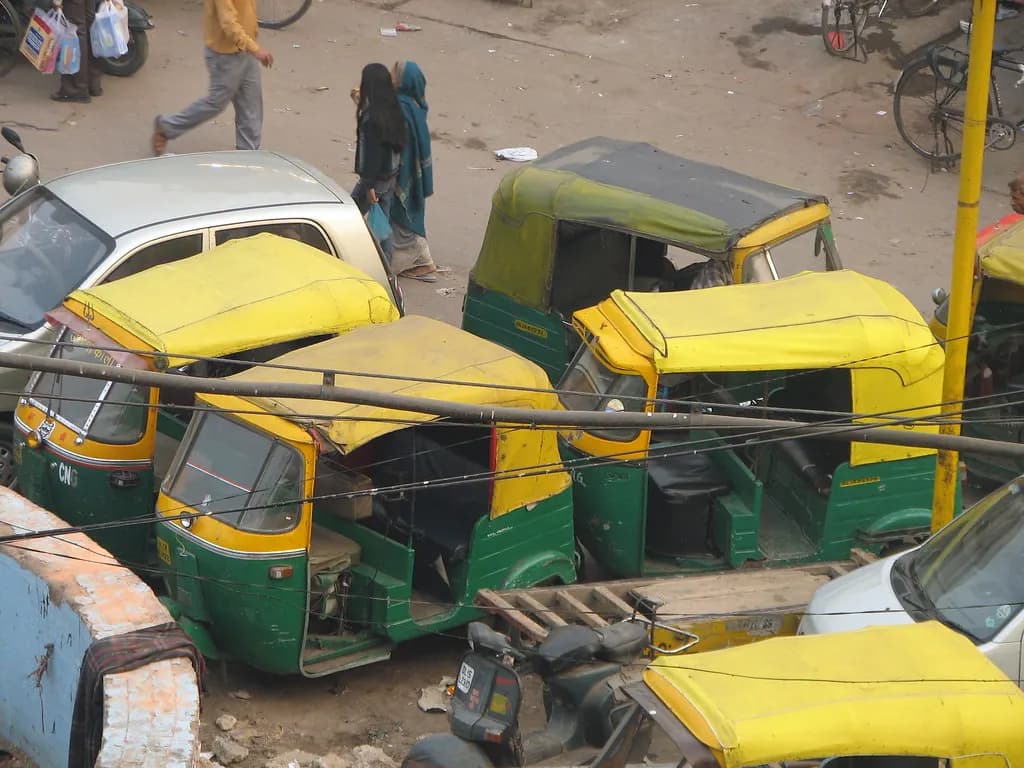
A radio taxi is a taxi, including a radio cab, by whatever name called, in two-way radio communication with a central control office and tracked by GPS or GPRS. Radio taxis are excluded from the non-AC exemption and taxed at 5% without ITC. Metered cabs — the black-and-yellow taxis with a fare meter — and auto-rickshaws, including e-rickshaws, are exempt when you hail them directly.
The permit printed on the vehicle tells you which category applies. Operators who run AC sleeper buses on contract-carriage permits but sell individual seats should take advice: tax authorities look at how the service is actually supplied, not only at the permit.
The 5% or 18% choice for cab and bus operators
Serial 8(vi) covers "transport of passengers by any motor vehicle designed to carry passengers where the cost of fuel is included in the consideration" — the entry that applies to cab companies, tour operators, travel agents running their own buses and most corporate transport contracts. The operator can charge:
- 5% (ITC only of input services in the same line of business), taking input tax credit only on input services in the same line of business — for example, a cab or bus hired from another operator — and only up to 5% of that input service; or
- 18% with full ITC with full input tax credit on vehicles, spares, tyres, repairs, insurance and other costs.
Before 22 September 2025 the higher option was 12%. Notification 15/2025–CT(Rate) replaced it with 18% for both passenger transport (serial 8) and renting with operator (serial 10). An operator still billing 12% on or after that date is using a rate that no longer exists; customers should ask for a corrected invoice.
The choice comes down to credit and customers. Diesel, petrol and CNG — usually the largest cost — are outside GST, so they carry no credit under either option. The 18% option pays off only when an operator buys a lot of taxable goods and services: a year in which it adds new buses, for example. Buses and passenger vehicles were themselves cut from 28% to 18% in September 2025, so the credit on a new bus is now smaller than before. Business customers who can claim credit don't mind 18%; individual travellers, schools and others who can't would see the price rise. That is why most small operators stay at 5%.
AC buses and radio taxis sit under the separate serial 8(ii) at 5% without ITC with no credit at all. In practice, operators of AC coaches running on contract and tour hire with fuel included use serial 8(vi), which gives them the option of limited credit at 5% or full credit at 18%.
Same ₹50 lakh of annual cab-hire revenue, two options
| 5% option | 18% option | |
|---|---|---|
GST charged to customers | ₹2,50,000 | ₹9,00,000 |
Credit on purchases (tyres, repairs, insurance, ₹8 lakh at 18%) | Not allowed | ₹1,44,000 |
Credit on a new ₹12 lakh car bought in the year (GST ₹2,16,000) | Not allowed | ₹2,16,000 |
Net GST paid in cash | ₹2,50,000 | ₹5,40,000 |
Cost absorbed by the operator | ₹3,60,000 of GST on purchases | Nil |
GST charged to customers
- 5% option
₹2,50,000
- 18% option
₹9,00,000
Credit on purchases (tyres, repairs, insurance, ₹8 lakh at 18%)
- 5% option
Not allowed
- 18% option
₹1,44,000
Credit on a new ₹12 lakh car bought in the year (GST ₹2,16,000)
- 5% option
Not allowed
- 18% option
₹2,16,000
Net GST paid in cash
- 5% option
₹2,50,000
- 18% option
₹5,40,000
Cost absorbed by the operator
- 5% option
₹3,60,000 of GST on purchases
- 18% option
Nil
The table assumes every customer is a registered business that claims the GST back. If half the customers are individuals, the 18% option raises their fares by 13 percentage points — usually a dealbreaker.
App-based rides: Ola, Uber, Rapido and bus platforms
For rides booked through an app, section 9(5) of the CGST Act shifts the tax to the electronic commerce operator (ECO). Notification 17/2017–CT(Rate), as amended, makes the ECO liable for passenger transport by radio taxi, motorcab, maxicab, motor cycle and any other motor vehicle except omnibus. The driver does not need to register or charge GST; the platform collects it in the fare and pays it.
Three later changes shaped how this works:
- Auto-rickshaws via apps — taxable from 1 January 2022. Notification 16/2021–CT(Rate) amended entry 17(e) so that the auto-rickshaw exemption does not apply to rides supplied through an ECO. A street-hailed auto remains exempt; an app-booked auto is taxed, with the platform paying 5% (ITC only of input services in the same line of business).
- Buses via apps — from 20 October 2023. Notification 16/2023–CT(Rate) took omnibuses out of the general clause and added clause (ia): the ECO pays GST on bus rides booked through it, except where the bus operator is a company. A company operator charges and pays GST itself; a proprietor or partnership operator's tax is paid by the platform.
- Bike taxis are covered as "motor cycle" in the same clause.
For riders, the GST is usually inside the displayed fare. A ₹500 cab ride at 5% includes about ₹24 of GST (₹500 × 5/105). Businesses that need credit should download the tax invoice from the app; note that credit on cab rides is generally blocked by section 17(5) unless the vehicle is used for a specified purpose, so most employers treat cab GST as a cost.
Renting a vehicle with a driver (rent-a-cab)
Hiring a car, tempo traveller or bus with a driver and fuel for a period — a day, a month, a year — is "renting of a motor vehicle designed to carry passengers" under serial 10(i), SAC 996601. The options mirror passenger transport: 5% (ITC only of input services in the same line of business) with credit only on input services in the same line of business, or 18% with full ITC with full credit. Corporate employee-transport contracts, monthly car hire for a factory manager, and tempo travellers hired for an event usually fall here.
Reverse charge on rent-a-cab to companies. Entry 15 of Notification 13/2017–CT(Rate) makes a body corporate pay GST under reverse charge when it hires a passenger vehicle with fuel from any person other than a body corporate who does not charge GST at the full-credit rate. In plain terms: if a proprietor or partnership firm bills your company for cab hire without GST (the 5% option), your company pays the 5% in cash through GSTR-3B. If the operator opts to charge 18% on its invoice, you pay that to the operator and there is no reverse charge. Our reverse charge guide lists all the entries.
Hire to a state transport undertaking. Giving a bus that carries more than twelve passengers on hire to a state transport undertaking is exempt under entry 22(a) of the exemption notification. Private operators who run buses for a state corporation under a hire agreement benefit from this.
Self-drive rentals do not qualify for the 5% option, because the 5% entries apply only where an operator (driver) and fuel are provided. Their classification — rental under heading 9966 or leasing of goods under 9973 at the vehicle's rate — depends on the arrangement, so confirm it before you price.
Rail, metro and waterways
Indian Railways charges GST at 5% on tickets in first class and AC classes (1A, 2A, 3A, 3E, chair car and executive chair car). Sleeper, second sitting and general unreserved tickets, and suburban season tickets, are exempt under entry 17(a). The GST is built into the fare shown on IRCTC; your ticket shows the GST component separately, and businesses registered for GST can add their GSTIN to receive a tax invoice.
Metro, monorail and tramway journeys are exempt under entry 17(b), as are passenger journeys on inland waterways and public transport by vessel between places in India other than predominantly for tourism. So a Kochi Water Metro ticket or a Mumbai ferry is exempt, but a sightseeing cruise is taxable.
Is this passenger ride taxable?
Step 1
Booked through an app?
yes: platform pays GST (bus: unless operator is a company)
Step 2
Metro, non-AC rail class, waterway?
yes: exempt
Step 3
Non-AC route bus, street auto or metered cab?
yes: exempt
Step 4
AC bus, radio taxi, AC rail?
5%
Step 5
Cab or bus hired with fuel, or tour/charter?
5% or 18% at operator's option
Worked examples
1. State transport bus ticket. A passenger pays ₹260 for a non-AC fast passenger bus from Kottayam to Thiruvananthapuram. It is a non-AC stage carriage: no GST. The AC Volvo on the same route at ₹480 is an AC stage carriage: the fare includes 5% GST of about ₹23.
2. Tour bus for a wedding. A Nagpur family hires a non-AC 35-seater with driver and diesel for ₹30,000 for two days. Hire for an event is excluded from the non-AC exemption. The operator, on the 5% option, bills ₹30,000 + ₹1,500 GST = ₹31,500. On the 18% option, the bill would be ₹35,400.
3. Corporate cab contract. A Pune software company hires six cars with drivers and fuel from a partnership firm for ₹3,00,000 a month. The firm charges no GST (5% option). The company, a body corporate, pays ₹15,000 under reverse charge in its GSTR-3B. If the firm opted for 18% and charged ₹54,000 on its invoice, the company would pay that instead and no reverse charge would arise. Either way, the company's credit is generally blocked under section 17(5) unless the cars carry employees under a legal obligation of the employer.
4. An app ride. A Hyderabad commuter pays ₹420 for a cab booked on an app. The platform's invoice shows a ride value of ₹400 and GST of ₹20 at 5% (ITC only of input services in the same line of business); the driver files nothing.
5. AC rail ticket. A 3A ticket from Delhi to Lucknow with a base fare of ₹1,200 carries ₹60 of GST at 5%. The sleeper-class ticket on the same train has no GST.
Use the GST calculator to test your own fares, and add or remove GST from inclusive prices.
Registration, place of supply and invoices
An operator must register once aggregate turnover crosses ₹20 lakh (₹10 lakh in special-category states). Exempt fares count toward that turnover, so a bus operator running mostly exempt non-AC routes and a few AC services can cross the limit. Operators supplying only through apps covered by section 9(5) don't need to register for those rides.
Place of supply for passenger transport is the location of a registered recipient; for other recipients it is the place where the passenger embarks for a continuous journey. A Bengaluru company booking a cab in Chennai for an employee therefore receives an IGST invoice if the operator is registered in Tamil Nadu and the company has given its Karnataka GSTIN.
Invoices should show SAC 9964 (or 996601 for rental), the option chosen, and whether tax is payable under reverse charge. Look up codes with the HSN code finder and raise bills with the invoice generator.
Transport operator's GST checklist
0/6Common mistakes
Treating every non-AC bus as exempt. The exemption for contract carriages excludes tourism, conducted tours, charters and hire. Event and tour hire is taxable.
Charging 12%. The 12% option ended on 21 September 2025. Use 18% if you want full credit.
Mixing 5% and credit. An operator on the 5% option cannot claim credit on vehicles, tyres or repairs — only on input services from another operator in the same line, capped at 5%. Claiming full credit while billing 5% is a common audit finding.
Companies missing reverse charge on cab hire. If a non-corporate operator's invoice shows no GST, the company owes 5% under reverse charge.
Drivers on apps registering and charging GST themselves. For rides covered by section 9(5), the platform pays. A driver who also charges GST double-taxes the passenger.
Confusing passenger and goods transport. A tempo hired to move furniture is goods transport — exempt unless a GTA issues a consignment note. See GST on freight.
Official links
- Notification 11/2017-CT(Rate) — service ratesSerial 8 passenger transport, serial 10 rental
- Notification 12/2017-CT(Rate) — exemptionsEntries 15, 17, 22
- Notification 15/2025-CT(Rate) (Gazette)12% option replaced by 18% from 22 Sep 2025
- Notification 16/2023-CT(Rate)Bus rides through e-commerce operators
- Scheme of Classification of Services (SAC list)Headings 9964 and 9966
What to do next
If you run cabs or buses, list each contract, classify it, and decide between 5% and 18% based on your customers and planned vehicle purchases. If your company hires cars, check every operator's invoice for GST and set up reverse charge for those that don't charge it. For moving goods rather than people, read GST on freight; for buying a passenger vehicle, see GST on cars; and if you are planning a fleet business, our transport business plan walks through the costs.
This is general information, not legal or tax advice — confirm on the official source or with a professional.
Frequently asked questions
For passengers, ordinary non-AC buses, metro, auto-rickshaws, metered cabs and non-AC train classes are exempt. AC buses, radio taxis and AC or first-class rail travel are taxed at 5% without ITC or 5%. Cab and bus hire with fuel is 5% (ITC only of input services in the same line of business) or, at the operator's option, 18% with full ITC. Goods transport by a GTA is covered separately.
Not on ordinary non-AC stage-carriage buses such as most state transport services — they are exempt under entry 15 of Notification 12/2017-CT(Rate). AC stage-carriage buses charge 5% without ITC. A bus hired for a tour, charter or private trip is taxable even if it is non-AC, at 5% (ITC only of input services in the same line of business) or 18% with full ITC.
For rides booked through an app, the platform (the e-commerce operator) pays GST under section 9(5) of the CGST Act, not the driver. Cab rides are taxed at 5% (ITC only of input services in the same line of business). Auto-rickshaw rides booked through an app have been taxable since 1 January 2022, while autos hailed on the street remain exempt. Bus rides booked through a platform are taxed by the platform unless the bus operator is a company.
Renting a passenger vehicle with a driver, where fuel is included in the price, is taxed at 5% (ITC only of input services in the same line of business) with credit limited to input services in the same line of business, or 18% with full ITC with full credit. The 18% option replaced the old 12% option from 22 September 2025. A non-corporate operator billing a company at 5% may shift the tax to the company under reverse charge.
Only on first-class and air-conditioned classes, which are taxed at 5%. Sleeper, second-class and general tickets are exempt under entry 17 of Notification 12/2017-CT(Rate). Suburban, metro, monorail and tramway travel is also exempt.
Passenger transport falls under heading 9964. Local land transport by bus, metro, autos and other vehicles is 996411, taxi services 996412 and 996423, local bus charters 996413, and long-distance road transport by bus or car 996422. Rental of road vehicles with or without operator is 996601 under heading 9966.
Sources & verification
Figures on this page were checked against the sources below when it was last reviewed on 9 October 2026. Each rate and limit is stored once with its own official source and review date, and official update channels are monitored daily so changes are picked up. How we verify
- 1.Notification No. 11/2017 – Central Tax (Rate) (services rates) — CBIC · accessed 9 October 2026
- 2.Notification No. 15/2025 – Central Tax (Rate) — Gazette of India · accessed 9 October 2026
- 3.Recommendations of the 56th Meeting of the GST Council — PIB, Ministry of Finance · accessed 9 October 2026
- 4.Notification No. 12/2017 – Central Tax (Rate) (services exemptions) — CBIC · accessed 9 October 2026
- 5.Notification No. 16/2023 – Central Tax (Rate) (section 9(5) passenger transport) — GST Council / CBIC · accessed 9 October 2026
- 6.Scheme of Classification of Services (Annexure to Notification 11/2017-CT(Rate)) — CBIC · accessed 9 October 2026
- 7.Notification 16/2021-CT(Rate) — auto-rickshaw rides through e-commerce operators — Taxscan · accessed 9 October 2026
MSMETOOLS is an independent platform and is not affiliated with any government agency, ministry or department.
Tools for this
GST Calculator (India)
Calculate GST for your sales and purchases with current rates.
Invoice Generator
Create professional invoices with tax, logo and custom details.
HSN Code Finder (India)
Find the correct HSN/SAC code for your product.
Related guides
 GST on Freight 2026: SAC/HSN Code, GTA Rate & RCMRead guide
 GST on Renting of Motor Vehicles 2026: 5% or 18% & RCMRead guide
 GST on Air Tickets 2026: Economy 5%, Business 18% & ITCRead guide
 GST on Event Management 2026: 18% Rate, SAC & Pure AgentRead guide
Official links open the government site in a new tab.