 Starting & growing a business
Construction Cost per Sq Ft in India (2026): CPWD Benchmark, Material Quantities and a Worked 1,000 sq ft Estimate
Construction cost per sq ft in India (2026): CPWD Plinth Area Rates, material quantities, city-wise estimates, GST on works contracts and a 1,000 sq ft example.
 Edited by Sumeet YadavFounder & editor, MSMETOOLS · fact-checked against official sources
Contents (11)
- 1. What "construction cost per sq ft" actually includes
- 2. The official benchmark: CPWD Plinth Area Rates 2025
- 3. Where the money goes: cost breakdown of a house
- 4. Material quantities per sq ft (thumb rules)
- 5. City-wise construction cost per sq ft (2026 estimates)
- 6. With material vs without material: labour-only rates
- 7. GST on construction: works contract vs pure labour
- 8. Worked example: estimating a 1,000 sq ft house
- 9. How to calculate construction cost per sq ft for your project
- 10. Mistakes that blow up the per-sq-ft budget
- 11. What to do next
"What does it cost per square foot?" is the first question anyone asks before building a house, a shop-cum-residence or a small factory shed — and the answer you get from contractors can vary by ₹1,000 per sq ft for what sounds like the same job. This guide is for owners, small builders and contractors in India who want a number they can defend. It starts with the only official benchmark, CPWD's Plinth Area Rates 2025, then breaks the cost into materials and labour, gives city-wise ranges with their basis, explains GST on works contracts versus labour-only contracts, and finishes with a worked 1,000 sq ft estimate. Figures were checked in October 2026.
Quick answer
A contractor-built RCC house with materials costs roughly ₹1,600–₹2,600 per sq ft of built-up area in most Indian cities in 2026 (our estimate from published builder and manufacturer data), and ₹3,000–₹5,500 for premium metro finishes. The official benchmark — CPWD's Plinth Area Rates 2025 — puts government residential quarters at ₹24,410 per sq m (about ₹2,268 per sq ft) including GST and contractor's profit, before services.
CPWD PAR 2025 base date: 1 April 2025; add 12.5% for electrical and 9% for plumbing in quarters
Thumb rules per sq ft: ~0.4 bag cement, 3.5–4.5 kg steel, ~1 cft sand, ~1.2 cft aggregate
GST: 18% on a works contract with materials; a pure labour contract for your own single house is exempt
Worked example: 1,000 sq ft standard house ≈ ₹21.7 lakh including GST (≈ ₹2,170 per sq ft)
What "construction cost per sq ft" actually includes
A per-sq-ft rate is total construction cost divided by built-up area — the floor area of every storey measured to the outside of the walls, including wall thickness, staircases and balconies as your contractor defines them. It is not carpet area (usable floor inside the walls, typically 15–25% less) and it is not plot area. When one contractor says ₹1,800 and another says ₹2,300, the first thing to check is whether both are dividing by the same area.
The second thing to check is the scope. A typical "with material" quote covers foundations, the RCC frame, walls, plaster, flooring, doors and windows, electrical wiring and switches, plumbing and sanitary fittings, and painting. It usually leaves out the cost of land, building-plan approval fees, the architect and structural engineer, soil testing, borewell, sump and overhead tank, compound wall, gate, septic tank or sewer connection, electricity and water connection charges, modular kitchen, wardrobes and false ceilings. Those items can add 10–20% to the budget, and they are the usual reason projects "overrun".
The third thing is specification. "Vitrified tiles" can mean ₹45 or ₹150 a sq ft; a "branded" sanitary package can be twice the price of a basic one. Insist on a written specification sheet with brand, grade and allowance per item before you compare per-sq-ft rates.
The official benchmark: CPWD Plinth Area Rates 2025
The Central Public Works Department publishes Plinth Area Rates (PAR) for preparing preliminary estimates of government buildings. Banks' valuers, engineers and courts use them too, because they are based on the actual cost of buildings CPWD's field units have recently completed. The latest edition is PAR 2025 — the 12th since 1955 — with rates as on 1 April 2025, when the Delhi cost index was reset to 100. We found no 2026 edition as of October 2026; CPWD has issued a new edition roughly every two years (2019, 2020, 2021, 2023, 2025).
CPWD Plinth Area Rates 2025 — building cost (Delhi, base 1 April 2025)
| Building type | Structure | Rate per sq m | ≈ per sq ft |
|---|---|---|---|
Residential quarters / hostels (3.0 m floor) | RCC framed, up to 6 storeys | ₹24,410 per sq m | ₹2,268 |
Residential quarters / hostels (3.0 m floor) | Composite (part load-bearing) | ₹20,750 per sq m | ₹1,928 |
Offices / colleges (3.6 m floor) | RCC framed, up to 6 storeys | ₹30,920 per sq m | ₹2,873 |
Schools (3.6 m floor) | RCC framed | ₹23,530 | ₹2,186 |
Basement floor (up to 3.35 m, with waterproofing) | Rate for basement area, raft extra | ₹23,170 | ₹2,153 |
Residential quarters / hostels (3.0 m floor)
- Structure
RCC framed, up to 6 storeys
- Rate per sq m
₹24,410 per sq m
- ≈ per sq ft
₹2,268
Residential quarters / hostels (3.0 m floor)
- Structure
Composite (part load-bearing)
- Rate per sq m
₹20,750 per sq m
- ≈ per sq ft
₹1,928
Offices / colleges (3.6 m floor)
- Structure
RCC framed, up to 6 storeys
- Rate per sq m
₹30,920 per sq m
- ≈ per sq ft
₹2,873
Schools (3.6 m floor)
- Structure
RCC framed
- Rate per sq m
₹23,530
- ≈ per sq ft
₹2,186
Basement floor (up to 3.35 m, with waterproofing)
- Structure
Rate for basement area, raft extra
- Rate per sq m
₹23,170
- ≈ per sq ft
₹2,153
Three things make these numbers more useful than they first look. First, Note 1 of PAR 2025 says the rates already include the contractor's profit and overheads, GST and the labour welfare cess, so they are comparable to an all-in contractor price rather than a bare material-and-labour cost. Second, services are added as a percentage of building cost: internal electrical installations at 12.5%, power wiring and plugs at 4%, and internal water supply and sanitary installations at 9% for quarters (12% for hostels with attached toilets). Third, there are extras for site conditions: ₹205 per sq m of ground-floor area for every 0.3 m of foundation deeper than 1.2 m, ₹470 for every 0.3 m of plinth above 0.6 m, ₹12,765 per sq m for a raft foundation and ₹22,240 for piles up to 15 m.
Put together, a government quarter with an RCC frame works out to about ₹24,410 + 9% plumbing + 12.5% electrical ≈ ₹29,658 per sq m, or roughly ₹2,755 per sq ft, before external services, approvals and development works. That is a useful ceiling for a well-specified, professionally supervised building in Delhi. Private houses built to a simpler specification usually come in below it; premium private homes go well above it.
Adjusting CPWD rates for your city and date
PAR is indexed to Delhi. CPWD's method is to multiply the PAR rate by the cost index of your location at the date of estimate, divided by 100. Delhi's index was 100 on 1 April 2025; earlier editions show it drifting 2–3 points a year (for example, 100 in April 2023, 102 in October 2023, 103 in October 2024). CPWD field units publish local cost indices for other stations, worked out from local rates of cement, steel, sand, aggregate, bricks and labour using the proforma in Annexure VI of the PAR. If you're estimating outside Delhi and can't find a local index, keep the PAR rate as a ceiling and apply your local material and labour rates to the quantity method below instead.
Where the money goes: cost breakdown of a house
Manufacturers' and builders' published breakdowns broadly agree on the split for an ordinary house. JK Cement's 2026 guide puts materials at 50–60% of the budget and labour at 25–30%, with the rest going to finishing, fittings and overheads. Within materials, cement and steel are the two biggest single lines, which is why a ₹5 per kg move in steel or a ₹20 move in a bag of cement shows up in your final bill.
It helps to think of the building in stages, because contractors bill and owners pay that way:
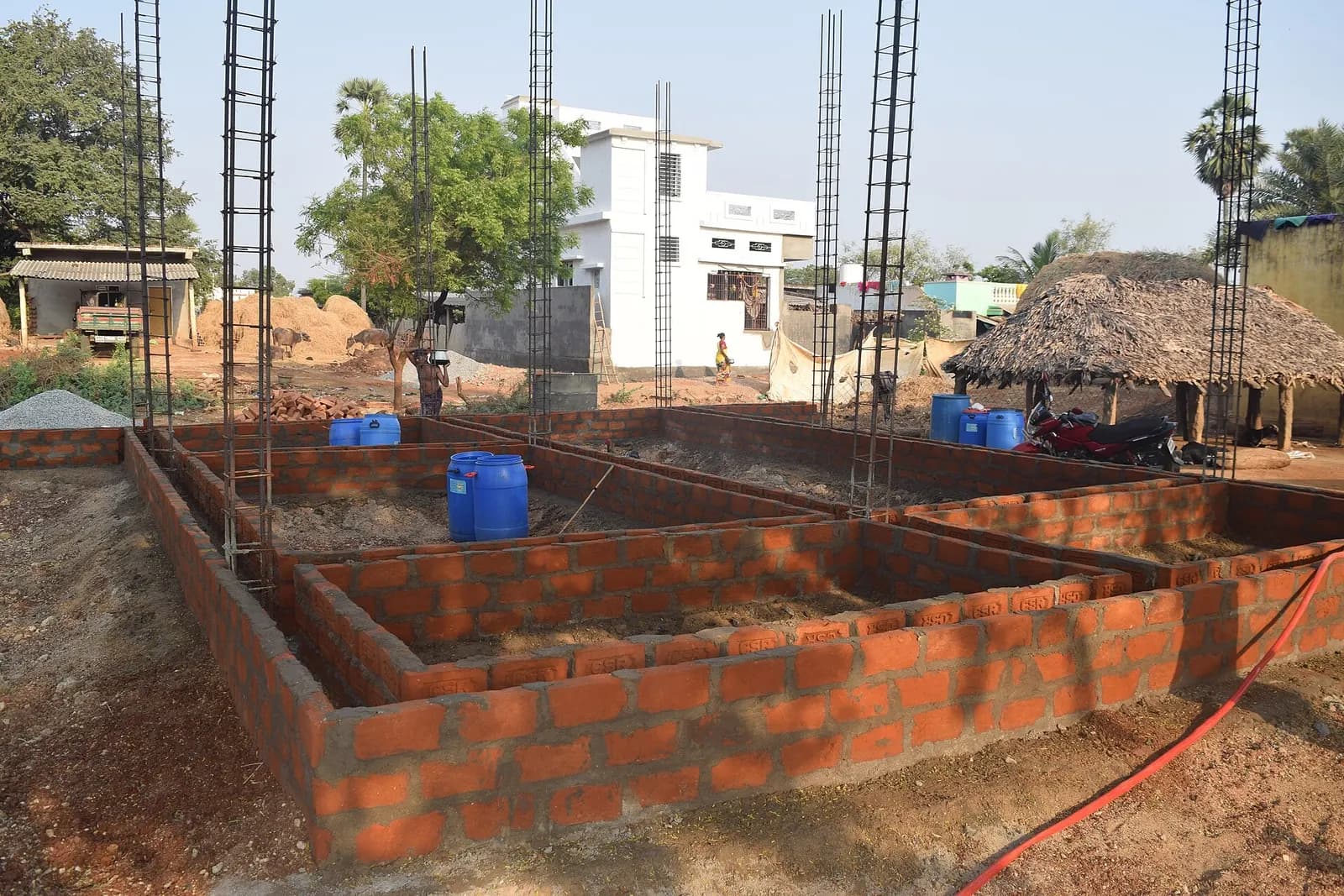
- Foundation and plinth (roughly 12–18% of cost) — excavation, PCC, footings, plinth beams, plinth masonry and filling. Black cotton soil, a high water table or a sloping plot pushes this up sharply.
- Superstructure (roughly 30–35%) — columns, beams, slabs, staircase, brick or block walls. This is where steel, cement and shuttering hire are concentrated.
- Finishing (roughly 30–40%) — plaster, flooring, tiling, doors and windows, painting, kitchen platform and railings. Your specification choices move this band the most.
- Services (roughly 12–18%) — electrical wiring, switches and distribution board; plumbing, sanitary ware, water tanks and drainage.
These shares are our estimates, consistent with the CPWD services percentages and published builder breakdowns. Use them to sanity-check a quote: if the "structure" portion of a ₹2,000 per sq ft quote is only ₹500, the contractor is either under-reinforcing or planning to recover money through variations later.
Material quantities per sq ft (thumb rules)
Engineers use quick "per sq ft of built-up area" quantities to budget an RCC-framed house before the structural drawings are ready. These are widely used estimating thumb rules, not standards — your structural engineer's design and bar-bending schedule decide the real quantities.
| Material | Thumb rule per sq ft (built-up) | For 1,000 sq ft | Price assumption used below (ex-GST) |
|---|---|---|---|
| Cement | 0.4 bag (50 kg) | 400 bags | ₹355 a bag (≈ ₹420 retail incl. GST) |
| Steel (TMT Fe500D) | 3.5–4.5 kg | 4,000 kg | ₹52 a kg (≈ ₹62 incl. GST) |
| Sand (river or M-sand) | 0.8–1.2 cft | 1,000 cft | ₹55 a cft |
| Coarse aggregate | 1.0–1.35 cft | 1,200 cft | ₹45 a cft |
| Bricks (or equivalent blocks) | about 8 | 8,000 | ₹8 each |
| Paint | 0.18 litre | 180 litres | included in painting line |
| Flooring tiles | 1.3 sq ft (with wastage) | 1,300 sq ft | included in flooring line |
The cement and steel price assumptions are based on 2026 market trackers: InfraLens lists OPC 53 cement at roughly ₹387–₹468 a bag across 50 cities, and Tata nexarc put secondary Fe500D TMT at about ₹51,600–₹56,300 a tonne in May 2026, with branded bars costing more. Sand, aggregate and brick prices differ hugely by district, so replace our numbers with three local dealer quotes.
Two refinements matter. Steel per sq ft rises with the number of storeys and with seismic zone — a G+2 house in a high-seismic area can need 5 kg per sq ft or more. And if you use AAC blocks instead of clay bricks, you'll buy fewer, larger units and less mortar, but the blocks cost more each. For concrete volumes slab by slab, our concrete calculator gives cement, sand and aggregate for any mix ratio.
City-wise construction cost per sq ft (2026 estimates)
There's no official city-wise rate for private construction, so the ranges below are MSMETOOLS estimates for a contractor-built house with materials, standard specification, ground plus one or two floors. The basis for each is shown — mainly published 2026 guides from JSW One Homes, JK Cement and Brick&Bolt, which are themselves based on builder quotes. Treat them as a first filter, not a quote.
| City | Basic (₹/sq ft) | Standard (₹/sq ft) | Premium (₹/sq ft) | Basis |
|---|---|---|---|---|
| Delhi NCR | 1,600 – 2,200 | 2,200 – 3,200 | 3,500 – 5,500 | Brick&Bolt Delhi 2026 tiers |
| Bangalore | 1,940 – 2,100 | 2,100 – 2,600 | 2,700 – 3,500+ | Brick&Bolt Bangalore packages; JSW One ₹1,800–2,500 |
| Hyderabad | 1,700 – 1,900 | 1,900 – 2,300 | 2,500 – 3,500 | JSW One ₹1,700–2,300 |
| Chennai | 1,800 – 1,900 | 1,900 – 2,200 | 2,500 – 3,500 | JSW One ₹1,900–2,200 |
| Kochi | 1,900 – 2,100 | 2,100 – 2,500 | 2,800 – 3,800 | JSW One ₹2,100–2,500 |
| Mumbai / Pune | 2,000 – 2,400 | 2,400 – 3,200 | 3,500 – 5,000 | Metro uplift of 20–30% (JK Cement) |
| Indore / tier-2 cities | 1,500 – 1,700 | 1,600 – 2,100 | 2,300 – 3,000 | JSW One Indore ₹1,600–2,100 |
Why the spread? Labour is the biggest swing factor: masons in Mumbai or Bangalore earn far more per day than in Indore or Bhubaneswar, and contractors in IT corridors charge for that. Sand is the next — states that restrict river-sand mining push builders to M-sand, which changes prices. Plot access matters too: a narrow lane that a transit mixer can't enter means site-mixed concrete and head-load labour. And height matters: Brick&Bolt notes G+1 houses cost 10–15% more per sq ft than single-storey builds in its Bangalore pricing, because of the staircase, heavier columns and scaffolding.
With material vs without material: labour-only rates
Many owners in India hire a labour contractor ("labour-only" or "without material") and buy cement, steel, sand and fittings themselves. Labour-only rates for civil work — excavation to plaster — typically run about ₹350–₹500 per sq ft in tier-2 cities, and more where finishing labour (tiling, painting, plumbing and electrical labour) is included or where wages are high; Brick&Bolt quotes ₹600–₹1,000 per sq ft for Bangalore. These are estimates; rates are negotiated locally and usually paid stage-wise (plinth, each slab, brickwork, plaster).
Labour-only looks cheaper because the contractor isn't earning a margin on material and GST is lower (see the next section). The costs are less visible: you, or someone you pay, must order, check and store material, chase deliveries on slab day, and control wastage and theft. A contractor buying at trade rates can also beat your retail prices on cement and steel. For a first house, a turnkey contract with a tight specification sheet and stage-wise payments is usually less stressful; for someone with site experience, labour-only can save 8–12%.
GST on construction: works contract vs pure labour
GST changes the per-sq-ft figure more than most owners realise, and the rules depend on what you buy.
Turnkey contract (with material). When the contractor supplies both materials and labour to build your house, it is a works contract — a composite supply of service. Since 22 September 2025 all composite works contracts, including the last concessional government entries, are taxed at 18% with input tax credit. The contractor claims credit for GST paid on cement (18%, down from 28% since the same date), steel (18%) and other inputs, and charges you 18% on the full contract value. As an individual building your own home you can't claim that GST back, so it is a real cost.
Labour-only contract. Serial number 11 of Notification 12/2017-Central Tax (Rate) exempts pure labour contracts of construction, erection, commissioning or installation of original works pertaining to a single residential unit otherwise than as part of a residential complex — rate Nil (exempt). Serial 10 separately exempts pure labour for beneficiary-led houses under PMAY / Housing for All. You still pay GST when you buy materials yourself, and the contractor can't supply any material under the exemption. Builder floors and multi-unit buildings are a grey area that has produced conflicting advance rulings, so take advice before relying on the exemption there.
Turnkey vs labour-only contract for your own house
| Turnkey (with material) | Labour-only (you buy material) | |
|---|---|---|
GST on the contract | 18% on full value, incl. margin | Nil (exempt) for a single residential unit |
GST on materials | Paid by contractor, claimed as credit | Paid by you at the counter, no credit |
Who controls quality and wastage | Contractor, against your spec sheet | You or your supervisor |
Typical saving | — | Roughly 8–12% if wastage is controlled (estimate) |
GST on the contract
- Turnkey (with material)
18% on full value, incl. margin
- Labour-only (you buy material)
Nil (exempt) for a single residential unit
GST on materials
- Turnkey (with material)
Paid by contractor, claimed as credit
- Labour-only (you buy material)
Paid by you at the counter, no credit
Who controls quality and wastage
- Turnkey (with material)
Contractor, against your spec sheet
- Labour-only (you buy material)
You or your supervisor
Typical saving
- Turnkey (with material)
—
- Labour-only (you buy material)
Roughly 8–12% if wastage is controlled (estimate)
Ready-built flats are different again: buying an under-construction flat from a builder attracts GST under separate residential real-estate rates, and a completed flat with a completion certificate attracts none. That's outside the scope of this guide.
Labour welfare cess. Under section 100 of the Code on Social Security, 2020, building work attracts a welfare cess of 1% of the cost of construction (cost of land excluded), but an individual building a house for their own residence is exempt where the total cost is up to ₹50 lakh. CPWD's rates include this cess; private quotes usually don't mention it because most homes fall under the exemption.
Worked example: estimating a 1,000 sq ft house
Here is an illustrative estimate for a 1,000 sq ft ground-floor house (2 BHK) in a tier-2 city, RCC frame on isolated footings, standard specification, built by a contractor on a turnkey (with-material) contract. All prices are MSMETOOLS assumptions at ex-GST rates, because a registered contractor recovers the GST on inputs as credit.
| Cost line | Basis | Amount (₹) |
|---|---|---|
| Cement | 400 bags × ₹355 | 1,42,000 |
| Steel | 4,000 kg × ₹52 | 2,08,000 |
| Sand | 1,000 cft × ₹55 | 55,000 |
| Aggregate | 1,200 cft × ₹45 | 54,000 |
| Bricks | 8,000 × ₹8 | 64,000 |
| Civil labour incl. shuttering | ₹380 per sq ft | 3,80,000 |
| Water, admixtures, waterproofing, curing | lump sum | 40,000 |
| Flooring and skirting (vitrified, with laying) | ~₹150 per sq ft | 1,50,000 |
| Doors and windows | 6 doors, 8 windows | 1,60,000 |
| Electrical (wiring, switches, DB) | ₹110 per sq ft | 1,10,000 |
| Plumbing and sanitary | 2 toilets + kitchen | 1,20,000 |
| Painting (putty + emulsion) | interior + exterior | 90,000 |
| Kitchen platform, railings, miscellaneous | lump sum | 70,000 |
| Direct cost | 16,43,000 | |
| Contractor's overheads and profit | 12% | 1,97,160 |
| Contract value before GST | 18,40,160 | |
| GST on works contract | 18% | 3,31,229 |
| Total payable | ≈ ₹21,71,389 |
That is about ₹2,171 per sq ft including GST — within the standard band for most tier-2 cities and below the CPWD government-quarter benchmark of about ₹2,755 per sq ft with services, which is what you'd expect for a single-storey private house with a simpler specification.
Outside the per-sq-ft figure, budget separately for: plan approval and development charges (vary by municipality), architect and structural design, soil test, borewell and sump, compound wall and gate, electricity and water connections, and a 10% contingency. On this house, those items can easily add ₹2–4 lakh.
If the same owner hired a labour-only contractor at ₹450 per sq ft for all labour (₹4.5 lakh, GST-exempt) and bought materials directly, they'd pay GST on materials at the counter with no credit, save the 12% contractor margin and the 18% GST on labour and margin, and take on the supervision risk. On these numbers the saving is roughly ₹1.5–2.5 lakh — real money, but only if wastage stays under control.
How to calculate construction cost per sq ft for your project
Work through it in this order, so nothing drops out of the comparison.
Calculate your own per-sq-ft cost
- 1
Fix the built-up area
Take the built-up area of every floor from the architect's drawings, including staircase and balconies, and agree with the contractor how each is counted.
- 2
Write the specification
Brand and grade of cement and steel, tile allowance per sq ft, door and window type, sanitary and electrical brands, paint system.
- 3
Estimate structure quantities
Use the structural drawings (or the thumb rules above at concept stage) and price them at local dealer rates.
- 4
Add labour and finishing packages
Stage-wise labour plus quoted rates for flooring, doors, electrical, plumbing and painting.
- 5
Add margin and GST
Contractor's overheads and profit plus 18% GST on a turnkey contract — or GST on materials you buy for a labour-only job.
- 6
Divide and compare
Divide by built-up area and compare with the city band and the CPWD benchmark. Keep approvals, design, utilities and a 10% contingency outside the comparison.
Mistakes that blow up the per-sq-ft budget
- Comparing quotes on different areas. One quote on carpet area and one on built-up area can differ by 20% for the same house.
- Accepting "brand allowances" without numbers. "Branded tiles" with no rupee allowance per sq ft invites substitution.
- Ignoring soil. A deep foundation or raft can add several hundred rupees per sq ft on the ground floor; get a soil test before you finalise the budget.
- No stage-wise payment schedule. Paying a large advance removes your leverage. Tie each payment to a measurable stage.
- Forgetting GST on the contract. An 18% line on a ₹18 lakh contract is more than ₹3 lakh; ask whether the quote is inclusive or exclusive of GST.
- Changing the design mid-way. Variations are where contractors recover thin margins. Freeze drawings before work starts.
Official links
- CPWD Plinth Area Rates 2025 (PDF)Official per sq m rates, services percentages, cost index
- CPWD websitePublications and cost index circulars
- GST Council — 56th meeting press releaseWorks contract and cement rate changes from 22 Sep 2025
- Notification 12/2017 — services exemptions (Telangana consolidated copy)S.No. 11 pure labour for a single residential unit
- CBIC GST portalCurrent rate notifications
What to do next
Start with drawings and a specification sheet, then run the quantity method above with three local dealer quotes for cement, steel and sand — our concrete calculator speeds up the slab and footing quantities. Ask at least three contractors to price the same specification, and compare their rates against the city band and the CPWD benchmark. If you're a contractor yourself, put your rate analysis into the quotation generator and read our construction business plan for margins, GST TDS and working capital; for the tax side, see GST on cement and input tax credit. Planning the inside of the house too? Our guide to running an interior design business explains how fit-out is priced.
This is general information, not legal or tax advice — confirm on the official source or with a professional. Market prices and city ranges are estimates; get written local quotes before you commit.
Frequently asked questions
For an ordinary RCC-framed house built by a contractor with materials, most published 2026 estimates fall between about ₹1,600 and ₹2,600 per sq ft of built-up area, rising to ₹3,000–₹5,500 for premium finishes in metros. The official CPWD benchmark for government residential quarters is ₹24,410 per sq m (about ₹2,268 per sq ft) before services. Land, approvals and interiors are extra.
CPWD's Plinth Area Rates 2025, with base date 1 April 2025, put residential quarters and hostels with an RCC frame and 3.0 m floor height at ₹24,410 per sq m, and composite load-bearing structures at ₹20,750 per sq m. These include GST, contractor's profit and labour cess; internal electrical work (12.5%) and plumbing (9%) are added on top.
The usual planning thumb rules for an RCC-framed house are about 0.4 bags of cement and 3.5–4.5 kg of steel per sq ft of built-up area, with roughly 1.0–1.2 cubic feet each of sand and aggregate and about 8 bricks. Multi-storey buildings and poor soil push steel up. Use these only for budgeting; order from your structural drawings and bar-bending schedule.
Labour-only rates, where you buy all materials yourself, typically run about ₹350–₹700 per sq ft depending on city and how much finishing labour is included; Bangalore contractors quote more. Labour is usually 25–30% of the total cost. A pure labour contract for your own single house is exempt from GST, unlike a contract that includes materials.
Yes, if your contractor supplies materials and labour together — that is a works contract taxed at 18% with input tax credit. A pure labour contract for building a single residential unit that isn't part of a residential complex is exempt. Either way, you pay GST on materials you buy yourself, such as cement and steel at 18%.
Add up every cost line — structure materials, labour, flooring, doors and windows, electrical, plumbing, painting, the contractor's margin and GST — and divide by the total built-up area of all floors. Don't divide by carpet area or plot area. Then add approvals, soil test, architect fees, borewell, compound wall and a 10% contingency outside the per-sq-ft figure.
Sources & verification
Figures on this page were checked against the sources below when it was last reviewed on 9 October 2026. Each rate and limit is stored once with its own official source and review date, and official update channels are monitored daily so changes are picked up. How we verify
- 1.Plinth Area Rates 2025 (as on 01.04.2025) — Central Public Works Department · accessed 9 October 2026
- 2.Notification No. 12/2017-State Tax (Rate) as amended — Telangana consolidated copy — Commercial Taxes Department, Telangana · accessed 9 October 2026
- 3.Recommendations of the 56th GST Council meeting (press release) — GST Council / PIB · accessed 9 October 2026
- 4.[Analysis] BOCW Cess under Code on Social Security 2020 — Taxmann · accessed 9 October 2026
- 5.Home construction cost in India — per sq ft rates and city-wise budget guide — JSW One Homes · accessed 9 October 2026
- 6.Cost of building a house in India: your complete 2026 guide — JK Cement · accessed 9 October 2026
- 7.House construction cost in Delhi (2026): ₹/sq ft + full cost breakdown — Brick&Bolt · accessed 9 October 2026
- 8.How much does it cost to build a house in Bangalore in 2026 — Brick&Bolt · accessed 9 October 2026
- 9.Steel prices in India (2026) — Tata nexarc · accessed 9 October 2026
- 10.Cement prices across 50 cities — InfraLens · accessed 9 October 2026
MSMETOOLS is an independent platform and is not affiliated with any government agency, ministry or department.
Tools for this
Construction Material Calculator
Estimate cement, sand and aggregate for slabs.
Quotation Generator
Create professional quotes for clients.
GST Calculator (India)
Calculate GST for your sales and purchases with current rates.
Budget Planner
Plan and track your business budget easily.
Related guides
 Construction Business Plan 2026: Costs, CPWD Classes & GSTRead guide
 Interior Design Business in India 2026: GST, Pricing & P&LRead guide
 What Is Bill of Quantities (BOQ)? Format & Example (2026)Read guide
 Start a Real Estate Business in India (2026): RERA & TaxRead guide
Official links open the government site in a new tab.