 HR, payroll & labor
Form 941 in 2026: The Quarterly Payroll Return, Deposit Schedules and Penalties
Form 941 for 2026: quarterly due dates, monthly vs semiweekly deposits, the $50,000 lookback and $100,000 next-day rule, Form 944, penalties and a worked example.
 Edited by Sumeet YadavFounder & editor, MSMETOOLS · fact-checked against official sources
Contents (10)
- 1. What Form 941 reports
- 2. Form 941 due dates for 2026
- 3. Monthly or semiweekly: working out your deposit schedule
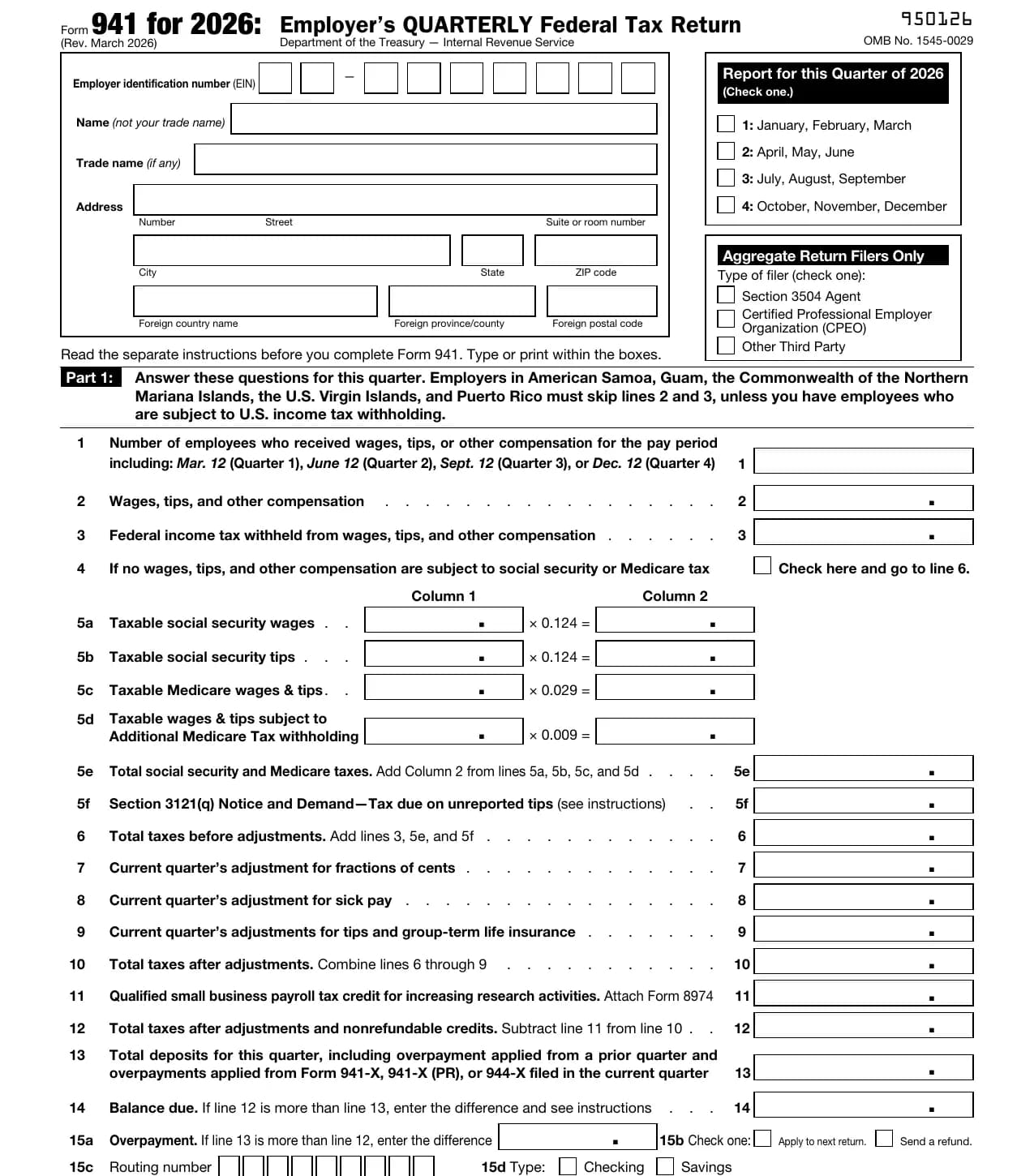
- 4. How to fill out Form 941, line by line
- 5. Worked example: a bakery's third quarter
- 6. Form 944: the annual alternative for very small employers
- 7. Penalties for late deposits, late filing and unpaid trust fund taxes
- 8. Correcting mistakes with Form 941-X
- 9. What changed for 2026
- 10. What to do next
The day you run your first payroll, you also take on a quarterly IRS filing: Form 941. It's the return where you report every W-2 employee's wages, the income tax you withheld from them, and the Social Security and Medicare tax you and they owe, and then prove you've already sent that money to the Treasury. This guide is for small employers and the owners of S corporations who pay themselves a salary. It covers the 2026 due dates, how to work out whether you deposit monthly or semiweekly, the $100,000 next-day rule, when you can file the annual Form 944 instead, the penalties that make late deposits expensive, and a full worked quarter. Rules were checked against the March 2026 Form 941 instructions and Publication 15 (2026) in October 2026.
Quick answer
Form 941 is the Employer's Quarterly Federal Tax Return. You file it four times a year to report wages, federal income tax withheld, and both shares of Social Security and Medicare tax. The tax itself is paid earlier, through electronic deposits on a monthly or semiweekly schedule set by your lookback period. The return just reconciles what you owed with what you deposited.
Due April 30, July 31, October 31 and January 31 (10 more days if all deposits were on time)
Monthly depositor if lookback-period tax was $50,000 or less; semiweekly if more
$100,000 accumulated on any day: deposit by the next business day
2026 rates: Social Security 6.2% each on wages up to $184,500; Medicare 1.45% each, no cap
Tiny employers ($1,000 or less a year) may file Form 944 annually, but only if the IRS approves
What Form 941 reports
Form 941 covers three federal taxes that ride on wages. The first is the federal income tax you withheld from employees' paychecks based on their Forms W-4. The second and third are Social Security and Medicare tax, together called FICA. Each has an employee share you withhold and an identical employer share you pay from your own pocket: 6.2% each for Social Security on wages up to $184,500 in 2026, and 1.45% each for Medicare with no wage cap. On top of that, you withhold an extra 0.9% Additional Medicare Tax from any employee's wages above $200,000 in the calendar year, with no employer match.
What's not on Form 941 matters just as much. Federal unemployment tax (FUTA) goes on the annual Form 940. State income tax withholding and state unemployment insurance go on state returns, which most states also require quarterly. Payments to independent contractors don't appear on Form 941 at all; they're reported on Form 1099-NEC. If you aren't sure whether someone is an employee, read our 1099 vs W-2 guide before your first payroll.
Who files it? Almost every employer that pays wages subject to income tax withholding or FICA, including a single-owner S corporation whose only employee is the owner. Seasonal employers who don't pay wages in some quarters can check a box to say so instead of filing for those quarters, and household and farm employers use other forms (Schedule H and Form 943). Once you've filed one Form 941, the IRS expects one every quarter until you file a final return, even if a quarter's tax is zero.
Form 941 due dates for 2026
Each quarterly return is due on the last day of the month after the quarter ends. The instructions give employers who deposited all of the quarter's tax on time an extra 10 days, to the 10th of the second month after the quarter. When a due date lands on a Saturday, Sunday or legal holiday, you file by the next business day.
| Quarter | Months covered | Quarter ends | Form 941 due | If all deposits on time |
|---|---|---|---|---|
| Q1 2026 | January–March | March 31 | April 30 | May 10 (Monday, May 11 in 2026) |
| Q2 2026 | April–June | June 30 | July 31 | August 10 |
| Q3 2026 | July–September | September 30 | October 31 (Monday, November 2 in 2026) | November 10 |
| Q4 2026 | October–December | December 31 | January 31 (Monday, February 1 in 2027) | February 10 |
Don't confuse the return due date with the deposit due date. The return is quarterly; the money usually goes in monthly or semiweekly, long before the return is filed. Only employers whose liability is tiny can skip deposits and pay with the return, as explained below.
Monthly or semiweekly: working out your deposit schedule
Your deposit schedule has nothing to do with how often you pay people. A business that pays every week can be a monthly depositor, and one that pays monthly can be a semiweekly depositor. The schedule depends only on the total tax you reported on Form 941 line 12 during the lookback period: the four quarters running from July 1 of the second preceding year to June 30 of the prior year. For 2026, that's July 1, 2024 through June 30, 2025. You determine your schedule once, before the year starts, and it holds for the whole calendar year unless the $100,000 rule kicks in.
If the lookback total was $50,000 or less, you're a monthly schedule depositor: the taxes on wages paid during a month are due by the 15th of the following month. If it was more than $50,000, you're a semiweekly schedule depositor, and the deadline depends on the payday. Taxes on wages paid on a Wednesday, Thursday or Friday are due by the following Wednesday. Taxes on wages paid on a Saturday, Sunday, Monday or Tuesday are due by the following Friday. If one semiweekly period spans two quarters, you make separate deposits for each quarter's liability, even if they're due the same day.
Publication 15 treats any quarter in the lookback period before you started the business as zero, so new employers are monthly depositors for their first calendar year. Working out the schedule before each year starts is your responsibility, not your payroll provider's. Semiweekly depositors must attach Schedule B (Form 941), which lists the tax liability for each payday, instead of filling in the monthly summary on line 16.
Which deposit rule applies?
Step 1
Add Form 941 line 12 for July 1, 2024 – June 30, 2025
Step 2
$50,000 or less → monthly
deposit by the 15th of next month
Step 3
More than $50,000 → semiweekly
Wed or Fri after payday; file Schedule B
Step 4
$100,000+ accumulated on any day
deposit next business day; become semiweekly
Step 5
Quarter total under $2,500
may pay with a timely Form 941 instead
The $100,000 next-day deposit rule
If you accumulate $100,000 or more of tax on any single day during a deposit period, you must deposit it by the next business day, whichever schedule you're normally on. The threshold is measured before nonrefundable credits. For a small business this usually happens only once, typically with a large bonus run or a big catch-up payroll. A monthly depositor who triggers it becomes a semiweekly depositor immediately, for the rest of that year and for the next year.
The $2,500 de minimis rule
If your total tax for the current quarter (line 12) is less than $2,500, and either the prior quarter's was also under $2,500 or you didn't trigger a next-day deposit in the current quarter, you can pay the quarter's tax with a timely filed Form 941 instead of depositing it. The instructions warn that if you aren't sure you'll stay under the line, you should deposit on your normal schedule anyway, because guessing wrong turns the whole quarter into late deposits.
All federal tax deposits must be made electronically, usually through EFTPS or IRS Direct Pay, or by same-day wire. With EFTPS, schedule the payment at least a day ahead of the due date, before the system's evening cutoff, so it settles on time. A deposit due on a weekend or legal holiday is on time if it's made by the next business day.
How to fill out Form 941, line by line
Payroll software and payroll providers prepare Form 941 automatically, but you still sign it and you're still liable for errors. Knowing what each part does helps you catch mistakes before they become penalties.
Completing Form 941
- 1
Header
Enter your EIN, legal name and address, and tick the quarter. The March 2026 revision adds an Aggregate Return Filers Only box that most small employers leave blank; it's for section 3504 agents, certified PEOs and other third parties filing for several clients.
- 2
Line 1 — Employees
Count the employees paid for the pay period that includes March 12, June 12, September 12 or December 12, depending on the quarter.
- 3
Lines 2–3 — Wages and income tax withheld
Line 2 is the quarter's total that will go in box 1 of employees' W-2s. Line 3 is the federal income tax you withheld.
- 4
Lines 5a–5e — Social Security and Medicare
Enter taxable wages and tips in column 1. Column 2 multiplies by 0.124 (Social Security, both shares), 0.029 (Medicare, both shares) and 0.009 (Additional Medicare). Line 5e totals them.
Tip: Stop counting an employee's wages on line 5a once they pass the $184,500 wage base.
- 5
Lines 6–12 — Totals and adjustments
Line 7 fixes fractions of cents from rounding each paycheck; lines 8–9 cover sick pay and tip adjustments; line 11 is the small-business research payroll credit. Line 12 is your total tax for the quarter.
- 6
Lines 13–15 — Deposits and balance
Line 13 is what you deposited. A balance due on line 14 should be paid electronically. An overpayment on line 15 can be applied to the next return or, new in 2026, refunded by direct deposit.
- 7
Part 2 — Deposit schedule
Monthly depositors enter the liability for each month on line 16; semiweekly depositors tick the box and attach Schedule B. The monthly figures must add up to line 12.
- 8
Parts 3–5 — Business details and signature
Tell the IRS if you closed or stopped paying wages, name a third-party designee if you want, and sign. An unsigned return isn't a valid return.
Worked example: a bakery's third quarter
Maple Street Bakery LLC in Ohio has six employees, pays every other Friday, and has been in business since 2022. Its Form 941 line 12 totals for the lookback period (Q3 2024 through Q2 2025) add up to $46,200, which is under $50,000, so it's a monthly depositor for all of 2026. In the third quarter of 2026 (July to September) it pays $78,000 of wages, evenly spread at $26,000 a month, and withholds $7,500 of federal income tax. No employee is anywhere near the Social Security wage base or the Additional Medicare threshold.
Maple Street Bakery, Q3 2026 Form 941
$9,672
Line 5a: $78,000 × 0.124
Social Security, both shares
$2,262
Line 5c: $78,000 × 0.029
Medicare, both shares
$19,434
Line 12 total tax
$7,500 income tax + $11,934 FICA
$6,478
Monthly liability on line 16
deposit by the 15th of the next month
Of the $19,434, the employees' paychecks bore $13,467 (the $7,500 of income tax plus their $5,967 half of FICA) and the bakery bore $5,967 as its employer share. That $5,967 is a real cost of payroll on top of wages, before FUTA and state unemployment tax. It's why a $26,000 monthly payroll costs the business more like $28,000.
The deposits fall due on the 15th of the month after each payroll month. July's $6,478 is due August 15, 2026, which is a Saturday, so it's on time if made by Monday, August 17. August's is due Tuesday, September 15, and September's by Thursday, October 15. Because October 31, 2026 is a Saturday, the return itself is due Monday, November 2, and since every deposit was on time the bakery may file as late as November 10. Line 16 shows $6,478 for each month, and line 13 shows $19,434 deposited, so line 14 is zero.
Now suppose the bakery's lookback total had been $61,000. It would be a semiweekly depositor. Its Friday paydays would each create a deposit due the following Wednesday, it would report each payday's liability on Schedule B, and missing a single Wednesday would trigger the penalty for that deposit. Same payroll, same tax, much tighter calendar.

Form 944: the annual alternative for very small employers
Form 944 is the annual version of Form 941 for the smallest employers, those whose total employment tax liability for the year is $1,000 or less. The Form 944 instructions say that at current rates, paying about $5,000 or less in wages in a year generally keeps you under that line. Think of a sole proprietor with one occasional part-time helper.
You can't choose Form 944 on your own. You file it only if the IRS has notified you in writing to do so. If you've been filing Form 941 and expect to qualify for 2026, the Form 944 instructions said to call the IRS between January 1 and April 1, 2026, or send a written request postmarked between January 1 and March 16, 2026; the same windows, adjusted for the calendar, apply each year. It works in reverse too: an employer told to file Form 944 can ask, in the same first-quarter window, to file quarterly Forms 941 instead. Form 944 is due by January 31 of the following year, and if the year's liability is under $2,500 you can pay it with the return.
An S corporation owner who takes a reasonable salary will almost always be above the Form 944 line. A $50,000 salary alone creates $7,650 of FICA before any income tax withholding. That's one more reason payroll setup matters for S corporations; see how to pay yourself from an LLC and our guide to the Form 2553 S corp election.
Penalties for late deposits, late filing and unpaid trust fund taxes
Payroll tax penalties stack quickly, and the IRS treats withheld taxes, money that belonged to your employees, more seriously than almost any other debt. Publication 15 sets out four layers.
The failure-to-deposit penalty depends on how late the deposit is: 2% (1–5 days late), 5% (6–15 days), 10% (16+ days), 15% (10+ days after an IRS demand). It applies to each deposit separately. If the bakery in the example had made its $6,478 August deposit 10 days late, the penalty would be 5%, or $323.90, even though the quarterly return was filed on time. The IRS applies deposits to the most recent liability first unless you designate otherwise within 90 days of a penalty notice, which can turn one late deposit into a chain of them.
Payroll tax penalty ladder
| Penalty | Rate | Applies to |
|---|---|---|
Failure to deposit | 2% / 5% / 10% / 15% | Each late or short deposit: 1–5 days, 6–15 days, 16+ days, or 10+ days after an IRS demand |
Failure to file | 5% of the unpaid tax for each month or part month, up to 25% | Unpaid tax on a late Form 941 |
Failure to pay | 0.5% a month, up to 25% | Tax paid after the due date |
Trust fund recovery | 100% of the unpaid trust fund tax | Withheld income tax and employee FICA not paid over; assessed personally |
Failure to deposit
- Rate
2% / 5% / 10% / 15%
- Applies to
Each late or short deposit: 1–5 days, 6–15 days, 16+ days, or 10+ days after an IRS demand
Failure to file
- Rate
5% of the unpaid tax for each month or part month, up to 25%
- Applies to
Unpaid tax on a late Form 941
Failure to pay
- Rate
0.5% a month, up to 25%
- Applies to
Tax paid after the due date
Trust fund recovery
- Rate
100% of the unpaid trust fund tax
- Applies to
Withheld income tax and employee FICA not paid over; assessed personally
The failure-to-file penalty is 5% of the unpaid tax for each month or part month, up to 25%. The failure-to-pay penalty is 0.5% a month, up to 25%. Interest runs on top of all of these.
The heaviest is the trust fund recovery penalty. If withheld income tax and the employee share of FICA aren't paid over, the IRS can assess 100% of the unpaid trust fund tax personally against anyone responsible for collecting and paying them who acted willfully: owners, officers, and sometimes bookkeepers or employees with signing authority. An LLC or corporation doesn't shield you from it. Publication 15 notes that paying other bills instead of the withheld taxes counts as willful.
There's some relief. The penalties don't apply if you show reasonable cause and not willful neglect. The IRS may also waive a deposit penalty for an inadvertent failure in the first quarter you were required to deposit, or the first deposit after your schedule changed, if you filed the return on time and meet the net worth limits for businesses ($7 million and no more than 500 employees). It can also waive the penalty the first time you mistakenly mail a payment to the IRS instead of depositing it electronically.
Correcting mistakes with Form 941-X
You don't amend Form 941 by filing another 941. Errors on a filed return are fixed with Form 941-X, filed separately for the quarter being corrected, and now available for electronic filing through Modernized e-File. Publication 15 explains that underreported tax corrected on time can qualify as an interest-free adjustment, so correct and pay it as soon as you find it. Overreported tax can be either adjusted on a future return or claimed as a refund. Fix the matching W-2s with Form W-2c at the same time so the Social Security Administration's records line up with the IRS's.
What changed for 2026
The March 2026 revision of Form 941 is the one to use for every quarter of 2026; the IRS says don't use an earlier revision for 2026 periods. It adds the Aggregate Return Filers Only box for agents and PEOs, and new direct deposit lines (15b to 15e) because, under Executive Order 14247 of March 25, 2025, the IRS now issues Form 941 refunds by direct deposit and asks employers to pay balances electronically. Form 941 transcripts for 2023 and later are available in your IRS business tax account.
The One Big Beautiful Bill Act's new deductions for qualified tips (up to $25,000) and qualified overtime pay (up to $12,500, or $25,000 for joint filers), available for 2025 through 2028, are claimed by workers on their own income tax returns. The Form 941 instructions are clear that tips and overtime remain subject to both shares of Social Security and Medicare tax, so your FICA on Form 941 doesn't change. What may change is income tax withholding, if employees give you updated Forms W-4 to reflect the deductions, plus new W-2 reporting of tips and overtime. Our overtime guide explains how to calculate the overtime premium in the first place.
Quarter-end Form 941 checklist
0/8Official links
- IRS — About Form 941Current form and instructions
- IRS — Instructions for Form 941Rev. March 2026
- IRS — Publication 15 (Circular E)Deposit rules and penalties
- IRS — Instructions for Schedule B (Form 941)Semiweekly depositors
- IRS — Instructions for Form 944Annual return for very small employers
- IRS — Depositing and reporting employment taxesEFTPS and deposit basics
What to do next
Before your next payroll, confirm your deposit schedule, enrol in EFTPS if you haven't, and put every deposit due date for the rest of the year in a shared calendar. If you're about to hire your first employee, check the minimum wage for your state and get an EIN first. The salary slip generator gives employees a clear record of gross pay and deductions each payday.
This is general information, not legal or tax advice — confirm on the official source or with a professional.
Frequently asked questions
Form 941, the Employer's Quarterly Federal Tax Return, reports the wages you paid in a quarter, the federal income tax you withheld from employees, and both the employee and employer shares of Social Security and Medicare tax. It also reconciles those liabilities against the deposits you made. Most employers with W-2 employees file it four times a year, even in quarters when no tax is owed.
Form 941 is due by the last day of the month after each quarter ends: April 30, July 31, October 31 and January 31. If you deposited all tax for the quarter on time, you get until the 10th of the following month. When a due date falls on a weekend or legal holiday, the next business day counts, so the third-quarter 2026 return is due Monday, November 2.
It depends on the total tax you reported on Form 941 line 12 during the lookback period, which for 2026 runs from July 1, 2024 to June 30, 2025. If that total was $50,000 or less, you're a monthly depositor; if more, you're semiweekly. New employers are monthly depositors in their first calendar year. How often you run payroll doesn't matter.
If you accumulate $100,000 or more of employment tax on any day during a deposit period, you must deposit it by the next business day, whatever your normal schedule. A monthly depositor who triggers the rule immediately becomes a semiweekly depositor for the rest of that year and the following year.
Only if the IRS has notified you in writing. Form 944 is an annual return for very small employers whose yearly employment tax liability is $1,000 or less, which the IRS says generally means about $5,000 or less in wages. To switch for a year, call the IRS between January 1 and April 1 or send a written request postmarked by mid-March.
The failure-to-deposit penalty is 2% (1–5 days late), 5% (6–15 days), 10% (16+ days), 15% (10+ days after an IRS demand). Filing Form 941 late adds 5% of the unpaid tax for each month or part month, up to 25%, and paying late adds 0.5% a month, up to 25%. If withheld taxes aren't paid over, the IRS can assess the trust fund recovery penalty, 100% of the unpaid trust fund tax, personally against owners or officers responsible.
Sources & verification
Figures on this page were checked against the sources below when it was last reviewed on 9 October 2026. Each rate and limit is stored once with its own official source and review date, and official update channels are monitored daily so changes are picked up. How we verify
- 1.Instructions for Form 941 (Rev. March 2026) — Internal Revenue Service · accessed 9 October 2026
- 2.Publication 15 (2026), (Circular E), Employer's Tax Guide — Internal Revenue Service · accessed 9 October 2026
- 3.Instructions for Form 944 (2025) — Internal Revenue Service · accessed 9 October 2026
- 4.About Form 941, Employer's Quarterly Federal Tax Return — Internal Revenue Service · accessed 9 October 2026
- 5.Form 941 for 2026 (Rev. March 2026) — Internal Revenue Service · accessed 9 October 2026
- 6.Instructions for Schedule B (Form 941) — Internal Revenue Service · accessed 9 October 2026
- 7.Depositing and reporting employment taxes — Internal Revenue Service · accessed 9 October 2026
MSMETOOLS is an independent platform and is not affiliated with any government agency, ministry or department.
Tools for this
Salary Slip Generator
Create professional salary slips in seconds.
Federal Tax Calculator (US)
Estimate federal income tax for individuals and businesses.
Freelance Hourly Rate Calculator
Work out the hourly rate you need to charge.
Related guides
 How to Calculate Overtime Pay (2026): Rules & ExamplesRead guide
 Minimum Wage by State (2026): Hourly Rates, Tipped & 2027Read guide
 Workers' Compensation Insurance (2026): Rules, Rates, CostsRead guide
 Form I-9 (2026): Edition, Documents, Deadlines & FinesRead guide
Official links open the government site in a new tab.