 HR, payroll & labour
Minimum Wages in Sikkim (2026): Daily Rates, Skill Grades and High-Altitude Pay
Sikkim minimum wages 2026: ₹500 a day for unskilled work, up to ₹565 highly skilled, plus 50–100% extra at high altitude — grades, monthly pay and examples.
 Edited by Sumeet YadavFounder & editor, MSMETOOLS · fact-checked against official sources
- Rates in force
- from 11 July 2022
- Last checked
- Against the official source on 12 October 2026
- Next revision due
- 1 October 2026 (not yet notified)
No revision notified since July 2022. The rates in force from 11 July 2022 are still the latest on the official source; a revision was due by 1 October 2026. Any later order may carry arrears back to its own effective date.
Contents (14)
- 1. How Sikkim's minimum wages work
- 2. Which employments are covered
- 3. Placing each worker in a grade
- 4. Monthly pay, hours, holidays and overtime
- 5. High-altitude pay
- 6. When will Sikkim revise the rates?
- 7. The Sikkim Code on Wages Rules, 2022
- 8. Central-sphere work in Sikkim
- 9. Worked payroll examples in ₹
- 10. Contract and migrant workers
- 11. Employer duties under the Code on Wages
- 12. Common mistakes Sikkim employers make
- 13. What happens if you underpay
- 14. What to do next
If you run a hotel on Gangtok's MG Marg, a pharmaceutical unit in the Rangpo–Majitar belt, a homestay in Pelling, a coaching centre in Namchi or a road crew in North Sikkim, the Sikkim Labour Department sets the least you can pay through one notification. It fixes four daily rates by skill, lists hundreds of job titles under each grade, and — uniquely among Indian states — raises the rate by 50% to 100% for work at high altitude. This guide takes every figure from the Sikkim Government Gazette, shows how to place each worker in a grade, works out monthly and altitude pay, explains where central rates apply instead, and works through payroll in rupees.
Quick answer
Sikkim's minimum wages, in force since 11 July 2022 under notification No.29/DL dated 14 September 2022, are ₹500 a day for unskilled work, ₹520 a day for semi-skilled, ₹535 a day for skilled and ₹565 a day for highly skilled work, including dearness allowance.
+50% from 8,001 ft, +75% from 12,001 ft, double above 16,000 ft
About ₹15,000 a month for unskilled full-time work (26 days + paid weekly holidays)
Overtime at double the rate beyond 8 hours a day or 48 a week
No revision since 2022 as of 12 October 2026
How Sikkim's minimum wages work
Sikkim revised its minimum wages under section 5 of the old Minimum Wages Act, 1948, in two steps. A proposal was published in Gazette No.278 on 11 July 2022, inviting objections for 60 days. After considering them, the Labour Department issued notification No.29/DL on 14 September 2022, printed in Sikkim Government Gazette Extraordinary No.368 the same day, with the new rates applying from 11 July 2022. It replaced notification No.11/DL of 15 September 2017.
The notification is simple in structure. It fixes one daily rate for each of four skill grades, lists the jobs that belong in each grade, and applies the same rates to all nine scheduled employments. The rates include dearness allowance but exclude any other concession a worker already enjoys, so free food or lodging can't be set off against them.
| Grade | Rate until 10 July 2022 | Rate from 11 July 2022 | Increase |
|---|---|---|---|
| Unskilled | ₹300 | ₹500 a day | ₹200 (67%) |
| Semi-skilled | ₹320 | ₹520 a day | ₹200 (63%) |
| Skilled | ₹335 | ₹535 a day | ₹200 (60%) |
| Highly skilled | ₹365 | ₹565 a day | ₹200 (55%) |
The flat ₹200 rise on every grade narrowed the gap between them. Today a highly skilled heavy-vehicle driver's floor is only ₹65 a day above an unskilled helper's.
These rates continue to apply under the Code on Wages, in force since 21 November 2025, until Sikkim fixes new rates under it.
Sikkim minimum wage calculator
A full month is 26 working days; the daily rate is the monthly rate ÷ 26 where the order fixes only a monthly figure.
Overtime is paid at twice the ordinary rate (daily rate ÷ 8 hours). Arrears assume the same shortfall in every month since the rates took effect on 11 July 2022; a claim under the Code on Wages must generally be filed within 3 years. Estimates only — check the order for your employment.
Which employments are covered
The schedule to the notification lists nine employments:
- Shops and commercial establishments.
- Industries manufacturing drugs and pharmaceuticals.
- Hydro-power projects.
- Distilleries and breweries.
- Construction of projects, including dams and multi-purpose projects.
- Hospitals, nursing homes and clinics, other than government hospitals and dispensaries.
- Private educational institutions, including tutorial institutions and computer coaching centres, excluding teaching staff.
- Casual contingency employees of government, semi-government bodies and public sector undertakings who are not covered by the state's regularisation policy.
- Any other industrial or manufacturing unit not listed.
The shops and commercial establishments entry is the broadest. It takes in retail shops, restaurants, hotels, homestays, travel agencies, offices and most service businesses in Gangtok, Namchi, Gyalshing, Mangan, Rangpo and Singtam. The "any other industrial unit" entry catches manufacturing that isn't named, from bakeries to furniture workshops. Teachers in private schools and coaching centres are excluded, but their office staff, drivers, peons and guards are covered.
Placing each worker in a grade
Sikkim's notification is more helpful than most because it names jobs. If a question arises about a worker's grade, the notification says it goes to the Labour Department, whose decision is final.
Unskilled (₹500 a day) — chowkidar, peon, safai karmachari, waiter, cleaner, packer, helper, office boy, mali, khalasi, shop assistant, service boy, room attendant, hospital or dispensary attendant, conductor, bill collector, yak, mule and pony attendants, grass cutter, field worker, and a security guard without stated experience.
Semi-skilled (₹520 a day) — assistant fitter, assistant welder, assistant painter, baker, pump man, gatekeeper, booking assistant, storekeeper, salesman, lineman, crane, compressor, engine and stone-crusher operators, mechanic, supervisor, tailor, dhobi, cobbler, barber, turbine operator, mixer operator, and a security guard with two years' experience.
Skilled (₹535 a day) — electrician, pipe fitter, carpenter, mason, painter, cook, quality controller, turner, machine man, chemist, foreman, boiler attendant, laboratory technician, radiographer, computer operator, LDC or typist, light-vehicle driver, draughtsman, welder-cum-denter, petrol pump manager, cable or fibre technician, and a security guard with five years' experience who has passed Class XII or works as a security supervisor.
Highly skilled (₹565 a day) — heavy-vehicle driver, bulldozer, excavator or roller operator, JCB driver, a plumber, welder, foreman, electrician, draughtsman or computer mechanic with an ITI certificate or diploma, and a security guard with eight years' experience and a degree, or an ex-Army JCO.
Two things follow. A cook in a Gangtok restaurant is skilled, not a helper. And an electrician jumps from skilled to highly skilled once he holds an ITI certificate or diploma, so check qualifications when you hire.
Monthly pay, hours, holidays and overtime
The notification fixes daily rates and three working rules:
- A worker who works six days in a row without absence gets one paid holiday that week, on Sunday or another haat (market) day.
- No worker may be made to work more than nine hours a day, including a one-hour break.
- Work beyond eight hours a day or 48 hours a week is overtime, paid at twice the ordinary rate.
The paid holiday is what turns the daily rate into a monthly figure. A full-time worker on a six-day week works about 26 days a month and is paid for about four weekly holidays as well, so the monthly minimum is roughly 30 days' pay:
| Grade | Day | Month (30 days' pay) | Hourly (÷ 8) | Overtime hour |
|---|---|---|---|---|
| Unskilled | ₹500 a day | ₹15,000 | ₹62.50 | ₹125 |
| Semi-skilled | ₹520 a day | ₹15,600 | ₹65 | ₹130 |
| Skilled | ₹535 a day | ₹16,050 | ₹66.88 | ₹133.75 |
| Highly skilled | ₹565 a day | ₹16,950 | ₹70.63 | ₹141.25 |
Some payroll sites quote 26 × the daily rate (₹13,000 for unskilled work). That leaves out the paid weekly holiday, so a flat monthly salary below ₹15,000 for an unskilled full-timer is hard to defend.
High-altitude pay
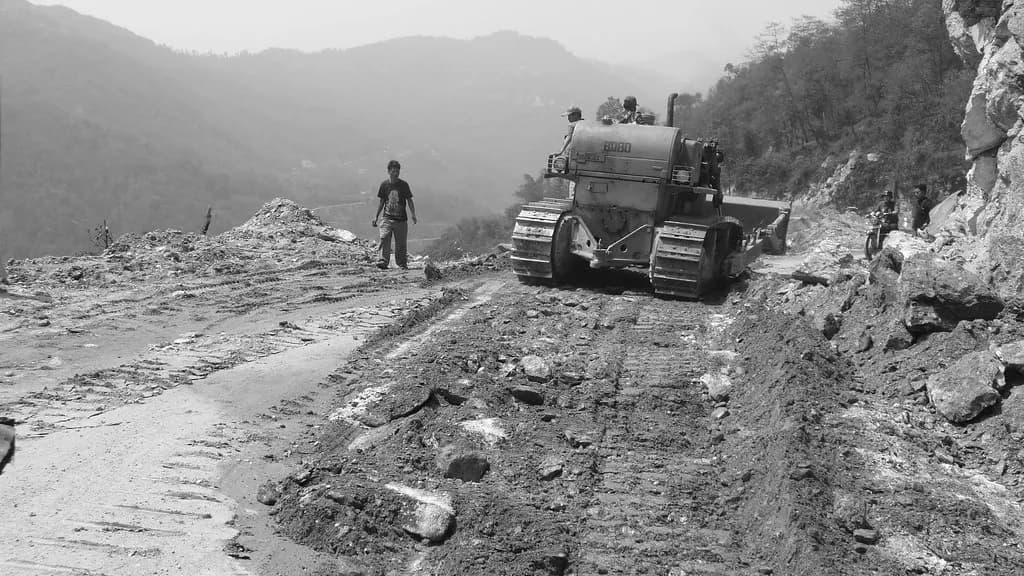
Much of Sikkim's work happens well above 8,000 ft — roads and bridges in North Sikkim, power lines, hydro-power sites, army supply contracts and tourism around Lachung, Lachen and Nathu La. The notification adds a percentage to the normal daily rate by altitude:
| Altitude band | Extra | Unskilled | Skilled | Highly skilled |
|---|---|---|---|---|
| Up to 8,000 ft | Normal rate | ₹500 a day | ₹535 a day | ₹565 a day |
| 8,001–12,000 ft | +50% | ₹750 | ₹802.50 | ₹847.50 |
| 12,001–16,000 ft | +75% | ₹875 | ₹936.25 | ₹988.75 |
| Above 16,000 ft | Double | ₹1,000 | ₹1,070 | ₹1,130 |
The altitude is where the work is done, not where the worker lives or where the contractor has its office. A crew that sleeps in a valley village and works on a road several thousand feet higher is paid at the band of the work site. Keep a simple record of the site and its altitude for each day, so that the band you paid can be shown if a worker or inspector asks.
When will Sikkim revise the rates?
Sikkim doesn't pay a separate variable dearness allowance, so rates change only when the state issues a new notification. The last two were in September 2017 and September 2022. When we checked the Labour Department's circulars on 12 October 2026, the latest postings were two July 2026 notices on decriminalising offences under the Sikkim Labour (Regulation of Employment and Conditions of Service) Act, 2021 and the Sikkim Shops and Commercial Establishment Act, 1983, and amended Shops and Commercial Establishment Rules in February 2026. The minimum wage notification had been re-posted on 5 June 2025, but no new rates had been issued.
The Code on Wages expects states to review minimum rates at intervals of not more than 5 years. Counting from July 2022, that points to a review by mid-2027. Revisions in Sikkim have been large and retrospective — the 2022 rates applied two months before they were notified — so set aside a reserve once a proposal appears in the Gazette.
Sikkim minimum wages, 2017–26
15 Sep 2017
Notification No.11/DL — ₹300 a day unskilled
28 Jan 2022
Draft Sikkim Code on Wages Rules, 2022 published
28 Apr 2022
Sikkim Code on Wages Rules, 2022 notified (as reported)
11 Jul 2022
Revision proposal published; new rates apply from this date
14 Sep 2022
Notification No.29/DL — ₹500 a day unskilled
12 Oct 2026
No newer rate notification
The Sikkim Code on Wages Rules, 2022
Sikkim was among the early states to make its own rules under the Code on Wages. A draft of the Sikkim Code on Wages Rules, 2022 appeared in the Gazette on 28 January 2022 under notification No.11/DL, with 45 days for objections. The Lakshmikumaran & Sridharan state tracker records the final rules as notified on 28 April 2022, repealing the Sikkim Minimum Wages Rules, 2005 and the Sikkim Payment of Wages Rules, 1992. We could not open the final Gazette copy, so confirm the text with the Labour Department before relying on a specific rule.
Because the Code itself came into force only on 21 November 2025, those rules now have real effect. The wage rates, though, still come from the 2022 notification until the state fixes new ones under section 6 of the Code. The national floor wage under section 9 had not been notified; the old advisory figure was ₹176 a day (advisory, 2017), well below Sikkim's rate.
Central-sphere work in Sikkim
If your workers are employed by or for a central government office, a bank, Pakyong airport, a central public sector undertaking — including the central hydro-power undertakings that run several Teesta projects — a cantonment or a central institution, the central minimum wages apply instead. No Sikkim town is listed in Area A or B of the central annexure, so all of Sikkim is Area C.
From 1 October 2026 that means ₹565 a day for unskilled construction, sweeping and cleaning, ₹661 for semi-skilled work, ₹794 for skilled work and unarmed guards, and ₹933 for highly skilled work and armed guards. The central rates don't carry Sikkim's altitude uplift, but even so, at sites below 8,000 ft they are well above the state's ₹500 a day. Above 8,000 ft, compare the two and pay whichever is higher if both could apply to your contract.
Minimum-wage check for a Sikkim employee
Step 1
Central-sphere work? → Area C rates
Step 2
Find the job in the grade lists
4 grades
Step 3
Check the work-site altitude
+50% / +75% / 2×
Step 4
Day rate × days worked + paid weekly holiday
Step 5
Overtime at 2× beyond 8 h or 48 h
Step 6
Watch for a 2027 revision
Worked payroll examples in ₹
Example 1 — a shop assistant on MG Marg, Gangtok. Unskilled, six days a week: ₹15,000 a month.
- ESI (wages below ₹21,000/month, if covered): employee 0.75% = ₹112.50; employer 3.25% = ₹487.50
- EPF at 12% of wages (if covered): ₹1,800 each side
- Net pay = ₹13,087.50
Example 2 — a cook in a Pelling hotel. Skilled: ₹535 a day a day, or ₹16,050 a month. Pelling is below 8,000 ft, so no uplift.
Example 3 — a road crew in North Sikkim at about 10,000 ft. Six unskilled labourers and one JCB driver work 24 days. Labourers: ₹750 × 24 × 6 = ₹1,08,000. JCB driver (highly skilled): ₹847.50 × 24 = ₹20,340. Total wages ₹1,28,340, before overtime.
Example 4 — security guards at a Namchi hospital. A new guard: ₹500 a day a day. A guard with two years' experience: ₹520 a day. The shift supervisor with five years and Class XII: ₹535 a day.
Example 5 — overtime in a pharmaceutical unit. A semi-skilled machine operator works his normal 48 hours and is called in for an eight-hour shift on his rest day. Those 8 hours take the week past 48, so they are overtime: 8 × ₹130 = ₹1,040 on top of his ordinary wage. (Remember the nine-hour cap on a single day, including the break.)
Contract and migrant workers
Most labour on Sikkim's construction and hydro-power sites comes through contractors, and many workers come from West Bengal, Bihar and Nepal. All of them are owed Sikkim rates — with the altitude uplift — for work done in Sikkim. The principal employer can be held answerable if a contractor underpays, so ask for monthly wage registers, bank-transfer proof and ESI and EPF challans, and write the altitude bands into the contract so the contractor can't price them out.
For daily-rated workers, keep an attendance register showing the site, the date and the hours worked. It is the simplest way to prove that the paid holiday and the altitude uplift were applied.
Employer duties under the Code on Wages
- Pay on time — monthly wages before the end of the 7th day of the next month; full and final settlement within 2 working days.
- Deductions — no more than 50% of wages of wages in total.
- Overtime — twice the normal rate of wages, as the notification also says.
- Records — keep employee, wage and attendance registers and give a wage slip each period; see our salary slip guide.
- Benefits — ESI and EPF come on top of the minimum.
Sikkim minimum wage checklist
0/6Common mistakes Sikkim employers make
Ignoring the altitude uplift. A labourer at 13,000 ft on the normal rate is short by ₹375 a day.
Paying 26 days to monthly staff. The paid weekly holiday is part of the minimum; ₹13,000 a month for an unskilled full-timer is short by about ₹2,000.
Treating cooks and drivers as helpers. Cooks and light-vehicle drivers are skilled; heavy-vehicle and JCB drivers are highly skilled.
Using the state rate on central projects. Contracts with central undertakings and offices pay the central Area C rates.
Counting meals and rooms. The rates exclude concessions, so the cash wage must reach the full amount.
What happens if you underpay
A worker, a group of workers or a union can claim unpaid minimum wages under the Code on Wages within 3 years, and the authority can award the shortfall plus compensation of up to 10 times the claim. Paying below the minimum is an offence with a fine of up to ₹50,000 for a first offence and up to ₹1 lakh fine and/or 3 months' imprisonment for a repeat. Complaints go to the Labour Department in Gangtok and its district offices.
What to do next
Check each worker's grade against the job lists, add the altitude uplift for every site above 8,000 ft, and make sure monthly staff are paid for their weekly holidays. Then issue wage slips with our free salary slip generator, read our guides to the four labour codes and the Code on Wages, and compare our West Bengal page if you also employ people around Siliguri and Darjeeling.
This is general information, not legal or tax advice — confirm on the official source or with a professional.
Frequently asked questions
Sikkim's rates, in force since 11 July 2022 under notification No.29/DL, are ₹500 a day for unskilled work, ₹520 a day for semi-skilled, ₹535 a day for skilled and ₹565 a day for highly skilled work, including dearness allowance. No later revision had been notified by 12 October 2026.
The notification fixes daily rates and gives one paid holiday after six days' continuous work. A full-time worker on a six-day week therefore earns 26 working days plus about four paid holidays — roughly 30 days' pay, or ₹15,000 a month at the unskilled rate. For skilled work it is ₹16,050, and for highly skilled ₹16,950.
Workers get the normal rate up to 8,000 ft, 50% more from 8,001 to 12,000 ft, 75% more from 12,001 to 16,000 ft and double above 16,000 ft. An unskilled worker therefore gets ₹750, ₹875 or ₹1,000 a day in those three bands.
On 14 September 2022, with effect from 11 July 2022, when the unskilled rate rose from ₹300 to ₹500 a day. The previous revision was in September 2017. The Code on Wages says states should review rates at intervals of not more than 5 years, which points to a review by mid-2027.
It depends on experience. A guard with no stated experience is unskilled (₹500 a day), with two years semi-skilled (₹520 a day), with five years plus Class XII or as security supervisor skilled (₹535 a day), and with eight years plus a degree or an ex-Army JCO highly skilled (₹565 a day).
Only for central-sphere work, such as central government offices, banks, Pakyong airport, central PSUs (including central hydro-power undertakings) and their contractors. No Sikkim town is in Area A or B, so all of Sikkim is Area C: ₹565 a day for unskilled construction, sweeping and cleaning from 1 October 2026.
Sources & verification
Figures on this page were checked against the sources below when it was last reviewed on 12 October 2026. Each rate and limit is stored once with its own official source and review date, and official update channels are monitored daily so changes are picked up. How we verify
- 1.Sikkim Government Gazette Extraordinary No.368, 14 September 2022 — Department of Labour Notification No.29/DL (rates w.e.f. 11 July 2022) — Department of Labour, Government of Sikkim · accessed 12 October 2026
- 2.Labour Department, Government of Sikkim — Circulars and notices — Department of Labour, Government of Sikkim · accessed 12 October 2026
- 3.Labour Department, Government of Sikkim — Acts and rules — Department of Labour, Government of Sikkim · accessed 12 October 2026
- 4.Labour Bureau orders dated 30 September 2026 — revised VDA and central minimum wages w.e.f. 01.10.2026, with Area A/B/C annexure — Labour Bureau, Chandigarh, Ministry of Labour & Employment (published on clc.gov.in) · accessed 12 October 2026
- 5.The Code on Wages, 2019 (No. 29 of 2019) — India Code, Legislative Department · accessed 12 October 2026
- 6.Government announces implementation of the four Labour Codes (21 Nov 2025) — PIB — Ministry of Labour & Employment · accessed 12 October 2026
- 7.Sikkim — Wages (state labour law tracker) — Lakshmikumaran & Sridharan Attorneys · accessed 12 October 2026
- 8.Draft Sikkim Code on Wages Rules, 2022 (Gazette No.12, 28 January 2022, notification No.11/DL dated 27.01.2022) — Department of Labour, Government of Sikkim (reproduced by Aparajitha) · accessed 12 October 2026
- 9.Finally, Sikkim notifies 67% increase in minimum wages — EastMojo · accessed 12 October 2026
MSMETOOLS is an independent platform and is not affiliated with any government agency, ministry or department.
Tools for this
Related guides
 Minimum Wages in Meghalaya 2026: Daily Rates, VDA & PayRead guide
 Minimum Wages in Bihar 2026: Daily Rates, VDA & PayrollRead guide
 Minimum Wages in Kerala 2026: Shop Rates, DA & PayrollRead guide
 Minimum Wages in Puducherry 2026: Rates, DA & CPI 471Read guide
Official links open the government site in a new tab.