 Finance & accounting
What Is Variable Cost? Meaning, Formula and Worked Examples for Small Businesses (2026)
What is variable cost? Fixed vs variable vs semi-variable costs, the formula, contribution margin and CVP analysis, with 2026 examples for a bakery and garment unit.
 Edited by Sumeet YadavFounder & editor, MSMETOOLS · fact-checked against official sources
Contents (9)
- 1. What variable cost means
- 2. Common variable costs in an Indian small business
- 3. The formulas you need
- 4. Example 1: a neighbourhood bakery
- 5. Example 2: a T-shirt stitching unit
- 6. Variable cost in cost-volume-profit analysis
- 7. Variable cost in your accounts and loan applications
- 8. Common mistakes
- 9. What to do next
Every pricing decision, discount and expansion plan in a small business comes back to one question: what does it cost me to make or sell one more unit? That is your variable cost. This guide explains what variable cost means, how it differs from fixed and semi-variable costs, the formulas you need, how variable cost drives contribution margin and cost-volume-profit analysis, and works through two Indian examples — a neighbourhood bakery and a T-shirt stitching unit — including how to split an electricity bill and when it pays to move tailors from piece rates to salaries.
Quick answer
A variable cost is a cost that changes in direct proportion to how much you produce or sell — raw material, packaging, piece-rate wages, power used in production, freight and sales commission. Total variable cost = variable cost per unit × units. What each unit leaves after its variable cost is its contribution, which pays fixed costs first and then becomes profit.
Fixed costs (rent, salaries, interest, depreciation) stay the same within a range of output
Semi-variable costs, like electricity, have a fixed part and a usage part — split them before you analyse
Contribution margin = (price − variable cost) ÷ price; break-even sales = fixed costs ÷ that margin
Cutting variable cost per unit lifts profit on every unit you sell
What variable cost means
The Institute of Chartered Accountants of India (ICAI) classifies costs by how they behave as activity changes. Variable costs tend to move with the volume of activity: produce more and they rise, produce less and they fall. Fixed costs are incurred for a period and, within limits of output and turnover, are not affected by how much you make — the ICAI material gives rent and insurance of a factory building as examples. Semi-variable costs contain both elements; telephone bills, gas and electricity are the classic cases.
The idea is simple but the test is practical: if you made one more unit tomorrow, would this cost go up? Flour for one more loaf, yes. Thread and fabric for one more shirt, yes. The rent on the shop, no. That "one more unit" cost is what accountants call marginal cost. ICAI defines it as the amount by which total variable costs change when output rises by one unit, and in practice treats it as equal to the variable cost of a unit: direct material, direct labour, direct expenses and variable overheads.
Variable cost per unit is usually roughly constant — every loaf needs about the same flour — while total variable cost grows with volume. Fixed cost behaves the other way round: the total is constant, but the fixed cost per unit falls as you produce more, because the same rent is spread over more units. That mirror-image behaviour is why volume matters so much to profit.
| Variable cost | Fixed cost | Semi-variable cost | |
|---|---|---|---|
| Total cost as output rises | Rises in proportion | Stays the same (within a range) | Rises, but less than proportionately |
| Cost per unit as output rises | Stays about the same | Falls | Falls slowly |
| Typical examples | Raw material, packaging, piece-rate wages, production power, freight, commission | Rent, salaries, insurance, loan interest, depreciation | Electricity, phone and internet, vehicle running, maintenance |
| Can you avoid it by stopping production for a month? | Yes, mostly | No | Only the usage part |
Common variable costs in an Indian small business
Which costs are variable depends on how you run the business, not just on what they are called. A useful list for most MSMEs:
- Raw material and goods for resale — flour, fabric, steel, spices, or the stock a trader buys.
- Packaging and labels — pouches, cartons, tags, carry bags.
- Piece-rate and batch labour — tailors paid per piece, packers paid per carton, casual workers hired for a rush order. Overtime is variable too.
- Power and fuel used in production — the energy charge for running machines and ovens, LPG for a kitchen.
- Freight and delivery — courier per parcel, transport per trip, delivery partners paid per drop.
- Selling costs per order — sales commission, payment-gateway fees, marketplace or aggregator commission.
Some costs look variable but behave as fixed in the short run. A salaried tailor is paid whether or not orders arrive, so the salary is fixed for that month even though tailoring is "production labour". Loan interest is fixed; so is depreciation on a machine, which is charged whether the machine runs one shift or three.
GST needs care. If you are registered under the regular scheme and claim input tax credit, the GST on your purchases is not a cost — it is recovered when you pay tax on your sales — so leave it out of variable cost and use prices before GST. If you are a composition dealer or in a sector where you can't claim credit, the GST on inputs is part of your cost. Our break-even guide shows the same treatment for a cloud kitchen paying GST on aggregator commission it cannot recover.

The formulas you need
Every variable-cost calculation rests on a few relationships. ICAI's marginal costing material sets them out as the marginal cost equation: sales minus variable cost equals contribution, and contribution minus fixed cost equals profit.
| What you want | Formula |
|---|---|
| Total variable cost | Variable cost per unit × units produced or sold |
| Variable cost per unit | Total variable cost ÷ units |
| Total cost | Fixed cost + total variable cost |
| Contribution per unit | Selling price − variable cost per unit |
| Contribution margin (P/V) ratio | Contribution ÷ sales × 100 |
| Profit | Total contribution − fixed cost |
| Break-even units | Fixed cost ÷ contribution per unit |
| Break-even sales (₹) | Fixed cost ÷ P/V ratio |
| Variable cost ratio | Variable cost ÷ sales × 100 (= 100% − P/V ratio) |
The variable cost ratio is often the quickest health check. If your variable costs are 85% of sales, only ₹15 of every ₹100 is left to cover rent, salaries and interest; a small rise in material prices can wipe out your profit. If they are 50%, you have room to absorb a cost increase or offer a discount.
Example 1: a neighbourhood bakery
Take an illustrative bakery in a tier-2 city that sells two products. All prices are before any GST and the costs are estimates for a small electric-oven bakery; yours will differ.
Bread (400 g loaf), sold at ₹40. Variable cost per loaf: flour ₹9, other ingredients (sugar, yeast, fat, salt) ₹4, packaging ₹2, oven power ₹2.50 and a per-loaf commission to the delivery boy ₹2.50 — ₹20. Contribution: ₹20 a loaf, a 50% margin.
Cake (500 g), sold at ₹300. Variable cost: ingredients ₹120, box ₹20, oven power ₹10 and sales commission ₹15 — ₹165. Contribution: ₹135 a cake, a 45% margin.
Monthly fixed costs: rent ₹30,000; a salaried baker and helper ₹40,000; the fixed part of the electricity bill ₹4,000; interest on an oven loan ₹6,000; depreciation on equipment ₹5,000; other overheads ₹6,000 — ₹91,000.
In a typical month the bakery sells 3,000 loaves and 300 cakes.
| Bread | Cake | Total | |
|---|---|---|---|
| Units | 3,000 | 300 | |
| Sales | ₹1,20,000 | ₹90,000 | ₹2,10,000 |
| Variable cost | ₹60,000 | ₹49,500 | ₹1,09,500 |
| Contribution | ₹60,000 | ₹40,500 | ₹1,00,500 |
| Fixed cost | ₹91,000 | ||
| Profit | ₹9,500 |
The blended P/V ratio is ₹1,00,500 ÷ ₹2,10,000, about 47.9%, so break-even sales are ₹91,000 ÷ 47.9%, about ₹1.90 lakh a month at this product mix. The bakery is only about ₹20,000 above break-even — a thin cushion. Two levers are obvious from the table. Each extra cake contributes ₹135 against ₹20 for a loaf, so pushing cake orders for birthdays and festivals improves profit far more than selling more bread. And because flour is the biggest single variable cost in bread, a ₹2 a kg cut through buying directly from a mill adds about ₹1,500 a month at 3,000 loaves.
Splitting the electricity bill with the high–low method
The bakery's electricity bill is semi-variable: a fixed monthly charge plus an energy charge that depends on how long the oven runs. ICAI lists five ways to split such costs; the simplest is the high–low method, which compares two months with different output.
Suppose the bill was ₹9,000 in a slow month with 2,000 loaves and ₹14,000 in a busy month with 4,000 loaves. The difference in cost, ₹5,000, divided by the difference in output, 2,000 loaves, gives a variable cost of ₹2.50 a loaf. In the slow month that accounts for ₹5,000 of the bill, so the fixed element is ₹9,000 − ₹5,000 = ₹4,000. That is exactly how the figures above were built: ₹2.50 of power in each loaf's variable cost and ₹4,000 in fixed costs. With more months of data, the least-squares method gives a better line; ICAI's material calls it the best method of the five.
Try it — bakery break-even
Example 2: a T-shirt stitching unit
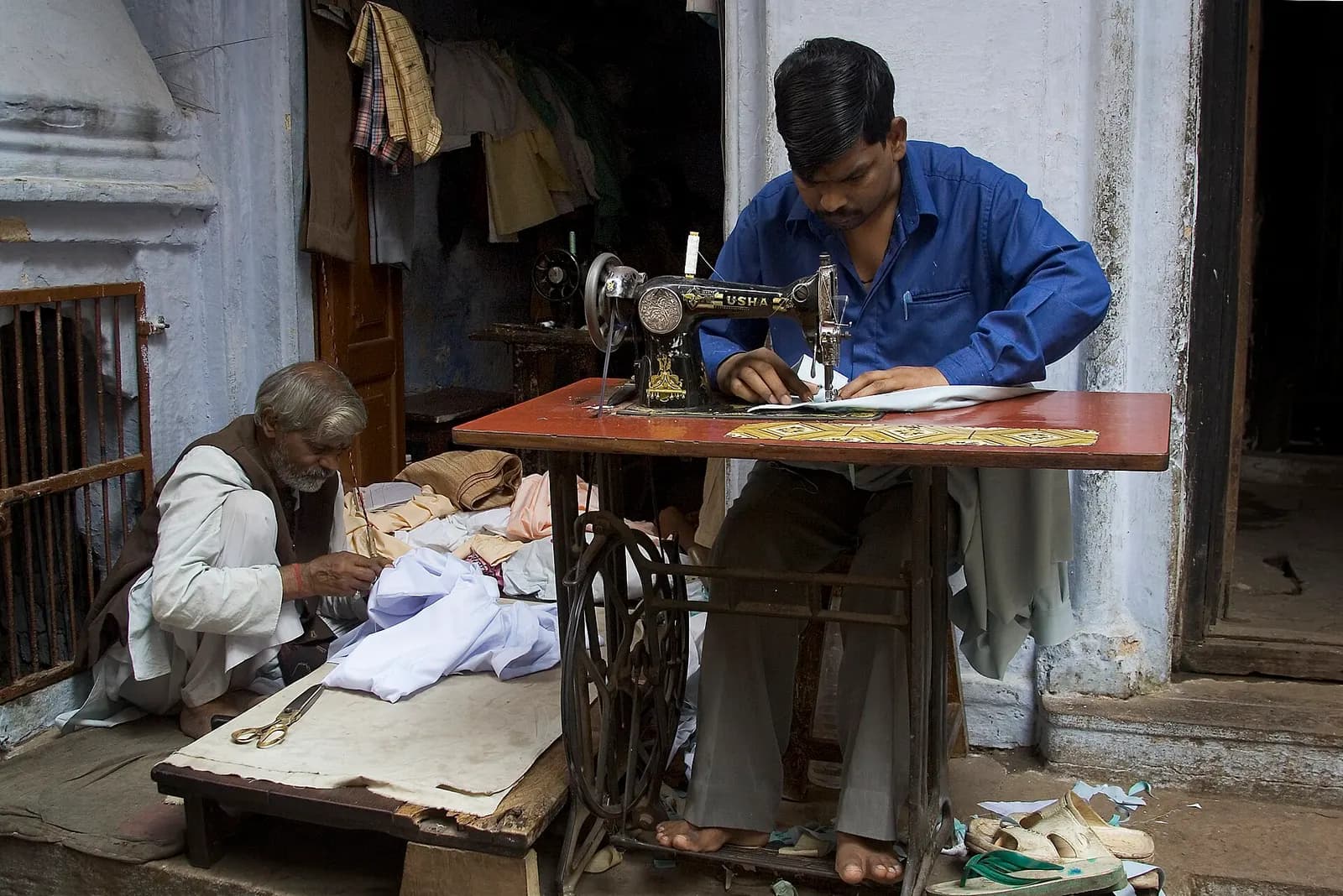
Now take an illustrative garment unit in Tiruppur or Ludhiana that stitches cotton T-shirts for a brand at ₹180 a piece before GST. Variable cost per piece: fabric ₹85, trims, labels and packing ₹12, stitching at a piece rate of ₹18, power ₹3 and freight to the buyer ₹4 — ₹122. Contribution: ₹58 a piece, a P/V ratio of about 32%.
Monthly fixed costs: shed rent ₹60,000; a salaried supervisor, quality checker and accountant ₹75,000; interest on a machinery loan ₹15,000; depreciation ₹20,000; other overheads ₹10,000 — ₹1,80,000.
Break-even is ₹1,80,000 ÷ ₹58, about 3,104 pieces a month. At 5,000 pieces, profit is 5,000 × ₹58 − ₹1,80,000 = ₹1,10,000.
Piece rate or salary? The indifference point
Suppose the owner is considering putting 12 tailors on a monthly salary of ₹16,000 each instead of paying ₹18 a piece. Stitching then moves out of variable cost and into fixed cost.
| Piece rate | Salaried tailors | |
|---|---|---|
| Variable cost per piece | ₹122 | ₹104 |
| Contribution per piece | ₹58 | ₹76 |
| Monthly fixed cost | ₹1,80,000 | ₹3,72,000 |
| Break-even | about 3,104 pieces | about 4,895 pieces |
| Profit at 5,000 pieces | ₹1,10,000 | ₹8,000 |
| Profit at 7,000 pieces | ₹2,26,000 | ₹1,60,000 |
The two options give the same profit where the extra fixed cost equals the extra contribution: ₹1,92,000 ÷ ₹18 ≈ 10,667 pieces a month. Below that volume, piece rates are cheaper; above it, salaries are — provided 12 tailors can actually produce that many. This is operating leverage: higher fixed costs and lower variable costs make profit swing more sharply with volume, upwards in good months and downwards in bad ones. Units with seasonal or uncertain orders usually keep labour variable for exactly this reason, and must also respect the applicable minimum wage when setting piece rates.
Variable cost in cost-volume-profit analysis
Cost-volume-profit (CVP) analysis uses the split between fixed and variable costs to show how profit responds to changes in price, volume, variable cost and fixed cost. ICAI's material lists what it tells management: how costs behave with volume, where the business breaks even, how sensitive profit is to output, the profit at a projected volume and the volume needed for a target profit.
Run the bakery's bread through a few what-ifs. A 5% price cut, from ₹40 to ₹38, takes contribution from ₹20 to ₹18 — a 10% drop — so the same profit needs about 11% more loaves. A ₹2 rise in variable cost has the same effect. A ₹10,000 rise in rent, by contrast, needs only 500 more loaves a month at ₹20 contribution. When margins are thin, variable-cost changes hurt more than fixed-cost changes, which is why buying terms and wastage control deserve as much attention as rent negotiations.
Bread at the bakery — what each change does
| Change | Contribution per loaf | Extra loaves a month to keep the same profit |
|---|---|---|
None (₹40 price, ₹20 variable cost) | ₹20 | — |
Price cut 5% to ₹38 | ₹18 | About 11% more volume |
Variable cost up ₹2 to ₹22 | ₹18 | About 11% more volume |
Rent up ₹10,000 a month | ₹20 | 500 loaves |
None (₹40 price, ₹20 variable cost)
- Contribution per loaf
₹20
- Extra loaves a month to keep the same profit
—
Price cut 5% to ₹38
- Contribution per loaf
₹18
- Extra loaves a month to keep the same profit
About 11% more volume
Variable cost up ₹2 to ₹22
- Contribution per loaf
₹18
- Extra loaves a month to keep the same profit
About 11% more volume
Rent up ₹10,000 a month
- Contribution per loaf
₹20
- Extra loaves a month to keep the same profit
500 loaves
CVP rests on assumptions that ICAI spells out: costs can be split cleanly into fixed and variable parts; revenue and costs are linear within a relevant range; price, variable cost per unit and fixed cost are known and constant; the sales mix stays the same; and the time value of money is ignored. Real businesses bend these. Bulk discounts lower material cost per unit at higher volumes; fixed costs jump in steps when you add a shift or rent a second shed; and a change in product mix changes your blended margin. Treat CVP as a planning tool, recalculated when conditions change.
Variable cost in your accounts and loan applications
Your profit and loss account doesn't label costs fixed or variable — you have to do it. Go through the expense ledger once, tag each head as fixed, variable or semi-variable, and split the semi-variable ones with the high–low method. Then build a simple marginal cost statement: sales, less variable costs, equals contribution; less fixed costs, equals profit. That one page is more useful for pricing than a standard P&L.
For inventory valuation in financial statements, the rules are different. Under Ind AS 2, which applies to companies following Ind AS, and the equivalent AS 2 for others, the cost of finished goods includes variable production overheads based on actual use of facilities and fixed production overheads allocated on normal capacity; unabsorbed fixed overhead in a low-output period is expensed rather than piled into stock. Marginal costing for decisions values stock at variable cost only. Keep the two separate: management decisions on contribution, statutory accounts as the standards require.
Lenders use the same split. Bank and government model project reports — such as the National Horticulture Board's — separate fixed and variable costs to show contribution, break-even as a percentage of capacity and cash break-even. Interest on term loans sits in fixed costs and, on floating-rate loans, moves with the RBI repo rate (5.50% as of October 2026). Working capital is driven by variable costs: the more material and stock a sale needs, the more cash is tied up until the customer pays. Our working capital guide shows how to size it.
Common mistakes
Treating all labour as variable. Salaried staff are fixed; only piece-rate, casual and overtime labour scale with output.
Leaving out per-order costs. Payment-gateway fees, marketplace commission, delivery and returns are variable and, for online sales, often one of the largest cost lines after the product itself.
Including recoverable GST. If you claim input tax credit, the GST on inputs isn't a cost; including it overstates variable cost and makes you price too high.
Ignoring wastage. Rejected pieces, burnt batches and expired stock are variable costs. If 3% of output is wasted, your variable cost per good unit is about 3% higher than your recipe or bill of materials suggests.
Using last year's material prices. Variable cost per unit moves with commodity prices. Update your costing whenever a major input changes price, before you quote.
Work out your variable cost in five steps
- 1
List every expense head
Take the last three months of your profit and loss account or expense ledger.
- 2
Tag each one
Fixed, variable or semi-variable — ask whether it would rise if you made one more unit.
- 3
Split the semi-variable costs
Use the high–low method on two months with different output to find the per-unit and fixed parts.
- 4
Calculate variable cost per unit
Divide total variable cost by units, or build it from the bill of materials, labour rate, packaging, power and freight per unit.
- 5
Find contribution and break-even
Open the break-even calculatorPrice minus variable cost per unit; then fixed costs divided by contribution.
Official references
- ICAI — Basic Concepts (cost behaviour)Fixed, variable, semi-variable; segregation methods
- ICAI — Marginal CostingContribution, P/V ratio, CVP assumptions
- NHB model project report — break-even annexureFixed and variable costs in a project report
- RBI — current ratesRepo rate behind floating loan interest
What to do next
Tag your costs, work out variable cost and contribution per unit for your top products, then find your break-even in our break-even calculator and read the full break-even point guide. Check your pricing with the profit margin calculator, and if you're planning a bakery, our bakery business plan puts these numbers into a complete project.
This is general information, not legal or tax advice — confirm on the official source or with a professional.
Frequently asked questions
A variable cost is a cost that rises and falls with how much you make or sell. If you bake twice as many loaves, you buy roughly twice as much flour, packaging and oven power — those are variable costs. Rent and a salaried manager's pay stay the same whether you bake 1,000 loaves or 3,000; those are fixed costs.
Total variable cost = variable cost per unit × number of units. Variable cost per unit is the sum of everything you spend for one more unit: material, packaging, piece-rate labour, power used in production, freight and commission. If a T-shirt needs ₹122 of these and you make 5,000, total variable cost is ₹6.1 lakh.
Raw material, goods bought for resale, packaging, piece-rate wages, power and fuel used in production, freight-out, sales commission, payment-gateway fees and marketplace commission. Salaried staff, rent, insurance, loan interest and depreciation are usually fixed. Electricity and phone bills are typically semi-variable: a fixed monthly charge plus a part that rises with use.
A cost with both a fixed and a variable part. An industrial electricity bill has a fixed or demand charge plus an energy charge per unit; a delivery van has insurance and the driver's salary plus fuel per trip. ICAI's study material lists the high–low, graphical, analytical, comparison and least-squares methods to split them into fixed and variable parts.
Contribution is selling price minus variable cost. It is what each sale leaves to pay fixed costs and then profit. A ₹40 loaf with ₹20 of variable cost contributes ₹20, a 50% contribution margin. Break-even sales are fixed costs divided by that margin, so lowering variable cost per unit raises contribution and lowers break-even.
It depends on how you pay. Piece-rate workers, daily-wage workers hired for a batch, overtime and sales commission are variable. Monthly salaried staff are fixed in the short run, because you pay them whether or not orders come in. Switching from piece-rate to salaried tailors therefore raises fixed costs and lowers variable cost per unit.
Sources & verification
Figures on this page were checked against the sources below when it was last reviewed on 9 October 2026. Each rate and limit is stored once with its own official source and review date, and official update channels are monitored daily so changes are picked up. How we verify
- 1.Cost Accounting study material, Chapter 1: Basic Concepts — The Institute of Chartered Accountants of India (Board of Studies) · accessed 9 October 2026
- 2.Cost Accounting study material, Chapter 12: Marginal Costing — The Institute of Chartered Accountants of India (Board of Studies) · accessed 9 October 2026
- 3.National Horticulture Board — Model project report, Annexure XII: Break-even analysis — National Horticulture Board, Ministry of Agriculture & Farmers Welfare · accessed 9 October 2026
- 4.Reserve Bank of India — current policy repo rate — Reserve Bank of India · accessed 9 October 2026
- 5.Indian Accounting Standard (Ind AS) 2, Inventories (reproduced text, paragraphs 12–13) — TaxGuru (secondary reproduction of the MCA-notified standard) · accessed 9 October 2026
- 6.Understanding normal capacity under Ind AS 2 (secondary) — Taxmann · accessed 9 October 2026
MSMETOOLS is an independent platform and is not affiliated with any government agency, ministry or department.
Tools for this
Break Even Calculator
Find your break even point and units.
Profit Margin Calculator
Calculate profit, markup and margin for your products or services.
Markup Calculator
Turn cost and markup into a selling price.
Related guides
 What Is Break-Even Point? Formula & Examples in ₹ (2026)Read guide
 What Is Working Capital? Formula, Cycle & Bank Limits 2026Read guide
 What Is a Cash Flow Statement? AS 3, Ind AS 7 & Example 2026Read guide
 How to Calculate EMI for a Business Loan (2026 Guide)Read guide
Official links open the government site in a new tab.