 Finance & accounting
What Is a Profit and Loss Statement? Schedule III Format, Proprietor P&L and a Worked MSME Example (2026)
What is a profit and loss statement for Indian businesses (2026): Schedule III format, proprietor P&L for ITR, gross vs operating vs net profit, worked MSME example.
 Edited by Sumeet YadavFounder & editor, MSMETOOLS · fact-checked against official sources
Contents (9)
- 1. What is a profit and loss statement?
- 2. The Schedule III format for companies
- 3. Gross profit, operating profit and net profit
- 4. Worked example: a small manufacturing company's P&L
- 5. A proprietor's or firm's P&L for the income-tax return
- 6. How to read a P&L — what owners and banks look for
- 7. Common P&L mistakes small businesses make
- 8. When the P&L has to be ready
- 9. What to do next
The profit and loss statement is the report most business owners look at first and understand least. It answers one question: over the year, did the business make money, and where did the money go? This guide is for MSME owners, first-time founders and accounts staff in India. It explains what a P&L shows, the Schedule III format that companies must follow, how a proprietor's P&L feeds into the income-tax return, the difference between gross, operating and net profit, and a complete worked P&L for a small manufacturing company, with tax.
Quick answer
A profit and loss (P&L) statement shows a business's income and expenses over a period — usually the financial year 1 April to 31 March — and the resulting profit or loss. Companies must present it in the Schedule III format of the Companies Act. Proprietors and firms prepare one for their tax return (ITR-3), bank loans and audits.
Revenue − expenses = profit before tax; minus tax = net profit
Gross profit, operating profit and net profit answer different questions
It covers a period; the balance sheet is a single date
Small companies and OPCs need no cash-flow statement, but always a P&L
What is a profit and loss statement?
A profit and loss statement, also called a P&L, profit and loss account, statement of profit and loss or income statement, summarises the revenue a business earned and the expenses it incurred in a period, and the difference between them. If income exceeds expenses, the business made a profit; if not, a loss.
Schedule III to the Companies Act, 2013 says in terms that "Statement of Profit and Loss" has the same meaning as "Profit and Loss Account", so the names are interchangeable. Section 2(40) of the Act lists it as one of the financial statements every company must prepare, along with the balance sheet, cash-flow statement (for most companies), statement of changes in equity where applicable, and notes.
A P&L is prepared on the accrual basis. Income is recorded when it is earned, not when cash arrives, and expenses when they are incurred, not when paid. A sale invoiced on 25 March and paid in May belongs to the year ending 31 March. This is why a profitable business can still run short of cash, and why you need the cash-flow statement as well.
The P&L also covers only revenue items. Buying a machine is not an expense in the year of purchase; it goes to the balance sheet as an asset, and only the year's depreciation comes to the P&L. Repaying a loan is not an expense either; only the interest is. Getting these two points right fixes most of the errors small businesses make when they draw up their own P&L.
How the P&L connects to the other statements
Step 1
Sales and other income
Step 2
Less: all expenses for the year
Step 3
Profit after tax
the P&L result
Step 4
Reserves / owner's capital
balance sheet
Step 5
Cash movement explained
cash-flow statement
The Schedule III format for companies
Every company prepares its P&L under section 129 and Schedule III. Division I applies to companies that follow the Accounting Standards, which covers almost every MSME company. Division II applies to companies on Ind AS, which are mainly listed companies and those above ₹250 crore net worth, and has a different layout that includes other comprehensive income.
Division I uses a vertical format with two figure columns: the current year and the previous year. Each line refers to a note number where the detail sits. The order of lines is fixed:
| No. | Line item (Division I) | What goes in it |
|---|---|---|
| I | Revenue from operations | Sale of products, sale of services, other operating revenue |
| II | Other income | Interest, dividends, gains on investments, other non-operating income |
| III | Total income (I + II) | |
| IV | Expenses | Cost of materials consumed; purchases of stock-in-trade; changes in inventories of finished goods, WIP and stock-in-trade; employee benefits; finance costs; depreciation and amortisation; other expenses |
| V | Profit before exceptional and extraordinary items and tax (III − IV) | |
| VI–VIII | Exceptional items, extraordinary items | One-off gains or losses, shown separately |
| IX | Profit before tax | |
| X | Tax expense | Current tax and deferred tax |
| XI–XV | Profit from continuing and discontinuing operations; profit for the period | |
| XVI | Earnings per equity share | Basic and diluted |
What the notes must show
The face of the statement is only the summary. The general instructions in Part II of Schedule III require notes that break revenue into sale of products, services and other operating revenue; finance costs into interest, other borrowing costs and certain foreign-exchange differences; and other income into interest, dividends, net gains on investments and other non-operating income.
Notes must also disclose employee benefits split into salaries and wages, contributions to provident and other funds, ESOP cost and staff welfare; payments to the auditor by type of service; and any item of income or expenditure exceeding 1% of revenue from operations or ₹1,00,000, whichever is higher. Expenses such as power and fuel, rent, repairs to buildings and machinery, insurance, and rates and taxes are listed separately.
What changed in 2021
Amendments notified on 24 March 2021 and applying from 1 April 2021 added three P&L disclosures: any undisclosed income surrendered in tax assessments, details of CSR spending for companies covered by section 135, and profit or loss on, and holdings of, crypto or virtual currency. The rounding rule was also tightened: rounding off is now compulsory and depends on total income, with companies below ₹100 crore rounding to the nearest hundreds, thousands, lakhs or millions. These items rarely affect a small company, but your auditor will ask you to confirm them.
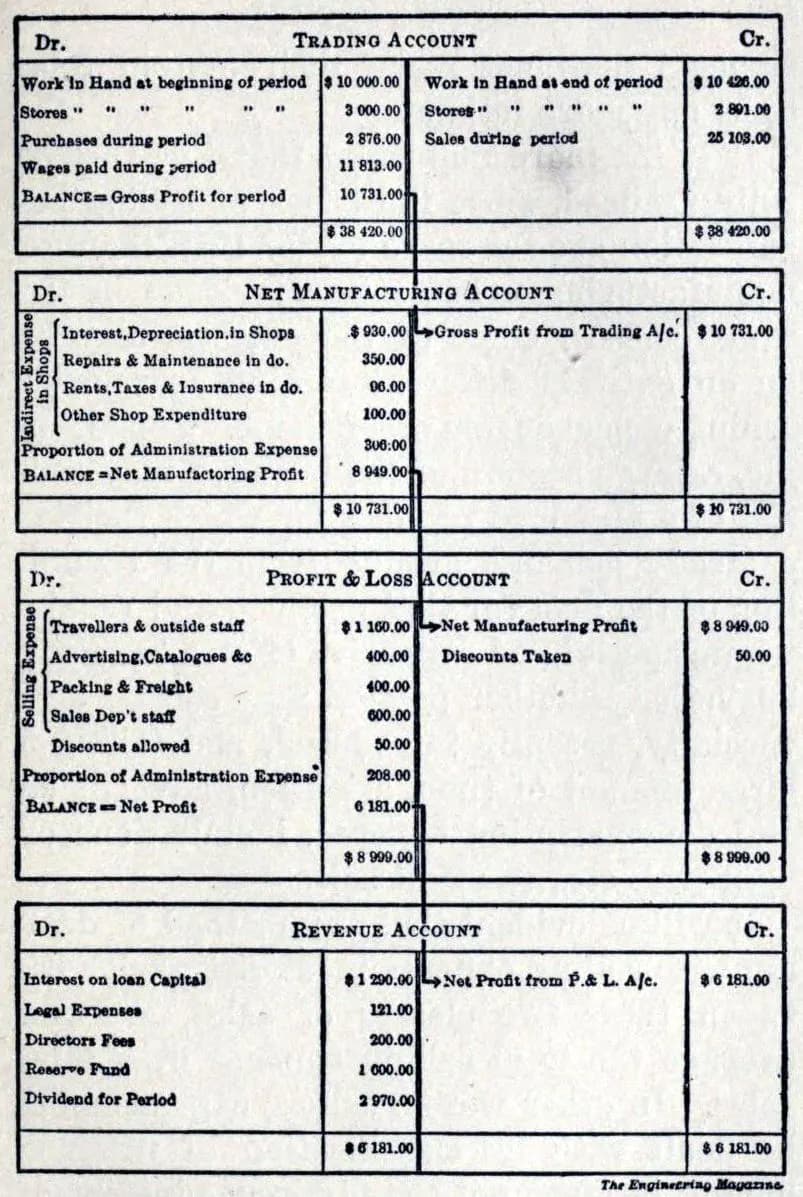
Gross profit, operating profit and net profit
Schedule III does not print a gross profit line, but every owner, banker and investor calculates it. The three profit levels answer different questions, and confusing them leads to wrong pricing decisions.
Gross profit is revenue from operations minus the direct cost of what you sold: materials consumed, goods purchased for resale and the change in inventories. Some businesses also deduct direct labour and factory power. Gross profit tells you whether your pricing covers your product cost. If gross margin falls while sales rise, you are probably discounting or your input costs have jumped.
Operating profit, often called EBIT (earnings before interest and tax), deducts all the other operating expenses as well: staff costs, rent, administration, selling expenses and depreciation. It shows whether the business itself is profitable, before considering how it is financed. Add back depreciation and you get EBITDA, a rough measure of cash generated by operations, which lenders use widely.
Net profit is what remains after finance costs and income tax, plus any other income. It is the figure that flows to the balance sheet as an increase in reserves or the owner's capital. Two businesses with identical operating profit can have very different net profit if one is funded by expensive loans.
The four profit lines in one place
Gross profit
Revenue − cost of goods sold
pricing vs product cost
EBITDA
Operating profit + depreciation
lenders' favourite
Operating profit (EBIT)
Gross profit − operating expenses
before interest and tax
Net profit
EBIT + other income − interest − tax
goes to reserves
Worked example: a small manufacturing company's P&L
Meenakshi Weaves Private Limited is a small company in Erode that makes cotton fabric, with a few traded items such as yarn. Its figures for the year ended 31 March 2026 are below, in the Schedule III order. Figures are in ₹ lakh.
| Particulars | ₹ lakh |
|---|---|
| I. Revenue from operations (sale of products) | 120.00 |
| II. Other income (interest on fixed deposit) | 0.60 |
| III. Total income | 120.60 |
| Cost of materials consumed (yarn, dyes) | 66.00 |
| Purchases of stock-in-trade | 4.00 |
| Changes in inventories (opening ₹5.00 − closing ₹7.00) | (2.00) |
| Employee benefits expense | 18.00 |
| Finance costs (term loan and cash credit interest) | 3.20 |
| Depreciation | 4.80 |
| Other expenses (power, rent, freight, repairs, admin) | 14.40 |
| IV. Total expenses | 108.40 |
| V. Profit before tax (III − IV) | 12.20 |
| X. Tax expense (current tax at the concessional rate, about 25.17% effective) | 3.07 |
| XV. Profit for the period | 9.13 |
Now the three profit lines:
- Gross profit = 120.00 − (66.00 + 4.00 − 2.00) = ₹52.00 lakh, a gross margin of 43.3%. The increase in closing stock reduces cost of goods sold, because some of the year's materials are sitting in the warehouse as finished cloth.
- Operating profit (EBIT) = 120.00 − (68.00 + 18.00 + 4.80 + 14.40) = ₹14.80 lakh, or 12.3% of revenue. EBITDA is ₹19.60 lakh.
- Net profit = 14.80 + 0.60 other income − 3.20 interest − 3.07 tax = ₹9.13 lakh, a net margin of 7.6%.
The tax line assumes the company has opted for the concessional company rate of 22% (+ surcharge & cess), which with the 10% surcharge and 4% cess comes to about 25.17% of ₹12.20 lakh. A bank looking at this P&L would compute interest coverage of 14.80 ÷ 3.20 = 4.6 times, comfortably above what most lenders want, and would compare the margins with last year's column. Because its paid-up capital and turnover are within the small company limits, Meenakshi Weaves need not attach a cash-flow statement, though its bank may still ask for one.
To see how far sales could fall before this business makes a loss, split the expenses into fixed and variable and use our break-even point guide or the break-even calculator.

A proprietor's or firm's P&L for the income-tax return
Proprietorships and partnership firms do not follow Schedule III. Most accountants prepare a trading account, which arrives at gross profit, followed by a profit and loss account, which arrives at net profit. From financial years beginning 1 April 2024, ICAI's Guidance Note on Financial Statements of Non-Corporate Entities gives a standard format that is close to Schedule III and shows the movement in the owner's capital account. Lenders increasingly expect it.
A few items are treated differently from a company:
- Drawings are not expenses. Money the proprietor takes for personal use reduces capital in the balance sheet; it never appears in the P&L.
- Income tax is not an expense of a proprietorship, because the tax is the owner's personal liability.
- Owner's salary and interest on own capital are not deductible for a proprietor. A partnership firm can pay partners salary and interest within limits set by the income-tax law and the partnership deed.
Company P&L vs proprietor's P&L
| Point | Company | Proprietor / firm |
|---|---|---|
Format | Schedule III, Division I (vertical) | Trading + P&L account; ICAI non-corporate format from FY 2024-25 |
Owner's pay | Director's salary is an expense | Proprietor's drawings are not an expense |
Income tax | Shown as tax expense | Not in the P&L (owner's liability) |
Audit | Always audited under the Companies Act | Only if a tax audit applies |
Filed with | RoC in AOC-4, and ITR-6 | ITR-3 / ITR-5 schedules, or ITR-4 if presumptive |
Format
- Company
Schedule III, Division I (vertical)
- Proprietor / firm
Trading + P&L account; ICAI non-corporate format from FY 2024-25
Owner's pay
- Company
Director's salary is an expense
- Proprietor / firm
Proprietor's drawings are not an expense
Income tax
- Company
Shown as tax expense
- Proprietor / firm
Not in the P&L (owner's liability)
Audit
- Company
Always audited under the Companies Act
- Proprietor / firm
Only if a tax audit applies
Filed with
- Company
RoC in AOC-4, and ITR-6
- Proprietor / firm
ITR-3 / ITR-5 schedules, or ITR-4 if presumptive
Which return uses the P&L
The Income Tax Department's guidance says ITR-3 applies to individuals and HUFs with income from business or profession. ITR-3 has its own balance sheet and profit and loss schedules, so your books must produce a P&L in that layout. Firms and LLPs use ITR-5; companies use ITR-6.
ITR-4 (Sugam) is for resident individuals, HUFs and firms (other than LLPs) who declare business income on a presumptive basis. Small businesses within ₹3 crore (if cash receipts ≤ 5%), else ₹2 crore turnover can declare a deemed profit of 8% of turnover, or 6% for receipts through banking channels, without maintaining a full P&L. ITR-4 cannot be used by someone who is a company director, has total income above ₹50 lakh, or has certain capital gains and foreign assets. Declaring a profit below the presumptive rate brings in books of account and, in many cases, a tax audit, so talk to your CA before doing so. From 1 April 2026 the Income-tax Act, 2025 replaces the 1961 Act and renumbers these provisions; the presumptive scheme continues.
Example. Arjun runs a grocery store in Madurai as a proprietor. In 2025-26 his sales are ₹60 lakh, opening stock ₹4 lakh, purchases ₹52 lakh and closing stock ₹5 lakh. His trading account shows cost of goods sold of ₹51 lakh and gross profit of ₹9 lakh, a 15% margin. Rent ₹1.80 lakh, helper wages ₹2.40 lakh, electricity ₹0.36 lakh, cash-credit interest ₹0.50 lakh, depreciation ₹0.30 lakh and sundry expenses ₹0.24 lakh total ₹5.60 lakh, leaving a net profit of ₹3.40 lakh. If most of his sales are received digitally, the presumptive deemed profit would be 6% of ₹60 lakh, or ₹3.60 lakh. He can simply file ITR-4 on ₹3.60 lakh. If he wants to declare his actual ₹3.40 lakh, he needs proper books and must check whether an audit is triggered.
How to read a P&L — what owners and banks look for
Reading a P&L is mostly about comparisons: this year against last year, margins against your industry, and expenses against revenue. Our profit margin calculator helps with the arithmetic.
Banks lending to MSMEs look at the P&L together with the balance sheet. They take two or three years of audited statements and a projection. Beyond margins, they compute the debt service coverage ratio from net profit, depreciation and interest, compare reported sales with GST returns and bank credits, and check that the owner's or directors' remuneration is reasonable. A P&L that shows high sales but thin profit year after year, or sudden profit just before a loan application, invites questions.
P&L review checklist
0/8Common P&L mistakes small businesses make
Booking capital spending as expenses. A new machine, a computer or office renovation that lasts years belongs in fixed assets. Charging it to the P&L understates profit this year, overstates it in future years, and the tax officer will disallow the expense anyway.
Treating loan repayments as expenses. Only interest is a P&L expense. The principal reduces the loan in the balance sheet. Owners who put EMI totals in the P&L understate profit badly.
Ignoring closing stock. Without a proper stock count at year end, cost of goods sold and gross profit are guesses. A lower closing stock figure makes profit look smaller; a higher one inflates it. Banks and auditors will test it.
Mixing personal and business expenses. Household bills, personal travel and family phone bills paid from the business account are not business expenses. For a proprietor they are drawings; for a company they are a problem for the director.
Cash basis instead of accrual. Recording only what was received and paid leaves out unpaid bills, unbilled work and prepaid expenses. Companies must use accrual accounting, and so should any business that wants a credible P&L.
Not reconciling with GST and TDS data. The income-tax department's annual information statement already knows your GST turnover and the TDS deducted on your receipts. If your P&L revenue does not match, expect a notice. Reconcile before you file.
When the P&L has to be ready
For a company, the audited P&L is approved by the board, signed by the auditor and then filed with the Registrar in Form AOC-4 within 30 days of the AGM; an AGM must be held by 30 September for a March year end. One Person Companies, which hold no AGM, file within 180 days of the year end. The same P&L is the base for the company's income-tax return in ITR-6.
For businesses that need a tax audit, the deadlines are set each year. For the year 2025-26 the audit report was due by 21 October 2026 and the return by 21 November 2026 after the CBDT's extension. In practice that means your books should be closed, stock counted and the draft P&L ready by July or August, so the auditor has time to test it. A P&L prepared in a hurry the week before the deadline is the one most likely to carry the mistakes listed above.
Monthly or quarterly management P&Ls are not required by law, but they are the most useful habit a growing MSME can build. A simple monthly P&L from your accounting software, compared with the same month last year, shows margin pressure months before the annual accounts do.
What to do next
Pull last year's and this year's P&L side by side and work out gross, operating and net margin for each; the profit margin calculator does it in seconds. Then read the matching balance sheet guide and cash-flow statement guide so you can see how profit turns into assets and cash. If your company's accounts are due for audit, our statutory audit guide explains what the auditor will check.
This is general information, not legal or tax advice — confirm on the official source or with a professional.
Frequently asked questions
A profit and loss (P&L) statement shows how much a business earned and spent over a period, usually the financial year from 1 April to 31 March, and whether it made a profit or a loss. It starts with sales and other income, deducts the costs of goods, salaries, rent, interest, depreciation and other expenses, and ends with profit before and after tax.
Companies following the Accounting Standards use Division I of Schedule III. It lists Revenue from operations, Other income, Total income, then expenses — cost of materials consumed, purchases of stock-in-trade, changes in inventories, employee benefits, finance costs, depreciation and other expenses — then profit before exceptional items, exceptional items, profit before tax, current and deferred tax, profit for the period and earnings per share.
Gross profit is sales minus the direct cost of the goods sold. Operating profit (EBIT) also deducts staff costs, rent, power, depreciation and other operating expenses, but not interest and tax. Net profit is what remains after interest and income tax; it is the figure that adds to reserves or the owner's capital in the balance sheet.
A proprietor who files ITR-3 reports business income through the return's balance sheet and profit and loss schedules, so a P&L is needed. A proprietor who opts for the presumptive scheme and files ITR-4 does not report a full P&L, only turnover and deemed profit, subject to the scheme's limit of ₹3 crore (if cash receipts ≤ 5%), else ₹2 crore. Banks lending to a proprietor still ask for a P&L and balance sheet.
Yes. Schedule III itself says the term Statement of Profit and Loss has the same meaning as Profit and Loss Account. 'Income statement' is the international name. Not-for-profit entities prepare a similar statement called an income and expenditure account.
No. Under section 2(40) of the Companies Act, the financial statements of a One Person Company, a small company and a dormant company need not include a cash-flow statement. They still prepare the balance sheet, the statement of profit and loss and notes. A small company currently means paid-up capital up to ₹10 crore and turnover up to ₹100 crore.
Sources & verification
Figures on this page were checked against the sources below when it was last reviewed on 9 October 2026. Each rate and limit is stored once with its own official source and review date, and official update channels are monitored daily so changes are picked up. How we verify
- 1.The Companies Act, 2013 — section 2(40), section 129 and Schedule III — India Code (Legislative Department) · accessed 9 October 2026
- 2.ITR-3 and ITR-4 — applicable returns — Income Tax Department · accessed 9 October 2026
- 3.Applicability of Accounting Standards to non-company entities (from 1 April 2024) — EIRC of ICAI · accessed 9 October 2026
- 4.MCA raises small company thresholds to ₹10 crore capital and ₹100 crore turnover — Taxmann · accessed 9 October 2026
- 5.ICAI's new balance sheet format for non-corporate entities — ClearTax · accessed 9 October 2026
- 6.Specimen exhibit of subdivision of profit and loss account (1910) — Wikimedia Commons · accessed 9 October 2026
MSMETOOLS is an independent platform and is not affiliated with any government agency, ministry or department.
Tools for this
Profit Margin Calculator
Calculate profit, markup and margin for your products or services.
Break Even Calculator
Find your break even point and units.
Related guides
 What Is a Balance Sheet? Schedule III Format & Ratios 2026Read guide
 What Is a Cash Flow Statement? AS 3, Ind AS 7 & Example 2026Read guide
 What Is Break-Even Point? Formula & Examples in ₹ (2026)Read guide
 What Is Variable Cost? Formula & Examples in ₹ (2026)Read guide
Official links open the government site in a new tab.