 Sales tax
Nevada Sales Tax in 2026: County Rates, Las Vegas, the Seller's Permit and the Commerce Tax
Nevada sales tax 2026: the 6.85% state rate, county rates to 8.375% in Las Vegas, the $15 permit and security deposit, the new 20th due date and the Commerce Tax.
 Edited by Sumeet YadavFounder & editor, MSMETOOLS · fact-checked against official sources
Contents (11)
- 1. How the Nevada rate is built
- 2. County rates in 2026
- 3. What's taxable and what's exempt
- 4. Worked examples in dollars
- 5. Getting a seller's permit
- 6. Filing, paying and the new due date
- 7. Pricing, receipts and records
- 8. Remote sellers and marketplaces
- 9. The Commerce Tax and other business taxes
- 10. Common mistakes and how to fix them
- 11. What to do next
Nevada has no personal income tax, so sales tax does a lot of the work of funding the state, its schools and its counties. If you sell in Nevada, whether from a shop in Henderson, a food truck in Reno or an online store shipping into the state, this guide covers the 2026 rules: the 6.85% statewide rate and the county rates on top, the seller's permit and the security deposit that catches many new businesses by surprise, the new 20th-of-the-month due date, the collection allowance and how the Commerce Tax and State Business License fit around sales tax. Everything was checked against Nevada Department of Taxation guidance in October 2026.
Quick answer
Nevada's statewide sales tax rate is 6.85%. Counties add optional taxes, so the rate is 8.375% in Las Vegas and the rest of Clark County and 8.265% in Reno and Washoe County. Each county has a single rate; cities don't add their own.
A seller's permit costs $15 per location, and most new sellers post a security deposit
Returns are due by the 20th of the month after the period, since the January 2026 period (AB 594)
File on time to keep a 0.25% collection allowance on sales tax
Remote sellers register after more than $100,000 or 200 or more transactions in a year
The separate Commerce Tax applies only above $4 million of Nevada gross revenue
How the Nevada rate is built
Nevada's sales tax isn't one tax but several, collected together. The Department of Taxation describes three that every retail sale carries: the state sales tax, the local school support tax and the city-county relief tax. Together they make up the 6.85% that applies everywhere in the state. Counties can then add optional local taxes approved under state law, which is why most counties charge more.
The important simplification is that each county has one rate. Unlike Arizona or Colorado, Nevada cities don't levy their own general sales tax, so Las Vegas, Henderson and North Las Vegas all charge the same Clark County rate, and Reno and Sparks share Washoe County's. On a return, you report sales by county, and the form applies the right rate for the period end date you select.
Use tax mirrors sales tax. If a Nevada business buys taxable goods from a seller that didn't charge Nevada tax, it owes use tax at the rate for the county where the goods are used, including any local surcharges. Consultants, contractors and other service businesses that don't sell goods often owe consumer use tax on materials and equipment they buy out of state.
Nevada sales tax at a glance (2026)
6.85%
Statewide minimum rate
8.375%
Clark County (Las Vegas)
Since January 1, 2020
$15
Seller's permit
Per location
0.25%
Collection allowance
Sales tax filed on time
County rates in 2026
Here are the rates the Department of Taxation lists for each county, with the dates they took effect. They haven't changed since Clark County's increase on January 1, 2020.
| County | Main towns | Rate | In effect since |
|---|---|---|---|
| Clark | Las Vegas, Henderson, North Las Vegas | 8.375% | January 1, 2020 |
| Washoe | Reno, Sparks | 8.265% | April 1, 2017 |
| White Pine | Ely | 7.725% | July 1, 2009 |
| Carson City | Carson City | 7.60% | October 1, 2014 |
| Churchill, Storey | Fallon, Virginia City | 7.60% | July 1, 2009 |
| Nye | Pahrump, Tonopah | 7.60% | April 1, 2014 |
| Douglas, Lyon | Gardnerville, Stateline, Fernley | 7.10% | July 1, 2009 |
| Elko | Elko, West Wendover | 7.10% | July 1, 2016 |
| Lander, Lincoln, Pershing | Battle Mountain, Caliente, Lovelock | 7.10% | July 1, 2009 |
| Esmeralda, Eureka, Humboldt, Mineral | Goldfield, Eureka, Winnemucca, Hawthorne | 6.85% | — |
Clark County's rate went up by one-eighth of one percent on January 1, 2020. Contractors with contracts signed before that date could apply for a refund of the increase on qualifying materials, using a form the department still publishes. Nye County's rate rose from 7.1% to 7.6% on April 1, 2014, and Elko's moved to 7.1% on July 1, 2016.
The department also publishes rate sheets for each rate that show the tax on any sale amount, and a state sales tax map with an alphabetical list of towns and the county they're in. Use them when an address near a county line is unclear; Lake Tahoe's Stateline, for example, is in Douglas County, not Washoe.
Las Vegas special districts
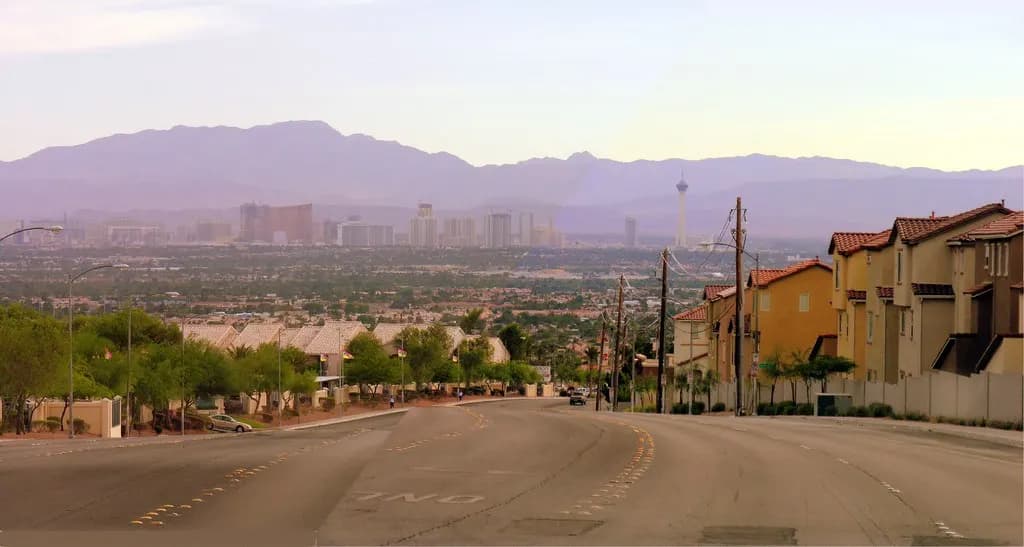
Some businesses in Clark County, mostly around resorts, arenas and new developments, sit in special taxing districts such as tourism improvement districts or the Stadium Entertainment Improvement District around the stadium. They report on the department's Special Districts/Liquor Surcharge return instead of the standard one. The same return is used by restaurants in cities and counties that let covered food establishments sell alcohol to go or by delivery. If you're opening in a resort corridor, ask the department which return applies before your first filing.
What's taxable and what's exempt
Nevada taxes the sale, lease, rental and other transfer of tangible personal property. Services aren't taxed in general, but services that are part of selling goods are. Fabrication labor, the work of making an item you sell, is taxable. Repair, reconditioning and installation labor isn't taxed if it's listed separately on the invoice. Consulting and other services that don't involve selling goods aren't taxed.
Delivery charges get similar treatment. Since May 22, 2009, freight, shipping and postage charges for delivering goods to the customer aren't taxable if they're stated separately on the invoice. Handling, packing and crating charges are taxable even if separately stated, and freight you paid to bring goods into your store is part of your cost.
Unprepared food for home consumption, prescription medicines, farm machinery and equipment, newspapers and finance charges on credit sales are exempt. Prepared food and restaurant meals are taxable, and the department's Regulation R056-18 sets out when food counts as prepared for immediate consumption. Beer, wine and liquor are taxable on the full price including excise taxes. Products delivered electronically, such as downloaded software, e-magazines, clipart and program code, aren't taxed, though the same software on a disk is.
Religious, charitable and educational nonprofits aren't automatically exempt because of their federal status. They apply to the department for an exemption letter and renew it every five years. Government agencies are exempt by statute.
Taxable or not in Nevada?
| Item or charge | Taxed? | Note |
|---|---|---|
Clothing, furniture, electronics | Yes | County rate |
Groceries (unprepared food) | No | Exempt |
Restaurant meals and prepared food | Yes | Full county rate |
Separately stated delivery charge | No | Since May 22, 2009 |
Separately stated installation or repair labor | No | Itemize on the invoice |
Downloaded software and e-books | No | Software on a disk is taxed |
Consulting and professional services | No | Use tax may apply to supplies |
Clothing, furniture, electronics
- Taxed?
Yes
- Note
County rate
Groceries (unprepared food)
- Taxed?
No
- Note
Exempt
Restaurant meals and prepared food
- Taxed?
Yes
- Note
Full county rate
Separately stated delivery charge
- Taxed?
No
- Note
Since May 22, 2009
Separately stated installation or repair labor
- Taxed?
No
- Note
Itemize on the invoice
Downloaded software and e-books
- Taxed?
No
- Note
Software on a disk is taxed
Consulting and professional services
- Taxed?
No
- Note
Use tax may apply to supplies
Worked examples in dollars
A Las Vegas electronics shop. A customer buys a $1,200 laptop. Tax at 8.375% is $100.50, for a total of $1,300.50. The same laptop in Reno is taxed at 8.265%, or $99.18, and in Winnemucca at 6.85%, or $82.20.
A Henderson appliance store. A $900 refrigerator is delivered and installed for a $75 delivery fee and a $120 installation charge, all on one invoice with each charge listed separately. Tax applies only to the $900, so it's $75.38. If the store lumps everything into one $1,095 price, tax rises to $91.71.
The collection allowance. A Reno restaurant collects $20,000 of sales tax in a month and files by the 20th. It keeps 0.25% of the sales tax, $50, and pays $19,950. The allowance applies only to sales tax, not to use tax, and it's lost if the return or payment is late.
The security deposit. A new Las Vegas boutique expects about $2,000 of sales tax a month and will file monthly. Its security is three times that, $6,000, posted as cash, a surety bond or a Nevada bank's irrevocable letter of credit. A small craft seller expecting $450 of tax a quarter and filing quarterly would owe twice that, $900. Because that's $1,000 or less, no security is required.
Try it — Las Vegas sales tax on $1,200
Getting a seller's permit
Every retailer selling goods that will be used in Nevada needs a sales and use tax permit under NRS 372.220. Businesses that don't sell but buy taxable goods without paying tax register for a consumer use tax permit instead. The order matters: you need a federal EIN first, then a Nevada State Business License from the Secretary of State through Nevada Orion, and only then the tax permit through My Nevada Tax or a paper registration form.
The permit costs $15 for each location. Display it at the location it was issued for. A change of location or ownership needs a new permit, and some account changes carry a $15 fee. If you have stores in more than one county, tell the department how your sales split between counties.
The State Business License is separate and costs more: $200 a year for most entities and $500 for corporations. Our Nevada business license guide explains it, along with county and city licenses in Las Vegas, Henderson and Reno.
The security deposit
Nevada is one of the few states that routinely asks new sellers for security. Under NRS 372.510, the department requires a deposit when you get a permit. For monthly filers it's three times your estimated average monthly tax, and for quarterly filers twice your estimated quarterly tax. If the amount calculated is $1,000 or less, none is required, though the department can demand security later if you become habitually late.
You can post cash, a surety bond from an insurance company, or an irrevocable letter of credit from a Nevada bank, credit union or savings and loan. The department publishes a surety bond acknowledgement form to give your insurer. After three years of perfect payment history, the Nevada Tax Commission can waive the security and refund any cash deposit, provided you ask in writing. Corporations must have two officers sign personal guarantees for the amount instead. A late return or bounced check after a waiver brings the requirement back.
Before your first Nevada sale
0/6Filing, paying and the new due date
The department assigns your filing frequency based on taxable sales. Monthly filing is mandatory if taxable sales are more than $10,000 a month. Quarterly filing applies below that, and annual filing is available if taxable sales were under $1,500 in the previous year. You must file a return for every period even if you made no taxable sales.
The due date changed in 2026. Assembly Bill 594 moved the deadline from the last day of the following month to the 20th of the month. It applies from the January 2026 period, so the first return under the new rule was due on February 20, 2026. If the 20th falls on a weekend or holiday, the due date is the next business day. The department announced the change on January 23, 2026, and its website now flags it on the home page.
Late payment is expensive. Penalties rise with the number of days late under NAC 360.395: 2% for 1 to 10 days, 4% for 11 to 15, 6% for 16 to 20, 8% for 21 to 30 and 10% after that. Interest of 0.75% a month is added, and you lose the collection allowance. You can file and pay online through My Nevada Tax; if you mail a return, only a U.S. Postal Service postmark counts as proof of timely filing.
Nevada sales tax dates to know
October 1, 2019
Remote seller and marketplace rules apply at $100,000 or 200 transactions
January 1, 2020
Clark County rate rises to 8.375%
February 20, 2026
First return due under the new 20th-of-the-month deadline (AB 594)
August 14, 2026
Commerce Tax return for fiscal year 2025–2026 due
December 7, 2026
Phase 3 of My Nevada Tax moves more tax types online
Pricing, receipts and records
Nevada has a few rules about how you show tax to customers. You can include sales tax in your prices, but only if you tell customers, either with a sign they can see or on the printed receipt. Without that notice, the department treats the full amount charged as the price and expects tax on top of it. You also can't advertise that you'll absorb the tax, leave it off the price or refund it, under NRS 372.115.
Tax you collect belongs to the state from the moment you collect it. NRS 372.354 requires you to hold it in trust in a separate account, which can be a separate bank account or a separate ledger account. Keep your sales records, invoices, resale certificates and returns for at least four years; if returns weren't filed, the department can look back eight years. Resale certificates from customers don't expire while their account is open, but it's good practice to check them regularly with the department's permit search.
Remote sellers and marketplaces
Since October 1, 2019, out-of-state sellers must collect Nevada sales tax if their sales into the state, counting both direct sales and marketplace sales, are more than $100,000 or reach 200 or more separate transactions in the current or previous calendar year. Nevada is one of the states that still uses a transaction count. Once you cross the threshold, you register to start collecting on the first day of the first calendar month at least 30 days later.
Marketplace facilitators collect on sales they facilitate and give their sellers a certificate of collection. A remote seller whose only connection to Nevada is inventory in a third-party fulfillment center doesn't need to register if the marketplace collects the tax. Nevada has been a full member of the Streamlined Sales and Use Tax Agreement since April 1, 2008, so remote sellers can use a certified service provider and the Streamlined registration system.
The Commerce Tax and other business taxes
Nevada's lack of a corporate income tax doesn't mean businesses avoid tax on revenue. The Commerce Tax applies to businesses whose Nevada gross revenue exceeds $4 million in a fiscal year ending June 30. The rate depends on your industry category, based on your NAICS code. The return is due 45 days after the fiscal year ends; for 2025–2026 it was due August 14, 2026, and a 30-day extension is available on request. Part of the Commerce Tax paid can be credited against the Modified Business Tax, Nevada's payroll tax.
For most small retailers, the Commerce Tax won't apply, but the threshold counts gross revenue, not sales tax collected, and a busy restaurant or car dealership can reach it. Track Nevada revenue by fiscal year, not calendar year.
Common mistakes and how to fix them
Still filing at month-end. Since the January 2026 period, the deadline is the 20th. A return filed on the 30th is now ten days late, costing a 2% penalty plus interest and the collection allowance.
Adding a city rate. Nevada cities don't levy general sales tax. If your system adds a Las Vegas or Reno city rate on top of the county rate, you're over-collecting.
Lumping delivery or installation into the price. Separately stated delivery and installation charges aren't taxable. One combined price makes the whole amount taxable.
Forgetting security. Posting security is part of getting the permit, so budget for it in your opening costs, or ask an insurer about a surety bond, which usually ties up less cash than a deposit.
Buying a business without a clearance. Under Nevada's successor liability rules, a buyer can become personally liable for the seller's unpaid taxes up to the price paid. Ask the department for a certificate of amount due before closing.
What to do next
Get your State Business License, register for your sales tax permit with security arranged, load the county rate for each location and move your filing reminders to the 20th. Use the sales tax calculator to check receipts and our how to calculate sales tax guide to work out tax-included prices. Selling into neighboring states too? Compare our California and Arizona sales tax guides.
This is general information, not legal or tax advice — confirm on the official source or with a professional.
Frequently asked questions
The statewide minimum rate is 6.85%, made up of the state sales tax, the local school support tax and city-county relief taxes. Counties add optional taxes, so rates run from 6.85% in Esmeralda, Eureka, Humboldt and Mineral counties to 8.375% in Clark County. Each county has one rate that applies everywhere in it; Nevada cities don't add their own.
Las Vegas, Henderson, North Las Vegas and the rest of Clark County charge 8.375%. The rate rose by one-eighth of a percent on January 1, 2020. A $100 purchase costs $108.38. Hotels, live entertainment and rental cars carry separate taxes, and some tourism districts report on a special return, but the general rate on goods is 8.375%.
The sales tax permit costs $15 per location. You'll usually also need to post security: three times your estimated average monthly tax if you file monthly, or twice your estimated quarterly tax if you file quarterly. If the amount works out to $1,000 or less, no security is required. You also need a Nevada State Business License first.
From the January 2026 period, returns and payments are due by the 20th of the month after the period ends, under Assembly Bill 594. They used to be due on the last day of the month. If the 20th falls on a weekend or holiday, the due date moves to the next business day. Filing on time lets you keep a 0.25% collection allowance on sales tax.
Unprepared food for home consumption is exempt from Nevada sales tax, as are prescription medicines. Prepared food, restaurant meals, alcohol and soft drinks are taxable at the full county rate. Nevada also doesn't tax products delivered electronically, such as downloaded software and e-books, but software on a disk is taxable.
It's an annual tax on businesses whose Nevada gross revenue exceeds $4 million in a fiscal year ending June 30. Rates vary by industry. The return is due 45 days after the fiscal year ends; for the 2025–2026 year it was due August 14, 2026. Businesses under the threshold owe nothing. It's separate from sales tax and from the State Business License.
Sources & verification
Figures on this page were checked against the sources below when it was last reviewed on 9 October 2026. Each rate and limit is stored once with its own official source and review date, and official update channels are monitored daily so changes are picked up. How we verify
- 1.Sales Tax & Use Tax — Nevada Department of Taxation · accessed 9 October 2026
- 2.Taxpayer Information Packet (V2026.2) — Nevada Department of Taxation · accessed 9 October 2026
- 3.Nevada Revises Sales and Use Tax Deadlines Under AB 594 — Nevada Department of Taxation · accessed 9 October 2026
- 4.Start / Run a Business — Nevada Department of Taxation · accessed 9 October 2026
- 5.Sales Tax FAQs — Nevada Department of Taxation · accessed 9 October 2026
- 6.Marketplace Facilitator/Seller FAQs — Nevada Department of Taxation · accessed 9 October 2026
- 7.Commerce Tax — Nevada Department of Taxation · accessed 9 October 2026
- 8.State Business License FAQ — Nevada Secretary of State · accessed 9 October 2026
MSMETOOLS is an independent platform and is not affiliated with any government agency, ministry or department.
Tools for this
Sales Tax Calculator (US)
Calculate sales tax for all US states and cities.
Invoice Generator
Create professional invoices with tax, logo and custom details.
Related guides
 Nevada Business License 2026: Fees, ORION & Local LicensesRead guide
 Arizona Sales Tax Rate 2026: TPT, City Rates & LicenseRead guide
 Ohio Sales Tax Rate 2026: 5.75% State, Columbus & Cleveland 8%Read guide
 Nebraska Sales Tax 2026: 5.5% Rate, Omaha 7%, PermitsRead guide
Official links open the government site in a new tab.