 Sales tax
Nebraska Sales Tax in 2026: 5.5% State Rate, Local Rates, Omaha and How to File
Nebraska sales tax 2026: the 5.5% state rate, local rates up to 2%, Omaha's 7% plus its 2.5% restaurant tax, the free permit, filing thresholds and worked examples.
 Edited by Sumeet YadavFounder & editor, MSMETOOLS · fact-checked against official sources
Contents (11)
- 1. How the Nebraska rate is built
- 2. Omaha, Lincoln and other city rates
- 3. Food: what's exempt and what isn't
- 4. Which services are taxable in Nebraska
- 5. Worked examples in dollars
- 6. Getting a Nebraska sales tax permit
- 7. Filing frequency, due dates and the collection fee
- 8. Remote sellers, marketplaces and use tax
- 9. Recent changes to know
- 10. Common mistakes and how to fix them
- 11. What to do next
Nebraska's sales tax looks simple from a distance: one 5.5% state rate and a local add-on of 1% to 2% in most towns. Up close there are details that trip up new businesses, from Omaha's separate restaurant tax and Good Life District rates to the fact that candy and canned soda are tax-free groceries here. This guide is for retailers, restaurants, contractors, service businesses and online sellers who need the 2026 rules: state and local rates, what Omaha and Lincoln charge, how food and services are treated, how to get a permit and how to file. We checked every figure against the Nebraska Department of Revenue (DOR) and its July 1, 2026 local rate chart in October 2026.
Quick answer
Nebraska's state sales tax rate is 5.5%. Cities and villages add up to 2%, so Omaha totals 7% and Lincoln 7.25%. Groceries, including candy and canned soft drinks, are exempt. Restaurants in Omaha also charge a 2.5% city restaurant tax.
The sales tax permit is free; you need one for each location
Returns are due the 20th; annual, quarterly or monthly depending on your yearly tax
Retailers keep 3% of the first $5,000 of tax each month, up to $150 a month
Repair and installation labor on taxable goods is taxable
Remote sellers collect after $100,000 or 200 transactions
How the Nebraska rate is built
The state levies 5.5% on retail sales of goods and on a list of services. Use tax at the same rate applies to taxable items bought without Nebraska tax, such as equipment ordered from an out-of-state website.
Local sales taxes are mostly city and village taxes. DOR's July 1, 2026 rate chart lists hundreds of municipalities with a local rate, and almost all of them are 1%, 1.5% or 2%. Only a few use other figures: Lincoln levies 1.75%, and four small villages levy 0.5%. Counties generally don't levy sales tax, with one exception: Dakota County adds 0.5%, but only on sales outside a municipality that has its own local tax. Sales in rural areas and in towns with no local tax pay only the state rate.
The local rate follows the delivery location. A sale picked up at your store uses your store's rate, while goods delivered to a customer use the rate at the delivery address. An Omaha retailer delivering to Papillion charges Papillion's 7.5%, and the same retailer delivering to a farm outside any taxing town charges 5.5%. DOR's Sales Tax Rate Finder looks up a street address. Since LB 208 of 2025, a seller that has only a customer's five-digit ZIP code must use the highest rate in that ZIP code, so collecting full addresses saves customers money.
Local rates change at the start of a quarter, and DOR announces changes in advance. In the past two years, Norfolk, Friend and Mullen rose to 2%, Lindsay and Filley added new taxes, Elm Creek, Wilber and Edgar rose to 1.5%, and Eagle, Hay Springs and Winside have changes scheduled for January 1, 2027.
Nebraska sales tax at a glance (2026)
5.5%
State sales tax rate
7%
Omaha total
Plus 2.5% on restaurant food and drink
7.25%
Lincoln total
free
Sales tax permit
Omaha, Lincoln and other city rates
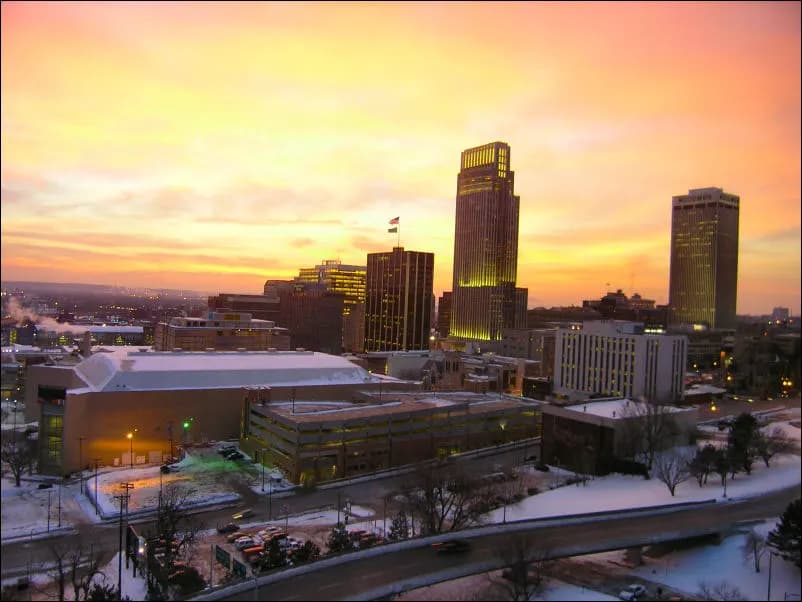
Omaha's total rate is 7%: 5.5% state and 1.5% city. Bellevue is also 7%. Papillion, Gretna and Norfolk are at 7.5%. Lincoln is 7.25%, the only city on the chart with a 1.75% rate. Grand Island and North Platte are 7.5%, while Kearney, Hastings, Columbus and Scottsbluff are 7%.
Omaha's restaurant tax
Restaurants, bars and other places selling food and drink in Omaha owe the city's restaurant and drinking place occupation tax: 2.5% of gross receipts from food and beverages under Omaha Code Sec. 19-802. It's a city tax, not a sales tax, so it's filed with the City of Omaha Finance Department rather than DOR, monthly by the last day of the following month.
The two taxes interact. DOR's occupation tax guidance says the occupation tax must be included in the sales price before you calculate state and local sales tax, and the receipt must show the two taxes separately. You can't simply add the rates and charge 9.5%. On a $100 meal, the occupation tax is $2.50 and sales tax at 7% applies to $102.50, so the total tax is $9.68.
Some Omaha districts add their own occupation taxes in enhanced employment areas, and other Nebraska cities have their own occupation taxes on restaurants or hotels. Ask the city's finance office before you open.
Good Life Districts
Nebraska's Good Life Transformational Projects Act lets large destination developments charge a reduced state sales tax. DOR's chart shows that opted-in retailers in Omaha's Avenue One district charge a 2.75% state rate, and those sales are reported separately. Since October 1, 2025, the other Good Life Districts, including Nebraska Crossing in Gretna and districts in Grand Island, Bellevue and Kearney, use the full 5.5% state rate; any city rate is added on top.
Food: what's exempt and what isn't
Nebraska exempts food and food ingredients for human consumption under Neb. Rev. Stat. 77-2704.24, except prepared food and food sold through vending machines. DOR's Reg-1-087 spells out a broad definition. It includes staples like milk, meat, flour and eggs, but also soft drinks, bottled water, ice, candy and chewing gum. Products with a Nutrition Facts box on the label are treated as food. That's more generous than many states, which tax candy and soda even when they exempt groceries.
Some things are excluded: alcoholic beverages, tobacco and dietary supplements, which carry a Supplement Facts box. That label test matters for energy drinks, which are exempt with Nutrition Facts and taxable with Supplement Facts. Every item sold through a vending machine is taxable, including a can of soda that would be exempt at a store counter.
Prepared food is taxable. That covers food the seller heats, food the seller mixes or combines and sells as one item, and food sold with utensils. Fountain drinks, iced coffee drinks and soft-serve ice cream count as prepared food. Convenience stores need to watch a special rule: if more than 75% of a seller's food sales are prepared food, utensils merely available on the premises make other food taxable too. DOR's convenience store example shows a store well below that line, so its bottled soda stays exempt.
Food at an Omaha store (2026)
| Item | Taxable? | Rate |
|---|---|---|
Milk, bread, meat, produce | No | 0% |
Candy bar or canned soda | No | 0% |
Energy drink with Nutrition Facts label | No | 0% |
Vitamins with Supplement Facts label | Yes | 7% |
Fountain drink or hot sandwich | Yes | 7% |
Soda from a vending machine | Yes | 7% |
Beer | Yes | 7% |
Milk, bread, meat, produce
- Taxable?
No
- Rate
0%
Candy bar or canned soda
- Taxable?
No
- Rate
0%
Energy drink with Nutrition Facts label
- Taxable?
No
- Rate
0%
Vitamins with Supplement Facts label
- Taxable?
Yes
- Rate
7%
Fountain drink or hot sandwich
- Taxable?
Yes
- Rate
7%
Soda from a vending machine
- Taxable?
Yes
- Rate
7%
Beer
- Taxable?
Yes
- Rate
7%
Which services are taxable in Nebraska
Nebraska taxes services selectively. The broadest category is labor connected to taxable goods: production and assembly labor, and repair and installation labor when the item being repaired or installed is taxable. Delivery and shipping charges on taxable items are taxable too, as are fuel surcharges on taxable sales.
DOR's services FAQ lists other taxable services. They include building cleaning and maintenance, such as construction cleanup, furnace and duct cleaning and cleanup after fire or flood; pest control; motor vehicle towing; motor vehicle washing and waxing, including coin-operated washes; security services, including off-duty police security and repair of security systems; grooming, shearing and medicated baths for animals other than livestock; detective services; RV park pad rentals; and computer software training when the provider also sells the software. Repairs and maintenance such as refinishing furniture, repairing appliances and musical instruments, gunsmith work, clothing alterations and tool sharpening are also taxable. Cleaning clothes isn't.
Is the service taxable in Nebraska?
| Service | Taxable? | Note |
|---|---|---|
Car or appliance repair, parts and labor | Yes | Repair of taxable property |
Office cleaning after a flood | Yes | Building cleaning and maintenance |
Termite treatment | Yes | Pest control |
Dog grooming | Yes | Animal services (not livestock) |
Dry cleaning a suit | No | Cleaning clothes isn't taxed |
Tax preparation | No | Professional service |
Car or appliance repair, parts and labor
- Taxable?
Yes
- Note
Repair of taxable property
Office cleaning after a flood
- Taxable?
Yes
- Note
Building cleaning and maintenance
Termite treatment
- Taxable?
Yes
- Note
Pest control
Dog grooming
- Taxable?
Yes
- Note
Animal services (not livestock)
Dry cleaning a suit
- Taxable?
No
- Note
Cleaning clothes isn't taxed
Tax preparation
- Taxable?
No
- Note
Professional service
Professional services aren't on the list. Legal, accounting, engineering, consulting, medical and most personal services remain untaxed. Proposals to extend the tax to more services have been debated in recent sessions, but none had become law as of October 2026.
Contractors
Construction contractors who annex property to real estate or repair it must register in the Nebraska Department of Labor's Contractor Registration Database. When they register, they choose one of three options for how tax on building materials is handled, and that choice decides whether they also need a sales tax permit. Since July 1, 2026, a contractor can buy building materials tax-free when working for a client that has its own buyer-based exemption, such as a qualifying nonprofit.
Worked examples in dollars
A television in Omaha. A customer buys a $1,000 television at an Omaha store. Tax at 7% is $70, for a total of $1,070. In Lincoln, the same sale costs $72.50 in tax at 7.25%.
Dinner in Omaha. A restaurant bill is $100 before tax. The 2.5% restaurant tax adds $2.50. Sales tax at 7% on $102.50 is $7.18. The customer pays $109.68, and the receipt shows the two taxes separately.
A grocery run. A shopper buys $150 of groceries, including soda and candy, plus a $6 bottle of vitamins at an Omaha supermarket. The groceries are exempt. The vitamins are taxable at 7%, so tax is $0.42.
A car repair in Lincoln. A shop bills $350 in labor and $250 in parts. Because the car is taxable property, both are taxable: tax at 7.25% on $600 is $43.50.
Try it — Omaha sales tax on $1,000
Getting a Nebraska sales tax permit
Every retailer making taxable sales in Nebraska needs a sales tax permit before starting. Apply on the Nebraska Tax Application, Form 20, online through DOR or by mail or fax. There's no charge: the permit has been free since October 1, 2002, and DOR warns about websites that try to "sell" Nebraska sales tax certificates. Get your federal EIN first if you need one.
Under Reg-1-004, you need a separate permit for each retail location, and it must be displayed where you do business. Moving locations requires a change request, Form 22. If you stop selling temporarily, you can cancel the permit and reinstate it later without charge. If DOR revokes a permit for violations, you'll need to post security and pay a reissue fee of $25 for a first revocation and $50 for each one after that.
Businesses with several locations under at least 80% common ownership can apply on Form 11 to file one combined return, but combined filers must e-file monthly through NebFile.
Before your first Nebraska sale
0/7Filing frequency, due dates and the collection fee
DOR assigns your frequency from your yearly tax. Form 20 sets the bands: less than $900 a year, annual; $900 to $2,999, quarterly; $3,000 or more, monthly. Returns and payments are due on the 20th of the month after the period ends, and you must file even when you had no sales. Report state tax and each local jurisdiction's tax on Form 10 and its Schedule I.
Nebraska pays retailers for collecting. Since October 1, 2022, you can keep a collection fee of 3% of the first $5,000 of tax each month, which works out to a cap of $150 a month. A monthly filer collecting $4,000 keeps $120; one collecting $8,000 keeps $150. No fee is allowed on use tax you report for your own purchases or on tax paid under a direct payment permit. Under LB 208 of 2025, a seller whose taxes are handled by a Streamlined certified service provider can't also take the fee, because the provider is already paid.
Late returns cost a penalty of 10% of the tax or $25, whichever is greater, plus interest from the due date. Keep records that support your returns for at least three years.

Remote sellers, marketplaces and use tax
A remote seller or multivendor marketplace platform is engaged in business in Nebraska once it has more than $100,000 or 200 transactions in Nebraska. Sales a remote seller makes through a marketplace count toward its thresholds, though the marketplace collects the tax on those sales. Nebraska is a full member of the Streamlined Sales and Use Tax Agreement, so remote sellers can register through the central Streamlined system and use certified software.
Nebraska businesses owe use tax on taxable items bought without Nebraska tax, at the state rate plus the local rate where the item is used. Report it on your Form 10. If you don't need a sales tax permit, you can apply for a use tax permit instead. Equipment, furniture, software and supplies bought online are the usual sources of use tax bills in an audit.
Recent changes to know
Several changes in 2025 and 2026 affect day-to-day compliance. LB 208 (2025) added the five-digit ZIP code rule and the certified service provider limit on the collection fee. Good Life District rates outside Avenue One moved to 5.5% from October 1, 2025. LB 901 (2026) repealed several exemptions on July 1, 2026, including those for data center equipment, community-based energy development projects, biochips, mineral oil used as grain dust suppressant, game birds and certain nonprofit purchases. The same date brought the contractor buyer-based exemption. Local rate changes continue each quarter, with no changes on October 1, 2026 and three on January 1, 2027.
Recent Nebraska sales tax changes
2025
LB 208: five-digit ZIP code rule; no collection fee for sellers using a Streamlined certified service provider
Oct 1, 2025
Good Life Districts other than Avenue One move to the 5.5% state rate
Jul 1, 2026
LB 901 repeals six exemptions; contractor buyer-based exemption begins
Jan 1, 2027
New or higher local rates in Winside, Eagle and Hay Springs
Common mistakes and how to fix them
Taxing candy and canned soda. Sellers from other states often do. In Nebraska these are food and exempt unless sold as prepared food or from a vending machine.
Combining Omaha's restaurant tax with sales tax. Calculate the 2.5% first, then sales tax on the total, and show both on the receipt.
Missing repair labor. Labor to repair or install taxable property is taxable. Itemizing labor separately doesn't change that.
Using one rate for all deliveries. Delivered goods are taxed at the delivery address. Use the Rate Finder or full nine-digit ZIP codes.
Using an old collection fee. Many systems still compute 2.5% capped at $75. The fee has been 3% of the first $5,000, up to $150 a month, since October 2022, so you may be leaving money on the table.
Official links
- DOR — Sales and Use TaxRates, changes and guides
- Local rate chart, July 1, 2026Every city and village rate
- Sales Tax Rate FinderRate for a street address
- Form 20, Nebraska Tax ApplicationApply for a permit
- Sales tax on certain services FAQsWhich services are taxable
- Nebraska sales tax exemptionsFood, agriculture, manufacturing
What to do next
File Form 20 for each location, look up the local rate for every store and delivery area, and set your register so groceries, candy and canned soda are exempt while prepared food, vending sales and supplements are taxed. If you run an Omaha restaurant, register for the city's restaurant tax too. Mark the 20th on your calendar and claim the collection fee. Use the sales tax calculator to check receipts at 7% or your local rate, and our guide to calculating sales tax. Selling into neighboring states? Compare our Iowa, Kansas, Missouri and Colorado guides, and read about economic nexus.
This is general information, not legal or tax advice — confirm on the official source or with a professional.
Frequently asked questions
The state rate is 5.5%. Most cities and villages add a local rate of 1% to 2%, so totals usually fall between 6.5% and 7.5%. Omaha totals 7% and Lincoln 7.25%. Areas with no local tax pay just 5.5%, and unincorporated Dakota County adds 0.5%.
Omaha's sales tax is 7%: the 5.5% state rate plus the city's 1.5%. Restaurants and bars also charge Omaha's 2.5% restaurant occupation tax, and sales tax applies to the price including that tax, so a restaurant bill carries about 9.7% in total.
Groceries aren't. Nebraska exempts food and food ingredients for home consumption, and its definition includes candy, gum, bottled water and soft drinks in cans or bottles. Prepared food, such as restaurant meals, hot food and fountain drinks, is taxable, as is everything sold through a vending machine. Dietary supplements with a Supplement Facts label are taxable.
It's free. Nebraska dropped its permit fee on October 1, 2002. You apply on the Nebraska Tax Application, Form 20, online or on paper, and you need a separate permit for each retail location. A fee applies only to reissue a permit after the Department revokes it.
It depends on your yearly tax. Below $900 you file annually; from $900 to just under $3,000, quarterly; at $3,000 or more, monthly. Returns and payments are due on the 20th of the month after the period. Retailers keep a collection fee of 3% of the first $5,000 of tax, up to $150 a month.
Some. Nebraska taxes labor to repair or install taxable property, plus specific services such as building cleaning and maintenance, pest control, motor vehicle towing and washing, security services, animal grooming, detective services and RV park fees. Most professional services, such as legal, accounting and medical work, aren't taxed.
Remote sellers and marketplace platforms must register and collect once they have more than $100,000 or 200 transactions into Nebraska in the current or previous calendar year. Sales made through a marketplace count toward a remote seller's thresholds, but the marketplace collects on them.
Sources & verification
Figures on this page were checked against the sources below when it was last reviewed on 11 October 2026. Each rate and limit is stored once with its own official source and review date, and official update channels are monitored daily so changes are picked up. How we verify
- 1.Sales and Use Tax — Nebraska Department of Revenue · accessed 11 October 2026
- 2.Local Sales and Use Tax Rates, effective July 1, 2026 — Nebraska Department of Revenue · accessed 11 October 2026
- 3.Nebraska Tax Application, Form 20 — Nebraska Department of Revenue · accessed 11 October 2026
- 4.Revenue Ruling 01-02-11: Sales tax permit application fee — Nebraska Department of Revenue · accessed 11 October 2026
- 5.Reg-1-004 Permits — Nebraska Department of Revenue · accessed 11 October 2026
- 6.Nebraska and Local Sales and Use Tax Return, Form 10 and instructions — Nebraska Department of Revenue · accessed 11 October 2026
- 7.Nebraska Tax Rate Chronologies — Nebraska Department of Revenue · accessed 11 October 2026
- 8.Reg-1-087 Food and Food Ingredients — Nebraska Department of Revenue · accessed 11 October 2026
- 9.Nebraska Sales Tax Exemptions — Nebraska Department of Revenue · accessed 11 October 2026
- 10.Sales Tax on Certain Services FAQs — Nebraska Department of Revenue · accessed 11 October 2026
- 11.Occupation Taxes — Nebraska Department of Revenue · accessed 11 October 2026
- 12.Obtain Necessary Licenses and Permits (Omaha ONEBiz) — City of Omaha · accessed 11 October 2026
- 13.Legislative Bill 208 Brings Compliance Updates for Nebraska Sales Tax — Sales Tax Institute · accessed 11 October 2026
MSMETOOLS is an independent platform and is not affiliated with any government agency, ministry or department.
Tools for this
Sales Tax Calculator (US)
Calculate sales tax for all US states and cities.
Invoice Generator
Create professional invoices with tax, logo and custom details.
Related guides
 Kansas Sales Tax Rate 2026: 6.5% State, 0% on FoodRead guide
 Nebraska Business License 2026: Free Permit & Local RulesRead guide
 Iowa Sales Tax 2026: 6% Rate, 1% Local Tax & Permit GuideRead guide
 Colorado Sales Tax Rate 2026: 2.9% State, Denver & Home-RuleRead guide
Official links open the government site in a new tab.