 Sales tax
Iowa Sales Tax in 2026: The 6% Rate, Local Option Tax, Taxable Services and the Free Permit
Iowa sales tax 2026: the 6% state rate, the 1% local option tax and Des Moines' 7% total, taxable services, the free permit, filing dates and worked examples.
 Edited by Sumeet YadavFounder & editor, MSMETOOLS · fact-checked against official sources
Contents (12)
- 1. How the Iowa rate works
- 2. Rates in Des Moines and other Iowa cities
- 3. Which services are taxable in Iowa
- 4. Food, clothing and other common exemptions
- 5. Worked examples in dollars
- 6. Getting your Iowa sales tax permit
- 7. Filing and paying
- 8. Sales price rules that change the tax
- 9. Remote sellers and marketplaces
- 10. Use tax for Iowa businesses
- 11. Common mistakes and how to fix them
- 12. What to do next
Iowa's sales tax looks simple at first: one state rate and one possible local add-on. The details trip people up, though. Iowa taxes a long list of services that most states leave alone, local option taxes switch on and off city by city, and the filing rules changed for everyone a few years ago. This guide is for shop owners, contractors, salons, landscapers and online sellers who need the 2026 rules in one place: the 6% state rate, the 1% local option tax, what Des Moines and other cities charge, which services are taxed, how to get the free permit and how to file. Every figure was checked against Iowa Department of Revenue guidance in October 2026.
Quick answer
Iowa's state sales tax is 6%. Most cities and counties add a 1% local option sales tax, so the total is 7% in Des Moines and most of the state, and 6% where no local option tax applies. Iowa also taxes about 75 services, from car repair to lawn care.
The sales and use tax permit is free, through GovConnectIowa
File annually if you collect under $1,200 a year; otherwise monthly, by the last day of the next month
Remote sellers collect once Iowa sales reach $100,000 in a year
Grocery food is exempt, but candy, soft drinks and prepared food are taxed
Iowa City, Coralville and North Liberty moved to 7% on July 1, 2026
How the Iowa rate works
Iowa imposes a sales tax and a matching use tax, both at 6%. Sales tax applies when you sell goods, specified digital products or a listed service, and it's due when the customer first uses the service or takes delivery of the goods, not when you get paid. Use tax applies when an Iowa business or resident buys something taxable without paying Iowa tax, usually from an out-of-state seller.
On top of the state rate, most local jurisdictions impose a local option sales tax, commonly called LOST, at 1%. The rate is the same everywhere it applies, so an Iowa sale is taxed at either 6% or 7% in total. What varies is whether a given city, or the unincorporated part of a county, has adopted it. Within one county, some cities may charge it and others may not. New local taxes can start only on January 1 or July 1.
Two quirks matter for buyers. There is no local option use tax, so an Iowa business paying use tax on an untaxed out-of-state purchase pays the 6% state rate only. And if you're a retailer who should have charged the local option tax but didn't, you stay liable for the uncollected local tax even if your customer later pays use tax. Part of the state rate funds school infrastructure under the SAVE program, but that's built into the 6% and doesn't appear as a separate charge.
Rates in Des Moines and other Iowa cities
The Department of Revenue publishes a status list of every jurisdiction twice a year. The July 1, 2026 list shows Des Moines at 7%, with its Polk County local option tax dating from July 1, 2019. The city's small Warren County section has had the tax even longer. Most of the metro is also at 7%, but not all of it, which is why you should never assume a suburb matches the city next door.
| City | County | Total rate | Note |
|---|---|---|---|
| Des Moines | Polk | 7% | Local option tax since July 1, 2019 |
| West Des Moines (Polk, Dallas, Warren parts) | Polk / Dallas / Warren | 7% | The Madison County sliver is 6% |
| Ankeny | Polk | 6% | No local option tax |
| Waukee (Polk part), Norwalk | Polk | 6% | No local option tax |
| Cedar Rapids | Linn | 7% | Johnson County sliver is 6% |
| Iowa City, Coralville, North Liberty | Johnson | 7% | New from July 1, 2026 |
| Davenport | Scott | 7% | |
| Sioux City | Woodbury | 7% | Plymouth County sliver is 6% |
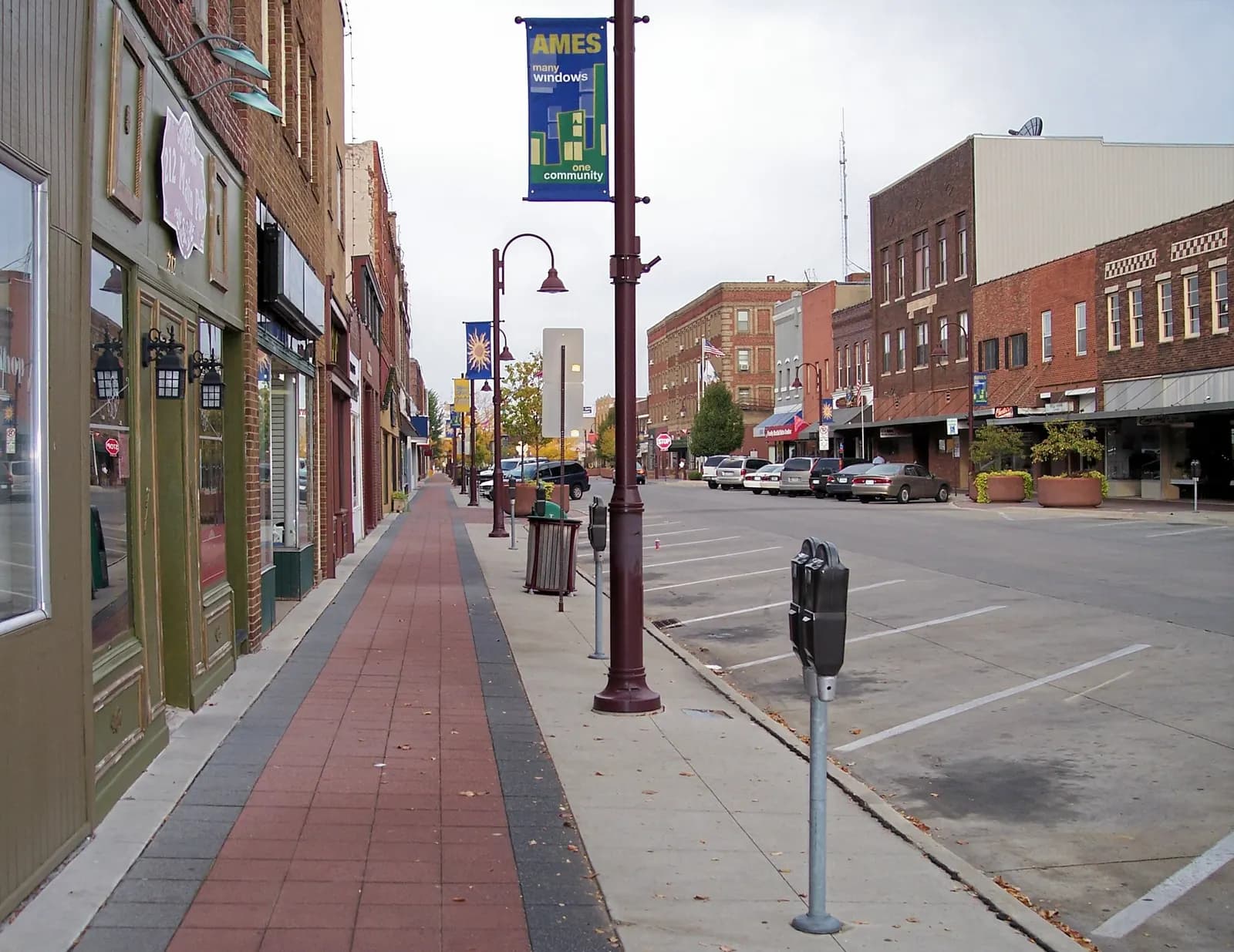
| Ames | Story | 7% |
The biggest change in 2026 was in Johnson County. Iowa City, Coralville, North Liberty, Oxford and Shueyville all began charging the local option tax on July 1, 2026, taking them from 6% to 7%. If you sell into eastern Iowa and your point-of-sale system still shows 6% for those cities, update it, because your business owes the local tax you should have collected.
For an exact address, use the Department's sales tax lookup or its tax mapper rather than a ZIP code. ZIP codes cross city and county lines, and a delivery to a farm outside city limits depends on whether that county's unincorporated area has the tax.

Which services are taxable in Iowa
Iowa follows two opposite rules. Goods are taxable unless a law exempts them, while services are exempt unless a law taxes them. The list of taxed services in Iowa Code section 423.2(6) is long, about 75 items, and it reaches many small businesses that would never charge sales tax in neighboring states.
The list includes repair work of almost every kind: vehicles, appliances, electronics, farm implements, machines, motors, guns, jewelry and watches, shoes and bicycles. It covers trades such as plumbing, pipe fitting, electrical installation, carpentry repair, roof and glass repair, painting, welding, excavating and demolition. Personal services on the list include barber and beauty services, tanning, massage unless performed by a licensed massage therapist, pet grooming and dating services. Property services include landscaping, lawn care, tree trimming, swimming pool cleaning, extermination, and janitorial or cleaning work for non-residential customers.
Business services are also taxed: employment and executive search agencies, investment counseling, security and detective services, telephone answering, test laboratories and information services. So are mini-storage, parking, campgrounds, golf and country club fees and other commercial recreation. On the digital side, software as a service, pay television including streaming video, and services to install or maintain digital products are taxable. Taxis, ride sharing, limousines and similar personal transportation services were added too.
There are three exemptions that matter most to service businesses. First, services performed on new construction, reconstruction, alteration, expansion or remodeling of a building are exempt, while repairs stay taxable, so a plumber's new-home rough-in isn't taxed but fixing a leak is. Second, services bought for resale are exempt, such as one auto shop subcontracting a radiator repair to another. Third, residential cleaning paid for by the occupant isn't taxed, though the same work in an office is.
Taxable or not in Iowa?
| Service or item | Taxed? | Note |
|---|---|---|
Car repair and oil changes | Yes | Parts and labor |
Haircut or salon service | Yes | Barber and beauty services |
Lawn care and landscaping | Yes | Including tree trimming |
Plumbing repair in an existing home | Yes | Repair stays taxable |
Plumbing in a new home build | No | New construction exemption |
Office cleaning | Yes | Non-residential janitorial |
House cleaning paid by the occupant | No | Residential exemption |
Accounting, legal and medical services | No | Not on the taxable list |
Car repair and oil changes
- Taxed?
Yes
- Note
Parts and labor
Haircut or salon service
- Taxed?
Yes
- Note
Barber and beauty services
Lawn care and landscaping
- Taxed?
Yes
- Note
Including tree trimming
Plumbing repair in an existing home
- Taxed?
Yes
- Note
Repair stays taxable
Plumbing in a new home build
- Taxed?
No
- Note
New construction exemption
Office cleaning
- Taxed?
Yes
- Note
Non-residential janitorial
House cleaning paid by the occupant
- Taxed?
No
- Note
Residential exemption
Accounting, legal and medical services
- Taxed?
No
- Note
Not on the taxable list
Food, clothing and other common exemptions
Grocery food is exempt. That covers bread, flour, meat, fish, eggs, milk and packaged ice cream, fruits and vegetables, frozen food, coffee and tea, and snack foods such as chips, nuts, popcorn and pretzels. Candy, soft drinks, dietary supplements, alcohol, tobacco, food sold through vending machines and prepared food are taxable. Iowa also taxes items people buy alongside groceries, such as pet food, paper products, soap and vitamins. SNAP purchases are exempt.
Prescription drugs, insulin and diabetic testing supplies, oxygen equipment and certain medical devices are exempt. Newspapers are exempt. Residential gas and electricity are exempt from the state tax but still carry the local option tax where it applies, a detail that catches out utilities and landlords who bill tenants for energy.
Iowa's sales tax holiday runs on the first Friday and Saturday of August. Each article of clothing or footwear priced under $100 is exempt from both state and local tax during that window. Store coupons and discounts can bring an item under $100, but manufacturer's coupons and rebates can't, and you can't split a pair of shoes or a suit to fit under the limit.
Nonprofits are often surprised to learn they pay tax. Churches and most nonprofit organizations pay Iowa sales tax on what they buy. Only specific groups, such as private nonprofit schools, nonprofit hospitals, hospices and museums, are exempt. Their fundraising sales can be exempt when the profits go to a 501(c)(3), a government body or a nonprofit school.
Worked examples in dollars
A Des Moines electronics sale. A customer buys a $1,000 laptop in Des Moines. Tax at 7% is $70, for a total of $1,070. The same laptop sold from a shop in Ankeny is taxed at 6%, or $60. If the Ankeny shop delivers it to a customer in Des Moines, the rate follows the delivery address, so it's $70.
A plumbing call. A plumber in Cedar Rapids charges $250 for labor and $150 for parts to fix a water heater in an existing home. All $400 is taxable at 7%, so the tax is $28. On a new house, the plumber's installation charge is exempt, and the plumber instead pays tax on materials when buying them, as a contractor.
A card surcharge. A Davenport salon adds a 3% surcharge to a $200 color service paid by card, making $206 before tax. Iowa treats a processing fee on a taxable sale as part of the sales price, so tax is 7% of $206, or $14.42, not 7% of $200.
Backing tax out of a total. A bar in Ames prices drinks with tax included and takes in $10,700 in a month. Because the local option tax applies, it divides by 1.07 to get $10,000 of gross sales and reports $700 of tax. Where only the 6% state rate applies, the divisor is 1.06.
Try it — Des Moines sales tax on $1,000
Getting your Iowa sales tax permit
Every retailer selling taxable goods or services in or into Iowa needs a sales and use tax permit. The permit is free. Apply online through GovConnectIowa, which is also where you'll file and pay, or use the paper Iowa Business Tax Permit Registration, form 78-005. Have your federal EIN ready, and if you're a corporation, partnership or LLC, each owner's name and Social Security number.
After you submit, keep a copy of the application. The Department says you can start collecting tax right away, with the copy as proof of registration, and your account letter arrives as soon as one business day electronically or within six weeks by mail. Iowa is a member of the Streamlined Sales and Use Tax Agreement, so remote sellers can register here and in other member states through one free Streamlined registration.
A few rules cause repeat applications. Each location you sell from needs its own permit. Moving your business to a different county means cancelling the old permit and applying again, and a change of owner does the same, because permits don't transfer. Iowa doesn't issue temporary permits for craft shows or fairs; you hold one permanent permit and can ask to file as a seasonal filer if you only sell four months a year or less.
The Department can ask for a bond. New applicants may have to post one if they or a company officer had a poor filing record or collection problems on a previous permit. Existing filers can be asked for a bond after repeated late returns or bounced payments. For a monthly filer, the minimum bond equals five months of tax, and no bond is less than $100.
Before your first Iowa sale
0/6Filing and paying
Senate File 2367, signed in 2022, simplified Iowa's filing rules. Sales tax and use tax now share one permit and one return, and filing is either monthly or annual, based on the tax you expect to collect. The local option tax isn't counted when deciding which applies.
If you collect less than $1,200 a year, you file one annual return, due January 31 of the next year, online or on paper. At $1,200 or more, you file monthly, by the last day of the following month, and you must file and pay electronically. Seasonal filers, who collect at least $1,200 in four or fewer months, file only for the months they're active, on the same monthly due date. Hotels, car rental businesses and construction equipment sellers file monthly whatever their tax.
Every filer completes the local option schedule on the return whenever the taxable amount isn't zero, even if no local tax is due, so the Department can distribute local tax to the right jurisdictions. File a zero return when you had no sales. When a due date falls on a weekend or holiday, it moves to the next business day, and a paper return counts as filed on its postmark date.
Interest accrues for each month or part of a month that tax is late, at a rate the Department resets each year. Keep records for at least three years, since that's the normal audit window; the window is unlimited if no return was filed or a return was fraudulent.
Iowa sales tax dates to know
July 1, 2019
Remote seller and marketplace facilitator collection begins; Des Moines adds the 1% local option tax
2022
SF 2367 combines sales and use tax permits and moves filers to monthly or annual
July 1, 2026
Iowa City, Coralville, North Liberty, Oxford and Shueyville start the 1% local option tax
First Friday and Saturday of August
Sales tax holiday on clothing and footwear under $100
January 31
Annual returns due for filers under $1,200 a year
Sales price rules that change the tax
Iowa's sales price includes any charge you make that's needed to complete the sale. That's why credit card processing fees added to taxable sales are taxed, and why a surcharge for tariffs on a taxable product is taxed too. If the product itself is exempt, so is the tariff charge. Mandatory gratuities added to a bill are taxable; tips a customer leaves voluntarily aren't.
Delivery and installation charges are excluded when they're separately contracted for or itemized. Freight you pay to get goods into your store, often called freight-in, is part of your cost and is taxable if you pass it on to the customer, even when listed separately. Manufacturer rebates don't reduce the taxable price, but your own discounts and store coupons do.
You must add tax to the price and can't advertise that you'll absorb it. You can include tax in a price, which is common for alcohol and admissions, but only if you post a notice or show on the receipt that tax is included. With pennies scarce since the U.S. Mint stopped producing them, some retailers round cash totals to the nickel; the Department says tax is still calculated and reported on the actual price before rounding.
Remote sellers and marketplaces
Since July 1, 2019, an out-of-state seller with $100,000 or more of gross revenue from Iowa sales must register and collect Iowa sales tax plus the local option tax, the same as an Iowa store. The test counts all Iowa revenue, including exempt and wholesale sales and sales a marketplace already collected tax on. Iowa has no transaction-count test.
If you cross the threshold partway through a year, you start collecting on the first day of the next calendar month that's at least 30 days after you crossed it, and you keep collecting through the end of the following calendar year. The Department's example: a seller who first passes $100,000 on September 15 starts collecting on November 1 and continues through December 31 of the next year.
Marketplace facilitators with $100,000 or more of Iowa sales collect on everything sold through their platforms. A seller whose only Iowa sales go through such a marketplace doesn't need a permit. A seller with sales on its own website as well adds both channels together to test the threshold, then collects only on the non-marketplace sales. A business with a physical presence in Iowa collects on its own sales at any volume.
Use tax for Iowa businesses
Use tax is the side of Iowa's law that small businesses most often forget. If you buy office furniture, equipment or supplies from an out-of-state seller that doesn't charge Iowa tax, you owe 6% use tax on them. The same applies to taxable services bought outside Iowa and used here, such as a vehicle repaired in another state that didn't charge tax.
If you owe $1,200 or more of use tax a year, register for a sales and use tax permit and report the purchases on your return. Below that, you can use the Iowa Non-Permit Use Tax Return. Retailers also owe tax on goods consumed, meaning items bought tax-free for resale that end up used in the business, such as shampoo a salon uses on clients or a suit an owner takes from stock.
Remote seller start date in Iowa
Step 1
Iowa gross revenue reaches $100,000
Step 2
Wait at least 30 days
to the next month start
Step 3
Register and collect
state + local option
Step 4
Keep collecting
through the next calendar year
Common mistakes and how to fix them
Assuming a city's rate from its neighbor. Ankeny is at 6% and Des Moines at 7%, so check each address rather than each metro. If you under-collected the local tax, file amended returns and pay the difference; you're liable for it whether or not you charged it.
Not taxing a listed service. Landscapers, cleaners serving offices, pet groomers and repair shops often start without collecting. Register, start charging, and consider Iowa's voluntary disclosure program for past periods before the Department contacts you.
Still filing quarterly. Quarterly filing ended under SF 2367. Check your filing frequency in GovConnectIowa and make sure monthly returns go in by the last day of the next month.
Skipping the local option schedule. Leaving it blank can delay processing and misallocate local tax. Complete it on every return with taxable sales.
Missing the per-county permit rule. Moving across a county line without a new permit means returns filed under the wrong jurisdiction. Cancel and reapply before the move.
Official links
- Iowa Sales & Use Tax GuideRates, sales price rules and the taxable or exempt list
- Taxable services listServices taxed under Iowa Code 423.2(6)
- Local Option Sales Tax (LOST)Jurisdiction status list and rate lookup
- Business Permit RegistrationFree permit, form 78-005
- Filing Frequency & Return Due DatesAnnual or monthly, due dates
- GovConnectIowaRegister, file and pay
What to do next
Register for your free permit, check whether every location and delivery address has the local option tax, and decide which of your services sit on the taxable list. Then set a reminder for the last day of each month or January 31, depending on your filing frequency. Use the sales tax calculator to check receipts at 6% or 7%, and our guide to calculating sales tax for tax-included prices. Selling across the river too? Compare the rules in our Illinois, Missouri and Minnesota sales tax guides.
This is general information, not legal or tax advice — confirm on the official source or with a professional.
Frequently asked questions
The state rate is 6% on goods, specified digital products and taxable services. Most cities and counties add a 1% local option sales tax, so the total is 7% in most of Iowa and 6% where no local option tax applies. There is no local option use tax, and no Iowa location charges more than one local option percentage point.
Des Moines charges 7%: the 6% state rate plus the 1% local option tax, which the city's Polk County portion has had since July 1, 2019. Nearby suburbs differ. West Des Moines, Clive, Urbandale and Johnston are also at 7%, but the Iowa Department of Revenue lists Ankeny, Norwalk and the Polk County part of Waukee at 6%.
Nothing. The Iowa Department of Revenue says its business tax permits are free. You register through GovConnectIowa or on paper with form 78-005, and you need a federal EIN first. Each location that makes taxable sales needs its own permit, and moving to a new county means cancelling the old permit and applying for a new one.
Iowa taxes about 75 services listed in Iowa Code section 423.2(6). They include vehicle and appliance repair, plumbing, electrical work, barber and beauty services, pet grooming, landscaping and lawn care, nonresidential janitorial work, dry cleaning, parking, mini-storage, software as a service and personal transportation such as taxis and ride sharing. Services not on the list, like most legal, accounting and medical services, aren't taxed.
It depends on how much tax you collect. Businesses collecting less than $1,200 a year file one annual return due January 31. Everyone at or above $1,200 files monthly, due by the last day of the following month, and must file and pay electronically through GovConnectIowa. A zero return is still required when you had no sales.
Most grocery food is exempt from Iowa sales tax, including bread, meat, produce, milk, snack foods like chips and nuts, and coffee. Candy, soft drinks, dietary supplements, alcohol, food sold through vending machines and prepared food such as restaurant meals are taxable at 6% plus any local option tax.
Yes. On the first Friday and Saturday of August each year, clothing and footwear priced under $100 per item are exempt from both state sales tax and the local option tax. The holiday doesn't include Sunday, every open retailer must take part, and items priced at $100 or more stay fully taxable.
Sources & verification
Figures on this page were checked against the sources below when it was last reviewed on 9 October 2026. Each rate and limit is stored once with its own official source and review date, and official update channels are monitored daily so changes are picked up. How we verify
- 1.Sales & Use Tax Guide — Iowa Department of Revenue · accessed 9 October 2026
- 2.Iowa Sales and Use Tax: Taxable Services — Iowa Department of Revenue · accessed 9 October 2026
- 3.Filing Frequency & Return Due Dates — Iowa Department of Revenue · accessed 9 October 2026
- 4.Local Option Sales Tax (LOST) and Status of All Jurisdictions July 1, 2026 — Iowa Department of Revenue · accessed 9 October 2026
- 5.Updates to Iowa Local Option (LOST) Tax Jurisdictions — Iowa Department of Revenue · accessed 9 October 2026
- 6.Business Permit Registration — Iowa Department of Revenue · accessed 9 October 2026
- 7.Remote Sellers & Marketplace Facilitators — Iowa Department of Revenue · accessed 9 October 2026
- 8.Iowa Sales Tax on Food — Iowa Department of Revenue · accessed 9 October 2026
- 9.Iowa's Annual Sales Tax Holiday — Iowa Department of Revenue · accessed 9 October 2026
- 10.Sales and Use Tax Permit, Return Filing, and Payment Changes — Iowa Department of Revenue · accessed 9 October 2026
MSMETOOLS is an independent platform and is not affiliated with any government agency, ministry or department.
Tools for this
Sales Tax Calculator (US)
Calculate sales tax for all US states and cities.
Invoice Generator
Create professional invoices with tax, logo and custom details.
Related guides
 Missouri Sales Tax Rate 2026: 4.225% State + Local RatesRead guide
 Kansas Sales Tax Rate 2026: 6.5% State, 0% on FoodRead guide
 Wisconsin Sales Tax 2026: 5% State, Milwaukee 7.9% & PermitRead guide
 Idaho Sales Tax 2026: 6% Rate, Resort Taxes & PermitsRead guide
Official links open the government site in a new tab.