 Finance & accounting
Credit Card Processing Fees in 2026: What You Pay, Why, and How to Cut It
Credit card processing fees in 2026 explained: interchange, network and processor markup, pricing models, the Durbin debit cap and a worked $40,000 example.
 Edited by Sumeet YadavFounder & editor, MSMETOOLS · fact-checked against official sources
Contents (9)
- 1. What makes up a credit card processing fee
- 2. Interchange rates in 2026: what the card networks charge
- 3. The Durbin Amendment and the debit card cap
- 4. Pricing models: flat rate, tiered and interchange-plus
- 5. Worked example: a café processing $40,000 a month
- 6. How to read your statement and find your effective rate
- 7. How to lower your credit card processing fees
- 8. Changes to watch in 2026 and beyond
- 9. What to do next
Every time a customer taps, dips or types in a card number, a slice of the sale disappears before the money reaches your bank account. For most small businesses that slice is the third or fourth biggest expense after payroll, rent and inventory, yet it's the one owners understand least, because it's split across a bank you've never heard of, a card network and your processor. This guide breaks a credit card processing fee into its parts, explains the pricing models processors use, shows what the federal debit cap means for you, and works through a full month of fees for a real-sized café.
Quick answer
Credit card processing fees have three layers: interchange paid to the cardholder's bank (the biggest part, set by Visa and Mastercard), network fees paid to the card brand, and your processor's markup. All-in, most small businesses pay roughly 2% to 3.5% of card sales (an estimate — your mix decides it). Regulated debit cards are capped by federal rules, so they cost far less than rewards credit cards.
Visa Traditional Rewards credit in-store: 1.65% + $0.10 interchange; online: 2.04% + $0.10
Regulated debit (big banks): 21¢ + 0.05% of the transaction + 1¢ under Regulation II
Interchange-plus pricing shows the true cost; flat rate trades savings for simplicity
Your effective rate = total fees ÷ total card sales on your monthly statement
A pending Visa/Mastercard settlement could trim credit interchange by 10 basis points for five years
What makes up a credit card processing fee
When a customer pays $100 by card, three parties take a cut before you're paid. Understanding which is which tells you what you can negotiate and what you can't.
Interchange goes to the bank that issued the customer's card. Visa and Mastercard publish the rates, which differ by card type (debit, standard credit, rewards credit, business card), by how the card was taken (in person or online) and by industry. Visa's own schedule notes that merchants don't pay interchange directly; they pay a "merchant discount" to their own bank or processor, which builds interchange into its price. In practice, though, interchange is the floor of what you pay, and it typically makes up the largest share of your total cost. No processor can lower it for you, although some practices, such as sending complete transaction data, help you qualify for the correct rate rather than a more expensive downgrade.
Network fees, often called assessments or brand fees, go to Visa, Mastercard, Discover or American Express for using their rails. They're a small percentage of volume plus several per-transaction and monthly line items with names such as acquirer processing fee, network access fee or cross-border fee. The networks don't publish a single merchant-facing schedule, so treat any figure you see as an estimate; on a typical small-business statement they add up to roughly 0.1% to 0.2% of volume. Like interchange, they're passed through and aren't negotiable.
Processor markup is what your merchant services provider keeps for authorizing, settling, providing the terminal or gateway, customer support and taking on the risk that you'll leave it with chargebacks. This is the only layer you can negotiate. It may appear as a percentage, a per-transaction fee, a monthly fee, or be hidden inside a single flat rate.
Interchange rates in 2026: what the card networks charge
Visa publishes its US interchange schedule twice a year; the current edition took effect on April 18, 2026. Its consumer credit tables are organized by card product, from basic "all other products" cards up to Visa Infinite, and by program, such as card-present retail ("Product 2"), card-not-present ("Product 1"), supermarket, restaurant, recurring bills and small-ticket. The more premium the card, the higher the rate, because issuers fund customer rewards from interchange.
The difference between a debit card from a large bank and a premium travel card can be more than tenfold on the same sale. That's why two businesses with identical sales can pay very different amounts: a grocery store whose customers mostly use debit pays far less per dollar than a consulting firm whose clients pay with corporate rewards cards over the phone.
| Visa card type (rates effective April 18, 2026) | In-store (card present) | Online / keyed (card not present) |
|---|---|---|
| Regulated debit (issuer ≥ $10 billion assets) | 0.05% + $0.21 | 0.05% + $0.21 |
| Exempt debit (smaller banks, credit unions) | 0.80% + $0.15 | 1.65% + $0.15 |
| Traditional Rewards credit | 1.65% + $0.10 | 2.04% + $0.10 |
| Visa Signature Preferred credit | 2.10% + $0.10 | 2.50% + $0.10 |
| Visa Business credit (Product 1, by tier) | — | 2.65%–3.00% + $0.10 |
| Non-qualified consumer credit | 3.15% + $0.10 | 3.15% + $0.10 |
A few patterns in the schedule matter for small businesses. Card-not-present transactions cost more because the card isn't physically authenticated. Keying a card number into a terminal instead of dipping or tapping it can push a sale into a more expensive category, so swipe-failures that staff "fix" by typing the number cost real money. Business and corporate cards carry some of the highest rates, which is why B2B sellers feel processing costs more sharply. And "non-qualified" rates catch transactions that miss data or timing requirements, such as batches settled late.
Mastercard publishes a comparable schedule, and its rates for similar products are in the same range. Discover and American Express set their own pricing; American Express charges merchants directly on some programs, and its rates tend to be higher than Visa and Mastercard consumer credit.
The Durbin Amendment and the debit card cap
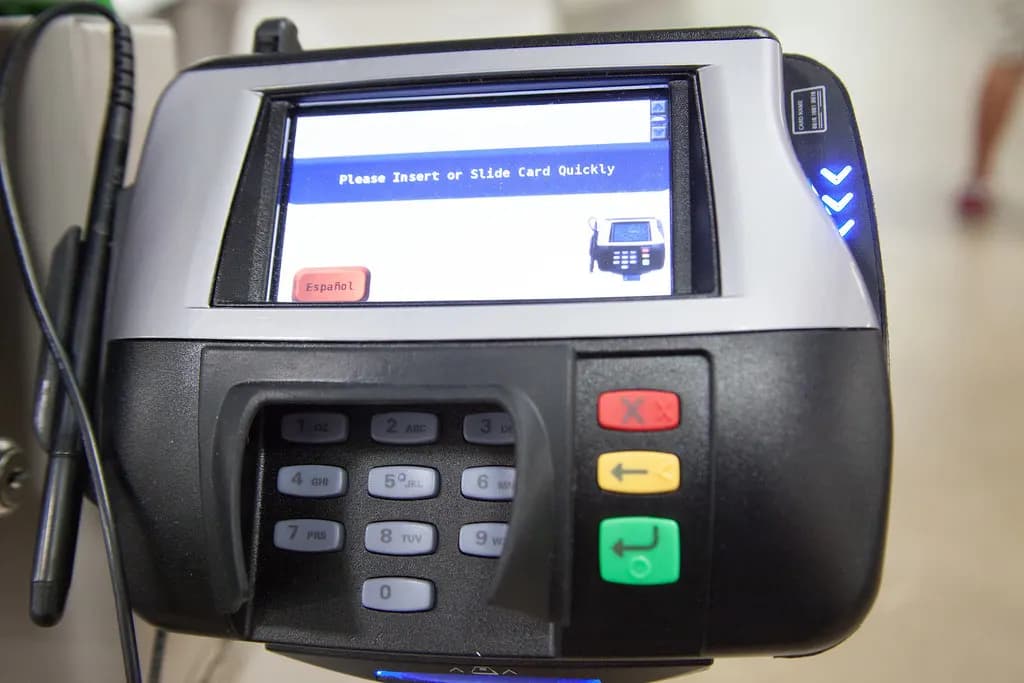
Debit cards are the bright spot in most fee statements, thanks to the Durbin Amendment in the 2010 Dodd-Frank Act. It directed the Federal Reserve to limit debit interchange to an amount reasonable and proportional to the issuer's costs. The result, Regulation II, caps the interchange that a debit card issuer with $10 billion or more in assets can receive at 21¢ + 0.05% of the transaction, plus 1¢ if it meets the Fed's fraud-prevention standards. Smaller banks and credit unions are exempt, which is why Visa's schedule lists separate "exempt" debit rates that are several times higher.
The cap is a fixed amount plus a tiny percentage, so it helps most on larger tickets. On a $100 debit sale from a big bank, interchange is about 27 cents, roughly 0.27%. On a $5 coffee it's about 22 cents, or 4.5% of the sale, which can exceed what a rewards credit card costs on the same purchase. Businesses with lots of small transactions should check whether their processor offers a small-ticket program.
The Federal Reserve's own data show the gap clearly. In 2024, covered (regulated) issuers received an average of $0.23 per debit transaction, while exempt issuers received $0.51. Regulation II also requires every debit card to be routable over at least two unaffiliated networks, and lets merchants choose the routing. Ask your processor whether it routes PIN-less debit to the cheapest network or simply sends everything over the card brand's own network.
Regulation II in the courts and at the Fed
Oct 1, 2011
Regulation II debit cap takes effect: 21¢ + 0.05% + 1¢ fraud adjustment
Oct 25, 2023
Fed proposes lowering it to 14.4¢ + 0.04% + 1.3¢ fraud adjustment — never finalized
Aug 6, 2025
North Dakota federal court (Corner Post) vacates Regulation II, then stays its own order pending appeal
Sep 15, 2025
Kentucky federal court upholds Regulation II in a separate case
May 13, 2026
Eighth Circuit hears the Corner Post appeal; no decision reported as of late September
Oct 22, 2026
Sixth Circuit scheduled to hear the Kentucky appeal
The legal picture is unsettled. In August 2025, a federal court in North Dakota, ruling in a case brought by a truck stop called Corner Post and two retail associations, held that the Fed had included costs the statute didn't allow and vacated the rule, but stayed its decision while the Fed appeals, so the cap is still being applied. A Kentucky court reached the opposite conclusion a month later. Meanwhile, the Fed's October 2023 proposal to lower the cap to 14.4¢ + 0.04% + 1.3¢ fraud adjustment has been neither finalized nor withdrawn. For a small business, the practical takeaway for now is that regulated debit stays cheap; if the appeals courts rule against the Fed, merchants' debit costs could fall further under a stricter cost standard, so watch for news through 2026.
Pricing models: flat rate, tiered and interchange-plus
Processors package the three layers in different ways. The model you're on matters as much as the headline rate.
Flat rate charges one percentage and a fixed fee for every card, regardless of type. Online platforms commonly advertise rates such as 2.9% + 30¢ for online cards, with lower rates for in-person sales. It's easy to understand and you can sign up in minutes, usually as a sub-merchant of a payment facilitator rather than with your own merchant account. The trade-off is that you pay the same on a cheap regulated debit card as on a premium rewards card, so businesses with lots of debit or larger tickets usually overpay.
Tiered pricing sorts transactions into "qualified", "mid-qualified" and "non-qualified" buckets with rising rates. The processor decides which interchange categories land in which bucket, and many push rewards and keyed cards into the expensive tiers. Tiered statements are hard to audit, which is why many independent consultants and trade groups recommend avoiding them.
Interchange-plus (also called cost-plus or pass-through) passes interchange and network fees through at cost and adds a disclosed markup, such as 0.30% plus 10 cents per transaction. Your statement then shows exactly what the bank and network took and what the processor kept. It's generally the most transparent model and the easiest to compare between providers. A variant, subscription or membership pricing, charges a monthly fee plus a small per-transaction fee on top of interchange.
Comparing processor pricing models
| Model | How it's priced | Best for | Watch out for |
|---|---|---|---|
Flat rate | One % + fixed fee on every card | New, small or seasonal sellers | Overpaying on debit and big tickets |
Tiered | Qualified / mid / non-qualified buckets | Rarely the best choice | Processor decides the buckets |
Interchange-plus | Pass-through cost + disclosed markup | Most businesses above a few thousand dollars a month | Monthly and PCI fees on top |
Subscription | Pass-through cost + monthly fee + small per-item fee | Higher-volume businesses | Monthly fee on slow months |
Flat rate
- How it's priced
One % + fixed fee on every card
- Best for
New, small or seasonal sellers
- Watch out for
Overpaying on debit and big tickets
Tiered
- How it's priced
Qualified / mid / non-qualified buckets
- Best for
Rarely the best choice
- Watch out for
Processor decides the buckets
Interchange-plus
- How it's priced
Pass-through cost + disclosed markup
- Best for
Most businesses above a few thousand dollars a month
- Watch out for
Monthly and PCI fees on top
Subscription
- How it's priced
Pass-through cost + monthly fee + small per-item fee
- Best for
Higher-volume businesses
- Watch out for
Monthly fee on slow months
Worked example: a café processing $40,000 a month
Here's how the layers add up for a café with $40,000 of monthly card sales across 1,600 transactions, an average ticket of $25. Assume 40% of transactions are on regulated debit cards from large banks, 20% on exempt debit cards from credit unions and community banks, and 40% on rewards credit cards, all dipped or tapped in store. The interchange rates come from Visa's April 2026 schedule; network fees and processor pricing are estimates for illustration.
Regulated debit: 640 sales totalling $16,000 cost 0.05% of $16,000 ($8.00) plus 22 cents each ($140.80), or $148.80. Exempt debit: 320 sales totalling $8,000 at 0.80% plus 15 cents cost $64.00 plus $48.00, or $112.00. Rewards credit: 640 sales totalling $16,000 at 1.65% plus 10 cents cost $264.00 plus $64.00, or $328.00. Total interchange is $588.80, about 1.47% of card sales.
On top of that, estimated network fees of about 0.14% of volume plus 2 cents a transaction add roughly $88. On an interchange-plus plan with a markup of 0.30% plus 10 cents and a $25 monthly fee, the processor's share is $120 plus $160 plus $25, or $305. The café's total is about $982, an effective rate of 2.45%.
Café, $40,000 card sales, 1,600 transactions (illustrative)
$588.80
Interchange
1.47% — Visa Apr 2026 rates
≈ $88
Network fees
estimate
$305
Processor markup + monthly
0.30% + 10¢ + $25
≈ 2.45%
Effective rate
≈ $982 a month
Compare that with a flat rate. At an illustrative in-person flat rate of 2.6% plus 15 cents, the same month costs $1,040 plus $240, or $1,280, which is 3.2%. That's almost $300 a month, or about $3,600 a year, more than the interchange-plus plan, mostly because the flat rate charges the same on the cheap debit transactions. If all 1,600 sales were online at 2.9% + 30¢, the cost would rise to $1,640, or 4.1%, because the fixed 30 cents weighs heavily on a $25 ticket.
The numbers move a lot with the mix. If the café's customers shifted to 70% rewards credit, interchange alone would rise to well over 1.6%. If its average ticket fell to $8, the fixed per-transaction pieces would dominate and the effective rate on regulated debit would be several percent. That's why the only meaningful comparison is to run your own statement through each quote. The payment fee calculator lets you test different rates and fixed fees against your average ticket.
Try it: what does a card sale cost you?
How to read your statement and find your effective rate
Start with two numbers: total card sales for the month and total fees deducted. Divide fees by sales and you have your effective rate, the single best measure of what card acceptance costs you. Track it monthly; a jump without a change in your business usually means a pricing change or a new fee.
Then look for the interchange detail. On an interchange-plus statement you'll see each category, such as Visa CPS Retail Debit or Mastercard World Elite, with counts and amounts, followed by network fees and the processor's markup. On tiered statements, look at how much volume lands in the "non-qualified" tier and ask why.
Common fees that creep in include monthly statement or account fees, PCI compliance or "non-compliance" fees (charged when you haven't completed your annual security questionnaire), batch or settlement fees, gateway fees for online payments, terminal lease payments, chargeback fees per dispute, annual fees, and early-termination fees in the contract. Terminal leases are a frequent trap: a non-cancellable lease on a basic terminal can cost far more over its term than buying the device outright.
Processors are required to send you Form 1099-K reporting your gross card receipts. For payment card transactions, the IRS says you'll receive one from your processor regardless of how many payments you received or their amount. The form shows gross sales before fees and refunds, so record fees as a separate expense rather than netting them from sales; our Form 1099-K guide explains how to reconcile it.
How to lower your credit card processing fees
You can't change interchange, but you can change almost everything around it.
Get quotes on interchange-plus and compare the markup only. Ask each provider for its percentage markup, per-transaction fee and every monthly, annual and per-incident fee in writing. Then run your last three months of statements through each quote. Sending a recent statement to two or three competitors is the fastest way to find out whether you're overpaying, and your current processor will often match a better offer.
Take cards the cheap way. Dip or tap rather than keying numbers. For online and phone sales, make sure your gateway sends the address verification and card security code, and for business-to-business sales, ask whether your processor supports enhanced data (often called Level 2 and Level 3), which can qualify commercial cards for lower interchange. Settle your batch every day, since late settlement can downgrade transactions.
Reduce disputes and fraud. Each chargeback costs the sale, a dispute fee, and staff time, and high dispute ratios can lead to reserves or account closure. Clear billing descriptors, quick refunds and good delivery records cut chargebacks.
Steer customers to cheaper payment methods. For invoices and recurring business payments, ACH bank transfers usually cost a fraction of card fees; our guide to ACH payments for small business explains how they work. You can also offer a cash or ACH discount, or, where state law allows, add a credit card surcharge; the credit card surcharge laws by state guide covers the rules.
Check the contract. Look for auto-renewal terms, early-termination fees and liquidated damages clauses before you sign, and diarize the renewal date so you can renegotiate.
Monthly processing-fee check
0/6Changes to watch in 2026 and beyond
Three developments could change what you pay. The first is the long-running antitrust case between merchants and Visa and Mastercard. Visa disclosed in November 2025 a revised proposed settlement with the class of merchants seeking rule changes. Under it, the average effective US credit interchange rate would fall by 10 basis points for five years, standard consumer credit rates would be capped at 1.25%, and merchants could choose whether to accept commercial, premium consumer and standard consumer credit cards separately rather than having to accept them all. It would also give merchants more freedom to surcharge. A federal judge in Brooklyn granted preliminary approval on June 9, 2026; final approval was still pending as of October 2026, and some merchant groups have objected and signalled appeals. Nothing in it applies until it's final.
The second is the Regulation II litigation described above. The third is Illinois's Interchange Fee Prohibition Act, which would bar interchange on the sales tax and tip portions of a transaction in Illinois. After a series of court rulings, a federal court in June 2026 permanently blocked it from being enforced against national banks, out-of-state banks and the card networks, and the state legislature passed a bill pushing its effective date to July 1, 2027, according to law-firm summaries. If you sell in Illinois, ask your processor how it plans to handle any part of the law that survives.
If your business accepts cards, also make sure your security questionnaire is current. PCI DSS version 4.0.1 requirements that had been "future-dated" became mandatory on March 31, 2025, and processors charge non-compliance fees each month you're out of date. Our merchant account guide covers PCI, reserves and underwriting in more depth.
Official links
- Federal Reserve — Regulation II compliance guideDebit interchange cap and exemptions
- Federal Reserve — Average debit interchange feesAnnual data by network
- Visa USA Interchange Reimbursement FeesCurrent published Visa interchange schedule
- IRS — Understanding your Form 1099-KHow card receipts are reported
- Visa Inc. 8-K — proposed merchant settlementSettlement terms pending court approval
What to do next
Pull your last three statements, calculate your effective rate and see how much of your volume is debit, rewards credit and keyed or online. Then get two written interchange-plus quotes and compare them on the same numbers. If card fees are eating your margin, look at moving regular business customers to ACH and check whether a surcharge or cash discount is legal where you operate. The payment fee calculator and profit margin calculator will show what each change is worth.
This is general information, not legal or tax advice — confirm on the official source or with a professional.
Frequently asked questions
There's no official average because every business has a different card mix. As a working estimate, most small businesses pay roughly 2% to 3.5% of card sales all-in. Interchange alone on Visa consumer credit runs from about 1.4% to over 3% depending on the card and channel, and regulated debit costs far less. Your effective rate is total fees divided by total card sales on your statement.
The Durbin Amendment led to the Federal Reserve's Regulation II, which caps debit interchange for card issuers with $10 billion or more in assets at 21¢ + 0.05% of the transaction, plus a 1¢ fraud-prevention adjustment. A 2025 court ruling vacated the rule, but the vacatur is stayed during appeal, so the cap still applies.
Usually, once you process more than a few thousand dollars a month or have a high share of debit cards. Interchange-plus passes through the real wholesale cost and adds a disclosed markup, so you benefit when customers use cheap regulated debit. Flat rate is simpler and predictable, which can suit very small or seasonal businesses. Compare both using your own statement, not the advertised rate.
Yes. Merchant fees you pay to accept cards are an ordinary and necessary business expense and are generally deductible in the year paid. Record them separately from gross sales so your books reconcile with the Form 1099-K your processor sends, which reports gross card receipts before fees, refunds or chargebacks.
In most states you can add a credit card surcharge if you follow card network rules: notify your processor 30 days ahead, cap it at your cost (Visa's maximum is 3%), disclose it, and never surcharge debit or prepaid cards. Connecticut and Massachusetts prohibit surcharges, and several states cap them. Cash discounts are another option.
Online, phone and keyed transactions carry more fraud risk because the card isn't physically verified with a chip or tap. Card networks price that risk into interchange. On Visa's April 2026 schedule, a Traditional Rewards credit card costs 1.65% + $0.10 in a store but 2.04% + $0.10 online.
Sources & verification
Figures on this page were checked against the sources below when it was last reviewed on 12 October 2026. Each rate and limit is stored once with its own official source and review date, and official update channels are monitored daily so changes are picked up. How we verify
- 1.Visa USA Interchange Reimbursement Fees (rates effective April 18, 2026) — Visa · accessed 12 October 2026
- 2.Regulation II (Debit Card Interchange Fees and Routing) — Small Entity Compliance Guide — Board of Governors of the Federal Reserve System · accessed 12 October 2026
- 3.12 CFR § 235.3 — Reasonable and proportional interchange fees — Legal Information Institute (text of Code of Federal Regulations) · accessed 12 October 2026
- 4.Regulation II — Average Debit Card Interchange Fee by Payment Card Network — Board of Governors of the Federal Reserve System · accessed 12 October 2026
- 5.Staff memo — Proposed revisions to Regulation II (Oct 25, 2023) — Board of Governors of the Federal Reserve System · accessed 12 October 2026
- 6.District Court Vacates Regulation II's Debit Card Interchange Fee Standard — Cooley LLP · accessed 12 October 2026
- 7.Regulation II: the debit cap after Corner Post (status as of Sept 20, 2026) — Pulse · accessed 12 October 2026
- 8.Visa Inc. Form 8-K — proposed settlement with injunctive relief class (Nov 10, 2025) — U.S. Securities and Exchange Commission (EDGAR) · accessed 12 October 2026
- 9.Court approves Visa-Mastercard settlement — Payments Dive · accessed 12 October 2026
- 10.Illinois Interchange Fee Law Maxes Out After Permanent Injunction and Legislative Postponement — Ballard Spahr LLP · accessed 12 October 2026
- 11.Understanding your Form 1099-K — Internal Revenue Service · accessed 12 October 2026
MSMETOOLS is an independent platform and is not affiliated with any government agency, ministry or department.
Tools for this
Payment Processing Fee Calculator
Calculate Stripe, PayPal, Square and gateway fees.
Profit Margin Calculator
Calculate profit, markup and margin for your products or services.
Markup Calculator
Turn cost and markup into a selling price.
Break Even Calculator
Find your break even point and units.
Related guides
 Credit Card Surcharge Laws by State 2026: Caps & BansRead guide
 ACH Payments for Small Business 2026: Costs, Timing, RulesRead guide
 Business Credit Cards 2026: Rules, Guarantees & Real CostsRead guide
 Merchant Account 2026: How It Works, Underwriting & ReservesRead guide
Official links open the government site in a new tab.