 Business registration & legal
Rhode Island Business License in 2026: Trade Names, Sales Permits, Contractors and Providence Licences
Rhode Island has no general business license. See what applies in 2026: the new state trade name registry, free sales permit, contractor rules and Providence.
 Edited by Sumeet YadavFounder & editor, MSMETOOLS · fact-checked against official sources
Contents (11)
- 1. Does Rhode Island have a state business license?
- 2. Trade names: the state registry that replaced the town clerk
- 3. The sales permit and Rhode Island taxes
- 4. Contractors: registration now, licensing from 2028
- 5. Food, health and other licensed activities
- 6. Providence: the Board of Licenses
- 7. If you hire employees
- 8. Home-based businesses
- 9. Worked examples: first-year costs
- 10. Common mistakes and how to fix them
- 11. What to do next
Rhode Island does not issue a general business licence. What it does have is a short list of state registrations, a set of agencies that license regulated work, and 39 cities and towns that each run their own local rules. The picture also changed recently: trade names, the state's version of a DBA, moved from town clerks to a single registry at the Department of State, and a new residential contractor licence is on the way. This guide walks through each layer with the 2026 fees, checked in October 2026, so you know what to file before you open.
Quick answer
Rhode Island has no general state business license. Sole proprietors who trade under a brand register a trade name with the Department of State for $20 and renew it free each year. Anyone selling taxable goods needs a free sales permit from the Division of Taxation. Contractors register with the CRLB for $150 a year, and local licences come from your city or town, such as Providence's Board of Licenses.
Sales tax 7%; permits expire June 30 and renew by February 1
LLC: $150 to form, $50 annual report, $400 minimum annual tax
Residential contractor licensure starts January 1, 2028
Use the free RI Business Assistant to list the state licences for your activity
Does Rhode Island have a state business license?
No. There is no single licence that every Rhode Island business must hold. The Department of State's Business Services Division describes its job as recording new business formations and trade names, not licensing businesses. Licensing happens in three other places instead.
State agencies license regulated activities. The Department of Business Regulation (DBR) covers contractors through the Contractors' Registration and Licensing Board, as well as accountants, insurance, real estate, food trucks, auto salvage and repair, health clubs and liquor oversight. The Department of Health (RIDOH) licenses food businesses, cosmetology, barbering, tattooing and health care. The Department of Labor and Training (DLT) licenses electricians, plumbers, HVAC and refrigeration workers, fire protection and alarm technicians. Other agencies handle farms and pesticide work (Environmental Management), child care (Children, Youth and Families) and passenger or goods transport (Public Utilities).
The Division of Taxation issues the sales permit, which is the closest thing to a general licence most shops and online sellers will hold.
Cities and towns handle zoning, local licences and local registration. The Department of State's own guidance notes that each of the 39 municipalities has its own requirements, and that the town you operate in may require zoning approval for your space, even at home, licences for activities such as liquor, food, laundries or pawnbroking, and registration with the city or town clerk.
The fastest way to sort this out is the state's free RI Business Assistant. You answer questions about your activity and it returns a checklist of the licences and registrations you need, estimated fees and the relevant laws. It saves a lot of guesswork, though it does not replace a call to your town hall.
Trade names: the state registry that replaced the town clerk
For years, Rhode Island sole proprietors filed a "doing business as" certificate with their town clerk. That system has moved. Trade names are now registered with the Department of State, which keeps a single online Trade Name Database, and city and town records were transferred to the state in stages. If you see an older guide or a town page telling you to file at the clerk's office, check the Department of State's transfer-date list first.
A trade name is for an unincorporated owner, such as a sole proprietor or a general partnership, that does business under a name other than the owner's own. It costs $20 to register, online with a card or by mail. The registration lets you trade under that name in one Rhode Island city or town, and availability is checked against the trade names already registered in that municipality, so "Ocean State Bakes" might be taken in Warwick but free in Woonsocket. A trade name creates no separate legal entity and gives no liability protection.
The rule that catches people out is the annual renewal. Every trade name must file a renewal with the Department of State between September 1 – November 30 each year, starting in the calendar year after it was registered. The renewal is free and short, but a trade name that misses it can be cancelled involuntarily. Put the window in your calendar the day you register.
LLCs and corporations do not file trade names. If an entity uses a name other than its legal name, it files a fictitious business name with the Department of State through the corporate filing system. That costs $50 for a for-profit entity, covers the whole state rather than one town, and does not need renewing each year as long as the entity stays in good standing. Our DBA guide compares these rules with other states.
| Filing | Who uses it | Fee | Renewal |
|---|---|---|---|
| Trade name | Sole proprietors, general partnerships | $20 | Free, every year, September 1 – November 30 |
| Fictitious business name | LLCs, corporations (for-profit) | $50 | None while the entity is in good standing |
| LLC articles of organization | New LLCs | $150 | Annual report $50, February 1 – May 1 |
| Sales permit | Anyone selling taxable goods or services | free | Expires June 30; renew by February 1 |
| Contractor registration | Contractors and subcontractors | $150 a year | Every year, with continuing education |
The sales permit and Rhode Island taxes
If you sell tangible goods or taxable services in Rhode Island, you need a permit to make sales at retail from the Division of Taxation before your first sale. It costs free: the state dropped the old $10 application and renewal charge for permit periods from July 1, 2022. You need a permit for each location, every permit expires on June 30, and renewals are due by February 1, so the permit is free but not permanent.
Once registered, you charge the 7% state rate. Rhode Island has no local sales taxes, but restaurants and bars also collect the 1% local meals and beverage tax, and short-term rentals and hotels carry their own taxes. Most sellers file monthly by the 20th, with quarterly filing allowed when tax averages less than $200 a month. Our Rhode Island sales tax guide covers rates, exemptions and due dates in detail.
Entity owners have one more cost to plan for. Every registered for-profit corporation, LLC and limited partnership pays at least $400 a year to the Division of Taxation, whether or not it makes a profit. That is on top of the $150 to form an LLC and the $50 annual report filed with the Department of State between February 1 and May 1. A sole proprietor with a trade name pays neither.
Rhode Island at a glance (2026)
7%
State sales tax
no local sales taxes
free
Sales permit
renew every year
$20
Trade name
one city or town
$400
Minimum business tax
LLCs and corporations
Contractors: registration now, licensing from 2028
Rhode Island regulates construction through the Contractors' Registration and Licensing Board (CRLB), part of the DBR's State Building Office. Anyone who builds, remodels, repairs, demolishes or moves residential or commercial structures for pay must be registered, and so must every subcontractor. That includes handyman work and trades the public often forgets, such as painters, power washers, fence and flooring installers, sealcoaters, pavers, masons and pool installers. Employees of a registered contractor do not register, but a worker paid on a 1099 is treated as a subcontractor and does.
Registration costs $150 and lasts one year. First-time applicants submit proof of a state-approved 5-hour pre-registration course, unless they will work only on commercial buildings, a certificate of general liability insurance of at least $500,000 naming the board as certificate holder, workers' compensation proof if they have employees, a government ID, and the Department of State business ID if they are an LLC or corporation. Out-of-state contractors also need a registered agent in Rhode Island, and there is no reciprocity with other states.
Renewal needs a 2.5-hour continuing education course and the same insurance. A registration that has lapsed adds a $50 late fee, and one expired for more than a year sends you back to the full pre-registration course. The board's FAQ says jobs under one contract worth less than $500 in total do not need registration, but anyone who advertises as a contractor must be registered regardless.
The stakes are real: an unregistered contractor cannot get a building permit in any of the 39 cities and towns, and faces civil and criminal penalties. The CRLB also licenses, rather than registers, commercial roofers, home inspectors, underground utility contractors, well drillers, pump installers and water filtration contractors. Electricians, plumbers, HVAC and refrigeration workers, sprinkler fitters and alarm technicians are licensed by DLT instead, and they only register with the CRLB if they contract outside the scope of that licence.
The new residential contractor licence
In 2025 the General Assembly created a residential contractor licence in chapter 5-65.4 of the General Laws. Starting January 1, 2028, no one may supervise the construction of a new home or structurally remodel an existing one, covering one-to-four family dwellings, without that licence from the CRLB. Contractors doing nonstructural home improvement work stay under the registration system only. The board was still setting up the programme in October 2026, so if you build or remodel homes, watch the CRLB's residential licensing page for the application and any exam requirements.
Remodelling homes in Rhode Island
Step 1
5-hour pre-registration course
Step 2
$500,000 liability certificate
Step 3
CRLB registration ($150/yr)
Step 4
Local building permit for each job
Step 5
Residential licence for structural work
from January 1, 2028
Food, health and other licensed activities
Restaurants, caterers, food processors and markets are licensed by RIDOH's food protection programme, which also covers food safety manager certification. Food trucks have a DBR element as well. Barbers, hairdressers, tattoo and piercing studios, massage practices and medical spas fall under RIDOH's professional licensing. Child care centres and family child care homes are licensed by the Department of Children, Youth and Families. The Attorney General's office licenses precious metals and jewellery dealers, telemarketers and security guard businesses.
Alcohol involves two levels. Retail liquor licences for bars, restaurants and package stores are granted by the local licensing board of your city or town, and the DBR regulates liquor sales statewide. Allow time for this: in most towns a liquor licence needs public notice and a hearing before the board, and you will usually need the food licence and zoning approval in place first.
If your activity is not on any of these lists, run it through the RI Business Assistant anyway. Some licences are not obvious, such as solar retailers and health clubs at DBR, or auto body and salvage operations.
Providence: the Board of Licenses
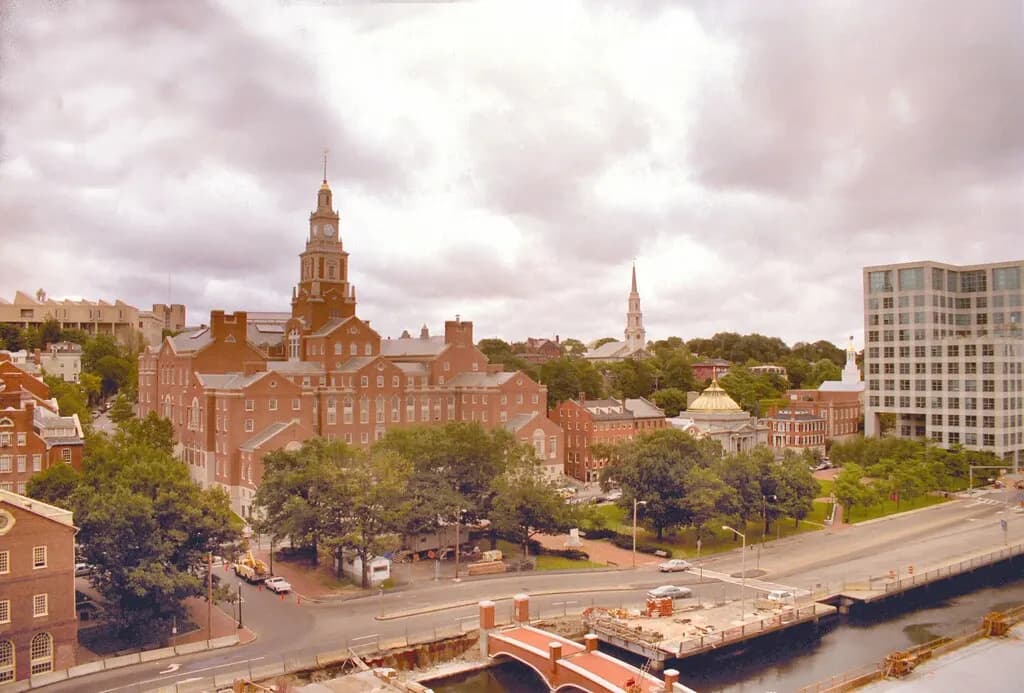
Providence does not license every business. It licenses particular activities through its Board of Licenses, which handles more than 30 categories, including food dispensing, peddlers, motor vehicle repair and nightlife operations, as well as over 400 liquor licences. In all the city issues more than 8,000 licences a year.
Applications are online only, through the city's licensing portal. Staff check that the application and supporting documents are complete, then schedule it for a hearing before the five-member Board of License Commissioners, whose agendas are posted on the city's meetings portal. All licences renew every year, with renewal dates staggered by licence type. The office is at 25 Dorrance Street in City Hall and can be reached at [email protected].
If your business does not fall into one of the board's categories, such as a consultancy, a design studio or many retail shops, you need no city licence in Providence. You still need zoning approval for the premises, building and sign permits for any fit-out, a sales permit if you sell taxable goods, and a trade name or fictitious name if you trade under a brand. Other cities and towns work differently: some ask every business to register with the clerk and renew each year, and the Department of State estimates those local fees at roughly $10 to $125.
If you hire employees
Hiring adds registrations rather than licences. You register with the Division of Taxation for income tax withholding and with DLT for unemployment insurance and Rhode Island's temporary disability insurance, and you need workers' compensation coverage. The state minimum wage is $16.00 an hour, rising to $17.00 on January 1, 2027, and tipped employees can be paid a cash wage of $3.89 if tips make up the difference. Get a free EIN from the IRS before your first payroll.
Registrations vs operating licences in Rhode Island
| What it does | Lets you run a regulated activity? | |
|---|---|---|
Trade name or fictitious name | Records the name you trade under | No |
LLC articles | Creates the legal entity | No |
Sales permit | Lets you collect and remit sales tax | No |
CRLB registration | Lets you contract construction work for pay | Yes |
RIDOH, DLT or board licence | Authorizes food, health, trade or professional work | Yes |
City or town licence | Authorizes listed local activities, such as food dispensing or liquor | Yes |
Trade name or fictitious name
- What it does
Records the name you trade under
- Lets you run a regulated activity?
No
LLC articles
- What it does
Creates the legal entity
- Lets you run a regulated activity?
No
Sales permit
- What it does
Lets you collect and remit sales tax
- Lets you run a regulated activity?
No
CRLB registration
- What it does
Lets you contract construction work for pay
- Lets you run a regulated activity?
Yes
RIDOH, DLT or board licence
- What it does
Authorizes food, health, trade or professional work
- Lets you run a regulated activity?
Yes
City or town licence
- What it does
Authorizes listed local activities, such as food dispensing or liquor
- Lets you run a regulated activity?
Yes
Home-based businesses
Working from home does not exempt you from any of the state rules. A sole proprietor selling crafts from a spare room in Cranston still needs a sales permit and, if trading under a brand, a trade name. Zoning is the local question. The Department of State points out that your city or town may need to approve the space you use for business, even when that space is your home, and many towns limit customer visits, employees, signs and outside storage for home occupations. If you plan to sell food you make at home, check RIDOH's rules before you start, because most home kitchens cannot be used for commercial food without a licence.
Worked examples: first-year costs
A candle maker in Cranston. Maya runs her business as a sole proprietor called "Narragansett Wick Co." She registers the trade name for $20, gets a free sales permit, and checks the city's home occupation rules. Her state costs in year one are $20. Each autumn she files the free trade name renewal between September 1 – November 30, and each winter she renews her sales permit before February 1.
A remodelling company in Warwick. Two partners form an LLC for $150, complete the 5-hour course and register with the CRLB for $150, with a $500,000 liability certificate. They budget $400 for the minimum business tax and $50 for the annual report. Before January 1, 2028, they plan for the residential licence, since they take on structural work.
A café in Providence. The owners get a RIDOH food licence, apply through the Board of Licenses for the city's food dispensing licence, and attend the board hearing. They register for a sales permit and collect 7% sales tax plus the 1% meals tax, so a $20 lunch carries $1.60 in tax. If they want to serve beer and wine, they apply to the board for a liquor licence well before opening.
Getting legally set up in Rhode Island
- 1
Run the RI Business Assistant
RI Business AssistantList the state licences and registrations for your exact activity before you commit to premises.
- 2
Choose a structure and name
Form an LLC for $150, or register a trade name for $20 if you trade under a brand as a sole proprietor.
- 3
Get an EIN and a sales permit
EIN guideThe EIN is free from the IRS. Register with the Division of Taxation for a free sales permit before your first taxable sale.
- 4
Get any state licence
Contractors register with the CRLB; food businesses with RIDOH; trades with DLT; professions with their board.
- 5
Clear local licensing and zoning
Ask your town clerk and zoning office what applies; in Providence, apply through the Board of Licenses portal.
Common mistakes and how to fix them
The first mistake is filing a DBA with the town clerk out of habit. Trade names are now a state filing, so register with the Department of State, and if you had a town certificate, check the state database to confirm your record transferred.
The second is forgetting the free trade name renewal. It is easy to miss because it costs nothing, but a missed renewal can cancel the name. File between September 1 – November 30 every year.
The third is treating the sales permit as permanent. It expires every June 30. Renew it before February 1, and file zero returns in months with no sales so the account stays in good standing.
The fourth is doing small contracting jobs without a CRLB registration. The $500 exemption covers only tiny one-off jobs, and advertising as a contractor requires registration whatever the job size. Without registration you also cannot pull a permit.
The fifth is overlooking the $400 minimum tax when choosing an LLC. It applies every year, even in a loss-making year, so build it into your first-year budget with the startup cost calculator.
Official Rhode Island links
What to do next
Start with the RI Business Assistant, then pick your structure: check the name with our LLC name checker or register a trade name with the Department of State. Get your free sales permit before you sell, and use our Rhode Island sales tax guide and sales tax calculator to price correctly. Then call your town clerk and zoning office before you sign a lease. For neighbouring states, see our Connecticut and Massachusetts guides or the business licenses overview.
This is general information, not legal or tax advice — confirm on the official source or with a professional.
Frequently asked questions
No. Rhode Island has no general state business licence. The Department of State registers entities and trade names, the Division of Taxation issues sales permits, and state agencies license regulated activities such as contracting, food, health care and the trades. Each of the 39 cities and towns sets its own local rules, so check with the town clerk and zoning office where you will operate.
Sole proprietors and partnerships register a trade name with the Rhode Island Department of State for $20, online or by mail. The name covers one city or town and must be renewed every year between September 1 – November 30, which is free. LLCs and corporations file a fictitious business name instead, costing $50 for a for-profit entity with no yearly renewal.
It's free. Rhode Island dropped the old $10 fee from July 1, 2022. You still need a permit before your first taxable sale, one for each location, and every permit expires on June 30 and must be renewed each year, with renewals due by February 1. The state sales tax rate is 7%.
Contractors and subcontractors must register with the Contractors' Registration and Licensing Board. Registration costs $150 a year and needs $500,000 of liability insurance and a 5-hour course for residential work. Electricians, plumbers and HVAC workers are licensed by the Department of Labor and Training. Residential contractor licensure starts on January 1, 2028.
Only for licensed activities. Providence's Board of Licenses issues more than 30 categories of licence, including food dispensing, peddlers, motor vehicle repair, nightlife and liquor, and renews them every year. Applications are online only and most go to a hearing before the board. Businesses outside those categories still need zoning approval and a state sales permit if they sell taxable goods.
It is a free online tool from the Rhode Island Department of State. You answer questions about your business and it builds a checklist of the state licences and registrations you need, with estimated costs and the laws that apply. It is the quickest way to check whether a state agency licenses your activity before you sign a lease.
Sources & verification
Figures on this page were checked against the sources below when it was last reviewed on 13 October 2026. Each rate and limit is stored once with its own official source and review date, and official update channels are monitored daily so changes are picked up. How we verify
- 1.Trade Name Welcome Packet — Rhode Island Department of State · accessed 13 October 2026
- 2.Fictitious Name vs. Trade Name — Rhode Island Department of State · accessed 13 October 2026
- 3.Trade Name Online Filing Guide — Rhode Island Department of State · accessed 13 October 2026
- 4.RI Trade Names — Rhode Island Department of State · accessed 13 October 2026
- 5.General Contractor Registration — Apply, Renew and FAQs — Rhode Island Contractors' Registration and Licensing Board · accessed 13 October 2026
- 6.R.I. Gen. Laws § 5-65.4-1 — Residential contractor licensing — State of Rhode Island General Assembly · accessed 13 October 2026
- 7.File Your Annual Report and Costs and Fees — Rhode Island Department of State · accessed 13 October 2026
- 8.City of Providence Board of Licenses — City of Providence · accessed 13 October 2026
- 9.Applying for licenses through the Board of Licenses — City of Providence 311 · accessed 13 October 2026
- 10.Sales and Use Tax — Rhode Island Division of Taxation · accessed 13 October 2026
MSMETOOLS is an independent platform and is not affiliated with any government agency, ministry or department.
Tools for this
Sales Tax Calculator (US)
Calculate sales tax for all US states and cities.
Startup Cost Calculator
Estimate how much capital you need to launch.
LLC Name Checker (US)
Check business name availability in your state.
Related guides
 Rhode Island Sales Tax 2026: 7% Rate, Meals & Hotel TaxRead guide
 Wyoming Business License 2026: Sales Tax & City RulesRead guide
 Massachusetts Business License 2026: What You NeedRead guide
 Connecticut Business License 2026: Permits, DCP & Town RulesRead guide
Official links open the government site in a new tab.