 Sales tax
States With No Sales Tax in 2026: The Five States and the Taxes That Replace It
States with no sales tax in 2026: Alaska, Delaware, Montana, New Hampshire and Oregon, the local and business taxes they use instead, with worked examples.
 Edited by Sumeet YadavFounder & editor, MSMETOOLS · fact-checked against official sources
Contents (10)
- 1. Which states have no sales tax?
- 2. Alaska: no state sales tax, but local sales taxes
- 3. Delaware: no sales tax, but a gross receipts tax on sellers
- 4. Oregon: no sales tax, but the Corporate Activity Tax
- 5. New Hampshire: no sales tax, but a meals and rooms tax
- 6. Montana: no sales tax, but resort and lodging taxes
- 7. Shopping across the border: what you still owe
- 8. What it means if your business is based in a no-sales-tax state
- 9. Common mistakes
- 10. What to do next
Five US states charge no statewide sales tax: Alaska, Delaware, Montana, New Hampshire and Oregon, sometimes called the NOMAD states. That's useful to know if you shop near a border, but the full picture matters more if you run a business. Each of these states raises money another way, through local sales taxes in Alaska, resort and lodging taxes in Montana, a meals and rooms tax in New Hampshire, and taxes on business receipts in Delaware and Oregon. This guide covers each state, the taxes that take sales tax's place, what shoppers and sellers actually pay, and worked examples in dollars. Figures were checked against state sources in October 2026.
Quick answer
The five states with no statewide sales tax in 2026 are Alaska, Delaware, Montana, New Hampshire and Oregon. Only Alaska lets local governments charge a general sales tax. The others replace it with targeted or business-level taxes, so 'no sales tax' doesn't mean 'no tax on spending'.
Alaska: no state tax, but many cities and boroughs charge local sales tax (Juneau 5%)
Delaware: sellers pay a gross receipts tax of up to 0.0945% to 1.9914%, never shown on the receipt
Oregon: businesses pay the Corporate Activity Tax of $250 plus 0.57% above $1 million
New Hampshire: 8.5% tax on restaurant meals, rooms and car rentals
Montana: resort towns may add up to 3% (plus 1%) on lodging, meals and drinks
Which states have no sales tax?
Forty-five states and the District of Columbia charge a statewide sales tax. The other five don't, but they aren't identical. Delaware, New Hampshire and Oregon have no general sales tax at any level: a shopper buying a laptop, a sofa or a pair of shoes pays the sticker price and nothing more. Montana has no general sales tax either, though state law lets small resort communities tax a short list of tourist-facing sales. Alaska is the outlier. It has no state tax, but its cities and boroughs can and do charge their own general sales tax, so some Alaskans pay more at the till than shoppers in states that do have a state tax.
The reason most often given is history and politics rather than economics. Oregon voters have rejected a sales tax at the ballot box many times. New Hampshire has long avoided both a broad sales tax and an income tax on wages. Alaska funds much of its budget from oil revenue and the earnings of the Permanent Fund, so the state never needed a sales tax and left the field to local governments.
Every one of these states still needs revenue, and each has made a different trade-off. Some lean on property tax, some on income tax, some on business taxes and some on tourists. The table below sums up what fills the gap.
| State | Statewide sales tax | Local sales tax? | Main replacement taxes |
|---|---|---|---|
| Alaska | 0% | Yes, in many cities and boroughs | Local sales taxes; oil and gas revenue |
| Delaware | 0% | No | Gross receipts tax on sellers; personal income tax |
| Montana | 0% | Resort tax only, in resort areas | 8% lodging taxes; resort tax; income tax |
| New Hampshire | 0% | No | 8.5% meals and rooms tax; business profits and enterprise taxes |
| Oregon | 0% | No | Corporate Activity Tax; personal income tax up to 9.9% |
Alaska: no state sales tax, but local sales taxes
Alaska is the only no-sales-tax state where you can still pay a general sales tax on everyday purchases. Cities and boroughs decide for themselves whether to levy one and at what rate. Many smaller communities rely on it heavily because they have little property to tax. Rates vary from town to town, and several, including Craig, Haines, Ketchikan, Sitka and Skagway, charge a different rate in the summer tourist season.
Some examples show how much this varies. The City and Borough of Juneau charges 5%. The City of Palmer, in the Mat-Su Valley, raised its rate from 3% to 4% on April 1, 2026. Anchorage, the largest city, has no general sales tax at all, although it does tax alcoholic beverages. So a shopper's bill depends entirely on where the sale happens, or, for deliveries, where the goods arrive.
Local caps add another wrinkle. Many Alaska towns apply sales tax only to the first part of a large purchase, such as the first few thousand dollars of a single item, and some set special caps for vehicles, boats and snowmachines. Others exempt essential food. Rules differ from town to town, so there's no single statewide answer.

Alaska's remote seller commission
Before 2020, online sellers outside Alaska had no practical way to collect dozens of different local taxes. Local governments solved that by forming the Alaska Remote Seller Sales Tax Commission (ARSSTC), which adopted a uniform code and a single registration and filing portal. As of its first-quarter 2026 report, the commission had 55 member jurisdictions, from Juneau, Sitka and Kodiak to small villages. Anchorage is a member for its alcoholic beverage tax only.
A remote seller must register once its gross sales delivered into Alaska reached $100,000 in the previous calendar year. All sales count, including exempt sales and sales into towns with no tax. The commission dropped its old 200-transaction test from January 1, 2025, so order counts no longer matter. Returns are monthly by default and due by the last day of the following month. Smaller sellers can apply for quarterly filing.
Marketplaces such as Amazon, Etsy and eBay are treated as the seller for the sales they facilitate. If you sell only through a marketplace, you don't register; the commission asks you to complete a marketplace seller affidavit instead. Only member towns are covered, though. Non-member towns still administer their own taxes, so a business with a physical presence in Alaska has to check each local code where it operates. Our Alaska business license guide covers the state-level licence every Alaska business needs.
Delaware: no sales tax, but a gross receipts tax on sellers
Delaware is famous for tax-free shopping, and its outlet malls draw buyers from Pennsylvania, New Jersey and Maryland. But the state taxes the seller instead of the shopper. Almost every business selling goods or services in Delaware pays the gross receipts tax (GRT) on its total receipts, with no deduction for the cost of goods, wages, rent or delivery.
Rates depend on the activity and run from about 0.0945% to 1.9914%. Retailers pay 0.7468%, contractors 0.6472%, and most professional and personal service providers 0.3983%. Each business gets a monthly or quarterly exclusion before tax applies, generally $100,000 a month ($300,000 a quarter), and higher for some activities. New businesses start as quarterly filers. Monthly filers' returns are due on the 20th of the following month and quarterly returns at the end of the month after the quarter ends. Late returns cost 5% a month plus 0.5% monthly interest.
Because the tax is on the seller, it doesn't appear as a separate line on the customer's receipt the way sales tax does. Businesses fold it into their prices. You also need a Delaware business license, which is a separate annual fee; see our Delaware business license guide.
Worked example: a Delaware retailer
A furniture store in Dover takes $1,500,000 in a quarter. As a retailer it pays 0.7468% on receipts above the quarterly exclusion of $300,000.
Delaware GRT for one quarter (retailer)
| Step | Amount |
|---|---|
Gross receipts for the quarter | $1,500,000 |
Less quarterly exclusion | − $300,000 |
Taxable gross receipts | $1,200,000 |
GRT at 0.7468% | $8,961.60 |
Gross receipts for the quarter
- Amount
$1,500,000
Less quarterly exclusion
- Amount
− $300,000
Taxable gross receipts
- Amount
$1,200,000
GRT at 0.7468%
- Amount
$8,961.60
The store pays about $8,962 for the quarter, roughly 0.6% of its sales. A shopper in a 6% sales tax state would have paid $90,000 in sales tax on the same $1.5 million of purchases. That gap is why Delaware's retail economy is built partly on cross-border shoppers, and why the GRT, small as it looks, matters a lot to low-margin retailers: it's charged on revenue, not profit, so it's due even in a loss-making quarter.
Oregon: no sales tax, but the Corporate Activity Tax
Oregon has no sales tax at the state or local level, and Oregon retailers don't collect any. Since 2020, though, larger businesses pay the Corporate Activity Tax (CAT), a tax on Oregon commercial activity, which broadly means gross receipts from sales sourced to Oregon. Despite the name, it applies to every kind of business entity, including LLCs, partnerships and sole proprietors, not just corporations.
The thresholds are generous to small firms. You must register within 30 days of passing $750,000 of Oregon commercial activity in a year, file a return once you pass $1 million, and pay tax on activity above that. The tax is $250 plus 0.57% of taxable commercial activity above $1 million. Before applying the rate, you subtract 35% of the greater of your cost inputs (broadly, cost of goods sold) or your labor costs. If you expect to owe $5,000 or more, you make quarterly estimated payments.
Worked example: an Oregon distributor
A Portland wholesaler has $3,000,000 of Oregon commercial activity in 2026. Its cost inputs are $1,400,000 and its labor costs $900,000.
| Step | Amount |
|---|---|
| Oregon commercial activity | $3,000,000 |
| Subtraction: 35% × $1,400,000 cost inputs (the larger figure) | − $490,000 |
| Taxable commercial activity | $2,510,000 |
| Less the first $1,000,000 | − $1,000,000 |
| Amount taxed at 0.57% | $1,510,000 × 0.0057 = $8,607 |
| Add the $250 base | $8,857 CAT for the year |
Some cities and counties add their own business taxes on top. Portland's business license tax and Multnomah County's business income tax are taxes on net income, not on sales, and Metro's supportive housing tax applies only to higher earners and larger businesses. The Oregon business license guide has the details for Portland-area firms.
New Hampshire: no sales tax, but a meals and rooms tax
New Hampshire charges no tax on most retail purchases, which is why its border towns are full of shoppers from Massachusetts, where the rate is 6.25%. The big exception is the Meals and Rentals Tax, commonly called the meals and rooms tax. It applies at 8.5% to restaurant meals and prepared food, to hotel and short-term room rentals, and to motor vehicle rentals. Alcoholic drinks served at a restaurant are taxed too, whether or not food is ordered. The rate was cut from 9% on October 1, 2021.
Any business selling taxable meals or renting rooms or vehicles needs an operator's license from the Department of Revenue Administration, and returns are due by the 15th of the following month through Granite Tax Connect. Short-term rental hosts count as operators unless a platform collects on their behalf.
The state also taxes businesses directly. The Business Profits Tax applies at 7.5% to businesses with gross receipts above $109,000, and the Business Enterprise Tax at 0.55% of the enterprise value tax base (broadly, wages, interest and dividends paid) once gross receipts pass $298,000. New Hampshire has no tax on wages, and it fully repealed its interest and dividends tax from January 1, 2025. Forming an entity there? See the New Hampshire LLC guide.
Example. A couple's $120 dinner bill at a Portsmouth restaurant carries $10.20 of meals tax ($120 × 0.085), for $130.20 before tip. A $900 television bought at a store down the road carries no tax at all.
Montana: no sales tax, but resort and lodging taxes
Montana has no general sales tax, and no city may impose one. State law makes one exception: small communities that qualify as resort communities or resort areas, such as Whitefish, West Yellowstone, Big Sky and Red Lodge, may ask voters to approve a resort tax. Under Montana Code section 7-6-1503, the rate can't exceed 3%, plus an extra levy of up to 1% for infrastructure.
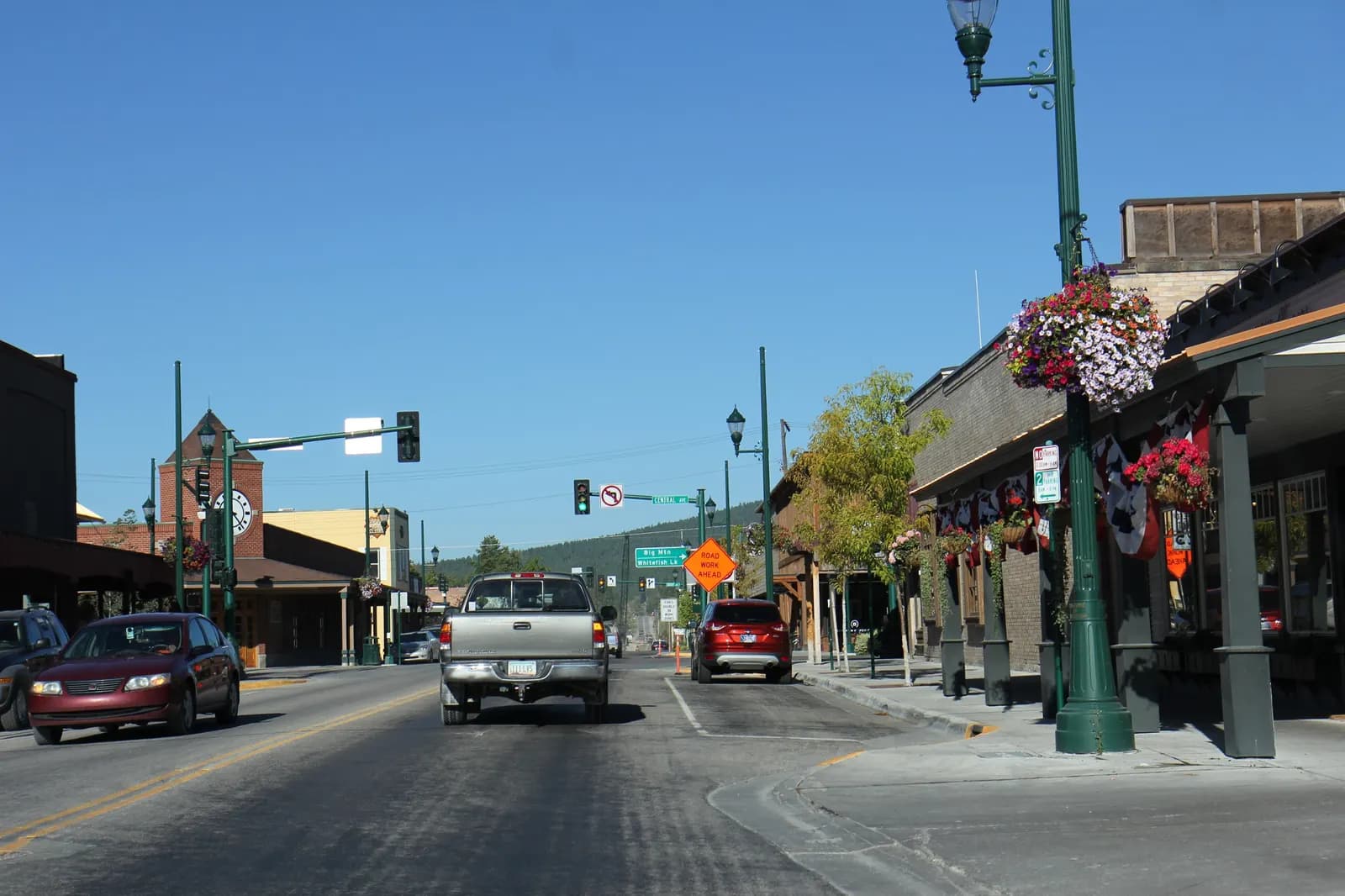
The resort tax applies only to sales by certain businesses: hotels, motels and campgrounds; restaurants and other food service; bars and taverns serving alcohol by the drink; and destination ski resorts and recreation facilities. Communities can also tax luxury goods as they define them. Sales for resale are exempt. Businesses register and file with the resort community, not the state.
Montana also taxes accommodation statewide. Guests at hotels, motels, vacation rentals and campgrounds pay lodging facility taxes totalling 8%, collected by the operator and filed with the Montana Department of Revenue. There are also state taxes on rental vehicles.
Example. A hotel room at $180 a night in a resort community levying a 3% resort tax costs $180 + $14.40 lodging taxes (8%) + $5.40 resort tax = $199.80 a night. A $180 pair of hiking boots bought in Billings, which isn't a resort community, carries no tax.
Shopping across the border: what you still owe
Driving to a no-tax state to shop is legal, but it doesn't always save as much as it looks. If you live in a state with a sales tax and bring goods home to use there, you generally owe your home state's use tax on them, at the rate you'd have paid locally. Use tax mirrors sales tax: it applies to taxable items bought without tax being charged. Most states give individuals a line on the income tax return to report it, and businesses report it on their sales and use tax returns. Big-ticket items such as cars, boats and trailers are caught automatically when you register them at home. Our use tax guide explains how it works.
The flow can run the other way too. Residents of no-tax states who shop in Washington, which borders Oregon and has a state rate of 6.5%, can claim back the state portion. Washington's nonresident exemption is open to residents of Alaska, Delaware, Montana, New Hampshire and Oregon (plus some Canadian provinces and territories). Most shoppers pay the tax at the register and then request a refund from the Washington Department of Revenue, once a year, for purchases made in the previous calendar year. The minimum request is $25, and only the state portion comes back, not local tax. Meals, lodging and other things used up in Washington don't qualify.
Example. An Oregon resident buys a $1,000 television in Vancouver, Washington, and pays the combined rate there. In the new year, they file a refund request through My DOR with photo ID and the receipt and get back the state portion of $1,000 × 6.5% = $65. The local part of the tax isn't refunded.
The no-sales-tax states at a glance (2026)
5
States with no statewide sales tax
AK, DE, MT, NH, OR
55
Alaska towns in the remote seller commission
Q1 2026
0.7468%
Delaware GRT on retailers
paid by the seller
0.57%
Oregon CAT above $1 million
plus $250
8.5%
New Hampshire meals and rooms tax
since Oct 1, 2021
What it means if your business is based in a no-sales-tax state
Being based in Oregon or Delaware doesn't mean you can ignore sales tax. Three situations come up again and again.
You sell into other states. Since the Supreme Court's 2018 Wayfair decision, every state with a sales tax can make out-of-state sellers collect once their sales into the state pass a threshold, usually $100,000 a year. An Oregon online store selling $150,000 a year to California customers isn't over California's $500,000 threshold, but the same sales into Washington, Idaho or Colorado would be over theirs. Our economic nexus guide has every state's threshold.
You have staff or stock elsewhere. A remote employee in Washington or inventory in an Amazon warehouse in Nevada can create physical nexus from the first sale.
You buy for your own use. Businesses in no-tax states that buy equipment or supplies for use in a taxing state, say for a branch office, owe that state's use tax if the seller didn't charge sales tax.
There's also an upside when buying for resale. A Delaware or Oregon retailer buying stock from a supplier in a taxing state can usually give the supplier a resale certificate or the Multistate Tax Commission's uniform certificate, even without a sales tax permit at home, though some states will want a registration number from somewhere.
Worked example: an Oregon online seller
A Bend company sells outdoor gear online. In the last twelve months it shipped $640,000 of goods: $220,000 to Oregon, $180,000 to Washington, $90,000 to Alaska, $70,000 to Idaho and $80,000 to California.
Where the Bend seller must collect
| Destination | Sales | Threshold | Must collect? |
|---|---|---|---|
Oregon | $220,000 | No sales tax | No sales tax; counts for CAT once over $750,000 |
Washington | $180,000 | more than $100,000 | Yes |
Alaska | $90,000 | $100,000 gross statewide | Not yet |
Idaho | $70,000 | $100,000 | No |
California | $80,000 | $500,000 | No |
Oregon
- Sales
$220,000
- Threshold
No sales tax
- Must collect?
No sales tax; counts for CAT once over $750,000
Washington
- Sales
$180,000
- Threshold
more than $100,000
- Must collect?
Yes
Alaska
- Sales
$90,000
- Threshold
$100,000 gross statewide
- Must collect?
Not yet
Idaho
- Sales
$70,000
- Threshold
$100,000
- Must collect?
No
California
- Sales
$80,000
- Threshold
$500,000
- Must collect?
No
Only Washington requires registration now. Alaska is close: another $10,000 in a calendar year and the business must register with the ARSSTC from the following year. Its Oregon CAT position is separate. CAT counts Oregon-sourced receipts, so $220,000 of Oregon sales is well below the $750,000 registration line.
Common mistakes
Assuming Alaska is tax-free. Remote sellers who skip the ARSSTC because "Alaska has no sales tax" end up owing local tax they never collected.
Printing Delaware GRT on receipts as if it were sales tax. The GRT is the seller's own cost. Showing it as a separate customer charge confuses buyers and doesn't change who owes it.
Forgetting Oregon CAT registration. The $750,000 registration trigger is lower than the $1 million filing line, and late registration has its own penalty of $100 a month, up to $1,000 a year.
Treating New Hampshire restaurants like shops. A café selling coffee beans and pastries to go must still charge meals tax on prepared food and drinks.
Ignoring use tax at home. Cross-border purchases for a business in a taxing state belong on that business's use tax return.
Running a business from a no-sales-tax state
0/6Official links
- Delaware — Gross receipts taxRates, exclusions, filing
- Oregon — Corporate Activity TaxRegistration and returns
- Alaska Remote Seller Sales Tax Commission — FAQRemote seller registration
- New Hampshire — Meals & Rentals TaxOperator licences and returns
- Montana Code 7-6-1503 — Resort tax
- Washington — Nonresident refundRefunds for AK, DE, MT, NH and OR residents
What to do next
If you're a shopper, the no-sales-tax states save real money on big purchases, but check your home state's use tax before you drive across the border with a new appliance. If you're a business, work out which replacement tax applies where you're based, then look outward: list your sales by destination state and check them against our economic nexus table. When you do need to charge tax, our guide to how to calculate sales tax and the sales tax calculator handle the arithmetic.
This is general information, not legal or tax advice — confirm on the official source or with a professional.
Frequently asked questions
Five states have no statewide sales tax in 2026: Alaska, Delaware, Montana, New Hampshire and Oregon. Only Alaska lets cities and boroughs charge their own general sales tax, so Delaware, New Hampshire and Oregon shoppers pay no sales tax on ordinary purchases anywhere. Montana has no general sales tax but allows small resort communities to tax lodging, meals, drinks and some luxury items.
Alaska has no state sales tax, but many cities and boroughs levy their own. Juneau charges 5%, and Palmer raised its rate to 4% on April 1, 2026. Anchorage has no general sales tax. Remote sellers with more than $100,000 of gross Alaska sales in a year register with the Alaska Remote Seller Sales Tax Commission and collect for its 55 member jurisdictions.
Shoppers pay no sales tax in Delaware. Instead, the seller pays a gross receipts tax on its own receipts. Retailers pay 0.7468% and most service providers 0.3983% on receipts above a monthly exclusion of $100,000 a month ($300,000 a quarter). The tax is a cost of doing business, so it may be built into prices, but it isn't added as a line on the receipt.
Oregon itself charges nothing. But if you live in a state with a sales tax, you generally owe that state's use tax on goods you bring home for use there, at the rate that would have applied at home. Most states ask individuals to report it on their income tax return. Businesses report it on their sales and use tax return.
Yes, if they have nexus there. An Oregon or Delaware business that ships to customers in other states must register and collect once it passes a state's economic nexus threshold, usually $100,000 of sales a year, or if it has staff or inventory there. Having no sales tax at home doesn't exempt you from other states' rules.
Alaska is the only state with neither a statewide sales tax nor a personal income tax. New Hampshire doesn't tax wages and fully repealed its interest and dividends tax from January 1, 2025, but it taxes business profits and meals. Delaware, Montana and Oregon all have personal income taxes, and Oregon's top rate is 9.9%.
Sources & verification
Figures on this page were checked against the sources below when it was last reviewed on 12 October 2026. Each rate and limit is stored once with its own official source and review date, and official update channels are monitored daily so changes are picked up. How we verify
- 1.Gross Receipts Tax — Delaware Division of Revenue · accessed 12 October 2026
- 2.Corporate Activity Tax — Oregon Department of Revenue · accessed 12 October 2026
- 3.MCA 7-6-1503 — Limit on resort tax rate, goods and services subject to tax — Montana Legislature (Montana Code Annotated 2025) · accessed 12 October 2026
- 4.Frequently Asked Questions — Alaska Remote Seller Sales Tax Commission · accessed 12 October 2026
- 5.1st Quarter 2026 Update and Overview (May 27, 2026) — Alaska Remote Seller Sales Tax Commission · accessed 12 October 2026
- 6.Meals & Rentals Tax — Frequently Asked Questions — New Hampshire Department of Revenue Administration · accessed 12 October 2026
- 7.Business Enterprise Tax FAQ — New Hampshire Department of Revenue Administration · accessed 12 October 2026
- 8.Sales tax exemption for nonresidents — Washington State Department of Revenue · accessed 12 October 2026
- 9.Alaska removes economic nexus transaction threshold — Avalara · accessed 12 October 2026
MSMETOOLS is an independent platform and is not affiliated with any government agency, ministry or department.
Tools for this
Sales Tax Calculator (US)
Calculate sales tax for all US states and cities.
Invoice Generator
Create professional invoices with tax, logo and custom details.
Related guides
 Economic Nexus by State (2026): Thresholds TableRead guide
 Washington Sales Tax Rate 2026: Seattle 10.55% & Local RatesRead guide
 Sales Tax on Services (2026): Which States Tax WhatRead guide
 New Mexico Gross Receipts Tax 2026: 4.875% & Local RatesRead guide
Official links open the government site in a new tab.